DEVELOPMENT AND VALIDATION OF RP-HPLC METHOD FOR
THE DETERMINATION OF TORSEMIDE IN BULK DOSAGE FORM
AND PHARMACEUTICAL FORMULATION
Poornima Singh*, Dr. Arun Patel, Prof. Shailendra Patel and Prof. Bhavesh Patel
Pharmaceutical Chemistry, Shri Ram Group of Institutions Jabalpur (M.P.).
ABSTRACT
In order to develop a RP-HPLC method effective most of the effort
should be spent in method development and optimization as this will
improve the final method performance. A well developed method
should be easy to validate. A method should be developed with the
goal to rapidly preclinical sample, formulation prototype and
commercial samples. In present work, validated RP-HPLC method was
developed for determination of Torsemide. By observing the validation
parameters, accuracy, precision, expressed as R.S.D (%), specificity,
linearity (correlation coefficient). The method proved to be simple,
accurate, precise, specific, and selective. The tablet formulation was
successfully analyzed using the developed methods. The results obtained from the validation
parameters met the ICH and USP requirements. The study highlights the benefits of the use
of ICH approach in establishment of estimation of drugs
KEYWORDS: RP-HPLC, Torsemide, retention time, validation-linearity, accuracy,
precision.
1. INTRODUCTION
Reversed Phase chromatography, a bonded phase chromatographic technique, uses water as
the base solvent. Separation based on solvent strength and selectivity also may be affected by
column temperature and pH. In general, the more polar components elute faster than the less
polar components.
Volume 8, Issue 9, 1381-1386. Research Article ISSN 2277– 7105
Article Received on 10 June 2019,
Revised on 01 July 2019, Accepted on 22 July 2019
DOI: 10.20959/wjpr20199-15558
*Corresponding Author
Poornima Singh
Pharmaceutical Chemistry,
Shri Ram Group of
TORSEMIDE chemically 3-pyridinesulfonamide, n-[[(1 methylethyl)amino]carbonyl]-4- [(3
methylphenyl)-1-isopropyl-3-[(4-m-toluidino-3-pyridylsulfonyl]urea is Thiazide-like Diuretic
which is used as antihypertensive agent.
Many analytical methods have been reported in the literature for the analysis of Torsemide.
The techniques include spectrophotometry, GC-MS, Magnetic resonance imaging study,
FT-IR, and a number of high performance liquid chromatography (HPLC) methods have been
reported for this drug using plasma and serum samples. HPLC have various practical
advantages including exponentially high sensitivity, accuracy, and resolution apart from the
decreased analysis time than the reported instruments. Thus there is a constant need of a
HPLC based method of Torsemide.
2. EXPERIMENTAL
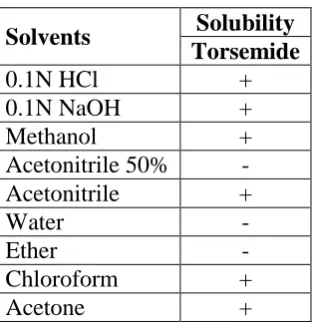
2.1 Determination of Solubility of Torsemide: Solubility of Torsemide was determined in
various solvents by visual inspection.
2.2 Selection of Solvent and Wavelength: The observed λMax of Torsemide was 288 nm.
Thus acetonitrile was selected as a solvent of choice as it will not interfere with the λMax
of Torsemide. The linearity of Torsemide was uniform at 288 nm, hence 288 nm was
selected as wavelength of analysis.
Fg. 1: Chemical structure of torsemide.
2.3 Mobile Phase Selection: In order to select a suitable mobile phase for the analysis of
Torsemide. the mobile phase found to be most suitable for analysis was Acetonitrile:
Phosphate buffer (0.05 M) in proportion of 70:30 (pH 2.4).
2.4 Preparation of Standard Solution: Accurately weighed 10 mg of Torsemide was
transferred to a 10 ml volumetric flask, sufficient amount of acetonitrile was added to
was made up to 10 ml (stock A; 1000 µg/ml) with acetonitrile. 1ml of stock A was taken
into 10 ml volumetric flask and further diluted up to 10 ml with acetonitrile (stock B;
100 µg/ml). Aliquots of stock B were further diluted up to 10 ml to get concentration of
10, 20, 30, 40, 50, 60, 70, 80, and 90 µg/ml.
2.5 Preparation of Sample Solution: Twenty tablets were weighed and content emptied.
The average weight was determined. It was finely powdered and mixed thoroughly.
Accurately weighed tablet powder equivalent to 10 mg of Torsemide was transferred to a
10 ml volumetric flask, sufficient amount of acetonitrile was added to dissolve it
followed by addition of 3 ml of 0.05M phosphate buffer (pH 2.4). Then volume was
made up to 10 ml (stock A’; 1000 µg/ml) with acetonitrile. 1ml of stock A’ was taken into 10 ml volumetric flask and further diluted up to 10 ml with acetonitrile (stock C’;
100 µg/ml). Aliquots of stock C’ were further diluted up to 10 ml to get concentration of
10, 20, 30, 40, 50, 60, 70, 80, and 90 µg/ml.
2.6 Determination of Assay For Sample Of Torsemide: Equal volume (20µl) of standard
and sample solution were injected separately equilibrium of stationary phase. The
chromatograms were recorded and the response i.e. peak area of major peaks were
measured. The content of Torsemide was calculated by comparing a sample peak with
that of standard. Amount of drug in tablet was calculated using following formula:
% Label claim = Aspl X Dstd X Wstd X A
Astd Dspl Wspl
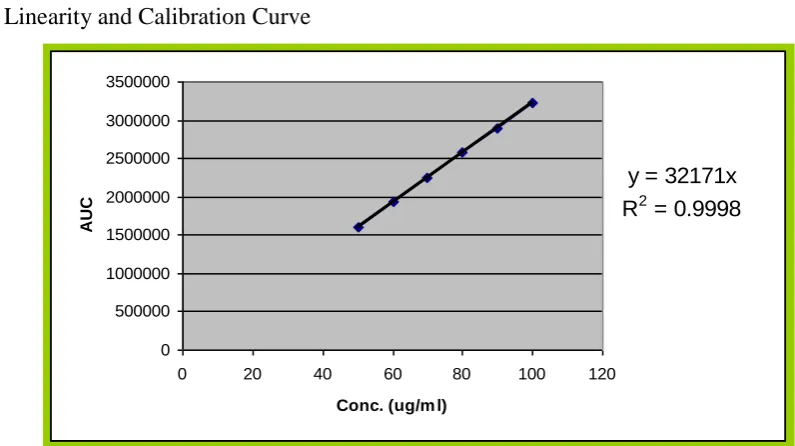
2.7 Linearity and Calibration Curve: In order to establish the linearity of analytical
method, a series of dilutions ranging from 50-100 µg/ml were prepared in the same manner
as described in the section 2.1.1.6. All the solutions were filtered through 0.22µ membrane
filter. The solutions were kept into the vials of the autosampler of the HPLC injection system,
so as to be injected in triplicate into the HPLC column, keeping the injection volume constant
(20µl). The chromatograms were recorded and calibration curve was plotted between the
mean peak area vs. respective concentration and a regression equation was obtained (Fig.
3.4). The linearity data of Torsemide.
3. RESULT AND DISCUSSION
Table 3.1 Solubility study of Torsemide.
Solvents Solubility
Torsemide
0.1N HCl +
0.1N NaOH +
Methanol +
Acetonitrile 50% -
Acetonitrile +
Water -
Ether -
Chloroform +
Acetone +
Selection of Solvent And Wavelength
Table 3.2 Interaction Properties of Solvents for Reverse Phase Liquid Chromatography
(Snyder L.R. et al, 1997)
Solvent UV cutoff
(nm) Po Xe Xd Xn
Dielectric constant
Increasing solvent polarity
Water 190 10.2 3.77 3.77 2.55 80
Acetonitrile 190 5.8 1.80 1.57 2.44 36
Methanol 205 5.1 2.45 1.12 1.58 33
[image:4.595.221.378.89.254.2] Selection of chromatographic condition
Table 3.3 Selection of Chromatographic Conditions.
VARIABLE CONDITION
Column
Dimensions 4.6 mm x 150 mm
Particle size 5 µ or equivalent
Bonded Phase Octadecyl silane
Mobile Phase
ACN: Phosphate Buffer (0.05M) 70:30
Temperature Room temperature
Sample volume 20 µl
Detection wavelength 288 nm
Flow rate 1.5 ml/min
Determination of Assay for Sample of Torsemide
Amount of drug in tablet was calculated using following formula:
% Label claim = Aspl X Dstd X Wstd X A
Astd Dspl Wspl
Where, Aspl is the peak area of the sample solution;
Astd is the peak area of torsemide working/reference standard;
Dspl is the dilution factor for torsemide working/reference standard;
Wstd is the weight of torsemide working/reference standard in mg
Wspl is the weight of sample in mg;
A is the average weight.
The % label claim reported is 99.8%.
Linearity and Calibration Curve
y = 32171x
R2 = 0.9998
0 500000 1000000 1500000 2000000 2500000 3000000 3500000
0 20 40 60 80 100 120
Conc. (ug/m l)
[image:5.595.88.486.189.412.2]AUC
Fig. 3.4: Calibration curve for torsemide.
REFERENCES
1. A.R. Gennaro, Remington, The Science and Practice of Pharmacy, Lippincott Williams
and Wilkins, Pennsylvania, 21st edn., 2005; 1: 537-544.
2. A.H. Beckett, J.B. Stenlake, Practical Pharmaceutical Chemistry, CBS Publishers and
Distributors, 4th edn., 2002; 2: 85-170.
3. British Pharmacopoeia, Published by The stationary office under the license from the controller of Her Majesty’s Stationary Office for the Health Dept., 2007; 2058-2059.
4. Code Q2A-Text on Validation of Analytical Procedure Step-3 Consensus Guideline,
1994, ICH Harmonised Tripartite Guideline.
5. Code Q2B- Validation of Analytical Procedure Methodology Step-4 Consensus
Guideline, 1994, ICH Harmonised Tripartite Guideline.
6. Dr. B.K. Sharma, Instrumental Methods of Chemical Analysis, Goel Publishing House,
24th edn., 2005; 3-20: 286-385.
7. D.A. Skoog, D.M. West, F.J. Hollar, S.R. Crouch, Fundamental of Analytical Chemistry,
8. D.A. Williams, T.L. Lemke, Foye’s Principles of Medicinal Chemistry, Lippincott
Williams and Wilkins, 6th edn., 2007; 732.
9. D. Fillic, M. Dumic, B. Klepic, A. Danilovski, M. Tudja, Polymorph V of Torasemide,
2007.
10. G.D. Christian, Analytical Chemistry, John Wiley and Sons, 21st edn., 1994; 14-64:
505-514, 537-548.
11. H.H. Willard, L.L. Merrit, J.A. Dean, F.A. Settle Jr., Instrumental Methods of Analysis,
CBS Publisher and Distributors, 7th edn., 1986; 513-651.
12. I. Meineke, S. Engelhardt, J. Brockmoller, Improved solid-phase extraction and HPLC
measurement of torasemide and its important metabolites, J. Chromatogr. B., 2006; 831:
31-35.
13. J. Aronhime, D. Leonov, M. Kordova, A. Schwartz, B. Dolitzky, Torsemide polymorphs,
2002.
14. J.H. Block and J.M. Beale, Wilson and Gisvold’s Textbook of Organic Medicinal and
Pharmaceutical Chemistry, 11th edn., 1999; 613-614.
15. J.M. Rollinger, E.M. Gstrein, A. Burger, Crystal forms of torasemide: New Insights, Eur.