An assessment of the impact of introducting a work based
development guide
KEMSHED, Matthew and ASKHAM, Phil
Available from Sheffield Hallam University Research Archive (SHURA) at:
http://shura.shu.ac.uk/7587/
This document is the author deposited version. You are advised to consult the publisher's version if you wish to cite from it.
Published version
KEMSHED, Matthew and ASKHAM, Phil (2012). An assessment of the impact of introducting a work based development guide. Sheffield Hallam University Built Environment Research Transactions, 4 (KIER), 69-78.
Copyright and re-use policy
See http://shura.shu.ac.uk/information.html
1
The Sheffield Hallam University Built
Environment Research Transactions
2012 Volume 4 Special Edition with KIER ISSN 1759-3190 Editorial Board
Luke E Bennett Tony Cheetham Zoe Cox Sarah Dickinson Dr Barry Haynes Richard Kebell
Dr. Elizabeth Laycock [Editor] Simon Mclean
Sam Moorwood
Dave Parsons Dr. Peter Rushforth Richard E. Smith Stuart Smith
Prof. Paul Stephenson Prof. Paul Watson Micah Wilson Garry Workman
Purpose of the Series
The aim of this publication is to provide an opportunity for students to publish the findings of their undergraduate or postgraduate work. Guidance on publication will be given by staff who will act as second authors. It is hoped that by providing a guided transition into the production of papers that students will be encouraged throughout their future careers to publish further papers. Guest papers are welcomed in any field relating to the Built Environment. Please contact [email protected]. A template will be provided on request.
Acknowledgements
The editorial team would like to acknowledge and thank Will Hughes, Reader in Construction Management and Economics, University of Reading for permission to use the ARCOM template and the associated resources.
Copyright
It is the responsibility of the author to obtain any permission necessary to reproduce or quote from published work and suitable acknowledgement should always be made.
2
Editorial
As Editor of this publication it has been a great pleasure to work with students from Kier who have been enrolled the B.Sc.(Hons) Construction and Commercial
Management course. This course was carefully designed with significant input from industry. The Built Environment Division has always seen vocational and industry relevant education as a key to development of all new courses.
The importance of work based learning is stressed within the programme as it is important to encourage students to continue self-development and life-long learning as well as to work closely with their employers to develop the necessary skills to assist them in their chosen career.
The delivery of this programme was an innovation to the Built Environment Division as it utilises part-time study by intensive block delivery. On campus delivery involves lectures and tutorials with additional curriculum enrichment provided by use of case studies, field situations and material from real situations used to assist the process of learning as well as to ensure it is current and practically applied. While on Campus students are able to access the wide range of traditional resources in the Learning Centre and Resources Room and the Learning Hub. Away from the campus students are supported and assisted to develop responsibility for self-managed study and independent learning by use of a wide range of resources available electronically from the Learning Centre and the Blackboard learning environment.
One of the underpinning ideals of the course is to encourage widening participation by attracting students into HE from groups that are currently under-represented in order to address shortages of intermediate level skills in the national and regional
economies.
The papers included in this volume showcase some of the student research work undertaken as part of their Dissertation Module and highlight the high levels of achievement that this, the first cohort, has demonstrated.
As always I would like to extend my personal thanks to the students, their academic co-authors and to the members of the Editorial team who spent so much effort in producing this edition.
Dr Elizabeth Laycock
Editor, Built Environment Research Transactions
3
CONTENTS
BIM as a Cost Planning Aid
Morné Ferreira ... 5
Abstract ... 5
Introduction ... 5
The role of BIM as an Aid for Cost Planning ... 6
Research Rationale ... 8
Literature Review ... 9
Method of Analysis – Interviews ... 11
Discussion ... 26
References ... 27
Time, Cost and Quality: Which constraint do construction professionals from a set company believe to be the most important when delivering construction projects Sam Murphy ... 33
Abstract ... 33
Introduction ... 33
Literature review ... 35
Results ... 40
Conclusions ... 44
References ... 46
A study into whether the construction of schools effectively meets sustainability standards Matthew Sparkes ... 48
Abstract. ... 48
Introduction. ... 49
Research rationale. ... 49
Literature review. ... 51
BREEAM; ... 52
Results ... 54
Discussion ... 60
4
Conclusion. ... 64
References. ... 65
An Assessment of the Impact of Introducing a Work Based Development Guide Matthew Kemshed & Phil Askham ... 69
Abstract ... 69
Introduction ... 70
Literature ... 71
Methodology ... 72
Discussion ... 74
Conclusions ... 75
5
BIM AS A COST PLANNING AID
Morné Ferreira1
Morné Ferreira graduated from Sheffield Hallam University in 2012 with a BSc (Hons) Construction and Commercial Management.
ABSTRACT
This paper focuses on the use of Building Information Models (BIM) as an aid to provide accurate and intelligent information to produce cost plans or estimates of construction projects. The research assesses whether BIM is being used as an aid to cost planning of construction projects or for other purposes; whether this use is consistent worldwide, and whether the perceived benefits and barriers are similar between users who are familiar with the technology and those who are just setting out. The analysis of the collected data supports the finding of the literature review that the industry itself recognises the need to improve. Where BIM is being used, particularly outside the UK, real and immediate benefits are being realised. The UK’s respondents perceived the following three points as the main benefits of BIM, when considered as an aid to cost planning: increased accuracy of quantities (ranked equal); increased productivity through automated take-off ability (ranked equal); and, real-time costing, which permits immediate decisions to be made which removes abortive works/design. The rest of the world (ROW) perceives the following to be the main benefits: clash detection; ability to view project in 3D; and design changes easily dealt with.
Keywords: BIM, Industry, Cost Planning
INTRODUCTION
Overview - The Construction Industry, Innovation and BIM
It is estimated that between 1996 and 2006 construction costs rose globally by 89% (Muse, 2012). Furthermore economic competition in the global market place is leading to companies seeking more efficient methods and tools to deliver their product and it is therefore imperative the construction industry finds ways to improve its current practices (Drucker, 1994 as cited by Bowden, et al., 2006; Yoders, 2009).
1
6
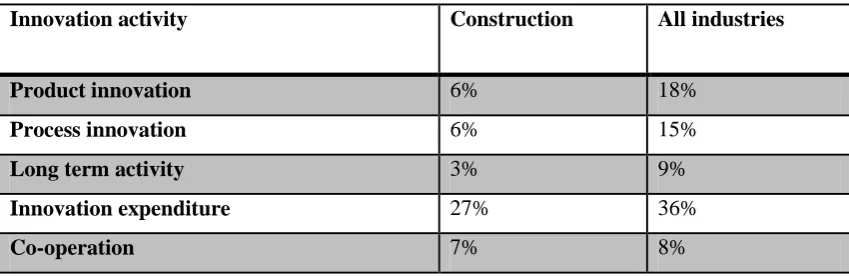
Research conducted by the Department for Trade and Industry within the UK in 2003 indicates that the construction industry as a whole has a history of lagging behind other industries with regards to efficiency and innovation (see Table 1 below).
Innovation activity Construction All industries
Product innovation 6% 18%
Process innovation 6% 15%
Long term activity 3% 9%
Innovation expenditure 27% 36%
Co-operation 7% 8%
Table 1 – Percentage of construction companies exhibiting innovation activities in the UK 2003 (Source: DTI, 2003)
Information and Communication Technologies like Building Information Modelling (BIM) have the potential to address the aforementioned market needs (Aouad et al., 1999; Kennett, 2010). According to a study (Based on figures extrapolated from US’ market data in 2008) by the Department of Business, Innovation and Skills, (2011, p.92), BIM can provide the industry with net-savings (offsetting setup costs) of 5% for new build projects and 1.5% for refurbishment projects. Additionally, a study by a major software vendor suggests that the return on investment (ROI) for BIM (M) systems is estimated to be greater than 60% (BIS, 2011, p.92). However, the construction industry is unique as a large part of the production process is often non-standardised (Barlow et al., 2003; Bowden et al., 2006; Rebolj et al., 2000; Peansupap & Walker, 2005; Chen & Kamara, 2008). Consider, amongst other factors, the difficulties resulting from: the different phases of a project within the construction process; the fragmented production and flow of information; the various independent yet interdependent professional disciplines; and, the external supply chain often employed. A case study, based upon a Canadian construction company, by Eastman et al., (2011), they found that a “traditional” approach to information-sharing on a typical $10 million plus project, each project had around 50 different types of document that were generated by 420 different participant companies – running into 56,000 pages of documents. This is certainly indicative of the scale of complexity of the challenge faced by construction professionals.
THE ROLE OF BIM AS AN AID FOR COST PLANNING
Before progressing any further with the rationale for the purpose of the research, it is first necessary to clarify and establish what BIM is. Charles Eastman (2008), a Professor in the Colleges of Architecture and Computing at the Georgia Institute of Technology and leading author on BIM, defines BIM as:
[image:7.595.85.510.146.284.2]7 Within the UK, proportionately, there are more bankruptcies within the construction industry than any other industry (Hillbrandt, 1984). Financial risks need to be controlled and mitigated during the phases of a project, namely pre-construction, construction, and post-construction. The cost planning and control project should encompass three basic elements, namely:
The setting of a budget;
The cost planning and control of the design process; and
The cost control of the procurement process (Brandon & Ferry, 1999). Cost planning should be considered central to the planning of a construction project – as the mismanagement and lack of available funds can lead to a project’s failure - whilst alternatively, surplus funds can also be uneconomical (Kaka, 1990 as cited by Askew, et al 1997). Accurate timing and the predictability of funds are essential and therefore the accurate estimates of material quantities may be considered a key activity. Consider further that the construction industry is unique in that a contractor, under some procurement routes, is expected to give a firm price to a client before actually knowing exactly and precisely how much the works and project are going to cost. As it is extremely rare that two projects are exactly the same, new estimates must be produced for each project - this is a time consuming and costly process (Brook, 2008; CIOB , 2009). Current methods, which may vary from cost consultant to cost consultant, are very time consuming and their accuracy is subject to human error (Wilson & Kusomo, 2004). Methods adopted for quantity take-offs include a scale rule and dimension paper; the use of a digitizer or some other form of onscreen take-off software – all of these methods have their respective limitations.
One of the key challenges a cost consultant faces is that a very large part of their time is spent on quantification, i.e. the measurement of the works to be extracted from two dimensional (2D) paper drawings or from electronic drawings. Subject to the level of detail provided and the chosen procurement route, this may be between 50-80% of the tender period (Sabol, 2008). Other complications include design changes, which tend to occur before a firm price has been produced, tender addendums, human error, and the current process of digitizing 2D paper drawings confirmations are why there is a clear need for improvement within the cost planning and estimation processes (McCuen, 2008). The capital cost of a construction project can easily spiral out of control if not managed. Consider “Pareto’s Law” or the 80:20 rule - which applies to most construction projects – suggests that when 20% of the design is complete, 80% of the costs are already committed (RICS, 2011).
8
preliminary estimates shows why it is vital to control estimates during the early stages of the design so that they can be controlled in construction.
RESEARCH RATIONALE
Data was collected in three stages:1. Stage 1 – Literature Review.
2. Stage 2 – Exploratory, semi-structured interviews. 3. Stage 3 – Questionnaire/survey.
Literature Review
Two primary themes were identified as areas that required further research. The first theme was to establish and understand how BIM is currently perceived within the UK’s construction industry, whilst understanding the current level of use on construction projects. The second theme was the use of BIM as a cost planning and estimation aid.
Interviews
The interviews explored the respondents’ professional experience of BIM, particularly in relation to its use as a cost planning aid. The themes emerging were used as the basis for devising subsequent in-depth survey questions.
Online Survey
9
Professional Group Number of members (approx.)
Australian Institute of Quantity Surveyors 1,200
Association of Cost Engineers (UK and Europe) 426
Association for the Advancement of Cost Engineers (Worldwide)
12,646
Autodesk Quantity Take-off (USA) 146
BIM Experts (Worldwide) 1,686
Contractor for BIM (Worldwide) 1,500
Chartered Institute of Builders (UK) 7,644
Estimators, Quantity Surveyors and Cost Engineers
(Worldwide)
12,700
Construction Networking (Worldwide) 8,827
Cost Engineer Forum (Worldwide) 1,493
Quantity Surveyors (Worldwide) 1,892
RIBA USA 234
RICS BIM (UK) 396
Royal Institute of British Architects (RIBA 9,152
RICS Oceana 1,556
RICS (UK) 18,749
The Professional Estimators Group (Worldwide) 7,700
UK QS and Commercial Management 1,379
TOTAL 89,326
Table 2 – Details of online professional bodies where online survey was posted (via Linkedin).
LITERATURE REVIEW
Overview of BIM [image:10.595.84.514.115.518.2]10
on construction projects (Pearson, 2012). In the recent market report, based upon respondents from North America, by Young et al., (2009) titled: “The Business Value of BIM” it was found that two-thirds of BIM users say they see positive returns on their overall investment in BIM. The same study found that 93% of BIM users also believed that there is potential to gain more value from BIM in the future.
In contrast other literature suggests that there is no BIM utopia whereby all the industry’s woes are going to be resolved overnight (Post, 2007; Eastman et al., 2011; Beck, 2011). There are additional considerations like traditional procurement routes - which will have to be radically adjusted or reviewed – whereby options like pooled profit, legal requirements, shared risk and so forth need to be explored (Yoders, 2009; Post, 2007; Smith & Tardif, 2009; Andre, 2011). “The standardisation of the BIM process is required to ensure its implementation”, has emerged as a key consideration of several academic papers (Krause et al., 2007; BIS, 2011; Gould, 2010).
BIM as a Cost Planning and Estimation Aid
It has emerged that BIM in a 5D format certainly has the potential to be an immense aid to the cost planning process (RICS, 2011a; McCuen, 2008; McCuen, 2010). In addition to being a software solution it may also be an aid to collaborative working, trust and information exchange. This will ensure that cost professionals can increase their knowledge of a project from an early stage and be able to generate exact quantity take-offs for procurement and cost planning purposes (Sabol, 2008; Krause et al., 2007). The market research by Young et al., (2009, p.22) found that 52% of BIM experts considered quantity take-off as a key emerging value of BIM.
However, there still appears to be a large “unknown” with regards to how the current industry is going to maximize the use of BIM with a 5D capacity. A recent survey prepared by BCIS for the RICS, (2011a)2 concluded that the use of BIM by quantity surveyors was relatively limited at present. The survey found that only 20% of respondents had used BIM within the last 12 months. The survey by the RICS, (2011a, p.8, Table 3) also found that only 1% of respondents used BIM “Very Often” for extracting quantities and at the opposite end of the scale, 22% of respondents “Never” used it for extracting quantities. Contained within the same research is the suggestion that :
“The effective adoption of BIM technologies by cost consultants and planners has been slow to date, and should this situation remain, then cost and programme services will not benefit from the productivity and speed of response that a settled BIM process can offer. This is not to say that the adoption of BIM will not be without its challenges, but that the professions cannot afford to be outside of the BIM loop”.
Co-ordination with other processes will be necessary. Just “dropping” estimating and BIM software on top of current procedures will not work (Krause et al., 2007).
11 Standardisation is required, or, alternatively working relationships with designers should be established to ensure software and object compatibility (Krause et al., 2007; McCuen, 2010). Ultimately clients need to drive the need for quantity take-off/cost estimating functions in BIM, this amongst other barriers like lack of training, lack of application interface and lack of standards are currently considered some of the major barriers to adoption (McCuen, 2010; RICS, 2011a). A further key consideration is that, on average within the UK at least, the present cost of training the average cost consultant to be fully competent with BIM technologies is between £2000-£4000 - according to a leading QS company Davis Langdon (Kucharek, 2011; David Matthews, 2011).
Appraisal of Literature
The findings of the research/literature to date, suggests agreement on one point at least – the construction industry needs to improve its practices. Specifically this refers to waste production, unnecessary re-work, and the fragmented design process, design coordination, cost certainty and so forth. There is also a general consensus that cost consultants are not realising the full potential of BIM to date as and aid to cost planning (McCuen, 2010; McCuen, 2008; Muse, 2012; RICS, 2011a).
METHOD OF ANALYSIS – INTERVIEWS
OverviewThe Thematic Analysis method was used for analysis of the interviews conducted. Thematic Analysis, in accordance with guidance offered by Blaxter et al., (2010) and Burnard, (1994 & 1991) , was carried out employing the following steps:
Data was transcribed from audio to text;
Following this text was “cleaned-up” and initial codes where giving to the data in systematic fashion across the entire data set;
Units of meaning were given to text to provide a medium for analysis; and
Following this data was categorised to find common themes and similarities. As only four interviews were carried out at this stage any descriptive statistical analysis would be invalid.
Emergent Themes
The themes that emerged from the interviews were:
Code A - Definitions of BIM
Code B - Time/resource required to produce model
Code C - Automated Quantity Extraction
Code D - Cost data attached to model
Code E - Limitations
Code F - Software considerations
12
The patterns that emerged from the exploratory interviews largely confirmed the findings of the literature carried in the production of this paper.
Limitations and Conclusion of Interviews
There are many additional legal, commercial, procurement, liability and ownership issues that require consideration too. The interviewees all have a vested interest in BIM technologies being adopted by the construction industry and this may have affected their response towards a “BIM favourable” slant. This does not undermine the integrity of the interviewees but merely suggests that the counter-argument has not been fully explored. A further limitation is that the interviews were conducted in the UK and therefore only representative of the UK’s construction industry. If someone in the USA was interviewed then the findings may differ.
Analysis of the interviews show that professionals involved largely agree with the literature review carried out. The themes identified in the text analysis also suggest that there is an explicit need for improvement within the estimation and cost planning processes. What is not clear, however, was how these improvements should be delivered to the industry. There is no utopia whereby all the inefficiencies of the industry are going to be addressed, which is considerably more complex than just “implementing a software programme”.
Method of Analysis – Online Questionnaire
Analysis of the questionnaires and the interpretation of the literature review suggest that the variables in this research may be classified into: geographical, professional, company size and funding stream.
An online questionnaire was used to collect data on General Participant Information, BIM Specific, and BIM Contractual Arrangements. The first section, General Participant Information, provided generic background information on respondents and was used as a baseline for correlation for which the subsequent section was referenced. The second section, BIM Specific, explored relationships between the variables in relation to BIM as an aid to cost planning. By providing a statistical analysis it was possible to consider probability and provide the researcher with the opportunity to judge whether the results are significant or purely due to chance (Naoum , 2007). Owing to the relatively low number of respondents, along with the fact that there are additional sources of information from which the conclusion of the research project has been drawn, the cross correlation method was used to analyse the data.
Findings: General Participant Information
The targeted responses were approximately 383 (based on Table 5 pg. 30) in order to provide a true representation of industry practitioners (between 75,000 to 100,000) (Collis & Hussey , 2009). The actual number of response received was 80 in total. Calculating the actual response was based on the following calculation:
13 Therefore the actual response rate was 0.1% as 89,326 people were potentially contacted and only 80 completed the survey from start to finish. The actual response rate refers to number of respondents who completed the survey. For example 70 respondents may have answered a question but did not complete the entire survey. This does not invalidate their response. Additionally, as the survey was sent mainly via Linkedin, the number of responses may also have been affected by factors including access to computer, general activity on the website etc. The range of respondents was fairly varied in terms of geographical location and profession.
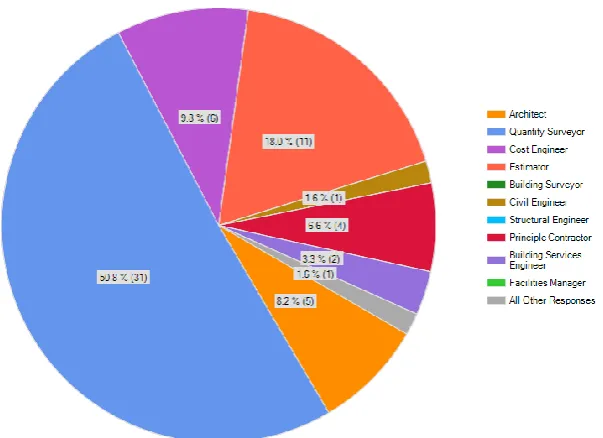
From Figure 1 below it is evident that the vast majority of respondents were cost consultants (cost engineers, quantity surveyors, or estimators) of one form or another - in total 78.6%. This is an appropriate range of respondents as these are the main professions that would have exposure to the research topic and therefore have more of a professional interest. Professionals such as architects, property developers and facilities managers do not have exposure to cost planning as a primary professional function.
[image:14.595.149.451.335.554.2]Figure 1 – Profession of respondents – all respondents
Furthermore, the majority of respondents were employed in practices/companies, which employed either 251-1000, or 1000+ members of staff – refer to Figure 2
14
Interestingly the vast majority of respondents were involved on Commercial projects, with Education and Mixed-use projects the next notable groups. Additionally, when considering the typical value of projects, the vast majority of respondents were involved with values between £5,000,000 > £20,000,000 (40.0%) and > £20,000,000 (34.7%) – see Figure 3.
Figure 2 – number of staff employed by practice/company – all respondents.
15
Figure 3 - Size of company where respondents are employed
[image:16.595.101.423.426.675.2]16
BIM Specific
This section of the questionnaire sought to measure the perceptions of two groups of people, namely:
Group 1 - Just aware of BIM as a cost planning aid; and
Group 2 - Aware and currently using BIM as a cost planning aid.
These groups served as baselines whereby other variables such as geographical location, company size and profession were compared. Two sub-categories were formed for comparison purposes, namely the United Kingdom (UK) and the rest of the world (ROW). This facilitated the detailed comparative analysis of practices in this country. The Spearman (rho) rank correlation coefficient method, which is a non-parametric method, was employed to measure the differences in ranking between the two groups of respondent’s scoring (Naoum , 2007). The following formula was employed:
( )
where, di = the difference in ranking between each pair of factors
N = number of factors
The commonly accepted test of significance suggested by Naoum (2007) was used to access the validity of the interpretation of casual relationships between correlated factors. The conventional level by which a conclusion may be drawn that the results are significant is where the probability is less than 5% (P <0.05) (Naoum , 2007, p.113)
Group 1 – Just aware of BIM as cost planning aid
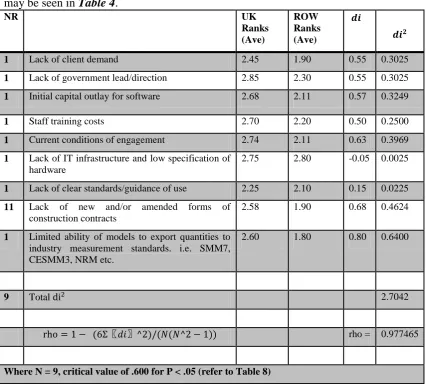
Group 1, 35 respondents were “Just aware of BIM as cost planning aid”. The vast majority were quantity surveyors, in fact 50%. Initially it was the intention to try and establish a relationship between profession and the use of BIM as a cost planning aid. However during the data collection process it soon became apparent that whilst this relationship could be established statistically it does not really provide a basis for comparison. Cost consultants provided the most responses as they are exposed to this professional activity whereas other disciplines are perhaps not. Additionally there may be some ambiguity in the terminology, i.e. quantity surveyor may not perform the same function in China and the term is rarely used in the USA, therefore this variable has to largely be discounted and the analysis following is based on the responses of all professions. The first set of data to be considered in this group is geographical, to examine whether there is statistical validity to the perceived findings. The Spearman Correlation (rho) method was carried out to determine whether results were significant or not. A rho of 0.977 was calculated demonstrating that the findings of the online survey are significant at very least. See Table 3.
17 why BIM is not yet being used as an aid to cost planning were formulated after discovering typical themes in the literature review. Responses were measured on a rating scale method and respondents were asked to provide their perceptions of the various statements. The general conclusion is that there is strong agreement about the reason that both the UK and ROW respondents, who have little awareness of BIM, have not implemented BIM.
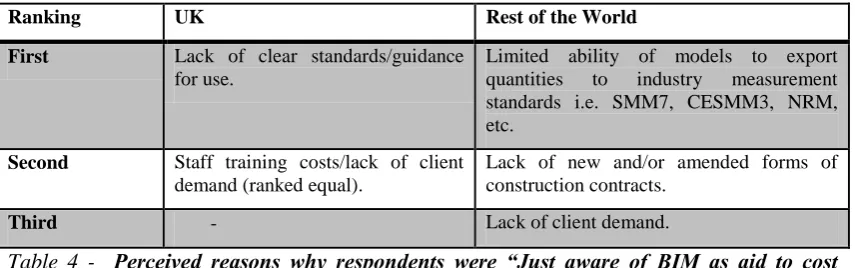
When comparing responses from the UK against the ROW in respect of respondents who were “Just aware of BIM as aid to cost planning”, a summary of the responses may be seen in Table 4.
NR UK
Ranks (Ave)
ROW Ranks (Ave)
1 Lack of client demand 2.45 1.90 0.55 0.3025
1 Lack of government lead/direction 2.85 2.30 0.55 0.3025 1 Initial capital outlay for software 2.68 2.11 0.57 0.3249
1 Staff training costs 2.70 2.20 0.50 0.2500
1 Current conditions of engagement 2.74 2.11 0.63 0.3969 1 Lack of IT infrastructure and low specification of
hardware
2.75 2.80 -0.05 0.0025
1 Lack of clear standards/guidance of use 2.25 2.10 0.15 0.0225 11 Lack of new and/or amended forms of
construction contracts
2.58 1.90 0.68 0.4624
1 Limited ability of models to export quantities to industry measurement standards. i.e. SMM7, CESMM3, NRM etc.
2.60 1.80 0.80 0.6400
9 Total 2.7042
( ) ( ( )) rho = 0.977465
[image:18.595.86.513.221.605.2]Where N = 9, critical value of .600 for P < .05 (refer to Table 8)
18
Ranking UK Rest of the World
First Lack of clear standards/guidance
for use.
Limited ability of models to export quantities to industry measurement standards i.e. SMM7, CESMM3, NRM, etc.
Second Staff training costs/lack of client demand (ranked equal).
Lack of new and/or amended forms of construction contracts.
Third - Lack of client demand.
Table 4 - Perceived reasons why respondents were “Just aware of BIM as aid to cost
planning” – UK vs. ROW.
[image:19.595.86.514.99.233.2]19
Figure 5 - Perceptions of UK Respondents who were “Just aware of cost planning aid” and not using it.
20
Figure 6 – Perceptions respondents from “rest of the world” who were “Just aware of cost planning aid” and not using it.
A number of authors consider that, in addition to economic factors, there is a relationship between the size of a company and the level of time/money spent on Research and Development (Cohen et al., 1987; Levin et al., 1988; Griliches, 1998). This consideration formed the logic for attempting to understand what affect the size of a company may have on the adoption of BIM as an aid to cost planning. Most respondents who were just aware of BIM as an aid to cost planning were larger companies. It is necessary to try and understand what percentage of large companies were only aware of BIM as an aid to cost planning compared to what percentage of small companies, to try and gain a better understanding of this relationship – refer to
21
Figure 7 - Typical company size of respondents in all regions who were “Just aware of BIM as a cost planning aid”
Additionally, with respect to funding streams for projects, it was noted that the main funding stream for projects where respondent were only aware but not using BIM as an aid to cost planning was private (56.7%), and the remainder being sourced via public funding streams (39.4%) or unknown (3%). This may indicate a relationship with why the respondents are not employing BIM as an aid to cost planning yet as, within the UK at least, it is governments that are driving the requirement for BIM on many projects, i.e. projects that will be funded by public funding streams and will most likely not be commercial buildings either.
Group 2 - Aware and currently using BIM as cost planning aid
22
Figure 8 - ROW response to “has BIM improved CP process since its adoption”
[image:23.595.149.457.445.667.2]23
Question 10 of the survey made statements about the benefits of BIM and sought to measure the perceptions of this group of respondents, who were currently employing BIM as an aid to cost planning. Once again the literature review and the exploratory interviews formed the basis for the statements. Responses were measured on the same scale as previously. A Likert rating scale method was employed and respondents were asked to provide their perception of the various statements – see Table 5.
Answer Options UK Ranks
(Ave)
ROW Ranks (Ave)
di di^2
1 Increased accuracy of quantities 1.14 2.30 -1.16 1.3456
1 Increased productivity through automated take-off ability 1.14 1.80 -0.66 0.4356
1 Design changes easily dealt with 1.43 1.70 -0.27 0.0729
1 More time to focus on "bid winning strategies" rather than measurement
1.36 1.90 -0.54 0.2916
1 Ability to see view project in 3D 1.43 1.60 -0.17 0.0289
1 Clash detection 1.43 1.50 -0.07 0.0049
1 Real-time costing which permits immediate decisions to be made which removes abortive works/design
1.36 2.30 -0.94 0.8836
1 Reduced design contingency as a result of "clash detection" i.e. % allowance decreased as result of BIM
1.36 2.00 -0.64 0.4096
1 More time to focus on abnormals like soil conditions etc. as a result of less time spent on measurement
1.29 1.80 -0.51 0.2601
9 Total di^2 3.7328
( ) ( ( )) rho = 0.969
[image:24.595.87.512.202.518.2]Where N = 9, critical value of .600 for P < .05
Table 5 – Spearman rank correlation coefficient where UK respondents are measured against the rest of the world for Question 10 of survey “Aware and currently using BIM as cost planning aid”
Once again the Spearman Correlation (rho) method was carried out to assess the significance of the results and this showed that the findings of the online survey are valid for comparing responses from two geographical locations.
24
However the UK respondent’s three leading perceptions (see Figure 10) of the benefit of using BIM as an aid to cost planning were (in order of first to third in accordance with response weighting):
Increased accuracy of quantities (ranked equal);
Increased productivity through automated take-off ability (ranked equal); and
Real-time costing, which permits immediate decisions to be made which removes abortive works/design.
Interestingly, some respondents had a negative reaction to some of the perceived benefits of BIM as an aid to cost planning, namely: “Ability to view a project in 3D” and “Clash Detection”.
The ROW’s responses (see Figure 11) differed considerably to the UK. The three leading perceptions of the benefit of using BIM as an aid to cost planning were (in order of first to third in response weighting):
Clash detection;
Ability to see view project in 3D; and
Design changes easily dealt with.
25
Figure 10 - Perceptions of the associated benefits of using BIM as an aid to cost planning – UK respondents
The use of funding streams was also fairly varied between the two groups. Within the UK the majority of respondents who were using BIM as an aid to cost planning were doing so on project funded by public funds, in fact 78.6%. In contrast, 80% of the ROW’s respondents, who were using BIM, were doing so on projects that were privately funded.
26
Figure 11 – Perceptions of the associated benefits of using BIM as an aid to cost planning – ROW respondents
DISCUSSION
Summary of Findings and Limitations
The findings of the research largely agree with the findings of the literature review – suggesting that they are reliable and valid. Additionally, during the past year, whilst this research project has been conducted, similar research projects by the RICS and NBS have also been carried out in relation to BIM (RICS, 2011a; NBS, 2012). The findings of these studies largely concur with the findings of this dissertation. Throughout the analysis of the data collected, the triangulation of the findings has been carried out. For example, some of the findings of interviews have been measured against the findings of the literature review; likewise with the online survey that was conducted. In summary, the major benefits identified by those who are currently using BIM as an aid to cost planning are: the increased accuracy of extracted quantities and increased productivity (UK) and clash detection (ROW).
27 relation to its use (UK respondents) and limited ability to export to industry measurement standards (ROW). Whilst these may appear as barriers at present, the research suggests that they are largely being addressed by the industry. This may be seen, in the UK at least, by the various continual professional development programmes (CPD) that are being hosted by professional bodies like the RICS and CIOB. There are also various steering and task groups like the UK BIM Task Group who are undertaking work to address these issues.
The research to date has provided a sound, albeit perhaps not fully conclusive, understanding of the topics researched. This provides a basis for further research and development on the subject matter and has assisted in raising the profile of the subject, even if only to the researcher and the participants of the online survey and exploratory interviews. It has also been interesting to discover that construction professionals worldwide are aware, and some are even using, BIM as an aid to the cost planning process. The benefits to use also appear to be real, tangible, and immediate - this should ensure that BIM’s adoption is assured.
Recommendations
To use BIM, as an aid to cost planning, additional training is required. Whilst conducting this research project, it became apparent that professional bodies like the RICS and CIOB are investing in continual professional development programmes to raise the profile of BIM. It would certainly help BIM’s implementation, as an aid to cost planning, if there were more focussed CPD events tailored specifically to this discipline of the industry. It is also suggested that further research into the technical nuances of the cost planning process should also be conducted to produce more refined findings.
REFERENCES
Ahsan, S. & Ahmad, S., 2008. Mobile Technologies for Inmproved Collaboration on Construction Sites. Creative Commons, Loughborough'S Institutional Repository. Amaratunga , D., Baldry, D., Sarshar, M. & Newton , R., 2002. Quantitative and qualitative
research in the built environment: application of "mixed" reserch approach. The University of Salford , 1, pp.17-31.
Andre, G.R., 2011. Building Information Modeling (BIM): Special Contract Issues. [Online] Available at: http://www.klgates.com/building-information-modeling-bim--special-contract-issues-10-07-2011/ [Accessed 04 February 2012].
Andrews, , 2003. Research Questions. London: Continuum.
Aouad, G. et al., 1999. Technology managment of IT in construction: a driver or an enabler?
Logistics Information Management, pp.13-137.
28
Ball, M., 1999. Chasing a Snail: Innovation and Housbuilding Firms' Stragtegies. pp.Vol 1, 9-22,.
Barlow, J., Childerhouse, P. & Gann, D., 2003. Choice and delivery in housebuilding: lessons from Japan for housebuilders. pp.31:2,134-145.
Beck, E., 2011. BIM Well With Others. [Online] Available at: http://www.architectmagazine.com/bim/bim-well-with-others.aspx [Accessed 29 January 2012].
BIS, 2011. BIM - Management for Value, Cost and Carbon Improvement. Strategy Paper. London: BIS A report for the Government Construction Client Group Building Information Modelling (BIM) Working Party.
Blaxter, , Hughes, & Tight , M., 2010. How to Research. Fourth ed. Maidenhead, UK: Open Unversity Press - McGraw Hill Education.
Bowden, S., Dorr, A., Thorpe, T. & Anumba, C., 2006. Mobile ICT support for construction process improvement. Automation in Construction, pp.664-76.
Brandon, P.S. & Ferry, D.J.&.F.J.D., 1999. Cost Planning of Buildings. Oxford : Blackwell Science.
Brook, M., 2008. ESTIMATING AND TENDERING FOR CONSTRUCTION WORK. Fourth Edition ed. Oxford, UK : Butterworth Heinemann is an imprint of Elsevier.
Brookes, M., 2008. Estimating and Tendering for Construction Work. Oxford: Butterworth-Heinemann. Fourth.
Bryman, A., 1988. Quantity and Quality in Social Research. London: Unwin Hyman.
BSI , 2007. BS 1192:2007 - Collaborative production of architectural, engineering,and construction information. London: British Standards.
BSI , 2010. BS ISO - 29481-1:2010 - Building information modelling - Information delvery manual. London: British Standards.
Buckley, B., 2008. BIM is in: Midwest Contractors Take Lead in Building INformation Modelling. MC, 14(7), p.39.
BuildingSMART, 2010. Constructing the business case - Building Information Modelling. London: BSI BSI.
Burnard, P., 1991. A method of analysing interview transcripts in qualative research. New Education Today , 11, pp.461-66.
Burnard, P., 1994. Searching for meaning: a method of analysing interview transcripts with a personal computer. Nurse Education Today , 14, pp.111-17.
Chen, & Kamara , , 2008. Using mobile computing for construction site information management. Engineering, Construction and Architectural Management, pp. 7 -20. Chen, Y. & Kamara, J.M., 2008. Using mobile computing for construciton site information
management. Engineering, Construciton and Architectural Management, pp.7-20. Chuck Eastman, P.T.R.S.K.L., 2008. BIM Handbook: A Guide to Building Information
29
CIOB , 2009. Code of Estimating Practice. Seventh ed. Oxford , UK: John Wiley and Son Ltd.
CM , 2010. Morrell backs BIM on public projects. [Online] Available at: http://construction-manager.co.uk/news/morrell-backs-bim-public-projects/ [Accessed 2011 May 22].
CM, 2011. BIM to be compulsory on all government projects. [Online] Available at: http://construction-manager.co.uk/news/bim-be-compulsory-all-projects/ [Accessed 22 May 2011].
CM, 2011. Construction Manager. [Online] Available at: http://www.construction-manager.co.uk/news/bim-wins-says-laing-qss-shun-it/ [Accessed 22 October 2011].
Cohen, , Levin , R. & Mowery , , 1987. Firm Size and R& D Intensity: A Re-examination.
National Bureau of Economic Research, April.
Collis, J. & Hussey , R., 2009. Business Research - A Practical Guide for Unerdgraduate & Postgraduate Students. Third Edition ed. Basingstoke: Palgrave McMillian.
Coolican , H., 1992. Researc Methods and Statistics in Psycology. London: Hodder & Stoughton.
Creswell, J.W., 1998. Qualitive Inquiry and Research Design: Choosing Among Five Approaches. Thousand Oaks , CA: SAGE.
David Matthews, I.W., 2011. Building. [Online] Available at: http://m.building.co.uk/news/bim-could-cost-qss-£2k-per-person/5018776.article [Accessed 22 October 2011].
Drucker, P., 1994. The theroy of business. Harvard Business Review .
DTI, 2003. Competing in the global economy: the innovation challenge. Innovation Report. London: Crown Copyright Department of Trade and Industry.
Eastman , , Teicholz, P., Sacks , & Liston , K., 2011. BIM Handbook - A Guide To Building Information Modelling For Owners, Managers, Designers, Engineers, and Constractors. Second ed. Hoboken, NJ, USA : John Wiley and Sons Inc..
ESRC, 2007. Economics Research Council. [Online] Available at: http://www.esrc.ac.uk/_images/Framework_for_Research_Ethics_tcm8-4586.pdf [Accessed 24 July 2011].
Gould, L., 2010. BIM demystified. Constuction Reserch and Innovation - Suriving the new economic order .
Griliches, Z., 1998. Issues in Assessing the Contribution of Research and Development. In Griliches, Z. R&D and Productivity: The Econometric Evidence. Chicago: University of Chicago Press. pp.17 - 45.
Hewage, K.N., Ruwanpura, J.J. & Jergeas, G.F., 2008. IT usage in Alberta's construciton projetcs: Current staus and challenges. Automation in Construction, pp.940-47. Hillbrandt, P.M., 1984. Analysis of the British Construction Industry. London: Macmillian
Press.
30
Juhola, V., 2011. Finland, Norway, Singapore, USA lead progress in construction. [Online] Available at: http://www.bimsightblog.com/finland-norway-singapore-usa-lead-progress-in-construction-industry/ [Accessed 30 May 2011].
Kaka, A.P., 1990. Corporate financial model for construction contracts - PhD Thesis. Loughboroug: Loughborough : Department of civil engineering.
Kennett, S., 2010. The use of force: Building information modelling. [Online] Available at:
http://www.building.co.uk/buildings/project-stage/the-use-of-force-building-information-modelling/5007579.article [Accessed 22 May 2011].
Kennett, S., 2010. The use of force: Building information modelling. [Online] Available at:
http://www.building.co.uk/buildings/project-stage/the-use-of-force-building-information-modelling/5007579.article [Accessed 20 June 2011].
Khanzode, , , Fischer, D.M. & Reed, D., 2008. Benefits And Lessons Learned Of Implementing Building Virtual Design And Construction (Vdc) Technologies For Coordination Of Mechanical, Electrical, And Plumbing (Mep) Systems On A Large Healthcare Project. [Online] Available at: http://itcon.org/cgi-bin/works/Show?2008_22 [Accessed 22 May 2011].
Khanzode, , , Fischer, D.M. & Reed, D., 2008. ITcon. [Online] Available at: http://itcon.org/cgi-bin/works/Show?2008_22 [Accessed 22 May 2011].
Krause , E.W., Watt, S. & Larson, P.D., 2007. Challenges in Estimating Costs Using Building Infomration Modelling. AACE International Transactions.
Krejcie, R.V. & Morgan , D.W., 1970. Determining sample size for research activities.
Educational and Psychological Measurement , (30), pp.607-10.
Kucharek, J.-C., 2011. Adopt and Adapt. [Online] Available at: http://www.ribajournal.com/index.php/feature/article/adopt_and_adapt1/ [Accessed 22 October 2011].
Levin , , Klevorick, A., Nelson , R. & Winter, S., 1988. Apropriating the returns from idustry R & D. Cowles Foundation for Research in Economincs, February.
Liu, A. & Fellows, R., 2008. Research Methods for Construction. Third Edition ed. Oxford : Blackwell Publishing.
March, C., 2009. Fianance and Control. Abingdon, Oxon, UK: Spon Press.
McCuen, M.T.L., 2008. BIM.01 - Scheduling, Estimating, and BIM: a Profitable Combination. AACE INTERNATIONAL TRANSACTIONS.
McCuen, T.L., 2010. Underdeveloped and Underutilized: Cost Estimaing in BIM. In Annual Meeting - AACE International., 2010.
McNeill, & Chapman , S., 2005. Research Methods. Third Edition ed. London: Routledge. Merton , & Kendal , , 1946. The focused Interview. Journal of Sociology, 51, pp.541-57. Miller, D.C., 1991. Hnadbook of Research Design and Social Measurement. Fifth Edition ed.
31
Morrell , , 2011. Paul Morrell: BIM to be rolled out to all projects by 2016. [Online] Available at: http://www.architectsjournal.co.uk/news/daily-news/paul-morrell-bim-to-be-rolled-out-to-all-projects-by-2016/8616487.article [Accessed 03 August 2011].
Morse, J.M., 1994. Emerging from the data: The cognitive process of anaylsis in qualitative inquiry. Thousand Oaks, CA: Sage.
Muse, A., 2012. Push me, pull me. RICS Construction Journal, p.11.
Naoum , D.S.G., 2007. Dissertation Research & Writing for Construction Students. Second Edition ed. Oxford, UK: Butterworth-Heinenmann.
NBS, 2012. NBS National BIM Survey. [Online] Available at: http://www.thenbs.com/topics/bim/articles/nbsNationalBimSurvey_2012.asp
[Accessed 22 March 2012].
Payne, S.L., 1980. The Art of Asking Questions. Princeton: Princeton University Press.
Peansupap, V. & Walker, D., 2005. Factors affetcing ICT diffusion - A case study of three large Australian construction contractors. Engineering, Construction and Architectural Managemnt, pp.21-37.
Pearson, A., 2012. A Model Solution. RICS - Modus , March. pp.35-37.
Pheng, L.S. & Chaun, J.C., 2000. Just-in-time management in precast concrete construction: a survey of the readiness of main contractors in Singapore. Singapore: MCB University Press [ISSN 0957-6061].
Post, N.M., 2007. E-Construction Hampered By Inability to Share 3-D Models. Engineering News Record , 12(258), p.16.
Rebolj, D., Magdic, N. & Cus-Babic, N., 2000. Mobile Computing in Construction. Smetanova : Construction IT Centre, Faculty of Civil Eng.
RICS, 2011a. RICS 2011 Building Information Modelling Survey Report. Survey. RICS.
RICS, 2011. Use of cost plans. [Online] Available at:
http://www.isurv.com.lcproxy.shu.ac.uk/site/scripts/documents_info.aspx?categoryID =55&documentID=290 [Accessed 07 June 2011].
Robson, C., 1993. Real World Research: A Resource for Social Scientists and Practicioner Researchers. Oxford: Blackwell.
Sabol, , 2008. Challenges in Cost Estimating with Building Information Modeling. White Paper. Washington: Design + Construction Strategies Design + Construction Strategies.
Schinler, D. & Nelson, , 2008. BIM and the Structural Engineering Community. [Online] Available at: http://www.structuremag.org/Archives/2008-12/C-Tech-BIM-Schinler&Nelson-Dec-08.pdf [Accessed 04 February 2012].
Silverman, , 1994. Interpreting Qualitative Data - Methods for Analysing Talk, Text and Interaction. London, UK: SAGE Publications Ltd.
32
Smith , D.K. & Tardif, M., 2009. Building Informaiton Modelling - Strategic Implementation Guide for Architects, Engineers, Constructors, and Real Estate Asset Managers. Hoboken, New Jersey, USA: John Wiley and Sons Inc.
Smith, & Jaggar, , 2007. Building Cost Planning for the Design Team. Second edition ed. Oxford : Butterworth-Heinemann.
Watson, P. & Laycock , E.A., 2010. Course Notes for BSc (Hons) Dissertation Module. Unpublished. Sheffield: Sheffield Hallam University.
Wilson , J. & Kusomo, , 2004. TENDER COST AND PRICE OPTIMISATION MODEL, AND PREQUALIFICATION BENCHMARK MECHANISM – A SYNERGY OF KNOWLEDGE MANAGEMENT AND RISK MANAGEMENT SYSTEMS. In
Cobra. Leeds, 2004. RICS.
Yoders, J., 2009. BIM + IPD Three Success Stories. Building Design and Construction , p.26. Young , , Jones , S., Bernstein, H.M. & Gudgel, J.E., 2009. The Business Value of BIM.
33
TIME, COST AND QUALITY: WHICH CONSTRAINT
DO CONSTRUCTION PROFESSIONALS FROM A SET
COMPANY BELIEVE TO BE THE MOST IMPORTANT
WHEN DELIVERING CONSTRUCTION PROJECTS
Sam Murphy 3
Sam Murphy graduated from Sheffield Hallam University in 2012 with a 2:1 BSc. Honours Degree. He works at Kier in the position of Site Manager.
ABSTRACT
The importance of the relationship between time cost and quality in the construction industry has been a long standing debate for many years. This research study looked at the importance of these three constraints whilst delivering construction projects from the view point of a set of professionals from a regional construction company in the UK. The main aim of this research was to establish if the professionals believed that one constraint was more important than the other two when delivering construction projects. A ten question research questionnaire was sent out to a number of chosen participants of the company, the results from this questionnaire were then gathered and analysed. The key findings from the results show that the professionals that took part in the research believe that time is the most important constraint, followed by cost, with quality being perceived as the least important. From these findings recommendations were put forward for future research to be carried out on the topic.
Keywords: Time, Cost, Quality, Programme, schedule, budget, project, constraints, specification, standard, defect free, construction.
INTRODUCTION
In the world of construction, time cost and quality are considered to be the main objectives and drivers of projects if they are to be delivered successfully (Chan et al, 2002).
3
34
Time can often be referred to as programme or schedule and is the restraint in which the project duration is measured against. Cost is the budgetary constraint that must be adhered to if a project is going to make a profit for those involved, and is often based on the client’s financial requirements on what they can afford to spend. Quality is known as the standard of the product that is being delivered to the client. To ensure projects are built to a specific quality there are specifications and standards that they must meet.
The three constraints are tied to each other throughout the duration of a project. If there is a quality issue this will more than likely need to be rectified, therefore costing money to be put right, which could then have an impact on the programme depending on how serious the defect may be. The standard of quality required can also determine time and cost at the project outset. If a project is running over budget then cut backs are likely to be made, these could then have an impact on the quality of the work, or even result in some items not being done at all. Time cost and quality work together in a never ending circle until the project is completed, the key is to balance all three to ensure no knock-on effects occur from one to the other (Martin and Tate, 2001).
This paper focused on Kier Construction-Western & Wales (KCWW) perception of time cost and quality within the construction industry, and if one of these three constraints is perceived to be more important than the other two when delivering a construction project. KCWW are a regional division of the national Kier Group plc, which is a national construction company, which covers the South West region of England and South Wales. KCWW are a company always looking to improve their services to the clients, with customer satisfaction surveys and interviews as part of the feedback process when projects are completed. However no business is sustainable without the hard work and commitment of the dedicated workforce, therefore making it vital that their thoughts on delivering projects are brought to the forefront, analysed and any recommendations made accordingly. What are the thoughts of those involved in delivering the project regarding time cost and quality? Is it that the project must be turned around in the time scale set? Or perhaps that it is to make a good margin on this project? Or possibly if quality is up to standard that should keep the client happy?
This research paper investigates and reviews the literature which has already been written on the topic of time, cost and quality in the construction industry. From the analysis of this research, topical areas were highlighted and relevant points were picked up to enable a thorough methodology and process of further research to be established. A resulting questionnaire was made for further research and analysis. This questionnaire was then introduced to the key employees of KCWW who are responsible for delivering construction projects, right through from the procurement team who obtain the contracts, to the site managers that complete contracts and deliver them to the client.
35 the questions. The findings from the questionnaire are then interpreted into results, with key findings and recommendations to be considered stated in the conclusions section.
The findings and recommendations will then be presented to the Company so that they can use them for future improvements to the business.
LITERATURE REVIEW
There have been many papers written on time cost and quality and their relationship in delivering construction projects successfully. It is often perceived that if you get all three of these constraints right then the project will be a success. Project success is usually defined by meeting not just these three objectives but also satisfying the stakeholders and fulfilling the end users needs (Baccarini, 1999).
To establish what literature was to be reviewed and to ensure it would be relevant for this research paper a search strategy was developed, where databases such as
Emerald, Construction Information Service (CIS) and Google Scholar were searched using the words listed in table 1 below. These words were developed from the three key words of time, cost and quality and were deemed to be of similar meaning in the construction industry.
Main key words Time Cost Quality
Programme Budget Specification
Delivery Finances Standard
[image:36.595.84.495.367.464.2]Schedule Funding Defect free
Table 1-Search strategy for literature review
This literature review looks into some of these papers that have been written on the topics of time cost and quality in the construction industry and highlights the common themes that are evident in the literature concerning each of the constraints. This review aims to establish the importance of this topic and provide background information that is needed to understand the study of the research question, and illustrate existing research already carried out in this field. The review shows how various studies relate to other studies and how differently each of the constraints can be perceived from different professionals involved in the delivery of construction projects.
The criteria of time, cost and quality have long been used to evaluate the performance and success of construction projects (Chan et al, 2002).
36
meeting the specifications (quality) was another. Alarcon et al (1998) have argued that these basic criteria are not appropriate for continuous improvement because they are ineffective in identifying the causes of productivity and quality losses. These parameters do not provide an adequate vision of the potential for improvement and the information obtained usually arrives too late for corrective action to be taken. Project success is a strategic management concept where project efforts must be aligned with both the short and long term goals of the company.
Atkinson (1999) also considers the criteria of time cost and quality as temporary criteria measurement for measuring efficiency during the delivery stage. Dweiri (2006) has shared this view of Atkinson and looked at the basic criteria as internal measures of project management efficiency. Similarly, Shenhar et al (2001) have considered the criteria of time, cost and quality, as a measurement of success in the short run when time to market is critical.
Rahman et al (1994) have researched the importance of getting things right first time and reducing non-conformance. By capturing the cost of non-conformance it can increase the quality and in return will produce higher profits to the contractor, or depending on the contract, possibly the client and other consultants. This theme was also discovered a decade later in Koushki and Kartam (2004), although the research was carried out in Kuwait and could be questionable in its relationship to the UK construction industry. The research was based on a questionnaire sent out to the owners of 450 residential projects across the city. One of the key points from the data analysis was that 85% of the owners utilised materials from local rather than imported resources, giving the reason for the local resources that they could sample the product at first hand to ensure they would be happy with the final outcome and that the local product was arguably cheaper than the imported products. Generally the materials imported for the build were those materials used for the construction of the structure of the building, often not seen when the project is completed. Another key point from Koushki and Kartam (2004) was that the owners were willing to pay and accept time delays for the higher quality end product. This could be linked to Rahman et al (1994) in terms of not rushing the delivery but getting it right first time can provide an
overall better project success. Rahman et al (1994) also states that the most common accepted delay was around three months, this was generally accepted by the owners, any longer and then concerns were raised. However a three month delay to
construction projects within the UK industry would not be looked upon lightly by the client and may have catastrophic effects on the companies involved.
37 The basis for the theories as to why NPV is so important comes from questionnaires and “semi-structured” interviews which appear to have been carried out on only seven site managers. It can be appreciated that interviews and questionnaires can be a lengthy method of data collection and hence a small sample size is used however regardless of data collection a sample size of seven is extremely small to be used as a generalisation and with no description as to how the sample were selected, it is
difficult to justify that the findings were representative. When carrying out research in an interview setting it is vital to have a strict structure to prevent any leading
questions from interviewers. It would also be beneficial to ensure that the interviewer is blinded to the aim of the study to prevent any bias towards what is trying to be found. There is no indication in this paper as to any interviewer blinding however judging by their key argument it sounds as though the interviewer knew what was trying to be proved. One of the key arguments is that project managers are not forth right with how successful a project is and because of this NPV should be implemented to measure success. This was based on asking seven project managers if they had “delivered” a project. This seems a fairly straight forward question which requires a yes or no answer. For the 90% of project managers who answered yes were then challenged by the interviewer as to if the project was on time only 50% answered yes. Perhaps if the interviewer had asked a more structured question to begin with, more accurate results could then be given. It is also important to note that 90% of seven interviewees are actually six project managers and not a large enough sample to base theories to be applied to a larger population.
Bowen et al (2002) aimed to look at the link between the effective management of project time cost and quality as previous research had shown that the importance of quality is often overlooked (Hughes & Williams, 1991). In order to do this they constructed a stratified questionnaire that was sent out to clients, architects, quantity surveyors, project managers, consulting engineers and general contractors. The answers that were sent back (79.4% of 180 questionnaires sent out) were then analysed by looking at each question individually and also by comparing the responses from each subgroup of participants.
This paper does provide some very strong evidence relating to the study design. The population looked at were clearly stated and indicated a wide range of participants, while accounting for differences in the answers. By sending out a questionnaire to participants it eliminates the chance for potential examiner bias which may occur if the questionnaires were completed with a researcher present. It was stated in this study design that the questionnaires were not sent out to individuals but to practices and organisations which could result in them being completed by the wrong people however this is unlikely to be the case.
38
involved will determine if the criteria be achieved and the project a success. This could be taken to mean that criteria and factors are always linked when determining project success. However, when considering time, cost and quality the success in one area would not automatically mean success in another. The success of a project will also vary depending on which angle the project is looked at and failing to fulfil, thus the factors of time and cost may perhaps be bypassed if the stakeholders are so pleased with the standards of the project, which again highlights that all three areas are equally important.
An interesting concept this paper presents is to break down project success in to “macro” and “micro” views, meaning if the original overall project concept is achieved and the achievements of smaller component levels respectively. The suggestion comes from the idea that the project could be successful on a macro level as long as the users of the construction are happy – i.e. the people using the completed project for its purpose. If so then surely the success of the project in this case would be determined by it’s quality and having it completed in the correct time frame so that it can be used. Cost would also factor in if those using the completed project had financially invested in to it. The micro breakdown of the project would also include time cost and quality. This highlights that however project success is determined it is almost impossible to break away from the time, cost and quality aspects.
Although this paper appears to be based on the authors own opinions as well as weak evidence of unstructured interviews and casual engagements, it can be used as
evidence that looking further in to time, cost and quality is a valuable direction to take. This is because ultimately when considering any area of project analysis the criteria or factors looked at will fall in to one of the categories of time, cost or quality. Having already looked at determining the importance of time, cost and quality in project success this paper by Li et al (2000) was reviewed in attempt to establish how well each are interlinked. With completion delays being prevalent in the construction industry the effects of time on cost and quality were analysed. When projects begin to over run there can be a significant effect on the financial cost and the extra hours to be invested in the project, which could affect quality due to decreased productivity and performance. There are a variety of factors which could account for over running on a project which makes it difficult to truly analyse, however in this paper Li et al
determined a system dynamics model to analyse the effects of time on project quality and cost. This model also provides analysis on the options available for projects which have over run such as increasing the length of the project versus providing extra resources to complete the project. Whichever solution is to be chosen for the project it is inevitable that project cost and quality are to be affected.
39 Kim et al (2011) wrote that projects should be completed before the project due dates and within budget. However Zeng et al (2009) say that sudden unexpected changes in construction technology, techniques, materials or human resources can have either a positive or negative effect on the project constraints, often increasing pressure on the project schedule and budget leading to project failure. To alleviate such pressures a technique called 'crashing activities' is often used. Crashing activities involves allocating more resources (such as materials, labour and equipment) than planned in order to complete the project more quickly (Kessler Chakrabarti, 1999). Kim et al (2011) say that in time-cost tradeoffs problems, projects are not always completed as scheduled without reworking or modification. This is mirrored in Atkinson’s (1999) findings where they say that a project is a one-time task that is constrained by time, cost and quality, and its success is determined by how well it meets these three constraints. Time-cost trade