AN EVALUATION OF ORGANIZATIONAL COMMITMENT OF INDIAN
DOCTORS WITH REFERENCE TO MARITAL STATUS
GNVS Institute of
ARTICLE INFO ABSTRACT
In the healthcare industry, a medical doctor has to play a significantly key professional role. The entire focus is on saving the life of patients with the help of his professional acumen,
educational proficiency. Doctors are committed ‘lifetime 24x7’ to their profession as well as to their attached hospital and patients.
reference to the marital status of the docto
eight cities, comprising of four zones of India. The study uses a stratified sampling method in which 138 Doctors from 32 hospitals has responded. This study uses the well
developed by Allen and Meyer (1997).
married and unmarried doctors for all the variables of the commitment. Marital status becomes irrelevant when doctors discharge their duties.
Copyright © 2015 Mrinali Tikare.This is an open access article distributed under the Creative Commons Att distribution, and reproduction in any medium, provided the original work is properly cited.
INTRODUCTION
Healthcare has become one of India's largest sectors
terms of revenue and employment. The Indian healthcare industry is growing at a tremendous pace due to its strengthening coverage, services and increasing expenditure by public as well private players. India's primary competitive advantage lies in its large pool of well
professionals. Also, India's cost advantage compared to peers in Asia and Western countries is significant
surgery in India is one-tenth of that in the US or Western Europe. India requires 600,000 to 700,000 additional beds over the next five to six years. (IBEF Report 2015). The study conducted by Nandan (2007) mentioned that the availability of adequate number of human resources with suitable skil and their appropriate deployment at different levels of health care set-up is essential for providing an effective health care services for the population. Hazarika (2013) identified that India faces an acute shortage of health personnel. Together with inequalities in the distribution of health workers, this shortfall impedes progress towards the achievement of the Millennium Development Goals.
*Corresponding author: Mrinali Tikare, GNVS Institute of Management, Mumbai, India.
ISSN: 0975-833X
Article History:
Received 25th June, 2015 Received in revised form 19th July, 2015
Accepted 23rd August, 2015 Published online 16th September,2015
Key words:
Marital status, Doctors, India,
Organizational Commitment.
Citation: Mrinali Tikare, 2015. “An evaluation of
International Journal of Current Research, 7, (9
RESEARCH ARTICLE
AN EVALUATION OF ORGANIZATIONAL COMMITMENT OF INDIAN
DOCTORS WITH REFERENCE TO MARITAL STATUS
*Mrinali Tikare
GNVS Institute of Management, Mumbai, India
ABSTRACT
In the healthcare industry, a medical doctor has to play a significantly key professional role. The entire focus is on saving the life of patients with the help of his professional acumen,
educational proficiency. Doctors are committed ‘lifetime 24x7’ to their profession as well as to their attached hospital and patients. The present study focuses on organizational commitment with reference to the marital status of the doctors/physicians/surgeons. The data have been collected from eight cities, comprising of four zones of India. The study uses a stratified sampling method in which 138 Doctors from 32 hospitals has responded. This study uses the well
developed by Allen and Meyer (1997). The results indicated that there are similarities between married and unmarried doctors for all the variables of the commitment. Marital status becomes irrelevant when doctors discharge their duties.
is an open access article distributed under the Creative Commons Attribution License, which distribution, and reproduction in any medium, provided the original work is properly cited.
Healthcare has become one of India's largest sectors - both in terms of revenue and employment. The Indian healthcare industry is growing at a tremendous pace due to its strengthening coverage, services and increasing expenditure by India's primary competitive advantage lies in its large pool of well-trained medical professionals. Also, India's cost advantage compared to peers in Asia and Western countries is significant – the cost of the US or Western Europe. India requires 600,000 to 700,000 additional beds over the next five to six years. (IBEF Report 2015). The study conducted by Nandan (2007) mentioned that the availability of adequate number of human resources with suitable skill mix and their appropriate deployment at different levels of health up is essential for providing an effective health care services for the population. Hazarika (2013) identified that India faces an acute shortage of health personnel. Together th inequalities in the distribution of health workers, this shortfall impedes progress towards the achievement of the
The Deloitte Report (2015) upholds that there is the shortage of qualified medical professionals is one of the key challenges facing the Indian healthcare industry. India’s ratio of 0.7 doctors and 1.5 nurses per 1,000 people is dramatically lower than the WHO average of 2.5 doctors.
industry, a medical doctor has to play a significant key professional role. The entire focus is on saving the life of patients with the help of his professional acumen, experience, and educational proficiency. Doctors are committed ‘lifetime 24x7’ to their profession as well as to their attached hospital and patients. To create the brand image of the hospital organization doctors has to be well motivated intrinsically as well as extrinsically and totally commi
organization. If one focuses on National and Regional newspapers of India (2011 to 2015), almost every alternate day there are some prominent issues highlighted related to doctors like – assault, strikes, migration to other countr
negligence (Victoria, 2013) and in extreme cases even suicide.
Thus, the key players of the hospitals in India represent a study in contrast with one facet which points to optimistic growth and demand and the other facet relating to the vulnerable situation of the doctors. Marriage, also called matrimony or wedlock, is a socially or ritually recognized union or legal contract between spouses that establishes rights and obligations between them, between them and their children,
Available online at http://www.journalcra.com
International Journal of Current Research
Vol. 7, Issue, 09, pp.20214-20222, September, 2015
INTERNATIONAL
evaluation of organizational commitment of indian doctors with reference to marital status 9), 20214-20222.
z
AN EVALUATION OF ORGANIZATIONAL COMMITMENT OF INDIAN
DOCTORS WITH REFERENCE TO MARITAL STATUS
In the healthcare industry, a medical doctor has to play a significantly key professional role. The entire focus is on saving the life of patients with the help of his professional acumen, experience, and educational proficiency. Doctors are committed ‘lifetime 24x7’ to their profession as well as to their The present study focuses on organizational commitment with rs/physicians/surgeons. The data have been collected from eight cities, comprising of four zones of India. The study uses a stratified sampling method in which 138 Doctors from 32 hospitals has responded. This study uses the well-known instrument - ACN scale The results indicated that there are similarities between married and unmarried doctors for all the variables of the commitment. Marital status becomes
ribution License, which permits unrestricted use,
The Deloitte Report (2015) upholds that there is the shortage of qualified medical professionals is one of the key challenges facing the Indian healthcare industry. India’s ratio of 0.7 doctors and 1.5 nurses per 1,000 people is dramatically lower WHO average of 2.5 doctors. In the healthcare industry, a medical doctor has to play a significant key professional role. The entire focus is on saving the life of patients with the help of his professional acumen, experience, Doctors are committed ‘lifetime 24x7’ to their profession as well as to their attached hospital To create the brand image of the hospital doctors has to be well motivated intrinsically as well as extrinsically and totally committed towards the hospital If one focuses on National and Regional newspapers of India (2011 to 2015), almost every alternate day there are some prominent issues highlighted related to doctors assault, strikes, migration to other countries, medical and in extreme cases even suicide.
Thus, the key players of the hospitals in India represent a study in contrast with one facet which points to optimistic growth and demand and the other facet relating to the vulnerable situation of the doctors. Marriage, also called matrimony or s a socially or ritually recognized union or legal contract between spouses that establishes rights and obligations between them, between them and their children,
INTERNATIONAL JOURNAL OF CURRENT RESEARCH
and between them and their in-laws. Marriage and established family life are the unique qualities of a human being, which makes them to be an integral element of social life. Marriage as an institution has a crucial role in helping two individuals to have personal growth and enrichment from established family life. Marriage is a commitment with love and responsibility for peace, happiness and development of strong family relationships. Marital adjustment calls for a maturity that accepts and understands growth and development in the spouse. Individuals may marry for several reasons, including legal, social, libidinal, emotional, financial, spiritual, and religious purposes. Selmanovic (2011) discussed that the hospital doctors in the workplace suffer from too much stress.
Burnout syndrome at work is a form of chronic stress reactions to stressors and develops as a result of inefficient coping with and solving every day, demanding stressful situations related to professional duties. Continuous exposure to stressors at the workplace, such as work at shifts, excessive workload, poor communication with superiors, and lack of continuous education of hospital physicians can lead to mental and physical exhaustion, professional burnout. This stress may impact on their marital relations. Miller, (2000) described that suicide rates have been found to be higher among physicians who are divorced, widowed, or never married. Divorce rates among physicians have been reported to be 10% to 20% higher than those in the general population. Furthermore, those couples that include a physician who remain married reported marriages that are more unhappy. Recently Times of India (20.4.2015) reported that a 31-year-old woman doctor of ‘All India Institute of Medical Sciences’ allegedly committed suicide due to "immense" mental torture caused by the sexual orientation of her husband, a dermatologist in the same hospital. Thus, the question arises that doctor, who is the healer and life saver – does he committed to his duties or does he have any commitment towards the organization? Therefore, this study focuses on the marital status of doctors and organizational commitment.
Organizational Commitment (OC)
Employee commitment towards an organization has been defined in a variety of ways including (1) an attitude or an orientation that links the identity of the person to the organization, (2) a process by which the goals of the organiza-tion and those of the individual become congruent, (3) an involvement with a particular organization, (4) the perceived rewards associated with continued participation in an organiza-tion, (5) the costs associated with leaving, and (6) normative pressures to act in a way that meets organizational goals. However, the adopted operational definition of this study is provided by Meyer and Allen (1991). According to this definition, organizational commitment is, “a psychological state that characterizes the employee’s relationship with the organization, and has implications for the decision to continue membership in the organization.”
Construct – Organizational Commitment
An employee's liking for an organization is termed affective commitment and includes identification with and involvement in the organization. Employees with a strong
affective commitment continue in employment with the organization because they want to do so. Continuance commitment refers to an awareness of the costs associated with leaving the organization. Employees whose primary link to the organization is based on continuance commitment remain with their employer because they need to do so. Finally, normative commitment reflects a feeling of obligation to continue employment. Employees with a high level of normative commitment feel that they ought to remain with the organization (Meyer and Allen, 1997).
Benefits of Organizational Commitment
Extant literature observed that advantages of ‘employees with high commitment’ like work devotion with great energy, better work performance, better adaption with change, high work satisfaction, high productivity, employee exhibit stability, employee accomplish organizational goals, accepts organizational demands, task completion, best quality production, addresses service recovery, participate in professional development, reduction in employee turnover, reduction in employee absenteeism (Steers, 1977; Porter et al., 1974; Reiches, 1985; Larkey and Morrill, 1995; Paré et al., 2001; Etzioni, 1975; Mowdays et al., 1974; Rod and Nicholas, 2010; Randall, 1987).
Review of Literature
The literature review is an attempt to offer insights into the factors that constitute an organizational commitment. The review of literature builds a causal linkage between the marital status of the employee and organizational commitment.
Studies related toMarital Status and organizational commitment
Generally an individual’s marital status can be divided into three categories – Married employees, Unmarried Employees, and Single parents. Taiuwo (2003) found that there is a positive relationship between organizational commitment and marital status. In the view of Chughtai and Zafar (2006), marital status has emerged as a consistent predictor of organizational commitment. Kalenberg et al. (1995), in their study of dentists, found that marriage is related to commitment. However, this relationship was only significant for behavioral commitment among males. Married people have more family responsibilities and need more stability and security in their jobs, and therefore, they are likely to be more committed to their current organization than their unmarried counterparts. Sikorska-Simmons (2005) suggested that married individuals have a greater commitment to their organizations. The studies conducted by Hrebiniak and Alutto (1972) and John and Taylor (1999) indicated that married people were more committed to their organization than unmarried people. The study of Kacmar et al. (1999), Mathieu and Zajac (1990) also corroborated that married individuals report higher levels of commitment than unmarried individuals because of their
greater financial burdens and family responsibilities. Bowen et al. (1994) who found that married workers were more
cater for that require financial support and as such they are more committed to the organization.
In the discussion of marriage and organizational commitment, even employees’ parental status has outstanding effects on work-family conflict (Bragger et al., 2005; Catalyst, 1996; 2003). According to many studies, parents’ experience more work-family conflict than those couples not having children and the reason is children requires disciplined time allocation. The results of Aggarwal and Khandelwal (2009) depicted that there is a significant difference between married and unmarried employees. They provided the rationale that since marriage increases responsibility of one’s family, off-the-job commitment and loyalty (to one’s spouse and children) finds itself difficult to translate in on-the-job commitment and loyalty. Research has documented a spill over effect between what happens at work and at home (Zedeck and Mosier, 1990) and that quality of one’s life, in general, can rub off on a person’s work life (Katzell and Thompson, 1990).
The study conducted by Santhana et al. (2012) in Chennai recognized that employed married women undertake multiple roles and work life balance becomes a challenge. Marital status majorly affects female employees as described by Corcoran et al. (1984) and Felmlee (1995). It is more probable for mothers rather than fathers to change jobs, work part time or quit working when the family responsibilities increase, because families generally cannot risk losing the income of the father, as it is generally higher.
By using Chi-square test, Maini (2001) showed that there is a significant negative relationship between marital status and job commitment. This implies that commitment to one's job may be more if one is single. Clearly marriage brings additional responsibilities of home management and child rearing which negatively affect the job commitment of a woman. Although Hrebiniak and Alutto (1972) observed that separated individuals, especially women, have more commitment level as they see higher costs attached to leaving an organization.
To justify the negative relationship of marital status and commitment Kapur (1975) stated, “to be successful in marriage, a woman is required to be submissive, whereas to be successful in a job, a woman is required to be assertive." Thus, expectations in these roles are contradictory and so a negative relationship exists between them. These findings agree with Fogarty (1971) that the expectations from a woman as a wife and mother are very different from those as an executive. In the study of nurses, Cherniss (1991) and Korabik and Rosin (1996) found that there is no association between marital status and occupational commitment.
Marital status incorporated factors like family responsibility, time allocation to children, financial burden, and contradictory roles in the workplace and the home. Married people need stability and security in their jobs. In the light of these findings and explanation, the question arises, which status group of doctors is more committed in hospital organization in India?
Therefore, this study hypothesizes that –
Null Hypothesis (Ho): There is no significant difference in the total organizational commitment level score with reference to Marital Status.
Research Methodology
This part outlines the detailed methodology followed in the research.
Significance of the Study
There are three ways in which this study added to the collective research literature: (a) it provides insight of organizational commitment of Doctors; (b) it may assist healthcare sectors in retaining, satisfying Doctors by enhancing the commitment level; (c) and it generated data that may be used to develop a model to prompt further research.
Objectives of the Research
The paper has three objectives, such as:
To find out the commitment level of Doctors towards their hospital organization.
To identify the differences in the commitment level of married and unmarried Indian Doctors.
To make suggestions to hospitals to build a committed workforce.
Hypotheses of the Study
[image:3.595.307.559.449.578.2]In the view of literature, the following null hypotheses can be proposed:
Table 1. Hypotheses
SR. NO. HYPOTHESES
3.3.a There is no significant difference in the mean affective commitment level scores of Doctors with reference to Marital Status.
3.3.b There is no significant difference in the mean continuance commitment level scores of Doctors with reference to Marital Status.
3.3.c There is no significant difference in the mean normative commitment level scores of Doctors with reference to Marital Status.
3.3.d There is no significant difference in the mean total organizational commitment level scores of Doctors with reference to Marital Status.
Source: Primary Work
Research Process
The study has undertaken by adopting the following process-
Table 2. Research Process
Epistemology Theoretical
Perspective
Methodology Methods Analysis
Objectivism Positivism Survey
Research
Sampling Questionnaire
Statistical analysis
Source: Primary Work
This research study has been designed to be deductive in nature and reflect an objective inquiry. The study seeks to present an acceptable notion of the differences among commitment level
[image:3.595.307.557.662.703.2]of the Doctors with reference to marital status. The epistemology of the study has taken a positivist stance and the phenomenon is explained with empiricism and logical reasoning by using quantitative data.
Scope of the Study
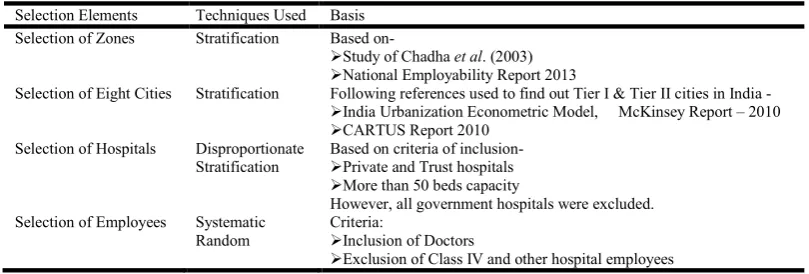
The data were collected from four zones and eight cities of India representing 32 hospitals. All these hospitals are either trust hospitals or private hospitals and have more than 50 bedded capacities. The focus of the study is on Doctors working in the hospitals. However, the discussion regarding ‘Gender’, ‘Occupational Commitment’, and ‘dual doctors marriage’ kept out of the scope of this study.
The Doctor is defined as, ‘A person who is licensed to practice medicine and has trained at a school of medicine (TheFreeDictionary.Com). The MCI defined as, ‘No person other than a doctor having qualification recognised by Medical Council of India and registered with the Medical Council of India/State Medical Council (s) is allowed to practice Modern system of Medicine or Surgery. According to the Medical Council of India (MCI), the total number of registered doctors in the country is 9,36,488 as on December 31, 2014. The operational definition of marital status is, ‘The marital status is the civil status of each individual in relation to the marriage laws or customs of the country, i.e. never married, married, widowed and not remarried, divorced and not remarried, married but legally separated, de-facto union (stats.oecd.org). However, with reference to Indian Doctors, this study has made only two groups, i.e. Married and Unmarried.
Data collection
To conduct this study, 300 questionnaires were distributed among the doctors. This study was conducted during May 2011 -March 2013. But after the completion of the survey, only 200 doctors gave their responses, out of which only 138 questionnaires were included in this study. As a result, the response rate was 46%. During this study, the following sampling techniques were used.
Description of Tools
It was decided to use a structured survey schedule because the information that needed to be obtained from doctors belongs to 32 different hospitals. The structured schedule ensures uniformity and accuracy while administering the schedule. The survey schedule has two parts. The first part covers demographic profile, i.e. Zone, City, Name of Hospital, Department, Qualification, Total Professional Experience, Age, Marital Status and Monthly Salary. The second part focuses on commitment variables which comprise of Affective
Commitment, Continuance Commitment, Normative
Commitment. The schedule includes all close-ended items.
Selection of Tool: Organizational Commitment
[image:4.595.97.502.455.592.2]Different scholars have conceptualized the OC construct differently and developed their measures accordingly. Only three measures that were considered standard, repetitively used earlier and previously tested. Out of these three measures, the researcher has selected Meyer and Allen’s (1997) scale. The Selection of Tool with appropriate rationale is presented as follows-
Table 3. Techniques Used In Sampling
Selection Elements Techniques Used Basis Selection of Zones Stratification Based on-
Study of Chadha et al. (2003)
National Employability Report 2013
Selection of Eight Cities Stratification Following references used to find out Tier I & Tier II cities in India -
India Urbanization Econometric Model, McKinsey Report – 2010
CARTUS Report 2010 Selection of Hospitals Disproportionate
Stratification
Based on criteria of inclusion-
Private and Trust hospitals
More than 50 beds capacity
However, all government hospitals were excluded. Selection of Employees Systematic
Random
Criteria:
Inclusion of Doctors
[image:4.595.52.549.631.758.2]Exclusion of Class IV and other hospital employees Primary Work
Table 4. Selection of Tool, its Dimensions with Appropriate Rationale
SR. No. Measures (Standard)
Developed by Dimensions Selected/ Not Selected
Rationale
1 Organization Commitment Questionnaire (OCQ)
Porter et al. (1974)
Loyalty, Value, Goal congruency, Willingness for Extra-effort
Not selected Quite old
Based on attitudinal dimension
2 British Organization Commitment Scale (BOCS)
Cook and Wall (1980)
Identification, Involvement, Loyalty
Not selected Primarily developed for the UK blue-collar workers
3 Three-dimensional scale (ACS, CCS, NCS)
Meyer and Allen (1991, 1997)
Affective, Continuance, Normative
Selected 1.Widely used in research* 2.Revalidated by Krishnaveni R. & Ramkumar N. (2008) and recommended suitable for future research in an Indian context.
The researcher wanted to use the latest scale which is suitable for the Indian context to shape up the research with finesse. Exploration of the extant literature revealed that Meyer and Allen’s scale (ACN) is the most widely used scale (Dunham et al., 1994; McGee and Ford, 1987). Moreover, Krishnaveni and Ramkumar N. (2008) studied the revalidation of the three-component conceptualization model of Meyer and Allen (1997) in the context of India and recommended that the scale is suitable for future research. Therefore, the researcher has used a ready-made tool developed by Allen and Meyer (1997) as they measured the desired variables, happens to be the most recent and was also found to be suitable in the Indian context. There is a total of 18 items in the scale of which four are reverse edged items. This was modified in the Indian context as recommended by Krishnaveni and Ramkumar (2008).
Reliability of the Tool
[image:5.595.35.289.301.350.2]The test details are depicted below:
Table 5. Reliability of Instrument (ACN)
Variables N =138
Cronbach Alpha
Cronbach Alpha of earlier* studies - Range
Affective Commitment (6 Items) 0.889 0.77 to 0.88
Continuance Commitment (6 Items) 0.775 0.65 to 0.86
Normative Commitment (6 Items) 0.711 0.69 to 0.84
*Allen & Mayer (1990a); Cohen A. (1996, 99); Cohen and Kirchmeyer (1995); Hackett et al. (1994); Meyer & Allen (1997); Meyer, Irving & Allen (1998); Somers & Birnbaum (1998).
Validity of the tool
After assessing the reliability of ACN measure, a factor analysis was conducted. After factor analysis, it was whittled down to 18 items under 3 components, namely, Affective, Continuance, and Normative Commitment (ACN). The following table indicates the results of factor analysis –
Based on the generally accepted rules of selecting a factor solution with Eigen values greater than 1 and incremental variance, a three-factor solution was accepted. Finally, the researcher has used the scale of Allen and Meyer (1997) without making any modifications.
Scoring Method
Respondents were asked to reply to each item using a five-point Likert scale format: Strongly agree; agree; neutral; disagree and strongly disagree- as it applies to his or her organizational commitment level. Higher scores indicated a higher level of commitment and lower scores indicates otherwise.
Interpreting the Score
The following ranges for the sets of scores provide a quick interpretation of the respondents’ scores.
Data Analysis
The statistical techniques like descriptive techniques and One-way Analysis of Variance (ANOVA) are used in this study to attain objectives of the study.
Demographic Profile
This part of the study is focused on details about the demographic profile of respondents (Doctors) from all over India.
Descriptive Analysis of Commitment Variables
The computation of Total Score, Mean and Standard Deviation is obtained by using SPSS. Table No. 9 shows the division of commitment level in three parameters, i.e. High Level, Moderate Level and Low Level.
[image:5.595.39.559.494.575.2]From the above table, it is observed that – All Doctors showed a moderate level of total organizational commitment, continuance commitment, and normative commitment. However, they possess a higher level of affective commitment towards the organization.
Table 6. Validity of Instrument - Factor Analysis
Variables –N=138 KMO Measures of Sampling Adequacy With P Value
No. New Components
The Total of Factor Loading
Eigen Values
Total Variance Explained
New Factors
Affective Commitment (6 Items)
0.882 P = 0.000
1 4.822 3.886 64.758 Affective Commitment
Continuance Commitment (6 Items)
0.781 P = 0.000
1 4.120 2.864 47.735 Continuance Commitment
Normative Commitment (6 Items)
0.753 P = 0.00
1 3.801 2.634 43.896 Normative Commitment
Source: Primary Work Extraction Method: Principal Component Analysis
Table 7. Range and Interpretation of Measurements
Variables No. of Questions Rating Scale Range Interpretation For Measurement Affective
Continuance Normative
6 (Each)
1 to 5 6 to 30 6.00 to 14.00 Lower Level of Commitment 14.01 to 23.00 Moderate Level of Commitment 23.01 to 30.00 High Level of Commitment Total Organizational Commitment 18 1 to 5 18 to 90 18.00 to 42.00 Lower Level of Commitment
42.01 to 66.00 Moderate Level of Commitment 66.01 to 90.00 High Level of Commitment Source: Primary Work,
[image:5.595.60.540.609.678.2]Testing of Hypotheses
This part presents testing of hypotheses formulated for the study. The data analysis has been presented.
Null Hypothesis – Marital Status and Doctors
The following table depicts descriptive statistics and Independent ‘t’ Test for commitment level with two groups of marital status. The significance level and retention or rejection of hypotheses also demonstrated with appropriate rationale.
Analysis
The group of married doctors revealed a higher mean for all the variables of commitment except continuance commitment.
However, there is no significant difference between married doctor groups and unmarried doctor groups as ‘p’ value is more than 0.05.
Findings
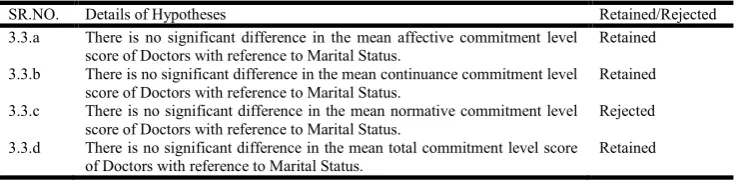
It is observed that there are similarities in the level of organizational commitment between the two groups. Hence, the following Null Hypotheses are retained with reference to Marital Status-
DISCUSSION
[image:6.595.154.437.77.205.2]The analysis on the basis of two groups of Marital Status described the similarity of the commitment level. The following may be the reason for a similar level of commitment
Table 8. Sample Distribution of Doctors
Demographic Profile Total N = 138
Groups Frequencies
N Percentage
Zone East Zone 35 25.4
North Zone 48 34.8
South Zone 17 12.3
West Zone 38 27.5
Total Experience Less than 10 Years 100 72.5% 10 to 20 Years 24 17.3% More than 20 Years 14 10.2%
Marital Status Married 88 63.8%
Unmarried 50 36.2%
Gender Male 96 69.6%
[image:6.595.105.489.236.288.2]Female 42 30.4%
Table 9. Score Mean and Standard Deviation
Variables of Commitment Score (Sum) Mean Standard Deviation Measurement of Level Total Organizational Commitment 8994 65.17 9.19 Moderate Level
Affective Commitment 3332 24.14 4.01 High Level
Continuance Commitment 2647 19.18 4.33 Moderate Level
Normative Commitment 3015 21.85 3.44 Moderate Level
Source: Primary Work
Table 10. Descriptive Statistics and Independent ‘t’ Test of Commitment with two groups of Marital Status
Marital Status Married Unmarried t Value Sig. p value
Significant / Not Significant (S/NS) Total Respondents - 138 88 50
Variables Mean
SD
Mean SD Affective Commitment 24.61
3.734
23.32 4.382
1.836 0.069 No Significant Difference Continuance Commitment 18.99
4.865
19.52 3.228
-0.690 0.491 No Significant Difference Normative Commitment 22.07
3.641
21.46 3.072
0.996 0.321 No Significant Difference Total organizational Commitment 65.67
9.765
64.30 8.114
0.841 0.402 No Significant Difference Source: Primary Work
Table 11. Retention or Rejection of Hypotheses – Marital Status
SR.NO. Details of Hypotheses Retained/Rejected
3.3.a There is no significant difference in the mean affective commitment level score of Doctors with reference to Marital Status.
Retained
3.3.b There is no significant difference in the mean continuance commitment level score of Doctors with reference to Marital Status.
Retained
3.3.c There is no significant difference in the mean normative commitment level score of Doctors with reference to Marital Status.
Rejected
3.3.d There is no significant difference in the mean total commitment level score of Doctors with reference to Marital Status.
Retained
[image:6.595.106.488.332.446.2] [image:6.595.114.484.490.580.2] Once the doctor enters the hospital, he/she immediately dons a professional role of healer and life saver thereby earning patients trust for life and this role not only requires dedication but also a higher degree of commitment and responsibility. Hence, marital status here becomes irrelevant and thus commitment level remains similar for all.
The other reason may be related to educational debt, which makes them more sincere for the hospital organization.
The doctors have to take ethical as well as legal responsibilities of patients’ treatment on behalf of hospital organization, which may make them more committed to hospital organization. It is also observed that on some emergency occasions doctors have to devote family time to patient or hospital organization.
From the above discussion, it may be concluded that factors like the professional role of healer and life saver and financial pressure affect organizational commitment. The previous research conducted by Maini (2001); Kapur (1975); Cherniss (1991); Korabik and Rosin (1996); and their findings associated with negative relationship between marital status and organizational commitment are consistent with the findings of the present study.
Implication and Recommendation
The marital status does not interfere if there is a professional role; if there are legal and ethical and financial responsibilities; and if there is an urge for career advancement. The following suggestions are proffered to HR Practitioners to build committed workforce in the hospital organization-
Married Doctors require accommodation for their families. If possible HR Heads should provide them such facility.
There should be provisions for Flexi-timings, vacations which may enhance the commitment level of the Doctors.
This study has used self-report survey which could be a limiting factor. It is also important to consider that the samples used in this study are Doctors, therefore the results of the study cannot be generalized to other industries.
REFERENCES
Abdul Azeez, E.P. 2013. Employed Women and Marital Satisfaction: A Study among Female Nurses. International Journal of Management and Social Sciences Research (IJMSSR), 2-11.
Aggarwal, K. and Khandelwal 2009. Organisational commitment in multinationals: A dynamic interplay among personal, organisational and societal factors. ASBM Journal of Management, II (1).
Allen, N. J. and Meyer, J. P. 1990a. The Measurement and Antecedents of Affective, Continuance and Normative Commitment to the Organization. Journal of Occupational Psychology, 63(1), 1-18.
Blau, G. 1985. The measurement and prediction of career commitment. Journal of Occupational Psychology, 58, 277-288.
Bowen, C.F., Radhakrishna, R. and Keyser, R. 1994 .Job satisfaction and commitment of 4-H Agents. Journal of Extension, 32, 1-22.
Bragger, J.D., Rodriguez-Srednicki, O., Kutcher, E.J., Indovino, L. and Rosner, E. 2005. Work-family conflict, work-family culture, and organizational citizenship behaviour among teachers. Journal of Business and Psychology, 20 2, 303-324.
Catalyst 1996. Women in corporate leadership. New York: Catalyst.
Catalyst, 2003. Women in US Corporate Leadership. Catalyst, New York.
Chadha, V.K. 2007. Annual Risk Of Tuberculous Infection In Andhra Pradesh, India. Indian J. Tuberculous, 54:177-183. Cherniss, C. 1991. Career commitment in human service
professionals: A biographical study. Human Relations, 44(5), 419-437.
Chughtai, A. A. and Zafar, S. 2006. Antecedents and consequences of organizational commitment among Pakistani university teachers. Applied H.R.M. Research, 11 (1), 39-64.
Clark, L.A. and Watson, D. 1995. Constructing Validity: Basic issues in objective scale development. Psychological Assessment, 7, (3), 309-319.
Cohen, A. 1991. Career stage as a moderator of the relationship between organisational commitment and is outcome: A meta-analysis. Journal of Occupational Psychology, 64(3), 253–268.
Cohen, A. 1995. Some antecedents of employee commitment and their influence on job performance: A multi-foci study. South African Journal of Business Management, 26(4), 45– 135.
Cohen, A. 2003. Multiple commitments in the workplace: An integrative approach. Mahwah, NJ: Lawrence Erlbaum. Corcoran, M., Duncan, G.J. and Ponza, M. 1984. Work
experience, job segregation, and wages. Cited from Reskin, B. (Ed.) Sex Segregation in the Workplace, pp. 171-191. Washington, DC: National Academy Press.
Dunham, R., Grube, J., and Castaneda, M. 1994. Organizational commitment: the utility of an integrative definition. Journal of Applied Psychology, 79, 3, 370-380. Etzioni, A., 1975. A comparative evaluation of complex
organization: On power, involvement and their correlates. New Jersey: Free Press.
Farooq, N., Irfan, M., and Farooq, M. 2011. Measurement of the degree of organizational commitment among the faculty members of private sector universities in Peshawar city. Interdisciplinary Journal of Contemporary Research in Business, 3, 4.
Felmlee, D.H. 1995. Causes and consequences of women’s employment discontinuity. Work and Occupations, 22, 2, 167-187.
Fogarty, M.P. and Rapoport R.N. 1971. Sex career and family. London, George Allen and Unwin Ltd.
Hashmi H. A. et al., 2007. Marital Adjustment, Stress and Depression among Working and Non-Working Married Women. Internet Journal of Medical. 2(1):19-26.
Hazarika I. 2013. Health workforce in India: Assessment of availability, production and distribution. WHO South-East Asia J Public Health; 2:106-12.
Hrebiniak, L. G., and Alutto, J. A. 1972. Personal and role related factors in the development of organizational commitment. Administrative Science Quarterly, 17, 555-572.
John, M. C., and Taylor, W. T 1999. Leadership style, school climate and the institutional commitment of teachers. International Forum (InFo), 2(1), 25-57.
Kacmar, K. M., Carlson, D., and Brymer, R. A. 1999. Antecedents and consequences of organizational commitment: A comparison of two scales. Educational and Psychological Measurement, 59, 976–994.
Kalenberg, D.O., Becker, B.W. and Zvonkovic, A. 1995. Work and commitment among young professionals: A study of male and female dentists. Human Relations. 48, (11), 1355 77.
Kapur Promilla 1975. The changing status of the working women in India. India: Vikas publishing Pvt. Ltd.
Katzell, R. A., and Thompson, D. E. 1990. Work motivation: Theory and practice. American Psychologist, 45, 144-153. Korabik, K. and Rosin, H. 1995. Organizational experiences
and propensity to leave: A multivariate investigation of men and women managers. Journal of Vocational Behavior, 46, 1–16.
Krishnaveni, R. and Ramkumar, N. 2008. Revalidation process for established instruments: A case of Meyer and Allen’s organizational commitment scale. ICFAI Journal of Organizational Behavior, 7, 2, 7-17.
Larkey, L., and Morrill, C. 1995. Organizational commitment as symbolic process. Western Journal of Communication, 59, 193- 212.
Maini, V. 2001. Job commitment of women executives. Management and Labour Studies, 26, 247.
Mathieu, J. E., and Zajac, D. M. 1990. A review and meta-analysis of the antecedents, correlates and consequences of organizational commitment. Psychological Bulletin, 108, 171-194.
McGee, G. W., Ford, R. C. 1987. Two (or more) dimensions of organizational commitment: Re-examination of the affective and continuance commitment scales. Journal of Applied Psychology, 72, 638-642.
Mckinsey Report 2014. India Healthcare.
Meyer, J. P. and Allen, N. J. 1984. Testing the side bet theory of
organizational commitment: Some methodological
considerations. Journal of Applied Psychology, 69, 372-378. Meyer, J. P. and Allen, N. J. 1997. Commitment in the
Workplace: Theory, Research and Application. Thousand Oaks, Ca: Sage Publications.
Meyer, J. P. and Smith, C.A. 2000 HRM Practices and Organizational Commitment: Test of a Mediation Model. Canadian Journal of Administrative Sciences, 4, 3, 19-33. Meyer, J. P., Allen, N. J., and Smith, C. A. 1993. Commitment to
organizations and occupations: Extension and test of a three-component conceptualization. Journal of Applied Psychology, 78, 538-551.
Meyer, J. P., Allen, N. J., and. Gellatly, I. R. 1990. Affective and continuance commitment to the organization: Evaluation of measures and analysis of concurrent and time-lagged rela-tions. Journal of Applied Psychology, 75, 710-720.
Meyer, J. P., and Allen, N. J. 1991. A three-component conceptualization of organizational commitment. Human Resource Management Review, 1, 61-89.
Meyer, J. P., and Herscovitch, L. 2001. Commitment in the workplace: Toward a general model. Human Resource Management Review, 11, 299-326.
Miller M.N and Mcgowen R. 2000. The Painful Truth: Physicians Are Not Invincible. Southern Medical Journal, 93,10.
Mowday, R. T, Steers, R. M., and Porter, L. M. 1979. The measurement of organizational commitment. Journal of Vocational Behavior, 14, 224-247.
Mowday, R., Porter, L. and Steers, R. 1982. Employee organization Linkages: The Psychology of Commitment, Absenteeism, and Turnover. New York: Academic Press. Nair, Sreelekha 2007. Rethinking citizenship, community and
rights: the case of nurses from Kerala in Delhi. Indian Journal of Gender Studies, 14, 137.
Nandan D., Nair K.S., and Datta U. 2007. Human Resources For Public Health In India – Issues And Challenges. Health and Population Perspectives and Issues 30 (4): 230-242. Pare, G., Tremblay, M. and Lalonde, P. 2001. The role of
organizational commitment and citizenship behaviors in understanding relations between human resources practices and turnover intentions of IT personnel. Scientific Series -24, CIRANO, Montreal, Canada.
Porter, L. W., and Smith, F. J. 1970. The etiology of
organizational commitment. Unpublished manuscript,
University of California, Irvine.
Porter, L. W., Steers, R. M., Mowday, R. T., and Boulian, P. V. 1974. Organizational commitment, job satisfaction and turnover among psychiatric technicians. Journal of Applied Psychology, 59, 603 609.
Priyadarshini, M. S. and Padmanathan, S. 2012. A study on understanding the levels of job satisfaction, job motivation, organizational commitment, perceived organization support
among fresher’s and experienced academicians.
International Journal of Research in Commerce and Management, 3, 12.
Randall, D. M. 1987. Commitment and the organization: The organization man revisited. Academy of Management Review, 12, 460-471.
Reichers, A. E. 1985. A review and re-conceptualization of organizational commitment. Academy of Management Review, 10, 465-476.
Rod, M. and Nicholas, J. A. 2010. Management commitment to service quality and service recovery performance: A study of frontline employees in public and private hospitals. International Journal of Pharmaceutical and Healthcare Marketing, 4, 1, 84-103.
Selmanovic S., Ramic E, Pranjic N, Brekalo-Lazarevic S, Pasic Z, Alic A. 2011. Stress at work and burnout syndrome in hospital doctors. Med Arh (PubMed); 65(4):221-4.
Sharma K. and Vatsa M. 2011. Domestic Violence against Nurses by their Marital Partners: A Facility-based Study at a Tertiary Care Hospital. Indian J Community Med. 36(3): 222–227.
Siew P.L., Chitpakdee, B., Chontawan, R. 2011. Factors Predicting Organizational Commitment among Nurses in State Hospitals, Malaysia. The International Medical Journal Malaysia, 10 (2).
Sikorska-Simmons E. 2005. Predictors of organizational commitment among staff in assisted living. The Gerontological Society of America. 45, 2, 196–205.
doctors: a survey exploring the professional and family lives of young physicians. Ann Intern Med., 16;130,312-9. Somers, M.J., and Birnbaum, D. 1998. Work-related
commitment and job performance: It’s also the nature of performance that counts. Journal of Organizational Behaviour, 19, 621-634.
Steers, R. M. 1975. Problems in the measurement of organizational effectiveness. Administrative Science Quarterly, 20, 546 – 558.
Steers, R. M. 1977. Antecedents and outcomes of organizational commitment. Administrative Science Quarterly, 22, 46-56.
Steers, R. M., and Rhodes, S. R. 1978. Major influences on employee absenteeism: A process model. Journal of Applied Psychology, 63, 4, 391-407.
Taiuwo, K.O. (As cited in Qureshi, M.I., Saleem, A. M., Salahuddin, H. 2012. Assessment of selected factors on organizational commitment. Gomal University Journal of Research, 28, 2.
Victoria N. 2013. Patient centered hospitals: a study to evaluate the effectiveness of health care delivery in the three selected hospitals in Guntur District, Andhra Pradesh, India. Doctoral dissertation, Acharya Nagarjuna University. Zedeck, S., and Mosier, K. 1990. Work in the family and
employee organization. American Psychologist, 45, 240-251.