P.S. KARSTEN
Categorizing information in manuals
Creating a universal categorization in declarative information
Graduation committee:
Dr. J. Karreman N. Baas, MSc.
Enschede: 16 March 2011
1
Abstract
In previous research on the topic of text types in manuals, many different definitions of text types have been used. This makes it more difficult than necessary to compare the results of research on this topic. To solve this problem a complete universal categorization of the information in manuals is needed. A part of this categorization is readily available. Three types of information are currently discerned in manuals. Two come in the form of well defined procedural and motivational
information, while the third, often used, term of declarative information lacks uniformity in its definition and internal categorization. This study aims to split up declarative information into a well defined categorization. To accomplish this, three forms of research have been conducted: a literature review, a content analysis of real-life manuals, and open and closed card sort studies among a group of participants with professions related to this field of research as well as a group of participants unfamiliar with the field.
The literature review indicated that in available research many different implementations and definitions of declarative information were used. All these different views of declarative information were collected and compared, leading to a universal categorization with six different categories: internal working, purpose, advice, topology, comparison and terminology.
The content analysis of real-life manuals was carried out to check whether current manuals would contain information not covered by this categorization, but did not indicate any need for redefinition of these categories or the inclusion of any others.
The open card sort was conducted to check what alternative categories participants would create. This study showed that some of the participants created categorizations in which the categories from the literature review could be discerned and others created interesting alternative categories; however these categories will have to be researched to determine whether they are a viable alternative.
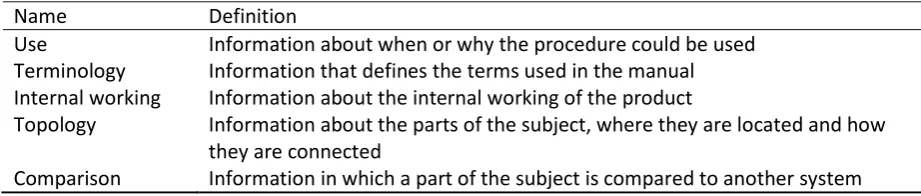
The closed card sort was conducted to determine whether the suggested universal categorization scheme would lead participants to categorize pieces of information consistently. It appeared that the items created for the purpose category were difficult to categorize; whether this was due to the chosen items or the definition of the category is not entirely clear. As the group of participants familiar with the field of research had a strong tendency to categorize these items as advice, the advice and purpose category were merged into the newly formed use category, leading to the following evolution of the categorization:
Use: Information about when or why the procedure could be used Terminology: Information that defines the terms used in the manual Internal working: Information about the internal working of the product
Topology: Information about the parts of the subject, where they are located and how they are connected
3
Table of contents
1. Introduction ... 5
2. Information types in manuals ... 7
2.1. Procedural information ... 7
2.2. Motivational information ... 7
2.3. Declarative information ... 8
3. Literature research into current definitions ... 11
3.1. Method ... 11
3.2. Results ... 11
3.3. Summary of categories from literature ... 14
4. Content analysis of information types in real-life manuals ... 17
4.1. Method ... 17
4.2. Results ... 18
4.3. Conclusion ... 19
5. Card sort study to determine a categorization ... 21
5.1. Method ... 21
5.2. Results of the open sort ... 23
5.3. Results of the closed sort ... 28
5.4. Conclusion ... 32
6. Conclusion ... 33
6.1. What categorization can be derived from previous research? ... 33
6.2. What additions can be derived from practice? ... 33
6.3. How do the participants categorize declarative information? ... 33
6.4. Can the participants use the new categorization? ... 34
6.5. What is the most usable categorization of declarative information? ... 34
7. Discussion ... 35
8. Recommendations ... 37
References ... 39
5
1.
Introduction
The manuals of devices are frequently criticized. They are accused of not helping the user enough and being too complex. Despite this reputation of manuals, the majority of users still read the manuals (Schriver, 1997; Jansen & Balijon, 2002). Since both users and manufacturers want the best manuals for their products, research into manuals has to be conducted. This research was started in the eighties by companies like IBM which had to provide manuals with their hardware and software. From this research the notion was raised that the users of manuals use an action oriented approach when using manuals; they seem prefer to learn by doing (Carroll & Mack, 1983).
Since different parts of manuals have different goals to accomplish, there is a variety of different types of information that can be distinguished. To research the effects of these types of information these need good definitions. There are already various definitions for information types in manuals, but there is not one universally used categorization.
The type of information in manuals that enables the users to learn by doing is procedural
information. This type of information consists of the steps that have to be taken, the preconditions for these steps and the reactions of the product. Procedural information enables the users to learn by doing, and its value has rarely been questioned.
That procedural information is well defined is partially due to the focus on this type of information by researchers with the perspective of minimalism. The name of this perspective could lead to some confusion, but contrary to what the name would suggest, minimalism does not promote the minimization of manuals, but rather the user-centered design of manuals (Van der Meij, 2003). Minimalism consists of four principles: Choose an action-oriented approach; Anchor the tool in the task domain; Support error recognition and recovery; and Support reading to do, study, and locate (Van der Meij, 2003, p. 222). Minimalism focuses on the procedural information in instructional text.
Farkas (1999) introduced a method to write manuals resembling minimalism named the streamlined step procedure. With this method the procedure to get from the start state to the desired state is the focus of an instructional text. This method is still widely used and the results of this method can for example currently be found in the help function of Microsoft Windows.
In contrast to procedural information, the value of all other types of information has been the subject of debate and research with a variety of conclusions. These studieshowever have been conducted with various definitions of the types, making it difficult to compare their results.
In the other types of information one can distinguish motivational information on one hand and all other types on the other. The latter category is known as declarative information. Since this type of information consists of all other types of information, it is difficult to research the effects of these types of information without a complete categorization. The lack of such a categorization prevents an easy comparison between studies.
This research aims to construct a general categorization of declarative information in manuals. To make this model as versatile as possible this research will consist of three different parts. The first part is a literature review. It consists of a summary of each definition of (a subset of) declarative information used in previous research. From this summary a definite categorization based on
6
the types of information used in existing manuals are compared to the categorization derived from the literature. The focus of this part is to find additions to the categorization from literature. In the third part of this research the users are asked to generate a categorization of declarative
7
2.
Information types in manuals
When looking at information in manuals a global distinction of three information types can be made: procedural, motivational, and declarative information. The necessity of procedural information is well established in practice. The effects of motivational and declarative information, however, are not as clear cut. The following paragraphs will give (1) a description of procedural information, (2) a description of motivational information, and (3) a description of declarative information, the current state of declarative information research and the problems that have risen in available research.
2.1.
Procedural information
Procedural information is the most frequently used type of information in real-life manuals. The definition used for procedural information in this study is in line with the definition used by Ummelen (1997) as well as Karreman, Ummelen and Steehouder (2005). Procedural information is the information that consists of actions, reactions from the system or device, and the conditions for the actions.
The different elements of procedural information are illustrated in the following example:
The gas hose has to be connected before cooking. (condition)
1. Turn on the gas. (action 1)
2. Light the gas with a match. (action 2)
The burner is now on. (result/reaction)
The use of procedural information was established early in the history of research on manuals. Carroll and Mack (1983) found in their research that users of manuals prefer an action-oriented approach; in other words that users prefer to learn by doing. This requires that a manual is written in such a manner that it accommodates such usage.
2.2.
Motivational information
Motivational information has hardly been studied in the past, but has recently received more attention. For this study motivational information is defined as information designed to encourage users to follow the procedure, to remove any fear that users might be experiencing, and to assure users that they have made the right decision.
An example of motivational information is:
There is nothing to worry about; anyone can follow these instructions.
Loorbach, Karreman and Steehouder (2007) recently conducted a study in which they used manuals written with different strategies:
A control version;
A version aimed at increasing the attention of the user; in this manual a number of headings used questions or idioms, and colors were used to accentuate certain segments;
8
A version aimed at increasing the confidence of the user; in this version segments were added to increase the user’s confidence about operating the device.
The task performance was significantly better in the relevance and confidence versions than in the control version. The confidence version differed in the results from the control version; the participants who used the confidence version gave up significantly later than users in the control version in one of the three presented tasks.
Another example of a recent study concerned with motivational information focuses on the use of agents to influence the motivation of the users of a manual (Van der Meij, 2008). For this study a basic manual and a modified manual were constructed. The basic version was a manual constructed with the streamlined step procedure. The modified version had added personas and motivational parts. The results of this study proved that the basic manual supported learning and doing better than the modified manual.
The use and implementations of motivational information are different among researchers. Since these definitions are similar, this type of information lends itself well to a general definition.
2.3.
Declarative information
Declarative information in turn is all information about the device available in manuals which is not procedural or motivational information. This definition is very broad and therefore difficult to use without a proper categorization of its own. Declarative information can, for example, provide the reader with an image of the internal working of the device or an overview of its components.
A few examples of declarative information are:
V means that the certificate chain is trusted and valid.
With a conference call, you can have a joint conversation with two or more persons.
This paragraph consists of two parts: the first discusses the current state of declarative information research. In the second part the problems with recent research will be discussed.
Current state
Various researchers have conducted studies on the topic of declarative information. These studies used different subtypes of declarative information. The effects were separated in positive effects and negative effects.
Advantages
There are five types of positive effects of declarative information in manuals found in research.
9
Users can be made less error prone. This effect can be obtained when the declarative information is used to explain the purpose of parts of procedures (Kieras & Bovair, 1984).
Users remember the procedures better (Catrambone, 1995). This is an effect of declarative information that explains the purpose of the steps in the procedure.
Declarative information can help users to perform faster. This can either imply that they are immediately faster due to the use of examples and principles (Catrambone, 1995) or that they are faster when faced with a new task (Smith & Goodman, 1982).
Declarative information promotes transfer; declarative information aids the user when conducting a new task in the same domain. When users are faced with a new task, those that use a manual with principles or sub-goals perform better than those using a plain manual (Smith & Goodman, 1982). Users reading declarative information about the used device performed better when the location of buttons on the device differed between the training device and the testing device compared to users reading marketing information (Karreman, 2004). This was the only effect found by Karreman when she researched transfer; when the labels of the buttons changed to synonyms the difference in transfer did not prove to be significant.
Disadvantages
There are two known disadvantages of declarative information:
The addition of declarative information in manuals increases the reported cognitive pressure of the users (Karreman, 2004, p. 119). This could be due to the fact that the readers of the manuals have to process more information which increases the cognitive pressure.
Declarative information in manuals lowers the confidence of the users of the manual (Karreman, 2004, p. 120). This could be due to the fact that additional information in
manuals consisting of large quantities of declarative information can make the device appear more complex.
Problems with available research
There are some notes to be placed with available research, as found by Mirel (1991). She performed a literature review on instructive text research and found that the research published in the nineteen eighties lacked comparability. The research did not use a standard method and there was no
10
Creating the categorization of declarative information
From the available literature it is concluded that no general categorization of declarative information exists. To remedy this problem, this study aims to create a usable categorization. To create this categorization four sources are used: (1) the literature available on this subject, to build the categorization on the current scientific view; (2) a selection of current manuals, to determine whether there are additions to be made to the categorization from literature; (3) professional targeted users of the categorization, to determine whether the technical writers and researchers used other categorizations and could use the created categorization from literature and practice; and (4) an equivalent group of laymen, to determine whether different categories would be created without prior knowledge of the domain and whether the categorization from literature and practice is usable for participants without prior knowledge.
Research question:
What is the most usable categorization of declarative information for research?
Sub-questions:
What categorization can be derived from previous research on declarative information?
What additional categories can be derived from current manuals to complete this categorization?
How do professionals and laymen categorize declarative information?
11
3.
Literature research into current definitions
Since there are many different defined types and subtypes of declarative information used in
research a new categorization has to be created that considers each of those definitions. This chapter aims to provide a categorization based on available literature.
3.1.
Method
In available literature different definitions and implementations of declarative information were found. All these definitions and implementations were compared and combined to create one single categorization of declarative information.
3.2.
Results
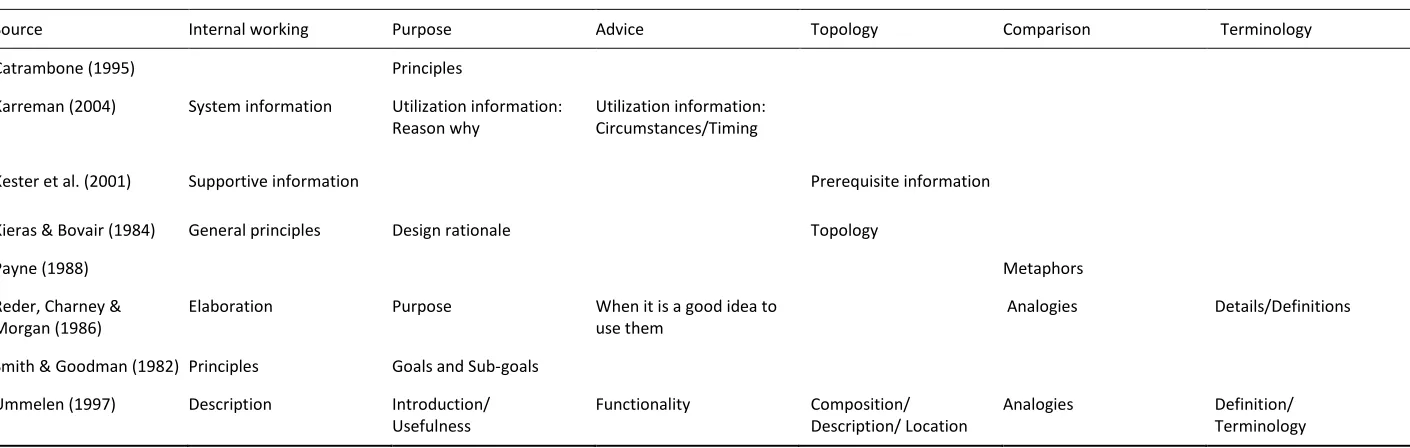
This paragraph provides an overview of each of the types of information found in literature. Table 2 (see page 15) has been constructed to create an overview of the differences and overlap of the various definitions of declarative information. This table is constructed to answer the first sub-question of the study. The exact terms in the studies can be found in each of the following category descriptions. The categories are sorted by the number of studies that feature them.
Internal working
The internal working category is the type of information that gives the reader of the manual a look at the internal working of the product. This type is referred to in research as ‘system information’ (Karreman, 2004), ‘supportive information’ (Kester, Kirschner, Van Merriënboer, & Baumer, 2001), ‘general principles’ (Kieras & Bovair, 1984), ‘elaborations’ (Reder, Charney, & Morgan, 1986), or just ‘principles’ (Smith & Goodman, 1982). In addition to this variety in terminology, the authors use different definitions and occasionally no definition whatsoever. To come to a single definition those found in the literature are compared.
Karreman (2004) defines ‘system information’ as the “information about the internal working of the product”. Kester et al. (2001) use the term supportive information. This type of information describes the operation of the subject and the principles underlying it. Kieras and Bovair (1984) use no
definition of the term general principles used in their study. From the implementation it can however be derived that they use it to explain the internal working of the subject of the manual; Reder, Charney and Morgan (1986) use explanations about the system in one of their experiments, and refer to this type of information as basic elaboration. Smith and Goodman (1982) use the implementation as a general schema of the working of the subject. This provides yet another understanding of this type of information, but no definition.
For a general definition of this subcategory of declarative information the definition of Karreman (2004) will be used, as it is clearly stated in the book: “Information about the internal working of the product”. An example of this type of information is: “The TV can receive video and audio signals simultaneously when using an HDMI cable.”
Purpose
12
and ‘usefulness’ (Ummelen, 1997). This type of information is researched frequently and there is a wide variety of terms used for this type of information.
The implementations of this type of information are as follows: (1) Catrambone (1995) uses a circular definition, which does not suit the purpose of this study, from his implementation it can be derived that ‘principles’ can provide a rationale for actions. (2) Karreman (2004) uses the purpose category as a subtype of utilization information, described as providing the user with “a reason why (…)
particular functions of the system can be used”. (3) Kieras and Bovair (1984) use design rationale as term for a subset of their interpretation of declarative information. This provides the user with the reason for the procedure to be as it is. (4) Reder, Charney and Morgan (1986) mention the purpose of the commands as one of the types of information used in their experiments. They provide no definition of this type of information. (5) Smith and Goodman (1982) have used sub-goals in their functional manual to give the users a framework to anchor the used steps. (6) Ummelen (1997) mentions the introduction as a type of information which informs the user of the purpose of the provided procedures. She also uses the explanation of usefulness as a type of information; she used as description for this term the term functionality, which is strange since she uses functionality later on as a term to convey when the subject can be used.
There is no general definition of information in the purpose category found in literature. This information will therefore be defined as “Information about the purpose and goal of the current procedure”. An example of purpose is: “With a conference call, you can have a joint conversation with two or more persons.”
Advice
Information in the advice category answers the question of when it is a good idea to use a function or setting of the product. This type of information is applied by three researchers; Karreman (2004) uses this type of information as ‘timing’ in her definition of utilization information, Reder, Charney and Morgan (1986) use it as timing in the concept-rich version of their created manual, and Ummelen (1997, p. 26) uses a similar concept: functionality.
Karreman (2004) uses in her research the timing information as a subpart of a larger type of
declarative information named utilization information. Another part of the utilization information is the circumstances of use. The circumstances of use are only mentioned by Karreman (2004). An example of this type of information is a table with different cooking times of different types of food in the manual of a microwave oven. This type of information appears at first sight to be very similar to the conditions of the procedural information. However, the circumstances sketch a possible situation and pose no condition contrary to the procedural conditions. Just as advice, the
circumstances of use provide the user with an answer to the question when it is advisable to use a specific function of the product. In this study the circumstances will therefore be placed in the advice category. Reder, Charney and Morgan (1986) use the timing as a type of content rich information. Ummelen (1997) uses the term ‘functionality’ with as elaboration: ‘when is it useful?’
13
Topology
The topology category refers to the location of the different parts of the subject both in its interface and physical composition. This information type has been referred to as prerequisite information (Kester, Kirschner, Van Merriënboer, & Baumer, 2001), topology (Kieras & Bovair, 1984) and as compositions, description and location (Ummelen, 1997).
Kester, Kirschner, Van Merriënboer and Baumer (2001) use topology as part of their prerequisite information, they illustrate this part by providing example questions that could be answered by this type of information. These questions concern the locations and names of parts of the subject. Kieras and Bovair (1984) define the topology to show “what is connected to what”, thus providing the user with a location of each part of the system and how these parts are connected. Three types of information defined by Ummelen (1997) are considered topology. She does not state a definition of the first type: compositions. She does however use an example to illustrate the use of composition in her study. She uses the example of a cell address of a spreadsheet that consists of an x coordinate that represents the column of the cell, a y coordinate that represents the row of the cell, and a z coordinate that represents the page on which the cell is located. The second type she acknowledges is the type named description. This type of information should answer the question: “What does it look like?” Finally she defines location information which describes where the parts of the subject can be found.
Since there is no definition available from used literature, a new definition has been created to use in the categorization. This definition is: “information about the parts of the subject and how they are located and connected”. An example of information from the topology category is: “The music home screen has two parts, the upper part contains locally stored audio content, and the lower part shows online audio content. When online content is not available, the lower part shows local content.”
Comparison
The comparison category contains the type of information that gives users a comparison to another more familiar setting to improve the understanding of the system. This information has been referred to as metaphors (Payne, 1988) and analogies (Reder, Charney, & Morgan, 1986; Ummelen, 1997). The usage of this type of information is more uniform than the other types, partially because it is used by fewer researchers. Payne (1988) illustrates the use of metaphors in his article by giving examples. The metaphors are comparisons of the subject of the manual to a familiar system. Reder, Charney and Morgan (1986) similarly provide no definition. However from the implementation it is derived that they use it as a comparison of the subject with another familiar system. Ummelen (1997, p. 27) uses the definition of an analogy as a piece of information in which “a part of the system is compared to another system”.
The general definition of this subcategory will incorporate the definition used by Ummelen (1997): “Information in which a part of the system is compared to another system”. An example of the comparison information is entering text with the remote control of a television, just like you would enter the letters in a SMS on the keypad of a mobile phone.
Terminology
14
these types of information and details are only mentioned briefly, but derived from their example of these types of information, definitions can be put in the terminology category. Ummelen (1997, p. 26) uses two types of information that can be placed in this category: definition; ‘what is it?’ and terminology; ‘what is it called?’ This first term used by Ummelen (1997) poses a problem as it is broader than the terminology category.
Since there is no current definition for terminology in literature, it is defined as: “Information that defines the terms used in the manual”. An example of terminology is: “V means that the certificate chain is trusted and valid.”
Examples
Multiple researchers have researched the use of examples in manuals. This is sometimes defined as declarative information. In this study, examples are not considered to be declarative information, because examples are specific cases of procedures; that is, they consist therefore of procedural, motivational and declarative information. Examples have been researched by both Catrambone (1995) and Reder, Charney and Morgan (1986). An example is an illustration of the current procedure (Catrambone, 1995) and the concept of this type of information is similar among all authors.
Options
The options category consists of a type of declarative information mentioned by Ummelen (1997). In her view options are declarative information that answers the question: what possibilities are there? This type of information can be used in various ways. For example advice can be given about when a function of the product can be used; in that case this type of information will be grouped in with the advice category. This will not be considered a separate category; each of the possible information from this category can be placed in another already defined category.
3.3.
Summary of categories from literature
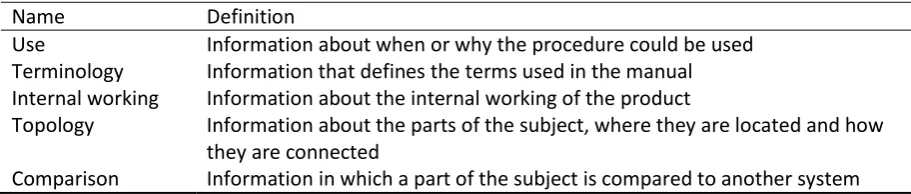
The definitive version of the categorization derived from literature is as follows: Internal working; Purpose, Advice, Topology, Comparison, and Terminology. In table 1 the proposed names and definitions of the subtypes of declarative information are listed.
Table 1
Categories derived from literature
Name Definition
Internal working Information about the internal working of the product
Purpose Information about the purpose and goal of the current procedure Advice Information about when it is a good idea to use the procedure
Topology Information about the parts of the subject, where they are located and how they are connected
Table 2
Different used definitions and implementations of declarative information in research
Source Internal working Purpose Advice Topology Comparison Terminology
Catrambone (1995) Principles
Karreman (2004) System information Utilization information:
Reason why
Utilization information: Circumstances/Timing
Kester et al. (2001) Supportive information Prerequisite information
Kieras & Bovair (1984) General principles Design rationale Topology
Payne (1988) Metaphors
Reder, Charney & Morgan (1986)
Elaboration Purpose When it is a good idea to
use them
Analogies Details/Definitions
Smith & Goodman (1982) Principles Goals and Sub-goals
Ummelen (1997) Description Introduction/
Usefulness
Functionality Composition/
Description/ Location
Analogies Definition/
Terminology
17
4.
Content analysis of information types in real-life manuals
The previous chapter provided a picture of the declarative information types used in research; this raises the question: are any alterations to the categorization from literature necessary? This chapter aims to provide an answer to this question.
4.1.
Method
To provide an answer to which of the found types of declarative information are used in practice, the different types of information that are currently used have to be assessed. This has been
accomplished by the execution of a content analysis of a corpus of recent real-life manuals. As a basis for the classification scheme of this corpus research the literature-derived categorization is used.
Selected manuals
This research is conducted on twenty-three manuals spread over four categories: audio, set-top box, telephone, and television. These categories are selected because manuals are still provided with the products in these categories. For each of these categories the biggest or most prominent
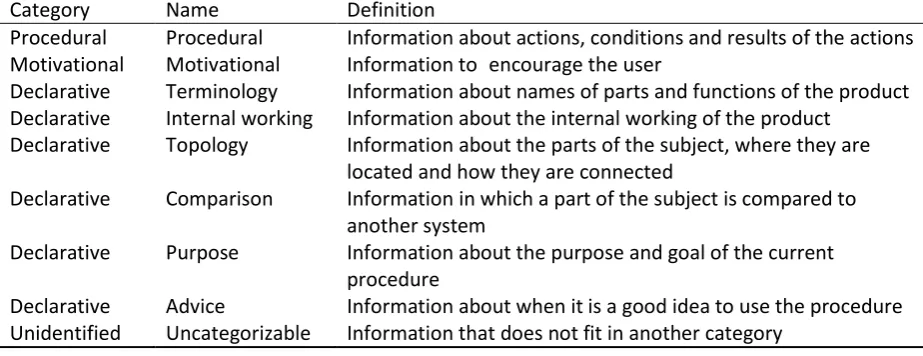
manufacturers have been selected, and of these manufacturers the latest, according to their website, product was used. The manuals were downloaded from the websites of the manufacturers and only official manuals are used. Pages which do not contain any relevant information are omitted from the sample. These are the pages which contain the table of contents, lists of trademarks and copyrights and indexes. From all the remaining pages of the manuals, ten pages were randomly selected with the random number generator from random.org. This resulted in a corpus of 230 pages from current manuals from different manufacturers. The manual with the least amount of pages had twenty pages, so it was possible to randomly choose ten pages from all manuals. For a more detailed look at the categorization refer to appendix 1 for detailed information about the manuals in the corpus. These selected pages were subsequently analyzed with the following categories: procedural information, motivational information, six types of declarative information derived from the literature review, and uncategorizable information (See also table 3 and appendix 2: Annotator Instruction).
Procedure
The sample of the manuals is divided into blocks to enable the annotators to categorize the available information. These blocks of information are defined by the layout of the manual, in the form of bullet points, blank lines and returns, unless there are more types of information available in the block; then each of those types of information is annotated. This procedure has been chosen to enable the annotators to count subsequent pieces of the same type of information, and it will enable them to acknowledge different types of information in the same block that is defined by layout.
The corpus was annotated by one rater. When all information in the selected pages was annotated, an inventory was made to see which types of information was available in real-life manuals, which information was uncategorizable, and which categories could be constructed to categorize the, so far, uncategorizable information. With the additional categories from this part added to the categorization from literature, the result was a categorization derived from both literature and practice.
18
Kappa statistic (Cohen, 1960) to confirm the consistency among raters. The second rater used one tenth of the pages of the corpus, twenty three pages in total. The second rater used every third page of the random selections of the manuals.
[image:20.595.66.528.277.455.2]The interrater reliability was found to be Kappa = 0.58, 95% CI (0.513, 0.643). When the data is analyzed it appears that many blocks are interpreted as being procedural and purpose by one rater and as entirely procedural by the other rater. When these cases are combined into the procedural category, the Kappa increases to 0.64, 95% CI (0.581, 0.705). This corrected Kappa indicates a substantial agreement (Landis & Koch, 1977). This leads to a final interrater reliability of 0.64 with a 95% confidence interval of (0.581, 0.705).
Table 3
Categories used to classify information in manuals
4.2.
Results
This paragraph consists of the findings of the corpus research, in particular the information types found in the corpus, the analysis of the uncategorizable information and the consistency of the categorization.
Information types in the corpus
Each type of information from the categorization was found in the corpus. However the information pieces are not evenly spread among the categories. Half of the information was classified as
procedural information (49.7%). Some of the types of information were hardly used in the
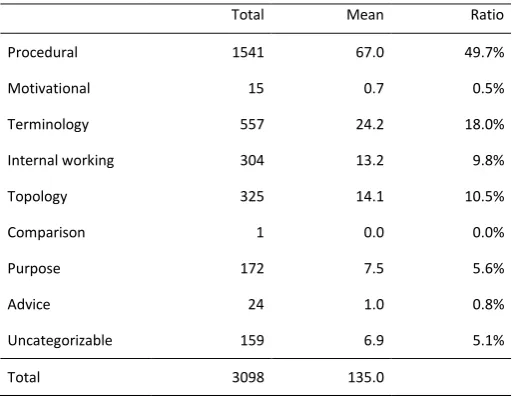
researched corpus. 0.5% of the pieces of information were categorized as motivational information, just one piece (0.0%) as comparison and 0.8% as advice. Table 4 summarizes of the number of blocks per type of information. A table with the complete results is available in appendix 3, which contains a summary of the number of blocks per type of information for each manual.
Uncategorizable information
In the analysis it was found that 5.1% of all pieces of information fell in the uncategorizable category. To make a more usable categorization this information was analyzed. Most of the uncategorizable information falls in the category ‘internal references’. This category consists of references to other parts of the manual and it contained 79.4% of all information classified as uncategorizable. Among Category Name Definition
Procedural Procedural Information about actions, conditions and results of the actions Motivational Motivational Information to encourage the user
Declarative Terminology Information about names of parts and functions of the product Declarative Internal working Information about the internal working of the product
Declarative Topology Information about the parts of the subject, where they are located and how they are connected
Declarative Comparison Information in which a part of the subject is compared to another system
Declarative Purpose Information about the purpose and goal of the current procedure
19 the discerned types of uncategorizable information are no types of declarative information. The table with the complete analysis of the uncategorizable information is available in appendix 4.
Table 4
Blocks of information per type of information
Total Mean Ratio
Procedural 1541 67.0 49.7%
Motivational 15 0.7 0.5%
Terminology 557 24.2 18.0%
Internal working 304 13.2 9.8%
Topology 325 14.1 10.5%
Comparison 1 0.0 0.0%
Purpose 172 7.5 5.6%
Advice 24 1.0 0.8%
Uncategorizable 159 6.9 5.1%
Total 3098 135.0
4.3.
Conclusion
All types of information that existed in the categorization where found in the analyzed manuals. The most used type of information is the procedural information. Of the declarative information only the terminology and topology categories accounted for more than 10% of the blocks in the manuals. The least found types of information in the manual were: the motivational category, only one manual used this information type to comfort the users; the comparison category, only one manual used this type of information and tried to explain a feature using an analogy; and finally the advice category. The most frequently encountered type of uncategorizable information was of the internal reference category. However, this category will not be considered in the remainder of this research because it is not a form of declarative information.
21
5.
Card sort study to determine a categorization
The previous two chapters paint a picture of a categorization as extracted from literature and a picture of usability of this categorization when faced with manuals from practice. This chapter aims to provide a picture of the categorization that users would create and whether users are able to work with the categorization as derived from literature and practice. To reach these two targets a two-part study has been carried out. The first part was an open sort method to let the users generate
categories on the basis of blocks of information and the second part was a closed sort method to let the users place the pieces of information in the categories derived from literature.
5.1.
Method
This third study is a two-part study: the first part is designed to generate a list of alternative
categorizations in addition to the categorization derived from literature; the second part is designed to test the usability of the categorization for declarative information created from literature and practice. For both of these questions a sorting method has been selected.
For the first question an open card sort was conducted. This method can be used to let participants generate categorizations on their own (Coxon, 1999). The open card sort offers the freedom to the participants to not only generate the categories, but also give a rationale for the created
categorization (Coxon, 1999, pp. 8-9). Unfortunately there are two disadvantages to the open card sort. These are (1) the broad range of the number of categories that the participants can generate, from one (the “lumper”, who lumps every piece of information in the same category) to the number of pieces of information (the “splitter”, who separates each piece of information in its own category) and (2) the possibility of the participants generating categorizations that are of no interest to the researcher. It is possible to counter the first problem by using fixed-sorting, a subtype of card sorting where the researcher poses a limit on the number of categories the participant can use. This fix has the disadvantage that the natural grouping of the participants is disrupted. The disadvantage of this fix was considered to outweigh the disadvantage of the open sort method; the disturbance of all participants might influence the results more than a few lumpers and splitters (Coxon, 1999, pp. 20-21), so the unrestricted open sort is used. The second problem can be countered by providing an explicit criterion for sorting the objects (Coxon, 1999, p. 8), but a more explicit criterion than ‘sort by text type’ was not deemed beneficial to the study at hand, as it would have limited the range of possible results.
For the second question a closed card sort was conducted. This method can be used to test the usability of an existing categorization. The closed card sort offers a good method of verification for the categories derived from literature. By forcing the participants to use the predefined
categorization the clarity of the categorization will become clear.
Participants
22
participants were from various fields of study except the field of technical communication. This group will be referred to as the laymen. Two of the laymen only did the open sort. Each of the other laymen completed the entire study.
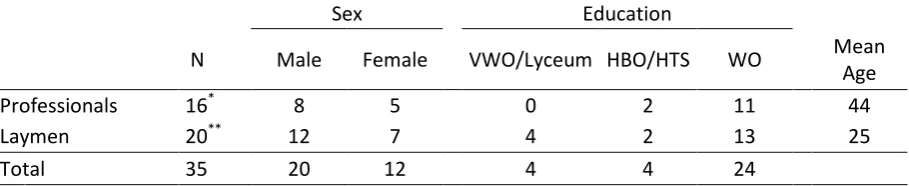
[image:24.595.71.526.243.336.2]The mean age of the professionals is 44, in contrast to the mean age of 25 for the laymen. Both groups consist of highly educated participants. For a more detailed summary of the participants refer to table 5. For a representative sample fifteen participants per group were needed (Nielsen, 2004) (Tullis & Wood, 2004).
Table 5
Summary of sort participants
Materials
Thirty pieces of information from the sample of the content analysis (see chapter 0) were used as cards for the card sort study. These pieces are blocks of information as defined by the content analysis. Six pieces of information were selected for each of the five researched categories of declarative information. The sixth type of declarative information, comparison information, is not used because only one instance of this type of information was found in the corpus. For each of the English blocks from the content analysis sample exactly the same was picked from the equivalent Dutch real-life manual. These were selected based on the clarity of the blocks and were selected only when the Dutch equivalent manual was available. These blocks were in Dutch to allow the
participants to more easily classify the information. The information in the blocks was stripped of product names; each instance was replaced by a neutral term. For example ‘iPhone’ was replaced with ‘device’ or ‘telephone’. Each of the blocks of information is available in appendix 5.
Procedure
During the experiment the participant was asked to group the blocks of information into different categories based on text type. The card sort was an online card sort through websort.net. The sets of information blocks were randomized for each sort task. This randomization was chosen to avoid possible biasing due to the order in which the items are presented (Coxon, 1999, p. 16). The
participant was greeted with an instruction about the card sort. The first sort was the open card sort to prevent the closed card sort from having an influence on the open card sort.
When the participant was content with his categorization the participant could save it and continue with the closed sort.
During this second sort the participants sorted the text blocks in five different predefined categories with the title provided; this to provide the participants with easily identifiable categories. When the
Sex Education
N Male Female VWO/Lyceum HBO/HTS WO
Mean Age
Professionals 16* 8 5 0 2 11 44
Laymen 20** 12 7 4 2 13 25
Total 35 20 12 4 4 24
* **
23 participant was content with the sorting of the blocks, the participant could continue to the third part which contained questions about demographical data and offered the opportunity to place remarks.
A pretest was conducted with three extra participants from the laymen to determine the usability of this procedure; this led to small alterations to the participant instructions. The exact instructions are available in appendix 6.
Analysis
The goal of the open sort is to find new viewpoints on the subject. This was accomplished by using websort.net’s analysis tools. These tools generated a list of created categorizations by the
participants and dendrograms of the sort data. The goal of the closed sort was to find whether the categorization is usable by both groups. The closed sort data was also analyzed using websort.net’s analysis tools. This provided tables with in each cell the percentage of participants who placed the item in that category. The remarks made by the participants are used to illustrate the sort of the participants.
5.2.
Results of the open sort
This paragraph contains the results of the open sort analysis. The categorizations are first roughly described, and then each of the sub-types of categorizations is described one by one.
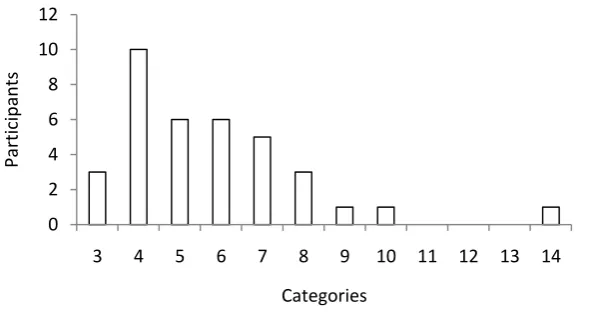
[image:25.595.84.381.435.596.2]The open sorts ranged from three to fourteen created categories. Ten of the participants created four categories. The complete distribution of participants by number of categories created is available in figure 1.
Figure 1. The number of participants per number of categories in their categorization.
In the open sort two professionals and four laymen did not create a categorization based on text types. These participants used the subject of the text blocks to make a categorization. This
categorization is not usable to answer whether there are other usable categorizations for research. It appears that selecting by text type is not the first type of categorization that some users create. Examples of categories used by these participants are ‘Clock’ and ‘Calling’.
One of the professionals used a different kind of categorization based on text types. He created a categorization based on the tone of the message of the block: “I have thought on several formats, but ultimately opted for these three categories: active instructive, passive instructive and (neutral)
0 2 4 6 8 10 12
3 4 5 6 7 8 9 10 11 12 13 14
Pa
rticip
an
ts
24
informative.” In the comments he has added: “The text blocks are often quite forcing and final (do this then that happens / this is what happens anyway), I labeled these as active instructive. Other texts are more passive (if you want this, you can do that), these are labeled as passive instructive. Informative texts are rarely a forcing tone, so I labeled as neutral. Then I added a final category created: info / passive. These pieces contain both (neutral) information and passive instructions to follow.” So this final category has been added to enable the participant to place some text blocks in two categories. An example from one of these text blocks is: “A simple passcode is a four-digit number. To increase security, turn off Simple Passcode and use a longer passcode with a combination of numbers, letters, punctuation, and special characters.” This is an interesting alternative categorization from textual perspective; this categorization offers an alternative to the categorizations based on text type. From the perspective of this study this categorization is not a type of categorization that was sought; this is not a categorization based on declarative information.
Alternative categorizations created by participants
All other participants created a categorization with the definition of text type as used in this research. These participants created many different categorizations. Some of the categorizations were similar to the categorization from literature and practice, while others were completely
different. The highlights of the different categorizations created by the participants are the following; in these descriptions the wording of the participants is kept:
The following categorization created by a layman uses fewer categories than the constructed
categorization from literature. In this categorization the ‘pointers’ appear to be a combination of the purpose and advice categories. The other categories appear not to be as easily mapped onto the categorization from literature.
Pointers: These describe how the device and certain functions should be used.
Possible functions: These describe the options of usage. These parts will not describe how the functions should be used; only possibilities are described.
Objective information: These give factual information about the device.
Limitations: These describe what is not possible with the device.
The following categorization created by a professional, a technical writer, is interesting because it provides a point of view from the user of the manual. It appears that the ‘instructions for use’ category is, when the contents are considered, very similar to the advice category from the literature review. The items from the advice category are often placed into a category with a similar name to instructions. This means that the blocks designated as advice appear to the participants as
instructions which would place them in the procedural information category in the universal categorization.
The category ‘Extra information’ is not necessary for the normal use of the device, but it is important enough to add to the instructions for the user.
The category ‘Instructions for use’ consists of descriptions of the tasks that the user can execute. The use of the imperative mood is an indication for this category.
25
The category ‘Functions of the device’ gives information about the functions of the device, not about what the user can do with them. The verb ‘can’ is an indication for this category.
The category ‘Solving problems’ tells the user about how potential problems can be solved.
The following categorization created by a layman appears to be created from a technical point of view. The categories are described as functions from a computer program.
Definition: a = b
Conditional explanation: if a then thingsHappen()
Conditional explanation of action: if youWant(a) then doThis()
Explanation of an action: doThis()
(Explanation of a) feature
Statement: not-feature-related statement of fact
Explanation
Dendrogram analysis of the open sort
From the open sort data two dendrograms were created; the first is of the professionals, with those who used a non text type based categorization omitted. The second dendrogram uses the data of the laymen. When the items were placed together in the categorization by more than 50% of the
participants, these items are considered to be in the same group. In the dendrograms this is made visible with a visual clue to indicate each group.
Dendrogram analysis, professionals
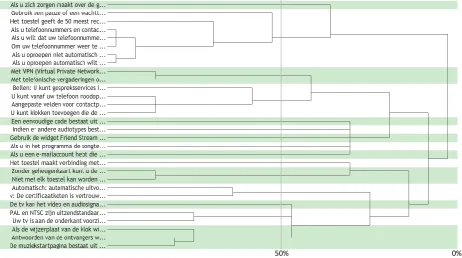
In the dendrogram of the professionals the best matching text blocks are placed into the same group by 77% of the participants. This is the first combination of the text blocks in Figure 2. The second combination is at 69% of the cases, the third at 62% and the fourth at 54%. This leads to a total of twenty groups with four of them with more than one item. In Figure 2 these groups are indicated by the green and white bars. All blocks from each of the groups are available in English in appendix 7.
Figure 2. Dendrogram of the professionals who created a categorization based on text type (N=12).
26
These groups are discussed one by one from top to bottom in the following paragraphs.
In this first group each of the text blocks have the same sentence structure. When this is considered, it appears that the first text block actually consists of two information types. The first part of the sentence contains conditions and the second part contains instructions. Each of these text blocks consist of, as one of the participants put it, a conditional explanation for an action: if you want this, you will have to do that. The other users usually call this group the instructions. Most of the items from this group are placed into the advice category by the researcher, but not all. This group will therefore be referred to as conditional instructions.
In the second group both information blocks describe a possible state of a feature not working. This group is called limitations, disclaimer or conditions when discerned as a separate group. These two blocks are also placed into the background information and system specification groups. This group will be referred to as limitations.
The text blocks in the third group describe the behavior of the device under certain conditions. This group is never separately discerned by the participants. Every time these two text blocks were added into the same group, it had a name like background descriptions, limitations or system specifications. This group will be referred to as conditional working.
In the fourth group each of the blocks shows the purpose of the device or function. The first block: “VPN (virtual private network) provides secure access over the Internet to private networks, such as the network at your company or school.” is grouped into the terminology category by the researcher; whereas most participants placed it in a purpose-like group. This can be explained because it is possible that the participants interpreted the text block as the description of the use or purpose of VPN rather than the definition of the term VPN. The groups containing these information blocks are defined by the participants as functions and possibilities. This group will be referred to as
possibilities.
Summarized it appears that the following groups can be discerned in the open card sort of the professionals: conditional instructions, limitations, conditional working and possibilities. This categorization shows similarities to the proposed universal categorization. The conditional instructions appear to be similar to the advice category partially due to the items placed in this category and partially because the description of conditional instructions mentions the structure that fits in the advice category: when you want this; do that. The conditional working group appears to be similar to the internal working category; both items in this group were placed into the internal working category by the researcher. This sub-set however contains both the working and a condition when this behavior can be observed. The possibilities group contains mostly items placed into the purpose category by the researcher. This is not peculiar since possibilities indicate types of
functionality. The limitations group does not fit with the proposed categorization; it appears that the participants acknowledge, in contrast to the researcher, the difference between things that can be done or possibilities and things that cannot be done or limitations. In the proposed categorization both these types of items are be placed in the internal working category.
Dendrogram analysis, laymen
27 two is at 94%, the third at 75%, the fourth at 63% and the fifth at 56%. This leads to a total of fifteen groups with seven of them with more than one item. All blocks from each of the groups are available in English in appendix 8.
Figure 3. Dendrogram of the laymen who created a categorization based on text type (N=15).
These groups are discussed one by one from top to bottom in the following paragraphs.
This first group of the laymen is similar to the first group of the professionals. The only difference is that the block “Use a pause or a wait to separate additional numbers, for example a password or extension, from a main phone number. After dialing the main phone number, your BlackBerry® device either pauses before dialing the additional numbers.” is included. This block does not fit as well in the sentence structure as detailed by the professionals. It does however give a condition and an action, only in this block the condition is preceded by the action. This group is described in the following ways: instructions, informative, product information, advice, conditional instructions, explanations and options. It appears that the laymen use a broader spectrum of titles than the professionals. This group will be called the same as the similar group from the professionals. This means this group will be referred to as conditional instructions.
The second group consists entirely of blocks from the fourth group of the professionals; not all blocks are included. The group of the professionals consisted of the possibilities of the device. The laymen named the groups that included these two pieces of information: features, functions, and non-product specific information. This group will be referred to as features.
This third group is partially the same as the fourth group of the professionals; two of the blocks are the same with two different additions. One of these additions if from the third group of the
professionals, this was the block “You can make emergency calls from your phone even if you don’t have a SIM card installed or your SIM card has been blocked.” This could be interpreted as a
possibility so this is not a peculiar choice. The other addition is different for both groups. The laymen
28
placed these blocks into categories with the names options or possibilities. This group will be referred to as possibilities.
The fourth group consists of blocks that describe a limitation of the device. An example of a block of this group is: “Without a memory card you can't use the camera, nor can you play or download music files and video clips.” This group is created both by laymen and professionals. This is exactly the same group as the second group of the professionals. Professionals and laymen even used the same names for this group: limitations or disclaimer. This group will therefore be referred to as limitations.
The fifth group contained for example: “v: The certificate chain is trusted and valid, and the revocation status of the certificate chain is good.” The name of the group used for these cases is explanation of a term. This is in line with the terminology category in which these terms were placed by the researcher. This group will therefore be referred to as terminology.
The information blocks from the sixth group are always part of a larger group with a title that translates to variations of specifications. An example of a block from this group is “Your TV is equipped with a Kensington security slot on the bottom of the TV.” This group will therefore be referred to as specifications.
The seventh group contains for example the following two blocks: “If the clock face is white, it’s daytime in that city. If the clock face is black, it’s nighttime.” and “Replies from any of the recipients are sent only to you, not to the other people you texted.” These blocks are designated as internal working and topology. This group does not fit on a category from the proposed universal
categorization. When a participant placed all the information blocks of the seventh group together, the group name was product description, explanations, internal working, factual information or exploratory information. These blocks are never defined as a separate group; they are always part of a larger group. This group will be referred to as explanations.
Summarized it appears that the following groups can be discerned in the open card sort of the laymen: conditional instructions, features, possibilities, limitations, terminology, specifications and explanations. This categorization contains three of the same groups as the categorization of the open card sort by the professionals: conditional instructions, possibilities and limitations. The same conclusions can be drawn for conditional instructions and limitations as were drawn with the professionals. Most of the laymen however split the possibilities group of the professionals in two: features and possibilities. These two groups are very similar in types of information and would both fit in the purpose category of the proposed universal categorization. The terminology group of the laymen is the same as the terminology group of the universal categorization. The last two groups of the laymen do not fit the universal proposed categorization. The items from these groups are always part of a larger group and there was no majority of participants for these larger groups. So it appears that it was hard for the participants to create a meaningful categorization; no two categorizations were equal. The open sort resulted in a categorization that is partially in line with the proposed categorization, but there are some notable differences.
5.3.
Results of the closed sort
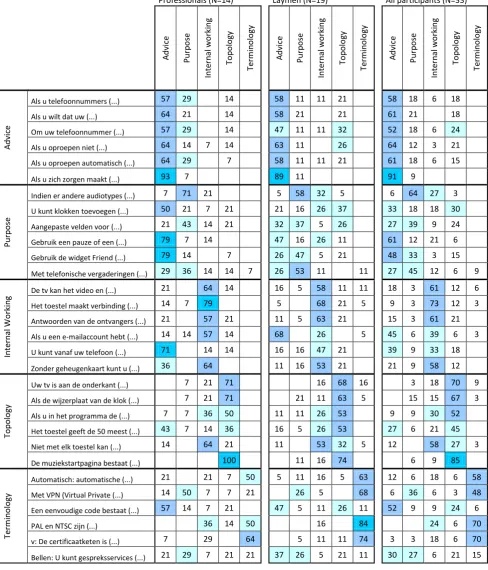
29
Advice
The items grouped into the advice category appear to be the clearest. The only item that was grouped in the advice category by the researcher but not by a clear majority of the laymen is “To display your phone number when you make calls, change the Restrict My Identity field to Never.” 32% of the laymen placed this item in the topology category. This can be explained by the word ‘display’; since the topology category deals with the interface of a device, a block with the word display in it can easily be associated with this category.
Purpose
Purpose proved to be the most unclear category; the only item that a majority of participants of both groups placed in this category is “When different audio types exist in an input signal, this function allows you to select the audio type you want.” These following three items were placed in the advice category by the professionals while the laymen did not have a clear preference: “You can add clocks to show the time in other major cities and time zones around the world.”, “Use a pause or a wait to separate additional numbers, for example a password or extension, from a main phone number. After dialing the main phone number, your BlackBerry® device either pauses before dialing the additional numbers.” and “Use the Friend Stream widget so you can easily update your status and view other people’s status updates right on the Home screen.” These items illustrate that the fuzzy distinction between purpose and advice poses a problem to the participants. More about these reported problems can be found on the next page in the comments by the participants. “Custom contact fields can store information that you want to remember about a contact, for example, you might want to add a custom contact field named Sports team or Favorite color.” was an item that was hard to place for all participants. Of the professionals, 43% placed this in the purpose category, but the remaining participants were divided. The final item from the purpose category: “With a conference or multiparty call, you can have a joint conversation with two or more persons.” was placed into the purpose category by 53% of the laymen, whereas the professionals did not have a clear preference.
Internal working
Items grouped into the internal working category appear to be clear. The professionals placed five of the six items designated as internal working into this category and the laymen placed four of the six in the internal working category. The two blocks that do not fit as clearly are the “If your email account uses a BlackBerry® Enterprise Server, your administrator might be able to track the location of your BlackBerry device. For more information, contact your administrator.” and “You can make emergency calls from your phone even if you don’t have a SIM card installed or your SIM card has been blocked.” The first block is placed in the internal working category by most professionals, whereas the laymen place this block mostly in the advice category. The ‘For more information, contact your administrator’-part of this block could be the cause of this discrepancy. Neither group clearly places the second block in the internal working category. Of the professionals, 71% placed it in the advice category, while 47% of the laymen placed it in the internal working category. While the professionals, in contrast to the researcher, seemed to have a clear preference to place this block in the advice category, the laymen appear to be divided.
Topology
30
stored audio content, and the lower part shows online audio content. When online content is not available, the lower part shows local content.” in the topology category. This makes this item the only item which was placed in one category by all professionals. The next two items are not clear: “The song’s lyrics also appear, if you’ve added them to the song in iTunes.” and “iPhone displays the 50 most recent messages in the conversation. To see earlier messages, scroll to the top and tap Load Earlier Messages.”; both are spread out over the categories by the professionals. Of the laymen however, 53% placed these in the topology category. The placement of these items by the
professionals can be explained by the second part of each of those items; the first of the two is also placed in the internal working category and the second is also placed in the advice category. The last item that was designated as topology is “Depending on your BlackBerry® device model, the camera or video camera might not be supported or some camera or video camera features might not be available.” This item was mostly placed in the internal working category by both groups of
participants. This item provides information about a feature that is not available. That makes it hard to place in the current categorization.
Terminology
When analyzing the items that were grouped into the terminology category by the researcher, a peculiar finding is that the laymen are more in line with the researcher than the professionals. The majority placed four of the selected terminology blocks in the terminology category. The
professionals place only one of the blocks in the terminology category. This block that appears to be clearly terminology is the block: “v: The certificate chain is trusted and valid, and the revocation status of the certificate chain is good.” The two blocks that both the majority of laymen and majority of professionals did not place in the terminology category are: “A simple passcode is a four-digit number. To increase security, turn off Simple Passcode and use a longer passcode with a
combination of numbers, letters, punctuation, and special characters.” and “Call: Set up call services such as voicemail, call forwarding, call waiting, and caller ID.” Both groups of participants want to place the item about the simple passcode in the advice category. This can be explained; the second part ‘to increase security’ can be interpreted as an advice to use the longer passcode. The ‘Call’ item is not as clear; most of the participants placed it in the advice or purpose category.
Comments made by the participants
Over one third of the participants reported they did not have a problem with the categorization. The remarks of the other participants about the closed sort can be summarized by a remark from one of the participants who stated the categories have fuzzy boundaries.
Five participants reported that the distinction between internal working and topology was not clear. This is not apparent from the analysis of the items, as the internal working and topology categories have just one switched item per participant group. Four participants reported difficulty with the distinction between the advice category and other categories. Three of them reported the
combination of the advice category with one other category: one internal working, one purpose and one topology, and one participant reported combination of advice, purpose and topology.
31 topology were placed in the topology category. During the closed sort the purpose category proved to be more difficult; this was the second most reported difficult category. Few participants reported the advice category as most difficult category. It was the least chosen as most difficult category: only one professional chose this category and no layman. For more details see figure 4.
Table 6
Closed sort, percentage items per category for each group of participants
Professionals (N=14) Laymen (N=19) All participants (N=33)
A d vice Pur p o se In te rn al w o rk in g To p o lo gy Te rmi n o lo gy A d vice Pur p o se In te rn al w o rk in g To p o lo gy Te rmi n o lo gy A d vice Pur p o se In te rn al w o rk in g To p o lo gy Te rmi n o lo gy A d vice
Als u telefoonnummers (...) 57 29 . 14 . 58 11 11 21 . 58 18 6 18 .
Als u wilt dat uw (...) 64 21 . 14 . 58 21 . 21 . 61 21 . 18 .
Om uw telefoonnummer (...) 57 29 . 14 . 47 11 11 32 . 52 18 6 24 .
Als u oproepen niet (...) 64 14 7 14 . 63 11 . 26 . 64 12 3 21 .
Als u oproepen automatisch (...) 64 29 . 7 . 58 11 11 21 . 61 18 6 15 .
Als u zich zorgen maakt (...) 93 7 . . . 89 11 . . . 91 9 . . .
Pur
p
o
se
Indien er andere audiotypes (...) 7 71 21 . . 5 58 32 5 . 6 64 27 3 .
U kunt klokken toevoegen (...) 50 21 7 21 . 21 16 26 37 . 33 18 18 30 .
Aangepaste velden voor (...) 21 43 14 21 . 32 37 5 26 . 27 39 9 24 .
Gebruik een pauze of een (...) 79 7 14 . . 47 16 26 11 . 61 12 21 6 .
Gebruik de widget Friend (...) 79 14 . 7 . 26 47 5 21 . 48 33 3 15 .
Met telefonische vergaderingen (...) 29 36 14 14 7 26 53 11 . 11 27 45 12 6 9
In te rn al W o rk in
g De tv kan het video en (...) 21 . 64 14 . 16 5 58 11 11 18 3 61 12 6
Het toestel maakt verbinding (...) 14 7 79 . . 5 . 68 21 5 9 3 73 12 3
Antwoorden van de ontvangers (...) 21 . 57 21 . 11 5 63 21 . 15 3 61 21 .
Als u een e-mailaccount hebt (...) 14 14 57 14 . 68 . 26 . 5 45 6 39 6 3
U kunt vanaf uw telefoon (...) 71 . 14 14 . 16 16 47 21 . 39 9 33 18 .
Zonder geheugenkaart kunt u (...) 36 . 64 . . 11 16 53 21 . 21 9 58 12 .
To
p
o
lo
gy
Uw tv is aan de onderkant (...) . 7 21 71 . . . 16 68 16 . 3 18 70 9
Als de wijzerplaat van de klok (...) . 7 21 71 . . 21 11 63 5 . 15 15 67 3
Als u in het programma de (...) 7 7 36 50 . 11 11 26 53 . 9 9 30 52 .
Het toestel geeft de 50 meest (...) 43 7 14 36 . 16 5 26 53 . 27 6 21 45 .
Niet met elk toestel kan (...) 14 . 64 21 . 11 . 53 32 5 12 . 58 27 3
De muziekstartpagina bestaat (...) . . . 100 . . 11 16 74 . . 6 9 85 .
Te rmi n o lo gy
Automatisch: automatische (...) 21 . 21 7 50 5 11 16 5 63 12 6 18 6 58
Met VPN (Virtual Private (...) 14 50 7 7 21 . 26 5 . 68 6 36 6 3 48
Een eenvoudige code bestaat (...) 57 14 7 21 . 47 5 11 26 11 52 9 9 24 6
PAL en NTSC zijn (...) . . 36 14 50 . . 16 . 84 . . 24 6 70
v: De certificaatketen is (...) 7 . 29 . 64 . 5 11 11 74 3 3 18 6 70
32
Figure 4. Reported difficult categories per participant group
5.4.
Conclusion
The open sort yielded no general categorization. The open sort resulted in a few alternative
categories. These categories could be researched to determine whether these categorizations have a higher usability then the proposed universal categorization.
From the closed sort it can be concluded that the categorization is a step in the right direction, though there are unfortunately still a number of items that do not fit exactly in one of the categories. This could be due to the chosen blocks; when these contain multiple types of information, they are difficult to categorize. This is especially apparent in blocks designated as terminology, which were spread out over the different categories by professional participants. This is probably due to the text blocks chosen for the terminology category. Some of these contained traces of different information types which made categorizing these blocks difficult. Another problem with the proposed universal categorization is that, although the laymen are inconsistent in their placement of items designated as purpose, the professionals placed half of these items in the advice category. Due to this apparent overlap between the purpose and advice categories, the proposed evolution of the universal categorization is: use (a combination o