SPIED: Stanford Pattern-based Information Extraction and Diagnostics
Sonal Gupta Christopher D. Manning
Department of Computer Science Stanford University
{sonal, manning}@cs.stanford.edu
Abstract
This paper aims to provide an effective interface for progressive refinement of pattern-based information extraction sys-tems. Pattern-based information extrac-tion (IE) systems have an advantage over machine learning based systems that pat-terns are easy to customize to cope with errors and are interpretable by humans. Building a pattern-based system is usually an iterative process of trying different pa-rameters and thresholds to learn patterns and entities with high precision and recall. Since patterns are interpretable to humans, it is possible to identify sources of errors, such as patterns responsible for extract-ing incorrect entities and vice-versa, and correct them. However, it involves time consuming manual inspection of the ex-tracted output. We present a light-weight tool, SPIED, to aid IE system develop-ers in learning entities using patterns with bootstrapping, and visualizing the learned entities and patterns with explanations. SPIED is the first publicly available tool to visualize diagnostic information of multi-ple pattern learning systems to the best of our knowledge.
1 Introduction
Entity extraction using rules dominates commer-cial industry, mainly because rules are effective, interpretable by humans, and easy to customize to cope with errors (Chiticariu et al., 2013). Rules, which can be hand crafted or learned by a sys-tem, are commonly created by looking at the con-text around already known entities, such as surface word patterns (Hearst, 1992) and dependency pat-terns (Yangarber et al., 2000). Building a pattern-based learning system is usually a repetitive pro-cess, usually performed by the system developer,
of manually examining a system’s output to iden-tify improvements or errors introduced by chang-ing the entity or pattern extractor. Interpretabil-ity of patterns makes it easier for humans to iden-tify sources of errors by inspecting patterns that extracted incorrect instances or instances that re-sulted in learning of bad patterns. Parameters range from window size of the context in surface word patterns to thresholds for learning a candi-date entity. At present, there is a lack of tools helping a system developer to understand results and to improve results iteratively.
Visualizing diagnostic information of a system and contrasting it with another system can make the iterative process easier and more efficient. For example, consider a user trying to decide on the context’s window size in surface words patterns. And the user deliberates that part-of-speech (POS) restriction of context words might be required for a reduced window size to avoid extracting erro-neous mentions.1 By comparing and contrasting
extractions of two systems with different parame-ters, the user can investigate the cases in which the POS restriction is required with smaller window size, and whether the restriction causes the system to miss some correct entities. In contrast, compar-ing just accuracy of two systems does not allow inspecting finer details of extractions that increase or decrease accuracy and to make changes accord-ingly.
In this paper, we present a pattern-based entity learning and diagnostics tool, SPIED. It consists of two components: 1. pattern-based entity learn-ing uslearn-ing bootstrapplearn-ing (SPIED-Learn), and 2. vi-sualizing the output of one or two entity learning systems (SPIED-Viz). SPIED-Viz is independent of SPIED-Learn and can be used with any pattern-based entity learner. For demonstration, we use the output of Learn as an input to
SPIED-1A shorter context size usually extracts entities with
higher recall but lower precision.
Viz. SPIED-Viz has pattern-centric and entity-centric views, which visualize learned patterns and entities, respectively, and the explanations for learning them. SPIED-Viz can also contrast two systems by comparing the ranks of learned enti-ties and patterns. In this paper, as a concrete ex-ample, we learn and visualize drug-treatment (DT) entities from unlabeled patient-generated medical text, starting with seed dictionaries of entities for multiple classes. The task was proposed and fur-ther developed in Gupta and Manning (2014b) and Gupta and Manning (2014a).
Our contributions in this paper are: 1. we present a novel diagnostic tool for visual-ization of output of multiple pattern-based entity learning systems, and 2. we release the code of an end-to-end pattern learning sys-tem, which learns entities using patterns in a bootstrapped system and visualizes its diag-nostic output. The pattern learning code is available at http://nlp.stanford.edu/ software/patternslearning.shtml. The visualization code is available at http://nlp.stanford.edu/software/ patternviz.shtml.
2 Learning Patterns and Entities
Bootstrapped systems have been commonly used to learn entities (Riloff, 1996; Collins and Singer, 1999). SPIED-Learn is based on the system de-scribed in Gupta and Manning (2014a), which builds upon the previous bootstrapped pattern-learning work and proposed an improved mea-sure to score patterns (Step 3 below). It learns entities for given classes from unlabeled text by bootstrapping from seed dictionaries. Patterns are learned using labeled entities, and entities are learned based on the extractions of learned pat-terns. The process is iteratively performed until no more patterns or entities can be learned. The following steps give a short summary of the itera-tive learning of entities belonging to a class DT:
1. Data labeling: The text is labeled using the class dictionaries, starting with the seed dic-tionaries in the first iteration. A phrase matching a dictionary phrase is labeled with the dictionary’s class.
2. Pattern generation: Patterns are generated us-ing the context around the positively labeled entities to create candidate patterns for DT.
3. Pattern learning: Candidate patterns are scored using a pattern scoring measure and the top ones are added to the list of learned patterns for DT. The maximum number of patterns learned is given as an input to the system by the developer.
4. Entity learning: Learned patterns for the class are applied to the text to extract candidate en-tities. An entity scorer ranks the candidate entities and adds the top entities to DT’s dic-tionary. The maximum number of entities learned is given as an input to the system by the developer.
5. Repeat steps 1-4 for a given number of itera-tions.
SPIED provides an option to use any of the pat-tern scoring measures described in (Riloff, 1996; Thelen and Riloff, 2002; Yangarber et al., 2002; Lin et al., 2003; Gupta and Manning, 2014b). A pattern is scored based on the positive, negative, and unlabeled entities it extracts. The positive and negative labels of entities are heuristically deter-mined by the system using the dictionaries and the iterative entity learning process. The oracle labels of learned entities are not available to the learning system. Note that an entity that the system consid-ered positive might actually be incorrect, since the seed dictionaries can be noisy and the system can learn incorrect entities in the previous iterations, and vice-versa. SPIED’s entity scorer is the same as in Gupta and Manning (2014a).
Each candidate entity is scored using weights of the patterns that extract it and other entity scoring measures, such as TF-IDF. Thus, learning of each entity can be explained by the learned patterns that extract it, and learning of each pattern can be ex-plained by all the entities it extracts.
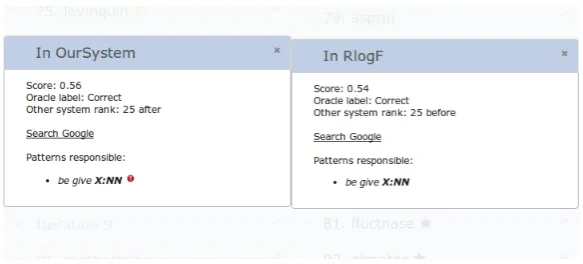
Figure 3: When the user click on the compare icon for an entity, the explanations of the entity extraction for both systems (if available) are displayed. This allows direct comparison of why the two systems learned the entity.
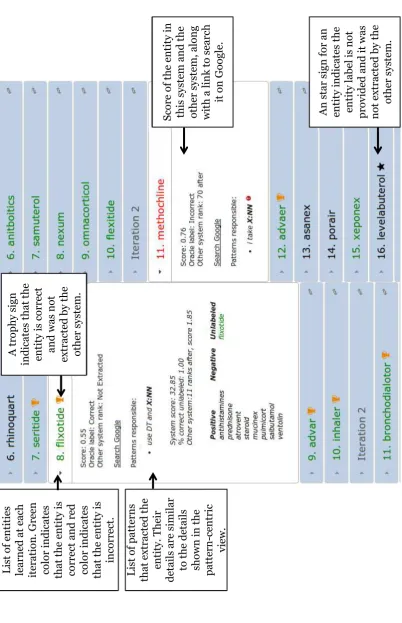
to two systems, and 2. an entity centric view that mainly focuses on the entities learned. Figure 1 shows a screenshot of the entity-centric view of SPIED-Viz. It displays following information:
Summary: A summary information of each sys-tem at each iteration and overall. It shows for each system the number of iterations, the number of patterns learned, and the number of correct and incorrect entities learned. Learned Entities with provenance: It shows
ranked list of entities learned by each system, along with an explanation of why the entity was learned. The details shown include the entity’s oracle label, its rank in the other sys-tem, and the learned patterns that extracted the entity. Such information can help the user to identify and inspect the patterns responsi-ble for learning an incorrect entity. The inter-face also provides a link to search the entity along with any user provided keywords (such as domain of the problem) on Google. System Comparison: SPIED-Viz can be used to
compare entities learned by two systems. It marks entities that are learned by one system but not by the other system, by either display-ing a trophy sign (if the entity is correct), a thumbs down sign (if the entity is incorrect), or a star sign (if the oracle label is not pro-vided).
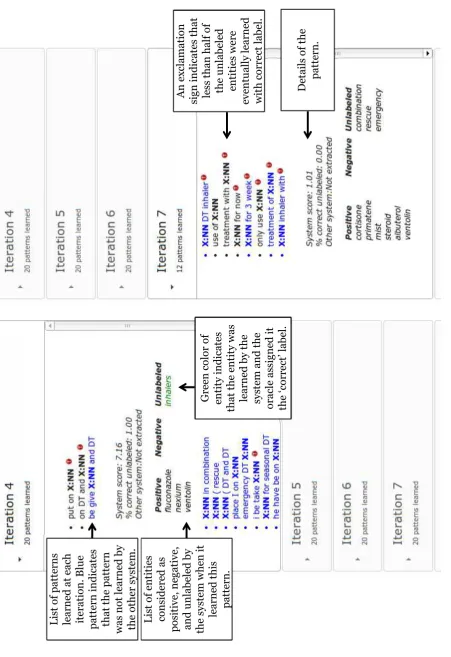
The second view of SPIED-Viz is centric. Figure 2 shows a screenshot of the pattern-centric view. It displays the following informa-tion.
Summary: A summary information of each sys-tem including the number of iterations and
number of patterns learned at each iteration and overall.
Learned Patterns with provenance: It shows ranked list of patterns along with the entities it extracts and their labels. Note that each pat-tern is associated with a set of positive, neg-ative and unlabeled entities, which were used to determine its score.2 It also shows the
per-centage of unlabeled entities extracted by a pattern that were eventually learned by the system and assessed as correct by the oracle. A smaller percentage means that the pattern extracted many entities that were either never learned or learned but were labeled as incor-rect by the oracle.
Figure 3 shows an option in the entity-centric view when hovering over an entity opens a win-dow on the side that shows the diagnostic informa-tion of the entity learned by the other system. This direct comparison is to directly contrast learning of an entity by both systems. For example, it can help the user to inspect why an entity was learned at an earlier rank than the other system.
An advantage of making the learning entities component and the visualization component inde-pendent is that a developer can use any pattern scorer or entity scorer in the system without de-pending on the visualization component to provide that functionality.
2Note that positive, negative, and unlabeled labels are
4 System Details
SPIED-Learn uses TokensRegex (Chang and Manning, 2014) to create and apply surface word patterns to text. SPIED-Viz takes details of learned entities and patterns as input in a JSON format. It uses Javascript, angular, and jquery to visualize the information in a web browser.
5 Related Work
Most interactive IE systems focus on annotation of text, labeling of entities, and manual writing of rules. Some annotation and labeling tools are: MITRE’s Callisto3, Knowtator4, SAPIENT
(Li-akata et al., 2009), brat5, Melita (Ciravegna et al.,
2002), and XConc Suite (Kim et al., 2008). Akbik et al. (2013) interactively helps non-expert users to manually write patterns over dependency trees. GATE6 provides the JAPE language that
recog-nizes regular expressions over annotations. Other systems focus on reducing manual effort for de-veloping extractors (Brauer et al., 2011; Li et al., 2011). In contrast, our tool focuses on visualizing and comparing diagnostic information associated with pattern learning systems.
WizIE (Li et al., 2012) is an integrated environ-ment for annotating text and writing pattern ex-tractors for information extraction. It also gener-ates regular expressions around labeled mentions and suggests patterns to users. It is most similar to our tool as it displays an explanation of the re-sults extracted by a pattern. However, it is focused towards hand writing and selection of rules. In ad-dition, it cannot be used to directly compare two pattern learning systems.
What’s Wrong With My NLP?7 is a tool for
jointly visualizing various natural language pro-cessing formats such as trees, graphs, and entities. It can be used alongside our system to visualize the patterns since we mainly focus on diagnostic information.
6 Future Work and Conclusion
We plan to add a feature for a user to provide the oracle label of a learned entity using the in-terface. Currently, the oracle labels are assigned offline. We also plan to extend SPIED to visualize
3http://callisto.mitre.org
4http://knowtator.sourceforge.net 5http://brat.nlplab.org
6http://gate.ac.uk
7https://code.google.com/p/whatswrong
diagnostic information of learned relations from a pattern-based relation learning system. Another avenue of future work is to evaluate SPIED-Viz by studying its users and their interactions with the system. In addition, we plan to improve the visualization by summarizing the diagnostic infor-mation, such as which parameters led to what mis-takes, to make it easier to understand for systems that extract large number of patterns and entities.
In conclusion, we present a novel diagnostic tool for pattern-based entity learning that visual-izes and compares output of one to two systems. It is light-weight web browser based visualization. The visualization can be used with any pattern-based entity learner. We make the code of an end-to-end system freely available for research pur-pose. The system learns entities and patterns using bootstrapping starting with seed dictionaries, and visualizes the diagnostic output. We hope SPIED will help other researchers and users to diagnose errors and tune parameters in their pattern-based entity learning system in an easy and efficient way.
References
Alan Akbik, Oresti Konomi, and Michail Melnikov. 2013. Propminer: A workflow for interactive infor-mation extraction and exploration using dependency trees. InACL (Conference System Demonstrations), pages 157–162.
Falk Brauer, Robert Rieger, Adrian Mocan, and Woj-ciech M. Barczynski. 2011. Enabling information extraction by inference of regular expressions from sample entities. InCIKM, pages 1285–1294. Angel X. Chang and Christopher D. Manning. 2014.
TokensRegex: Defining cascaded regular expres-sions over tokens. InStanford University Technical Report.
Laura Chiticariu, Yunyao Li, and Frederick R. Reiss. 2013. Rule-based information extraction is dead! long live rule-based information extraction systems! In Proceedings of the Conference on Empirical Methods in Natural Language Processing, EMNLP ’13, pages 827–832.
Fabio Ciravegna, Alexiei Dingli, Daniela Petrelli, and Yorick Wilks. 2002. User-system cooperation in document annotation based on information ex-traction. In In Proceedings of the 13th Interna-tional Conference on Knowledge Engineering and Knowledge Management, EKAW02, pages 122–137. Springer Verlag.
Empir-ical Methods in Natural Language Processing and Very Large Corpora, pages 100–110.
Sonal Gupta and Christopher D. Manning. 2014a. Im-proved pattern learning for bootstrapped entity ex-traction. In Proceedings of the Eighteenth Confer-ence on Computational Natural Language Learning (CoNLL).
Sonal Gupta and Christopher D. Manning. 2014b. In-duced lexico-syntactic patterns improve information extraction from online medical forums. Under Sub-mission.
Marti A Hearst. 1992. Automatic acquisition of hy-ponyms from large text corpora. InProceedings of the 14th International Conference on Computational linguistics, COLING ’92, pages 539–545.
Jin-Dong Kim, Tomoko Ohta, and Jun ichi Tsujii. 2008. Corpus annotation for mining biomedical events from literature. BMC Bioinformatics. Yunyao Li, Vivian Chu, Sebastian Blohm, Huaiyu
Zhu, and Howard Ho. 2011. Facilitating pat-tern discovery for relation extraction with semantic-signature-based clustering. In Proceedings of the 20th ACM International Conference on Informa-tion and Knowledge Management, CIKM ’11, pages 1415–1424.
Yunyao Li, Laura Chiticariu, Huahai Yang, Freder-ick R. Reiss, and Arnaldo Carreno-fuentes. 2012. Wizie: A best practices guided development envi-ronment for information extraction. InProceedings of the ACL 2012 System Demonstrations, ACL ’12, pages 109–114.
Maria Liakata, Claire Q, and Larisa N. Soldatova. 2009. Semantic annotation of papers: Interface & enrichment tool (sapient). In Proceedings of the BioNLP 2009 Workshop, pages 193–200.
Winston Lin, Roman Yangarber, and Ralph Grishman. 2003. Bootstrapped learning of semantic classes from positive and negative examples. In Proceed-ings of the ICML 2003 Workshop on The Continuum from Labeled to Unlabeled Data in Machine Learn-ing and Data MinLearn-ing.
Ellen Riloff. 1996. Automatically generating extrac-tion patterns from untagged text. In Proceedings of the 13th National Conference on Artificial Intelli-gence, AAAI’96, pages 1044–1049.
Michael Thelen and Ellen Riloff. 2002. A bootstrap-ping method for learning semantic lexicons using extraction pattern contexts. In Proceedings of the Conference on Empirical Methods in Natural Lan-guage Processing, EMNLP ’02, pages 214–221. Roman Yangarber, Ralph Grishman, and Pasi
Tapanainen. 2000. Automatic acquisition of domain knowledge for information extraction. In
Proceedings of the 18th International Conference on Computational Linguistics, COLING ’00, pages 940–946.