Improved Pattern Learning for Bootstrapped Entity Extraction
Sonal Gupta Christopher D. Manning
Department of Computer Science Stanford University
{sonal, manning}@cs.stanford.edu
Abstract
Bootstrapped pattern learning for entity extraction usually starts with seed entities and iteratively learns patterns and entities from unlabeled text. Patterns are scored by their ability to extract more positive en-tities and less negative enen-tities. A prob-lem is that due to the lack of labeled data, unlabeled entities are either assumed to be negative or are ignored by the existing pat-tern scoring measures. In this paper, we improve pattern scoring by predicting the labels of unlabeled entities. We use var-ious unsupervised features based on con-trasting domain-specific and general text, and exploiting distributional similarity and edit distances to learned entities. Our system outperforms existing pattern scor-ing algorithms for extractscor-ing drug-and-treatment entities from four medical fo-rums.
1 Introduction
This paper considers the problem of building ef-fective entity extractors for custom entity types from specialized domain corpora. We approach the problem by learning rules bootstrapped us-ing seed sets of entities. Though entity extrac-tion using machine learning is common in aca-demic research, rule-based systems dominate in commercial use (Chiticariu et al., 2013), mainly because rules are effective, interpretable, and are easy to customize by non-experts to cope with er-rors. They also have been shown to perform bet-ter than state-of-the-art machine learning methods on some specialized domains (Nallapati and Man-ning, 2008; Gupta and ManMan-ning, 2014a). In ad-dition, building supervised machine learning sys-tems for a reasonably large domain-specific cor-pus would require hand-labeling sufficient data to
Seed dictionary for class ‘animals’: {dog}
Text:
I own a catnamed Fluffy. I run with my pet dog. I also nap with my pet cat. I own a car.
Pattern 1: my pet X
Extractions = positive : {dog}, unlabeled : {cat}
Pattern 2: own a X
Extractions = positive : {dog}, unlabeled : {car}
Figure 1: An example pattern learning system for the class ‘animals’ from the text. Pattern 1 and 2 are candidate patterns. Text matched with the pat-terns is shown in italics and the extracted entities are shown in bold.
train a model, which can be costly and time con-suming. Bootstrapped machine-learned rules can make extraction easier and more efficient on such a corpus.
In a bootstrapped rule-based entity learning system, seed dictionaries and/or patterns provide weak supervision to label data. The system itera-tively learns new entities belonging to a specific class from unlabeled text (Riloff, 1996; Collins and Singer, 1999). Rules are typically defined by creating patterns around the entities, such as lexico-syntactic surface word patterns (Hearst, 1992) and dependency tree patterns (Yangarber et al., 2000). Patterns are scored by their abil-ity to extract more positive entities and less neg-ative entities. Top ranked patterns are used to extract candidate entities from text. High scor-ing candidate entities are added to the dictionaries and are used to generate more candidate patterns around them. In a supervised setting, the efficacy of patterns can be judged by their performance on a fully labeled dataset (Califf and Mooney, 1999; Ciravegna, 2001). In a bootstrapped sys-tem, where the data is not fully labeled, existing systems score patterns by either ignoring the
labeled entities or assuming them to be negative. However, these scoring schemes cannot differenti-ate between patterns that extract good versus bad unlabeled entities. The problem is similar to the closed world assumption in distantly supervised information extraction systems, when all proposi-tions missing from a knowledge base are consid-ered false (Ritter et al., 2013; Xu et al., 2013).
Predicting labels of unlabeled entities can im-prove scoring patterns. Consider the example shown in Figure 1. Current pattern learning sys-tems would score both patterns equally. However, features like distributional similarity can predict
‘cat’ to be closer to{dog} than ‘car’, and a
pat-tern learning system can use that information to rank ‘Pattern 1’ higher than ‘Pattern 2’.
In this paper, we work on bootstrapping en-tity extraction using seed sets of entities and an unlabeled text corpus. We improve the scoring of patterns for an entity class by defining a pat-tern’s score by the number of positive entities it extracts and the ratio of number of positive entities toexpectednumber of negative entities it extracts. Our main contribution is introducing the expected number of negative entities in pattern scoring – we predict probabilities of unlabeled entities belong-ing to the negative class. We estimate an unla-beled entity’s negative class probability by averag-ing probabilities from various unsupervised class predictors, such as distributional similarity, string edit distances from learned entities, and TF-IDF scores. Our system performs significantly better than existing pattern scoring measures for extract-ing drug-and-treatment entities from four
medi-cal forums on MedHelp1, a user health discussion
website.
We release the code for the systems described in
this paper at http://nlp.stanford.edu/
software/patternslearning.shtml.
We also release a visualization tool, described in Gupta and Manning (2014b), that visualizes and compares output of multiple pattern-based entity extraction systems. It can be downloaded at http://nlp.stanford.edu/software/
patternviz.shtml.
2 Related Work
Rule based learning has been a topic of interest for many years. Patwardhan (2010) gives a good overview of the research in the field. Rule
learn-1www.medhelp.org
ing systems differ in how they create rules, score them, and score the entities they extract. Here, we mainly discuss the rule scoring part of the previous entity extraction research.
The pioneering work by Hearst (1992) used hand written rules to automatically generate more rules that were manually evaluated to extract hypernym-hyponym pairs from text. Other supervised systems like SRV (Freitag, 1998), SLIPPER (Cohen and Singer, 1999),
(LP)2 (Ciravegna, 2001), and RAPIER (Califf
and Mooney, 1999) used a fully labeled corpus to either create or score rules.
Riloff (1996) used a set of seed entities to bootstrap learning of rules for entity extraction from unlabeled text. She scored a rule by a weighted conditional probability measure esti-mated by counting the number of positive entities among all the entities extracted by the rule. Thelen and Riloff (2002) extended the above bootstrap-ping algorithm for multi-class learning. Yangar-ber et al. (2002) and Lin et al. (2003) used a com-bination of accuracy and confidence of a pattern for multiclass entity learning, where the accuracy measure ignored unlabeled entities and the con-fidence measure treated them as negative. Gupta and Manning (2014a) used the ratio of scaled fre-quencies of positive entities among all extracted entities. None of the above measures predict labels of unlabeled entities to score patterns. Our sys-tem outperforms them in our experiments. Steven-son and Greenwood (2005) used Wordnet to assess patterns, which is not feasible for domains that have low coverage in Wordnet, such as medical data.
More recently, open information extraction systems have garnered attention. They focus on extracting entities and relations from the
web. KnowItAll’s entity extraction from the
unla-beled entities to be negative; one of our baselines is similar to their pattern assessment method.
Other open information extraction systems like ReVerb (Fader et al., 2011) and OLLIE (Mausam et al., 2012) are mainly geared towards generic, domain-independent relation extractors for web data. We tested learning an entity extractor for a given class using ReVerb. We labeled the binary and unary ReVerb extractions using the class seed entities and retrained its confidence function, with poor results. Poon and Domingos (2010) found a similar result for inducing a probabilistic ontol-ogy: an open information extraction system ex-tracted low accuracy relational triples on a small corpus.
In this paper, we use features such as distribu-tional similarity and edit distances from learned entities to score patterns. Similar measures have been used before but for learning entities, label-ing semantic classes, or for reduclabel-ing noise in seed sets (Pantel and Ravichandran, 2004; McIntosh and Curran, 2009). Measures for improving en-tity learning can be used alongside ours since we focus on scoring candidate patterns.
3 Approach
We use lexico-syntactic surface word patterns to extract entities from unlabeled text starting with seed dictionaries of entities for multiple classes. For ease of exposition, we present the approach
below for learning entities for one classC. It can
easily be generalized to multiple classes. We
re-fer to entities belonging toC as positive and
en-tities belonging to all other classes as negative. The bootstrapping process involves the following steps, iteratively performed until no more patterns or entities can be learned.
1. Labeling data and creating patterns: The text is labeled using the class dictionaries, start-ing with the seed dictionaries in the first iter-ation. A phrase matching a dictionary phrase is labeled with the dictionary’s class. Patterns are then created using the context around the positively labeled entities to create candidate
patterns forC.
2. Scoring Patterns: Candidate patterns are scored using a pattern scoring measure and the top ones are added to the list of learned
patterns forC.
3. Learning entities: Learned patterns for the class are applied to the text to extract candi-date entities. An entity scorer ranks the
can-didate entities and adds the top entities toC’s
dictionary.
The success of bootstrapped pattern learning methods crucially depends on the effectiveness of the pattern scorer and the entity scorer. Here we focus on improving the pattern scoring measure (Step 2 above).
3.1 Creating Patterns
Candidate patterns are created using contexts of words or their lemmas in a window of two to four words before and after a positively labeled token. Context words that are labeled with one of the classes are generalized with that class. The tar-get term has a part-of-speech (POS) restriction, which is the POS tag of the labeled token. We
create flexible patterns by ignoring the words{‘a’,
‘an’, ‘the’} and quotation marks when matching
patterns to the text. Some examples of the patterns are shown in Table 4.
3.2 Scoring Patterns
Judging the efficacy of patterns without using a fully labeled dataset can be challenging because of two types of failures: 1. penalizing good patterns that extract good (that is, positive) unlabeled enti-ties, and 2. giving high scores to bad patterns that extract bad (that is, negative) unlabeled entities. Existing systems that assume unlabeled entities as negative are too conservative in scoring patterns and suffer from the first problem. Systems that ignore unlabeled entities can suffer from both the problems. In this paper, we propose to estimate the labels of unlabeled entities to more accurately score the patterns.
For a patternr, setsPr, Nr, andUr denote the
positive, negative, and unlabeled entities extracted
byr, respectively. The pattern score,ps(r)is
cal-culated as
ps(r) = |N |Pr|
r|+Pe∈Ur(1−score(e))log(|Pr|)
where |.| denotes size of a set. The function
score(e) gives the probability of an entity e
be-longing toC. Ifeis a common word,score(e)is
0. Otherwise,score(e) is calculated as the
of which give a score between 0 and 1. The fea-ture scores are calculated using the seed dictio-naries, learned entities for all labels, Google
N-grams2, and clustering of domain words using
dis-tributional similarity. Thelog|Pr|term, inspired
from (Riloff, 1996), gives higher scores to patterns that extract more positive entities. Candidate
pat-terns are ranked byps(r)and the top patterns are
added to the list of learned patterns.
To calculate score(e), we use features that
as-sess unlabeled entities to be either closer to pos-itive or negative entities in an unsupervised way. We motivate our choice of the five features below with the following insights. If the dataset consists of informally written text, many unlabeled enti-ties are spelling mistakes and morphological vari-ations of labeled entities. We use two edit distance based features to predict labels for these unlabeled entities. Second, some unlabeled entities are sub-strings of multi-word dictionary phrases but do not necessarily belong to the dictionary’s class. For example, for learning drug names, the positive dic-tionary might contain ‘asthma meds’, but ‘asthma’ is negative and might occur in a negative dictio-nary as ‘asthma disease’. To predict the labels of entities that are a substring of dictionary phrases, we use SemOdd, which was used in Gupta and Manning (2014a) to learn entities. Third, for a specialized domain, unlabeled entities that com-monly occur in generic text are more likely to be negative. We use Google Ngrams (called GN) to get a fast, non-sparse estimate of the frequency of entities over a broad range of domains. The above features do not consider the context in which the entities occur in text. We use the fifth feature, Dist-Sim, to exploit contextual information of the la-beled entities using distributional similarity. The features are defined as:
Edit distance from positive entities (EDP): This
feature gives a score of 1 if e has low edit
distance to the positive entities. It is com-puted as maxp∈Pr1(editDist(p,e)|p| < 0.2),
where1(c)returns 1 if the conditioncis true
and 0 otherwise, |p| is the length of p, and
editDist(p, e) is the Damerau-Levenshtein
string edit distance betweenpande.
Edit distance from negative entities (EDN): It is
similar to EDP and gives a score of 1 ifehas
2http://storage.googleapis.com/books/
ngrams/books/datasetsv2.html. Accessed
Jan-uary 2008.
high edit distance to the negative entities. It is computed as1−maxn∈Nr1(editDist(n,e)|n| < 0.2).
Semantic odds ratio (SemOdd): First, we cal-culate the ratio of frequency of the entity term in the positive entities to its frequency in the negative entities with Laplace smoothing. The ratio is then normalized using a softmax function. The feature values for the unlabeled entities extracted by all the candidate patterns are then normalized using the min-max
func-tion to scale the values between 0 and 1.3
Google Ngram (GN): We calculate the ratio of
scaled frequency ofein the dataset to the
fre-quency in Google Ngrams. The scaling factor is to balance the two frequencies and is com-puted as the ratio of total number of phrases in the dataset to the total of phrases in Google Ngrams. The feature values are normalized in the same way as SemOdd.
Distributional similarity score (DistSim): Words that occur in similar contexts, such as ‘asthma’ and ‘depression’, are clustered us-ing distributional similarity. Unlabeled en-tities that get clustered with positive enen-tities are given higher score than the ones clustered with negative entities. To score the clusters, we learn a logistic regression classifier using cluster ID as features, and use their weights as scores for all the entities in those clusters. The dataset for logistic regression is created by considering all positively labeled words as positive and sampling negative and unlabeled words as negative. The scores for entities are normalized in the same way as SemOdd and GN.
Out of feature vocabulary entities for SemOdd, GN, and DistSim are given a score of 0. We use a simple way of combining the feature val-ues: we give equal weights to all features and average their scores. Features can be combined using a weighted average by manually tuning the weights on a development set; we leave it to the future work. Another way of weighting the fea-tures is to learn the weights using machine learn-ing. We experimented with learning weights for
3We do min-max normalization on top of the softmax
the features by training a logistic regression clas-sifier. We considered all positive words as positive and randomly sampled negative and unlabeled
en-tities as negative to predict score(e), but it
per-formed worse compared to averaging the scores on the development dataset. Preliminary investi-gation suggests that since the classifier was trained on a dataset heuristically labeled using the seed dictionaries, it was too noisy for the classifier to learn accurate weights. Presumably, the classifier also suffered from the closed world assumption of treating unlabeled examples as negative.
3.3 Learning Entities
We apply the learned patterns to the text and extract candidate entities. We discard common words, negative entities, and those containing non-alphanumeric characters from the set. The rest are scored by averaging the scores of DistSim, Sem-Odd, EDO, and EDN features from Section 3.2 and the following features.
Pattern TF-IDF scoring (PTF): For an entitye, it
is calculated as logfreq1 ePr∈Rps(r), where
Ris the set of learned patterns that extracte
and freqe is the frequency of e in the
cor-pus. Entities that are extracted by many high weighted patterns get higher weight. To mit-igate the effect of many commonly occurring entities also getting extracted by several pat-terns, we normalize the feature value with the log of the entity’s frequency. The values are normalized in the same way as DistSim and SemOdd.
Domain N-gram TF-IDF (DN): This feature gives higher scores to entities that are more prevalent in the corpus compared to the gen-eral domain. For example, to learn enti-ties about a specific disease from a disease-related corpus, the feature favors entities re-lated to the disease over generic medical en-tities. It is calculated in the same way as GN except the frequency is computed in the n-grams of the generic domain text.
Including GN in the phrase scoring features or including DN in the pattern scoring features did not perform well on the development set in our pi-lot experiments.
4 Experiments
4.1 Dataset
We evaluate our system on extracting drug-and-treatment (DT) entities in sentences from four fo-rums on the MedHelp user health discussion web-site: 1. Acne, 2. Adult Type II Diabetes (called Diabetes), 3. Ear Nose & Throat (called ENT), and 4. Asthma. The forums have discussion threads by users concerning health related prob-lems and treatments. The number of sentences in each forum are: 215,623 in ENT, 39,637 in Asthma, 63,355 in Diabetes, and 65,595 in Acne. We used Asthma as the development forum for feature engineering and parameter tuning. Simi-lar to Gupta and Manning (2014a), a DT entity is defined as a pharmaceutical drug, or any treatment or intervention mentioned that may help a symp-tom or a condition. It includes surgeries, lifestyle changes, alternative treatments, home remedies, and components of daily care and management of a disease, but does not include diagnostic tests and devices. More information is in the supplemen-tal material. A few example sentences from the dataset are below.
I plan to startcinnamonandholy basil- known to lower glucose in many people.
She gave me albuteral and symbicort (plus some hayfevermeds and asked me to use the peak flow meter.
My sinus infections were treated electrically,
withhigh voltage million volt electricity, which
solved the problem, but the treatment is not FDA approved and generally unavailable, except under experimentaltreatmentprotocols.
In these sentences, ‘cinanmon’, ‘holy basil’, ‘al-buteral’, ‘symbicort’, ‘meds’, ‘high voltage mil-lion volt electricity’, and ‘treatment’ are DT enti-ties.
We used entities from the following classes as negative: symptoms and conditions (SC), medi-cal specialists, body parts, and common tempo-ral nouns to remove dates and dosage informa-tion. We used the DT and SC seed dictionaries
from Gupta and Manning (2014a).4 The lists of
4The DT seed dictionary (36,091 phrases) and SC seed
dictionary (97,211 phrases) were automatically constructed from various sources on the Internet and expanded using the OAC Consumer Health Vocabulary (http://www.
consumerhealthvocab.org), which maps medical
body parts and temporal nouns were obtained from Wordnet (Fellbaum, 1998). The common words list was created using most common words on the
web and Twitter.5
For evaluation, the first author hand labeled the learned entities pooled from all systems. A word was evaluated by querying the word and the fo-rum name on Google and manually inspecting the results. More details on the labeling guidelines are in the Supplement section. Inter annotator agreement between the annotator and another re-searcher was computed on 200 randomly sampled learned entities from each of the Asthma and ENT forum. The agreement for the entities from the Asthma forum was 96% and from the ENT forum was 92.46%. The Cohen’s kappa scores were 0.91 and 0.83, respectively. Most disagreements were on food items like ‘yogurt’, which are hard to la-bel. Note that we use the hand labeled entities only as a test set for evaluation.
4.2 Baselines
As in Section 3, the setsPr,Nr, andUrare defined
as the positive, negative, and unlabeled entities
ex-tracted by a patternr, respectively. The setAris
defined as union of all the three sets. We com-pare our system with the following pattern scoring algorithms. Candidate entities are scored in the same way as described in Section 3.3. It is impor-tant to note that previous works also differ in how they create patterns, apply patterns, and score en-tities. Since we focus on only the pattern scoring aspect, we run experiments that differ in only that component.
PNOdd: Defined as |Pr|/|Nr|, this measure
ig-nores unlabeled entities and is similar to the domain specific pattern learning component of Etzioni et al. (2005) since all patterns with
|Pr|<2were discarded (more details in the
next section).
PUNOdd: Defined as |Pr|/(|Ur| +|Nr|), this
measure treats unlabeled entities as negative entities.
RlogF: Measure used by Riloff (1996) and Thelen and Riloff (2002), and calculated
as Rrlog|Pr|, where Rr was defined as
|Pr|/|Ar| (labeled RlogF-PUN). It assumed
and other classes as negative) and adding the top 50 words ex-tracted by the top 300 patterns to the SC class dictionary. This helps in adding corpus specific SC words to the dictionary.
5We used top 10,000 words from Google N-grams and top
5,000 words from Twitter (www.twitter.com), accessed from May 19 to 25, 2012.
unlabeled entities as negative entities. We also compare with a variant that ignores the
unlabeled entities, that is by defining Rr as
|Pr|/(|Pr+|Nr|)(labeled RlogF-PN).
Yangarber02: This measure from Yangarber et
al. (2002) calculated two scores, accr =
|Pr|/|Nr|andconfr = (|Pr|/|Ar|) log|Pr|.
Patterns withaccrless than a threshold were
discarded and the rest were ranked using
confr. We empirically determined that a
threshold of 0.8 performed best on the devel-opment forum.
Lin03: A measure proposed in Lin et al. (2003),
it was similar to Yangarber02, exceptconfr
was defined as log|Pr|(|Pr| − |Nr|)/|Ar|.
In essence, it discards a pattern if it extracts more negative entities than positive entities. SqrtRatioAll: This pattern scoring method was
used in Gupta and Manning (2014a) and defined asPk∈Pr√freqk/Pj∈Ar
p
freqj,
where freqi is the number of times entity
i is extracted by r. Sublinear scaling of
the term-frequency prevents high frequency words from overshadowing the contribution of low frequency words.
4.3 Experimental Setup
We used the same experimental setup for our sys-tem and the baselines. When matching phrases from a seed dictionary to text, a phrase is la-beled with the dictionary’s class if the sequence of phrase words or their lemmas match with the se-quence of words of a dictionary phrase. Since our corpora are from online discussion forums, they have many spelling mistakes and morphological variations of entities. To deal with the variations, we do fuzzy matching of words – if two words are one edit distance away and are more than 6 char-acters long, then they are considered a match.
We used Stanford TokensRegex (Chang and Manning, 2014) to create and apply surface word patterns to text, and used the Stanford Part-of-Speech (POS) tagger (Toutanova et al., 2003) to find POS tags of tokens and lemmatize them. When creating patterns, we discarded patterns whose left or right context was 1 or 2 stop words to
avoid generating low precision patterns.6 In each
iteration, we learned a maximum 20 patterns with
ps(r) ≥θrand maximum 10 words with score≥
6Three or more stop words resulted in some good patterns
0.76 0.78 0.8 0.82 0.84 0.86 0.88 0.9 0.92 0.94 0.96
0.1 0.2 0.3 0.4 0.5 0.6 0.7 0.8 0.9 1
P
recision
Recall (out of 221 correct entities) ASTHMA
OurSystem RlogF-PUN Yangarber02 SqrtAllRatio Lin03 PUNOdd
0.75 0.8 0.85 0.9 0.95 1
0.1 0.2 0.3 0.4 0.5 0.6 0.7 0.8 0.9
P
recision
Recall (out of 645 correct entities) ENT
OurSystem RlogF-PUN Yangarber02 SqrtAllRatio Lin03 PUNOdd
0.75 0.8 0.85 0.9 0.95 1
0.1 0.2 0.3 0.4 0.5 0.6 0.7 0.8 0.9 1
P
recision
Recall (out of 624 correct entities) ACNE
OurSystem RlogF-PUN Yangarber02 SqrtAllRatio Lin03 PUNOdd
0.76 0.78 0.8 0.82 0.84 0.86 0.88 0.9
0.2 0.3 0.4 0.5 0.6 0.7 0.8 0.9
P
recision
Recall (out of 118 correct entities) DIABETES
[image:7.595.82.513.68.323.2]OurSystem RlogF-PUN Yangarber02 SqrtAllRatio Lin03 PUNOdd
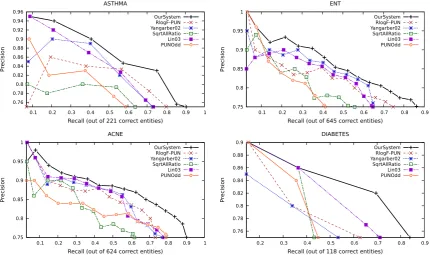
Figure 2: Precision vs. Recall curves of our system and the baselines for the four forums. Rlog-PN and PNOdd are not shown to improve clarity.
0.2. The initial value ofθrwas 1.0, which was
re-duced to0.8×θrwhenever the system did not
ex-tract any more patterns and words. We discarded patterns that extracted less than 2 positive entities. We selected these parameters by their performance on the development forum.
For calculating the DistSim feature used for scoring patterns and entities, we clustered all of MedHelp’s forum data into 1000 clusters using the Brown clustering algorithm (Brown et al., 1992;
Liang, 2005).7 For calculating the Domain Ngram
feature for scoring entities, we used n-grams from all user forums in MedHelp as the domain n-grams.
We evaluate systems by their precision and re-call in each iteration. Precision is defined as the fraction of correct entities among the entities ex-tracted. We stopped learning entities for a sys-tem if the precision dropped below 75% to extract entities with reasonably high precision. Recall is defined as the fraction of correct entities among the total unique correct entities pooled from all
systems while maintaining the precision ≥75%.
Note that true recall is very hard to compute since our dataset is unlabeled. To compare the systems
7The data consisted of around 4 million tokens. Words
that occurred less than 50 times were discarded, which re-sulted in 50353 unique words.
overall, we calculate the area under the precision-recall curves (AUC-PR).
System Asthma ENT Diabetes Acne OurSystem 68.36 60.71 67.62 68.01
PNOdd 51.62 50.31 05.91 58.45
PUNOdd 42.42 30.44 36.11 58.38 RlogF-PUN 56.13 54.11 48.70 57.04 RlogF-PN 53.46 52.84 16.59 62.35 SqrtRatioAll 41.49 40.44 35.47 46.46 Yangarber02 53.76 48.46 41.45 59.85
[image:7.595.309.522.416.511.2]Lin03 54.58 47.98 56.15 60.79
Table 1: Area under Precision-Recall curves of the systems.
4.4 Results
Figure 2 plots the precision and recall of systems.8
Table 1 shows AUC-PR scores for all systems. RlogF-PN and PNOdd have low value for Dia-betes because they learned generic patterns in ini-tial iteration, which led them to learn incorrect en-tities. Overall our system performed significantly better than existing systems. All systems extract more entities for Acne and ENT because different drugs and treatments are more prevalent in these forums. Diabetes and Asthma have more inter-ventions and lifestyle changes that are harder to 8We do not show plots of PNOdd and RlogF-PN to
Feature Asthma ENT Diabetes Acne All Features 68.36 60.71 67.62 68.01
EDP 68.66 59.07 60.03 65.15
EDN 59.39 59.21 16.75 65.96
SemOdd 67.07 58.41 60.51 65.04
GN 57.52 59.53 48.76 68.61
[image:8.595.308.486.61.213.2]DistSim 64.87 59.05 71.11 69.48 Table 2: Individual feature effectiveness: Area un-der Precision-Recall curves when our system uses individual features during pattern scoring. Other features are still used for entity scoring.
Feature Asthma ENT Diabetes Acne All Features 68.36 60.71 67.62 68.01 minusEDP 66.29 60.45 69.84 69.46
minusEDN 67.19 60.39 69.89 67.57 minusGN 65.53 60.33 66.07 67.28 minusSemOdd 66.66 60.76 70.79 68.25 minusDistSim 66.10 60.58 66.59 67.85
Table 3: Feature ablation study: Area under Precision-Recall curves when individual features are removed from our system during pattern scor-ing. The feature is still used for entity scorscor-ing.
extract.
To compare the effectiveness of each feature in our system, Table 2 shows the AUC-PR values when each feature was individually used for pat-tern scoring (other features were still used to learn entities). EDP and DistSim were strong predictors of labels of unlabeled entities because many good unlabeled entities were spelling mistakes of DT entities and occurred in similar context as them. Table 3 shows the AUC-PR values when each fea-ture was removed from the set of feafea-tures used to score patterns (the feature was still used for learn-ing entities). Removlearn-ing GN and DistSim reduced the AUC-PR scores for all forums.
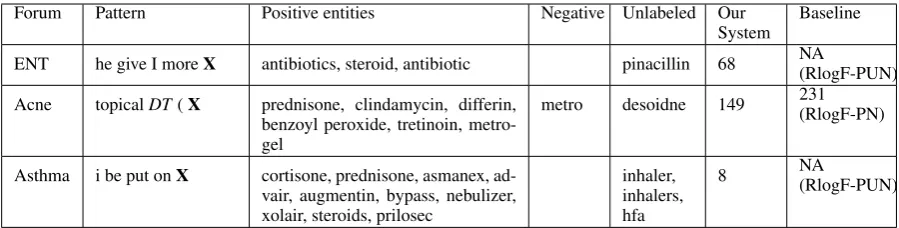
Table 4 shows some examples of patterns and the entities they extracted along with their labels when the pattern was learned. We learned the first pattern because ‘pinacillin’ has low edit distance from the positive entity ‘penicillin’. Similarly, we scored the second pattern higher than the base-line because ‘desoidne’ is a typo of the positive entity ‘desonide’. Note that the seed dictionaries are noisy – the entity ‘metro’, part of the positive entity ‘metrogel’, was falsely considered a neg-ative entity because it was in the common web words list. Our system learned the third pattern for two reasons: ‘inhaler’, ‘inhalers’, and ‘hfa’ oc-curred frequently as sub-phrases in the DT dictio-nary, and they were clustered with positive
enti-Our System RlogF-PUN
low dose ofX* mg ofX
mg ofX treat withX
X10 mg takeDTandX
she prescribeX be takeX
X500 mg she prescribeX
be takeDTandX* put onX
ent put I onX* stop takeX
DT( like X:NN i be prescribeX
likeDTandX have be takeX
[image:8.595.80.287.62.133.2]then prescribeX* tell I to takeX
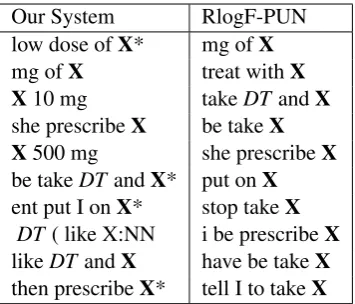
Table 5: Top 10 (simplified) patterns learned by our system and RlogF-PUN from the ENT forum. An asterisk denotes that the pattern was never
learned by the other system.Xis the target word.
ties by distributional similarity. Since RlogF-PUN does not distinguish between unlabeled and nega-tive entities, it is does not learn the pattern. Table 5 shows top 10 patterns learned for the ENT forum by our system and RlogF-PUN, the best perform-ing baseline for the forum. Our system preferred to learn patterns with longer contexts, which are usually higher precision, first.
5 Discussion and Conclusion
Our system extracted entities with higher preci-sion and recall than other existing systems. How-ever, learning entities from an informal text corpus that is partially labeled from seed entities presents some challenges. Our system made mistakes pri-marily due to three reasons. One, it sometimes extracted typos of negative entities that were not easily predictable by the edit distance measures, such as ‘knowwhere’. Second, patterns that ex-tracted many good but some bad unlabeled en-tities got high scores because of the good unla-beled entities. However, the bad unlaunla-beled enti-ties extracted by the highly weighted patterns were scored high by the PTF feature during the entity scoring phase, leading to extraction of the bad en-tities. Better features to predict negative entities and robust text normalization would help mitigate both the problems. Third, we used automatically constructed seed dictionaries that were not dataset specific, which led to incorrectly labeling of some entities (for example, ‘metro’ as negative in Ta-ble 4). Reducing noise in the dictionaries would increase precision and recall.
[image:8.595.74.290.211.284.2]Forum Pattern Positive entities Negative Unlabeled Our
System Baseline ENT he give I moreX antibiotics, steroid, antibiotic pinacillin 68 NA(RlogF-PUN) Acne topicalDT(X prednisone, clindamycin, differin,
benzoyl peroxide, tretinoin, metro-gel
metro desoidne 149 231(RlogF-PN)
Asthma i be put onX cortisone, prednisone, asmanex, ad-vair, augmentin, bypass, nebulizer, xolair, steroids, prilosec
inhaler, inhalers, hfa
[image:9.595.74.524.61.175.2]8 NA(RlogF-PUN)
Table 4: Example patterns and the entities extracted by them, along with the rank at which the pattern was added to the list of learned patterns. NA means that the system never learned the pattern. Baseline refers to the best performing baseline system on the forum. The patterns have been simplified to show
just the sequence of lemmas. Xrefers to the target entity; all of them in these examples had noun POS
restriction. Terms that have already been identified as the positive class were generalized to their class DT.
by taking the average of the feature scores. One area of future work is to learn weights using more sophisticated techniques; in pilot experi-ments, learning a logistic regression classifier on heuristically labeled data did not work well for ei-ther pattern scoring or entity scoring.
One limitation of our system and evaluation is that we learned single word entities, since calcu-lating some features for multi-word phrases is not straightforward. For example, word clusters using distributional similarity were constructed for sin-gle words. Our future work includes expanding the features to evaluate multi-word phrases. An-other avenue for future work is to use our pat-tern scoring method for learning other kinds of rules, such as dependency patterns, and in differ-ent kinds of systems, such as hybrid differ-entity learn-ing systems (Etzioni et al., 2005; Carlson et al., 2010). In addition, we did not explicitly address the problem of semantic drift (Curran et al., 2007) in this paper. In theory, learning better patterns would help lessen the problem; we plan to investi-gate this further.
In conclusion, we show that predicting the la-bels of unlabeled entities in the pattern scorer of a bootstrapped entity extraction system significantly improves precision and recall of learned entities. Our experiments demonstrate the importance of having models that contrast domain-specific and general domain text, and the usefulness of features that allow spelling variations when dealing with informal texts. Our pattern scorer outperforms ex-isting pattern scoring methods for learning drug-and-treatment entities from four medical web fo-rums.
Acknowledgments
We thank Diana MacLean for labeling the test data for calculating the inter-annotator agreement. We are also grateful to Gabor Angeli, Angel Chang, Manolis Savva, and the anonymous reviewers for their useful feedback. We thank MedHelp for sharing their anonymized data with us.
References
Peter F. Brown, Peter V. deSouza, Robert L. Mer-cer, Vincent J. Della Pietra, and Jenifer C. Lai. 1992. Class-based n-gram models of natural lan-guage. Computational Linguistics, 18:467–479. Mary Elaine Califf and Raymond J. Mooney. 1999.
Relational learning of pattern-match rules for in-formation extraction. In Proceedings of the 16th National Conference on Artificial Intelligence and the 11th Innovative Applications of Artificial Intelli-gence Conference, AAAI-IAAI ’99, pages 328–334. Andrew Carlson, Justin Betteridge, Richard C. Wang, Estevam R. Hruschka, Jr., and Tom M. Mitchell. 2010. Coupled semi-supervised learning for infor-mation extraction. InProceedings of the 3rd ACM International Conference on Web Search and Data Mining, WSDM ’10, pages 101–110.
Angel X. Chang and Christopher D. Manning. 2014. TokensRegex: Defining cascaded regular expres-sions over tokens. Technical Report CSTR 2014-02, Department of Computer Science, Stanford Univer-sity.
Fabio Ciravegna. 2001. Adaptive information extrac-tion from text by rule inducextrac-tion and generalisaextrac-tion. InProceedings of the 17th International Joint Con-ference on Artificial Intelligence, IJCAI’01, pages 1251–1256.
William W. Cohen and Yoram Singer. 1999. A simple, fast, and effective rule learner. InProceedings of the 16th National Conference on Artificial Intelligence and the 11th Innovative Applications of Artificial In-telligence Conference, pages 335–342.
Michael Collins and Yoram Singer. 1999. Unsuper-vised models for named entity classification. In Pro-ceedings of the Joint SIGDAT Conference on Empir-ical Methods in Natural Language Processing and Very Large Corpora, pages 100–110.
J. R. Curran, T. Murphy, and B. Scholz. 2007. Min-imising semantic drift with mutual exclusion boot-strapping. Proceedings of the Conference of the Pacific Association for Computational Linguistics, pages 172–180.
D. Downey, O. Etzioni, S. Soderland, and D. S. Weld. 2004. Learning Text Patterns for Web Informa-tion ExtracInforma-tion and Assessment. InProceedings of AAAI 2004 Workshop on Adaptive Text Extraction and Mining, ATEM ’04.
Oren Etzioni, Michael Cafarella, Doug Downey, Ana-Maria Popescu, Tal Shaked, Stephen Soderland, Daniel S. Weld, and Alexander Yates. 2005. Un-supervised named-entity extraction from the web: An experimental study. Artificial Intelligence, 165(1):91 – 134.
Anthony Fader, Stephen Soderland, and Oren Etzioni. 2011. Identifying relations for open information ex-traction. In Proceedings of the Conference on Em-pirical Methods in Natural Language Processing, EMNLP ’11, pages 1535–1545.
Christiane Fellbaum. 1998. WordNet: An Electronic Lexical Database. Bradford Books.
Dayne Freitag. 1998. Toward general-purpose learn-ing for information extraction. InProceedings of the 36th Annual Meeting of the Association for Compu-tational Linguistics and 17th International Confer-ence on Computational Linguistics, COLING-ACL ’98, pages 404–408.
Sonal Gupta and Christopher D. Manning. 2014a. In-duced lexico-syntactic patterns improve information extraction from online medical forums. Under Sub-mission.
Sonal Gupta and Christopher D. Manning. 2014b. Spied: Stanford pattern-based information extrac-tion and diagnostics. In Proceedings of the ACL 2014 Workshop on Interactive Language Learning, Visualization, and Interfaces (ACL-ILLVI).
Marti A Hearst. 1992. Automatic acquisition of hy-ponyms from large text corpora. InProceedings of the 14th International Conference on Computational linguistics, COLING ’92, pages 539–545.
Percy Liang. 2005. Semi-supervised learning for nat-ural language. Master’s thesis, MIT EECS.
Winston Lin, Roman Yangarber, and Ralph Grishman. 2003. Bootstrapped learning of semantic classes from positive and negative examples. In Proceed-ings of the ICML 2003 Workshop on The Continuum from Labeled to Unlabeled Data in Machine Learn-ing and Data MinLearn-ing.
Mausam, Michael Schmitz, Stephen Soderland, Robert Bart, and Oren Etzioni. 2012. Open language learn-ing for information extraction. In Proceedings of the 2012 Joint Conference on Empirical Methods in Natural Language Processing and Computational Natural Language Learning, EMNLP-CoNLL ’12, pages 523–534.
Tara McIntosh and James R. Curran. 2009. Reducing semantic drift with bagging and distributional sim-ilarity. In Proceedings of the Joint Conference of the 47th Annual Meeting of the ACL and the 4th In-ternational Joint Conference on Natural Language Processing of the AFNLP, ACL-IJCNLP ’09, pages 396–404.
Ramesh Nallapati and Christopher D. Manning. 2008. Legal docket-entry classification: Where machine learning stumbles. In Proceedings of the Confer-ence on Empirical Methods in Natural Language Processing, EMNLP ’08, pages 438–446.
Patrick Pantel and Deepak Ravichandran. 2004. Auto-matically labeling semantic classes. InProceedings of the Conference of the North American Chapter of the Association for Computational Linguistics on Human Language Technologies, HLT-NAACL ’04, pages 321–328.
S. Patwardhan. 2010. Widening the Field of View of Information Extraction through Sentential Event Recognition. Ph.D. thesis, University of Utah, May.
Hoifung Poon and Pedro Domingos. 2010. Unsuper-vised ontology induction from text. InProceedings of the 48th Annual Meeting of the Association for Computational Linguistics, ACL ’10, pages 296– 305.
Ellen Riloff. 1996. Automatically generating extrac-tion patterns from untagged text. In Proceedings of the 13th National Conference on Artificial Intelli-gence, AAAI’96, pages 1044–1049.
Mark Stevenson and Mark A. Greenwood. 2005. A semantic approach to IE pattern induction. In Pro-ceedings of the 43rd Annual Meeting on Association for Computational Linguistics, ACL ’05, pages 379– 386.
Michael Thelen and Ellen Riloff. 2002. A bootstrap-ping method for learning semantic lexicons using extraction pattern contexts. In Proceedings of the Conference on Empirical Methods in Natural Lan-guage Processing, EMNLP ’02, pages 214–221. Kristina Toutanova, Dan Klein, Christopher D.
Man-ning, and Yoram Singer. 2003. Feature-rich part-of-speech tagging with a cyclic dependency network. InProceedings of the 2003 Conference of the North American Chapter of the Association for Computa-tional Linguistics on Human Language Technology, HLT-NAACL ’03, pages 173–180.
Wei Xu, Raphael Hoffmann, Le Zhao, and Ralph Gr-ishman. 2013. Filling knowledge base gaps for dis-tant supervision of relation extraction. In Proceed-ings of the Association for Computational Linguis-tics (ACL), pages 665–670.
Roman Yangarber, Ralph Grishman, and Pasi Tapanainen. 2000. Automatic acquisition of domain knowledge for information extraction. In Proceedings of the 18th International Conference on Computational Linguistics, COLING ’00, pages 940–946.