Analysis of Flat Slab Structure Provided with
Shear Wall and Bracings
Manjula Hombal1, Prof. Vinayak Vijapur2
1
P.G. Student, 2Assistant Professor, Department of Civil Engineering, Govt engineering college, Devagiri, Haveri, Karnataka, India
Abstract: The present work is carried out on the analysis of flat slab with shear wall and the bracings. Flat slabs system of construction is one in which the beams used in the conventional methods of constructions are done away with. The slab directly rests on the column and load from the slab is directly transferred to the columns and then to the foundation. To support the heavy loads the thickness of slab near the support with the column is increased and these are called drops. The flat slab structure is modelled using ETABS software and analyses for non-linear static method (Push over analysis) as per 1893:2002.The project work is carried out for 5 story structure and the analysis for 4 different models like- RCC Structure, Flat slab structure, Flat slab with shear wall and with bracings. From the analysis the story displacement and drift value for flat slab with shear wall structure is less compare to the other models and the story shear is high for flat slab with shear wall so the flat slab with shear wall performed better than other structures.
Keywords: RC Structure, Flat slab, Shear wall, Bracing, Pushover analysis.
I. INTRODUCTION
Flat slab structures are defined as the structures only supported by columns, without beams .Thus a flat slab is a typical type of construction in which RCC slab is built monolithically with the supporting column. A plane ceiling is obtained thus giving attractive appearance from architectural point of view, the plane ceiling diffuses the light better and is considered to be less vulnerable in case of high seismic zones than usual beam slab construction. Flat slab system is very simple to construct and is efficient in that it requires the minimum building height for a given number of stories. The flat slab system is suitable for higher loads and larger spans, because The slab thickness varies from 125 mm to 300 mm for spans of 4 m to 9 m. Among the various floor systems, the flat slab system is the one with the highest dead load per unit area. There are many advantages of flat slab that it consumes lesser construction time, reduce the floor to floor height, easier form work.
II. OBJECTIVE OF THE PROJECT A. Modelling of RC and Flat slab structures are carried out using the ETABS software
B. The modelling and analysis the flat slab structure is carried out to know the effect of shear wall and bracings.
C. To carry out Pushover analysis along with code as per IS: 1893 Part-1 (2002) for the developed RC and flat slab building models with shear wall and bracings.
D. To study the behavior of the structure due to formation of the hinges under different stages.
E. To obtain different seismic parameters viz. story displacement, story drift, story shear, story stiffness for the developed building models from Pushover analysis.
III. METHODOLOGY
Methodology includes the modeling and analysis of the structure. Modelling of RC structure and flat slab with shear wall and bracing structure is carried out using ETABS 2016 software
A.Analysis Data
Size of Beam = 450x600 mm Size of Column = 600x600 mm Thickness of slab = 200 mm Thickness of shear wall = 230 mm Drop thickness = 250 mm
Size of drop panel = 2200x2200 mm Height of each story = 3m
B. About Models
1) RC = reinforced concrete structure
2) FS = Flat slab structure
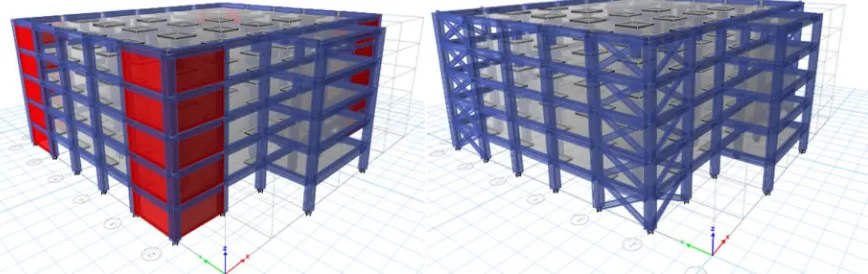
3) FS-SW = Flat slab with shear wall
4) FS-BR = Flat slab with bracings
[image:2.612.91.525.352.489.2]Figure1: Plan View of Flat Slab Structure Figure 2: 3D View of Flat Slab Structure
Figure 3: 3D View of Flat Slab with Shear Wall Structure Figure 4: 3D View of Flat Slab With Bracing Structure
IV. ANALYSIS RESULTS A. Story Displacement Results
Story displacement is total displacement of the storey with respect to ground and is maximum permissible limit prescribed in IS codes for buildings.
Figure 5: Story Displacement in X-Direction Figure 6: Story Displacement in Y-Direction 0
5 10 15 20 25
Story5 Story4 Story3 Story2 Story1 Base RC
FS
FS-SW
FS-BR
Story Displacement X-Dir
D
is
pl
a
ce
m
en
t
(m
m
)
0 5 10 15 20 25
Story5 Story4 Story3 Story2 Story1 Base RC
FS
FS-SW
FS-BR
Story Displacement Y-Dir
D
is
pl
a
ce
m
en
t
(m
m
B. Story Drift Results
[image:3.612.86.524.118.269.2]Story drift is the drift of one level of a multi-storey building relative to the level below.Story drift is plotted number of stories with respect to story drift.
Figure 7: Story Drift in X-direction Figure 8: Story Drift in Y-direction
C. Story Shear Results
[image:3.612.85.527.328.483.2]Story shear is the lateral forces acting on a story, due to the forces. It is calculated for each story, changes from minimum at the top to maximum at the bottom of the building.
Figure 9: Story Shear in X-direction Figure 10: Story Shear in Y-direction
[image:3.612.123.459.519.677.2]D. Pushover curve for RC Structure
Figure 11: Pushover curve for RC Structure
From the analysis the Base shear of the RC structure found to be 33613.16 kN and the performance point obtained at the displacement of the 48.543mm.
0 0.0002 0.0004 0.0006 0.0008 0.001 0.0012 0.0014 0.0016 0.0018 0.002 Story5Story4Story3Story2Story1 Base RC FS FS-SW FS-BR
Story Drift X-Dir
D ri ft v a lue ( m m ) 0 0.0002 0.0004 0.0006 0.0008 0.001 0.0012 0.0014 0.0016 0.0018
Story5 Story4 Story3 Story2 Story1 Base RC
FS
FS-SW
FS-BR
Story Drift Y-Dir
D ri ft v a lue ( m m ) 0 10000 20000 30000 40000 50000 60000
RC FS FS-SW FS-BR
Story Shear X-Dir
S h ea r (k N ) 0 10000 20000 30000 40000 50000
RC FS FS-SW FS-BR
Story Shear Y-Dir
E. Pushover Curve for Flat Slab Structure
Figure 12: Pushover curve for Flat Slab Structure
From the analysis the performance point found at the displacement value of 58.5mm and the base shear value is 26476.6547 kN which is more than that of the RC structure.
[image:4.612.153.479.315.465.2]F. Pushover Curve for Flat Slab with Shear Wall Structure
Figure 13: Pushover Curve for Flat Slab with Shear Wall
From the above pushover curve we came to know that all the assigned hinges are almost at the proportionality limit and the base shear is of 28543.085 and demand point at the spectral displacement is 9.448 mm.
G. Pushover Curve for Flat Slab with Shear Wall Structure
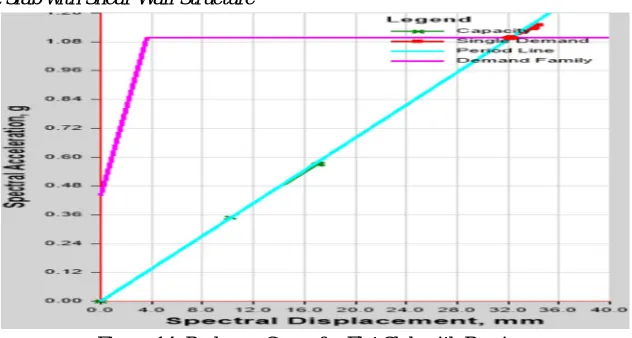
Figure 14: Pushover Curve for Flat Slab with Bracings
[image:4.612.157.473.520.689.2]V. CONCLUSION
A. From the analysis story displacement and Drift results of conventional flat slab is more when compare to flat slab with shear wall and bracings.
B. The drift and displacement in flat slab with shear wall structure found to show better performance when compared to all other models in both X and Y- Direction.
C. In the story shear values flat slab with shear wall structure shows maximum value compare to the other three models.
D. All over in pushover analysis the flat slab with shear wall is a better choice when compared with all other models. While the flat slab with bracings remains as a second choice.
E. From the pushover analysis the performance point for flat slab with shear wall is obtained at the lesser displacement value.
F. The story displacement and drift are higher for flat slab structure compare to conventional RC structure.
REFERENCES
[1] Dr. Uttamashagupta et.al, “Seismic behavior of buildings having flat slabs with the drops”. International Journal of Emerging Technology and Advanced Engineering website: www.ijetae.com (ISSN 2250-2459, volume 2, issue 10, October 2012).
[2] Dhananjay D. Joshi1, Dr. Pranesh B. Murnal “Performance of Flat Slab Structure Using Pushover Analysis”. International Research Journal of Engineering and Technology (IRJET) Volume 8, Issue 3, Sep. - Oct 2013.
[3] Ms. Navyashree K and Sahana T.S “Use of flat slabs in multi-story commercial building situated in high seismic zone”. IJRET: International Journal of Research in Engineering and Technology 2014.
[4] P. Srinivasulu, A. Dattatreya Kumar, “Behaviour of RCC flat slab structure under earthquake loading” International journal of engineering & science research (IJESR), Vol-5, Issue-7/821-829 July 2015.
[5] Drakshayani S, Chaithra N, “Seismic performance of RC flat slab structure with different types of steel bracing” International Journal of Research in Engineering and Technology eISSN: 2319-1163, pISSN: 2321-7308, Volume: 05 Issue: 08, Aug-2016
[6] Bhavesh Rajesh Sahni, Dr. Prashant D. Hiwase and Prasad P. Dahale “ Seismic behavior of flat slab building with shear wall” (IJCIET) Volume 9, Issue 5, May 2018
[7] Ashwini Ghorpade, Dr. B. Shivakumara Swamy “ Study on the performance of flat slab Structure Using Pushover Analysis With and Without Shear Wall” International Research Journal of Engineering and Technology(IRJET),volume5,Issue 07(2018).
[8] IS: 875 – 1987 - code of practice for design loads (other than earthquake) for buildings and structures, part 1: Dead loads, part 2: Imposed loads, part 5: Special loads and load combinations, bureau of Indian standards, New Delhi.
[9] IS: 1893 (part–1)–2002 - code of practice for criteria for earthquake resistant design of structures, part 1: general provisions and buildings, bureau of Indian standards, New Delhi.