
2285
Retrieve, Read, Rerank: Towards End-to-End
Multi-Document Reading Comprehension
Minghao Hu, Yuxing Peng, Zhen Huang, Dongsheng Li National University of Defense Technology, Changsha, China
{huminghao09,pengyuxing,huangzhen,dsli}@nudt.edu.cn
Abstract
This paper considers the reading comprehen-sion task in which multiple documents are given as input. Prior work has shown that a pipeline of retriever, reader, and reranker can improve the overall performance. How-ever, the pipeline system is inefficient since the input is re-encoded within each module, and is unable to leverage upstream compo-nents to help downstream training. In this work, we present RE3QA, a unified question
answering model that combines context re-trieving, reading comprehension, and answer reranking to predict the final answer. Unlike previous pipelined approaches, RE3QA shares
contextualized text representation across dif-ferent components, and is carefully designed to use high-quality upstream outputs (e.g., re-trieved context or candidate answers) for di-rectly supervising downstream modules (e.g., the reader or the reranker). As a result, the whole network can be trained end-to-end to avoid the context inconsistency problem. Ex-periments show that our model outperforms the pipelined baseline and achieves state-of-the-art results on two versions of TriviaQA and two variants of SQuAD.
1 Introduction
Teaching machines to read and comprehend text is a long-term goal of natural language process-ing. Despite recent success in leveraging reading comprehension (RC) models to answer questions given a related paragraph (Wang et al., 2017;Hu et al., 2018; Yu et al., 2018), extracting answers from documents or even a large corpus of text (e.g., Wikipedia or the whole web) remains to be an open challenge. This paper considers the multi-document RC task (Joshi et al.,2017), where the system needs to, given a question, identify the an-swer from multiple evidence documents. Unlike single-pargraph settings (Rajpurkar et al., 2016),
this task typically involves aretriever for select-ing few relevant document content (Chen et al., 2017), a reader for extracting answers from the retrieved context (Clark and Gardner,2018), and even a reranker for rescoring multiple candidate answers (Bogdanova and Foster,2016).
Previous approaches such as DS-QA (Lin et al., 2018) and R3 (Wang et al.,2018a) consist of sep-arate retriever and reader models that are jointly trained. Wang et al. (2018d) further propose to rerank multiple candidates for verifying the fi-nal answer. Wang et al. (2018b) investigate the full retrieve-read-rerank process by constructing a pipeline system that combines an information re-trieval (IR) engine, a neural reader, and two kinds of answer rerankers. Nevertheless, the pipeline system requires re-encoding inputs for each sub-task, which is inefficient for large RC tasks. More-over, as each model is trained independently, high-quality upstream outputs can not benefit down-stream modules. For example, as the training pro-ceeds, a neural retriever is able to provide more relevant context than an IR engine (Htut et al., 2018). However, the reader is still trained on the initial context retrieved using IR techniques. As a result, the reader could face acontext inconsis-tency problem once the neural retriever is used. Similar observation has been made byWang et al. (2018c), where integrating both the reader and the reranker into a unified network is more benefical than a pipeline (see Table1for more details).
Model Retrieve Read Rerank Architecture
DS-QA (Lin et al.,2018) 3 3 7 Pipeline
R3(Wang et al.,2018a) 3 3 7 Pipeline*
Extract-Select (Wang et al.,2018d) 7 3 3 Pipeline*
V-Net (Wang et al.,2018c) 7 3 3 Unified
Re-Ranker (Wang et al.,2018b) 3 3 3 Pipeline
[image:2.595.119.483.65.169.2]RE3QA 3 3 3 Unified
Table 1: Comparison of RE3QA with existing approaches. Our approach performs the full retrieve-read-rerank
process with a unified network instead of a pipeline of separate models. *: R3and Extract-Select jointly train two
models with reinforcement learning.
et al.,2018), where earlier blocks are used to pre-dict retrieving scores and later blocks are fed with few top-ranked segments to produce multiple can-didate answers. Redundant cancan-didates are pruned and the rest are reranked using their span represen-tations extracted from the shared contextualized representation. The final answer is chosen accord-ing to three factors: the retrievaccord-ing, readaccord-ing, and reranking scores. The whole network is trained end-to-end so that the context inconsistency prob-lem can be alleviated. Besides, we can avoid re-encoding input segments by sharing contextual-ized representations across different components, thus achieving better efficiency.
We evaluate our approach on four datasets. On TriviaQA-Wikipedia and TriviaQA-unfiltered datasets (Joshi et al., 2017), we achieve 75.2 F1 and 71.2 F1 respectively, outperforming previ-ous best approaches. On SQuAD-document and SQuAD-open datasets, both of which are modified versions of SQuAD (Rajpurkar et al., 2016), we obtain 14.8 and 4.1 absolute gains on F1 score over prior state-of-the-art results. Moreover, our ap-proach surpasses the pipelined baseline with faster inference speed on both TriviaQA-Wikipedia and SQuAD-document. Source code is released for fu-ture research exploration1.
2 Related Work
Recently, several large datasets have been pro-posed to facilitate the research in document-level reading comprehension (RC) (Clark and Gard-ner, 2018) or even open-domain question an-swering (Chen et al., 2017). TriviaQA (Joshi et al., 2017) is a challenging dataset containing over 650K question-answer-document triples, in which the document are either Wikipedia articles
1https://github.com/huminghao16/RE3QA
or web pages. Quasar-T (Dhingra et al.,2017) and SearchQA (Dunn et al.,2017), however, pair each question-answer pair with a set of web page snip-pets that are more analogous to paragraphs. Since this paper considers the multi-document RC task, we therefore choose to work on TriviaQA and two variants of SQuAD (Rajpurkar et al.,2016).
To tackle this task, previous approaches typi-cally first retrieve relevant document content and then extract answers from the retrieved context. Choi et al.(2017) construct a coarse-to-fine frame-work that answers the question from a retrieved document summary. Wang et al. (2018a) jointly train a ranker and a reader with reinforcement learning (Sutton and Barto, 2011). Lin et al. (2018) propose a pipeline system consisting of a paragraph selector and a paragraph reader. Yang et al.(2019) combine BERT with an IR toolkit for open-domain question answering.
However, Jia and Liang (2017) show that the RC models are easily fooled by adversarial exam-ples. By only extracting an answer without veri-fying it, the models may predict a wrong answer and are unable to recover from such mistakes (Hu et al., 2019). In response, Wang et al. (2018d) present an extract-then-select framework that in-volves candidate extraction and answer selection. Wang et al. (2018c) introduce a unified network for cross-passage answer verification. Wang et al. (2018b) explore two kinds of answer rerankers in an existing retrieve-read pipeline system. There are some other works that handle this task in different perspectives, such as using hierarchical answer span representations (Pang et al., 2019), modeling the interaction between the retriever and the reader (Das et al.,2019), and so on.
...
Retrieve Read Rerank
Pruning
document Answer
q T-Block
x J
T-Block
x (I-J)
scores
scoree
Pruning answer
scorea
c
nq T-Block
x J
T-Block
x (I-J)
An B
n scores
scoree score
a
T-Block 1
c
x J
X
q Early
stopped
scorer
2
c
2
A
2
B
d
1
d
scorer
scorer
Pruning answer Sliding
[image:3.595.81.517.64.274.2]window
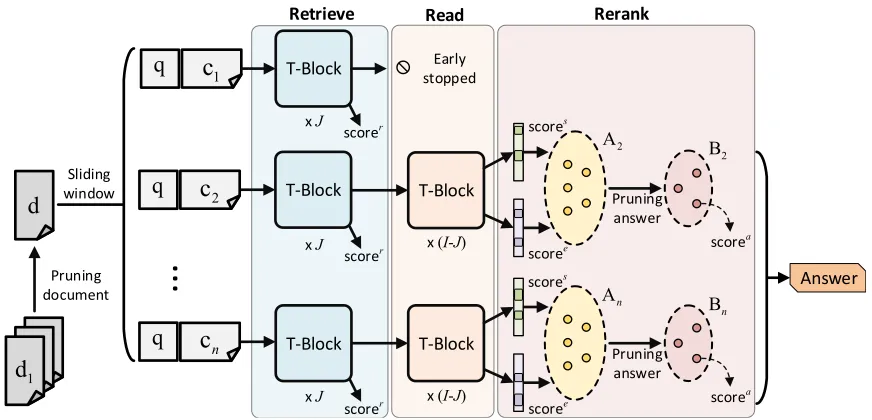
Figure 1: RE3QA architecture. The input documents are pruned and splitted into multiple segments of text, which
are then fed into the model2. Few top-ranked segments are retrieved and the rest are early stopped. Multiple
candidate answers are proposed for each segment, which are later pruned and reranked. RE3QA has three outputs
per candidate answer: the retrieving, reading, and reranking scores. The network is trained end-to-end with a multi-task objective. “T-Block” refers to pre-trained Transformer block (Devlin et al.,2018).
and reranker components into a unified network instead of a pipeline of separate models, (b) we share contextualized representation across differ-ent compondiffer-ents while pipelined approaches re-encode inputs for each model, and (c) we propose an end-to-end training strategy so that the context inconsistency problem can be alleviated.
A cascaded approach is recently proposed by Yan et al. (2019), which also combines several components such as the retriever and the reader while sharing several sets of parameters. Our ap-proach is different in that we ignore the document retrieval step since a minimal context phenomenon has been observed byMin et al.(2018), and we ad-ditionally consider answer reranking.
3 RE3QA
Figure1gives an overview of our multi-document reading comprehension approach. Formally, given a question and a set of documents, we first fil-ter out irrelevant document content to narrow the search space (§3.1). We then split the remain-ing context into multiple overlappremain-ing, fixed-length text segments. Next, we encode these segments along with the question using pre-trained Trans-former blocks (Devlin et al., 2018) (§3.2). To
maintain efficiency, the model computes a retriev-ing score based on shallow contextual representa-tions with early summarization, and only returns
a few top-ranked segments (§3.3). It then contin-ues encoding these retrieved segments and outputs multiple candidate answers under the distant su-pervision setting (§3.4). Finally, redundant can-didates are pruned and the rest are reranked us-ing their span representations (§3.5). The final an-swer is chosen according to the retrieving, reading, and reranking scores. Our model is trained end-to-end3by back-propagation (§3.6).
3.1 Document Pruning
The input to our model is a question qand a set of documents D = {d1, ...,dND}. Since the
documents could be retrieved by a search engine (e.g., up to 50 webpages in the unfiltered version of TriviaQA (Joshi et al.,2017)) or Wikipedia ar-ticles could contain hundreds of paragraphs, we therefore first discard irrelevant document content at paragraph level. Following Clark and Gardner (2018), we select the top-K paragraphs that have smallest TF-IDF cosine distances with each ques-tion. These paragraphs are then sorted according to their positions in the documents and concate-nated to form a new pruned document d. As a result, a large amount of unrelated text can be fil-tered out while a high recall is guaranteed. For ex-ample, nearly 95% of context are discarded while
3Note that “end-to-end training” only involves retrieving,
the chance of selected paragraphs containing cor-rect answers is 84.3% in TriviaQA-unfiltered.
3.2 Segment Encoding
Typically, existing approaches either read the re-trieved document at the paragraph level (Clark and Gardner,2018) or at the sentence level (Min et al., 2018). Instead, followingHewlett et al.(2017), we slide a window of lengthlwith a striderover the
pruned documentdand produce a set of text seg-mentsC={c1, ...,cn}, wheren=
l
Ld l
r
m
+ 1, andLdis the document length. Next, we encode
these segments along with the question using pre-trained Transformer blocks (Devlin et al., 2018), which is a highly parallel encoding scheme instead of recurrent approaches such as LSTMs.
The input to the network is a sequence of tokens x = (x1, ..., xLx) with length Lx. It is obtained
by concatenating the question, segment, and sev-eral delimiters as[[CLS];q;[SEP];c;[SEP]],
where[CLS]is a classification token and[SEP]
is another token for differentiating sentences. We refer to this sequence as “segment” in the rest of this paper. For each token xi inx, its input
rep-resentation is the element-wise addition of word, type, and position embeddings. Then, we can ob-tain the input embeddingsh0 2 RLx⇥Dh, where
Dh is hidden size.
Next, a series of I pre-trained Transformer
blocks are used to project the input embeddings into a sequence of contextualized vectors as:
hi= TransformerBlock(hi 1),8i2[1, I]
Here, we omit a detailed introduction on the block architecture and refer readers to Vaswani et al. (2017) for more details.
3.3 Early-Stopped Retriever
While we find the above parallel encoding scheme very appealing, there is a crucial computational in-efficiency if all segments are fully encoded. For example, the average number of segments per instance in TriviaQA-unfiltered is 20 even after pruning, while the total number of Transformer blocks is 12 or 24. Therefore, we propose to rank all segments using early-summarized hidden rep-resentations as a mechanism for efficiently retriev-ing few top-ranked segments.
Specifically, let hJ denote the hidden states in
the J-th block, where J < I. We compute a scorer 2R2 by summarizinghJ into a fix-sized
vector with a weighted self aligning layer followed by multi-layer perceptrons as:
µ= softmax(wµhJ)
scorer =wrtanh(Wr
XLx i=1µih
J i)
wherewµ,wr,Wrare parameters to be learned.
After obtaining the scores of all segments, we pass the top-N ranked segments per instance to
the subsequent blocks, and discard the rest. Here,
N is relatively small so that the model can focus on reading the most revelant context.
To train the retrieving component, we normalize scorerand define the objective function as:
LI =
X2
i=1y
r
i log(softmax(scorer)i) (1)
where yr is an one-hot label indicating whether current segment contains at least one exactly-matched ground truth answer text or not.
3.4 Distantly-Supervised Reader
Given the retrieved segments, the reading compo-nent aims to propose multiple candidate answers per segment. This is achieved by first element-wisely projecting the final hidden states hI into two sets of scores as follows:
scores=wshI , scoree=wehI
wherescores 2 RLx andscoree 2 RLx are the
scores for the start and end positions of answer spans, andws,weare trainable parameter vectors.
Next, let↵i and i denote the start and end
in-dices of candidate answerai. We compute a
read-ing score,si =scores↵i+score e
i, and then
pro-pose top-M candidates according to the descend-ing order of the scores, yielddescend-ing a set of prelimi-nary candidate answersA = {a1, ...,aM} along
with their scoresS={s1, ...,sM}.
Following previous work (Clark and Gardner, 2018), we label all text spans within a segment that match the gold answer as being correct, thus yield-ing two label vectorsys 2 RLx andye 2 RLx.
Since there is a chance that the segment does not contain any answer string, we then label the first element in bothysandyeas 1, and set the rest as 0. Finally, we define the objective function as:
LII =
XLx
i=1y
s
i log(softmax(scores)i)
XLx
j=1y
e
3.5 Answer Reranker
The answer reranker aims to rerank the candidate answers proposed by the previous reader. We first introduce a span-level non-maximum suppression algorithm to prune redundant candidate spans, and then predict the reranking scores for remaining candidates using their span representations. Span-level non-maximum suppression So far, the reader has proposed multiple candidate spans. However, since there is no constraint to predict an unique span for an answer string, multiple candi-dates may refer to the same text. As a result, other than the first correct span, all other spans on the same text would be false positives. Figure2shows a qualitative example of this phenomenon.
Question: In the late 60s Owen Finlay MacLaren pio-neered what useful item for parents of small chldren?
Answer:baby buggy
[image:5.595.309.528.69.207.2]Candidates:baby buggy, collapsible baby buggy, buggy, folding buggy, folding chair ...
Figure 2: An example from TriviaQA shows that mul-tiple candidate answers refer to the same text.
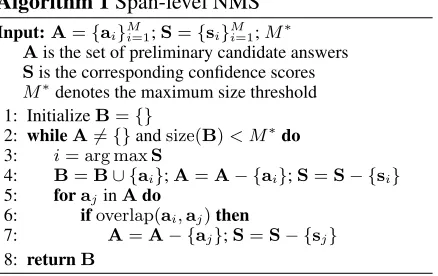
Inspired by the non-maximum suppression (NMS) algorithm (Rosenfeld and Thurston,1971) that is used to prune redundant bounding boxes in object detection (Ren et al., 2015), we present a span-level NMS (Algorithm 1) to alleviate the problem. Specifically, span-level NMS starts with a set of candidate answersAwith scoresS. After selecting the answer ai that possesses the
maxi-mum score, we remove it from the setAand add it toB. We also delete any answeraj inAthat is
overlapped withai. We define that two candidates
overlap with each other if they share at least one boundary position4. This process is repeated for
remaining answers inA, untilAis empty or the size ofBreaches a maximum threshold.
Candidate answer reranking Given the can-didate answer ai in B, we compute a reranking
score based on its span representation, where the representation is a weighted self-aligned vector bounded by the span boundary of the answer, sim-ilar toLee et al.(2017);He et al.(2018):
⌘ = softmax(w⌘hI↵i: i)
scoreai =watanh(Wa
X i
j=↵i
⌘j ↵i+1h I j)
4We also experimented with the span-level F1 function,
but found no performance improment.
Algorithm 1Span-level NMS
Input:A={ai}Mi=1;S={si}Mi=1;M⇤ Ais the set of preliminary candidate answers Sis the corresponding confidence scores
M⇤denotes the maximum size threshold
1: InitializeB={}
2: whileA6={}andsize(B)< M⇤do
3: i= arg maxS
4: B=B[{ai};A=A {ai};S=S {si}
5: forajinAdo
6: ifoverlap(ai,aj)then
7: A=A {aj};S=S {sj}
8: returnB
Here, scorea 2 RM⇤, andhI↵i: i is a shorthand for stacking a list of vectorshIj (↵i j i).
To train the reranker, we construct two kinds of labels for each candidate ai. First, we define
a hard label yihard as the maximum exact match score betweenai and ground truth answers.
Sec-ond, we also utilize a soft label ysof ti , which is computed as the maximum F1 score between ai
and gold answers, so that the partially correct pre-diction can still have a supervised signal. The above labels are annotated for each candidate in B, yielding yhard 2 RM⇤ andysof t 2 RM⇤. If there is no correct prediction inB(all elements of yhard are 0), then we replace the least confident candidate with a gold answer. Finally, we define the following reranking objective:
LIII =
XM⇤
i=1y
hard
i log(softmax(scorea)i)
+XM⇤
i=1||y
sof t i
scorea i
PM⇤
j=1scoreaj
||2 (3)
3.6 Training and Inference
Rather than separately training each component, we propose an end-to-end training strategy so that downstream components (e.g., the reader) can benefit from the high-quality upstream outputs (e.g., the retrieved segments) during training.
Specifically, we take a multi-task learning ap-proach (Caruna,1993;Ruder, 2017), sharing the parameters of earlier blocks with a joint objective function defined as:
J =LI +LII+LIII
Algorithm2details the training process. Before each epoch, we computescorer for all segments in the training setX. Then, we retrieve top-N seg-ments per instance and construct a new training set
˜
Dataset #Ins #Doc #Seg #Tok #Tok* K N Recall
TriviaQA-Wikipedia 7,993 1.8 17 10,256 2,103 14 8 94.8%
TriviaQA-unfiltered 11,313 11.7 20 52,635 2,542 14 8 84.3%
SQuAD-document 10,570 1 35 5,287 3,666 30 8 99.0%
SQuAD-open 10,570 5 42 38,159 5,103 30 8 64.9%
Table 2: Dataset statistics. ‘#Ins’ denotes the number of instances, while ‘#Doc’, ‘#Seg’, ‘#Tok’, and ‘#Tok*’ refer to the average number of documents, segments, and tokens before/after pruning, respectively. KandN are
the number of retrieved paragraphs and segments. All statistics are calculated on the development set.
each instance, if all of its top-ranked segments are negative examples, then we replace the least confi-dent one with a gold segment. During each epoch, we sample two sets of mini-batch from both theX
and theX˜, where the first batch is used to
calcu-lateLI and the other one for computingLII and
LIII. Note that the contextualized vectorshI are
shared across the reader and the reranker to avoid repeated computations. The batch size ofX is
dy-namically decided so that both ofX andX˜can be
traversed with the same number of steps.
During inference, we take the retrieving, read-ing, and reranking scores into account. We com-pare the scores across all segments from the same instance, and choose the final answer according to the weighted addition of these three scores.
Algorithm 2End-to-end training of RE3QA
Input:X={Xi}ti=1, whereXi={xji}nj=1;M⇥;k
Xis the dataset containingtinstances Xiisi-th instance containingnsegments
M⇥denotes the model with parameters⇥ kis the maximum number of epoch
1: Initialize⇥from pre-trained parameters 2: forepochin1, ..., kdo
3: Computescorerfor allxin
X 4: Retrieve top-Nsegments per instance 5: Construct a newX˜that includes retrievedx 6: forbatchX,batchX˜inX,X˜do
7: ComputeLIusingbatchXby Eq.1
8: ComputeLIIusingbatchX˜by Eq.2
9: ReusehIto computeLIIIby Eq.3
10: UpdateM⇥with graidentr(J)
4 Experimental Setup
Datasets We experiment on four datasets: (a) TriviaQA-Wikipedia (Joshi et al.,2017), a dataset of 77K trivia questions where each question is paired with one or multiple Wikipedia articles. (b) TriviaQA-unfiltered is a open-domain dataset that contains 99K question-answer tuples. The evi-dence documents are constructed by completing
a web search given the question. (c) SQuAD-document, a variant of SQuAD dataset (Rajpurkar et al., 2016) that pairs each question with a full Wikipedia article instead of a specific paragraph. (d) SQuAD-open (Chen et al., 2017) is the open domain version of SQuAD where the evidence corpus is the entire Wikipedia domain. For fair comparision to other methods, we retrieve top-5 articles as our input documents. The detailed statistics of these datasets are shown in Table2. Data preprocessing FollowingClark and Gard-ner(2018), we merge small paragraphs into a sin-gle paragraph of up to a threshold length in Triv-iaQA and SQuAD-open. The threshold is set as 200 by default. We manually tune the number of retrieved paragraphs K for each dataset, and set
the number of retrieved segmentsN as 8. Follow-ing Devlin et al.(2018), we set the window length
las384 Lq 3so thatLxis 384 and set the stride
ras 128, whereLqis the question length. We also
calculate the answer recall after document prun-ing, which indicates the performance upper bound. Model settings We initialize our model us-ing two publicly available uncased versions of BERT5: BERT
BASE and BERTLARGE, and refer
readers toDevlin et al.(2018) for details on model sizes. We use Adam optimizer with a learning rate of 3e-5 and warmup over the first 10% steps to fine-tune the network for 2 epochs. The batch size is 32 and a dropout probability of 0.1 is used. The number of blocksJused for early-stopped
re-triever is 3 for base model and 6 for large model by default. The number of proposed answersM
is 20, while the threshold of NMSM⇤ is 5.
Dur-ing inference, we tune the weights for retrievDur-ing, reading, and reranking, and set them as 1.4, 1, 1.4. Evaluation metrics We use mean average pre-cision (MAP) and top-N to evaluate the
Model EMFullF1 EMVerifiedF1
Baseline1 40.3 45.9 44.9 50.7
M-Reader2 46.9 52.9 54.5 59.5
Re-Ranker3 50.2 55.5 58.7 63.2
DrQA4 52.6 58.2 57.4 62.6
S-Norm5 64.0 68.9 68.0 72.9
MemoReader6 64.4 69.6 70.2 75.5
Reading Twice7 64.6 69.9 72.8 77.4
SLQA8 66.6 71.4 74.8 78.7
CAPE† 67.3 72.4 75.7 79.3
RE3QA
BASE 68.4 72.6 76.7 79.9
RE3QA
LARGE 71.0 75.2 80.3 83.0
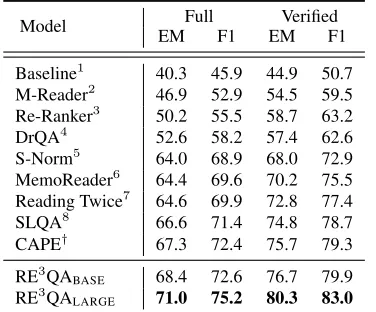
Table 3: Results on the TriviaQA-Wikipedia test set: Joshi et al. (2017)1, Hu et al. (2018)2, Wang et al.(2018b)3,Chen et al.(2017)4,Clark and Gard-ner (2018)5, Back et al. (2018)6, Weissenborn et al.
(2017)7, and Yan et al. (2019)8. † indicates
unpub-lished works.
Model EM F1
S-Norm (Clark and Gardner,2018) 64.08 72.37 RE3QA
BASE 77.90 84.81
RE3QA
LARGE 80.71 87.20
Table 4: Results on the SQuAD-document dev set.
ing component. As for evaluating the performance of reading and reranking, we measure the exact match (EM) accuracy and F1 score calculated be-tween the final prediction and gold answers. Baselines We construct two pipelined baselines (denoted as BERTPIPE and BERTPIPE*) to investi-gate the context inconsistency problem. Both sys-tems contain exactly the same components (e.g., retriever, reader, and reranker) as ours, except that they are trained separately. For BERTPIPE, the reader is trained on the context retrieved by an IR engine. As for BERTPIPE*, the reading context is obtained using the trained neural retriever.
5 Evaluation
5.1 Main Results
Table 3summarizes the results on the test set of TriviaQA-Wikipedia dataset. As we can see, our best model achieves 71.0 EM and 75.2 F1, firmly outperforming previous methods. Besides, Joshi et al. (2017) show that the evidence documents contain answers for only 79.7% of questions in the Wikipedia domain, suggesting that we are ap-proaching the ceiling performance of this task.
Model TriviaQA-unfilteredEM F1 SQuAD-openEM F1
DrQA1 32.3 38.3 27.1
-R32 47.3 53.7 29.1 37.5
DS-QA3 48.7 56.3 28.7 36.6
Re-Ranker4 50.6 57.3 -
-MINIMAL5 - - 34.7 42.5
Multi-Step6 51.9 61.7 31.9 39.2
S-Norm7 61.3 67.2 -
-HAS-QA8 63.6 68.9 -
-BERTserini9 - - 38.6 46.1
RE3QA
BASE 64.1 69.8 40.1 48.4
RE3QA
LARGE 65.5 71.2 41.9 50.2
Table 5: Results on TriviaQA-unfiltered test set and SQuAD-open dev set:Chen et al.(2017)1,Wang et al.
(2018a)2,Lin et al.(2018)3,Wang et al.(2018b)4,Min et al.(2018)5, Das et al.(2019)6,Clark and Gardner
(2018)7,Pang et al.(2019)8andYang et al.(2019)9.
Model TriviaQA-WikipediaF1 Speed SQuAD-documentF1 Speed
RE3QA 72.68 4.62 84.81 3.76
BERTPIPE 71.13 2.05 83.65 1.78
BERTPIPE* 71.59 2.08 84.04 1.82
Table 6: Comparison between our approach and the pipelined method. “Speed” denotes the number of in-stances processed per second during inference.
However, the score of 80.3 EM on the verified set implies that there is still room for improvement.
We also report the performance on document-level SQuAD in Table 4 to assess our approach in single-document setting. We find our approach adapts well: the best model achieves 87.2 F1. Note that the BERTLARGE model has obtained 90.9 F1
on the original SQuAD dataset (single-paragraph setting), which is only 3.7% ahead of us.
Finally, to validate our approach in open-domain scenarios, we run experiments on the TriviaQA-unfiltered and SQuAD-open datasets, as shown in Table5. Again, RE3QA surpasses prior works by an evident margin: our best model achieves 71.2 F1 on TriviaQA-unfiltered, and out-performs a BERT baseline by 4 F1 on SQuAD-open, indicating that our approach is effective for the challenging multi-document RC task.
5.2 Model Analysis
In this section, we analyze our approach by an-swering the following questions6: (a) Is
end-to-6The BERT
[image:7.595.89.277.63.219.2]Figure 3: F1 score on TriviaQA-Wikipedia and SQuAD-document w.r.t different number of retrieved segments.
J TriviaQA-Wikipedia SQuAD-document
MAP Top-3 Top-5 F1 Speed MAP Top-3 Top-5 F1 Speed
1 67.4 81.5 87.3 69.2 5.9 39.2 47.5 66.8 54.4 5.6
2 75.3 87.4 91.1 71.7 5.1 80.3 89.4 94.0 83.4 4.7
3 77.8 88.8 91.8 72.7 4.6 88.7 94.5 96.8 84.8 3.8
4 80.0 89.2 92.1 71.6 4.2 90.2 95.0 97.2 84.3 3.0
[image:8.595.101.494.237.341.2]5 80.6 89.6 92.3 71.7 3.5 91.0 95.6 97.6 84.3 2.3
Table 7: Retrieving performance with different number of blocksJused for the early-stopped retriever.
end network superior to the pipeline system? (b) How does each component contribute to the per-formance? (c) Is early-stopped retriever sufficient for returning high-quality segments? (d) How does the reranking loss affect the answer reranker?
Comparison with pipelined method First, we compare our approach with the pipelined baselines on TriviaQA-Wikipedia and SQuAD-document development sets in Table 6. Our approach out-performs BERTPIPE by 1.6/1.2 F1 on two datasets respectively, and is also 2.3/2.1 times faster dur-ing inference. Moreover, RE3QA also beats the BERTPIPE* baseline by 1.1/0.8 F1, even as the pa-rameters of retriever and reader are trained sequen-tially in BERTPIPE*. The above results confirm that the end-to-end training can indeed mitigate the context inconsistency problem, perhaps due to multi-task learning and parameter sharing. Our approach can also obtain inference speedups be-cause of the fact that it avoids re-encoding inputs by sharing contextualized representations.
Ablation study To show the effect of each indi-vidual component, we plot the F1 curve with re-spect to different number of retrieved segments in Figure 3. We notice that all curves become sta-ble as more text are used, implying that our
ap-proach is robust across different amounts of con-text. Next, to evaluate the reranker, we only consider the retrieving and reading scores, and the performance decreases by 2.8/0.8 F1 on two datasets after the reranker is removed. To ablate the retriever, we select segments based on the TF-IDF distance instead. The results show that the F1 score reduces by about 3.3 and 2.5 points on two datasets after the ablation. Removing both the retriever and the reranker performs the worst, which only achieves 68.1/81.0 F1 on two datasets at peak. The above results suggest that combining retriever, reader, and reranker is crucial for achiev-ing promisachiev-ing performance.
Effect of early-stopped retriever We assess whether the early-stopped retriever is sufficient for the segment retrieving task. Table 7 details the retrieving and reading results with different num-ber of blocks J being used. As we can see, the
model performs worst but maintains a high speed when J is 1. As J becomes larger, the
retriev-ing metrices such as MAP, Top-3 and Top-5 sig-nificantly increase on both datasets. On the other hand, the speed continues to decline since more computations have been done during retrieving. A
Jof 6 eventually leads to an out-of-memory issue
Model TriviaQA-WikipediaEM F1 SQuAD-documentEM F1
RE3QA 68.51 72.68 77.90 84.81
w/o NMS 68.29 72.33 77.67 84.36 w/oyhard 67.36 71.87 77.26 84.17
w/oysof t 67.76 72.29 77.04 84.05
Table 8: Reranking performance with different abla-tions. yhardandysof t refer to the two labels used to
train the reranker.
achieves the best result when J reaches 3, and
starts to degrade asJ continues rising. We
exper-iment with the RE3QA
LARGE model and observe
similar results, where the bestJ is 6. A likely
rea-son for this observation may be that sharing high-level features with the retriever could disturb the reading prediction. Therefore, the above results demonstrate that an early-stopped retriever with a relatively smallJis able to reach a good trade-off
between efficiency and effectiveness.
Effect of answer reranker Finally, we run our model under different reranking ablations and re-port the results in Table 8. As we can see, removing the non-maximum suppression (NMS) algorithm has a negative impact on the perfor-mance, suggesting it is necessary to prune highly-overlapped candidate answers before reranking. Ablating the hard label leads to a drop of 0.81 and 0.64 F1 scores on two datasets respectively, while the F1 drops by 0.39 and 0.76 points after remov-ing the soft label. This implies that the hard label has a larger impact than the soft label on the Triv-iaQA dataset, but vice versa on SQuAD.
6 Conclusion
We present RE3QA, a unified network that an-swers questions from multiple documents by con-ducting the retrieve-read-rerank process. We de-sign three components for each subtask and show that an end-to-end training strategy can bring in additional benefits. RE3QA outperforms the pipelined baseline with faster inference speed and achieves state-of-the-art results on four challeng-ing readchalleng-ing comprehension datasets. Future work will concentrate on designing a fast neural pruner to replace the IR-based pruning component, de-veloping better end-to-end training strategies, and adapting our approach to other datasets such as Natural Questions (Kwiatkowski et al.,2019).
Acknowledgments
We would like to thank Mandar Joshi for his help with TriviaQA submissions. We also thank anony-mous reviewers for their thoughtful comments and helpful suggestions. This work was supported by the National Key Research and Development Pro-gram of China (2018YFB0204300).
References
Seohyun Back, Seunghak Yu, Sathish Reddy Indurthi, Jihie Kim, and Jaegul Choo. 2018. Memoreader: Large-scale reading comprehension through neural memory controller. InProceedings of EMNLP.
Dasha Bogdanova and Jennifer Foster. 2016. This is how we do it: Answer reranking for open-domain how questions with paragraph vectors and minimal feature engineering. InProceedings of NAACL.
Rich Caruna. 1993. Multitask learning: A knowledge-based source of inductive bias. In Proceedings of ICML.
Danqi Chen, Adam Fisch, Jason Weston, and Antoine Bordes. 2017. Reading wikipedia to answer open-domain questions. InProceedings of ACL.
Eunsol Choi, Daniel Hewlett, Jakob Uszkoreit, Illia Polosukhin, Alexandre Lacoste, and Jonathan Be-rant. 2017. Coarse-to-fine question answering for long documents. InProceedings of ACL.
Christopher Clark and Matt Gardner. 2018. Simple and effective multi-paragraph reading comprehen-sion. InProceedings of ACL.
Rajarshi Das, Shehzaad Dhuliawala, Manzil Zaheer, and Andrew McCallum. 2019. Multi-step retriever-reader interaction for scalable open-domain question answering. InProceedings of ICLR.
Jacob Devlin, Ming-Wei Chang, Kenton Lee, and Kristina Toutanova. 2018. Bert: Pre-training of deep bidirectional transformers for language understand-ing.arXiv preprint arXiv:1810.04805.
Bhuwan Dhingra, Kathryn Mazaitis, and William W Cohen. 2017. Quasar: Datasets for question an-swering by search and reading. arXiv preprint arXiv:1707.03904.
Matthew Dunn, Levent Sagun, Mike Higgins, V Ugur Guney, Volkan Cirik, and Kyunghyun Cho. 2017. Searchqa: A new q&a dataset augmented with context from a search engine. arXiv preprint arXiv:1704.05179.
Daniel Hewlett, Llion Jones, Alexandre Lacoste, et al. 2017. Accurate supervised and semi-supervised ma-chine reading for long documents. InProceedings of EMNLP.
Phu Mon Htut, Samuel R Bowman, and Kyunghyun Cho. 2018. Training a ranking function for open-domain question answering. In Proceedings of NAACL.
Minghao Hu, Yuxing Peng, Zhen Huang, Xipeng Qiu, Furu Wei, and Ming Zhou. 2018. Reinforced mnemonic reader for machine reading comprehen-sion. InProceedings of IJCAI.
Minghao Hu, Yuxing Peng, Zhen Huang, Nan Yang, Ming Zhou, et al. 2019. Read+ verify: Machine reading comprehension with unanswerable ques-tions. InProceedings of AAAI.
Robin Jia and Percy Liang. 2017. Adversarial exam-ples for evaluating reading comprehension systems. InProceedings of EMNLP.
Mandar Joshi, Eunsol Choi, Daniel S Weld, and Luke Zettlemoyer. 2017. Triviaqa: A large scale distantly supervised challenge dataset for reading comprehen-sion. InProceedings of ACL.
Tom Kwiatkowski, Jennimaria Palomaki, Olivia Red-field, Michael Collins, Ankur Parikh, Chris Alberti, Danielle Epstein, Illia Polosukhin, Matthew Kelcey, Jacob Devlin, Kenton Lee, Kristina N. Toutanova, Llion Jones, Ming-Wei Chang, Andrew Dai, Jakob Uszkoreit, Quoc Le, and Slav Petrov. 2019. Natu-ral questions: a benchmark for question answering research. TACL.
Kenton Lee, Luheng He, Mike Lewis, and Luke Zettle-moyer. 2017. End-to-end neural coreference resolu-tion. arXiv preprint arXiv:1707.07045.
Yankai Lin, Haozhe Ji, Zhiyuan Liu, and Maosong Sun. 2018. Denoising distantly supervised open-domain question answering. InProceedings of ACL.
Sewon Min, Victor Zhong, Richard Socher, and Caim-ing Xiong. 2018. Efficient and robust question an-swering from minimal context over documents. In
Proceedings of ACL.
Liang Pang, Yanyan Lan, Jiafeng Guo, Jun Xu, Lixin Su, and Xueqi Cheng. 2019. Has-qa: Hierarchical answer spans model for open-domain question an-swering. InProceedings of AAAI.
Pranav Rajpurkar, Jian Zhang, Konstantin Lopyrev, and Percy Liang. 2016. Squad: 100,000+ questions for machine comprehension of text. InProceedings of EMNLP.
Shaoqing Ren, Kaiming He, Ross Girshick, and Jian Sun. 2015. Faster r-cnn: Towards real-time object detection with region proposal networks. In Pro-ceedings of NIPS.
Azriel Rosenfeld and Mark Thurston. 1971. Edge and curve detection for visual scene analysis. IEEE Transactions on computers, (5):562–569.
Sebastian Ruder. 2017. An overview of multi-task learning in deep neural networks. arXiv preprint arXiv:1706.05098.
Richard S Sutton and Andrew G Barto. 2011. Rein-forcement learning: An introduction.
Ashish Vaswani, Noam Shazeer, Niki Parmar, Jakob Uszkoreit, Llion Jones, Aidan N Gomez, Łukasz Kaiser, and Illia Polosukhin. 2017. Attention is all you need. InProceedings of NIPS.
Shuohang Wang, Mo Yu, Xiaoxiao Guo, Zhiguo Wang, Tim Klinger, Wei Zhang, Shiyu Chang, Gerald Tesauro, Bowen Zhou, and Jing Jiang. 2018a. R3: Reinforced ranker-reader for open-domain question answering. InProceedings of AAAI.
Shuohang Wang, Mo Yu, Jing Jiang, Wei Zhang, Xiaoxiao Guo, Shiyu Chang, Zhiguo Wang, Tim Klinger, Gerald Tesauro, and Murray Campbell. 2018b. Evidence aggregation for answer re-ranking in open-domain question answering. InProceedings of ICLR.
Wenhui Wang, Nan Yang, Furu Wei, Baobao Chang, and Ming Zhou. 2017. Gated self-matching net-works for reading comprehension and question an-swering. InProceedings of ACL.
Yizhong Wang, Kai Liu, Jing Liu, Wei He, Yajuan Lyu, Hua Wu, Sujian Li, and Haifeng Wang. 2018c. Multi-passage machine reading comprehension with cross-passage answer verification. In Proceedings of ACL.
Zhen Wang, Jiachen Liu, Xinyan Xiao, Yajuan Lyu, and Tian Wu. 2018d. Joint training of candidate extraction and answer selection for reading compre-hension. InProceedings of ACL.
Dirk Weissenborn, Tom´aˇs Koˇcisk`y, and Chris Dyer. 2017. Dynamic integration of background knowl-edge in neural nlu systems. arXiv preprint arXiv:1706.02596.
Ming Yan, Jiangnan Xia, Chen Wu, Bin Bi, Zhongzhou Zhao, Ji Zhang, Luo Si, Rui Wang, Wei Wang, and Haiqing Chen. 2019. A deep cascade model for multi-document reading comprehension. In Pro-ceedings of AAAI.
Wei Yang, Yuqing Xie, Aileen Lin, Xingyu Li, Luchen Tan, Kun Xiong, Ming Li, and Jimmy Lin. 2019. End-to-end open-domain question answering with bertserini. arXiv preprint arXiv:1902.01718. Adams Wei Yu, David Dohan, Minh-Thang Luong, Rui
Zhao, Kai Chen, Mohammad Norouzi, and Quoc V Le. 2018. Qanet: Combining local convolution with global self-attention for reading comprehension. In
Question:Which organisation was founded in Ontario,
Canada in 1897 by Adelaide Hoodless? Scores
Candidate Answers: Retrieving Reading Reranking
[1]Women’s Institute 0.517 11.226 2.093
[2]Young Women’s Christian Association 0.231 11.263 2.299
[3]Federated Women’s Institutes of Canada 0.426 11.267 1.742
[4]Victorian Order of Nurses 0.360 11.139 1.837
[5]National Council of Women 0.291 8.966 1.02
[image:11.595.87.514.65.196.2]. . . .
Table 9: A sampled case (ID: sfq 21220) from the TriviaQA-Wikipedia dev set shows that although candidate [2] and candidate [3] get higher reranking and reading scores, the candidate [1] is preferred by the retrieving component and is therefore chosen as the final answer. The ground truth answer is “Women’s Institute”.
Question:Hong Kong is one of two ‘special administrative
regions’ of China; what is the other? Scores
Candidate Answers: Retrieving Reading Reranking
[1]Macau 0.195 11.067 2.502
[2]Kowloon 0.346 11.175 1.795
[3]Kowloon, and the new territories 0.346 7.941 0
[4]Macau, China 0.323 7.812 0
[5]Taiwan 0.224 5.926 0.028
. . . .
Table 10: A sampled case (ID: sfq 10640) from the TriviaQA-Wikipedia dev set shows that although the candidate [2] gets higher retrieving and reading scores, the candidate [1] is chosen as the final answer since it has the highest reranking score. The ground truth answer is “Macau”.
A Case Study
To demonstrate how each component takes ef-fect when predicting the final answer, we conduct some qualitative case studies sampled from the RE3QA
LARGE model on the TriviaQA-Wikipedia
development set. For each question, we list top-5 candidate answers along with their retrieving, reading, and reranking scores.
As shown in Table9, we first notice that the top-ranked predictions have highly-relevant semantics and share the same linguistic pattern. As a result, the top-4 candidates contain very similar reading scores from 11.1 to 11.3, which matches the ob-servations ofClark and Gardner (2018). A likely reason of this phenomenon is that reading com-prehension models are easily fooled by confusing distractors (also referred as adversarial examples mentioned byJia and Liang(2017)). Under such circumstance, it is crucial to perform additional answer verifications to identify the final answer. In this example, we can see that the retriever becomes
the key factor when the reader and reranker are distracted by confusing candidates (e.g., the sec-ond and third predictions). By taking the weighted sum of the three scores, our model eventually pre-dicts the correct answer since the first prediction has the largest retrieving score.
[image:11.595.82.520.262.395.2]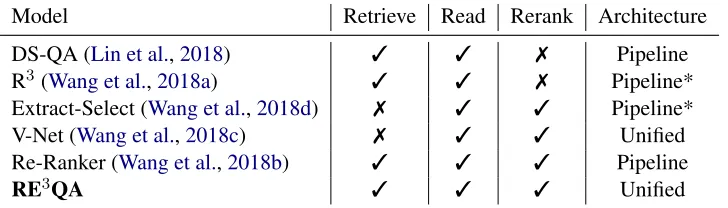

![Table 10: A sampled case (ID: sfq 10640) from the TriviaQA-Wikipedia dev set shows that although the candidate[2] gets higher retrieving and reading scores, the candidate [1] is chosen as the final answer since it has the highestreranking score](https://thumb-us.123doks.com/thumbv2/123dok_us/175961.512707/11.595.87.514.65.196/sampled-triviaqa-wikipedia-candidate-retrieving-reading-candidate-highestreranking.webp)
