University of Warwick institutional repository:http://go.warwick.ac.uk/wrap
A Thesis Submitted for the Degree of PhD at the University of Warwick
http://go.warwick.ac.uk/wrap/74094
This thesis is made available online and is protected by original copyright. Please scroll down to view the document itself.
Energy Conscious Adaptive Security
Chryssanthi Taramonli
A thesis submitted for the degree of
Doctor of Philosophy
November 2014
i
Table of Contents
Table of Contents ... i
List of Figures ... v
List of Tables... vii
Abbreviations ... viii
Terms introduced for this work ... ix
Acknowledgements ... x
Abstract ... xi
Chapter 1 - Introduction ... 1
1.1. Motivation ... 2
1.2. Research questions ... 3
1.3. Aims and objectives ... 3
1.4. Scope ... 4
1.5. Organization of this thesis ... 5
Chapter 2 - Background and literature review ... 7
2.1. Secure communications ... 8
2.1.1. Authentication... 9
2.1.2. Authorization ... 10
2.1.3. Cryptography ... 10
2.1.4. Encryption... 10
2.1.5. Security primitives ... 11
2.1.6. Stream ciphers ... 12
2.1.7. Block ciphers ... 12
2.1.8. Modes of operation ... 13
2.1.9. Encryption algorithms ... 15
2.1.10. Padding schemes ... 18
2.2. Energy ... 18
2.2.1. Energy efficiency ... 19
2.2.2. Energy consumption computation ... 20
2.3. Adaptive security ... 20
2.4. Relevant work ... 22
2.4.1. Green Cryptography ... 22
ii
2.4.3. Minimalism in Cryptography ... 26
2.4.4. Other efforts ... 27
2.5. Methods used ... 32
2.5.1. Reliability function ... 32
2.5.2. Concentration inequalities ... 33
2.5.2.1. Markov’s inequality ... 34
2.5.2.2. Chebyshev’s inequality ... 34
2.5.2.3. Chernoff bounds ... 35
2.5.2.4. Hoeffding’s inequality ... 36
2.5.2.5. Bennett’s inequality ... 37
2.5.2.6. Bernstein’s inequality ... 37
2.5.3. Statistical analysis ... 38
2.5.3.1. Correlation ... 38
2.5.3.2. Regression analysis ... 39
2.5.4. Betweenness Centrality ... 39
2.6. Closing remarks ... 40
Chapter 3 - Concept and implementation ... 42
3.1. Concept ... 42
3.2. Implementation overview ... 46
3.2.1. Simulation ... 46
3.2.2. Data analysis ... 48
3.3. Contribution ... 50
Chapter 4 - Reliability approach ... 52
4.1. Reliability ... 53
4.2. Methodology ... 55
4.3. Implementation and results ... 59
4.3.1. Example 1: Upper quartile time threshold ... 59
4.3.2. Example 2: 500 µs time threshold ... 61
4.4. Optimum threshold ... 64
4.4.1. Proposed algorithm ... 65
4.4.1.1. Example 1: R ≤ 5% - Case 4 ... 66
4.4.1.2. Example 2: R ≤ 5% - Case 6 ... 67
4.4.1.3. Example 3: R ≤ 3% - Case 6 ... 68
iii
4.6. Discussion ... 78
Chapter 5 - Probabilistic bound approach ... 80
5.1. Bounds on the tail distribution ... 80
5.2. Bound calculation – Chebyshev’s inequality ... 83
5.3. Bound calculation – Hoeffding’s inequality... 86
5.4. Bound calculation – Bennett’s inequality... 90
5.5. Bound calculation – Bernstein’s inequality ... 94
5.6. Results ... 97
5.6.1. Bounding the overall time – Upper Bound ... 99
5.6.1.1. Chebyshev’s – Cantelli’s bounds ... 99
5.6.1.2. Hoeffding’s bound ... 103
5.6.1.3. Bernstein’s and Bennett’s bounds... 105
5.6.1.4. Upper bound comparison for sum ... 108
5.6.2. Bounding the overall time – Two-sided bound ... 110
5.6.3. Bounding the mean time – Upper Bound ... 112
5.6.3.1. Chebyshev’s – Cantelli’s bounds ... 112
5.6.3.2. Hoeffding’s bound ... 118
5.6.3.3. Bennett’s – Bernstein’s ... 120
5.6.3.4. Upper bound comparison for mean ... 122
5.6.4. Bounding the mean time – Two-sided bound ... 125
5.7. Discussion ... 127
Chapter 6 - Statistical considerations ... 130
6.1. Variables and transformation ... 130
6.2. Assumptions and exploratory data analysis ... 131
6.2.1. Linearity ... 132
6.2.2. Normality ... 134
6.2.3. Independence ... 138
6.2.4. Homoscedasticity ... 139
6.2.5. Non multi-collinearity ... 141
6.3. Regression model ... 144
6.4. Goodness of fit ... 148
6.5. Discussion ... 149
Chapter 7 - Betweenness Centrality ... 152
iv
7.2. Implementation and results ... 156
7.3. Discussion ... 163
Chapter 8 - Conclusions and future work ... 169
References ... 177
v
List of Figures
Figure 3.1: Cipher class, retrieved from [73]. ... 47
Figure 4.1: Encryption system S. ... 53
Figure 4.2: Adaptive security scheme algorithm. ... 56
Figure 4.3: ECDF for sample cases 4, 6, 119, 321, 374... 62
Figure 4.4: ECDF and Reliability – Case 4. ... 63
Figure 4.5: Optimum threshold selection algorithm. ... 66
Figure 4.6: ECDF and Optimum threshold for R ≤ 0.05 – Case 4. ... 67
Figure 4.7: ECDF and Optimum threshold for R ≤ 0.05 – Case 6. ... 68
Figure 4.8: ECDF and Optimum threshold for R ≤ 0.03 – Case 6. ... 69
Figure 4.9: Theoretical 𝑆4 vs estimated 𝑆̂4 distribution... 71
Figure 4.10: Theoretical 𝑆6 vs estimated 𝑆̂6 distribution... 71
Figure 4.11: 𝑆̂4 vs 𝑆̂6 density plot. ... 72
Figure 4.12: 𝑊1 density plot. ... 75
Figure 4.13: 𝑄1, 𝑆4, 𝑆6 density plot. ... 77
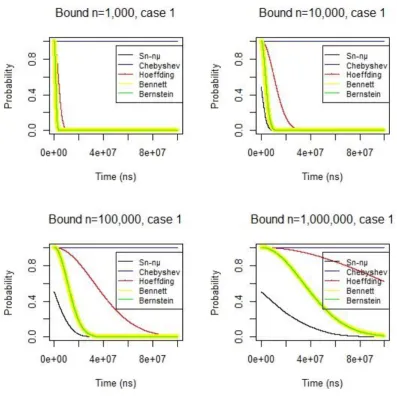
Figure 5.1: 𝐹̅𝐵 for n variation – Case 1. ... 100
Figure 5.2: Right tail of 𝐹̅𝐵 for 𝑛 variation – Case 1. ... 102
Figure 5.3: Right tail of 𝐹̅𝐵 and Chebyshev’s bound – Case 1. ... 103
Figure 5.4: Right tail of 𝐹̅𝐵 and Hoeffding’s bound – Case 1. ... 104
Figure 5.5: Right tail of 𝐹̅𝐵 and Bernstein’s bound – Case 1. ... 106
Figure 5.6: Bernstein’s and Bennett’s bound – Case 1. ... 107
Figure 5.7: Right tail of 𝐹̅𝐵 vs Bounds – Case 1. ... 109
Figure 5.8: Right tail of 𝐹̅𝐷and bounds – Case 1. ... 111
Figure 5.9: 𝐹̅𝐴 for n variation – Case 1. ... 113
Figure 5.10: Right tail of 𝐹̅𝐴 for n variation – Case 1. ... 114
Figure 5.11: Right tail of 𝐹̅𝐴 and Chebyshev’s bound – Case 1... 115
Figure 5.12: Probability 𝛾 vs Sample size n for Chebychev’s bound – Case 1. ... 116
Figure 5.13: Probability 𝛾 vs Accuracy 𝜀 for Chebyshev’s bound – Case 1. ... 117
Figure 5.14: Right tail of 𝐹̅𝐴 and Hoeffding’s bound – Case 1. ... 118
Figure 5.15: Probability 𝛾 vs Sample size n for Hoeffding’s bound – Case 1. ... 119
Figure 5.16: Probability 𝛾 vs Accuracy 𝜀 for Hoeffding’s bound – Case 1. ... 120
vi
Figure 5.18: Probability 𝛾 vs Sample size n – Case 1. ... 122
Figure 5.19: Right tail of 𝐹̅𝐴 vs bounds – Case 1. ... 123
Figure 5.20: Right tail of 𝐹̅𝐶 vs bounds – Case 1... 126
Figure 6.1: Boxplot of ENERGY and DATA. ... 133
Figure 6.2: Normal probabiltiy plot. ... 135
Figure 6.3:Standardized residuals histogram. ... 136
Figure 6.4: Residual scatterplot... 138
Figure 6.5: Standardized residual scatterplot. ... 140
Figure 6.6: Estimated energy vs observed energy. ... 150
Figure 7.1: Possible paths in a graph. ... 153
Figure 7.2: Betweenness centrality algorithm. ... 155
Figure 7.3: Encryption parameters’ connectivity. ... 156
Figure 7.4: Shortest paths and most central nodes: R = 0.4. ... 158
Figure 7.5: Shortest paths and most central nodes: R = 0.3. ... 159
Figure 7.6: Shortest paths and most central nodes: R = 0.2. ... 161
Figure 7.7: Shortest paths and most central nodes: R = 0.1. ... 162
vii
List of Tables
Table 3.1: Key size variation ... 48
Table 4.1: Simulated data sample ... 60
Table 4.2: Simulated data sample for a set threshold of 500 µs ... 61
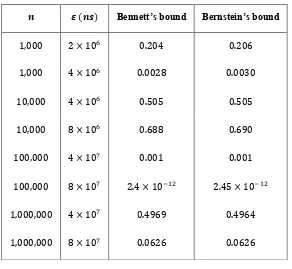
Table 5.1: Bennett’s and Bernstein’s values for various 𝑛 and ε. ... 108
Table 5.2: 𝑃(𝑆𝑛− 𝑛𝜇 ≥ 𝑎𝑛) investigation using 𝑛 and 𝑎 variation. ... 110
Table 5.3: 𝐹̅𝐷, Bernstein’s, Chebyshev’s and Hoeffding’s values for various 𝑛 and 𝜀. ... 112
Table 5.4: 𝑃(𝜇̂ − 𝜇 ≥ 𝜀) investigation for n and 𝛼 variation. ... 124
Table 5.5: 𝐹̅𝐶, Bernstein’s, Chebyshev’s and Hoeffding’s values for various n and 𝜀. ... 127
Table 6.1: Correlations ... 134
Table 6.2: Statistics ... 137
Table 6.3: Model summary and Durbin-Watson test for independence ... 139
Table 6.4: Coefficients and Collinearity statistics ... 141
Table 6.5: Collinearity diagnostics ... 143
Table 6.6: ANOVA table ... 146
Table 7.1: Betweenness centrality: R = 0.4. ... 158
Table 7.2: Betweenness centrality: R = 0.3. ... 160
Table 7.3: Betweenness centrality: R = 0.2. ... 162
Table 7.4: Betweenness centrality for R = 0.1. ... 163
Table 7.5: Most significant parameters ... 164
viii
Abbreviations
AES ANOVA
Advanced Encryption Standard
Analysis of Variance
CBC Cipher Block Chaining
CDF Cumulative Density Function
CFB Cipher text Feedback
CLT Central Limit Theorem
CPU Central Processing Unit
DES DESL
Data Encryption Standard
Data Encryption Standard Light
ECB Electronic Codebook
ECDF I.I.D.
Empirical Cumulative Density Function
Independent and Identically Distributed
IP Internet Protocol
IV Initialization Vector
JCA JCE MANET
Java Cryptography Architecture
Java Cryptography Extension
Mobile Ad hoc Network
NIST National Institute of Standards and Technology OFB P-box Output Feedback Permutation box PIN PDF RFID
Personal Identification Number
Probability Density Function
Radio Frequency Identification
RAM RC2 R.V S-box
Random Access Memory
Rivest Cipher
Random Variable
Substitution box
SPN SPSS
Substitution Permutation Network
ix
SSL TDES
Secure Sockets Layer
Triple Data Encryption Standard
VIF Variance Inflation Factor
WSN Wireless Sensor Network
XOR Exclusive OR
Terms introduced for this work
Encryption parameters Data size, Key size, Mode of operation, Padding scheme Security mode/case Combination of encryption parameters
Security requirement Encryption parameters specified by the user Time threshold
Energy threshold Lifetime
Reliability
Optimum threshold
Maximum encryption time desired by the user
Maximum energy consumption desired by the user
Probability that encryption will finish prior to a threshold
Probability that encryption will continue after a threshold
x
Acknowledgements
First and foremost, I would like to express my sincere gratitude to my supervisors,
Prof. Roger J. Green and Dr. Mark S. Leeson, for their help and guidance throughout
this work. I am gratefully indebted to them for their support and valuable advice
along the way.
I would also like to thank my parents for their continuous support and understanding
throughout my studies.
Last but not least, I would like to thank my fiancé whose conversation with has
enabled me to expand the perspectives of this work, but most importantly I would
like to thank him for his constant encouragement, patience and for having faith in
xi
Abstract
The rapid growth of information and communication systems in recent years has
brought with it an increased need for security. Meanwhile, encryption, which
constitutes the basis of the majority of security schemes, may imply a significant
amount of energy consumption. Encryption algorithms, depending on their
complexity, may consume a significant amount of computing resources, such as
memory, battery power and processing time. Therefore, low energy encryption is
crucial, especially for battery powered and passively powered devices. Thus, it is of
great importance to achieve the desired security possible at the lowest cost of energy.
The approach advocated in this thesis is based on the lack of energy implication in
security schemes. It investigates the optimum security mode selection in terms of the
energy consumption taking into consideration the security requirements and suggests
a model for energy-conscious adaptive security in communications. Stochastic and
statistical methods are implemented – namely reliability, concentration inequalities,
regression analysis and betweenness centrality – to evaluate the performance of the
security modes and a novel adaptive system is proposed as a flexible decision
making tool for selecting the most efficient security mode at the lowest cost of
energy. Several symmetric algorithms are simulated and the variation of four
encryption parameters is examined to conclude the selection of the most efficient
algorithm in terms of energy consumption. The proposed security approach is
twofold, as it has the ability to adjust dynamically the encryption parameters or the
energy consumption, either according to the energy limitations or the severity of the
1
Chapter 1 - Introduction
The rapid evolution of communication and the subsequent rise of security threats in
recent years, have led to the development and application of a plethora of security
schemes. To facilitate secret communication, modern security systems rely mainly on
encryption, the process of encoding information in a way that only the legitimate
receiver can decode.
Communication over networks often requires propagation of sensitive information
between parties. Online transactions, shopping, internet banking, Wireless Sensor
Networks (WSN) for healthcare monitoring, are only few cases that require
propagation of sensitive information, such as contact details, medical records,
passwords and Personal Identification Numbers (PINs). Furthermore, with the
evolution of Cloud Computing, that provides shared computing resources and data
storage in a network, encryption is a vital concern regarding the security of the data.
Therefore, the incredible growth of data communications and complexity of modern
communication systems, as well as the resulting growth of security threats, has led to
the development of complex and time consuming encryption algorithms. The latter,
however, depending on the complexity of the algorithm, may consume a significant
amount of computing resources, such as memory, processing time and battery power
[1]. The key challenge in providing low energy encryption solutions is subject to the
offset between minimum energy consumption and maximum encryption strength [2].
Hence, investigating and designing energy efficient encryption systems is necessary in
2
1.1. Motivation
Knowledge about the optimum selection of the most efficient encryption algorithm
under specific security restrictions would help in designing systems that can adjust the
security level, according to the desired level of strength while taking into
consideration the energy implications. Consequently, the relationship between energy
consumption and encryption parameters have to be investigated and modelled. In this
work this issue is addressed and the performance of the encryption schemes for all
available security options is investigated.
Traditional approaches mainly cope with maintaining a high level of confidentiality
and along this line a great deal of effort is put in achieving high secrecy. However, the
significant implication of energy consumption is not taken into consideration [2].
Therefore, modern approaches should bring together encryption strength and energy
saving. Existing approaches that take into consideration the encryption energy cost are
mainly based on experimental comparisons of encryption parameters in terms of
effectiveness and provide results on their behaviour with respect to their impact on
energy consumption. Although such efforts are very interesting, as demonstrated in
[3], there is an inherent need to develop global metrics to be used in specifying the
strength of encryption algorithms.
In spite of the fact that most authors use the individual performance of the encryption
parameters as factors to compare and rank algorithms, it does not seem reasonable to
consider the overall energy performance of the encryption system in complete
isolation from security [1] and [2]. This further stresses the need for a global quality
factor [3] and explains the importance of the development of a decision making
3
consumption. The latter statement is based on the fact that system energy consumption
depends on the combination of parameters not just on their individual impact [4].
The purpose of this thesis is to address all these issues and solve the problem
associated with the lack of the energy implication in modern security techniques.
1.2. Research questions
The aim of this research is to answer the following research questions:
1. Can the adaptability of encryption systems be based on the energy
consumption?
2. Does the combination of modelling techniques, improvement strategies and
verification methods facilitate the development of energy conscious adaptive
security?
3. Can energy conscious adaptive security be integrated into a formal decision
making process?
1.3. Aims and objectives
The aims of this thesis concern the maximization of encryption performance in terms
of energy consumption management, taking into consideration several inter-related
factors. It is intended to develop a generic security framework for the decision making
regarding the most efficient security mode selection. To this end, the following
4
1. To identify the limitations of existing security approaches
2. To deploy stochastic and statistical analysis using several mathematical
methods
3. To build a model that represents the encryption components and can be utilised
to estimate the energy consumption
4. To examine the impact of the encryption parameters on energy consumption
5. To investigate how a security framework can utilise this information to
maximize encryption performance
6. To develop a decision making tool for energy consumption management in
encryption systems
1.4. Scope
The approach advocated in this thesis is based on the lack of energy implication in
security schemes. In order to deal with this energy implication with a consistent
manner, this thesis adopts several stochastic and statistical methods. In this way, a
novel adaptive system is proposed as a flexible decision making tool for selecting the
most efficient security mode at the lowest cost of energy. This adaptive scheme
permits the interaction of the desired security with the energy constraints, allowing the
system to switch to the optimum security mode. The proposed security approach is
twofold, as the security mode can be adjusted either according to the severity of the
5
The proposed framework is generic, as it is not tied to any specific encryption scheme
or technology and could be therefore applied to any security system or device.
Although it would be particularly applicable to battery powered devices and passively
powered devices, where low energy encryption is crucial, it could also benefit
traditional computing devices. The suggested scheme is intended to assist in the
design, implementation, or management of encryption systems that need to adjust their
operation based on computational resources and security constraints. In addition, the
proposed energy conscious adaptive security scheme can be used in the evaluation
phase of an encryption system’s development life cycle, in order to assess the
effectiveness and performance of the encryption algorithms and/or parameters. This
could also prevent possible retrofitting after the final implementation of the system
and therefore avoid any costly modifications. Finally, although in this research five
symmetric algorithms are presented, the proposed scheme can be applied to other
symmetric or asymmetric algorithms as well. Furthermore, the variation of the
encryption parameters may include other or even more factors, depending on the
application and the parameters of interest for the specific experiment and/or analysis.
The key contribution of this work is a novel approach that stochastically and
statistically studies the overall influence of the configuration parameters on the total
energy consumption. The distinguishing feature of the work presented in this thesis is
the maximization of encryption system performance by energy consumption
management, taking into consideration several inter-related factors.
1.5. Organization of this thesis
6
security, energy and mathematical methods is presented, while previous work in low
energy encryption is reviewed. Chapter 3 describes the concept of how a global metric
for performance evaluation allows for optimal security mode selection. In Chapter 4,
the reliability model is presented, the limiting distribution of n encryption is analysed,
and the results of the experiments are discussed. Chapter 5 presents an extension of the
Reliability model, based on Chernoff bounds. Chebychev, Hoeffding, Bennett and
Bernstein bounds are used to investigate further the impact of n encryptions on the
energy consumption. Examples and results of this stochastic approach are included. In
Chapter 6, a statistical solution is proposed, based on regression. The model and
results obtained from the statistical analysis are also discussed. Chapter 7 deals with
the centrality approach, where the encryption system is treated as a graph and the
betweenness centrality that measures the significance of the encryption parameters is
examined. Finally, Chapter 8 presents the conclusions of this work and discusses
7
Chapter 2 - Background and literature review
The accelerated evolution of communication over networks as well as the consecutive
rising sophistication of security threats in recent years, have led to the development of
a wide variety of security approaches. With a view to achieving secret communication,
modern security frameworks rely heavily on encryption, the process of transforming
information into code, using mathematical formulas, in a way that only the authorised
person is able to decode. Failure to encrypt propagated data, may allow an attacker
who is sniffing the network's traffic, to eavesdrop the private communication between
the legitimate parties. The importance of encryption becomes even more crucial for the
propagation of sensitive data. Examples of sensitive information include, inter alia,
contact details, passwords and Personal Identification Numbers (PINs) for various
online transactions such as online shopping and internet banking, and medical records
for Wireless Sensor Networks (WSN) in healthcare monitoring. Web traffic analysis
could also reveal sensitive information about political opinions, religious beliefs,
sexual preferences or criminal records. Sensitive information, if compromised may
cause serious harm to the owner and therefore, sensitive data encryption is currently a
privacy and financial regulation for many organizations [5].
In addition to the above online transactions, security and privacy must also be
preserved for data that is stored, propagated and managed in modern cloud computing
technologies and services that provide shared computing resources and data storage in
a network. Encryption, which is the cornerstone of the security architecture, is
particularly important when dealing with large and complex data sets. Managing big
data from a security point of view may be a challenging task, due to the complexity in
the structure of the data that are stored and also due to the difficulty in their processing
8
computing services, modern data retrieval is also a vital aspect that has to be taken into
consideration when designing the security scheme of a system. This is especially true
for shared resources that host large amounts of data where a lack of adequate security
measures may result in security breaches.
Therefore, to ensure that an adequate level of security is provided for all the above
processes and services, the development of complex and time consuming encryption
algorithms is inevitable. However, depending on its complexity, an algorithm may
consume a significant amount of computing resources, such as memory, processing
time and battery power [1].
This chapter first provides an overview of communication security and protocols that
have been employed in recent years in order to defend against security threats. Also,
the notions of cryptography and cryptographic primitives are discussed. The chapter
also introduces the adaptive security concept addressed in this thesis and presents the
related work in the area of low energy encryption. Finally, the theory of the methods
used in the development of the energy conscious adaptive security scheme namely,
reliability theory, regression analysis, betweenness centrality, as well as the most
popular concentration inequalities are introduced [6].
2.1. Secure communications
In recent years, communication system numbers have grown exponentially in terms of
both devices and networks. Security, which is critical for ensuring protected
communication among systems, is therefore an important aspect to be considered.
9
information storage and networking [6]. Therefore, with the growth of networks and
communications, security has attracted considerable attention.
Security is the field of communications that consists of the provision and policies
utilized to provide the communication system the protection required to deter any kind
of threat [7]. It is widely recognised as a priority in the design and development of
today’s Information Technology systems, because threats such as malicious code and
computer hacking are a concern that has been increasing dramatically over the last
decade. There are various types of security attacks that a system may be exposed to,
such as the denial of service, unauthorized access and confidentiality breach.
Therefore, it is essential for a communication system to deploy several measures to
defend against such threats. The most commonly accepted security approach involves
three processes. These are Authentication, Authorization and Encryption.
2.1.1. Authentication
This is the first part of the security process, where users have to identify themselves
and provide verification of their identity. The most common means of user
authentication involves the use of a username and password. This is not the safest
means of demonstrating identity, as there are various forms of attacks that a hacker
may adopt to crack a password. For this reason, authentication technology is usually
integrated using hardware mechanisms, such as smart cards, or even biometric
solutions, e.g. fingerprint scans, and is also accompanied by other security processes
10
2.1.2. Authorization
Authorization is the process which after Authentication examines whether the user is
permitted to have access to the requested resource or not. Access to the specific
resource may be granted or denied, based on a wide variety of criteria. Other than the
use of a password, access control may depend on whether that user is a part of a
particular group or not [8].
2.1.3. Cryptography
Cryptography concerns communication in the presence of an adversary [9]. Secure
communications are commonly accomplished by utilizing security protocols which in
turn invariably employ cryptographic algorithms. The latter may include encryption
algorithms, which are used to provide authentication and privacy, as well as hash or
message digest algorithms that are used to provide message integrity [6].
2.1.4. Encryption
Encryption is the process that is used to algorithmically transform the data into an
unrecognizable format and can be achieved with the employment of encryption
algorithms. It involves obscuring information through the use of ciphers and rendering
it unreadable to the adversary without special knowledge [10]. The authorized
communicating party has to decode the encrypted data using a decryption key in order
to translate the encrypted data into recognizable information. Encryption complements
the authorization and authentication processes and is very important because it can
11
have failed or even in case that they are not at all considered in a security policy [11].
An encryption algorithm is a mathematical function that incorporates a keystream - a
sequence of random bits generated from the algorithm’s keyspace, which is the set of
all the possible keys. Although the level of secrecy of the encrypted data depends on
both the algorithm and the key, the encryption algorithm is known publicly. Therefore,
the key plays an important role in determining the security of the encrypted data. The
more possible keys that can be generated from the keyspace, the harder it becomes for
an attacker to guess which key has been used for encryption. For example, an
algorithm with a 128 bit key length offers 2128 possible keys. Encryption algorithms
can be divided into symmetric (private) key algorithms and asymmetric (public) key
algorithms. In the former, the sender and receiver must agree upon a key prior to
encryption. This private key which is usually a string of characters is then used by the
sender to encrypt a message and by the receiver to decrypt the result, known as the
ciphertext. In the latter, each party has two keys; one that is displayed publicly and one
that is kept private. The sender encrypts the message using the receiver’s public key
and only the intended recipient is able to decrypt the message [12].
2.1.5. Security primitives
Symmetric encryption or private key encryption is applied to achieve message
confidentiality. A secret key is used to encrypt the data and change the content in a
particular way. The key must be shared by both communicating parties. The sender
applies the encryption function to the data using the key to produce the cipher text.
The latter is sent instead of the original message to the receiver, which then applies the
decryption function using the same shared key. Message integrity is implicitly
12
[13]. Typical symmetric encryption algorithms include AES, DES, Triple DES, RC2
and Blowfish, which are introduced later in this chapter.
There are two fundamental types of symmetric algorithms: stream ciphers and block
ciphers.
2.1.6. Stream ciphers
Stream ciphers operate on streams of plaintext and ciphertext one bit at a time. Bits are
encrypted individually, by combining a bit from the key with a bit form the plaintext,
using the exclusive or operation (XOR). In stream cipher encryption, the same bit will
encrypt to a different bit every time it is encrypted, provided that a different
initialization vector is used. Stream ciphers operate via keystream generators, where, a
keystream is generated from a small initial key (seed) and is combined with the
plaintext to produce the ciphertext, using simple encryption transformations. A typical
encryption transformation is the XOR operation, which is applied to the keystream to
transform it into a pseudorandom bit stream which is then XORed with a stream of
plaintext bits to produce the stream of ciphertext bits. This encrypted stream can be
decrypted using the same random bit stream [14].
2.1.7. Block ciphers
In the case of block ciphers, the message is partitioned into data blocks of fixed length
and one block is encrypted at a time. If required, the blocks may be padded as well.
The blocks are then joined together, using a fixed encryption transformation, to make
13
therefore, the encryption of a plaintext bit depends on every other plaintext bit within
the same block. For older block ciphers the block size is 64 bits, while the block size
for relatively new designs is usually 128 bits [14].
As a block cipher encrypts plaintext in fixed-size n-bit blocks, for arbitrary length
messages that exceed the n-bit size that the cipher operates on, the simplest approach
is to partition the message into n-bit blocks and encrypt each of these separately. This
can be achieved by using different modes of operation that offer different properties.
The modes of operation describe how blocks interconnect with each other. Four of the
most common modes of operation namely ECB, CBC, CFB, and OFB, are discussed
below [13].
2.1.8. Modes of operation
The Electronic Codebook Mode (ECB) is the simplest mode of operation. In ECB
encryption, the plaintext is divided into blocks and each plaintext block is encrypted
separately. The forward cipher function is applied directly and independently to each
block of the plaintext. Therefore, any ciphertext block does not depend on any
previous plaintext block. The resulting sequence of output is the ciphertext. Regarding
the decryption, the inverse function is applied directly and independently to each block
of the ciphertext and the resulting sequence of output blocks is the plaintext. The
advantages of ECB are the simplicity of the operation, as well as the fact that multiple
blocks can be operated simultaneously. The disadvantage of this mode of operation is
that identical plaintext blocks are encrypted into identical ciphertext blocks and thus,
14
several times, the result of the encryption will contain several copies of the same
ciphertext and therefore the encryption might be insecure [15].
The Cipher Block Chaining (CBC) mode of operation features the combining of the
current plaintext blocks with the previous ciphertext blocks. Particularly, before being
encrypted to generate the ciphertext block, each plaintext block is XORed (chained)
with the previous ciphertext block. For the first block, an Initialization Vector (IV) is
required as a starting point. When a plaintext block is encrypted, the resulting
ciphertext is stored in a feedback register of the same size as the block size. Before the
next plaintext block is encrypted, it is XORed with the feedback register to become the
next input to the encrypting routine. This is repeated until the end of the message [14]
meaning that the encryption of each block depends on all the previous blocks. In this
mode, since the ciphertext is constantly changing, if a block of plaintext is repeated
twice, the result of the encryption of the two identical blocks will produce two
different ciphertext blocks. In decryption, the inverse cipher function is applied to the
corresponding ciphertext block and the resulting block is XORed with the previous
ciphertext block. In this mode, each ciphertext block depends on all the proceeding
plaintext blocks. [15]. The advantage of this CBC is that the attacker cannot deduce
the plaintext by looking at the encrypted blocks separately.
In the Cipher Feedback (CFB) mode of operation, the encryption of messages with
fewer bits than the block size is allowed. It features the feedback of successive
ciphertext blocks into the input blocks of the forward cipher to generate output blocks
that are XORed with consecutive bits of plaintext in order to produce the ciphertext.
Once the ciphertext is produced, it becomes the input block of the forward cipher to
produce the output block and so on. The method also needs an IV for the first block to
15
that the ciphertext depends on all the preceding plaintext [14]. The advantages of CFB
mode are that its operation is simple and that the input to the block cipher is
randomized. The disadvantage of CFB mode is that encryption cannot operate in
parallel.
The Output Feedback (OFB) mode of operation is a method of running a block cipher
as a synchronous stream cipher [14]. OFB mode operates in a similar fashion to CFB,
as it features the iteration of the forward cipher on the IV to generate an output block
that is XORed with the plaintext to produce the ciphertext. The size of the plaintext is
not necessarily an integer multiple of the block size, as in CFB mode. The difference
between CFB and OFB is that in CFB, it is the ciphertext that is fed back to the
register, whereas in OFB, it is the output block that is fed back to the register. In
encryption, the successive output blocks are produced from applying the forward
cipher function to the previous output blocks, and the output blocks are combined with
the corresponding plaintext blocks by the means of the XOR method to produce the
ciphertext blocks. Similarly, in decryption, the successive output blocks are produced
from applying the forward cipher function to the previous output blocks, and the
output blocks are XORed with the corresponding ciphertext blocks to recover the
plaintext blocks [15]. OFB does not allow for parallelism, but it prevents error
propagation, as an error in a ciphertext bit will only affect the corresponding plaintext
bit.
2.1.9. Encryption algorithms
The Data Encryption Standard (DES) is one of the most well-known symmetric key
16
called Lucifer. The US National Institute of Standards and Technology (NIST)
accepted it as a standard encryption algorithm and it officially became a federal
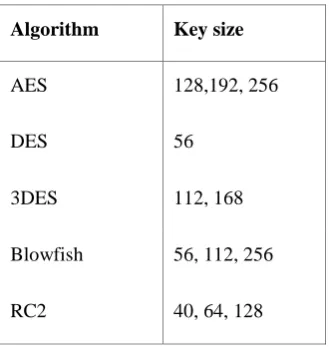
standard in 1976, with a 56-bit key [16]. DES processes plaintext blocks of 64 bits,
producing 64-bit ciphertext blocks. The secret key consists of 64 bits but only 56 bits
are effectively used. The remaining 8 bits are used for checking parity [11]. The
algorithm involves carrying out combinations, substitutions and permutations between
the plaintext secret key, while making sure the operations can be performed in both
directions for encryption and decryption accordingly. Since it became a standard,
many attacks and methods have been recorded that exploit weaknesses of DES,
making it an insecure block cipher. In 1998, a computer system was designed that was
able to break the DES encryption key in 3 days [17].
As an enhancement of DES, the Triple Data Encryption Standard (3DES) encryption
standard applies the DES cipher algorithm three times to each data block. 3DES
performs the DES encryption three times with different keys, making it more difficult
for an attacker to crack the encryption code. It has a 64 bit block size and a key length
of 56, 112 or 168 bits. In 3DES the encryption method is similar to the one in original
DES but three 64-bit keys are used instead of one, for an overall length of 192 bits.
Although 3DES is a more powerful version of DES and can be much more secure if
used properly, due to its complex computation it is three times slower than DES and
also slower than other block cipher methods [14].
The Advanced Encryption Standard (AES), which is one of the most popular
symmetric key algorithms, was proposed in 1997 by Daemen and Rijmen and
published in 2000 by the NIST [18]. It is a fast and flexible block cipher, as it can be
implemented on various platforms. It is based on the Rijndael cipher and supersedes
17
permutation (P-box) is a mathematical operation for rearranging the data, whilst the
substitution (S-box) is the operation for the replacement of a data unit with another.
There are several techniques for permutations and substitutions. AES operates on a 4
by 4 array of bytes, known as the state and has a fixed block size of 128 bits and a
variable key length of 128, 192, or 256 bits with 10, 12 and 14 rounds accordingly
[19].
Blowfish is a symmetric key block cipher designed by Schneier, in 1993, as a fast and
free alternative to the existing encryption algorithms. It operates on a 64-bit block size
of plaintext with a variable key length from 32 to 448 bits [14]. Blowfish is
unpatented, license-free, and is available free for all uses [12]. It is one of the most
common public domain encryption algorithms. As such, it has been subject to a
significant amount of cryptanalysis. Regarding its security, it is susceptible to attacks
on reflectively weak keys and therefore key selection is crucial. However, full
encryption has not been broken.
Rivest Cipher (RC2) is a variable key-size block cipher, designed in 1989 by Ron
Rivest for RSA Data Security, Inc. The cipher was initially intended as a drop-in
replacement for DES [20]. According to the designer company, software
implementations of RC2 are three times faster than DES. It is a 64- bit block cipher
with a variable key length ranging from 8 to 128 in steps of 8 bits. In addition, the
speed of the encryption is independent of the key size [14]. RC2 is based on the Feistel
network design, which involves 16 mixing and 2 mashing rounds. A mixing round
consists of interleaving an expanded key with the plaintext. A mashing round
combines different pieces of the expanded key and the result of the mixing rounds
18
2.1.10. Padding schemes
Block ciphers work on fixed sized encryption blocks. However, messages come in a
variety of lengths, sometimes leading to a shorter final block, as the message cannot be
divided into the required fixed size blocks [14]. Padding is the way to deal with this
problem. When the plaintext to be encrypted is not an exact multiple of the block size,
a padding string is added to the plaintext. For the decryption, the padding has to be
removed and so the padding scheme has to be known to both communicating parties.
Several padding schemes exist for the padding of the final block before encryption but
the commonest are ISO10126 and PKCS5.
In ISO10126, the padding is done at the end of the last block with random bytes. The
number of added bytes that are required in order to fill the block size is specified by
the last byte which is assigned the value of this number so that the receiver knows how
many bytes have been padded [14].
In the PKCS5 padding scheme, the number of bytes to be padded is equal to 8
-(number of bytes of plaintext) mod 8. This results in 1 to 8 bytes and depends on the
plaintext length. The number of bytes remaining to fill the required block size is added
at the end of the last block before encryption, all are assigned the value of the number
of the remaining bytes so that the receiver knows the number of padded bytes [11].
2.2. Energy
Encryption algorithms are computationally intensive, consuming a significant amount
of energy and computational resources that are crucial especially for battery powered
devices. Algorithms may result in a different level of energy efficiency under different
19
consuming less energy [22]. This can be shown if one considers the following.
Encryption strength is related to the difficulty of discovering the key, which in turn
depends on both the cipher used and the key size [23]. In general, longer keys provide
stronger security. Different ciphers may require different key lengths to achieve the
same security strength. Although a large key length could provide stronger security, it
could increase computation and thus energy consumption. Therefore, variations of the
algorithmic parameters, i.e. key size, mode of operation, data size and padding scheme
and so forth, may result in different levels of energy consumption.
2.2.1. Energy efficiency
Energy efficiency 𝑒 is defined as the energy dissipation that is essentially needed to
perform a certain function, divided by the actual total energy dissipation [24].
𝑒 =essential energy dissipation for a cerain functiontotal energy dissipation (2.1)
The energy efficiency of a certain function is independent of the actual
implementation and thus is independent of the issue whether an implementation is low
power. Low power is generally closely related to the hardware, whereas
energy-efficiency relates to the algorithm using the hardware [24].
Research in the area of energy efficiency was initially focussed on the physical layer,
as particularly for wireless devices, power consumption depends on the system
20
capacity is limited. Thus, the main objective of battery technology research is to
increase power capacity. However, this area has not experienced significant advances
in order to conform to the increasing energy demands [25]. Therefore, the solution lies
in the design of energy efficient schemes.
2.2.2. Energy consumption computation
To compute the energy consumption, the technique described by Naik and Wei [26] is
employed. Energy consumption can be represented by the product of the total number
of clock cycles taken by the encryption and the average current drawn by each CPU
clock cycle to deliver the basic encryption cost in units of ampere-cycles. To calculate
the total energy cost, this basic ampere-cycle encryption cost is divided by the
processor clock frequency in cycles per second to obtain the energy cost of encryption
in ampere-seconds. Multiplying this by the processor’s operating voltage produces the
energy cost () in Joules.
𝜀 =clock cycles×∗average current by CPU clock cycle×processorclock frequency ′s operating voltage (2.2)
2.3. Adaptive security
The rapid development and extensive application of computer networks have brought
new challenges in the area of information security [27]. In addition, the number and
complexity of security attacks in recent years has increased considerably. This raises
particular concerns on the ability of software development methods to deal with this
challenge. The traditional static security model and a single security policy cannot
21
taking into account the significance of dynamic elements implication. Initial efforts to
develop security systems employed static methods with fixed security measures.
Although this has led to the reduction of system vulnerabilities, with the advance of
the attacks in terms of complexity, the security measures had to be strengthened.
However, this advance in the security system brought with it an increased rate of
processing overhead and resource consumption of the system infrastructure, leading to
higher development and maintenance costs [27]. The solution to this obstacle is
therefore adaptive security. Adaptive systems dynamically change their behaviour in
order to respond to specific changes. There are several advantages in a system that is
able to adapt its security mechanisms compared to a static security system. For
example a system could respond to intrusions by strengthening its security policies. In
addition, different users need different level of security strength, for example the
department of defence network would require higher security than a personal webpage
[29]. Finally, different users have different access rights and therefore the adaptive
system could apply the appropriate restrictions by dynamically adapting users’ access.
What is more, mobile devices have experienced a period of rapid evolution in recent
years, bringing unprecedented changes in mobile applications. At the same time,
security risks have risen with the sophistication of mobile devices leading to the
development of several security schemes for mobile devices [30]. However,
encryption, which is the cornerstone of security, comes at a significant energy cost
[31]. Coupled with the aforementioned lack of progress in battery technology this has
led to a considerable decrease in battery life. According to [32] there is a widening
battery gap between trends in processor power consumption and improvements in
battery capacity. Thus, referring to low energy encryption for mobile devices, there is
22
The key challenge when designing adaptive security schemes is to find a common
point between the static behaviour of traditional security systems and the dynamic
security provision of adaptive systems.
The following section provides a background in adaptive security through discussion
of related literature.
2.4. Relevant work
This section provides an overview of previous work in the area of adaptive security
with regards to low energy consumption. This work has been influenced by several
research areas. The main and most relevant one is the comparison based approaches,
where researchers compare and rank encryption algorithms and encryption parameters
based on their impact on the energy consumption. The comparison is made either
between algorithms, or based on the variation of the encryption parameters of the same
algorithm. Furthermore, the concept of reusing existing ideas and principles that is
described in Green and lightweight cryptography, as well as in minimalism in
cryptography, has been adopted and is considered the main intention of this work.
First three resource conservation oriented areas of cryptography are introduced and
then general approaches in the area of low energy encryption, including the
comparison based approaches, are discussed.
2.4.1. Green Cryptography
Green cryptography suggests using ideas that have proven their merits. Encryption
23
while developing encryption should be based on the selection of existing algorithms,
according to the needs of the individual service. Green cryptography is aimed at
sustainable security within scalable implementations. It is about maximizing
confidence in cryptographic primitives while minimizing complexity in their
implementation [33].
In Troutman and Vincent’s work [33], a green approach to the design process is
suggested. They illustrate the concept of green cryptography using the pedigree of
AES and how essential elements of AES have been recycled in the design of its
successors. The aim of their work is to optimize the efforts of designers that have
already been spent on designing primitives and algorithms. To further support their
concept, they used Rijndael’s round transformation and compared to Twofish’s and
Serpent’s round transformation. They concluded that for different number of rounds,
the resulting numbers of full diffusion steps is varied, and therefore the ranking of the
compared ciphers is changed. This way, they showed that it is not always easy to
compare algorithms based on only one metric; instead, sometimes combinations of
metrics should be taken into consideration.
Several authors proposed security methods based on the concept of green
cryptography. A method for the construction of a compression function that could be
extended to a hash function, based on a fixed key block cipher was proposed in [34].
The authors analysed several schemes in terms of their security strength, by
performing attacks and they provided bounds on the security of each scheme.
In [35] the authors introduced the idea of using block ciphers to construct hash
functions and they proposed a method for constructing hash functions based on block
ciphers, where the hash code size is equal to the block size of the cipher and
24
secure schemes. The aim of their work was to minimize the design and
implementation effort. However, the first attempt to construct hash functions from
block ciphers was intended for the use with the DES [35].
Although these approaches mainly deal with specific ciphers and they present ways to
minimize the design and implementation effort, the concept of reusing existing
schemes is similar to the concept of this thesis. Specifically, although the proposed
scheme is not tight to any specific algorithms, the analysis in terms of their efficiency
can be used to identify the most energy efficient algorithm, for the requested security
service. In this way, it is not necessary to implement a new low energy encryption
algorithm; instead, based on its performance, the most efficient scheme can be
identified.
2.4.2. Lightweight Cryptography
In this area of cryptography the aim is to provide cryptographic algorithms and
primitives intended for use in devices with limited resources [36]. The main concern
of lightweight cryptography is extremely low resource requirements. Therefore, the
main idea is to find a compromise between low resource requirements, performance
and strength of cryptographic algorithms and primitives [36].
DESL, a new lightweight DES variant was proposed in [37], which is based on the
classical DES design, but uses a single box repeated eight times, instead of eight
S-boxes of the original DES. The reduction of the memory requirements for the S-box
storage made the light version of the original DES suitable for devices with
25
against certain types of attacks, this is not true for all types of attacks. DESL does not
provide high level of security, compared to its predecessor, the classical DES cipher.
In [38] the authors propose PRESENT, which is a Substitution-Permutation Network
based block cipher, suitable for small cyber-physical systems and is notable for its
compact size – 2.5 times smaller than AES. The cipher has been designed considering
security and power constraints as well. Although the main goal when designing
PRESENT was simplicity and hardware optimization, it provides adequate security for
applications with low security requirements. However, PRESENT is targeted to
specific applications in constrained environments, such as Radio Frequency
Identification (RFID) tags and sensor networks and therefore can only be applied to
applications that require moderate security levels.
The KLEIN family of lightweight block ciphers proposed by Gong et al. [39] is an
SPN cipher and was also designed for resource constrained devices. KLEIN offers can
have various key sizes and therefore can provide a moderate security level for several
applications, specifically in environments such as RFID tags and sensor networks.
Although it is resistant against specific cryptanalytic attacks, it has been proved that it
has a conservative security margin against various cryptanalysis.
The authors in [40] proposed KATAN and KTANTAN a new family of efficient
hardware oriented block ciphers that offer a solution for low-end devices where
encryption is necessary. In [41] the authors suggest the use of the KATAN lightweight
block cipher as a base for various cryptographic functions, including block ciphers,
stream ciphers and hash functions, therefore incorporating ideas form Green
cryptography. In [42] the same authors propose the use of a lightweight block cipher
26
not require significant resources. The authors also suggest a way to extend the set of
cryptographic algorithms of the IPSec protocol and include lightweight algorithms.
Efforts in the area of lightweight cryptography are mainly aiming to environments
with limited resources. This however is usually at the cost of security strength, as these
schemes can only provide moderate security. Although the design of lightweight
ciphers is very important for applications with low or moderate security requirements,
the mechanisms that are adopted in order to achieve higher efficiency in the
implementation may result in great expense in the security level that can be achieved.
Therefore, it is very important to investigate how this issue can be balanced. In this
work, the aim is to provide the most efficient security mode, considering possible
resource limitations.
2.4.3. Minimalism in Cryptography
Over the past decades, the analysis of minimal constructions has played an important
role in the area of cryptography. A great deal of effort was put in achieving the
minimal cryptographic assumptions that are sufficient for the construction of
cryptographic primitives and algorithms. Research has been carried out for example on
the analysis of the smallest number of rounds that is needed to make Feistel structures
with truly random functions secure, as well as on the simplest way to transform one
primitive into another by using the appropriate mode of operation [43].
In 1984 Ron Rivest proposed DES-X, an extension of DES, intending to increase the
DES key size without altering the cipher’s internal structure, in order to increase the
strength of DES against exhaustive key search attack [44]. The idea was to augment
27
applying DES and then XORing another 64-bit key to the output of DES-after the
encryption. Although this version of DES was proved to improve the cipher’s
resistance against differential and linear cryptanalysis compared to the original DES,
for brute force attacks there is no significant improvement regarding the security
strength compared to DES.
Influenced by the DES-X design, in 1991 the Even-Mansour block cipher was
proposed [45]. This scheme used similar keys but eliminated the keyed block cipher
between the two XOR operations, replacing it with a fixed random permutation.
Therefore, in order to encrypt a plaintext, the latter has to be XORed with one key
before applying the random permutation, and the outcome is then XORed with a
second key. Furthermore, as only one permutation is required, there is no need to
generate and store many permutations. The designers showed that when the
permutation is random, the cipher is secure. However, it was later proved that the
scheme can be compromised.
As described in this subsection, the idea of adjusting specific parameters of an
algorithm or a primitive can improve the security level. This concept has been adopted
in this thesis, as the security modes can be alternated by adjusting the encryption
parameters of the algorithms. In this way, although the required security level is
achieved, the selected security mode does not provide stronger security than is actually
needed and therefore no unnecessary energy is consumed.
2.4.4. Other efforts
In the absence of generally accepted metrics that could be used to analyse and quantify
28
developing an approach to cryptographic metrics that could be used to describe the
attributes of encryption algorithms and develop a framework for specifying the
strength of cryptographic technologies. Although an objective metric was not
identified, a subjective scale was suggested for rating the overall strength of an
algorithm. The concept of generalising the way that the available security modes can
be compared is very interesting. Although this is a rather challenging task, the concept
has been adopted in this thesis. Specifically, a metric has been proposed, that can be
used to compare algorithms based on their probability of finishing the encryption
process prior to a threshold – based either on time or energy.
Existing efforts to investigate the energy consumption characteristics of encryption
algorithms mainly deal with comparison based approaches. These studies are based on
experiments performed either for different encryption algorithms where the impact of
the encryption parameters on the energy consumption is observed, or for one
algorithm where the impact of its encryption parameters’ variation on energy
consumption is observed. The latter is usually based on a specific encryption
parameter i.e key size variation, and the impact of this variation is then analysed.
Although this information can be useful for further analysis of the algorithms and their
behaviour with respect to the energy consumption, the desired security level is not
taken into consideration. In this work, the suggested scheme examines and compares
the energy consumption of different algorithms based on the encryption parameters’
variation, while the security restrictions for the requested service are also taken into
account. Furthermore, in the proposed scheme, several algorithms can be compared, as
the scheme is not tight to any specific ciphers. The comparison is based on the
encryption parameters’ variation and therefore the impact of each one of them can also
29
Lamprecht et al. [46] conduct a comparative performance evaluation based on the
implementation of different encryption algorithms. The authors examined and
compared the average encryption time of a fixed size file using AES, DES, Blowfish
and DESede (DES variant). Following, they measured the encryption time for the
same algorithms using two modes of operation, CBC and ECB. Finally, they analysed
the performance of DES for different data sizes. Their study provides interesting
knowledge concerning the cryptographic methods, but does not generalise a
methodology for performance evaluation. Furthermore, it does not provide any
information about the relationship between security and performance and they do not
take energy consumption into consideration.
In [1], [47]-[48], the authors describe the effects of individual adjustments in
encryption parameters on security with respect to energy consumption. In their work, a
performance comparison between common encryption algorithms is presented. In [1],
the authors compared six algorithms based on their performance for different types of
files – text, audio and video. They used the throughput as the metric for the
performance comparison of the algorithm. Guo et al [47] compared AES, DES, 3DES
and Blowfish in terms of the energy they consume. In addition, they performed
comparisons of the algorithms for different key sizes and modes of operations.
However, the encryption parameters were varied one at a time. Therefore, only one
parameter can be examined following their approach. In [48] the authors examined
AES, DES, 3DES and Blowfish and compared them for a specific data size. In their
approach, they varied the key size and they performed the experiment for two different
modes of operation – ECB and CBC. They used the throughput as a performance
indicator.
30
develop global metrics for use in specifying the strength of encryption algorithms.
Potlapally et al. [6] studied the energy consumption requirements of security
protocols, using a parametric approach and focusing on battery-powered devices and
the application of the SSL. In their work, the authors compare several algorithms, by
measuring their encryption time and the corresponding energy consumption. In their
approach, they also consider the levels of cryptanalytic difficulty. However, the
encryption parameters remain fixed in their comparative approach. The same authors
also presented a framework for analysing the energy consumption of encryption
algorithms and compared the performance of common ciphers.
In [49]-[50] the authors highlight general problems and methods of their solutions
concerning the adaptive security concept in complex information systems. Their
theoretical approach concerning adaptive security implies the use of control theory and
dynamical systems theory. According to the authors, information gathering required
for the adaptation of a complex secure system can be achieved by registering external
influences and/or internal states. The optimal solution would be achieved by the
combination of these, but at the cost of the resources. The proposed method is based
on the optimal control of the system whose internal states depend on the external
influences.
In [51] a security framework for distributed system control is presented with a focus
on device level system control. The security problems of collaborative distributed
systems are addressed and a security framework is proposed based on three logical
domains, namely the client (stores user credentials), task repository (stores task
components, including functions and policies) and low level control device (security
control gateways incorporate requests and control actions and guarantee the secure