set of a circle graph
Nicholas Nash, David Gregg
PII:
S0020-0190(10)00139-0
DOI:
10.1016/j.ipl.2010.05.016
Reference:
IPL 4318
To appear in:
Information Processing Letters
Received date:
11 January 2010
Revised date:
19 May 2010
Accepted date:
20 May 2010
Please cite this article as: N. Nash, D. Gregg, An output sensitive algorithm for computing a maximum
independent set of a circle graph,
Information Processing Letters
(2010), doi: 10.1016/j.ipl.2010.05.016
ACCEPTED MANUSCRIPT
An Output Sensitive Algorithm for Computing a Maximum Independent
Set of a Circle Graph
Nicholas Nash
∗David Gregg
†Abstract
We present an output sensitive algorithm for computing a maximum independent set of an unweighted
circle graph. Our algorithm requiresO(nmin{d, α}) time at worst, for annvertex circle graph whereα
is the independence number of the circle graph anddis its density. Previous algorithms for this problem
required Θ(nd) time at worst.
1
Introduction
Theintersection graphof a finite family of setsX1, . . . , Xn, is an undirected graph ofnverticesv1, . . . , vn
with an edge connecting vi and vj if and only if Xi∩Xj = φ. A circle graph is an undirected graph
isomorphic to the intersection graph of a finite set of chords in a circle.
Finding a maximum independent set of a circle graph can be solved in time polynomial in the number
of vertices of the graph, Gavril [4] presented a Θ(n3) algorithm while others developed Θ(n2) algorithms
[3, 5, 9].
Apostolicoet al [1, 2] solve the problem in Θ(nd) time and space, where d is a parameter known as
thedensityof the circle graph. Valiente [11] solved the problem in Θ(nd) time and only Θ(n) space. Nash
et al [8] experimentally studied the relative performance of optimized implementations of both of the
preceding algorithms, showing that when suitably implemented, Valiente’s algorithm performs better. As
we note in Section 6 a variation of the algorithm described in this paper has been experimentally observed
to significantly out-perform the best performing previous algorithm.
Other problems that are N P-complete for general graphs can also be solved in polynomial time for
circle graphs, for example Tiskin [10] has shown anO(nlog2d) time algorithm for the maximum clique
problem. There are also problems that areN P-complete for both circle graphs and general graphs, such
as minimum dominating set [7].
∗Dept. of Computer Science, Trinity College Dublin, Ireland. Work supported by the Irish Research Council for Science,
Engineering and Technology (IRCSET), [email protected].
ACCEPTED MANUSCRIPT
The contribution of this paper is an algorithm for computing a maximum independent set of an
unweighted circle graph inO(nmin{d, α}) time, whereαis the independence number of the circle graph.
2
Background
A circle graph can be represented either by chords in a circle or intervals on the real line, and the
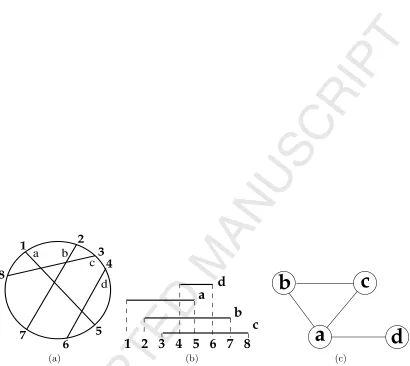
two representations may easily be obtained from one another [4]. Figure 1 shows an example of these
representations together with the circle graph they give rise to. We can assume without loss of generality
that no two chords (or intervals) share an end-point, since if two chords share an end-point we can slightly
move the end-point of one of the chords without changing the circle graph [4].
An interval representation of annvertex circle graph can be encoded as a permutationσof{1, ...,2n}
where the end-points of the intervals are formed by pairs (σ2k−1, σ2k), for 1≤k≤n. We refer to this as
aσ-representation of the circle graph. Note that this makes use of the assumption that no intervals share
an end-point. An arbitrary set of intervals can be transformed into this form inO(nlogn) time.
In this paper we make use solely of this interval representation. The density of an interval
repre-sentation is the maximum number of intervals crossing any point on the real line. Two intervals are
said to overlap if neither contains the other and they are not disjoint. If two intervals overlap then
their corresponding chords in the circle intersect. A maximum independent set is then a set of mutually
non-overlapping intervals with cardinality at least as large as any other mutually non-overlapping set of
intervals. Further background on circle graphs and related graph families is provided by Golumbic [6].
3
A Naive Algorithm
In this section we informally describe a naive algorithm for computing a maximum independent set of a
circle graph, as well as introducing some preliminary notation and definitions. This naive algorithm forms
the base for the output sensitive algorithm we introduce in Section 4.
We shall find it convenient to use the standard notation [a, b] ={x∈R|a≤x≤b}(fora < b) below
and to speak of one interval containing another when this is true set-wise inR. Given a set of intervalsI
we defineIq,m to be the subset of those intervals which are contained in [q, m]. Throughout this paper,
this setI should be regarded as having the form nk=1{[σ2k−1, σ2k]} for some given σ-representation of
ann vertex circle graph. We denote the set of maximum independent sets ofIq,m by M ISq,m, and we
denote their cardinality byM IS[q, m]. Finally, for an intervali= [a, b] we defineCM ISi=M ISa+1,b−1
andCM IS[i] =M IS[a+ 1, b−1]. Although M IS andCM ISdepend on the choice of a set of intervals
I, we choose to suppress this dependence in the notation because it shall never lead to ambiguity. We
ACCEPTED MANUSCRIPT
Property 3.1 If qis the right end-point of an interval, thenM IS[q, m] =M IS[q+ 1, m].
This property follows since, ifqis the right end-point of an interval, thenIq,m=Iq+1,m.
Property 3.2 If qis the left end-point of an interval i= [q, r]then
M IS[q, m] =
⎧ ⎨ ⎩
M IS[q+ 1, m] ifr > m
max{M IS[q+ 1, m],1 +CM IS[i] +M IS[r+ 1, m]} otherwise
Proof Ifr > mthenIq,m=Iq+1,mand soM IS[q, m] =M IS[q+1, m]. Assumer≤m. SinceIq,m\{i}=
Iq+1,m it follows that the cardinality of a maximum independent set of Iq,m\ {i} isM IS[q+ 1, m]. Let
V be a maximum cardinality independent set of Iq,m that includes i. Clearly for any other interval
j∈Iq,m that does not overlap withithen eitherj∈Iq+1,r−1 orj ∈Ir+1,m. Thus|V|= 1 +CM IS[i] +
M IS[r+ 1, m]. Since when r ≤ m any x ∈ M ISq,m can either include or exclude i, it follows that
M IS[q, m] = max{M IS[q+ 1, m],1 +CM IS[i] +M IS[r+ 1, m]} in this case.
Property 3.1 and 3.2 can be used to construct a simple dynamic programming algorithm for computing
a maximum independent set of a circle graph. Figure 2 shows pseudo-code for this algorithm, which
operates in Θ(n2) time while using Θ(n) space. This algorithm evaluatesM IS[q, m] in an arrayM[1. . .2n]
by increasingm from 1 to 2n, and then evaluating the entries of the recurrence for this value of m by
decreasingqfromm−1 down to 1. When the algorithm terminates,M[1] =M IS[1,2n]. We note that a
maximum independent set itself, and not just its weight, can easily be maintained while evaluating this
recurrence.
The algorithm of Figure 2 is less efficient than Valiente’s [11] Θ(nd) time algorithm, however, we
include it because it motivates the output sensitive algorithm we introduce in the next section. The basic
observation motivating the output sensitive algorithm is that, each timem is incremented in the naive
algorithm, the number of cells in the array M[1. . .2n] whose value changes (in fact, increases) may be
substantially smaller than the number of cells examined in the right-to-left scan ofqfromm−1 down to
1. Thus, if the set of cells that change can be determined efficiently, the resulting algorithm may be more
efficient too. We formalize this intuition in the remainder of this paper.
4
An Output Sensitive Algorithm
Definition 4.1 Given theσ-representation of annvertex circle graph, the update set atm,1≤m≤2n,
is
ACCEPTED MANUSCRIPT
Proposition 4.2 Ifq∈Sm thenM IS[q, m] = 1 +M IS[q, m−1].
Proof By assumption M IS[q, m] = k+M IS[q, m−1], k ≥ 1, and thus there must be an interval
i= [l, m] included in all x∈M ISq,m but not in anyy ∈M ISq,m−1. For allx∈M ISq,m clearlyx\ {i}
is an independent set of ofIq,m−1and ifk >1 then its cardinality would exceedM IS[q, m−1], which is
a contradiction and thusk= 1.
Definition 4.3 (update algorithm) Given the σ-representation of an n vertex circle graph, an integer 1≤m≤2n and an arrayM[1. . .2n] such thatM[q] =M IS[q, m−1]for1≤q≤m−1, andM[q] = 0
otherwise, and an arrayC[1. . . n] such that for each interval i= [l, r] withr≤m C[i] =CM IS[i](here
C[i]should be regarded as being indexed by the rank of i in theσ-representation of the circle graph) then
we define the updatealgorithm as follows:
If m is the left end-point of an interval, the algorithm terminates. Otherwise, there is an interval
i= [l, m] and the algorithm performs the assignmentM[l]←1 +C[i], andl is pushed onto a stackT.
The following procedure is then iterated until the stack T contains no entries. The top of the stack
is popped into x. If x > 1 and M[x] > M[x−1] then the update M[x−1] ← M[x] is performed (we
refer to this as a Type-1 update) and x−1 is pushed onto T. If there is an interval j = [p, x−1] and
1 +C[j] +M[x]> M[p] then the assignment M[p]←1 +C[j] +M[x]is performed (we refer to this as a
Type-2 update) andpis pushed onto T, and the process iterates.
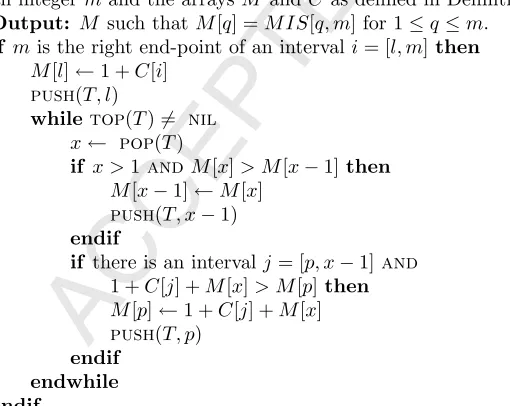
Pseudo-code for this algorithm is provided in Figure 3.
Lemma 4.4 If any cellM[q],1≤q≤m is modified by the update algorithm, thenM[q] =M IS[q, m]
when the algorithm terminates.
Proof Assume the algorithm iterates at least once until the stackT is empty, possibly modifying cells of
M. If, for all indicesxon the stackT we have M[x] =M IS[x, m] we say T is valid. Assume that T is
valid at the beginning of each loop iteration where any cell ofM is modified. Assume that value ofM[p]
has been modified by the algorithm on some iteration.
If pis a right end-point, then it must have been modified by a Type-1 update via an assignment of
the formM[p]←M[p+ 1], wherep+ 1 was popped fromT and sinceT is valid M[p] =M IS[p+ 1, m].
Moreover, by Property 3.1M IS[p, m] =M IS[p+ 1, m], and thusM[p] =M IS[p, m], as required. The
algorithm then pushes pontoT, and soT is still valid afterpis pushed onto it.
Otherwise, ifM[p] was modified and pis a left end-point of an interval j= [p, x−1], thenM[p] may
have been modified by either a Type-1 or a Type-2 update (but not both, see Proposition 4.2). IfM[p]
was modified only by a Type-1 update, thenM[p] =M[p+ 1] andM[p+ 1]≥1 +C[j] +M[x]. IfM[p] was
ACCEPTED MANUSCRIPT
case of either update,M[p] = max{M[p+ 1],1 +C[j] +M[x]}. SinceT is validM[p+ 1] =M IS[p+ 1, m]
andM[x] =M IS[x, m]. ThusM[p] = max{M IS[p+1, m],1+CM IS[j]+M IS[x, m]}, and so by Property
3.2M[p] =M IS[p, m] as required. The algorithm then pushes pontoT, and soT is still valid afterpis
pushed onto it.
It follows immediately from the above that ifT is valid at the beginning of some iteration of the loop,
thenT is valid at the beginning of the next iteration of the loop, and thus on every iteration of the loop.
To complete the proof, we showT is valid before the first iteration of the loop.
If m is the right end-point of an interval i = [l, m], then the first index pushed onto the stack is l.
Preceding this, the algorithm performs the assignmentM[l]←1 +C[i]. Note thatM IS[m+ 1, m] = 0,
and thatM IS[l+ 1, m] =M IS[l+ 1, m−1] =C[i], and thus by Property 3.2,M[l] =M IS[l, m] following
the assignment. As a resultT is valid afterl is pushed onto it.
Definition 4.5 If at some point during the execution of theupdatealgorithm we haveM[q] =M IS[q, m]
for allq≥p, we say thatM is fully updated atp.
Property 4.6 If M[p] is not modified by the update algorithm and M is fully updated at p+ 1 then
M IS[p, m] =M IS[p, m−1].
Proof If pis a right end-point and M[p+ 1] was not modified by the algorithm then, since M is fully
updated,M IS[p+ 1, m−1] = M IS[p+ 1, m] but by Property 3.1 M IS[p, m−1] =M IS[p+ 1, m−1]
and M IS[p, m] = M IS[p+ 1, m] and hence M IS[p, m] = M IS[p, m−1], as required. If p is a right
end-point and M[p+ 1] was modified by the algorithm, then since no Type-1 update ofM[p] occured,
we haveM[p]≥M[p+ 1], implying M IS[p, m−1]≥M IS[p+ 1, m], but by Property 3.1 M IS[p, m] =
M IS[p+ 1, m], and hence M IS[p, m−1] ≥ M IS[p, m] but clearly M IS[p, m−1] ≤ M IS[p, m] since
Ip,m−1⊆Ip,m, and henceM IS[p, m] =M IS[p, m−1], as required.
Otherwise, if p is a left end-point of an interval j = [p, x−1] and neither M[p+ 1] norM[x] has
been updated thenM IS[p+ 1, m] =M IS[p+ 1, m−1] and M[x] =M IS[x, m−1], thus, by Property
3.2M IS[p, m] = max{M IS[p+ 1, m−1],1 +CM IS[j] +M IS[x, m−1]} showing that atM IS[p, m] =
M IS[p, m−1] as required. Otherwise, if both of M[p+ 1] and M[x] have been updated then we have
M[p]≥max{M IS[p+ 1, m],1 +CM IS[j] +M IS[x, m]}, sinceM is fully updated and neither a Type-1
or a Type-2 update occured. That is,M IS[p, m−1]≥M IS[p, m], implying as above thatM IS[p, m] =
M IS[p, m−1], as is required. Lastly, we consider the cases where exactly one ofM[p+ 1] andM[x] has
been updated. By Property 3.2M IS[p, m−1] = max{M IS[p+ 1, m−1],1 +CM IS[j] +M IS[x, m−1]}.
Assume that only M[p+ 1] was updated, and since M is fully updated at p+ 1, M IS[p+ 1, m] >
ACCEPTED MANUSCRIPT
we have M IS[p, m−1] ≥ M IS[p+ 1, m], implying that M IS[p, m−1] > M IS[p+ 1, m−1] and in
turn thatM IS[p, m−1] = 1 +CM IS[j] +M IS[x, m−1], and once more since M[p] was not updated
1 +CM IS[j] +M IS[x, m−1]≥M IS[p+ 1, m], and henceM IS[p, m] = 1 +CM IS[j] +M IS[x, m−1],
and M IS[p, m] =M IS[p, m−1], as required. The other case, where onlyM[x] is updated is analogous.
Lemma 4.7 When the updatealgorithm terminatesM[q] =M IS[q, m]for1≤q≤m.
Proof If m is the left end-point of some interval then the algorithm can terminate without modifying
M because Iq,m = Iq,m−1 for 1 ≤ q ≤ m. Assume the algorithm iterates z ≥ 1 times. On the kth
iteration of the algorithm, we denote the contents of the stackT at the beginning of that iteration asTk.
Moreover we denote the largest index on someTk as F(Tk). Note that the algorithm modifies only the
cellsM[F(T1)], . . . , M[F(Tz)]. Note also that for each 1≤k < z the algorithm modifies none of the cells
M[F(Tk+1) + 1], . . . , M[F(Tk)−1].
Consider any iteration, 1≤k < z, and assume M is fully updated atF(Tk). It follows by F(Tk)−
F(Tk+1)−1 applications of Property 4.6 that M is fully updated atF(Tk+1) + 1. Moreover, when the
algorithm modifiesM[F(Tk+1)], by Lemma 4.4,M will be fully updated atF(Tk+1). Thus if M is fully
updated atF(Tk) at the beginning ofkthiteration of the algorithm, it is fully updated atF(Tk+1) on the
(k+ 1)th iteration. Note that at the beginning of the first iteration of the algorithm,M is fully updated
atF(T1) =l noting thatIr,m=Ir,m−1 forl < r≤mand thatM[l] =M IS[l, m] by the same argument
given at the end of in Lemma 4.4.
Finally, after the final,zthiteration, a furtherF(Tz)−1 applications of Property 4.6 show thatM is
fully updated at 1 when the algorithm terminates.
Lemma 4.8 Theupdatealgorithm terminates inO(1+|Sm|)time and usesO(1+|Sm|)space in addition
to the space used by its input.
Proof The algorithm only pushes an index qonto the stack T ifq∈Sm. Moreover, by Proposition 4.2
such an indexqcan be pushed ontoT at most once by the algorithm. ThusT can contain at most |Sm|
indices and since the algorithm uses at most constant space in addition toT the total space isO(1 +|Sm|)
space (allowing forSm=φ).
Since the main loop of the algorithm iterates untilT contains no entries, this loop can iterate at most
|Sm|times, with each iteration incurring constant time. Thus, the total time isO(1 +|Sm|).
ACCEPTED MANUSCRIPT
Proof Let f(q) be the number of the update sets {S1, . . . , S2n} that q is an element of. Clearly 2n
q=1f(q) = 2n
q=1|Sq|. Also note thatf(1)≥f(2)≥ · · · ≥f(2n), and in particular that α=f(1). It
follows that2qn=1f(q)≤2nαand thus that2qn=1|Sq| ≤2nα.
Lemma 4.10 Given the σ-representation of a circle graph, the cardinality of its maximum independent
sets can be computed inO(nα)time andO(n)space
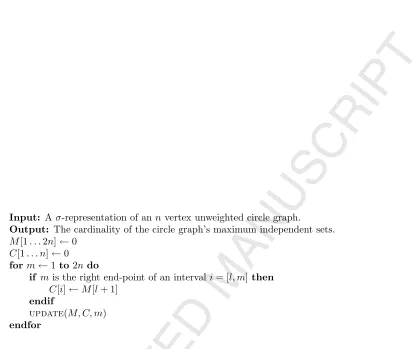
Proof We refer to the algorithm in Figure 4, here,update(M, C, m) denotes an invocation of theupdate
algorithm of Definition 4.3, Figure 3 and Lemma 4.7.
On themthiteration of the loop, givenM[q] =M IS[q, m−1] for 1≤q < mandC[i] =CM IS[i] for
all intervali∈Iq,m−1 withr < m, by Lemma 4.7,update will modifyM such thatM[q] =M IS[q, m]
for 1≤q≤m. Examining Figure 3,C will be modified givingC[i] =CM IS[i] for alli∈I1,m.
Thus, after themthiteration of the loop, the inputsCandM required byupdatein the next iteration
are available. Since on the first iteration the inputs required byupdateare trivially available, it follows
that when the for loop terminates M[1] holds the cardinality of the maximum independent sets of the
circle graph.
For the time complexity, note that there are 2ncalls to the updatealgorithm, requiring by Lemma
4.8, in total time2mn=1O(1 +|Sm|) which isO(nα) by Lemma 4.9.
For the space complexity, note that in addition to theO(n) space required by the input, the only space
usedO(n) for the arrayCand, by Lemma 4.8, at most O(n) for the stackT.
5
A Combined Algorithm
Having established theO(nα) time and O(n) space algorithm of Lemma 4.10, we can combine it with
Valiente’s [11]O(nd) time andO(n) space algorithm giving aO(nmin{d, α}) time algorithm. The following
is the main result of this paper.
Theorem 5.1 Given theσ-representation of a circle graph, the cardinality of its maximum independent
sets can be computed inO(nmin{d, α})time andO(n)space.
Proof In O(n) time and O(1) space the parameter d can be computed by a simple iteration over the
σ-representation. Now, theupdatealgorithm of Figure 3 is modified such that if an update to a cellM[q]
givesM[q]> d, then theupdatealgorithm simply sets a flagF and terminates.
To compute the cardinality of the maximum independent sets, the algorithm of Figure 4 is used with
this modifiedupdatealgorithm. When the algorithm terminates, if the flagF is not set, then it must be
the case thatα < dand hence the cardinality of the maximum independent sets has been determined in
ACCEPTED MANUSCRIPT
On the other hand, if the flagF is set, it must be the case thatd < α. In this case, at mostO(nd) time
has been incurred usingO(n) space. To complete the computation, Valiente’s algorithm [11] is invoked
on theσ-representation, requiring an additionalO(nd) time andO(n) space.
Thus, the modified algorithm requiresO(nmin{d, α}) time.
We note that a maximum independent set itself, and not just its cardinality, can easily be maintained
by this algorithm within the same time and space bounds. Referring to Figure 4, a cellC[i] ofC[1. . .2n]
can be thought of as representing an element of CM ISi rather than CM IS[i], and C[i] can then be
represented by a linked list of all the intervals directly contained in an element ofCM ISi (an intervalj
isdirectly contained inx∈CM ISi ifj∈xand there is nok∈xsuch thatj is contained in the element
ofCM ISk represented byC[k]). The same linked list representation can be used in place of M[1. . .2n].
This simple representation of a maximum independent set is illustrated by Valiente [11].
6
Conclusion
This paper has described a O(nmin{d, α}) time and O(n) space algorithm for computing a maximum
independent set of an unweighted circle graph. Future work could attempt to extend coverage to weighted
circle graphs. In addition, we note that in experiments we have observed an algorithm based on the
output sensitive approach described in this paper to perform excellently in practice. In these experiments,
a variation of the algorithm described in this paper was used. This variation appears to have favourable
constant factors and operates in timeO(nmin{d, αlogn}), it was compared to an optimized
implementa-tion of the previous best algorithm, whose experimental performance was documented in [8]. The output
sensitive algorithm was observed to offer much improved performance (by a factor of between 3 and 7).
Moreover, in these experiments we have observed a class of circle graphs withd= Θ(n) andα= Θ(√n).
We leave a full description of these experimental results to future work.
References
[1] A. Apostolico, M. J. Atallah, and S. E. Hambrusch. New clique and independent set algorithms for
circle graphs.Discrete Applied Mathematics, 36(1):1—24, 1992.
[2] A. Apostolico, M. J. Atallah, and S. E. Hambrusch. Erratum: New clique and independent set
algorithms for circle graphs (discrete applied mathematics 36 (1992) 1—24).Discrete Applied
Math-ematics,41(2):179—180, 1993.
[3] T. Asano, H. Imai, and A. Mukaiyama. Finding a maximum weight independent set of a circle graph.
ACCEPTED MANUSCRIPT
[4] F. Gavril. Algorithms for a maximum clique and a maximum independent set of a circle graph.
Networks, 3(3):261—273, 1973.
[5] O. Goldschmidt and A. Takvorian. An efficient algorithm for finding a maximum weight independent
set of a circle graph.IEICE Transactions, E77-A(10):1672—1674, 1994.
[6] M. C. Golumbic. Algorithmic Graph Theory and Perfect Graphs(Annals of Discrete Mathematics,
Vol 57). North-Holland Publishing Co., Amsterdam, The Netherlands, The Netherlands, 2004.
[7] J. M. Keil. The complexity of domination problems in circle graphs.Discrete Applied Mathematics,
42(1):51—63, 1993.
[8] N. Nash, S. Lelait, and D. Gregg. Efficiently implementing maximum independent set algorithms on
circle graphs.J. Exp. Algorithmics, 13(1.9):1—34, 2009.
[9] K. J. Supowit. Finding a maximum planar subset of a set of nets in a channel.IEEE Trans. on CAD
of Integrated Circuits and Systems, 6(1):93—94, 1987.
[10] A. Tiskin. Semi-local string comparison: algorithmic techniques and applications. CoRR,
abs/0707.3619, 2009.
[11] G. Valiente. A new simple algorithm for the maximum-weight independent set problem on circle
graphs. In T. Ibaraki, N. Katoh, and H. Ono, editors, ISAAC, volume 2906 of Lecture Notes in
ACCEPTED MANUSCRIPT
4
c
a b
d
2
1
8
7
6
5
3
c
d
b
a
1 2 3 4 5 6 7 8
b
a
c
d
[image:11.612.104.514.129.495.2](a) (b) (c)
ACCEPTED MANUSCRIPT
Input: Aσ-representation of annvertex unweighted circle graph.
Output: The cardinality of the circle graph’s maximum independent sets.
M[1. . .2n]←0
C[1. . . n]←0
form←1to2ndo
if mis the right end-point of an intervali= [l, m]then C[i]←M[l+ 1]
endif
forq←m−1downto 1do M[q]←M[q+ 1]
if qis the left end-point of an intervalj= [q, r] andr≤mthen M[q]←max{M[q+ 1],1 +C[j] +M[r+ 1]}
[image:12.612.92.505.126.317.2]endif endfor endfor
Figure 2: Pseudo-code for a simple Θ(
n
2) time and Θ(
n
) space algorithm for computing the cardinality of
a circle graph’s maximum independent sets.
Input: Theσ-representation of annvertex circle graph together with an integer mand the arraysM andCas defined in Definition 4.3.
Output: M such thatM[q] =M IS[q, m] for 1≤q≤m.
if mis the right end-point of an intervali= [l, m]then M[l]←1 +C[i]
push(T, l)
while top(T)= nil
x← pop(T)
if x >1 andM[x]> M[x−1]then M[x−1]←M[x]
push(T, x−1)
endif
if there is an intervalj= [p, x−1]and
1 +C[j] +M[x]> M[p]then M[p]←1 +C[j] +M[x]
push(T, p)
endif endwhile endif
[image:12.612.105.360.456.659.2]ACCEPTED MANUSCRIPT
Input: Aσ-representation of annvertex unweighted circle graph.
Output: The cardinality of the circle graph’s maximum independent sets.
M[1. . .2n]←0
C[1. . . n]←0
form←1to2ndo
if mis the right end-point of an intervali= [l, m]then C[i]←M[l+ 1]
endif
update(M, C, m)
[image:13.612.91.509.111.460.2]endfor