ScholarlyCommons
Publicly Accessible Penn Dissertations
1-1-2015
Programming Using Automata and Transducers
Loris D'antoni
University of Pennsylvania, [email protected]
Follow this and additional works at:
http://repository.upenn.edu/edissertations
Part of the
Computer Sciences Commons
This paper is posted at ScholarlyCommons.http://repository.upenn.edu/edissertations/1677 For more information, please [email protected].
Recommended Citation
Abstract
Automata, the simplest model of computation, have proven to be an effective tool in reasoning about
programs that operate over strings. Transducers augment automata to produce outputs and have been used to model string and tree transformations such as natural language translations. The success of these models is primarily due to their closure properties and decidable procedures, but good properties come at the price of limited expressiveness. Concretely, most models only support finite alphabets and can only represent small classes of languages and transformations. We focus on addressing these limitations and bridge the gap between the theory of automata and transducers and complex real-world applications: Can we extend automata and transducer models to operate over structured and infinite alphabets? Can we design languages that hide the complexity of these formalisms? Can we define executable models that can process the input efficiently? First, we introduce succinct models of transducers that can operate over large alphabets and design BEX, a language for analysing string coders. We use BEX to prove the correctness of UTF and BASE64 encoders and decoders. Next, we develop a theory of tree transducers over infinite alphabets and design FAST, a language for analysing tree-manipulating programs. We use FAST to detect vulnerabilities in HTML
sanitizers, check whether augmented reality taggers conflict, and optimize and analyze functional programs that operate over lists and trees. Finally, we focus on laying the foundations of stream processing of
hierarchical data such as XML files and program traces. We introduce two new efficient and executable models that can process the input in a left-to-right linear pass: symbolic visibly pushdown automata and streaming tree transducers. Symbolic visibly pushdown automata are closed under Boolean operations and can specify and efficiently monitor complex properties for hierarchical structures over infinite alphabets. Streaming tree transducers can express and efficiently process complex XML transformations while enjoying decidable procedures.
Degree Type
Dissertation
Degree Name
Doctor of Philosophy (PhD)
Graduate Group
Computer and Information Science
First Advisor
Rajeev Alur
Keywords
Automata, Programming languages, String transformations, Symbolic automata, Transducers, Tree transformations
Subject Categories
Computer Sciences
Loris D’Antoni
A DISSERTATION
in
Computer Science
Presented to the Faculties of the University of Pennsylvania
in
Partial Fulfilment of the Requirements for the
Degree of Doctor of Philosophy
2015
Supervisor of Dissertation
Rajeev Alur, Zisman Family Professor of Computer and Information Science
Graduate Group Chairperson
Lyle H. Ungar, Professor of Computer and Information Science
Dissertation Committee
Chaired by Sampath Kannan, Henry Salvatori Professor of Computer and Information Science
Benjamin C. Pierce, Henry Salvatori Professor of Computer and Information Science
Val Tannen, Professor of Computer and Information Science
Acknowledgements
The material described in this dissertation is the culmination of an extended collabora-tion with Rajeev Alur and Margus Veanes, with addicollabora-tional contribucollabora-tions from Benjamin Livshits and David Molnar. I am lucky to count these talented individuals as colleagues and friends, and I want to acknowledge their contributions to this dissertation.
Throughout my time at Penn, my adviser Rajeev Alur has granted me freedom to pur-sue the projects I believed in and great support when I needed to brainstorm, work on a proof, or simply decide on what to do next. Thank you for encouraging, nurturing, and providing help along this academic journey. To NSF, thank you for the Expeditions in Computing grant CCF 1138996, which funded most of my research.
Sampath Kannan, Benjamin Pierce, Val Tannen, and Margus Veanes have all graciously agreed to serve on my dissertation committee. I am grateful for the time they devoted to reading both my proposal and this dissertation. Their many insightful comments and suggestions greatly improved it.
Mariangiola Dezani-Ciancaglini introduced me to research when I was an undergrad-uate nearly 8 years ago and was the first person to truly believe in my capabilities, for which I am eternally grateful. Margus Veanes mentored me for two productive intern-ships at Microsoft Research Redmond during the summers of 2012 and 2013. Since then, Margus has been a great colleague, friend, and research collaborator.
To the formal methods, programming languages, and verification students at Penn, thank you for creating a friendly and stimulating research environment. To the Grad-uate Student in Engineering Group, thank you for all the social events and pleasant distractions from work.
To Adam, thank you for being an honest and supportive friend.
To my family, especially my parents Marinella and Stefano, thank you for supporting me and letting me pursue what I believed in. To my brother Christian, thank you for helping me push my potential to the limit.
ABSTRACT
PROGRAMMING USING AUTOMATA AND TRANSDUCERS
Loris D’Antoni
Dr. Rajeev Alur
Automata, the simplest model of computation, have proven to be an effective tool in reasoning about programs that operate over strings. Transducers augment automata to produce outputs and have been used to model string and tree transformations such as natural language translations. The success of these models is primarily due to their closure properties and decidable procedures, but good properties come at the price of limited expressiveness. Concretely, most models only support finite alphabets and can only represent small classes of languages and transformations.
We focus on addressing these limitations and bridge the gap between the theory of au-tomata and transducers and complex real-world applications: Can we extend automata and transducer models to operate over structured and infinite alphabets? Can we design lan-guages that hide the complexity of these formalisms? Can we define executable models that can process the input efficiently?
First, we introduce succinct models of transducers that can operate over large alpha-bets and design BEX, a language for analysing string coders. We use BEXto prove the
correctness of UTF and BASE64 encoders and decoders. Next, we develop a theory
of tree transducers over infinite alphabets and design FAST, a language for analysing
tree-manipulating programs. We use FASTto detect vulnerabilities in HTML sanitizers,
Contents
Acknowledgements iii
Abstract iv
List of tables xi
List of figures xiii
1 Introduction 1
1.1 Preamble . . . 1
1.2 Automata, languages, and program properties . . . 2
1.3 Transducers, transformations, and programs . . . 3
1.4 Limitations of existing models . . . 5
1.5 Contributions . . . 6
1.5.1 Foundational results . . . 6
1.5.2 Language design and implementation . . . 7
1.5.3 Applications . . . 7
I Transducer-based programming languages 9
2 BEX: a language for verifying string coders 10
2.1 Introduction . . . 10
2.1.1 Challenges in verifying real-world coders . . . 11
2.1.2 Contributions . . . 12
2.2 Verifying BASE64 in BEX . . . 13
2.3 Symbolic extended finite automata and transducers . . . 14
2.3.1 Preliminaries . . . 15
2.3.2 Model definitions . . . 15
2.3.3 From BEXto S-EFTs . . . 18
2.3.4 Cartesian S-EFAs and S-EFTs . . . 19
2.3.5 Monadic S-EFAs and S-EFTs . . . 20
2.4 Properties of symbolic extended finite automata . . . 20
2.5 Equivalence of symbolic extended finite transducers . . . 23
2.5.1 Equivalence of S-EFTs is undecidable . . . 24
2.5.2 Equivalence of Cartesian S-EFTs is Decidable . . . 25
2.6 Composition of symbolic extended finite transducers . . . 31
2.6.1 S-EFTs are not closed under composition . . . 31
2.6.2 A practical algorithm for composing S-EFTs . . . 34
2.7 Experiments and applications . . . 41
2.7.1 Analysis of string encoders . . . 41
2.7.2 Deep packet inspection . . . 43
2.7.3 Verification of list manipulating programs . . . 44
2.8 Related work . . . 44
2.8.2 Models that allow binary predicates . . . 45
2.8.3 Models over finite alphabets . . . 45
3 FAST: a transducer-based language for manipulating trees 47 3.1 Introduction . . . 47
3.1.1 Limitations of current models . . . 47
3.1.2 Contributions . . . 48
3.2 Overview of FAST . . . 49
3.3 Symbolic tree transducers and FAST . . . 52
3.3.1 Background . . . 53
3.3.2 Alternating symbolic tree automata . . . 54
3.3.3 Symbolic tree transducers with regular look-ahead . . . 58
3.3.4 The role of regular look-ahead . . . 61
3.3.5 Operations on automata and transducers . . . 62
3.4 Composition of S-TTRs . . . 63
3.4.1 Composition algorithm . . . 64
3.4.2 Proof of correctness . . . 67
3.5 Evaluation . . . 73
3.5.1 HTML sanitization . . . 74
3.5.2 Conflicting augmented reality applications . . . 75
3.5.3 Deforestation . . . 77
3.5.4 Analysis of functional programs . . . 78
3.5.5 CSS analysis . . . 79
3.6 Related work . . . 79
3.6.1 Tree transducers . . . 79
3.6.3 DSLs for tree manipulation . . . 80
3.6.4 Applications . . . 81
3.6.5 Open problems . . . 82
II Executable models for hierarchical data 83 4 Symbolic visibly pushdown automata 84 4.1 Introduction . . . 84
4.1.1 Existing models . . . 84
4.1.2 Contributions . . . 85
4.2 Motivating example . . . 86
4.3 Model definition . . . 88
4.4 Closure Properties and Decision Procedures . . . 90
4.4.1 Closure Properties . . . 91
4.4.2 Decision Procedures . . . 95
4.5 Applications and Evaluation . . . 96
4.5.1 XML Validation . . . 97
4.5.2 HTML Filters . . . 98
4.5.3 Runtime Program Monitors . . . 100
4.5.4 Experimental results . . . 100
5 Streaming tree transducers 104 5.1 Introduction . . . 104
5.1.1 Existing models of tree transducers . . . 104
5.1.2 Contributions . . . 105
5.1.3 Organization . . . 107
5.3 Model definition . . . 109
5.3.1 Nested words . . . 109
5.3.2 Nested words with holes . . . 110
5.3.3 Nested word expressions . . . 110
5.3.4 Single use restriction . . . 111
5.3.5 Transducer definition . . . 112
5.3.6 STT syntax . . . 112
5.3.7 STT semantics . . . 113
5.4 Examples . . . 114
5.4.1 Reverse . . . 115
5.4.2 Tag-based sorting . . . 115
5.4.3 Conditional swap . . . 115
5.5 Properties and variants . . . 116
5.5.1 Regular nested-word languages . . . 119
5.5.2 Copyless STTs . . . 120
5.5.3 Bottom-up transducers . . . 122
5.5.4 Regular look-ahead . . . 126
5.5.5 Multi-parameter STTs . . . 134
5.5.6 Closure under composition . . . 141
5.6 Restricted inputs . . . 151
5.6.1 Mapping strings . . . 152
5.6.2 Mapping ranked trees . . . 157
5.7 Restricted outputs . . . 161
5.7.1 Mapping nested words to strings . . . 161
5.7.2 Mapping nested words to ranked trees . . . 162
5.8.1 MSO for nested-word transductions . . . 163
5.8.2 Macro tree transducers . . . 168
5.8.3 MSO equivalence . . . 170
5.9 Decision problems . . . 173
5.9.1 Output analysis . . . 173
5.9.2 Functional equivalence . . . 175
5.10 Related work . . . 179
5.10.1 Executable models . . . 179
5.10.2 Regular look-ahead . . . 180
5.10.3 From SSTs to STTs . . . 180
5.10.4 Succinctness . . . 181
5.10.5 Input/output encoding . . . 181
5.10.6 Streaming algorithms . . . 182
5.10.7 Complexity of checking equivalence . . . 182
5.10.8 Alphabet limitations . . . 183
III Conclusion 184 6 Future work 185 6.1 Declarative languages . . . 185
6.2 Algorithms . . . 186
6.3 New models . . . 186
6.4 Data-parallelism . . . 186
6.5 New applications . . . 187
6.5.1 Direct memory access in device drivers . . . 187
6.5.3 Deep packet inspection . . . 188
6.5.4 Binary assemblers and disassemblers . . . 188
6.5.5 Binary code similarity analysis . . . 188
List of Tables
2.1 Analysed coders with corresponding look-aheads and running times. . 42
3.1 Summary of domain specific languages for manipulating trees. . . 81
List of Figures
1.1 Examples of finite automata. . . 2
1.2 Functional programs that can be modeled using transducers. . . 4
1.3 Examples of finite state transducers. . . 5
2.1 Role of string encoders and decoders. . . 11
2.2 BASE64 encoding . . . 12
2.3 BASE64 analysis in BEX. . . 14
2.4 Running times for equivalence/inequivalence checking. . . 43
3.1 Implementation and analysis of an HTML sanitizer in FAST. . . 50
3.2 Encoding of<div id=‘e"’><script>a</script></div><br />. 51 3.3 Result of applyingsanito the tree in Figure 3.2. . . 52
3.4 Syntax of FAST. . . 53
3.5 Tree languages in FAST. . . 55
3.6 Depiction of an S-TT linear rule of rank 3. . . 60
3.7 Conditional flip. . . 61
3.8 S-TTs for which the composition is naturally expressible by an S-TTR . 62 3.9 Non-composable S-TTR-definable transformations. . . 64
3.10 Augmented reality: running times for operations on transducers. . . 75
3.11 Deforestation advantage for a list of 4,096 integers. . . 77
3.12 Analysis of functional programs in FAST. . . 78
4.1 Example of S-VPA over the theory of integers. . . 90
4.2 Example XML Schema with an equivalent S-VPA. . . 97
4.3 S-VPAs for HTML filtering. . . 98
4.4 S-VPAW accepting well-formed HTML documents. . . 99
4.5 Time to filter an HTML file. . . 101
4.6 Running times for S-VPA equivalence and determinization. . . 103
5.1 Depiction of the transformation tree swap. . . 108
5.2 Example of paramter tree update. . . 140
5.3 Example of symbolic variable assignment. . . 157
“When you do things right, people won’t be sure you’ve done anything at all.”
Chapter 1
Introduction
“We forget old stories, but those stories remain the same.”
—Dejan Stojanovic, The Sun Watches the Sun
1.1
Preamble
How do we build reliable software? How do we increase programmers’ productivity? With
more than 18 million software developers worldwide, answering these questions is becoming increasingly important.1 Although there has been huge progress in this area,
reasoning about general purpose programs remains a hard task.
Programmers and end-users often need to solve tricky domain-specific tasks, such as writing text and XML transformations, that do not require the full power of general purpose programming languages. In fact, despite their complexity, these tasks of-ten only require a few specialized programming constructs. This aspect opens the opportunity for creating simpler domain-specific tools that do not require the power of general-purpose programming. The ultimate goal of designing programming lan-guages and techniques that make the programming of domain-specific tasks simpler, less error-prone, and more efficient is the main inspiration behind this dissertation.
In this dissertation we focus on programs that operate over strings, lists, and trees, and leverage the fact that finite state machines offer a suitable theoretical foundation for reasoning about these programs. Many variants of these finite state machines have been proposed and applied to different domains, such as program monitoring [LG07], natural language processing [MGHK09, Moh97, MK08], and XML processing [HP03,
q0
T
G
q0
A
C
all_TG
all_AC
FIGURE1.1: Examples of finite automata.
IH08, MSV00, BDM+06, Bec03, MBPS05]. We build on these models and identify novel ones that can be used to analyze many real-world programs.
1.2
Automata, languages, and program properties
Finite automata define sets of strings, also called languages. They are used in many applications, most notably in analysis of regular expressions and program monitor-ing [LG07]. Intuitively a finite automaton is a labeled graph with initial and final states (nodes). The labels of the edges are symbols over an input alphabet and each path through the graph corresponds to a string. The language defined by a particular au-tomaton is the set of all strings for which there is a path from an initial to a final state. For example, the automaton all_TG in Figure 1.1 accepts the language of all strings containing only the symbols T and G.
Automata can capture computations. In particular, they can be seen as programs that map lists to Boolean values. Examples of such programs can be seen in Figure 1.2. In particular, the programs all_TG and all_AC (lines 11–20) can be modeled using the automata depicted in Fig. 1.1 that accept strings over the alphabet base = {A, T, G, C}. Similarly, the programs is_dna and is_empty (lines 4–10) can be captured by two automata accepting all strings and only the empty string respectively.
Figure 1.2. For example, we can prove that the programs all_TG and all_AC accept disjoint languages by checking that the intersection of their corresponding automata is equivalent to the empty language.
1.3
Transducers, transformations, and programs
Although automata enjoy many useful properties, they can only model very limited classes of programs. Finite transducers extend finite automata to model partial func-tions from strings to strings, also called string transformafunc-tions. This is done by adding an output component to transitions. A finite state transducer is a labeled graph with initial and final states (nodes), where each edge carries an input symbol and a sequence of output symbols. Each path corresponding to an input string also produces an out-put string by outout-putting sequences of characters at each transition. The concatenation of such sequences is the output corresponding to the traversed path. The transforma-tion defined by a transducer is the set of all input/output string pairs for which there is a path from an initial to a final state. For example, the transducer map_base in Fig-ure 1.3 defines the transformation that outputs the DNA sequence matching the input one (maps each base to the matching one, e.g. A to T).
Transducers can be seen as programs that map lists into lists. Examples of such pro-grams can be seen in Figure 1.2. The propro-grams map_base and filter_AC (lines 21–35) can be modeled using the transducers depicted in Figure 1.3.
1 (∗ Types f o r DNA bases and sequences ∗)
2 type base = A | T | G | C
3 type dnaseq = l i s t base
4 (∗ True f o r any DNA sequence l ∗)
5 l e t is_dna ( l : dnaseq ) : bool = true
6 (∗ True f o r empty sequence ∗)
7 l e t is_empty ( l : dnaseq ) : bool =
8 match l with
9 [ ] −> true
10 | _ −> f a l s e
11 (∗ True i f a l l the elements of the l i s t l are T or A ∗)
12 l e t r e c all_TG ( l : dnaseq ) : bool =
13 match l with
14 [ ] −> true
15 | h : : t −> ( h = T || h = G) && ( all_TG t )
16 (∗ True i f a l l the elements of the l i s t l are even ∗)
17 l e t r e c all_AC ( l : dnaseq ) : bool =
18 match l with
19 [ ] −> true
20 | h : : t −> ( h = A || h = C) && ( all_AC t )
21 (∗ Replaces each base with the matching one∗)
22 l e t r e c map_base ( l : dnaseq ) : dnaseq =
23 match l with
24 [ ] −> [ ]
25 | A : : t −> T : : ( map_base t )
26 | T : : t −> A : : ( map_base t ) 27 | G : : t −> C : : ( map_base t ) 28 | C : : t −> G : : ( map_base t )
29 (∗ Removes a l l the T and G elements from a l i s t l ∗)
30 l e t r e c f i l t e r _ A C ( l : dnaseq ) : dnaseq = match l with
31 [ ] −> [ ]
32 | A : : t −> A : : ( f i l t e r _ A C t ) 33 | C : : t −> C : : ( f i l t e r _ A C t ) 34 | T : : t −> f i l t e r _ A C t 35 | G : : t −> f i l t e r _ A C t
36 (∗ Applies map_base then f i l t e r _ A C to l ∗)
37 l e t m_f_DNA ( l : dnaseq ) : dnaseq = f i l t e r _ A C ( map_base l )
38 (∗ Applies f i l t e r _ A C then map_base then f i l t e r _ A C to l ∗)
39 l e t f_m_f_DNA ( l : dnaseq ) : dnaseq = m_f_DNA ( f i l t e r _ A C l )
40 (∗ Reverses a l i s t ∗)
41 l e t r e c r e v e r s e ( l : dnaseq ) : dnaseq =
42 match l with
43 [ ] −> [ ]
44 | h : : t −> ( r e v e r s e t ) @ [ h ]
q0 A/T
map_base T/A
G/C C/G
q0
A/A T/ε
G/ε C/C
filter_AC
q0 A/ε T/ A
G/C C/ε
m_f_DNA
FIGURE1.3: Examples of finite state transducers.
1.4
Limitations of existing models
Interesting programs can be modeled using finite automata and transducers. However, the capabilities of these formalisms are limited: they only operate over strings, they can only capture limited classes of languages and transformations (e.g. reverse in Fig. 1.2 cannot be modeled as a finite state transducer), and they are limited to finite alphabets.
Many models and techniques have been proposed to attenuate these limitations. Au-tomata and transducers have been extended to trees [Eng75, Eng77, CDG+07], richer transducer models have been presented to handle more complex functions [AC10, AC11, EH01], there have been extensions to support infinite and structured alpha-bets [VHL+12, KF94], and a few programming languages were implemented to sim-plify programming in these models [PS12, MK08]. Although all these extensions have progressed towards addressing many of the limitations, there are simple domains that could potentially benefit from transducer-based analysis that cannot be modeled using existing models.
The following limitations still exist:
Alphabet expressiveness: Although several extensions have been proposed, many tree
and string transformations and XML languages over infinite domains cannot be expressed using existing models;
Executable models: Most models proposed to capture larger classes of functions are not
efficiently executable. In particular, they typically require multiple passes over the input.
Usability: Automata and transducers are complex to use for an average user and the
1.5
Contributions
The goal of this dissertation is to bridge part of the gap between practical applications and the theory of automata and transducers. Its contributions are divided between the following areas:
Foundational results: We define novel automata and transducer models that can express
large classes of languages and transformations. For many of these models we provide strong theoretical guarantees and exactly characterize their expressive-ness.
Implementation: We implement two programming languages, FASTand BEX, that have
their semantics given in terms of automata and transducers. Using these seman-tics, programs written in FAST and BEXcan be statically analyzed. We also
de-velop the open-source automata library SVPAlib, for coding automata over infi-nite alphabets.
Applications: We show how transducer-based languages are beneficial in proving
prop-erties of real-world programs. We use BEXto prove the correctness of BASE64
and UTF8 coders, and FASTto prove the absence of malicious outputs in HTML
sanitizers, to check interference of augmented reality applications, to optimize functional language compilation, and to analyze functional programs over trees.
The rest of this chapter expands on each of these contributions in detail.
1.5.1 Foundational results
automata, which extend visibly pushdown automata predicates to support infinite al-phabets. We show that this expressive model is closed under Boolean operations, can be determinized, and enjoys decidable emptiness. Chapter 5 defines streaming tree ducers together with many equivalent variants. We show how streaming tree trans-ducers capture the class of monadic-second-order-definable tree transformations, are closed under compositions and regular look-ahead, and enjoy decidable equivalence. For this last problem we provide a NEXPTIMEupper bound, the first elementary upper
bound for this class of transductions.
1.5.2 Language design and implementation
Automata and transducers are elegant models but are hard to program with. Our sec-ond contribution is the design and implementation of two programming languages, BEX and FAST, that act as frontend for automata and transducer models. BEX is a
rule-based language described in Chapter 2, and it is a frontend for extended sym-bolic finite transducers over the theory of bit-vectors. This language allows the user to naturally program complex string encoders such as UTF8 and BASE64 encoders
and decoders using less than 50 lines of code. BEXsupports regular-expression-based
pattern matching, bit-vector operations such as bit-shift, bit-or, and bit-extract, and transducer operations such as equivalence and composition. BEX is also available
as a runnable web interface athttp://rise4fun.com/Bex/. FASTis a functional
language described in Chapter 3, and it is a frontend for symbolic tree transducers with regular look-ahead over the theories supported by the satisfiability module theory (SMT) solver Z3 [DMB08]. These include theories over bit-vectors, integers, reals, and data-types. FAST also supports Boolean operations over languages, language
equiva-lence, transducer composition, and regular type-checking. FAST is also available as a
runnable interface athttp://rise4fun.com/fast/. Finally, we implemented
SV-PAlib, an open-source symbolic automata library that supports typical automata opera-tions for automata over infinite alphabets (Chapter 4). The SVPAlib library is available athttps://github.com/lorisdanto/symbolicautomata.
1.5.3 Applications
Although elegant automata and transducer models are already rewarding by them-selves, applying them to solve problems gives them new life. My third contribution is the use of automata and transducer models to solve real-world problems. In Chapter 2 we use BEXto program efficient versions of BASE64 and UTF8 encoders and decoders
of these encoders. These efficient implementations, thanks to their transducer-based semantics, have been used to generate efficient data-parallel code [VMML15]. In Chap-ter 3 we use FAST to 1) prove safety properties for HTML sanitizers in the context
of web security; 2) analyze whether two augmented reality taggers ever try to anno-tate the same node of an input tree; 3) efficiently compose functional programs using transducer composition as a deforestation technique; and 4) prove pre-post condition properties of functional programs that transform lists and trees over complex domains. Finally, in Chapter 4 we show how to efficiently monitor complex properties on XML documents and structured program traces using the library SVPAlib.
1.6
Acknowledgements
This dissertation describes work performed in cooperation with many different col-leagues and portions of it are based on papers written in collaboration with them. In particular, the presentation of the language BEX described in Chapter 2 is a revised
version of two papers by D’Antoni and Veanes [DV13b, DV13a, DV15]. The language FASTwas designed in collaboration with Margus Veanes and the description presented
Part I
Chapter 2
B
EX
: a language for verifying string
coders
“Words are the source of misunderstandings.”
—Antoine de Saint-Exup´ery, The Little Prince
2.1
Introduction
String coders enable communication across different applications by translating be-tween different string formats. String coders are ubiquitous: emails sent through SMTP are encoded using BASE64, text entered inside HTML forms is encoded using URL
en-code, and Unicode text files are converted from UTF8 to UTF16 when stored in memory.
Despite the wide adoption of these encodings, their analysis is difficult, and care-fully crafted invalid UTF8 sequences have been used to bypass security validations.
Several attacks have been demonstrated based on over-encoding the characters ‘.’
and ‘/’ in malformed URLs.1 For example, the invalid sequence[C016,AF16](that de-codes to ‘/’) has been used to bypass a literal check in the Microsoft IIS server (in
un-patched Windows 2000 SP1) to determine if a URL contains “../../” by encoding it
as “..%C0%AF../”. Similar vulnerabilities exists in Apache Tomcat (≤6.0.18), where
“%C0%AE” has been used for encoding ‘.’.2Further attacks have used double-encoding,
where the input string is encoded twice to violate some of the decoder assumptions.3
1http://www.sans.org/security-resources/malwarefaq/wnt-unicode.php
2http://web.nvd.nist.gov/view/vuln/detail?vulnId=CVE-2008-2938
Input format Output format Encoder
Decoder
FIGURE2.1: Role of string encoders and decoders.
2.1.1 Challenges in verifying real-world coders
To verify string coders we need to check whether the encoder (E) and decoder (D) invert each other:
E◦D≡ I∧D◦E≡ I
Here Idenotes the identity function. This property guarantees that there exists a bijec-tion between the input and the output format. This implies that there is only one way to encode each string, preventing attacks such as the one used in Apache Tomcat, in which the same symbol can be encoded in two different ways. Checking this property requires the use of sequential composition and functional equivalence. Luckily, finite state transducers are closed under composition and enjoy decidable equivalence.
Unfortunately the problem is not so simple. Despite their small sizes, string coders are hard to verify using finite state transducers due to the following reasons:
Large alphabets: coders operate over large alphabets containing up to 232characters;
Bit-vectors: coder implementations perform complex bit-vector operations to achieve
efficiency;
Look-ahead: each output symbol can depend on multiple adjacent input symbols.
These challenges can already be observed in the simple case of BASE64 encoding
(Fig-ure 2.2). A BASE64 encoder transforms sequences of bytes into sequences of 6-bit
char-acters. This is done by reading 3 characters at a time, splitting the resulting sequence of 24 bits into groups of 6 bits, and applying a character mapping to the each 6-bit num-ber. Even in this simple setting the input alphabet contains 256 characters, the output is computed using bit-vector operation to isolate particular bits, and each output symbol may depend on different input symbols. For example in Figure 2.2 the output letter ‘W’ depends on the last two bits of the letter ‘M’ and the first four bits of the letter ‘a’.
of ’a’ and use them in the next step to build the corresponding output symbol. For large alphabets, this would cause an explosion in the number of states and transitions. Thus, finite state transducers are not a good candidate for verifying string coders as they cannot naturally represent bit-vector semantics, and they would face a state-space explosion in the case of large alphabets.
Text content M a n
ASCII 77 (4D16) 97 (6116) 110 (6E16)
Bit pattern 0 1 0 0 1 1 0 1 0 1 1 0 0 0 0 1 0 1 1 0 1 1 1 0
Index 19 22 5 46
BASE64 T W F u
FIGURE2.2: BASE64 encoding
2.1.2 Contributions
We introduce Symbolic Extended Finite Transducers (S-EFT) as a model for verifying string coders. S-EFTs differ from finite state transducers in the following aspects:
Symbolic alphabets: transitions operate over the alphabet symbolically via predicates
and functions;
Finite look-ahead: transitions can read more than one input symbol at a time.
These aspects address the limitations of finite state transducers and allow us to natu-rally model coders like the one shown in Figure 2.2.
Unfortunately, we show that S-EFTs are not closed under composition and the equiva-lence problem is undecidable. We therefore introduce a subclass of S-EFTs called Carte-sian for which we provide a practical composition algorithm and show equivalence to be decidable. In a Cartesian S-EFT, the predicates appearing in each transition are only allowed to contain conjunctions of unary predicates. We demonstrate how this restric-tion is enough to model string coders.
Finally, we design BEX, an S-EFT-based language for verifying string coders, and we
use it to prove verify efficient implementations of BASE16, BASE32, BASE64, and UTF8
encoders and decoders.
This chapter is structured as follows:
• in Section 2.2 we give an overview of BEXand present a small case-study;
• in Section 2.4 we study of the closure and decidability properties of S-EFAs;
• in Section 2.5 we study the equivalence problem for S-EFTs and we show that:
– the equivalence of single-valued S-EFTs is undecidable;
– the equivalence of single-valued Cartesian S-EFTs is decidable;
• in Section 2.6 we show that S-EFTs are not closed under composition and provide a sound but incomplete composition algorithm;
• in Section 2.7 we show how BEXcan be used to program real-world coders;
• in Section 2.8 we discuss related work.
2.2
Verifying B
ASE64 in B
EXWe give an overview of the language BEX and illustrate how we can use it to verify
an implementation of a BASE64 encoder and a decoder (Figure 2.3). BASE64 is used to
transfer binary data in textual format, e.g., in emails via the protocol MIME. The digits of the encoding are chosen in the safe ASCII range of characters that remain unmodified during transport over textual media.
Figure 2.3 contains BEXimplementations of base64encode and base64decode. The
en-coder reads characters (bytes) in the range 0 and 255 and produces characters in the set
[a–zA–Z0–9+/]. The decoder does the opposite.
The program ‘base64encode’ reads 3 characters at a time and applies the operation we illustrated in Figure 2.2. Each 6 bit character obtained after the split is transformed using the function ‘em’. If the string has a length that is not divisible by 3, one or two ‘=’ symbols are added at the end of the output (in the figure the character ’$’ stands for end of string). We explain the syntax of BEXusing the rule in lines 12–14. The rule can
be read as: if the first two symbols of the input are two bytes (characters between 0 and FF), then output the four comma-separated characters appearing on the right-hand side of the rule. The symbols #0 and #1 respectively represent the first and second character being read. In the figure ‘bits(i,j,s)’ is the function that, given a bit-vectors, extracts the bit-vector starting at indexi(from right to left) and ending at indexj. For example ‘bits(2, 1, 0110)=11’. The function ‘ite(b,s1,s2)’ stands for ‘if b then s1 else s2’. After
applying a rule that reads n symbols of a string c1. . .cncn+1. . .ck, BEX produces the rule’s output and then calls the same function again on the suffixcn+1. . .ck.
1 2 3 4 5 6 7 8 9 10 11 12 13 14 15 16 17 18 19 20 21 22 23 24 25 26 27 28 29 30
// Character maps
functionem(x):=ite(x <=25,x+65, ite(x<=51,x+71, ite(x <=61,x−4, ite(x==62, ‘+’, ‘/’)))) functiondm(x):=ite(x==‘/’, 63, ite(x ==‘+’, 62,
ite(x <=‘9’,x+4, ite(x<=‘Z’,x−65,x−71)))) // Base64 encoder
programbase64encode :=repeat{
[\0–\xFF]{3} ⇒ [em(bits(7, 2, #0)),
em((bits(1, 0, #0)<<4)|bits(7, 4, #1)),
em((bits(3, 0, #1)<<2)|bits(7, 6, #2)),
em(bits(5, 0, #2))];
[\0–\xFF]{2}$ ⇒ [em(bits(7, 2, #0)),
em((bits(1, 0, #0)<<4)|bits(7, 4, #1)),
em(bits(3, 0, #1)<<2), ‘ =’];
[\0–\xFF]{1}$ ⇒ [em(bits(7, 2, #0)),
em((bits(1, 0, #0)<<4)|bits(7, 4, #1)), ‘=’, ‘=’];
}
// Base64 decoder
programbase64decode :=repeat{
[a–zA–Z0–9+/]{4} ⇒ [(dm(#0)<<2)|bits(5, 4, dm(#1)),
(bits(3, 0, dm(#1))<<4)|bits(5, 2, dm(#2)), (bits(1, 0, dm(#2))<<6)|dm(#3)];
[a–zA–Z0–9+/]{3}=$ ⇒ [(dm(#0)<<2)|bits(5, 4, dm(#1)),
(bits(3, 0, dm(#1))<<4)|bits(5, 2, dm(#2))]; [a–zA–Z0–9+/]{2}==$ ⇒ [(dm(#0)<<2)|bits(5, 4, dm(#1))];
}
// Identity
programidentity{[\0–\xFF]⇒[#0];}
// Check correctness
assert-true(comp(base64encode, base64decode),eq(identity));
FIGURE2.3: BASE64 analysis in BEX.
added equal (‘=’) symbols at the end of the string. The program ‘identity’ applies the identity function to strings over characters in the range 0 and 255.
Using BEXwe can check whether our implementation of the BASE64 decoder correctly
inverts the encoder. This is done by writing the assertion on line 30 which BEX can
automatically verify. The assertion says that the composition of the encoder with the decoder is functionally equivalent to the identity. Verifying this property requires the ability to compose programs and check their equivalence.
2.3
Symbolic extended finite automata and transducers
2.3.1 Preliminaries
We assume a recursively enumerable (r.e.) background universe U with function and relation symbols. Definitions below are given with U as an implicit parameter. We useλ-terms to represent anonymous functions. A Booleanλ-termλx.ϕ(x), wherexis a variable of typeσ is called aσ-predicate. Our notational conventions are consistent
with the definition of symbolic transducers [VHL+12]. The universe is multi-typed withUτ denoting the sub-universe of elements of typeτ. We writeΣforUσandΓfor
Uγ.
A label theory is given by a recursively enumerable set Ψ of formulas that is closed
under Boolean operations, substitution, equality and if-then-else terms. A label theory
Ψisdecidablewhen satisfiability forϕ∈Ψ,IsSat(ϕ), is decidable.
For σ-predicates ϕ, we assume an effective witness functionW such that, ifIsSat(ϕ)
then W(ϕ) ∈ [[ϕ]], where [[ϕ]] ⊆ Uσ is the set of all values that satisfy ϕ; ϕis valid, IsValid(ϕ), when[[ϕ]] =Uσ.
2.3.2 Model definitions
In this chapter we present an extension of S-FTs where transitions are allowed to con-sume more than one symbol, calledextendedS-FTs orS-EFTs.
Definition 2.1. ASymbolic Extended Finite Transducer (S-EFT)withinput typeσand out-put typeγis a tupleA= (Q,q0,R),
• Qis a finite set ofstates;
• q0∈ Qis theinitial state;
• Ris a finite set ofrules,R=∆∪F, where
– ∆is a set oftransitions r = (p,`,ϕ,f,q), denotedp−−→ϕ/`f q, where
p∈Qis thestartstate ofr;
`≥1 is thelook-aheadofr;
ϕ, theguardofr, is aσ`-predicate;
f, theoutputofr, is aλ-terms fromσ`to sequences ofγ; q∈ Qis thecontinuationstate ofr;
Thelook-aheadof Ais the maximum of all look-aheads of rules in R. An S-EFT where all the rules have outputεis aSymbolic Extended Finite Automaton(S-EFA).
A finalizer is a rule without a continuation state. A finalizer with look-ahead`is used
when the end of the input sequence has been reached with exactly ` input elements
remaining. A finalizer is a generalization of a final state. In the non-symbolic setting, finalizers can be avoided by adding a new symbol to the alphabet that is only used to mark the end of the input. In the presence of arbitrary input types, this is not always possible without affecting the theory, e.g., when the input type isIntthen that symbol would have to be outsideInt.
In the remainder of the section let A = (Q,q0,R), R = ∆∪F, be a fixed S-EFT with input typeσand output typeγ. The semantics of rules inRis as follows:
[[p−−→ϕ/`f q]] def= {p −−−−−−−−−−−−−−→[a0,...,a`−1]/[[`f]](a0,...,a`−1) q|(a0, . . . ,a`−1)∈[[ϕ]]}.
The notation p [a0,...,a`−1]/[[f]](a0,...,a`−1)
−−−−−−−−−−−−−−→` q is a shorthand for a tuple
(p,`,(a0, . . . ,a`−1),[[f]](a0, . . . ,a`−1),q). Intuitively, a rule with look-ahead ` reads `
adjacent input symbolss = [a0, . . . ,a`−1]and produces a sequence of output symbols that is a function of the consumed input f(s).
Let[[R]] def=Sr∈R[[r]]. We writes1·s2for the concatenation of sequencess1ands2.
Definition 2.2. For u ∈ Σ∗,v ∈ Γ∗,q ∈ Q,q0 ∈ Q∪ {•}, defineq −−→u/→vA q0 as follows: there existsn≥0 and{pi −−→ui/vi pi+1 |i≤n} ⊆[[R]]such that
u=u0·u1· · ·un, v=v0·v1· · ·vn, q= p0, q0 = pn+1.
Let alsoq−→ε→/εA qfor allq∈Q.
Definition 2.3. Thetransduction relationof Ais defined asTA(u)=def{v|q0−−→u/→ •}v .
The following example illustrates typical (realistic) S-EFTs over a label theory of linear modular arithmetic. We use the following abbreviated notation for rules, by omitting explicitλ’s. We write
p ϕ(x¯)/[f1(x¯),...,fk(x¯)]
−−−−−−−−−−−→` q for p λx¯.ϕ(x¯)/λx¯.[f1(x¯),...,fk(x¯)]
−−−−−−−−−−−−−−→` q,
whereϕand fi are terms whose free variables are among ¯x= (x0, . . . ,x`−1).
Example 2.4. This example illustrates the S-EFTs Base64encode and Base64decode
Base64encode is an S-EFT with one state and four rules:
p true/[pb72(x0)q,p(b10(x0)4)|b47(x1)q,p(b03(x1)2)|b67(x2)q,pb50(x2)q]
−−−−−−−−−−−−−−−−−−−−−−−−−−−−−−−−−−−−→3 p
p−−−→true0/[] • p true/[pb72(x0)q,pb10(x0)4q,‘=’,‘=’]
−−−−−−−−−−−−−−−−−−−−→1 •
p true/[pb72(x0)q,p(b10(x0)4)|b47(x1)q,pb30(x1)2q,‘=’]
−−−−−−−−−−−−−−−−−−−−−−−−−−−−−→2 •
where bm
n(x)extracts bits m through n from x, e.g., b23(13) = 3, x|y is bitwise OR of x and y,
xk is x shifted left by k bits, andpxqis the mapping
pxq= (def x≤25 ?x+65 :(x≤51 ?x+71 :(x≤61 ?x−4 :(x=62 ?‘+’:‘/’))))
of values between0and63into a standardized sequence of safe ASCII character codes (‘en’ in
Figure 2.3). The last two finalizers correspond to the cases when the length of the input sequence is not a multiple of three. Observe that the length of the output sequence is always a multiple of
four. The character‘=’(61 in ASCII) is used as a padding character and it is not a BASE64
digit. i.e.,‘=’is not in the range ofpxq.
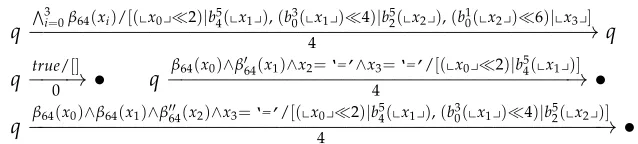
Base64decode is an S-EFT that decodes aBASE64encoded sequence back into the original byte
sequence. Base64decode has also one state and four rules:
q V3i=0β64(xi)/[(xx0y2)|b5
4(xx1y),(b3
0(xx1y)4)|b5
2(xx2y),(b1
0(xx2y)6)|xx3y]
−−−−−−−−−−−−−−−−−−−−−−−−−−−−−−−−−−−−−−−−−→4 q
q−−−→true0/[] • q β64(x0)∧β064(x1)∧x2=‘=’∧x3=‘=’/[(xx0y2)|b5 4(xx1y)]
−−−−−−−−−−−−−−−−−−−−−−−−−−−−−−→4 •
q β64(x0)∧β64(x1)∧β0064(x2)∧x3=‘=’/[(xx0y2)|b5
4(xx1y),(b3
0(xx1y)4)|b5 2(xx2y)]
−−−−−−−−−−−−−−−−−−−−−−−−−−−−−−−−−−−−−−−−−−−→4 •
The functionxyyis the inverse ofpxq, i.e.,xpxqy= x, for0 ≤ x≤ 63. The predicateβ64(y)
is true iff y is a valid BASE64 digit, i.e., y = pxqfor some x,0 ≤ x ≤ 63. The predicates
β064(y)andβ0064(y)are restricted versions ofβ64(y). Unlike Base64encode, Base64decode does
not accept all input sequences of bytes, and sequences that do not correspond to any encoding are rejected.4
The following subclass of S-EFTs captures transductions that behave as partial func-tions fromΣ∗toΓ∗.
Definition 2.5. A functionf : X → 2Y issingle-valued if|f(x)| ≤ 1 for allx ∈ X. An S-EFTAis single-valued ifTAis single-valued.
A sufficient condition for single-valuedness is determinism. We defineϕfψ, where ϕ
is a σm-predicate and ψ a σn-predicate, as the σmax(m,n)-predicate
λ(x1, . . . ,xmax(m,n)).ϕ(x1, . . . ,xm)∧ψ(x1, . . . ,xn). We defineequivalence of f and g with
respect toϕ, f ≡ϕ g, as: IsValid(λx¯.(ϕ(x¯)⇒ f(x¯) =g(x¯))).
Definition 2.6. Aisdeterministicif for allp−−→ϕ/`f q,p−−−→ϕ0`/0f0 q0 ∈ R:
(a) Assumeq,q0 ∈Q. IfIsSat(ϕfϕ0)thenq=q0,`=`0 and f ≡
ϕfϕ0 f0.
(b) Assumeq= q0 =•. IfIsSat(ϕfϕ0)and`=`0then f ≡
ϕfϕ0 f0.
(c) Assumeq∈ Qandq0 =•. IfIsSat(ϕfϕ0)then` > `0.
Intuitively, determinism means that no two rules may overlap. It follows from the definitions that ifAis deterministic thenAis single-valued. Both S-EFTs in Example 2.4 are deterministic.
Thedomainof a functionf : X → 2YisD(f) =def {x ∈ X | f(x) 6= ∅}and for an S-EFT
A, D(A) def= D(TA). When A is single-valued and u ∈ D(A), we treat Aas a partial
function from Σ∗ to Γ∗ and write A(u) for the value v such that T
A(u) = {v}. For example,Base64encode("Foo") ="Rm9v"andBase64decode("QmFy") ="Bar".
2.3.3 From BEX to S-EFTs
We describe how BEXprograms are compiled into S-EFTs. The syntaxes of S-EFTs and
BEXare very similar and BEXprovides a simple way to represent the rules of an S-EFT.
In BEXthe state component is maintained by an integer variableq, which is initialized
to a valuev0.
programname := [q= v0]repeat{body}
The program base64encode in Figure 2.2 has only one state and this component does not appear. Rules are of the two different forms. The first form is
guard,q=v1⇒update[q=v2]
whereguardis a regular expression that accepts only strings with some finite lengthl
and does not contain the symbol$denoting the end of string, andupdateis a sequence
of bit-vector-arithmetic expressions over the free variables{#0, . . . , #{l−1}}. This rule is translated into an S-EFT rule
v1 λx1,...,xl.(x1···xl
)∈L(guard)/λ#0,...,#{l−1}.update
−−−−−−−−−−−−−−−−−−−−−−−−−−→l v2
whereL(guard)is the set of strings accepted by the regular expressionguard. The
The second form is
guard$,q= v1⇒update
where guardis a regular expression that accepts only strings with some finite length
land does not contain the symbol$, andupdateis a sequence of bit-vector-arithmetic
expressions over the free variables {#0, . . . , #{l−1}}. This rule is translated into an S-EFT rule
v1 −−−−−−−−−−−−−−−−−−−−−−−−−−→λx1,...,xl.(x1···xl)∈L(guard)l /λ#0,...,#{l−1}.update •
2.3.4 Cartesian S-EFAs and S-EFTs
We introduce a subclass of S-EFTs that plays an important role in this chapter. A binary relation R over X is Cartesian over X if R is the Cartesian product R1×R2 of some
R1,R2⊆ X. The definition is lifted ton-ary relations andσn-predicates forn≥ 2 in the
obvious way. In order to decide if a satisfiableσn-predicate ϕis Cartesian over σ, let (a0, . . . ,an−1) =W(ϕ)and perform the following validity check:
IsCartesian(ϕ) def= ∀x¯(ϕ(x¯)⇔ ^
i<n
ϕ(a0, . . . ,ai−1,xi,ai+1, . . . ,an−1)).
In other words, aσn-predicateϕis Cartesian overσif ϕcan be rewritten equivalently
as a conjunction ofnindependentσ-predicates.
Definition 2.7. An S-EFT (S-EFA) isCartesianif all its guards are Cartesian.
Both S-EFTs in Example 2.4 are Cartesian.Base64encodeis trivially so, while the guards of all rules ofBase64decodeare conjunctions of independent unary predicates. In con-trast, a predicate such asλ(x0,x1).x0 =x1is not Cartesian.
Note thatIsCartesian(ϕ)is decidable by using the decision procedure of the label theory. Namely, decide unsatisfiability of¬IsCartesian(ϕ).
Cartesian S-EFAs capture exactly the class of S-FA definable languages. An S-FA is an S-EFA with final states and in which all transitions have lookahead 1.
Theorem 2.8(Cartesian S-EFA = S-FA). Cartesian S-EFAs and S-FAs are equivalent in
ex-pressiveness.
Proof. The ⇐direction is immediate. We prove the⇒direction. Given a Cartesian
S-EFAA= (Q,q0,(∆,F))we construct an equivalent S-FAA0. Without loss of generality
p −−−→ϕ(x1) r, r −−−→ψ(x2) q. Finally, if Ahas a finalizer q −−→true0 •, the state qwill be final in
A0.
As a consequence Cartesian S-EFAs enjoy all the properties of S-FAs (regular languages) such as boolean closures and decidability of equivalence.
2.3.5 Monadic S-EFAs and S-EFTs
We say that a (quantifier free) formula is inmonadic normal formorMNFif it is a Boolean combination of unary formulas, where a unary formulais a formula with at most one free variable. A formula ismonadicif it has an equivalent MNF. A natural problem that arises is deciding whether a formula is monadic and, if so, constructing its MNF. For example, the formula x < y over integers does not have an MNF while the formula
x < ymod 2 has an MNF(x <0∧ymod 2 = 0)∨(x <1∧ymod 2 = 1)that is also a DNF. Another MNF of x < ymod 2 isx < 0∨(x < 1∧ymod 2 = 1), which is also a
DNF but with semantically overlapping disjuncts.
Definition 2.9. An S-EFT (S-EFA) ismonadicif all its guards are monadic.
Veanes et al. [VBNB14] showed that if the label theory is decidable and a formula is monadic then its MNF can be constructed effectively.
Theorem 2.10. Monadic S-EFTs and Cartesian S-EFTs are effectively equivalent. Moreover,
this holds also for the deterministic case.
Proof. The ⇐ direction is immediate because Cartesian S-EFTs are a special case of
monadic S-EFTs. For the direction⇒, we first apply the proceduremondecfrom Veanes et al. [VBNB14] to each guardφ of the monadic S-EFT to obtain an equivalent MNF
of the guard, which we then rewrite into an equivalent DNFWi<nφi. Finally, we can replace each rule p −−→φ/`f qby the rules p φi/f
−−→` q, fori < n, where allφi are Cartesian. Determinism is clearly preserved, because all the new rules have identical outputs so the conditions (a) and (b) of Definition 2.6 are trivially fulfilled.
2.4
Properties of symbolic extended finite automata
First, we show how checking the emptiness of the intersection of two S-EFA definable languages is an undecidable problem.
Theorem 2.11(Domain Intersection). Given two S-EFAs A and B with look-ahead 2 over
quantifier-free successor arithmetic and tuples, checking whether there exists an input accepted by both A and B is undecidable.
Proof. Recall that a Minsky machine has two registers r1 andr2that can hold natural
numbers and a program that is a finite sequence of instructions. Each instruction is one of the following: INCi (incrementri and continue with the next instruction);DECi (decrementri ifri > 0 and continue with the next instruction); JZi(j) (ifri = 0 then jump to thej’th instruction else continue with the next instruction). The machine halts when the end of the program is reached. LetMbe a Minsky machine with programP. Letσ=N3represent the type of the snapshot or configuration(program counter,r1,r2)
ofM.
Supposeπj : σ→Nprojects thej’th element of ak-tuple where 0 ≤ j < k. Construct S-EFAsAandBoverσas follows. Letϕinibe theσ-predicateλx.(x= (0, 0, 0))stating
that the program counter and both registers are 0. Let ϕfin be the final σ-predicate λx.(π0(x) =|P| ∧π1(x)6=0).
Let ϕstepbe theσ2-predicateλ(x,x0).Wi<|P|ϕ
step
i where ϕstepi is the formula for thei’th instruction. If thei’th instruction isINC1then ϕstepi is
π0(x) =i∧π0(x0) =i+1∧π1(x0) =π1(x) +1∧π2(x0) =π2(x).
If thei’th instruction isJZ1(j)thenϕstepi is
π0(x) =i∧π0(x0) =Ite(π1(x) =0,j,i+1)∧π1(x0) =π1(x)∧π2(x0) =π2(x).
Similarly for the other cases. Thus, ϕstep encodes the valid step relation of M from
current configurationxto the next configurationx0. Let
A = ({p0},p0,{p0 ϕ step
−−→2 p0, p0−−→true0 •})and
B = ({q0,q1},q0,{q0 ϕ ini
−→1 q1, q1 ϕ
step
−−→2 q1, q1 ϕ
fin
−−→1 •}).
Soα∈ D(A)∩D(B)iffαis a valid computation of M, i.e.,α[0]is the initial
configura-tion,α[i+1]is a valid successor configuration of α[i](this follows from Afor all odd i<|α|and fromBfor all eveni<|α|), andα[|α| −1]is a halting configuration.
Theorem 2.12(Emptiness). Given an S-EFA A it is decidable to determine whether it accepts
any input.
Given A, we first remove all the transitions with unsatisfiable guards. Let’s call the new S-EFAA0. If A0has a path from the initial state to•, then Ais not empty.
Theorem 2.13(Boolean Properties). S-EFAs are closed under union but not closed under
intersection and complement.
Proof. Given two S-EFAs A1 = (Q1,q10,R1) and A2 = (Q2,q20,R2) over a sort σ we
construct an S-EFABoverσ such thatD(C) = D(A)∪D(B). Cwill have statesQ = Q1∪Q2∪ {q0}and initial state q0. The transition relation R of C is then defined as
follows:
R=R1∪R2∪ {q0−→ϕk q|q10
ϕ
−→k q∈ R1∨q20
ϕ
−→k q∈R2}.
As a consequence of Theorems 2.11, and 2.12 we have that S-EFA are not closed under intersection; if they were using Theorem 2.12 one could decide intersection emptiness. Since S-EFAs are closed under union, S-EFAs cannot be closed under complement; if they were we could use Boolean operations to show closure under intersection.
While checking the emptiness of an S-EFA is a decidable problem, it is not possible to decide whether an S-EFA accepts every possible input. It follows that equivalence is also undecidable.
Theorem 2.14(Universality and Equivalence). Given an S-EFA A over σ it is
undecid-able to check whether A accepts all the sequences inσ∗, and given two S-EFAs A and B it is
undecidable to check whether A and B accept the same language.
Proof. Let M be a Minsky machine with programP. Letσ = N3represent the type of
the snapshot or configuration(program counter,r1,r2)ofM. Letϕini,ϕfinandϕstepbe as
in Theorem 2.11.
We construct an S-EFAAMthat does not accept all the strings inσ∗iffMhalts on input
(0, 0)with a non-zero output inr1. The latter is an undecidable problem as an instance
Let
A = ({p0,p1},p0,{p0−−→true1 p0, p0 ¬ϕ step
−−−→2 p1, p1−−→true1 p1, p1−−→true0 •}),
B = ({q0,q1},q0,{q0 ¬ϕ ini
−−→1 q1, q1−−→true1 q1, q1−−→true0 •}),
C = ({r0},r0,{r0 −−→true1 r0, r0 ¬ϕ fin
−−→1 •}),
D = ({s0},s0,{s0−−→true0 •}).
Aaccepts all theM configuration sequences in which at least one step is wrong,Ball those that start with the wrong initial state,Call those that end in the wrong configura-tion, andDthe empty sequence. We define AM = A∪B∪C∪Dusing Theorem 2.13.
AMdoes not accept all the inputs inσ∗ iff Mhalts on input(0, 0)with a non-zero out-put inr1(i.e. such sequence of configuration wouldn’t be accepted by AM). Since one can trivially construct an S-EFAAll that accepts all strings we have that being able to check the equivalence ofAllandAMwould solve an undecidable problem. The unde-cidability of equivalence follows.
We finally show that longer a look-ahead adds expressiveness.
Theorem 2.15. For every k there exists an S-EFA with look-ahead k+1that cannot be repre-sented by any S-EFA with look-ahead k.
Proof. Consider the S-EFA Aover the theory of integers with one initial state q0 and
one final stateq1. The S-EFAAhas only one transition betweenq0andq1of look-ahead
k+1 with the following predicateψ(x1, . . . ,xk+1) = x1 = x2 = . . .= xk+1. There does
not exist an S-EFABwith look-aheadkequivalent to A. Let’s assumeBexists by way of contradiction. SinceAonly accepts strings of lengthk+1,Bcan only have finitely many paths from its initial state to any final state. Let’s assume that every path has length 2 and it has guards of the formϕ1(x1. . .xl)andϕ2(xl+1. . .xk+1). We now must
have thatψ(x1, . . . ,xk+1)≡ Wϕ1(x1. . .xl)∧ϕ2(xl+1. . .xk+1). However the predicateψ
does not admit such a representation as the variables andxl andxl+1do not belong to
any binary relation and cannot be compared for equality.
2.5
Equivalence of symbolic extended finite transducers
is decidable for S-FTs (over decidable label theories). In this section we show that equivalence of S-EFTs is in general undecidable, but decidable for Cartesian S-EFTs.
Definition 2.16. Functions f,g : X → 2Y are one-equal, f =1 g, if for all x ∈ X, if
x ∈D(f)∩D(g)then|f(x)∪g(x)|=1. Let
f]g(x)def=
(
f(x)∪g(x), ifx∈D(f)∩D(g);
∅, otherwise.
Proposition 2.17. f=1 gifff]gis single-valued.
Note thatf =1 fifffis single-valued. Thus, one-equality is a more refined notion than single-valuedness, because an effective construction ofA]Bsuch thatTA]B =TA]TB
may not always be feasible or even possible for some classes of transducers.
Definition 2.18. Functionsf,g:X→2Yaredomain-equivalentifD(f) =D(g).
Definitions 2.16 and 2.18 are lifted to transducers. For domain-equivalent single-valued transducersAandB,A=1 Bimplies equivalence of AandB(TA=TB).
2.5.1 Equivalence of S-EFTs is undecidable
We now show that one-equality of S-EFTs over decidable label theories is undecidable in general.
Theorem 2.19(One-equality). One-equality of S-EFTs with look-ahead 2 over quantifier-free
successor arithmetic and tuples is undecidable.
Proof. We give a reduction from the Domain Intersection problem of Theorem 2.11. Let
A1 andA2 be S-EFAs with look-ahead 2 over quantifier-free successor arithmetic and
tuples. We construct S-EFTsA0
i, fori∈ {1, 2}, as follows:
A0
i = (QAi,q0Ai,∆Ai ∪ {p
ϕ/[i]
−−→k • |p −→ϕk • ∈ FAi}).
SoTA0
i(t) ={[i]}ift∈ D(Ai)andTA0i(t) =∅otherwise. Letf =TA10 ]TA02. So
• |f(t)|=0 ifft6∈D(A1)∪D(A2);
• |f(t)|=1 ifft∈D(A1)∪D(A2)andt 6∈D(A1)∩D(A2);
• |f(t)|=2 ifft∈D(A1)∩D(A2).
It follows thatA0
Equivalence of symbolic finite transducers with look-back In this section we briefly describe a model that is tightly related to S-EFTs and for which equivalence is also un-decidable. Symbolic finite transducers with look-backk (k-SLTs) [BB13] have a sliding window of sizek that allows, in addition to the current input character, references of up tok−1 previous characters (using predicates of arityk). All the states of an SLTs are final and are associated with a constant output. Botinˇcan et al. [BB13] incorrectly claimed that equivalence of SLTs is decidable. We can prove using the same technique shown in the proof of Theorem 2.19 that equivalence is also undecidable for SLTs. We do not formally define SLTs here, but we briefly explain why the proof of Theorem 2.19 extends to this model. We letσ = N3 be the input sort and represent configurations
of a Minsky machine in the same way we discussed in the proof of Theorem 2.11. Un-like S-EFTs, SLTs do not consumeksymbols at a time and can therefore read the same input character multiple times using look-back. We can construct an SLT Athat when reading each character in the input uses the predicateϕstepdefined in Theorem 2.19 to
check whether thecurrentconfiguration of the Minsky machine follows from the pre-vious one. Finally, the state following the accepting configuration outputs the constant
a(every other state outputsε). The SLTAoutputsεon every run that is not an
accept-ing one for the Minsky machine and aon the accepting run (if it exists). We can now construct a simple SLTBwith look-back 1 with one transition defined on the predicate
truethat always outputsε. The two SLTsAandBare one-equal iff the Minsky machine
does not halt (i.e. the first SLT never outputs a). The incorrect proof of decidability presented by Botinˇcan et al. [BB13] relies on intersecting the transitions of the two SLTs and then checking emptiness. Unfortunately, this does not work because the activation of a transition may depend on what transition was triggered in the previous step and simple cross-product construction does not take this into account.
2.5.2 Equivalence of Cartesian S-EFTs is Decidable
This is the main decidability result of the chapter and it extends the corresponding result for S-FTs presented by Veanes et al. [VHL+12, Theorem 1]. We use the following definitions. A transition,p −−→ϕ/`f qwhere` >1,ϕis Cartesian andW(ϕ) = (a1, . . . ,a`), is represented, given ϕi = λx.ϕ(a1, . . . ,ai−1,x,ai+1, . . . ,a`), by the following path of
splittransitions,
p−−→ϕ1/1f p1−−−→ϕ2/1⊥ p2· · ·p`−1
ϕ`/⊥
−−−→1 q
where pi for 1 ≤ i < ` are new temporary states. Let ∆sA denote such split view of
Example 2.20. It is trivial to transform any S-EFT into an equivalent (possibly
nondeterminis-tic) form where all finalizers have zero look-ahead. Consider the S-EFT
Base64encode in Example 2.4. In the last two finalizers, replace • with a new state p1 and
add the new finalizer p1−−−→true0/ε •.
Definition 2.21. Let Aand B be Cartesian S-EFTs with same input and output types and zero-look-ahead finalizers. Theproductof AandBis the followingproduct S-EFT A×B. Theinitial state q0
A×B of A×Bis(q0A,q0B). The states and transitions ofA×Bare obtained as the least fixed point of
(p,q)∈QA×B
p−−→ϕ/1f p0 ∈∆s
A
q−−→ψ/1g q0 ∈ ∆s
B
IsSat(ϕ∧ψ)
=⇒ (p0,q0)∈ QA×B, (p,q)−−−−−→ϕ∧ψ/1(f,g) (p0,q0)∈∆A×B.
Let FA×B be the set of all rules(p,q) −−−−−→true/0(v,w) •such that p −−−→true0/v • ∈ FA, q −−−→true0/w
• ∈ FB, and (p,q) ∈ QA×B. Finally, remove from QA×B (and ∆A×B) all dead ends (non-initial states from which•is not reachable).5
We lift the definition of transductions to product S-EFTs. A pair-state(p,q)∈ QA×Bis
alignedif all transitions from(p,q)have outputs(f,g)such thatf 6=⊥andg6=⊥. The
relation→−→/ A×B is defined analogously to S-EFTs.
Lemma 2.22(Product). For all aligned(p,q)∈QA×B, u ∈Σ∗, v,w∈Γ∗:
(p,q)−−−−→u/(v,w)→A×B • ⇔ p−−→u/→vA• ∧q−−→u/→wB •
Proof. This follows by induction on the input string u. The base case u = εis trivial
as the product machine A×Boutputs(ε,ε)andAandBboth outputε, or all outputs
are undefined. The inductive case is u = a1· · ·alu0 where l ≥ 1 and by induction hypothesis, for allp0,q0,u0,v0,w0,
(p0,q0)−−−−−→u0/(v0,w→0)A
×B • ⇔ p0 u
0/v0
−−→→A • ∧q0 u
0/w0
−−−→→B •
If they exists, letp−−→ϕ/lf p1andq−−→ψ/lg q1be theAandBtransitions out ofpandqthat are
defined ona1. . .al. The outputs ofAandBona1· · ·al are f(a1, . . . ,al)andg(a1, . . . ,al) respectively. The corresponding transition in A×B is(p,q) −−−−−→ϕ∧ψ/l(f,g) (p1,q1). Since
a1. . .al is a model of bothϕandψ, it is also a model ofϕ∧ψ. Therefore, the output of
A×Bon a1· · ·al is(f(a1, . . . ,al),g(a1, . . . ,al)). Since by I.H. the outputs on the suffix
u0also match this concludes the proof.
5 In our constructions we always remove unnecessary states to improve the efficiency of our