Comparison of Blade Element Method and CFD
Simulations of a 10 MW Wind Turbine
Galih Bangga
Institute of Aerodynamics and Gas Dynamics, University of Stuttgart, Pfaffenwaldring 21 70569 Stuttgart, Germany; [email protected], [email protected]
Academic Editor: name
Version October 12, 2018 submitted to Preprints
Abstract:The present studies deliver the computational investigations of a 10 MW turbine with a
1
diameter of 205.8 m developed within the framework of the AVATAR (Advanced Aerodynamic Tools
2
for Large Rotors) project. The simulations were carried out using two methods with different fidelity
3
levels, namely the computational fluid dynamics (CFD) and blade element and momentum (BEM)
4
approaches. For this purpose, a new BEM code namely B-GO was developed employing several
5
correction terms and three different polar and spatial interpolation options. Several flow conditions
6
were considered in the simulations, ranging from the design condition to the off-design condition
7
where massive flow separation takes place, challenging the validity of the BEM approach. An excellent
8
agreement is obtained between the BEM computations and the 3D CFD results for all blade regions,
9
even when massive flow separation occurs on the blade inboard area. The results demonstrate that
10
the selection of the polar data can influence the accuracy of the BEM results significantly, where the
11
3D polar datasets extracted from the CFD simulations are considered the best. The BEM prediction
12
depends on the interpolation order and the blade segment discretization.
13
Keywords:aerodynamics; BEM; CFD; simulation; wind turbine.
14
1. Motivation and State of the Art
15
The increased fossil fuel depletion in past decades has led to a shortage in electricity production
16
causing an increasing need in finding alternatives to fossil energy sources [1]. Wind energy has been
17
identified as one of the most promising sources for renewable energy industry [2,3]. There are two
18
main categories of wind turbines according to its rotational axis: Horizontal Axis Wind Turbines
19
(HAWTs) and Vertical Axis Wind Turbines (VAWTs). The former has been developed significantly
20
during the last decades in terms of research and commercialization.
21
Following the successful flight of Wright Brothers in 1903, researches within the aeronautical field
22
increase significantly especially in the field of propeller aerodynamics. In 1920, a German researcher
23
Betz [4] from Göttingen University developed a theory for propeller to drive the airplanes. Later, this
24
formula becomes the limit for energy extraction from the wind by simply reversing the flow of the
25
equations that is well known as the Betz limit. This implies that, even for the most ideal wind turbine,
26
the energy extracted cannot be higher than 59.3%. The performance of the turbine depends strongly
27
upon the aerodynamic design of the blades, that influences the loads acting on the rotor. It has been
28
shown from various studies that the lift driven turbine is more efficient compared to the drag driven
29
turbines [5].
30
Throughout the years, various aerodynamic modelling approaches for wind turbine simulations
31
have been developed, ranging from basic method to advanced high fidelity models. The works of Betz
32
[4] and Glauert [6] have become the founding theory for the famous blade element and momentum
33
(BEM) approach. This method, since then, has become the most widely used tool in wind turbine
34
research and industry due to its simplicity and minimal computing requirement. The method allows
35
one to perform a complete design of new blades or evaluating existing designs by utilizing the existing
36
lift and drag polar data of the airfoils constructing the blade, as described for example in [7].
37
The BEM approach models the turbine as a rotating actuator disc and the acting forces are
38
evaluated at each blade segment. There is no interaction from one to the other blade segments and the
39
method is based on the inviscid approach. As a result, the three-dimensional (3D) effects occurring
40
on the blade cannot be captured at all by the model. This is especially true near the tip and the root
41
areas. The former is caused by the flow recirculation resulting in the downwash effect and reduced
42
effective angle of attack. This effect can be modelled using a simple tip loss correction implemented in
43
the code, for example by the Prandtl tip loss correction [8], with a relatively good accuracy. On the
44
other hand, the 3D effect occurring in the root area is harder to be modelled because this involves
45
many factors including massive flow separation and three-dimensional flow behaviour. The effect is
46
widely known as rotational augmentation and has been investigated intensively since it was found by
47
Himmelskamp in 1945 [9], for example by Sörensen [10], Snel et al. [11], Du & Selig [12] and Bangga et
48
al. [1,13–16]. Under the influence of rotational augmentation, the sectional lift coefficient in the blade
49
root increases compared to the two-dimensional (2D) conditions causing the stall delay effect. The
50
centrifugal and Coriolis forces within the blade boundary layer are believed to be the main causes
51
of the phenomena for delaying the occurrence of separation. Wood [17] suggested an alternative
52
explanation that the inviscid effect is actually the main cause of the phenomenon, not the viscous effect.
53
Very recently, Bangga [13] found that both inviscid and viscous effects have their own importance for
54
the 3D rotational augmentation.
55
With the development of computing performance in the recent years, the use of the high fidelity
56
computational fluid dynamics (CFD) approach for fully resolved wind turbine rotor becomes possible.
57
This way, the three-dimensional effects occurring on the rotor blade can be physically captured. Duque
58
et al. [18] carried CFD computations of the NREL Phase VI blade using a lifting line code and a CFD
59
code that made use of overset grids and an algebraic turbulence model known as the Baldwin-Lomax
60
model, showing an improved prediction for the CFD approach compared to the lifting line model.
61
Pape and Lecanu [19] compared two turbulence models, namely the Wilcox [20] and SST models [21],
62
for wind turbine predictions. The results demonstrated that the SST model was superior compared to
63
the Wilcox model, but both were failed to accurately simulate the post-stall behaviour of the turbine
64
blade. Bangga et al. [16,22] performed CFD computations for a small MEXICO (Model Experiments
65
in Controlled Conditions) rotor [23]. They obtained a good agreement with experimental data by
66
using the Hybrid RANS/LES approach based on the SST model within the boundary layer area. They
67
observed that the 3D rotational augmentation is prominent in the root area of the rotor. It was observed
68
that the lift coefficient in the tip area reduces compared to the 2D condition due to the tip loss effect.
69
The same behaviour was also observed in [13,15]. With a sufficiently accurate CFD computation, it was
70
possible to reproduce the airfoil characteristics under rotational augmentation without using empirical
71
stall correction models.
72
One may think that there is no benefit for using the 3D polar as expensive 3D CFD computations
73
need to be done in advance. Despite that, this effort is useful when code-to-code comparison shall
74
be done in the absence of experimental data. Learning from the experience of similar comparison
75
for the AVATAR blade in [24], a significant discrepancy was obtained between different simulation
76
tools with different fidelity orders. At this point it was difficult to argue whether the differences are
77
coming from the polar data or the modelling approach. In this sense, the input polar data at least shall
78
be consistent if one intends to really assess the modelling behaviour of the method. The use of the
79
3D polar data is expected to be more beneficial for this purpose. Schneider et al. [25] documented
80
that the polar data extracted from the 3D CFD simulation of a 7.5 MW wind turbine enhanced the
81
BEM prediction significantly. A similar conclusion was obtained very recently by Guma et al. [26]
82
for a 750 kW research turbine. They observed that the origin of the polars is a crucial input that can
83
make strong difference in the results. The tangential component of the loads was proven to be harder
84
to reproduce for this case. They further indicated that the results of BEM may depend on the polar
85
interpolation. BEM codes usually employ the linear interpolation approach, for example FAST [27]
86
and QBlade [28]. To obtain a good representation of the blade geometry and polar data, a large number
of blade elements need to be specified. This was supported by the work of Heramarwan [29] using
88
the QBlade code, especially near the tip region. Marten et al. [30] documented that the BEM results
89
linearly interpolated based on the real airfoil geometry in comparison to the direct polar data can
90
differ depending on the characteristic of the neighbouring airfoil sections. McCrink and Gregory [31]
91
provided an example for the BEM calculations based on the polynomial interpolation functions in
92
MATLAB [32]. Despite that, the results were not compared to the other interpolation approaches.
93
It becomes clear that the source of the polar data and the type of interpolation used can influence
94
the blade element method predictions. Indeed these studies have been carried out long ago for wind
95
turbine applications. However, to the date there is no literature investigating the highlighted issues
96
for a very large wind turbine where the rotor diameter is greater than 200 m. The main aim of the
97
present work is to investigate the consistency of simulation tools with different fidelity levels to predict
98
the performance of a large 10 MW rotor. This becomes increasingly important as wind turbine is
99
significantly increasing in size nowadays to meet the energy demand. On the other hand, the design is
100
still based on a simple BEM model. The importance of the usage of 3D polar data and interpolation
101
order will be demonstrated in the paper. The paper is constructed as follows; the simulation approaches
102
are described in Section2, the results are discussed in Section3and all the findings are concluded in
103
Section4.
104
2. Simulation Approaches
105
2.1. Blade Element and Momentum
106
The blade element and momentum theory has its origins in momentum theory and the
107
development from this to the useful calculation tool is well explained in many texts [33–35]. The
108
general mathematical descriptions of this approach will be given in the following discussions, divided
109
into two sections. The first one is by using the momentum balance on a rotating annular stream tube
110
passing on a turbine (momentum theory). The second part is by examining the forces acting at the
111
blade elements at various sections along the blade (blade element theory). These two methods then
112
provide a series of equations that can be solved iteratively.
113
2.1.1. One dimensional momentum theory and the momentum transfer
114
The one-dimensional momentum theory that serves as a foundation for the BEM theory is
115
described in this section. This approach assumes the flow to be steady, inviscid, incompressible and
116
axisymmetric [1]. The rotor in this case can be modelled as a frictionless permeable actuator disc which
117
is assumed to impart no rotational velocity to the flow [33]. The momentum theory basically consists
118
of a control volume for conservation of mass, axial and angular momentum balances, and energy
119
conservation [36]. This surrounds the actuator disc and is bounded by a stream-tube, with two cross
120
sections far upstream and far downstream of the disc [33]. A commonly used general assumption for
121
the BEM theory is that the stream-tube is not interacting with the fluid flow outside of the evaluated
122
boundary. The modelled actuator disc extracts the energy from the stream-tube by generating an
123
axial force acting on the disc. The stream-tube enlarges downstream of the rotor plane. This causes
124
a pressure drop of the fluid flow just downstream of the disc. In the farfield region, the pressure is
125
usually assumed to reach the ambient atmospheric pressure level. In this sense, the flow velocity must
126
be smaller than the inflow speed to satisfy the Bernoulli’s equation.
127
The following equations define the energy equations upstream and downstream of the actuator
128
disc.
129
pamb+1 2ρU
2=p
ud+1 2ρU
2
disc (1)
pdd+ 1 2ρU
2
disc=pamb+ 1 2ρU
2
where pamb, pud and pdd define the ambient pressure, the pressure just upstream of the disc and
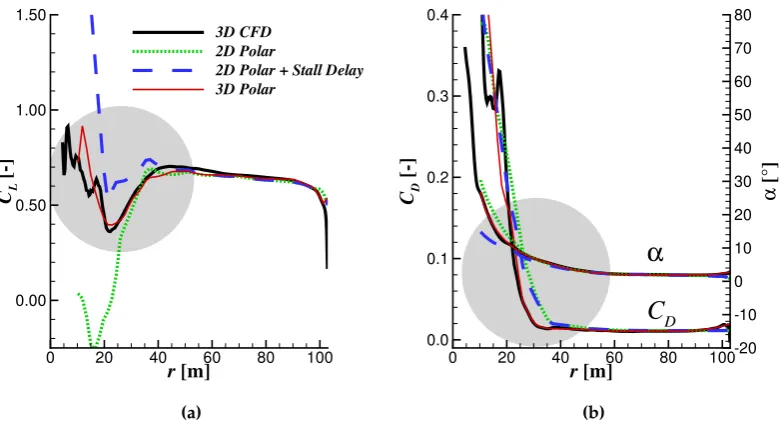
130
downstream of the disc, respectively. The velocity componentsU,UdiscandU1represent the inflow
131
velocity, the wind speed at the rotor disc and far downstream of the disc, respectively. The axial force
132
can then easily be obtained based on the pressure drop, between upstream-and-downstream-vicinity
133
of the actuator disc, derived from Equations (1) and (2) as
134
Fn= 1 2ρAdisc
U2−U12. (3)
Based on the momentum balance, the difference in the momentum between the upstream and
135
downstream planes of the disc must be compensated by an acting force in axial direction. In this sense,
136
the axial force can also be written in form of the flow momentum difference as
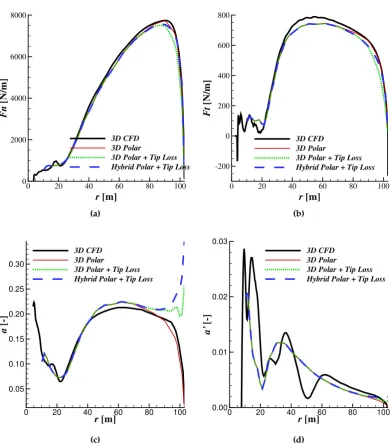
137
Fn =m˙ (U−U1), (4)
where the mass flow rate can be written as ˙m=ρAdiscUdisc. By comparing Equations (3) and (4), the
138
wind velocity at the actuator disc location is none other than the average velocity of the far upstream
139
and downstream the rotor plane. A new parameterais defined as the fractional reduction in flow
140
speed between the free-stream and the actuator disc.
141
a= U−Udisc
U . (5)
Then, the velocities at the rotor plane and far downstream of the disc can be redefined as a function of
142
a. The axial force in Equation (3) then can be rewritten as
143
Fn=2ρAdiscU2a(1−a). (6)
Using the axial induction factor with Equation (3), one may obtain the expression for the power
144
extraction
145
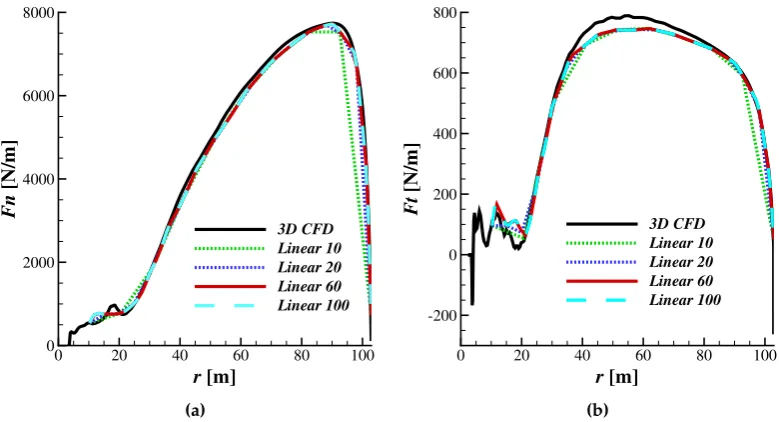
P=2ρAdiscU3a(1−a)2. (7)
According to one dimensional momentum theory, there is a pressure drop (energy lost) when the
146
wind flows through the rotor. Some of the energy loss from this axial flow is converted into rotational
147
momentum of the stream-tube, as a reaction to the rotational torque imparted to the turbine rotor thus
148
rotating annular stream tube is then introduced [1].
149
Rotating annular stream tube is shown in Figure1. Four stations are shown in the diagram, some
150
way upstream of the turbine (1), just before the blades (2), just after the blades (3) and some way
151
downstream of the blades (4). As the wind passes between stations 2 and 3, the motion of the turbine
152
causes the wind to rotate in the wake downstream of the turbine. The blade wake rotates with an
153
angular velocityωand the blades rotate with an angular velocity ofΩ. Recalling the conservation of
154
angular momentum, the torque calculation of a rotating annular element of fluid at a radiusrcan be
155
written as
156
dQ=dm˙(ωr)r=ρUdisc2πrdr(ωr)r (8) by introducing the angular (tangential) induction factorb = ω
2Ω, the elemental torque can then be
157
rewritten as
158
dQ=4b(1−a)ρUΩr2πrdr (9)
2.1.2. Blade element theory
159
The blade element theory divides the rotor blade into several discrete radial elements (airfoils)
160
as described earlier in Section2.1. This theory relies on two key assumptions: (1) There are no
aerodynamic interactions between the 2D airfoil elements in different sections, and (2) the forces acting
162
on the elements are solely determined by the lift and drag characteristics of the airfoils shape and
163
relative inflow [1].
164
The definitions of the velocity vector and the lift (L) and drag (D) acting on the blade section are
165
illustrated in Figure2. The total angle between the circumferential direction to the relative inflow (V)
166
is represented by variableφ. This angle is composed by the local angle of attack (α) and the sum of the
167
pitch and twist angles (θ). The variableU∞represents the inflow wind speed andΩis the rotational
168
speed of the turbine. Note thatU∞in Figure2is the same asUused in Section2.1.1.
169
The axial force and torque acting on the blade element can be obtained using the relations for lift
170
and drag, that are represented by the lift (CL) and drag (CD) coefficients assuming the chord length (c)
171
of the blade element is known from the geometrical model. These are formulated as following
172
dFA=N1 2ρV
2c(C
Lcosφ+CDsinφ)dr (10)
dT =N1 2ρV
2cr(C
Lsinφ−CDcosφ)dr. (11)
By introducing a new parameter that represents the ratio of the tangential to the inflow velocity,
173
λr = UrΩ∞, well known as the local speed ratio, the total flow angle can be redefined as
174
φ=tan−1
U(1−a) rΩ(1+b)
=tan−1
(1−a) λr(1+b)
. (12)
2.1.3. B-GO code description
175
A short description of the BEM code B-GO will be presented in the following section. The
176
B-GO code was written in Python language employing several commonly used packages. B-GO
177
is constructed by several subroutines that is called in the main calculations. These routines are
178
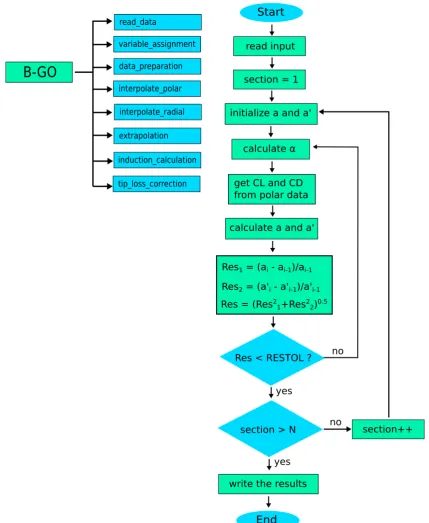
read_data, variable_assignment, data_preparation, interpolate_polar, interpolate_radial,
179
extrapolation, induction_calculation and tip_loss_correction, illustrated in Figure 3. By
180
writing each main part of the code as a subroutine, the code can be further developed in the future by
181
simply modifying only the respective functions.
182
blades
1
2 3
4
Ωr(1+b)
U∞
(1-a)
V θ
ϕ
L
D ϕ
L sin ϕ - D cos ϕ
L cos
ϕ
+ D si
n
ϕ
Figure 2.Velocity vector and forces acting on the blade element.
The BEM computation is started by reading the input data. First, the axial (a) and tangential (a0)
183
induction factors are set to a small value (0.0001) to initialize the calculation. The angle of attack is
184
calculated by applying the following formula
185
α=φ−θ. (13)
CLandCDcan then be obtained from the polar data of the respective sections. Note that interpolation
186
and extrapolation of the polar data are necessary because there is a high probability that the polar data
187
does not exist for the corresponding angle of attack. The interpolation can be carried out using one
188
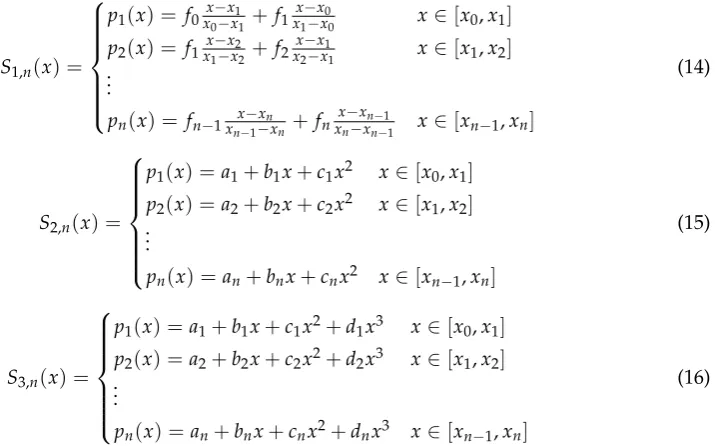
of the three different interpolation options that the user can choose, namely linear-, quadratic- and
189
cubic-spline interpolations. These can be expressed as:
190
S1,n(x) =
p1(x) = f0x−x1 x0−x1 +f1
x−x0
x1−x0 x∈[x0,x1]
p2(x) = f1xx−x1−x22 +f2 x−x1
x2−x1 x∈[x1,x2] ..
.
pn(x) = fn−1xnx−xn−1−xn +fnxnx−x−xnn−−11 x∈[xn−1,xn]
(14)
S2,n(x) =
p1(x) =a1+b1x+c1x2 x∈[x0,x1] p2(x) =a2+b2x+c2x2 x∈[x1,x2] ..
.
pn(x) =an+bnx+cnx2 x∈[xn−1,xn]
(15)
S3,n(x) =
p1(x) =a1+b1x+c1x2+d1x3 x∈[x0,x1] p2(x) =a2+b2x+c2x2+d2x3 x∈[x1,x2] ..
.
pn(x) =an+bnx+cnx2+dnx3 x∈[xn−1,xn]
(16)
whereS1,n(x),S2,n(x)andS3,n(x)are the linear, quadratic and cubic continuous functions, respectively,
191
that interpolate the data constructed by several polynomialsp1(x),p1(x), ..,pn(x). The constants (an,
192
bn,cn,dn) shall be determined on each function for the corresponding dataset range[xn−1,xn]. Most of
193
BEM codes usually employ the linear interpolation approach. Newaanda0can be calculated using
194
a= 1
4
Cnσ
Ftipsin2φ+1
B-GO
variable_assignment read_data
data_preparation
interpolate_polar
extrapolation interpolate_radial
induction_calculation
tip_loss_correction
read input
Start
section = 1
initialize a and a'
calculate α
get CL and CD from polar data
calculate a and a'
Res1 = (ai - ai-1)/ai-1
Res2 = (a'i - a'i-1)/a'i-1
Res < RESTOL ? Res = (Res21+Res22)0.5
section > N section++
End
write the resultsno
no yes
yes
Figure 3.List of subroutines constructing the BEM code and the calculation procedure.
a0= 1
4
Ctσ
Ftipsinφcosφ−1
, (18)
where
195
Ct=CLsinφ−CDcosφ (20)
σ= cB
2πr. (21)
The Prandtl tip loss correction is given as [8]
196
Ftip= 2 π cos
−1 e−B(R−r)
√ 1+λ2 2R
!
, (22)
whereBandRare the number of blades and the rotor radius, respectively. The obtained inductions
197
are then compared with the inductions from the previous iteration, and the residual is calculated. The
198
converge is defined when the residual is smaller than the user defined tolerance, that was set to 1 X
199
10−11for the present studies. Otherwise, 100 iterations were applied. The calculations are performed
200
for each blade section until the maximum number of blade elements ofN. The interpolation is also
201
applied to refine the evaluated segments in the radial directions, both for the polar and the blade
202
geometry, using one of the three available interpolation options as mentioned above. This allows a
203
more accurate computation to be performed.
204
In case the induction factor is higher than 0.4, the Froude momentum theory is no longer valid.
205
Spera [37] suggested a correction for the axial induction, ifa>ac, as
206
a=1+1
2K(1−2ac)− 1 2
q
(K(1−2ac) +2)2+4(Ka2c−1) (23) whereacis commonly about 0.2 andKis defined as
207
K= 4Ftipsin 2
φ
σCn . (24)
2.2. Computational Fluid Dynamics
208
The Computational Fluid Dynamics (CFD) approach is a combination of interdisciplinary fields such as physics, numerical mathematics and computer sciences to model the physical fluid flow phenomena. Turbulence is the main concern for accuracy and applicability for flow simulations using CFD. One way out of this issue is to simplify the solution variables of the Navier-Stokes equations by the Reynolds-Averaged Navier-Stokes (RANS) approach, which pose the time-averaged form of the Navier-Stokes equations. The fluid flow variables in the governing equations are subdivided into the mean and fluctuating components. For compressible flow, it is advocated to use the weighted density well known as the Favré averaging technique. This is done by utilizing the Reynolds averaging for density and pressure, yet for velocity, internal energy, enthalpy and temperature the Favré averaging procedure can be used [38–40]. The Favré averaged equation for velocity is acquired using:
˜ ui =
1 ¯ ρ T→lim∞
1 T
Z t+T
t ρuit.. (25)
equation is obtained. This mathematical expression is referred to as the Favré- and Reynolds-averaged Navier-Stokes equations [13]. In the cartesian tensor form the equations add up to
∂ρ¯ ∂t +
∂ ∂xi
(ρ¯u˜i) =0 (26)
∂
∂t(ρ¯u˜i) + ∂ ∂xj
¯ ρu˜iu˜j
= ∂p¯
∂xi
+ ∂ ∂xj
"
µ ∂u˜i ∂xj
+∂u˜j ∂xi
!#
− ∂
∂xj ˜
τijRANS. (27)
The left hand side of Equation (27) accounts for the fluid momentum incorporating the variation of the mean flow with the time. This is balanced by the mean pressure gradient, viscous stresses and the apparent stress ˜τijRANS, also known as the Reynolds stress (Favré-averaged) on the other side of the equation. Since the equation cannot directly be solved, the equation is remodeled to close the equation [13]. The Boussinesq hypothesis is generally taken as an approach to relate the mean velocity gradients to the Reynolds stress, for comparison see Hinze [41]. In this model the turbulent viscosity is expressed in the variableµt[13].
−τ˜ijRANS=µt ∂u˜i
∂xj
+∂u˜j ∂xi
! −2
3
¯
pk˜+µt∂u˜k
∂xk
δij (28)
Many turbulence models are developed based on this relation through the modeling of the turbulent viscosity, commonly referred to as eddy viscosity turbulence models (EVTMs). Examples of the EVTMs are the Spalart-Allmaras (SA) model & its derivatives (1-equation),k−εmodel & the k−ωmodel & their derivatives (2-equation), and the Reynolds stress model (RSM) & its derivatives (7-equation). The shear stress transport (SST)k−ωmodel according to Menter [42] is a two-equation model family widely used in industry and research, because the model is able to deliver reasonable predictions for flows with a strong adverse pressure gradient. The model can be mathematically expressed as
∂ρk ∂t +
∂ρujk
∂xj
=P−β∗ρωk+ ∂ ∂xj
"
(µ+σkµt) ∂k
∂xj
#
(29)
∂ρω ∂t +
∂ρujω ∂xj
= γω νt P
−βρω2+ ∂ ∂xj
"
(µ+σωµt)
∂ω ∂xj
#
+2(1−F1)ρσω2
ω ∂k ∂xj
∂ω
∂xj. (30)
The parameters used in these equations are determined as
P=τij
ui
xj (31)
τij=µt
2Sij−
2 3ρkδij
(32)
Sij= 1 2
ui
xj
+uj xi
!
(33)
µt= ρa1k
max(a1ω,ΩF2). (34)
For the present studies, the generic 10 MW AVATAR blade [43] was chosen. The rotor is designed
209
based on the DTU 10 MW wind turbine [44] with a larger blade radius ofR= 102.9 m. The blade was
210
constructed by 6 different DU airfoils as presented in Table1. The airfoils are interpolated along the
211
blade radius, and the shapes are illustrated in Figure4. For further detail, the reader is suggested to
212
refer to [43]. The calculations were performed without tower to avoid the unsteady tower disturbance
213
effects. A Cartesian coordinate system was adopted in the present studies, where the details are
Table 1.Airfoil sections used for the AVATAR reference blade [15,43].
Airfoil Thickness [t/c] Airfoil Type
60.0% Artificial, based on thickest available DU
40.1% DU 00-W2-401
35.0% DU 00-W2-350
30.0% DU 97-W300
24.0% DU 91-W2-250 (modified fort/c=24%)
21.0% Based on DU 00-W212, added trailing edge thickness
x/c
y/
c
Figure 4.Visualization of the sectional airfoils employed in the AVATAR blade.
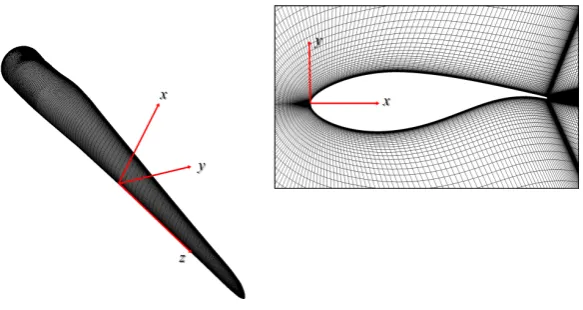
Figure 5.Surface mesh and detailed cross-section mesh of the blade. Variablesx,yandzrepresent local coordinate of the blade section in the rotating frame of reference.
illustrated in Figure5. In the rotating (local) coordinate system,x,yandzrepresent chordwise, normal
215
and spanwise directions of the blade which rotate together with the rotor.
216
The grid for the rotor simulations consist of several components, background (BGm), wake
217
refinement (Rm), blade (Bm) and nacelle (Nm) meshes as shown in Figure6. The blade mesh consists of
218
280x128 cells in chordwise and normal directions, respectively. The blade is discretized by 192 cells
219
along the radius with significant refinement near the root and tip areas. Figure5shows the surface
220
meshes and the sectional mesh of the blade used in the present investigations. The mesh of the blade is
221
C-H type and was constructed using the commercial grid generator Gridgen [45] with the "automesh"
Figure 6. Grid setup showing blade (purple); spinner and nacelle (red); refinement (yellow) and background grids (green). VariablesX,YandZrepresent coordinate system in the inertial frame of reference.
script developed at the institute. The 3D blade mesh was refined near the wall area satisfying the
223
non-dimensional wall distancey+ <1 to resolve the viscous sub-layer. The total resolution for the
224
complete domain reaches 39 million grid points.
225
The CFD FLOWer code [46,47] was used to numerically model the fluid flow over the rotor
226
by solving the Navier-Stokes equations on the structured meshes. A central scheme based on the
227
Jameson-Schmidt-Turkel (JST) formulation was employed for flux discretization, resulting in a second
228
order accuracy on smooth meshes. For turbulent closure, the two-equation shear stress transport (SST)
229
k−ωmodel according to Menter [42] was used. In the present analysis, fully turbulent computations
230
were carried out for the 3D rotor. The simulations were performed with the time step size of 0.037
231
s which corresponds to two degree blade revolution per physical time step. The time step can be
232
calculated as∆t[s] =∆t[°]/(Ω360°), where∆t[°]is the azimuthal time step size. Each physical time
233
step was iterated towards a pseudo steady state using 35 sub-iterations. The simulations have been
234
carried out for 11 rotor revolutions. The last one revolution was employed for the data extraction
235
purpose. The impacts of different rotor revolutions on the extracted data are shown in [13]. The basic
236
sensitivity of the CFD computations towards the blade grid and time resolutions have been presented
237
in Ref [15] and [48], respectively. For a better overview of the grid convergence studies, the results
238
of the quantified grid convergence index (GCI) according to Celik et al. [49] are presented in Table2
239
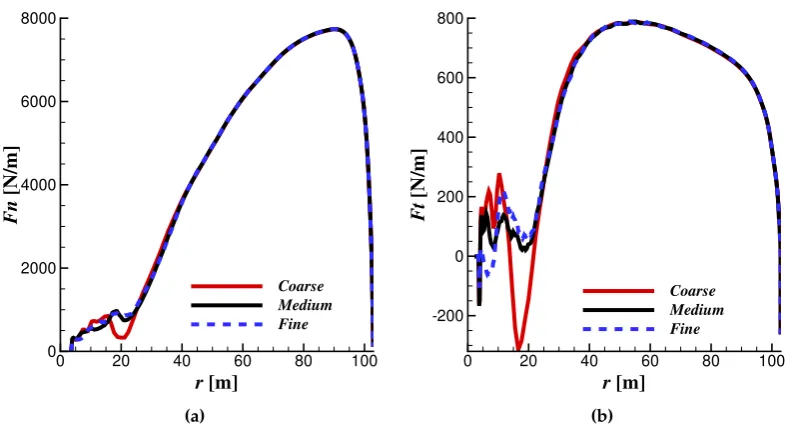
and the sectional loads are shown in Figure7. The coarse blade mesh consists of 136 cells in radial
240
direction (blade total cells number of 8.1 x 10⁶), medium mesh of 192 cells (10.9 x 10⁶) and fine mesh of
241
272 cells (15.9 x 10⁶). The background, wake refinement and nacelle meshes consist of 1.9 x 10⁶, 16.34 x
242
106and 3.5 x 10⁶cells, respectively. The grid convergence index for the fine grid is very small (less than
243
0.5%), stating that the solutions are spatially converged. It can be seen that the magnitude of power
244
and thrust for the medium and the fine grids are very close. The extrapolated relative errors are less
245
than 0.5% in both parameters, while a higher error is observed for the coarse grid due to inaccurate
246
prediction of the sectional forces in the blade inboard region. This is indicated in the sectional loads
247
predictions displayed in Figure7showing the sectional axial (Fn) and tangential force (Ft) distributions
r [m]
F
n
[
N
/m
]
0 20 40 60 80 100
0 2000 4000 6000 8000
Coarse Medium Fine
(a)
r [m]
F
t
[
N
/m
]
0 20 40 60 80 100
-200 0 200 400 600 800
Coarse Medium Fine
(b)
Figure 7.Grid density influence on the sectional loads predictions of the generic 10 MW AVATAR blade.
Table 2.Grid convergence study for the AVATAR blade using the GCI approach. Data are obtained from the URANS calculations.
Parameter Power Thrust
Value fine 9.28 x 10⁶W 1.330 x 10⁶N Value medium 9.26 x 10⁶W 1.328 x 10⁶N Value coarse 9.20 x 10⁶W 1.326 x 10⁶N Extrapolated rel. error
-fine 0.12% 0.27%
-medium 0.36% 0.47%
-coarse 1.02% 0.58%
Grid convercence index 0.15% 0.34%
over the radius. It can be seen clearly that the coarse grid shows a strong underestimation of the
249
sectional loads in the inboard area atr≈20 m. The main reason is that the rotational augmentation
250
effects are not well captured by the corresponding grid, that separated flow is stronger. On the other
251
hand, the medium and fine grids have similar results, indicating grid convergence. Considering the
252
accuracy and computational effort, the selection of the medium grid for CFD simulations is reasonable.
253
3. Results and Discussion
254
3.1. 3D CFD and BEM Comparison
255
This section presents the results of the comparative studies between the expensive fully resolved
256
CFD with the lower fidelity BEM computations for the AVATAR turbine. The simulations were
257
conducted at a wind speed ofU∞= 10.5 m/s, rotational speed ofn= 9.02 rpm and at zero pitch angle
258
(αp). This is the standard test case in the code-to-code comparison for the AVATAR project in [24]. To
259
avoid the necessity for 3D correction in the root area, the 3D polar data extracted from CFD simulations
260
in Ref [15] were considered in the BEM computations. The term 3D polar means that the polar data is
261
obtained directly from the 3D CFD simulations of wind turbine. In this sense, all the 3D effects are
262
already included in the polar. To demonstrate that this polar dataset is suitable for the computations,
two different polar datasets, namely the polar obtained from 2D CFD computations with and without
264
a stall delay model based on [50], are considered for comparison. The same 2D polar datasets were
265
used in [51]. The comparison is displayed in Figure8, showingFn Ftdistributions over the blade
266
radius. Note that the Prandtl tip loss correction is activated only for the 2D polar data, with and
267
without the stall delay model. It is clearly shown that the 3D CFD simulations can only be modelled
268
accurately by the use of the 3D polar dataset, especially in the root area. The pure 2D polar definitely
269
underestimates the loads in the inboard region of the blade as the 3D rotational effect is missing. The
270
use of the stall delay model improves the BEM prediction at certain regions. However, the blade
271
forces are overestimated significantly in the extreme root area forr≤20 m. A slight overestimation
272
is also observed starting forr≤40 m forFn. The quantified error of the BEM simulations relative to
273
the 3D CFD results is presented in Table3. In Figure9, the effects of the polar origin on theCL,CD
274
r [m]
F
n
[
N
/m
]
0 20 40 60 80 100
0 2000 4000 6000 8000
3D CFD 2D Polar
2D Polar + Stall Delay 3D Polar
(a)
r [m]
F
t
[
N
/m
]
0 20 40 60 80 100
-200 0 200 400 600 800
3D CFD 2D Polar
2D Polar + Stall Delay 3D Polar
(b)
Figure 8.Effects of various polar datasets on the accuracy of BEM predictions.
r [m] CL
[
-]
0 20 40 60 80 100
0.00 0.50 1.00 1.50
3D CFD 2D Polar
2D Polar + Stall Delay 3D Polar
(a)
r [m]
CD
[
-]
α
[
°]
0 20 40 60 80 100
0.0 0.1 0.2 0.3 0.4
-20 -10 0 10 20 30 40 50 60 70 80
C
D
α
(b)
andαdistributions are presented. A large discrepancy between the results is observed in the grey
275
shaded area in the root region of the blade in comparison with the 3D CFD results when the 2D polar
276
is employed. The uncorrected 2D polar underestimatesCLwhile the corrected 2D polar overestimates
277
it. It is interesting to see that an inverse behaviour is shown forα. In terms ofCD, results from the
278
2D and 2D corrected polars consistently show overpredictive values within this area. In contrast, the
279
usage of the 3D polar extracted from the 3D CFD simulations yields a consistent agreement with the
280
3D CFD data.
281
Despite the usefulness of the 3D polar, there is a limitation of its use. For example, it requires
282
the expensive 3D simulations to be carried out in advance and the tip loss effect is already present in
283
the extracted polar results. Regarding the latter, it is an advantage for BEM because this removes the
284
dependency of the calculations on the employed tip loss model, but is a side effect when a lifting line
285
approach will be used as the tip loss is calculated directly in the calculation of the induced velocity
286
itself. Therefore, a simple approach combining the 3D polar dataset with the 2D polar is suggested in
287
the present studies. The 2D polar, for example, can be applied in the region that is affected by the tip
288
loss influence. This is expected to arise starting fromr≥90 m. The evidence of this can be seen on the
289
αandCLdistributions in Figure10, indicated by the vertical lines. Figure11displays the comparison
290
of three cases; (1) 3D polar without a tip loss, (2) 3D polar with a tip loss model and (3) hybrid polar
291
with a tip loss model. It is shown that the 3D polar dataset accuracy in modelling the axial (Figure11a)
292
and tangential (Figure11b) forces near the tip area reduces as the tip loss model is activated. The use
293
of the hybrid polar is clearly able to minimize this drawback. Despite that, the hybrid polar trend is
294
clearly different than the 3D CFD results in terms of the induction distributions. Figure11cshows the
295
axial induction (a) distributions predicted using different models. It can be seen that the pure 3D and
296
Table 3.Error quantification of the sectional loads with respect to the 3D CFD data.
eFn[%] eFt[%]
r=15 m r=60 m r=90 m r=15 m r=60 m r=90 m
2D Polar 99.01 3.45 2.56 598.24 6.67 6.06
2D Polar + Stall Delay 127.80 3.19 2.56 468.88 6.48 6.06
3D Polar 11.84 3.08 0.24 19.58 4.81 0.33
r [m]
CL
[
-]
0 20 40 60 80 100
0.00 0.50 1.00 1.50 2.00 2.50 3.00
2D Polar + No Tip Loss 2D Polar + Tip Loss
(a)
r [m]
α
[
°]
0 20 40 60 80 100
-2.00 0.00 2.00 4.00 6.00 8.00 10.00 12.00 14.00 16.00
2D Polar + No Tip Loss 2D Polar + Tip Loss
(b)
r [m]
F
n
[
N
/m
]
0 20 40 60 80 100
0 2000 4000 6000 8000
3D CFD 3D Polar
3D Polar + Tip Loss Hybrid Polar + Tip Loss
(a)
r [m]
F
t
[
N
/m
]
0 20 40 60 80 100
-200 0 200 400 600 800
3D CFD 3D Polar
3D Polar + Tip Loss Hybrid Polar + Tip Loss
(b)
r [m]
a
[
-]
0 20 40 60 80 100
0.05 0.10 0.15 0.20 0.25 0.30
3D CFD 3D Polar
3D Polar + Tip Loss Hybrid Polar + Tip Loss
(c)
r [m]
a’
[
-]
0 20 40 60 80 100
0.00 0.01 0.02 0.03
3D CFD 3D Polar
3D Polar + Tip Loss Hybrid Polar + Tip Loss
(d)
Figure 11.Tip loss model influence on the 3D polar datasets.
the hybrid polar datasets predict an increasing axial induction factor near the tip when the tip loss
297
model is activated. This is caused simply by the modelling behaviour of the Prandtl tip loss factor that
298
increases the induction term in order to reduce the local effective angle of attack. A similar behaviour
299
is observed for the tangential induction (a0) distribution shown in Figure11d, but is less prominent.
300
The local drop and increase of the tangential induction in the middle and in the root area is hardly
301
captured by BEM using all polar datasets. This fluctuating behaviour is caused by the trailing vortices
302
influence within that area as demonstrated in [13,48], that surely cannot be modelled by BEM.
303
As the polar and the blade geometry has to be interpolated, the use of several interpolation
304
options in B-GO for BEM predictions is investigated. Figure12presents the influence of the linear
305
and cubic spline interpolations for polar on the BEM results. It can be seen that the effect of polar
306
interpolation is minimum if the polar data points for a blade section is sufficient. Experience has
307
shown that if the data points are limited, i.e., the polar has no enough resolution, the interpolation
308
option can determine the accuracy of the results.
The interpolation order of the blade geometry and the polar in radial direction, however, can
310
strongly influence the results as demonstrated in Figures13to16. For linear interpolation in Figure
311
13, it can be seen that the number of blade elements strongly influence the accuracy of the prediction
312
especially in the tip area of the blade. With increasing blade element number, the accuracy of the
313
computation improves. This is, however, does not hold true for the quadratic interpolation displayed
314
in Figure14. A prominent periodic change of the polar trend is shown in the middle part of the blade
315
even though though the accuracy of the results near the tip improves. Therefore, this interpolation
316
type is not recommended for further simulations. Figure15shows the effects of using the cubic
317
interpolation approach on the results. It can be seen that the accuracy improves significantly for all
318
r [m]
F
n
[
N
/m
]
0 20 40 60 80 100
0 2000 4000 6000 8000
3D CFD Linear Cubic
(a)
r [m]
F
t
[
N
/m
]
0 20 40 60 80 100
-200 0 200 400 600 800
3D CFD Linear Cubic
(b)
Figure 12.Effects of interpolation order of the polar data on the sectional force distributions along the blade radius.
r [m]
F
n
[
N
/m
]
0 20 40 60 80 100
0 2000 4000 6000 8000
3D CFD Linear 10 Linear 20 Linear 60 Linear 100
(a)
r [m]
F
t
[
N
/m
]
0 20 40 60 80 100
-200 0 200 400 600 800
3D CFD Linear 10 Linear 20 Linear 60 Linear 100
(b)
r [m]
F
n
[
N
/m
]
0 20 40 60 80 100
0 2000 4000 6000 8000
3D CFD Quadratic 10 Quadratic 20 Quadratic 60 Quadratic 100
(a)
r [m]
F
t
[
N
/m
]
0 20 40 60 80 100
-200 0 200 400 600 800
3D CFD Quadratic 10 Quadratic 20 Quadratic 60 Quadratic 100
(b)
Figure 14. Effects of blade element discretization for radial-quadratic spline interpolation on the sectional force distributions along the blade radius.
r [m]
F
n
[
N
/m
]
0 20 40 60 80 100
0 2000 4000 6000 8000
3D CFD Cubic 10 Cubic 20 Cubic 60 Cubic 100
(a)
r [m]
F
t
[
N
/m
]
0 20 40 60 80 100
-200 0 200 400 600 800
3D CFD Cubic 10 Cubic 20 Cubic 60 Cubic 100
(b)
Figure 15.Effects of blade element discretization for radial-cubic spline interpolation on the sectional force distributions along the blade radius.
blade regions by increasing the blade elements from 10 to 20. This interpolation type shows a better
319
prediction than the linear interpolation for the same amount of blade elements. This behaviour is
320
shown in Figure16where the BEM prediction using the cubic interpolation is more accurate than the
321
linear interpolation especially at the maximum axial force level in Figure16a. Therefore, the cubic
322
interpolation is suggested for further studies.
323
3.2. Simulations at Various Operating Conditions
324
In this sections, the influence of various operating conditions on the rotor performance is evaluated.
325
Figure17presents the numerical simulations of the AVATAR rotor for two different wind speeds,
r [m]
F
n
[
N
/m
]
0 20 40 60 80 100
0 2000 4000 6000 8000
3D CFD Linear 60 Cubic 60
(a)
r [m]
F
t
[
N
/m
]
0 20 40 60 80 100
-200 0 200 400 600 800
3D CFD Linear 60 Cubic 60
(b)
Figure 16.Effects of the radial interpolation order on the sectional force distributions along the blade radius.
r [m]
F
n
[
N
/m
]
0 20 40 60 80 100
0 4000 8000 12000
16000 3D CFD
BEM
20 m/s
10.5 m/s
(a)
r [m]
F
t
[
N
/m
]
0 20 40 60 80 100
0 1000 2000 3000 4000
3D CFD BEM
20 m/s
10.5 m/s
(b)
Figure 17.Sectional loads predicted by BEM and CFD for two different wind speeds. 3D polar and cubic-spline interpolation are employed.
namelyU∞= 10.5 m/s and 20 m/s. The rotational speed and pitch angle are kept constant (n= 9.02
327
rpm andαp= 0°). The higher wind speed case is characterized by massive flow separation for most of
328
the blade sections as the operating angle of attack is high, especially in the inboard area as already
329
shown in [48]. Despite that, the BEM simulations carried out in the B-GO code are able to mimic the
330
3D CFD results with an excellent agreement for the whole blade region. This indicates that the use of
331
the 3D polar data and cubic interpolation for polar and blade geometry is a suitable approach to be
332
used for wind turbine simulations at various flow situations.
333
In Figure18, the effects of tip speed ratio (λ) and pitch angle of the blade on the rotor performance
334
are evaluated. The results of the 3D CFD simulations are also presented for comparison. Three different
λ [-] CP
[
-]
4 6 8 10 12 14
0 0.1 0.2 0.3 0.4 0.5
BEM α
p = -5°
BEM α
p = 0°
BEM α
p = 5°
3D CFD α
p = 0°
(a)
λ [-] CT
[
-]
4 6 8 10 12 14
0.0 0.2 0.4 0.6 0.8 1.0 1.2
1.4 BEM αp = -5°
BEM α p = 0° BEM α
p = 5° 3D CFD α
p = 0°
(b)
Figure 18.Power and thrust coefficients at various tip speed ratios and pitch angles.
pitch angles are considered;αp= -5°, 0° and 5°. Note that positive pitch reduces the angle of attack. It
336
can be seen that the turbine power coefficientCPis about 0.2 regardless of the pitch angle value. This
337
shows that a higher pitch angle than 5° is required to control the turbine when it is operating at a wind
338
speed higher than 20 m/s, assuming the rotational speed is 9.02 rpm. With increasingλ, the power
339
coefficient value differs considerably. The smallest pitch angle generates the most mechanical power as
340
the angle of attack increases. The operating range of the turbine is also broader, from 2<λ<14, that
341
is ideal for the turbine operation. The turbine performance in terms of the power coefficient reduces
342
accordingly as the pitch angle increases to 0° and 5°. The maximum power coefficient is, however,
343
located at a similar flow situation forαp= -5° and 0° atλ≈9, while it occurs atλ ≈5.5 forαp= 5°.
344
Despite that, the increased power coefficient for the reduced pitch angle is not appearing without price.
345
The thrust coefficientCTincreases considerably for the lower pitch value than the higher one. This
346
may be dangerous for the rotor and tower structure and may reduce the lifetime of the machines.
347
4. Conclusions
348
Numerical simulations employing Blade Element and Momentum (BEM) and Computational
349
Fluid Dynamics (CFD) approaches for a large 10 MW wind turbine have been carried out. The AVATAR
350
(Advanced Aerodynamic Tools for Large Rotors) turbine with a diameter of 205.8 m developed within
351
the framework of the AVATAR project was chosen for this purpose.
352
A careful selection of the polar dataset for BEM computations is important to ensure the accuracy
353
of the results. It was shown that the 3D polar obtained from fully resolved 3D CFD simulations is the
354
most accurate dataset. The inability of the 3D polar to use the tip loss correction in BEM or ultimately
355
in the lifting line approach can be compensated by using the hybrid polar, replacing the area where
356
the tip loss appear by the 2D polar data. The accuracy of the BEM computations is also influenced
357
by the discretization of the blade segments and how they are interpolated from the existing polar
358
dataset. The studies reveal that the cubic-spline interpolation is suitable for the prediction. The linear
359
interpolation is also suitable for this purpose. However, it requires more number of blade segments to
360
achieve similar results especially in the tip area. On the other hand, the quadratic-spline interpolation
361
produces non physical oscillations of the data in the middle blade area. Thus, this is not recommended
362
to be used for later studies. Considering all the parameters above, the comparison between BEM and
363
CFD shows an excellent agreement for all blade sections even at a high wind speed case where massive
flow separation takes place in the inboard area. At last, it has been documented that the turbine
365
performance depends upon the pitch angle and tip speed ratio. The smaller pitch angle increases the
366
maximum power coefficient and rotor operating range, but the thrust force coefficient enhances as well
367
as a price. This may put more stress on the structure and can reduce the lifetime of the machine itself.
368
Funding:This research received no external funding.
369
Acknowledgments: The authors would gratefully acknowledge the follwoing institutions; the AVATAR
370
consortium for the provision of the blade geometry and the High Performance Computing Center Stuttgart
371
(HLRS) for the computational resources.
372
Conflicts of Interest:The authors declare no conflict of interest.
373
374
1. Bangga, G.; Hutomo, G.; Syawitri, T.; Kusumadewi, T.; Oktavia, W.; Sabila, A.; Setiadi, H.; Faisal, M.;
375
Hendranata, Y.; Lastomo, D.; others. Enhancing BEM simulations of a stalled wind turbine using a 3D
376
correction model. Journal of Physics: Conference Series. IOP Publishing, 2018, Vol. 974, p. 012020.
377
2. Hutomo, G.; Bangga, G.; Sasongko, H. CFD studies of the dynamic stall characteristics on a rotating airfoil.
378
Applied Mechanics and Materials2016,836, 109–114.
379
3. Bangga, G.; Lutz, T.; Dessoky, A.; Krämer, E. Unsteady Navier-Stokes studies on loads, wake, and dynamic
380
stall characteristics of a two-bladed vertical axis wind turbine. Journal of Renewable and Sustainable Energy
381
2017,9, 053303.
382
4. Betz, A. Das Maximum der theoretisch möglichen Ausnutzung des Windes durch Windmotoren.Zeitschrift
383
fur das gesamte Turbinenwesten1920,20.
384
5. Gasch, R.; Twele, J.Wind power plants: fundamentals, design, construction and operation; Springer Science &
385
Business Media, 2011.
386
6. Glauert, H.The elements of aerofoil and airscrew theory; Cambridge University Press, 1983.
387
7. Ingram, G. Wind turbine blade analysis using the blade element momentum method version 1.0.School of
388
Engineering, Durham University, UK2005.
389
8. Prandtl, L.; Betz, A. Vier Abhandlungen zur Hydrodynamik und Aerodynamik; Vol. 3, Universitätsverlag
390
Göttingen, 2010.
391
9. Himmelskamp, H.Profile investigations on a rotating airscrew; MAP, 1947.
392
10. Sørensen, J.N. Three-level, viscous-inviscid interaction technique for the prediction of separated flow past
393
rotating wing. PhD thesis, Technical University of Denmark (DTU), 1986.
394
11. Snel, H.; Houwink, R.; Bosschers, J.; Piers, W.; Van Bussel, G.; Bruining, A. Sectional prediction of 3D effects
395
for stalled flow on rotating blades and comparison with measurements. Proc. European Community Wind
396
Energy Conference, HS Stevens and Associates, LÃ1, 1993, Vol. 4.
397
12. Du, Z.; Selig, M. The effect of rotation on the boundary layer of a wind turbine blade. Renewable Energy
398
2000,20, 167–181.
399
13. Bangga, G.Three-Dimensional Flow in the Root Region of Wind Turbine Rotors; Kassel University Press GmbH,
400
2018.
401
14. Bangga, G.; Kim, Y.; Lutz, T.; Weihing, P.; Krämer, E. Investigations of the inflow turbulence effect on
402
rotational augmentation by means of CFD.Journal of Physics: Conference Series2016,753, 022026.
403
15. Bangga, G.; Lutz, T.; Jost, E.; Krämer, E. CFD studies on rotational augmentation at the inboard sections of
404
a 10 MW wind turbine rotor.Journal of Renewable and Sustainable Energy2017,9, 023304.
405
16. Bangga, G.; Lutz, T.; Krämer, E. Root flow characteristics and 3D effects of an isolated wind turbine rotor.
406
Journal of Mechanical Science and Technology2017,31, 3839–3844.
407
17. Wood, D. A three-dimensional analysis of stall-delay on a horizontal-axis wind turbine. Journal of Wind
408
Engineering and Industrial Aerodynamics1991,37, 1–14.
409
18. Duque, E.P.; Burklund, M.D.; Johnson, W. Navier-Stokes and comprehensive analysis performance
410
predictions of the NREL phase VI experiment. ASME 2003 Wind Energy Symposium. American Society of
411
Mechanical Engineers, 2003, pp. 43–61.
412
19. Pape, A.L.; Lecanu, J. 3D Navier–Stokes computations of a stall-regulated wind turbine. Wind Energy: An
413
International Journal for Progress and Applications in Wind Power Conversion Technology2004,7, 309–324.
20. Wilcox, D.C.; others. Turbulence modeling for CFD; Vol. 2, DCW industries La Canada, CA, 1998.
415
21. Menter, F.R. Two-equation eddy-viscosity turbulence models for engineering applications.AIAA journal
416
1994,32, 1598–1605.
417
22. Bangga, G.; Weihing, P.; Lutz, T.; Krämer, E. Effect of computational grid on accurate prediction of a wind
418
turbine rotor using delayed detached-eddy simulations.Journal of Mechanical Science and Technology2017,
419
31, 2359–2364.
420
23. Boorsma, K.; Schepers, J. New MEXICO experiment. Preliminary overview with initial validation Technical
421
Report ECN-E–14-048) ECN2014.
422
24. Sørensen, N.; Hansen, N.; Garcia, N.; Florentie, L.; Boorsma, K.; Gomez-Iradi, S.; Prospathopoulus, J.;
423
Barakos, G.; Wang, Y.; Jost, E.; others. AVATAR D2. 3–Power curve predictions.AVATAR project2015.
424
25. Schneider, M.S.; Nitzsche, J.; Hennings, H. Accurate load prediction by BEM with airfoil data from 3D
425
RANS simulations. Journal of Physics: Conference Series. IOP Publishing, 2016, Vol. 753, p. 082016.
426
26. Guma, G.; Bangga, G.; Jost, E.; Lutz, T.; Krämer, E. Consistent 3D CFD and BEM simulations of a research
427
turbine considering rotational augmentation. Journal of Physics: Conference Series. IOP Publishing, 2018,
428
Vol. 1037, p. 022024.
429
27. Jonkman, J.M.; Buhl Jr, M.L.; others. FAST user’s guide. National Renewable Energy Laboratory, Golden, CO,
430
Technical Report No. NREL/EL-500-382302005.
431
28. Marten, D.; Wendler, J.; Pechlivanoglou, G.; Nayeri, C.; Paschereit, C. QBLADE: an open source tool for
432
design and simulation of horizontal and vertical axis wind turbines. Int. J. Emerging Technol. Adv. Eng
433
2013,3, 264–269.
434
29. Heramarwan, H. Sensitivity of wind turbine loads to variation of aerodynamic polars predicted by BEM
435
and free vortex approaches. Bachelor’s thesis, University of Stuttgart, 2018.
436
30. Marten, D.; Pechlivanoglou, G.; Nayeri, C.; Paschereit, C. Integration of a WT Blade Design tool in
437
XFOIL/XFLR5. 10th German Wind Energy Conference (DEWEK 2010), Bremen, Germany, Nov, 2010, pp.
438
17–18.
439
31. McCrink, M.; Gregory, J.W. Blade element momentum modeling of low-Re small UAS electric propulsion
440
systems. 33rd AIAA Applied Aerodynamics Conference, 2015, p. 3296.
441
32. Li, L. MATLAB User Manual.The MathWorks, Inc., Natick, MA2001.
442
33. Masters, I.; Chapman, J.; Willis, M.; Orme, J. A robust blade element momentum theory model for tidal
443
stream turbines including tip and hub loss corrections. Journal of Marine Engineering & Technology2011,
444
10, 25–35.
445
34. Moriarty, P.J.; Hansen, A.C.AeroDyn theory manual; National Renewable Energy Laboratory Golden, CO,
446
2005.
447
35. Manwell, J.F.; McGowan, J.G.; Rogers, A.L.Wind energy explained: theory, design and application; John Wiley
448
& Sons, 2010.
449
36. Sørensen, J.N.General momentum theory for horizontal axis wind turbines; Vol. 4, Springer, 2016.
450
37. Spera, D.A. Wind turbine technology1994.
451
38. Blazek, J.Computational Fluid Dynamics - Principles and Applications; Butterworth-Heinemann, imprint of
452
Elsevier, 2015.
453
39. Jameson, A. Multigrid algorithms for compressible flow calculations. Lecture Notes in Mathematics.
454
Springer, 1986, Vol. 1228, pp. 166–201.
455
40. Favre, A. Equations des gaz turbulents compressibles, part 1 et 2. Journal de mecanique1965,4, 391.
456
41. Hinze, J. Turbulence McGraw-Hill. New York1975,218.
457
42. Menter, F.R. Two-equation eddy-viscosity turbulence models for engineering applications.AIAA journal
458
1994,32, 1598–1605.
459
43. Lekou, D.; others. Avatar deliverable d1.2 reference blade design. Technical report, ECN Wind Energy,
460
2015.
461
44. Bak, C.; Zahle, F.; Bitsche, R.; Kim, T.; Yde, A.; Henriksen, L.; Andersen, P.; Natarajan, A.; Hansen,
462
M. Design and performance of a 10 MW turbine. Technical report, Technical University of Denmark,
463
dtu-10mw-rwt.vindenergi.dtu.dk, 2013.
464
45. -. Gridgen version 15 user manual. Pointwise Inc., 2012.
465
46. Kroll, N.; Rossow, C.C.; Becker, K.; Thiele, F. The MEGAFLOW project.Aerospace Science and Technology
466
2000,4, 223–237.
47. Aumann, P.; Bartelheimer, W.; Bleecke, H.; Kuntz, M.; Lieser, J.; Monsen, E.; Eisfeld, B.; Fassbender, J.;
468
Heinrich, R.; Kroll N, Mauss M, Raddatz J, Reisch U, Roll B, Schwarz T.FLOWer installation and user manual.
469
Deutsches Zentrum fur Luft- und Raumfahrt, 2008.
470
48. Bangga, G.; Weihing, P.; Lutz, T.; Krämer, E. Hybrid RANS/LES simulations of the three-dimensional flow
471
at root region of a 10 MW wind turbine rotor. InNew Results in Numerical and Experimental Fluid Mechanics
472
XI; Springer, 2018; pp. 707–716.
473
49. Celik, I.B.; Ghia, U.; Roache, P.J.; others. Procedure for estimation and reporting of uncertainty due to
474
discretization in CFD applications.Journal of fluids Engineering2008,130.
475
50. Chaviaropoulos, P.; Hansen, M.O. Investigating three-dimensional and rotational effects on wind turbine
476
blades by means of a quasi-3D Navier-Stokes solver. Journal of Fluids Engineering2000,122, 330–336.
477
51. Bangga, G.; Guma, G.; Lutz, T.; Krämer, E. Numerical simulations of a large offshore wind turbine exposed
478
to turbulent inflow conditions. Wind Engineering2018,42, 88–96.
![Figure 1. Rotating annular stream tube at various streamwise positions. The illustration is redrawnwith modifications based on Ref [7].](https://thumb-us.123doks.com/thumbv2/123dok_us/1015137.1601470/5.595.147.451.516.725/figure-rotating-annular-streamwise-positions-illustration-redrawnwith-modications.webp)