O R I G I N A L A R T I C L E
Open Access
OsProT1
and
OsProT3
Function to Mediate
Proline- and
γ
-aminobutyric acid-specific
Transport in Yeast and are Differentially
Expressed in Rice (
Oryza sativa
L.)
Jin-Hong Lin
1†, Zhi-Jun Xu
1†, Jia-Shi Peng
2†, Jing Zhao
1, Guo-Bin Zhang
3, Jun Xie
1, Zhen-Xie Yi
1, Jian-Hua Zhang
4,5,
Ji-Ming Gong
6, Neng-Hui Ye
1*and Shuan Meng
1*Abstract
Background:Proline (Pro) andγ-aminobutyric acid (GABA) play important roles in plant development and stress tolerance. However, the molecular components responsible for the transport of these molecules in rice remain largely unknown.
Results:Here we identified OsProT1 and OsProT3 as functional transporters for Pro and GABA. Transient expression of eGFP-OsProTs in plant protoplasts revealed that both OsProT1 and OsProT3 are localized to the plasma
membrane. Ectopic expression in a yeast mutant demonstrated that both OsProT1 and OsProT3 specifically mediate transport of Pro and GABA with affinity for Pro in the low affinity range. qRT-PCR analyses suggested thatOsProT1 was preferentially expressed in leaf sheathes during vegetative growth, whileOsProT3exhibited relatively high expression levels in several tissues, including nodes, panicles and roots. Interestingly, bothOsProT1andOsProT3 were induced by cadmium stress in rice shoots.
Conclusions:Our results suggested that plasma membrane-localized OsProT1 and OsProT3 efficiently transport Pro and GABA when ectopically expressed in yeast and appear to be involved in various physiological processes, including adaption to cadmium stress in rice plants.
Keywords:OsProT1, OsProT3, Proline, GABA, Transporter, Stress tolerance
Background
Pro and GABA are key players in plant growth and re-sistance to stresses. Accumulation of Pro in pollen is crucial for pollen fertility and deficiency of Pro leads to morphological defects in leaves and inflorescences in
Arabidopsis(Funck et al.2012; Mattioli et al.2012; Bian-cucci et al. 2015; Mattioli et al. 2018). In maize plants, Pro was also observed to contribute to final grain pro-duction (Spoljarevic et al. 2011). Moreover, Pro is proven to be a member of major compatible solutes which are highly soluble compounds with low molecular
weight and are usually nontoxic even at high concentra-tions (Ashraf and Foolad2007). It could provide osmotic effects for plants to cope with stresses including drought, salt, nutrient deficiency, heat, heavy metal toxicity and UV-B radiation (Szabados and Savoure 2010; Per et al.
2017). During stress, Pro content is dramatically elevated by enhanced synthesis and decreased degradation (Szabados and Savoure 2010; Kaur and Asthir 2015). Increased Pro synthesis is mainly attributed to upregula-tion of P5CS which is a key enzyme for Pro biosynthesis; thus enhancing P5CSexpression by transgenic approach could effectively improve the ability of plant to tolerate stresses (Kishor et al.1995; Igarashi et al.2000).
GABA, a nonproteinogenic amino acid, rapidly accu-mulates in response to both abiotic and biotic stresses (Shelp et al. 2012; Bown and Shelp 2016). It has been
© The Author(s). 2019Open AccessThis article is distributed under the terms of the Creative Commons Attribution 4.0 International License (http://creativecommons.org/licenses/by/4.0/), which permits unrestricted use, distribution, and reproduction in any medium, provided you give appropriate credit to the original author(s) and the source, provide a link to the Creative Commons license, and indicate if changes were made.
* Correspondence:[email protected];[email protected] †Jin-Hong Lin, Zhi-Jun Xu and Jia-Shi Peng contributed equally to this work. 1Southern Regional Collaborative Innovation Center for Grain and Oil Crops
in China, College of Agronomy, Hunan Agricultural University, Changsha 410128, China
shown that GABA functions in defense against insect herbivory and drought tolerance in Arabidopsis (Scholz et al. 2015; Bown and Shelp 2016; Mekonnen et al.
2016). Moreover, GABA can bind Aluminum-Activated Malate Transporter (ALMT) membrane channels and stimulate anion efflux or inhibit anion influx at the tono-plast or plasma membrane during drought-induced sto-matal closure (Ramesh et al. 2015; Bown and Shelp
2016). In addition, GABA is considered as a pivotal amino acid in post-pollination fertilization (Biancucci et al.2015).
The transport processes of Pro were considered to be important for altering Pro content inside plants, as no relation was observed between the accumulation and synthesis of Pro during grapevine berry maturation (Stines et al. 1999). Biosynthesis of Pro occurs mainly in the cytosol and chloroplasts (Szabados and Savoure2010), but Pro can be detected in the xylem and phloem sap in several plant species (Weibull et al. 1990; Bialczyk et al.
2004; Lehmann et al.2010), further confirming the cross-membrane and cross-tissue transport of Pro. Moreover, the long-distance transport of Pro in phloem is increased in response to water stress in alfalfa (Girousse et al.1996), indicating that Pro transport is essential for plants under both normal and stress conditions. Similar observations were also obtained for GABA, as it can be released from mesophyll cells (Chung et al. 1992) and transported through vascular tissues (Shelp et al.1999).
The transporters responsible for Pro transport have been identified in some subfamilies of the amino acid transporter (AAT) family in Arabidopsis including the amino acid permease (AAP) family, the lysine-histidine transporter family and the Pro transporter (ProT) family. Meanwhile, some members of the ProT family and GABA transporters in Arabidopsis are also responsible for transporting GABA (Lehmann et al. 2010; Shelp et al.2012). It is worth mentioning that ProTs frequently display specific transport activity for Pro, glycine betaine and GABA in different species includingArabidopsis, to-mato, barley and the common bean (Schwacke et al.
1999; Grallath et al. 2005; Fujiwara et al.2010; Lehmann et al.2011; Chen et al.2016).
Previous studies have identified 79 and 85AAT genes in rice genomes (Lu et al.2012; Zhao et al.2012). How-ever, the transport activities of the encoded proteins have rarely been examined. As such, the components re-sponsible for Pro and GABA transport in rice remain unclear. As OsProTs are likely to participate in these transport processes and OsProT2 has been characterized as a functional Pro transporter through its expression in
Xenopusoocytes (Igarashi et al.2000), we identified and functionally characterized the other two OsProT mem-bers in order to uncover the details for Pro and GABA transport in rice. Our results demonstrated that plasma
membrane-localized OsProT1 and OsProT3 are func-tional uptake transporters for Pro and GABA in yeast and might get involved in normal growth and stress tol-erancein planta.
Results
Phylogenetic Analysis and Prediction of Transmembrane Helices for OsProT1 and OsProT3
The ProT subfamily contains three members in rice (Zhao et al.2012). The OsProT1 sequence exhibits 38.7% and 40% identity to OsProT2 and OsProT3 (Add-itional file1: Figure S1), respectively. Surprisingly, a rela-tively higher identity of 81.4% was found between OsProT2 and OsProT3 (Additional file1: Figure S1), in-dicating that OsProT2 and OsProT3 might have similar molecular functions. Phylogenetic analysis of ProTs in
Oryza sativa, Zea mays, Sorghum bicolor, Arabidopsis thaliana,Lycopersicon esculentum, Brachypodium distach-yon, Vitis vinifera,Glycine maxand Gossypium hirsutum
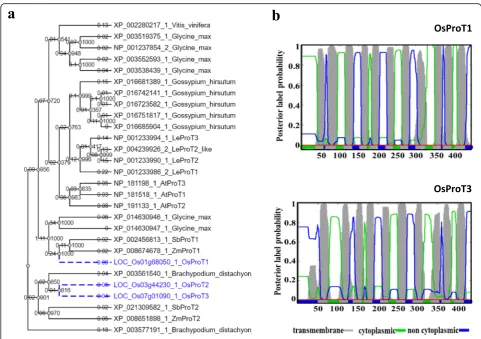
was performed to examine the evolutionary relationships of OsProTs with other ProTs. OsProT1 are closely related with ZmProT1 and SbProT1, while OsProT2 and OsProT3 show closer evolutionary relationship to XP 003561540.1 from Brachypodium distachyon than ProTs from other species (Fig.1a). Additionally, ProT members from Arabidopsis thaliana, Lycopersicon esculentum and
Gossypium hirsutumwhich all belong to dicotyledons can be grouped into three small clusters, and each of these three clusters is specific to one species (Fig. 1a). Noting that only one ProT member existed inVitis viniferawhich has not undergone recent whole genome duplication (Jail-lon et al.2007).
Membrane-spanning regions analyses using Phobius (http://phobius.sbc.su.se/) revealed that both OsProT1 and OsProT3 were predicted to contain 11 putative transmembrane regions (Fig. 1b). The regions between 9th and 10th transmembrane segments of OsProT1 and OsProT3 are slightly short.
OsProT1 and OsProT3 are Localized in the Plasma Membrane
Prediction of membrane-spanning regions of OsProT1 and OsProT3 indicated that these two proteins are both localized to membranes. To confirm whether OsProT1 and OsProT3 are targeted to the plasma membrane or to subcellular membranes, eGFP fusion proteins driven by the 35S promoter were transiently expressed in meso-phyll protoplasts of Arabidopsis. As shown in Fig. 2, GFP fluorescence of eGFP-OsProT1 or eGFP-OsProT3 was observed at the plasma membrane and co-localizes with the plasma membrane marker Dil (1,1′ -dioctade-cyl-3,3,3′,3′-tetramethylindocarbocyanine perchlorate). These data demonstrate that OsProT1 and OsProT3 are localized to the plasma membrane.
OsProT1 and OsProT3 are Functional Transporters for pro and GABA in Yeast
To investigate the transport activities of OsProT1 and OsProT3, functional complementation experiments were performed using the yeast amino acid transport mutant
22△10α. The 22△10α yeast strain lacks ten amino acid transporters addressed at the plasma membrane and is unable to grow on any proteinogenic amino acid or GABA as the sole nitrogen source, except for arginine (Besnard et al. 2016). OsProT1 and OsProT3 were expressed in22△10αyeast under the control of the GPD promoter; transformants expressing OsProT1 or OsProT3 were able to grow on media with Pro or GABA as the sole nitrogen resource (Fig. 3a and b), suggesting of that OsProT1 and OsProT3 have the ability to uptake Pro or GABA into yeast cells. Interestingly, 22△10α ex-pressing OsProT1 or OsProT3 failed to restore the growth defect on media with other amino acids as the sole nitrogen resource, including acidic (Asp or Glu), aromatic (Phe, Trp, or Asn), or other neutral (Val, Thr,
Ser, Leu, Ile, Gly, or Ala) amino acids (Fig.3c). These re-sults suggested that OsProT1 and OsProT3 are func-tional transporters and specifically transport Pro and GABA.
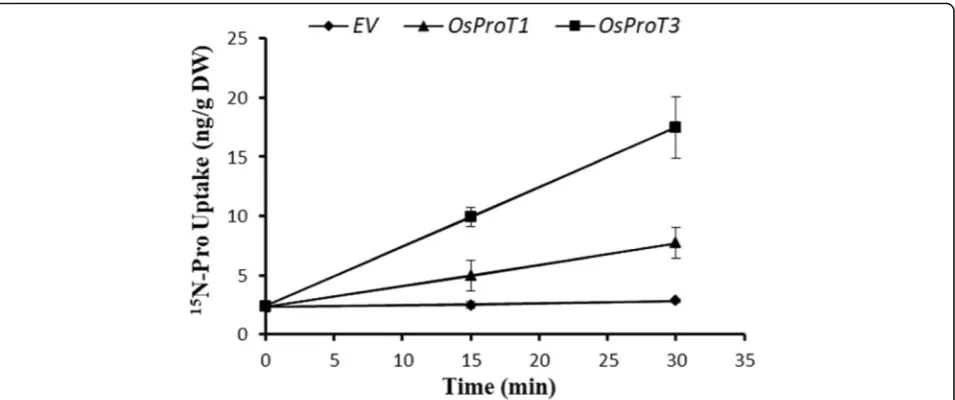
The functions of OsProT1 and OsProT3 in the uptake of Pro were further confirmed by15N-Pro labeled exper-iments. Yeast 22△10α cells expressing OsProT1, OsProT3 or the empty vector (EV) were cultured with15N labeled Pro, and the15N content in yeast cells was subse-quently analyzed. As shown in Fig. 4, 22△10α cells ex-pressing OsProT3 possessed significantly higher 15N content than the cells expressing OsProT1, and both were higher than that in cells transformed with EV 15 min or 30 min after labeling (Fig. 4), indicating that both OsProT1 and OsProT3 are Pro transporters for absorbing Pro into cells and that OsProT3 is more capable than OsProT1 in transporting Pro when expressed in yeast.
To determine the affinity of OsProT1 and OsProT3 for Pro, concentration-dependent15N labeled Pro uptake by 22△10α expressing OsProT1 and OsProT3 were
Fig. 2Subcellular localization of eGFP-OsProT fusion proteins inArabidopsismesophyll protoplasts.eGFP-OsProT1oreGFP-OsProT3was driven by the 35S promoter and transiently expressed inArabidopsisprotoplasts. The fluorescent dye Dil at a concentration of 10μM was used to indicate the plasma membrane. Bars = 10μm
Fig. 3Functional analyses of OsProT1 and OsProT3 in yeast mutant22△10α.a-c,Yeast mutant strain22△10αwas transformed withp426GPD
empty vector (EV) or the plasmid containing the coding sequence ofOsProT1orOsProT3, and grown on SD plates with (NH4)2SO4, Pro, GABA or other amino acid as the sole nitrogen source for about 4 days
performed. Apparent Km (Kmapp) values were deter-mined by fitting15N uptake rates at each substrate con-centration to the Michaelis-Menten equation. As shown in Fig. 5, Kmapp values of OsProT1 and OsProT3 for Pro are 4.24 ± 1.24 mM and 1.81 ± 0.23 mM, respectively. These data indicated that OsProT1 and OsProT3 are both in the low-affinity range for transport of Pro, while OsProT3 showed a higher affinity than OsProT1 with respect to Pro transport.
OsProT1andOsProT3showed Differential Expression Patterns in Rice
To evaluate the physiological function of OsProT1 and
OsProT3, their expression levels in different tissues at vegetative and reproductive stages were detected.
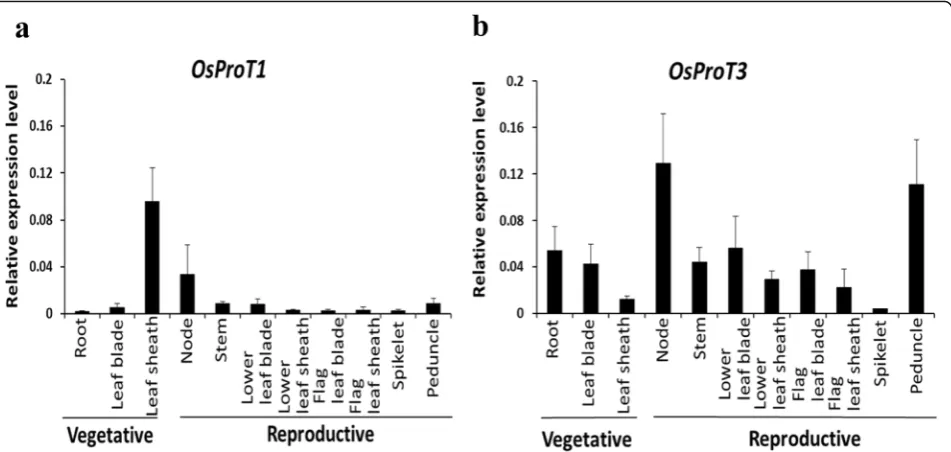
OsProT1 exhibited highest expression in the leaf sheath
at the vegetative stage with higher expression in nodes at the reproductive stage than in other tissues (Fig. 6a).
OsProT3 showed relatively high expression levels in sev-eral tissues including root and leaf blade with higher levels in nodes and peduncles (Fig. 6b). OsProT2 was predominantly expressed in the leaf blade, especially in the flag leaf blade at the reproductive stage (Additional sfile 1: Figure S2). These data indicated that OsProT
members are expressed differentially within rice plant and might be involved in different transport processes for Pro and GABA.
Given that abiotic stresses affect the expression of
ProTgenes in many species, includingArabidopsis, com-mon bean and barley (Rentsch et al. 1996; Ueda et al.
2001; Lehmann et al.2010; Chen et al.2016), we further characterized the expression levels of OsProTs in
Fig. 4Uptake of15N-labeled Pro by yeast22△10αcells. Yeast cells expressingOsProT1orOsProT3were incubated with 1.5 mM15N-Pro for 15 min and 30 min, and the15N retained in the cells was subsequently measured. Values are means ± SD,n= 4
Fig. 5OsProT1 and OsProT3 are low affinity Pro transporters.aandb,OsProT1(a) orOsProT3(b) expressed yeast strain22△10αwas cultivated with different concentrations of15N-labeled Pro for 10 min and the15N content was subsequently determined after being collected and dried.
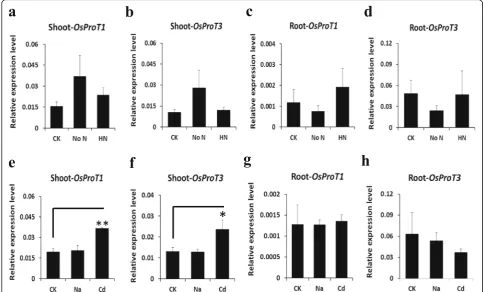
response to diverse abiotic stresses. Nitrogen deficiency or high nitrogen treatment exerted only a weak influence onOsProTs expressions, except forOsProT2, which was significantly repressed in roots by nitrogen deficiency (Fig.7a-d, Additional file1: Figure S3a and b). The expres-sions ofOsProT1andOsProT3in shoots, but not in roots, were significantly enhanced by cadmium treatment (Fig.7e and f). However, cadmium stress exerted very weak effects onOsProT2expression (Additional file1: Figure S3c and d), and salt stress hardly affects the expression of allOsProTsin both the shoots and roots (Fig.7e-h, Additional file1: Figure S3c and d). These data suggested that transcript regulation ofOsProTsmight be involved in coping with nutrient and heavy metal stress in rice plants.
Discussion
The accumulation of plant compatible osmolytes, such as Pro and GABA, in response to stress is frequently ob-served, which is mainly attributed to a combination of increased synthesis and decreased degradation (Leh-mann et al. 2010; Shelp et al. 2012; Kaur and Asthir
2015). Meanwhile, abundant evidence has proven that transport of these compatible osmolytes also plays im-portant roles (Igarashi et al.2000; Lehmann et al.2010; Shelp et al.2012). However, the transporters involved in transporting Pro and GABA are largely unknown.
A previous study reported that OsProT2 transports Pro when expressed in Xenopus oocytes (Igarashi et al.
2000). In this study, we characterized the other two OsProT members, OsProT1 and OsProT3, as functional transporters for Pro and GABA. AtProT1–3, HvProT2
and LeProTl were previously identified as efficient trans-porters for Pro, glycine betaine and GABA (Schwacke et al. 1999; Grallath et al. 2005; Fujiwara et al. 2010). Rice lacks the enzyme requirement for glycine betaine bio-synthesis; thus, rice likely does not accumulate and trans-port glycine betaine (Rathinasabapathi et al.1993). When expressed in yeast, OsProT1 and OsProT3 specifically me-diated the transport of Pro and GABA (Figs.3, 4and 5). However, the affinity for Pro was different between the in-dividual transporters (Fig. 5). OsProT3 showed a higher affinity for Pro than that of OsProT1, and they are both lower than that of the three AtProTs withKmappvalues of 0.427 ± 0.017 mM, 0.500 ± 0.005 mM, 0.999 ± 0.036 mM for Pro, respectively (Grallath et al.2005).
OsProT1 and OsProT3 are both localized to the plasma membrane and function to uptake Pro and GABA from the apoplast (Fig. 2, 3 and 4). Further ex-pression analyses indicated that OsProT1, OsProT3 and OsProT2 play different roles within rice plants. The high expression of OsProT1 in leaf sheath at the vegetative stage (Fig. 6a) suggests that OsProT1 might uptake Pro and GABA as nutrition for seeding growth. OsProT2 might be involved in Pro and GABA remobilization from flag leaf blade, as it shows much higher expression in flag leaf blade than in other tissues (Additional file 1: Figure S2). OsProT3 likely contributes to more physio-logical processes due to its high expression in more tis-sues at different stages (Fig. 6b). Consistently, ProTs in
Arabidopsis also exhibit similar substrate specificity but different expression patterns (Grallath et al. 2005).
AtProT1 is expressed mainly in phloem or phloem
Fig. 6Expression levels ofOsProT1andOsProT3in different organs at vegetative and reproductive stages.aandb, Different samples were collected from rice grown in the soil. The expression levels ofOsProT1(a) andOsProT3(b) were determined by real-time RT-PCR using the
OsACTIN1gene as internal control. Values are means ± SD,n= 4
parenchyma throughout the whole plant, while AtProT2
is localized in the roots, andAtProT3is expressed in the above-ground portions of plants (Grallath et al. 2005; Lehmann et al.2011). In addition toProTs, evidence in-dicates that AtAAP members also exhibit difference in tissue expression patterns which guarantees their unique functions in Arabidopsis (Tegeder and Rentsch 2010; Tegeder2012; Tegeder and Masclaux-Daubresse2018).
Upon exposure to salt, plants often accumulate Pro (Ueda et al.2001; Mansour and Ali2017; Per et al. 2017). However, gene expression data revealed that salinity hardly affects expression levels of OsProTs(Fig. 7e-h, Additional file 1: Figure S3c and d). Consistent with our results,
OsProT2was not induced by salt treatment in a previous study (Igarashi et al.2000). Surprisingly, Cd stress induced the expression ofOsProT1andOsProT3in shoots (Fig.7e and f). The accumulation of Pro frequently occurs in re-sponse to heavy metal stress (Sharma and Dietz 2006; Amna et al.2015), and high constitutive Pro content was detected in metal-tolerant plants (Sharma and Dietz2006). Given that the transport of Pro might participate in Cd stress tolerance, as the expression ofOsProT1andOsProT3
in shoots were induced by Cd, additional investigation into Pro transport process may improve plant tolerance to Cd.
Conclusion
In the present study, two plasma membrane-localized OsProT members, OsProT1 and OsProT3, were charac-terized as functional molecular components for trans-porting Pro and GABA. When ectopically expressed in yeast, OsProT1 and OsProT3 specifically mediated the uptake of Pro and GABA, and both exhibited low affinity for transporting Pro.OsProT1and OsProT3might func-tion in differentially physiological processes, including stress tolerance, based on their differential expression patterns. Our work identified new molecular compo-nents for controlling the transport of Pro and GABA, and provides new clues to improve stress tolerance in rice by manipulating these transporters.
Materials and methods
Plant material and growth conditions
Uniformly germinated seeds (Oryza sativa L. var. Nipponbare) were cultivated in 96-well plates with
removed bottoms (Li et al. 2015) and were then grown hydroponically in Yoshida solution (Adjust pH to 5.8, refreshed every 2 d) at 28 °C, approximately 60% humid-ity and a 16-h-light/8-h-dark photoperiod. 14-day-old seedlings were further treated for the analysis of gene expression. Yoshida solution without NH4NO3 or
con-taining 10 mM NH4NO3 was used for
nitrogen-starvation or high-nitrogen experiments, respectively. Yoshida solution with 50μM CdCl2 or 100 mM NaCl
was used for abiotic stress treatments.
To determine gene expression at the reproductive stage, 3-week-old rice seedlings were transplanted into flooded soil in pots with two seedlings per hill. Soil properties were pH =6.66, organic matter = 48.51 g·kg−1, totalN= 2.2 g·kg−1, total P= 0.8 g·kg−1, total K = 6.32 g·kg−1, available N= 123.24 mg·kg−1, available P= 26.04 mg·kg−1, and available K = 118.19 mg·kg−1. Fertilizers used were urea for N at dose of 34.5 g·m−2, single superphosphate for P at dose of 50 g·m−2, and potassium chloride for K at doses of 20 g·m−2. Different tissues at reproductive stage were collected for further RNA extraction.
Radial tree construction and multiple alignments of OsProTs
OsProT protein sequences were obtained (http://rice. plantbiology.msu.edu/) according to accession numbers LOC_Os01g68050.1 for OsProT1, LOC_Os03g44230.1 for OsProT2, and LOC_Os07g01090.1 for OsProT3 and were then aligned using CLUST W with default parame-ters. The homologous sequences in other species were obtained via blasting on the NCBI database using OsProT sequences as references. The phylogenetic tree of ProT proteins was constructed by NGPhylogeny.fr (Lemoine et al. 2019) with 1000 bootstrap replications using the default parameters after removing redundant sequences and selecting representative splice forms of the same gene.
Functional Analysis of OsProTs in22△10α
Coding sequences ofOsProT1and OsProT3were ampli-fied (primers are listed in Additional file 1: Table S1) from cDNA template of Nipponbare followed by cloning into the p426GPD vector with theBamH1andEcoR1 re-striction sites, leading to the final p426GPD-OsProT1 and OsProT3 constructs, respectively. p426GPD-OsProT1, p426GPD-OsProT3 and the empty vector p426GPD were separately transformed into mutant yeast
22△10α cells as previously described (Elble 1992). Func-tional complementation assays were performed as de-scribed (Fischer et al. 2002; Besnard et al. 2016) with minor modifications. Yeast cells were grown to log phase using SD medium containing 3 mM (NH4)2SO4. Then,
cells were collected, rewashed, diluted to an OD600 of 0.8 in sterile water, and spotted onto SD plates containing
indicated L-amino acid as the sole nitrogen source at dose of 3 mM. The cells were then grown for about 4 d before being photographed. For 15N-Pro uptake assays, 1.5 mM
15
N labeled L-Pro (99 atom %) was added to the culture after yeast cells had reached log phase, and the cells were collected at 0 min, 15 min and 30 min. Then, the cells were immediately washed three times by ultrapure water and dried at 80 °C for 24 h.15N retained in the cells was measured as previously described (He et al.2017) using a continuous- flow isotope ratio mass spectrometer coupled to a carbon nitrogen elemental analyzer.
Determination ofKmappfor Pro by Yeast Uptake Assay
Analyses of Kmapp were performed as described previ-ously (Hsu et al. 1993; Hirner et al. 2006; Wang and Tsay 2011) with minor modifications. Yeast cells ex-pressing OsProT1 or OsProT3 were cultured with SD medium containing 3 mM (NH4)2SO4 until the OD600
reached 0.8. Then, the cells were cultured with SD medium containing different concentrations of 15N-Pro ranging from 0.25 mM to 40 mM for 10 min. The collec-tion of cells and determinacollec-tion of 15N contents were performed as described above. The curves and the
Kmappvalues were obtained by fitting to the Michaelis-Menten equation in the SigmaPlot 12.0 program.
Subcellular Localization Analysis of OsProT1 and OsProT3
The amplified fragment ofOsProT1andOsProT3(primers used for amplifying are listed in Additional file1: Table S1) coding sequences were cloned in frame with eGFP into pA7-eGFP vector using Xba1 and BamH1, resulting in
eGFP-OsProT1andeGFP-OsProT3constructs, respectively, driven by the 35S promoter. Fusion constructions were then transiently expressed inArabidopsisprotoplasts as de-scribed previously (Yoo et al. 2007). Transformed proto-plasts were incubated in the dark at 22 °C overnight, and eGFP images were subsequently obtained using confocal microscopy (Olympus-FV1000) (Peng et al. 2017). The fluorescent dye Dil was used at a concentration of 10μM to indicate the plasma membrane (Wang et al.2019).
Quantitative RT-PCR (Reverse Transcription Polymerase Chain Reaction)
RNA was extracted using TRIzol reagent (Invitrogen, 15, 596,026) as previously described (Meng et al. 2016). First-strand cDNA was synthesized using cDNA Synthe-sis Kit (Vazyme, R212), and quantitative RT–PCR was performed using SYBR Green with a StepOnePlus instrument (Applied Biosystems). OsACTIN1 (LOC_ Os03g50885.1) was selected as internal reference gene. Primers used for assays are all listed in Additional file1: Table S1. The different samples used for the qPCR are biological replicates, and relative expression levels are
the expression of OsProTs normalized to that of OsAC-TIN1using formula Ratio = 2(Ct_OsActin−Ct_OsProT).
Supplementary information
Supplementary informationaccompanies this paper athttps://doi.org/10. 1186/s12284-019-0341-7.
Additional file 1:Figure S1.Alignment of OsProT proteins.Figure S2. Expression levels ofOsProT2in different organs at vegetative and reproductive stages.Figure S3.OsProT2transcript levels in rice plants under different abiotic stress conditions.Table S1.The primers used in this study.
Abbreviations
AAP:Amino acid permease; AAT: Amino acid transporter; ALMT: Aluminum-Activated Malate Transporter; Dil: 1,1′- dioctadecyl- 3,3,3′,3′
-tetramethylindocarbocyanine perchlorate; eGFP: Enhanced green fluorescent protein; EV: Empty vector; GABA:γ-aminobutyric acid;Kmapp: ApparentKm; Pro: Proline; ProT: Proline transporter; qRT-PCR: Quantitative real time polymerase chain reaction
Acknowledgments
We are grateful to Dr. Guillaume Pilot (Virginia Tech) and Dr. Nan Guo (Nanjing Agricultural University) for providing the yeast mutant22△10α, and to Dr. Ren-Jie Tang (Shanghai Institutes for Biological Sciences) for providing p426GPD vector.
Authors’contributions
S M, JHZ and NHY designed the research. S M, JHL, ZJX, JX, JSP and GBZ performed the experiments. S M, JHL and JZ analyzed the data. S M, JMG, JSP, GBZ and ZXY wrote the paper. All authors read and approved the final manuscript.
Funding
This work was supported by the National Key Research and Development Program of China (Grant 2017YFD0301502), the Hunan Provincial Natural Science Foundation of China (Grants 2018JJ3230, 2018JJ3235, 2018JJ2173), the National Natural Science Foundation of China (Grant 31700212), the Fund for Excellent Talents in Crop Discipline of Hunan Agricultural University (Grants YXQN2018–5) and open project of National Key Laboratory of Plant Molecular Genetics.
Availability of data and materials
All data generated or analyzed during this study are included in this published article and its supplementary information files.
Ethics approval and consent to participate Not applicable.
Consent for publication Not applicable.
Competing interests
The authors declare that they have no competing interests.
Author details
1Southern Regional Collaborative Innovation Center for Grain and Oil Crops
in China, College of Agronomy, Hunan Agricultural University, Changsha 410128, China.2Key Laboratory of Ecological Remediation and Safe Utilization of Heavy Metal-Polluted Soils, College of Life Science, Hunan University of Science and Technology, Xiangtan 411201, China.3State Key Laboratory of Crop Biology, College of Agronomy, Shandong Agricultural University, Taian 271018, Shandong, China.4Department of Biology, Hong Kong Baptist University, Kowloon 999077, Hong Kong.5School of Life Sciences and State Key Laboratory of Agrobiotechnology, The Chinese University of Hong Kong, Shatin 999077, Hong Kong.6National Key Laboratory of Plant Molecular Genetics and CAS center for excellence in Molecular Plant Sciences, Shanghai Institute of Plant Physiology and Ecology, Chinese Academy of Sciences, Shanghai 200032, China.
Received: 27 April 2019 Accepted: 21 October 2019
References
Amna MS, Syed JH, Munis MF, Chaudhary HJ (2015) Phyto-extraction of nickel by linum usitatissimum in association with glomus intraradices. Int J
Phytoremediation 17:981–987
Ashraf M, Foolad MR (2007) Roles of glycine betaine and proline in improving plant abiotic stress resistance. Environ Exp Bot 59:206–216
Besnard J, Pratelli R, Zhao C, Sonawala U, Collakova E, Pilot G, Okumoto S (2016) UMAMIT14 is an amino acid exporter involved in phloem unloading in
Arabidopsisroots. J Exp Bot 67:6385–6397
Bialczyk J, Lechowski Z, Dziga D (2004) Composition of the xylem sap of tomato seedlings cultivated on media with HCO3−and nitrogen source as NO3−or NH4+. Plant Soil 263:265–272
Biancucci M, Mattioli R, Forlani G, Funck D, Costantino P, Trovato M (2015) Role of proline and GABA in sexual reproduction of angiosperms. Front Plant Sci 6:680
Bown AW, Shelp BJ (2016) Plant GABA: not just a metabolite. Trends Plant Sci 21: 811–813
Chen J, Wu J, Lu Y, Cao Y, Zeng H, Zhang Z, Wang L, Wang S (2016) Molecular cloning and characterization of a gene encoding the proline transporter protein in common bean (Phaseolus vulgaris L.). Crop Journal 4:384–390 Chung I, Bown AW, Shelp BJ (1992) The production and efflux of
4-aminobutyrate in isolated mesophyll cells. Plant Physiol 99:659–664 Elble R (1992) A simple and efficient procedure for transformation of yeasts.
Biotechniques 13:18–20
Fischer WN, Loo DD, Koch W, Ludewig U, Boorer KJ, Tegeder M, Rentsch D, Wright EM, Frommer WB (2002) Low and high affinity amino acid H+ -cotransporters for cellular import of neutral and charged amino acids. Plant J 29:717–731
Fujiwara T, Mitsuya S, Miyake H, Hattori T, Takabe T (2010) Characterization of a novel glycinebetaine/proline transporter gene expressed in the mestome sheath and lateral root cap cells in barley. Planta 232:133–143
Funck D, Winter G, Baumgarten L, Forlani G (2012) Requirement of proline synthesis duringArabidopsisreproductive development. BMC Plant Biol 12: 1471–2229
Girousse C, Bournoville R, Bonnemain JL (1996) Water deficit-induced changes in concentrations in proline and some other amino acids in the phloem sap of alfalfa. Plant Physiol 111:109–113
Grallath S, Weimar T, Meyer A, Gumy C, Suter-Grotemeyer M, Neuhaus JM, Rentsch D (2005) TheAtProTfamily. Compatible solute transporters with similar substrate specificity but differential expression patterns. Plant Physiol 137:117–126
He YN, Peng JS, Cai Y, Liu DF, Guan Y, Yi HY, Gong JM (2017) Tonoplast-localized nitrate uptake transporters involved in vacuolar nitrate efflux and reallocation inArabidopsis. Sci Rep 7:6417
Hirner A, Ladwig F, Stransky H, Okumoto S, Keinath M, Harms A, Frommer WB, Koch W (2006)ArabidopsisLHT1 is a high-affinity transporter for cellular amino acid uptake in both root epidermis and leaf mesophyll. Plant Cell 18: 1931–1946
Hsu LC, Chiou TJ, Chen L, Bush DR (1993) Cloning a plant amino acid transporter by functional complementation of a yeast amino acid transport mutant. Proc Natl Acad Sci U S A 90:7441–7445
Igarashi Y, Yoshiba Y, Takeshita T, Nomura S, Otomo J, Yamaguchi-Shinozaki K, Shinozaki K (2000) Molecular cloning and characterization of a cDNA encoding proline transporter in rice. Plant Cell Physiol 41:750–756 Jaillon O, Aury JM, Noel B, Policriti A, Clepet C, Casagrande A, Choisne N,
Aubourg S, Vitulo N, Jubin C et al (2007) The grapevine genome sequence suggests ancestral hexaploidization in major angiosperm phyla. Nature 449: 463–467
Kaur G, Asthir B (2015) Proline: a key player in plant abiotic stress tolerance. Biol Plant 59:609–619
Kishor P, Hong Z, Miao GH, Hu C, Verma D (1995) Overexpression of△1 -pyrroline-5-carboxylate synthetase increases proline production and confers osmotolerance in transgenic plants. Plant Physiol 108:1387–1394 Lehmann S, Funck D, Szabados L, Rentsch D (2010) Proline metabolism and
transport in plant development. Amino Acids 39:949–962
Lemoine F, Correia D, Lefort V, Doppelt-Azeroual O, Mareuil F, Cohen-Boulakia S, Gascuel O (2019) NGPhylogeny.fr: new generation phylogenetic services for non-specialists. Nucleic Acids Res 47:W260–W265
Li XM, Chao DY, Wu Y, Huang XH, Chen K, Cui LG, Su L, Ye WW, Chen H, Chen HC, Dong NQ, Guo T, Shi M, Feng Q, Zhang P, Han B, Shan JX, Gao JP, Lin HX (2015) Natural alleles of a proteasomeα2 subunit gene contribute to thermotolerance and adaptation of African rice. Nat Genet 47:827–833 Lu YE, Song ZY, Lu K, Lian XM, Cai HM (2012) Molecular characterization,
expression and functional analysis of the amino acid transporter gene family (OsAATs) in rice. Acta Physiol Plant 34:1943–1962
Mansour MMF, Ali EF (2017) Evaluation of proline functions in saline conditions. Phytochemistry 140:52–68
Mattioli R, Biancucci M, El Shall A, Mosca L, Costantino P, Funck D, Trovato M (2018) Proline synthesis in developing microspores is required for pollen development and fertility. BMC Plant Biol 18:356
Mattioli R, Biancucci M, Lonoce C, Costantino P, Trovato M (2012) Proline is required for male gametophyte development inArabidopsis. BMC Plant Biol 12:236
Mekonnen DW, Flugge UI, Ludewig F (2016) Gamma-aminobutyric acid depletion affects stomata closure and drought tolerance ofArabidopsis thaliana. Plant Sci 245:25–34
Meng S, Peng JS, He YN, Zhang GB, Yi HY, Fu YL, Gong JM (2016)Arabidopsis
NRT1.5 mediates the suppression of nitrate starvation-induced leaf senescence by modulating foliar potassium level. Mol Plant 9:461–470 Peng JS, Ding G, Meng S, Yi HY, Gong JM (2017) Enhanced metal tolerance
correlates with heterotypic variation in SpMTL, a metallothionein-like protein from the hyperaccumulatorSedum plumbizincicola. Plant Cell Environ 40: 1368–1378
Per TS, Khan NA, Reddy PS, Masood A, Hasanuzzaman M, Khan MIR, Anjum NA (2017) Approaches in modulating proline metabolism in plants for salt and drought stress tolerance: Phytohormones, mineral nutrients and transgenics. Plant Physiol Biochem 115:126–140
Ramesh SA, Tyerman SD, Xu B, Bose J, Kaur S, Conn V, Domingos P, Ullah S, Wege S, Shabala S, Feijo JA, Ryan PR, Gilliham M (2015) GABA signalling modulates plant growth by directly regulating the activity of plant-specific anion transporters. Nat Commun 6:7879
Rathinasabapathi B, Gage DA, Mackill DJ, Hanson AD (1993) Cultivated and wild Rices do not accumulate glycinebetaine due to deficiencies in two biosynthetic steps. Crop Sci 33:534–538
Rentsch D, Hirner B, Schmelzer E, Frommer WB (1996) Salt stress-induced proline transporters and salt stress-repressed broad specificity amino acid permeases identified by suppression of a yeast amino acid permease-targeting mutant. Plant Cell 8:1437–1446
Scholz SS, Reichelt M, Mekonnen DW, Ludewig F, Mithofer A (2015) Insect herbivory-elicited GABA accumulation in plants is a wound-induced, direct, systemic, and jasmonate-independent defense response. Front Plant Sci 6:1128
Schwacke R, Grallath S, Breitkreuz KE, Stransky E, Stransky H, Frommer WB, Rentsch D (1999) LeProT1, a transporter for proline, glycine betaine, and gamma-amino butyric acid in tomato pollen. Plant Cell 11:377–392 Sharma SS, Dietz KJ (2006) The significance of amino acids and amino
acid-derived molecules in plant responses and adaptation to heavy metal stress. J Exp Bot 57:711–726
Shelp BJ, Bown AW, McLean MD (1999) Metabolism and functions of gamma-aminobutyric acid. Trends Plant Sci 4:446–452
Shelp BJ, Mullen RT, Waller JC (2012) Compartmentation of GABA metabolism raises intriguing questions. Trends Plant Sci 17:57–59
Spoljarevic M, Agic D, Lisjak M, Gumze A, Wilson ID, Hancock JT, Teklic T (2011) The relationship of proline content and metabolism on the productivity of maize plants. Plant Signal Behav 6:251–257
Stines AP, Naylor DJ, Hoj PB, van Heeswijck R (1999) Proline accumulation in developing grapevine fruit occurs independently of changes in the levels of
△1-pyrroline-5-carboxylate synthetase mRNA or protein. Plant Physiol 120:923 Szabados L, Savoure A (2010) Proline: a multifunctional amino acid. Trends Plant
Sci 15:89–97
Tegeder M (2012) Transporters for amino acids in plant cells: some functions and many unknowns. Curr Opin Plant Biol 15:315–321
Tegeder M, Masclaux-Daubresse C (2018) Source and sink mechanisms of nitrogen transport and use. New Phytol 217:35–53
Tegeder M, Rentsch D (2010) Uptake and partitioning of amino acids and peptides. Mol Plant 3:997–1011
Ueda A, Shi W, Sanmiya K, Shono M, Takabe T (2001) Functional analysis of salt-inducible proline transporter of barley roots. Plant Cell Physiol 42:1282–1289 Wang H, Ji F, Zhang Y, Hou J, Liu W, Huang J, Liang W (2019) Interactions
between hydrogen sulphide and nitric oxide regulate two soybean citrate transporters during the alleviation of aluminium toxicity. Plant Cell Environ 42:2340–2356
Wang YY, Tsay YF (2011) Arabidopsis nitrate transporter NRT1.9 is important in phloem nitrate transport. Plant Cell 23:1945–1957
Weibull J, Ronquist F, Brishammar S (1990) Free amino acid composition of leaf exudates and phloem sap : a comparative study in oats and barley. Plant Physiol 92:222–226
Yoo SD, Cho YH, Sheen J (2007)Arabidopsismesophyll protoplasts: a versatile cell system for transient gene expression analysis. Nat Protoc 2:1565–1572 Zhao H, Ma H, Yu L, Wang X, Zhao J (2012) Genome-wide survey and expression
analysis of amino acid transporter gene family in rice (Oryza sativaL.). PLoS One 7:15
Publisher’s Note
Springer Nature remains neutral with regard to jurisdictional claims in published maps and institutional affiliations.