TRAINING NEEDS THROUGH THE EYES OF THE CLOSE FRIENDS AND RELATIVES OF PEOPLE WITH MENTAL DISORDERS
Ivanka Stambolova, Dimitrinka Lambreva
Medical University - Sofia, Faculty of Public Health, 8, Bialo more Str.
Abstract
The modern views and approaches in psychiatry pay special attention to families of patients with mental disorders. There is no doubt that the relatives are key players for the sick person and the main helpers in treatment. The Aim of this study is to describe and analyze the need of information and training to families of patients with mental disorders. Methods: An anonymous survey has been carried out of 165 relatives of people with mental disorders hospitalized in psychiatric hospitals in Sofia, Vratsa and Novi Iskar in January-February 2014.Results The majority of the families of patients with mental disorders like to receive more information on the problems associated with mental illnesses. Relatives of people with mental disorders claim their being ready to be trained in special organized training courses and seminars.
Key words: patients, mental disorders, relatives, training
1. INTRODUCTION
The modern views and approaches in psychiatry put a special focus on work with the close friends and relatives of individuals with mental disorders. Undoubtedly the close friends and relatives are the key figures for the sick and the main helpers for their treatment. In the psychiatric practice the close friends and relatives are those who may provide special assistance upon assessment of the patient's condition at any time. The close friends and relatives of individuals with mental disorders take upon themselves the burden to care for the sick and for that reason they need adequate help and support to get better understanding of the patient and render the care that the patient needs.
Surely in our modern society still reins the stigma toward individuals with mental disorders. Families also suffer from the stigmatizing attitude because of their relation with a person with a mental problem. The mental diagnosis sounds like a sentence in Bulgaria. In response the families often hide and conceal their problems as they feel ashamed and embarrassed. They do not speak frankly about the disease of their relative, they rarely seek help and support beyond the limits of their family; they suffer in silence and live in isolation. They often experience much pain, guilt, fear, anger, hopelessness. Wrapped up in the care for their relative, they ignore their own needs and just don't know how to care of themselves. They share that they need more attention and understanding. They very much appreciate the information provided to them by specialists if it is in accessible language.
The need of regular training of the close friends and relatives of people with mental disorders is undoubted. Getting appropriate information related to the disease results not only in optimization of care but also reduces the feeling of uncertainty and doom. The key tasks for the work with the close friends and relatives must be:
- The provision of basic concepts in the field of psychopathology concerning the disease and its aetiology, clinical picture, progress; methods of study and treatment; the basic rights of individuals with mental disorders; opportunities for psycho-social rehabilitation and reintegration of mental patients; regulatory documents governing the activity of psychiatric services.
Appropriate forms for work with the close friends and relatives may include elaboration of brochures, leaflets and other visual aids; conducting individual and group lectures, organization of training courses, etc.With regard to the above, we conducted our own survey on the needs of information and training through the eyes of the close friends and relatives of individuals with mental disorders.
2. PURPOSE
To describe and analyse the needs of information and training of the close friends and relatives of individuals with mental disorders
3. METHODS
Anonymous survey was conducted among 165 close friends and relatives of people with mental disorders hospitalized in psychiatric inpatient departments on the territory of Sofia, Vratsa and Novi Iskar. Among respondents prevail women and people at a mature age. The number of individuals with high and higher education is approximately identical.
gender age education
Men Women 18-44 years 45-59 years 60-74 years Over 75 years
primary high education
higher education
57 108 52 69 34 10 18 75 72
Table 1 Distribution of the close friends and relatives participating in the survey by gender, age and education
The survey was conducted from January to February 2014.The primary data from the survey have been collected and analysed by documentary, sociological and statistical methods. Anonymous questionnaire was developed for the needs of the survey. Processing of the material and the quantitative analysis was conducted through statistical package of applied software – SPSS 17.0. The products of Microsoft Office, including ExсelMicrosoft Office were used for graphic presentation of the results.
4. RESULTS
Fig. 1 Sufficiency of information
To the question whether they would like to receive more information, 71% of the respondents reply positively and only 12% negatively.
Fig. 2 Willingness of the close friends and relatives to obtain more information
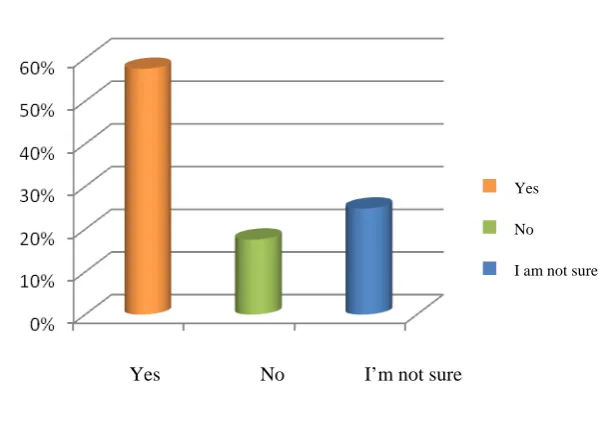
To the question whether they would participate at a seminar or course of training, 58 % of the respondents say "yes", 25% are not sure at present and 18% consider that they would not take part in training courses.
Yes
No
I am not sure
Yes No I’m not sure
Yes No I am not sure
Fig. 3 Readiness of the close friends and relatives to attend training courses
We asked the close friends and relatives from where they obtain the required information. Considering that they were able to give more than one answer, the results look as follows: 61% of the respondents state that they receive the required information from their medical doctor, 18% receive information from other sick people and from their close friends and relatives, 17 % from different visual aids and 3% from training courses and seminars.
Sources percent
From the medical doctor and nurse 61%
From other sick people and their close friends and relatives 17%
From brochures, leaflets and other visual aids 18%
From training courses and seminars 3%
Table 2 Sources of information for the close friends and relatives
5. CONCLUSIONS
The majority of close friends and relatives of people with mental disorders wish to obtain more information on problems related with mental diseases.
The close friends and relatives of people with mental disorders express their readiness to attend training courses and seminars organized for their needs.
Despite of the readiness of the close friends and relatives and the modern focus on the development and implementation of training programmes for the families of mental patients, only few of the close friends and relatives of people with mental disorders are covered by training courses and seminars.
We should consider the opinion of the close friends and relatives of people with mental disorders and Yes No I’m not sure
REFERENCES
Germanov D. (2006) The Stigma of the Mental Disease, 1st edition, Sofia
Carter R., S. Golant. (2002) With Love to People with Mental Illness, Bulgarian Association of Psychiatry, Sofia
Lambreva D. (2013) Psychiatric Nursing, Potayniche S., 2013, ISBN 978-954-2965-09-1, Sofia
Okoliyski M. (2007) Needs and Attitudes to Mental Health and Psychiatric Health Services in the town of Blagoevgrad and the region, Journal of Social Medicine, 1/2007, page 6-9,48 page