Factors Influencing Singaporean Elders to Move to
Thai Retirement Home
Woraphot Treeyawuthiwat and Supeecha Panichpathom*
Thammasat Business School, Thammasat University,
Thailand
Abstract
Problem/Purpose:
Earlier research papers pointed out that people migrated from their homeland for retirements or better work career opportunities, however, most papers concentrated on the western not eastern demographics. Studies pertaining to Asian behaviors enhance housing developers’ understandings customers’ needs and properly expand their housing markets. This study explores factors, which influence Singaporean elders to have retired lives in Thailand.
Design/methodology/approach
Researchers of this study went to Singapore to gather data from Singaporeans who are at least 55 years old. Measurement items were tested for reliability with Cronbach alpha. Data reduction was performed with exploratory factor analysis. The hypotheses were tested by multiple regression analysis.
Findings
Personal aspects (consisting of financial concerns and personal concerns) and other three factors (consisting of facilities, provision of public services and location) had significant positive association with willingness to move to Thai retirement homes. Certain measurement items found to be the main contributors of the move among westerners had little or no relationships among the easterners, which may be due to culture differences.
Research limitations/implications
Government authorities earned an insight into setting policies or infrastructures to promote Thailand to be the chosen “Retirement Destination”. Housing developers gain focused attentions to pertinent factors to develop accommodations to satisfy Singaporean elders, for example, they want to live in locations with good transportation networks and easily access to hospitals.
Originality/value
This paper studies housing needs of people in ASEAN community in order to prepare developers for enhanced opportunities of AEC (ASEAN Economic Community) in year 2015.
Keywords: retirement housing, elderly, Singaporeans, AEC, Thailand
1. INTRODUCTION
1.1 Aging Population
The trend of declining fertility rates and increasing longevity, especially, in the twenty-first century, put burden on working population to care for elders (Mutcher, 1993; and Narknisorn & Kusakabe, 2013). In Asia, aging population has grown rapidly, jumping from 44 percents in 1950 to predicted number of 62 percents in 2050. Within the next few decades, Asia will have the world’s highest number of old age population (Mutcher, 1993; and Narknisorn & Kusakabe, 2013). In general, an age that sets for retirement reflects the social recognition of old age in that society. In Singapore, the official retirement age shifted from fifty-five to sixty-two in 1999, but the aged population in Singapore increased from 3.8 percents in 1957 to 9.1 percents in 1990 and expect to be 23 percents in 2020.
1.2 Retirement Industry
1.3 The Accommodations for Singaporeans Elders
Singapore is Thailand neighbouring country located on the south of Malaysia and to the north of the Indonesia. Even though Singapore is a small country with an area of only 716.1 kilometers square, people’s spending power is ranked as fourth-highest per capita income of $61,803 in the world in 2012 (Wikipedia, n.d.). AEC or ASEAN Economic Community in 2015 is a cooperation that would transform ASEAN into a single regional of common market with free movement of goods, services, investments capital and skilled labor with a population of more than 600 million. AEC, finally, will freely and easily mobilize labours, and goods and services from one country to another and create potential demand for accommodations. The emergence of transnational retirement industry is a response to the aging phenomenon and AEC.
This study emphasizes on analyzing important factors in Singaporean elders’ perspectives if they were to move to Thailand for retirement. These factors are personal aspects, facilities, provisions of public services and locations. Following the introduction are literature review & conceptual framework, research methodology, results of empirical study & discussions, and conclusions & further research.
2. LITERATURE REVIEW &CONCEPTUAL FRAMEWORK 2.1 Activity Constraints
Many previous studies (Ball and Nanda, 2013, Gilleard and Higgs, 2007) found that older people usually hesitate to move but their health conditions caused them to change their minds (Ball and Nanda, 2013). Immobility or low mobility were common attributes among the elders (Piggott, 2007; and Uren & Goldring, 2007). As a person grows older, coping with daily activities are becoming very difficult due to physical deterioration. Those elders who are living alone, the outcome of falling may be life-threatening (Ball and Nanda, 2013). Croucher (2008) found that most elders who have decided to move into specialized housing have been experiencing health problems.
2.2 Willingness to Move to Thai Retirement Home
Two distinct factors caused retirees to migrate to another country for retirement were recreational opportunities or personal concerns and financial aspects (Gibler et al., 2009, Crompton, 1998). As elders are living longer than before, engaging them with activities may be necessary because loneliness is common among them (Livette, 2006). When people retired, their senses of financial stability are gone and feared that they would not be able to maintain their standard of living (Butters, 2002). They, thus, migrate to places where there are lower cost of living expenses (Gibler et al., 2009, Crompton, 1998). Other factors are the location of their accommodation, the availability of facilities in housings and/or communities to meet their needs and the ease of accessibility on public services provided in the host country (Teck-Hong, 2011, Kane et al., 2000, Ling and Gunawansa, 2011). These four independent variables are used in the model to find the relationship with the willingness of the elderly Singaporeans to move to Thai retirement homes.
2.3 Personal Aspects and Willingness to Move to Thai Retirement Homes
Personal aspects will examine on both personal and financial concerns among the elders. (a) Personal Concerns
Previous studies stated that people moved when their existing homes could not satisfy their needs, such as insufficient personal care assistances, housekeeping services and meal deliveries (Gibler et al., 2009, Lee and Gibler, 2004, Crompton, 1998). Another reason to migration is for better recreational opportunities (Crompton (1998) so elders Singaporeans would choose to move to Thailand due to lots of recreational activities in Thailand and sufficient public facilities/areas, such as public parks, provided for the elders in Singapore (Wong, 2003). Good experience of the country is also important in determining when making decision to migrate (Gibler et al., 2009, Crompton, 1998).
(b) Financial Concerns
Retirees are more concerned about their standard of living when they are left with only savings and pensions and financial issue was one of the most concerns among elders (Gibler et al., 2009; and Wong (2003), Gibler et al. (2009) Those who wish to maintain or even increase their living standards may opt for migration to countries with lower living expenses. According to the above discussion, this leads to the following hypotheses:
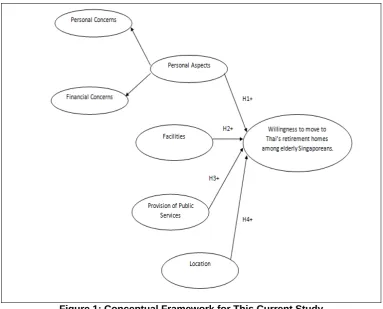
H1: Personal aspects are positively associated with willingness of the elderly Singaporeans to move to Thai retirement homes.
2.4 Facilities and Willingness to Move to Thai Retirement Homes
the daily activities ranging from helping elders with their showers, preparing meals and maintaining their homes. The designs of housings to accommodate the elders’ physical characteristics, such as placing non-slip floorings in bedrooms, is necessary to avoid possible risks of falling and injuries (Leung et al., 2012). According to a study of Ling and Gunawansa (2011), 72 percents of Singaporean respondents were concerned on environmental issues and would gladly pay more for housings that have green features.
Security and safety features, such as gates and guarded premises and 24-hours surveillance cameras to ensure safe environment for people to live in, would be of concern if retirees were to move from a relatively high-secure country to another less secure country (Kim et al., 2003, Gibler et al., 2009, Crompton, 1998). Communal facilities are shared among the community members for leisure and social purposes, such as common areas for social interaction, sporting facilities such as fitness, clubrooms and sauna, and green areas such as parks and gardens.
Loneliness is one of the common psychological reasons that trigger elders to move into specialized housing (Livette, 2006). Loss of spouse or close friends may cause loss of companion and thus, wanting to find new friends whom these elders can socialize with. According to the mention above, the study implies the following hypothesis:
H2: Facilities are positively associated with willingness of the elderly Singaporeans to move to Thai retirement homes.
2.5 Provisions of Public Services and Willingness to Move to Thai Retirement Homes
Singaporean elders placed high importance on provision of public services (Gibler et al., 2009, Wong, 2003, Kane et al., 2000, Crompton, 1998). Public transport in Singapore covers from public shuttle bus services to rail-link systems and is so efficient and accessible that at least half of the population utilizes it every day. As for the medical services, Singapore has a very well-established health care system. The government ensures that its people are able to have access to the health care services by making compulsory savings known as Medisave scheme (Wong, 2003). Thus, accessibility on medical services may be of concern when they decide to move to Thai retirement home.
Sufficient installation of wayfinding signs, lamp posts and good infrastructure can improve the accessibility of foreigners when they are new to the area and increase environmental safety (Kane et al., 2000). The next hypothesis is as follows.
H3: Public services are positively associated with willingness of the elderly Singaporeans to move to Thai retirement homes.
2.6 Location and Willingness to Move to Thai Retirement Homes
Location of housing has been one of the major considerations when wanting to relocate (Fernandez et al., 2002, Eves and Kippes, 2010). People usually want to live near hospitals and choose to live near supermarkets or other services to enhance their conveniences (Fernandez et al., 2002) and close to green areas and free from pollution (Teck-Hong, 2011).
Asian cultures place very much emphasize on family ties. In Singapore, elders views personal health condition, family ties, public safety, health care services and public transportation as the five most important integrals of life (Wong, 2003). Living close to the airport would allow them to travel back to meet their family members and vice versa conveniently (Foxley, 2001). The last hypothesis is as follows.
H4: Location is positively associated with willingness of the elderly Singaporeans to move to Thai retirement homes.
Based on discussion above, the authors developed a conceptual framework demonstrating four factors that have direct relationships with the willingness of the elder Singaporeans to move to Thai retirement homes as shown in Figure 1.
3. RESEARCH METHODOLOGY 3.1 Sampling & Data Collection
Figure 1: Conceptual Framework for This Current Study
Sample size was determined by using the following formula; n = 2x z2
E2 n = The determined sample size
E = Acceptable Margin of Error; E = Mean * Acceptable Margin of Error Z = Z-score value
σ = Standard deviation of the population
Acceptable margin of error is set to be 5 percents (to be conservative) and the mean value obtained from previous and relevant research paper is 3.23, so E is equal to 0.1615. Confidence level is 95 percents so Z is equal to 1.96. The highest standard deviation of all the five constructs is 1.04 (Ricky Y.K. Chan (2000). Calculation for sample size is 160 which is (1.04)2x(1.96)2/(0.1615)2. This number is more than using the
common method as a rule of thumb by multiplying the number of items by 5, which is 155. In conclusion, the number of needed respondents would be at least 160.
3.2 Measurement Items
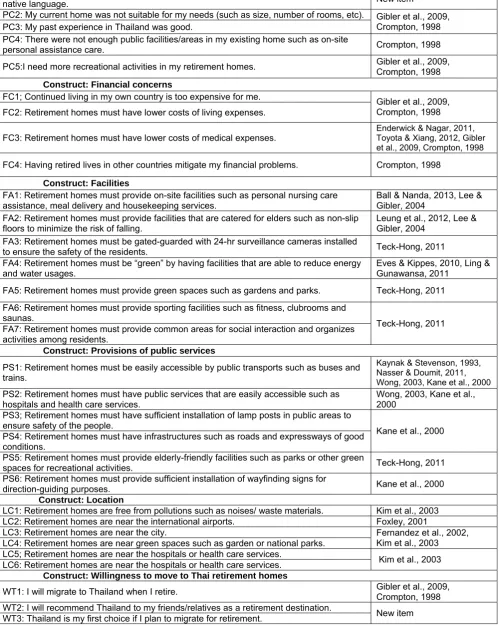
Measurement items of all constructs in this study derived from reviewing related prior studies and from interviewing limited number of samples (Table 1).
3.3 Data Analysis
Table 1: Measurement Items of This Study
Measurement Item Reference
Construct: Personal concerns
PC1: Serviced staffs of retirement homes must have good communication skills in my
native language. New item
PC2: My current home was not suitable for my needs (such as size, number of rooms, etc). Gibler et al., 2009, Crompton, 1998 PC3: My past experience in Thailand was good.
PC4: There were not enough public facilities/areas in my existing home such as on-site
personal assistance care. Crompton, 1998
PC5:I need more recreational activities in my retirement homes. Gibler et al., 2009, Crompton, 1998
Construct: Financial concerns
FC1; Continued living in my own country is too expensive for me. Gibler et al., 2009, Crompton, 1998 FC2: Retirement homes must have lower costs of living expenses.
FC3: Retirement homes must have lower costs of medical expenses. Enderwick & Nagar, 2011, Toyota & Xiang, 2012, Gibler et al., 2009, Crompton, 1998
FC4: Having retired lives in other countries mitigate my financial problems. Crompton, 1998
Construct: Facilities
FA1: Retirement homes must provide on-site facilities such as personal nursing care assistance, meal delivery and housekeeping services.
Ball & Nanda, 2013, Lee & Gibler, 2004
FA2: Retirement homes must provide facilities that are catered for elders such as non-slip
floors to minimize the risk of falling. Leung et al., 2012, Lee & Gibler, 2004 FA3: Retirement homes must be gated-guarded with 24-hr surveillance cameras installed
to ensure the safety of the residents. Teck-Hong, 2011
FA4: Retirement homes must be “green” by having facilities that are able to reduce energy and water usages.
Eves & Kippes, 2010, Ling & Gunawansa, 2011
FA5: Retirement homes must provide green spaces such as gardens and parks. Teck-Hong, 2011
FA6: Retirement homes must provide sporting facilities such as fitness, clubrooms and
saunas. Teck-Hong, 2011
FA7: Retirement homes must provide common areas for social interaction and organizes activities among residents.
Construct: Provisions of public services
PS1: Retirement homes must be easily accessible by public transports such as buses and trains.
Kaynak & Stevenson, 1993, Nasser & Doumit, 2011, Wong, 2003, Kane et al., 2000
PS2: Retirement homes must have public services that are easily accessible such as
hospitals and health care services. Wong, 2003, Kane et al., 2000
PS3; Retirement homes must have sufficient installation of lamp posts in public areas to
ensure safety of the people. Kane et al., 2000
PS4: Retirement homes must have infrastructures such as roads and expressways of good conditions.
PS5: Retirement homes must provide elderly-friendly facilities such as parks or other green
spaces for recreational activities. Teck-Hong, 2011
PS6: Retirement homes must provide sufficient installation of wayfinding signs for
direction-guiding purposes. Kane et al., 2000
Construct: Location
LC1: Retirement homes are free from pollutions such as noises/ waste materials. Kim et al., 2003 LC2: Retirement homes are near the international airports. Foxley, 2001
LC3: Retirement homes are near the city. Fernandez et al., 2002,
Kim et al., 2003 LC4: Retirement homes are near green spaces such as garden or national parks.
LC5; Retirement homes are near the hospitals or health care services. Kim et al., 2003 LC6: Retirement homes are near the hospitals or health care services.
Construct: Willingness to move to Thai retirement homes
WT1: I will migrate to Thailand when I retire. Gibler et al., 2009, Crompton, 1998 WT2: I will recommend Thailand to my friends/relatives as a retirement destination. New item
4. RESULTS AND DISCUSSIONS 4.1 Descriptive Statistics
The total number of valid questionnaires collected for this research was 194. Most respondents were male (64%) with age between 55-59 (43%) and are Chinese ethnic group (72%). None of respondents were 74 years old. Most respondents’ highest educational level was a bachelor’s degree (55%) and more than 85 percents of the respondents were married. Monthly household disposable incomes were mostly distributed in the range of S$3,000-$3,999 (66%). No respondents were in the income range of less than S$1000. The existing housing of almost half of respondents lived in four-room public housing (28%).
4.2 Factor Analysis & Reliability Test
Table 2: Cronbach Alpha for All Constructs
Construct Cronbach Alpha Number of Items Items Deleted
Personal concerns (PC) 0.643 4 PC5
Financial concerns (FC) 0.953 3 FC4
Facilities (FA) 0.803 4 FA1, FA6, FA7
Provisions of public services (PS) 0.784 4 PS4, PS5
Location (LC) 0.627 4 LC5, LC6
Willingness to move to Thai retirement
homes 0.838 3
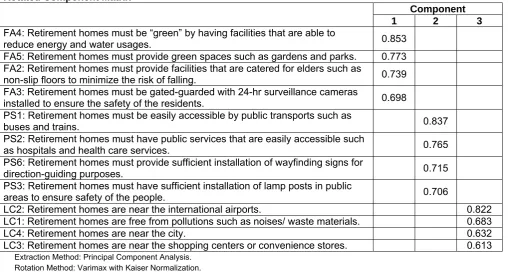
Table 2 demonstrated Cronbach alpha values for all six constructs, namely, personal concerns, financial concerns, facilities, provision of public services, location and willingness to move to Thai retirement homes. Factor loading of three independent variables, namely, facilities, provisions of public services, and location are shown in Table 3. All constructs have quite high factor loading (0.613 – 0.853) signifying that each measurement items can explain its construct quite well.
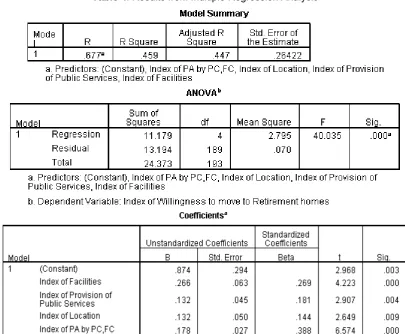
The results from performing multiple regression analysis to test all four hypotheses are shown in Table 4., which demonstrated that all four hypotheses were accepted. The adjusted R square indicated that all four independent constructs were able to explain the variance of willingness to move to Thai retirement homes of the elderly Singaporean (WT) by 44.7 percents. The linear regression equation on these relationships is written below:
WT = .388(PA) ** + .269(FA) ** + .181(PS) ** + .144(LC) **
The strength of the influences of each independent variable on dependent variable are personal aspects, facilities, provision of public services and location respectively.
Table 3: Rotated Component Matrix on Facilities, Provisions of Public Services and Locations Rotated Component Matrixa
Component
1 2 3 FA4: Retirement homes must be “green” by having facilities that are able to
reduce energy and water usages. 0.853
FA5: Retirement homes must provide green spaces such as gardens and parks. 0.773 FA2: Retirement homes must provide facilities that are catered for elders such as
non-slip floors to minimize the risk of falling. 0.739 FA3: Retirement homes must be gated-guarded with 24-hr surveillance cameras
installed to ensure the safety of the residents. 0.698 PS1: Retirement homes must be easily accessible by public transports such as
buses and trains. 0.837
PS2: Retirement homes must have public services that are easily accessible such
as hospitals and health care services. 0.765
PS6: Retirement homes must provide sufficient installation of wayfinding signs for
direction-guiding purposes. 0.715
PS3: Retirement homes must have sufficient installation of lamp posts in public
areas to ensure safety of the people. 0.706
LC2: Retirement homes are near the international airports. 0.822 LC1: Retirement homes are free from pollutions such as noises/ waste materials. 0.683
LC4: Retirement homes are near the city. 0.632
LC3: Retirement homes are near the shopping centers or convenience stores. 0.613
The result of hypothesis 1 is in line with both Gibler’s and Traci’s research papers which suggested that both sub-factors of personal aspects, which were personal concerns and financial concerns, do have influence on the decision-makings when elders are planning for migration to other countries.
The result of hypothesis 2 isin line with both Tan’s and Gibler’s research papers which suggested that facilities do have influence on the decision-makings when elders are planning for migration to other countries.
The result of hypothesis 3 is in line with Grace’s, Kane’s and Kaynak’s research papers which suggested that provisions of public services do have influence on the decision-makings when elders are planning for migration to other countries.
The result of hypothesis 4 is in line with both Kim’s and Fernandez’s research papers which suggested that locations do have influence on the decision-makings when elders are planning for migration to other countries. Interestingly, all items pertinent to recreational activities, areas or facilities (items PC5, FA6, FA7, PS5 and LC5 shown in Table 1) were taken out. This result verified that previous studies pertaining to recreation were not applicable to elderly Singaporeans. The incongruence between this study and previous studies might be due to different context, i.e., not migration from United States to Spain but from Singapore to Thailand. Furthermore, most of respondents of this study (77 percents) did not reach retirement age yet and might not think they need on-site services (item FA1). Further interviews with some samples enlightened some explanations of taking out item FC4 (having retired lives in other countries mitigate my financial problems), item PS4 (retirement homes must have infrastructures such as roads and expressways of good conditions) and item LC6 (retirement homes are near the hospitals or health care services). Elderly Singaporeans could afford to live in their own country but prefer to migrate to countries with lower costs of living so item FC4 was not applicable. They believed that the conditions of infrastructure are good so PS4 was not their concerns. Majority of respondents was Chinese, who perceived that living close to hospitals or health care services made them depress rather than cheerful or lively. Item LC6, thus, was deleted from this study. The respondents also revealed that they concern about international airport accessibility (item LC2) because according to Thai law, they had to renew their visa every three or six months and they also want to maintain relations to their family from time to time. Even though they had compulsory savings under Medisave scheme, elderly Singaporeans felt that they could not easily and conveniently access health care services in Singapore.
5. CONCLUSIONS AND FURTHER RESEARCH
The contributions of this study are (1) Thailand policy makers will be aware of the related business opportunities other than medical tourism and implement new policies that hope to attract elderly Singaporeans to retire in Thailand, and (2) Thailand property developers will be better prepared and designed houses that match their preferences in years to come.
On the national contexts, Thai government learnt that there is tendency to attract foreigners to retire in Thailand. They, therefore, should promote Thailand to be the top “retirement destination country”. However, they should deregulate visa requirements to relieve the visa renewal concern. Thai government should promote Thailand to be the top “Medical Tourism” destinations.
The results from this study highlighted that elderly Singaporeans wanted retirement homes in other country to be located with free pollution, near international airport and shopping centers. Real estate developers, who plan to develop retirement homes, should also propagate the information of the quality of hospitals and health care services offered in Thailand and prepare their staff with English proficiency. Finally, they should not waste their money on recreational activities, areas or facilities.
However, the results of this study based on samples who mostly are Chinese people with the age under 60. Further study might very these factors by gathering data from different ethnics and age.
REFERENCES
BALL, M. & NANDA, A. 2013. Household attributes and the future demand for retirement housing. International Journal of Housing Markets and Analysis, 6, 45-62.
BUTTERS, J. 2002. Managing the mental and emotional aspects of retirement. Leadership in Health Services, 15, 6-11. CROMPTON, T. L. H. A. J. L. 1998. <The role of recreation amenities in retiree relocation decisions.pdf>.
ENDERWICK, P. & NAGAR, S. 2011. The competitive challenge of emerging markets: the case of medical tourism. International Journal of Emerging Markets, 6, 329-350.
EVES, C. & KIPPES, S. 2010. Public awareness of “green” and “energy efficient” residential property: An empirical survey based on data from New Zealand. Property Management, 28, 193-208.
FERNANDEZ, J. A. D. C. G., OLIVEIRA, R. D. & HOCHHEIM, N. 2002. Application of family life cycle concept in determining potential segment for housing projects: Case study of two downtown projects in Florianópolis, Brazil. Property Management, 20, 312-325.
FOXLEY, S. 2001. Serviced apartments in the UK – a growth sector? Journal of Property Investment & Finance, 19, 79-89. GIBLER, K. M., CASADO-DíAZ, J. M., CASADO-DíAZ, M. A., RODRíGUEZ, V. & TALTAVULL, P. 2009. Late life second
move housing choices of international retiree migrants. International Journal of Housing Markets and Analysis, 2, 190-210.
GILLEARD, C. & HIGGS, P. 2007. The Third Age and the Baby Boomers. International journal of ageing and later life, 2, 13-30.
KANE, G., HEANEY, G. & MCGREAL, S. 2000. Resident participation in the evaluation of external accessibility requirements in housing estates. Facilities, 18, 45-55.
KAYNAK, E. & STEVENSON, L. 1993. Comparative Study of Home Buying Behaviour of Atlantic Canadians. Management Research News, 5, 3-11.
KIM, S.-H., KIM, H.-B. & KIM, W. G. 2003. Impacts of senior citizens’ lifestyle on their choices of elderly housing. Journal of Consumer Marketing, 20, 210-226.
LEE, E. & GIBLER, K. M. 2004. Preferences for Korean seniors housing. Journal of Property Investment & Finance, 22, 112-135.
LEUNG, M.-Y., YU, J. & YU, S. 2012. Investigating key components of the facilities management of residential care and attention homes. Facilities, 30, 611-629.
LING, F. Y. Y. & GUNAWANSA, A. 2011. Strategies for potential owners in Singapore to own environmentally sustainable homes. Engineering, Construction and Architectural Management, 18, 579-594.
LIVETTE, M. 2006. Retirement housing for sale and differences in the decision to purchase that are determined by gender or marital status. Property Management, 24, 7-19.
NASSER, R. & DOUMIT, J. 2011. Developing criteria for elderly nursing homes: the case of Lebanon. International Journal of Health Care Quality Assurance, 24, 211-222.
RICKY Y.K. CHAN, L. B. Y. L. 2000. <Antecedents of green purchases, a survey in china.pdf>.
TECK-HONG, T. 2011. Neighborhood preferences of house buyers: the case of Klang Valley, Malaysia. International Journal of Housing Markets and Analysis, 4, 58-69.
TOYOTA, M. & XIANG, B. 2012. The emerging transnational “retirement industry” in Southeast Asia. International Journal of Sociology and Social Policy, 32, 708-719.
WIKIPEDIA. n.d. List of countries by GDP (PPP) per capita [Online]. Available: http://en.wikipedia.org/wiki/List_of_countries_by_GDP_(PPP)_per_capita.