SVM BASED PREDICTION OF MAJOR
HISTOCOMPATIBILITY COMPLEX BINDERS:
EXPRESSION AND ANALYSIS OF Mesobuthus Tamulus
PEPTIDE
Smruti S. Changbhale
1, Sonu Mishra
2, Virendra Gomase
31
The Global Open University, Dimapur, Nagaland, (India)
2,3
Department of Biotechnology, Mewar University, Chittorgarh, Rajasthan,(India)
ABSTRACT
Mesobuthus tamulus is an Indian red scorpion, which is the most lethal species of the Buthidae family in India.
In this research work, we predict the peptide binders of neurotoxin from Mesobuthus tamulussequence to MHC-I molecules are as 11mer_H2_Db, 10mer_H2_Db, 9mer_H2_Db, 8mer_H2_Db.Also study integrates prediction of peptide MHC class I binding; proteasomal C terminal cleavage and TAP transport efficiency by using sequence and properties of the amino acids. We also found the binding of peptides to different alleles by using Position Specific Scoring Matrix. Neurotoxin from Mesobuthus tamulusis64 residues long with 56 nonamers having antigenic MHC binding peptides. PSSM based server will predict the peptide binders of neurotoxin from
Mesobuthus tamulussequence to MHCII molecules are as I_Ab.p, I_Ad.p, I_Ag7, which are found antigenic epitopes region in neurotoxin from Mesobuthus.
Keywords: neurotoxin, Peptide, Antigen, MHC, TAP, PSSM
I. INTRODUCTION
Mesobuthus tamulus is widespread across vegetated lowlands with subtropical to tropical, humid climate, lives
close to human settlements, especially in rural areas. Mesobuthus tamulus, an Indian red scorpion, is the most
lethal species of the Buthidae family in India. Mesobuthus tamulus venoms consist of a several toxins that are
associated with high morbility and mortality, especially among the childrens. Accidents caused by scorpion are
a relatively common event in tropical and subtropical countries. The effect and symptoms of the sting start
immediately with a few minutes after the sting and usually progress to a maximum severity within 5 hours, i.e.,
vomiting, profuse salivation, sweating, nausea, irritability, hyperthermia, and convulsion. Clinical signs and
symptoms observed in humans and experimental animals are related with an excessive systemic host
inflammatory response to stings and stings, respectively [1-5]. However, Identification of antigenic peptide that binds to MHC [Major Histocompatibility Complex]- molecule improves the understanding of specificity of
immune responses and is important for discovery of vaccines. MHC molecules are cell surface proteins that
1.1 MHC Class I Antigen
In the Antigen-presentation process, antigenic protein (neurotoxin from Mesobuthus tamulus) is cleaved into oligopeptides in the proteasome [4-6], then cleaved fragments of peptides enter the endoplasmic reticulum (ER)
via TAP protein where these peptides form a complex with MHC class I molecule [7-11]. Then these complexes
are translocated towards the surface of the antigen presenting cell, where they are recognized by T-cell to elicit
an immune response [12-16]. Therefore, prediction of TAP binding peptides is important for identification of
the MHC class-1 restricted T cell epitopes.
1.2 Proteasomal Degradation
Proteasomal degradation is important step in the antigen-presentation process to regulate the balance between
intracellular proteins [17]. Inside the proteasome by the action of proteinase the antigenic protein (neurotoxin
from Mesobuthus tamulus) are cleavaged into oligopeptides [18] and then these oligopeptides are binds to the TAP, which transports these peptides into the ER.
1.3 Transport of peptide by TAP
TAP is heterodimeric transmembrane protein, is a family of ABC transporter that transports antigenic peptide
(neurotoxin from Mesobuthus tamulus) into ER [19] because most of the MHC binding peptides are unable to diffuse across membrane, but TAP able to carry them inside the ER where it binds to MHC class I molecules.
These MHC-peptide complexes will be translocate on the surface of antigen presenting cells [20] and are
recognized by T-cell receptors to elicit an immune response.
1.4 MHC Class II Antigen
In the extracellular antigen presentation, prediction of peptides binding to a MHC class II molecule is difficult
due to different side chains and longer length [21-23]. In the MHC class II antigen presentation process,
antigenic protein neurotoxin from Mesobuthus tamulusare ingested by antigen-presenting cells through the process of endocytosis or phagocytosis, then cleaved by cathepsins a class of protease into oligopeptides in the
endosomes, than are fuse with lysosomes containing MHC class II molecules [24] and present them at the cell
surface for recognition by T cells [25-33]. Where T helper cells trigger an immune response by inflammation
and swelling due to phagocytes or may lead to an antibody-mediated immune response via B-cell activation.
Since MHCs have a key role in immune system by stimulating cellular and humoral immunity against
neurotoxin from Mesobuthus tamulusand are used for controlling specific immunological processes by creating peptides to bind to specific MHC alleles and this binding affinity to specific peptides are used for designing
synthetic peptide vaccines [34-37].
II. MATERIALS AND METHODS
2.1 Predictions of MHC class I binding peptide
MHC binding peptide is predicted using neural networks trained on C terminals of known epitopes. By using
using Position Specific Scoring Matrices (PSSMs) whose C terminal end is likely to be the result of proteosomal
cleavage.
2.2 Prediction of Antigenic Peptides by Cascade SVM based TAPPred method
By using TAPPred we predict TAP binders on the basis of sequence and the properties of amino acids. We
found the MHCI binding regions [Table-3], the binding affinity of neurotoxin from Mesobuthus tamulus having 64 amino acids, which shows 56nonamers.
2.3 Predictions of MHC class II binding peptide
MHC peptide binding of neurotoxin from Mesobuthus tamulusis predicted using neural networks trained on C terminals of known epitopes. By using RANKPEP we predict peptide binders to MHCII molecules from protein
sequences or sequence alignments using Position Specific Scoring Matrices (PSSMs). MHC molecule binds to
some of the peptide fragments generated after proteolytic cleavage of antigen.
III. RESULTS AND INTERPRETATION
In this research work, we predict the peptide binders of neurotoxin from Mesobuthus tamulussequence to MHC-I molecules are as 11mer_H2_Db, 10mer_H2_Db, 9mer_H2_Db, 8mer_H2_Db [Table-1]. MHC molecule binds
to peptide fragments which are generated after proteolytic cleavage of antigen tend to be high-efficiency
binders. TAP is an important transporter that involved in the translocation of peptides from cytosol to ER. TAP
binds and translocates selective peptides for binding to specific MHC molecules. Therefore, predicting binding
affinity of those peptides toward the TAP transporter is crucial to identify the MHC class-1 restricted T cell
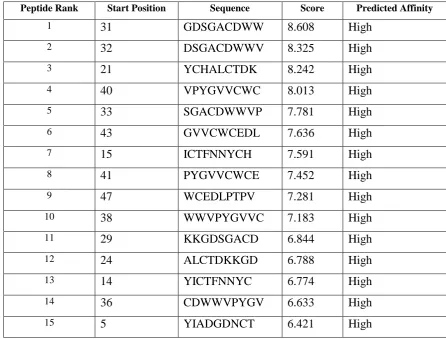
epitopes. Cascade based support vector machine shows 15 High affinity TAP binder residues at N and C termini
using sequence and properties of the amino acids of neurotoxin from Mesobuthus tamulus[Table-3]. This method integrates prediction of peptide MHC class I binding; proteasomal C terminal cleavage and TAP
transport efficiency by using sequence and properties of the amino acids. We also found the binding of peptides
to different alleles by using Position Specific Scoring Matrix. Neurotoxin from Mesobuthus tamulusis64 residues long with 56nonamers having antigenic MHC binding peptides. PSSM based server will predict the
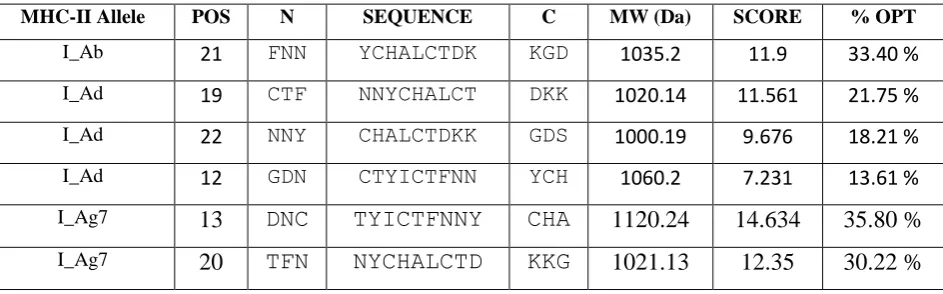
peptide binders of neurotoxin from Mesobuthus tamulussequence to MHCII molecules are as I_Ab.p, I_Ad.p,I_Ag7 which are found antigenic epitopes region in neurotoxin from Mesobuthus tamulus[Table-2].
Table -1 Peptide binders of neurotoxin from Mesobuthus tamulusto MHC-I molecules, having C-terminal ends
are proteosomal cleavage sites.
MHC-I Allele POS N SEQUENCE C MW (Da) SCORE % OPT
8mer_H2_Db
7
GYI
ADGDNCTY
ICT
839.83
19.409
36.97 %
8mer_H2_Db
8
YIA
DGDNCTYI
CTF
881.91
16.284
31.02 %
8mer_H2_Db
18
ICT
FNNYCHAL
CTD
963.08
2.657
5.06 %
8mer_H2_Db
55
PTP
VPIRGSGK
CR
794.95
2.514
4.79 %
9mer_H2_Db
16
TYI
CTFNNYCHA
LCT
1054.16
23.475
46.61 %
9mer_H2_Db
7
GYI
ADGDNCTYI
CTF
952.99
21.29
42.27 %
9mer_H2_Db
22
NNY
CHALCTDKK
GDS
1000.19
4.452
8.84 %
9mer_H2_Db
39
CDW
WVPYGVVCW
CED
1044.3
1.977
3.93 %
9mer_H2_Db
43
VPY
GVVCWCEDL
PTP
982.17
1.602
3.18 %
9mer_H2_Db
21
FNN
YCHALCTDK
KGD
1035.2
0.592
1.18 %
10mer_H2_Db
16
TYI
CTFNNYCHAL
CTD
1167.32
10.739
18.25 %
10mer_H2_Db
6
DGY
IADGDNCTYI
CTF
1066.15
2.075
3.53 %
11mer_H2_Db
15
CTY
ICTFNNYCHAL
CTD
1280.48
19.833
24.95 %
* The RANKPEP consists of a list of selected peptides binding potential (score) to the MHC molecule from the
query given at a selected threshold. Peptides shown here contain a C-terminal residue that is predicted to be the
result of proteasomal cleavage and also focus on the prediction of conserved epitopes that help to avoid immune
evasion resulting from mutation. Proteasomal cleavage options are only applied to the prediction of
MHCI-restricted peptides.
Table -2 Cascade SVM based High affinity TAP Binders of neurotoxin from Mesobuthus tamulus
Peptide Rank Start Position Sequence Score Predicted Affinity
* TAPPred showing Cascade SVM based High affinity TAP Binders sites, their sequence, rank, position and
scores are displayed in the tabular output are to be found 15 High affinity TAP Transporter peptide regions
which represents predicted TAP binders residues which occur at N and C termini neurotoxin from Mesobuthus tamulus.
Table - 3 Peptide binders of neurotoxin from Mesobuthus tamulusto MHC-II molecules.
MHC-II Allele POS N SEQUENCE C MW (Da) SCORE % OPT
I_Ab
21
FNN
YCHALCTDK
KGD
1035.2
11.9
33.40 %
I_Ad
19
CTF
NNYCHALCT
DKK
1020.14
11.561
21.75 %
I_Ad
22
NNY
CHALCTDKK
GDS
1000.19
9.676
18.21 %
I_Ad
12
GDN
CTYICTFNN
YCH
1060.2
7.231
13.61 %
I_Ag7
13
DNC
TYICTFNNY
CHA
1120.24
14.634
35.80 %
I_Ag7
20
TFN
NYCHALCTD
KKG
1021.13
12.35
30.22 %
IV. CONCLUSION
The Antigenic proteins (neurotoxin from Mesobuthus tamulusinvolved multiple antigenic components to direct and empower the immune system to protect the host from the neurotoxin. Major histocompatibility complexes
(MHC-I and MHC-II) display specificity to bind with their respective epitopes. MHC class molecules are cell
surface proteins that take active part in host immune reactions to response almost all antigens. This knowledge
of the immune responses to an antigen protein (neurotoxin from Mesobuthus tamulus) clear that the whole protein is not necessary for raising the immune response, but a small fragment of antigen can induce immune
response against whole antigen. This means the increase in affinity of MHC binding peptides may result in
enhancement of immunogenicity of neurotoxin from Mesobuthus tamulus, hence are helpful in silico to design and develop highly predictive computational tools for the identification of T-cell epitopes. Finally, accurate
prediction remains vital for the future to design synthetic peptide vaccine.
Abbreviations
MHC - Major Histocompatibility Complex
TAP -Transporter associated with antigen processing
PSSM- Position Specific Scoring Matrices
SVM - Support Vector Machine
REFERENCES
[1] Rochat H., Rochat C., Kopeyan C., Miranda F., Lissitzky S., Edman P. Scorpion neurotoxins: a family of
homologous proteins. FEBS Lett, 1970; 10, 349-51.
[2] Mackinnon R., Cohen Sl., Kuo A., Lee A., Chait Bt. Structural conservation in prokaryotic and eukaryotic
potassium channels. Science, 1998; 280, 106-9.
[3] Ismail M. The scorpion envenoming syndrome. Toxicon. 1995; 33:825–58.
[4] Quintero-Hernández, J.M. Jiménez-Vargas, G.B. Gurrola, H.H.F. Valdivia, L.D. Possani. Scorpion venom
components that affect ion-channels function. Toxicon. 2013; 76: 328–342. doi:
10.1016/j.toxicon.2013.07.012
[5] Mebs D. Scorpions and snakes, such as cobras, mambas and vipers made the African continent famous for
venomous animals. Bulletin de la Societe de PathologieExotique. 2002; 95(3):p. 131.
[6] Holzhütter HG, Frömmel C, Kloetzel PM. A theoretical approach towards the identification of
cleavage-determining amino acid motifs of the 20 S proteasome. J Mol Biol. 1999 Mar 5;286(4):1251-65.
[7] Rock K, Gramm C, Rothstein L, Clark , Stein R, Dick L, Hwang D, Goldberg AL. Inhibitors of the
proteasome block the degradation of most cell proteins and the generation of peptides presented on MHC
class I molecules. Cell 1994;. 78:761–771.
[8] Bhasin M, Raghava GP. Pcleavage: an SVM based method for prediction of constitutive proteasome and
immunoproteasome cleavage sites in antigenic sequences Nucleic Acids Res 2005;33: W202-207.
[9] Vyas JM, Van der Veen AG &Ploegh HL. The known unknowns of antigen processing and presentation.
Nat Rev Immunol.2008; 8(8): 607-618.
[10] Kelly A, Powis SH, Kerr LA, Mockridge I, Elliott T, Bastin J, Uchanska-Ziegler B, Ziegler A, Trowsdale
J, Townsend A. Assembly and function of the two ABC transporter proteins encoded in the human major
histocompatibility complex.Nature. 1992 Feb 13;355(6361):641-4.
[11] Lautscham G, Rickinson A, Blake N. TAP-independent antigen presentation on MHC class I molecules:
Lessons from Epstein--Barr virus. Microbes and Infection.2003; 5:291–299.
[12] Nussbaum AK,Kuttler C, Tenzer S &Schild H. Using the World Wide Web for predicting CTL epitopes.
Curr. Opin. Immunol. 2003; 15: 69–74.
[13] Lankat-Buttgereit B &Tampe R. The transporter associated with antigen processing: Function and
implications in human diseases. Physiol. Rev. 2002; 82: 187–204.
[14] Rock KL, York IA & Goldberg AL. Post-proteasomal antigen processing for major histocompatibility
complex class I presentation. Nature immunology2004; 5(7): 670-677.
[15] Hammerling GJ, Vogt AB &Kropshofer H. Antigen processing and presentation: Towards the millennium.
Immunol. Rev.1999; 172: 5–11.
[16] Bhasin M, Ragahava GPS. A hybrid approach for predicting promiscuous MHC class I restricted T cell
epitopes. J Biosciences. 2007; 32(1):31–42.
[17] Brussic V, Bajic VB, Petrovsky N. Computational methods for prediction of T-cell epitopes--a framework
[18] Reidesel H, Kolbeck B, Schmetzer O, Knapp EW. Peptide binding at class I major histocompatibility
complex scored with linear functions and support vector machines. Genome Informatics. 2004; 15(1):198–
212.
[19] Princiotta MF, Finzi D, Qian SB, Gibbs J, Schuchmann S, Buttgereit F, et al., Quantitating protein synthesis,degradation, and endogenous antigen processing. Immunity. 2003; 18(3): 343-354.
[20] Rock KL, York IA & Goldberg AL. Post-proteasomal antigen processing for major histocompatibility
complex class I presentation. Nat Immunol, 2004; 5(7):670-677.
[21] Procko E &Gaudet R. Antigen processing and presentation: TAPping into ABC transporters.
CurrOpinImmunol, 2009; 21(1):84-91.
[22] Yewdell JW, Reits E &Neefjes J. Making sense of mass destruction: quantitating MHC class I antigen
presentation. Nat Rev Immunol.2003; 3(12): 952-961.
[23] Stern LJ, Wiley DC. Antigenic peptide binding by class I and class II histocompatibility proteins. Behring
Inst Mitt.1994; (94):1-10.
[24] Hammer J, Bono E, Gallazzi F, Belunis C, Nagy Z, Sinigaglia F. Precise prediction of major
histocompatibility complex class II-peptide interaction based on peptide side chain scanning. J Exp
Med.1994; 180(6):2353-2358.
[25] Jardetzky TS, Brown JH, Gorga JC, Stern LJ, Urban RG, Strominger JL, Wiley DC. Crystallographic
analysis of endogenous peptides associated with HLA-DR1 suggests a common, polyproline II-like
conformation for bound peptides. Proc. Natl Acad. Sci. USA.1996; 93: 734–738.
[26] Cresswell P. Assembly, transport, and function of MHC class II molecules. Annu Rev Immunol1994;12:
259–293.
[27] Rudolph MG, Stanfield RL, Wilson IA. How TCRs bind MHCs, peptides, and coreceptors. Annu Rev
Immunol.2006; 24: 419–466.
[28] Nielsen M, Lund O, Buus S, Lundegaard C. MHC Class II epitope predictive algorithms. Immunology.
2010; 130:319–328.
[29] Nielsen M, Lundegaard C, Worning P, Hvid CS, Lamberth K, et al. Improved prediction of MHC class I
and class II epitopes using a novel Gibbs sampling approach. Bioinformatics. 2004;20:1388–1397.
[30] Murugan N, Dai Y (2005). Prediction of MHC class II binding peptides based on an iterative learning
model. Immunome Res. 2005; 1:6.
[31] Salomon J, Flower DR. Predicting Class II MHC-Peptide binding: a kernel based approach using
similarity scores. BMC Bioinformatics. 2006; 7:501.
[32] Bordner AJ, Mittelmann HD. Prediction of the binding affinities of peptides to class II MHC using a
regularized thermodynamic model. BMC Bioinformatics. 2010; 11:41.
[33] Nielsen M, Lundegaard C, Lund O. Prediction of MHC class II binding affinity using SMM-align, a novel
stabilization matrix alignment method. BMC Bioinformatics.2007;8:238.
[34] Gomase VS, Chitlange NR. Sensitive Quantitative Predictions of MHC Binding Peptides and Fragment
[35] Changbhale SS, Chitlange NR, Gomase VS, Kale KV. An Immunoinformatics Approach to Design
Synthetic Peptide Vaccine from DendroaspispolylepispolylepisDendrotoxin-K(DTX-K). Journal of
Environmental & Analytical Toxicology, 2012; 2(7), 157. doi:10.4172/2161-0525.1000157.
[36] Reche PA, Glutting JP, Zhang H, Reinherz EL. Enhancement to the RANKPEP resource for the prediction
of peptide binding to MHC molecules using profiles. Immunogenetics. 2004;56(6):405–419.
[37] Gomase VS, Chitlange NR, Changbhale SS, Kale KV. Prediction of Brugiamalayi antigenic peptides:
candidates for synthetic vaccine design against lymphatic filariasis. Protein Pept Lett. 2013