Rebecca J Mullins. Three-Dimensional Modeling Usage in Higher Institution
Classrooms. A Master’s Paper for the M.S. in L.S degree. April, 2019. 44 pages. Advisor: Ryan Shaw
This study examines a series of interviews concerning the creation and utilization of dimensional objects in higher institutional learning. It examines how three-dimensional models are created, how objects are made available through copyright standards and future implications for three-dimensional technology.
Headings:
Copyright
THREE-DIMENSIONAL MODELING USAGE IN HIGHER INSTITUTION CLASSROOMS
by
Rebecca J Mullins
A Master’s paper submitted to the faculty of the School of Information and Library Science of the University of North Carolina at Chapel Hill
in partial fulfillment of the requirements for the degree of Master of Science in
Library Science.
Chapel Hill, North Carolina April 2019
Approved by
Table of Contents
Introduction ... 2
Literature Review ... 4
1.1. Three-Dimensional Scanning ... 4
1.2. Model Processing and Creation ... 8
1.3. Applications in Education ... 12
1.4. Copyright Implications... 14
1.5. Summary ... 17
Methodology ... 18
2.1. Object Selection and Importance ... 19
2.2. Data Collection and Storage ... 21
2.3. Interviews ... 21
Findings ... 23
Conclusion ... 27
Resources ... 28
Appendix A – Recruitment Email ... 31
Appendix B – Consent Form ... 32
Appendix C – Survey Questions ... 35
Appendix D – Interview Handout ... 37
Introduction
Touch as a medium for cultural objects is often associated with forbidding signs, warning individuals to refrain to do more than looking. Arguments for long-term
preservation of items supersedes patron learning, leaving knowledge to be gathered through thick-plated glass or grainy, second-hand photos. Combined with Western ideas of ocular-centrism and modern scientific principles, touch of these artifacts is confined to experts in antiquity. While the situation has remained thus for decades, a resurgence in adding tactical learning to cultural objects is occurring. Professional historians, archivists, professors and others are wanting to engage individuals beyond traditional text-block labels associated with inaccessible items. One such answer which continues to appear when digital technologies are discussed is the use of three-dimensional modeling. Despite the challenges which still plague institutions with creating three-dimensional modeling, further interest in providing public access remains high.
personal, individual’s uses as a hobby for created historic models rather than institutional use as a means to spread access to authentic replicas.
This study seeks to understand the value of three-dimensional modeling of cultural heritage in classroom settings. Additionally, it attempts to fill a gap in the
literature on how professors may utilize three-dimensional modeling for user engagement with various pieces. This study aims to answer the following questions:
1. Does tactile manipulation of an item help users understand its cultural significance at a deeper level?
2. Does the rising general interest in three-dimensional technology increase desire for interactive cultural learning?
Literature Review
Awareness and interest in utilizing three-dimensional digitization modeling has increased dramatically in the past decade. However there has yet to emerge a widespread use of this technology in higher-education classroom learning of cultural objects. Much of the literature related to cultural three-dimensional modeling in educational settings focuses on primary school learners, with utilization decreasing as learners age. On the other side, three-dimensional printing of cultural objects has been relegated to amateur enthusiasts and special case scenarios, despite the increase in cultural object scanning.
1.1.
Three-Dimensional Scanning
space for individuals to showcase their three-dimensional models. Contrastingly, Thingiverse provides a platform for users to create items in provided software. As described on Sketchfab’s mission statement, “ … [as] a community of millions of creators who have published millions of models, we are the largest platform for immersive and interactive 3D” (2019). Users of Sketchfab are provided digital models and are given access to physical models through purchase in the company’s store. In comparison, Thingiverse provides users access to three-dimensional model files for download and printing on personal devices. Users are “encouraged to be licensed under a creative common license …” (one of several licenses which allows the distribution of otherwise copyrighted work for free) “… to help encourage an open platform” (MakerBot Industries, 2019). If users decide to create their own scan of an existing object, there are two main ways items are scanned; photogrammetry and infrared, also known as
structured light scanning.
Photogrammetry is defined by the American Society of Photogrammetry and Remote Sensing as “the art, science, and technology of obtaining reliable information about physical objects and the environment through the processes of recording,
referred to as remote sensing, because it not necessary for physical contact to occur. Unique to this technique is the collection of both qualitative and quantitative data. For example, photogrammetry photographs provide qualitative data such as the house appears to be new, with blue walls and quantitative data, such as the house is twenty by twenty-five feet large. Photogrammetry requires very few tools and completion requires a simple high-resolution digital camera. Typically used in conjunction with other techniques, photogrammetry provides necessary color and texture information. Additionally, this information provides necessary data when final processing occurs.
Non-contact scanners, which use radiation to acquire object information, begin the photogrammetry. The location of each point in three - dimensional space is calculated by determining the “time of flight” of the reflected laser beam, which is proportional to the distance to the scanner. Combined with the directional parameters of the scanner (azimuth and angle) this will give the location relative to the scanner’s position. The data density of the scans varies between 25 to 50 mm and the distance from which the object is scanned range between 2 and 750 m, depending on the system employed (Slob et al. 2002). Total time of scanning is dependent upon the size of the object, as well as the resolution desired. For a small paper sphere roughly two inches in diameter, scan times varied from less than three minutes to almost forty-five, depending on resolution chosen. Generally, moderate resolutions are chosen, such as a 0.5 scan resolution (1 being the highest), and moderate quality (Wang et al, 2014).
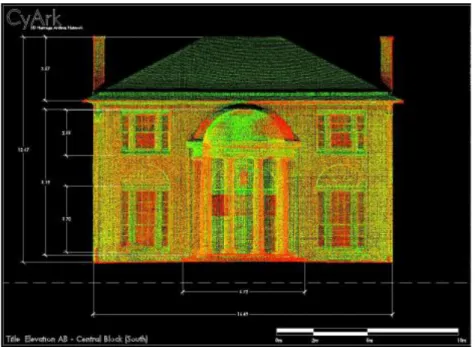
When scanning, it is important to find the appropriate number to acquire the best three- dimensional images with the minimum number of total images. The optimal
positions are perpendicular to the walls and the remaining four lies at approximately the diagonals of the building (See, Figure 1). Much like the human eye, photogrammetry
mimics the perspective shift in viewpoint by creating an overlapping series of consecutive images (Hrozek et al. 2012). Generally, professionals agree overlapping ranges from ten to twenty percent of the object is appropriate for necessary data without excessive information.
(Wang et al, 2014). The resulting data returned from the scans is a dense “cloud” of points in three-dimensional space.
Whether employing infrared, photogrammetry or LIDAR, there are differences to note. LIDAR, while effective, is best used for large topographic areas, requiring historic sites to employ additional techniques. LIDAR provides the highest quality scans, but it is also the most expensive option. LIDAR scanners require specialized knowledge and programming software, in addition to an extensive workstation (Wheeler, 2017). Opposing, photogrammetry allows even non-specialist operators are able to carry out the processing cycle, depending on the automation of the system. Some limitations, however, are a lack of fully automatic procedures that provide satisfactory results, especially in texture less parts of pictures, where point-clouds are less trustworthy. Often, calibration is completed on the job (self-calibration) to provide measurements that are more accurate. Figure 1: Positions for optimal number of scans (Hrozek et
However, to solve issues describing position and orientation of the camera in the global system and interior (focal length, coordinates of principal point and distortion
parameters) orientation parameters are required (Kolecka, 2012).
1.2.
Model Processing and Creation
The next step in three-dimensional model creation is the data processing of the point cloud over the intended object (See Figure 2). Each point within the cloud
represents a single spot on the objects surface. The higher the point density, the more accurate the surface is represented (Slob et al, 2002). The amount of point cloud data obtained by scanning
is very large and contains miscellaneous noise, requiring
detailed processing alignment. For point cloud aligning, which can be done either manually or automatically
depending on the user, it is necessary to pick at least three points that are mutual for both image point clouds. A single building can be comprised of hundreds of scans, based on size and complexity. Grouped together based on location (interior, exterior, aerial), images are processed in small amounts of data units. (Paolicci, 2017).
When creating a point cloud, an often-occurring issue is partially captured scans. In order to complete the three-dimensional rendition, scans or surfaces must be combined into one continuous object. When stitching the scans together, a common issue in that it is seldom known with sufficient accuracy how the object moved relative to the scanner in between shots (Baerentzen et al, 2012). To solve this, corresponding points are found through the use of large measure points. Measure points, known as markers, is an image of a black or white circle in the center. Markers are applied in a consistent location and vary in size depending upon the scanned object (Everything about Markers, 2017). The
resulting data allows photogrammetric software to begin creating a mesh overlap, the next step in creating a three-dimensional model.
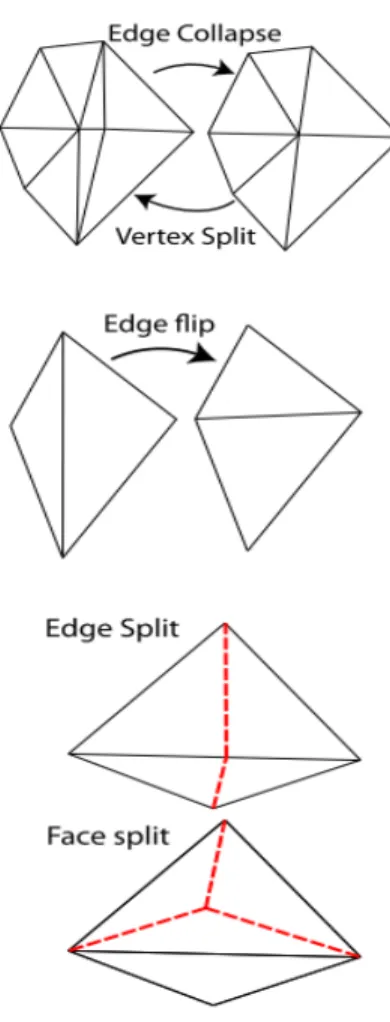
There are four different options for mesh smoothing, edge collapse, vertex split, edge flip and edge or face splitting. (See Figure 3). An edge collapse removes a single edge and the two adjacent faces (when dealing specifically with triangle meshes). This method is often used for simplification due to its ability reduce mesh complexity. Simply, collapsing an edge is welding two endpoint vertices together. The inverse of this action it a vertex split. While edge collapse
reduces geometric detail, vertex split introduces detail. Next is edge flip, also called an edge swap. This connects points differently than the algorithm did Figure 3: Mesh smoothing options
previously, improving regularity in the mesh overlay. The final option is to split an edge or face. Similar to an edge flip, this option creates more detail in the mesh by creating smaller triangles or polygons (Baerentzen et al, 2012).
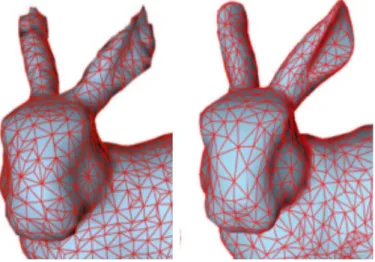
Simplifying consists of two parts: deleting meshes that do not belong to the intended object and reducing the number of vertices and faces, while maintain the overall shape of the object. (See Figure 4). There are several ways to simplify mesh overlays, depending upon available technology and compatible algorithms utilized. Simplifying algorithms replace edges with a single vertex, removing overlap and excessive polygon connections. The first technique, known as variation shape approximation, directly computes by simplifying very detailed triangle meshes to polygonal meshes. The main concept is to cluster faces
together in order to show a smooth surface, instead of connecting all the points (Baerentzen et al, 2012). Another method, as previously discussed is to edge collapse. Edges are collapsed according to a
priority code established by the user and the coordinates of the new edge is determined by a placement function. The algorithm terminates when a user supplemented stop predicate is met, such as reaching a desired number of edges. The same concept is used
when reducing the number of faces on an object. In many cases, vertices and faces are reduced by over fifty-percent, reducing the file size. (Hrozek et al, 2012).
Once a data cloud is processed, production of a mesh overlay begins. When creating the mesh, users connect cloud points together, creating polygonal shapes across the objects surface. This surface reconstruction infers the object shape underneath (Zhou, et al. 2012). Simply, a polygonal or triangle mesh is simply a set of faces, a set of edges and a set of vertices, understanding that the edges and vertices form the faces. Polygonal meshes produced from real- world objects contain issues such as over or under sampling of points or irregularity of point placement. These issues are spurring the research community to find solutions, such as mesh smoothing. Mesh smoothing is the process of removing excess background noise, a process which preserves mesh connectivity.
final step in the manufacturing process is postprocessing, which is removing excess materials and cleaning the part.
Until recently, three-dimensional printers were limited to printing one material at-a-time, with multiple materials requiring separate reservoirs and reconfiguring of the machine. In early 2019, scientists at the University of Wisconsin created a
three-dimensional printer which could layer multiple materials at a time by utilizing single reservoir (Blaszczyk, 2019). University of Wisconsin – Madison Professor of Chemistry A.J. Boydston, leader of this recent work, along with graduate student Johanna Schwartz explains “As amazing as 3D printing is, in many cases it only offers one color with which to paint; the field needs a full color palette.” By utilizing a chemical approach to
complement engineering advances, this new chemistry-based approach uses a single reservoir with two monomers (the molecules that are joined together to create a 3D-printed substance). Then, either ultraviolet or visible light is used to link those monomers together. Depending on which light is used, the final product will have different
properties, like stiffness. Boydston and Schwartz hope this single-reservoir approach could be more practical than using multiple reservoirs of material.
1.3.
Applications in Education
reasons, or because they are too big or too small to understand. Objects that do not have any tactile information beforehand (e.g. images) can be translated or enhanced for a more complete understanding” (2014, p.6). The past decade has seen a change in how using multi-sensory experiences in learning is being requested more by its ability to provide accessibility and inclusivity. Given the growing diversity of classroom settings, inclusivity in education through technology is growing. Currently, classroom settings contain diverse student learners in relation to ethnicity, class, gender, and sexual orientation, in addition to English language learning students and children with disabilities (Hicks, 2014).
three-dimensional printer, and only five percent had access to a three-dimensional scanner. Despite the inaccessibility, when asked about future technology they would like to see in their classrooms, this same study found the two most highly requested
technology was three-dimensional anything (scanning, printing and design) and augmented or virtual reality. (Schaffhausen & Nagel, 2016, p. 12).
Even with computers in the classroom, history and social studies educators have been reluctant to use three-dimensional technologies, preferring to continue using
“enduring methods of lecture, whole group discussion, small-group work, reliance on the textbook and worksheets, homework, and tests” (Maloy et al, 2017, p. 231). Despite this, there is ample evidence that learning can be enhanced through active experiences. Lipson states that upwards of 90% of knowledge is retained when a concrete experience is involved with abstract conceptualization and learning theories and practical studies additionally suggest that a significant portion of undergraduate students are sensory based learners which require hands-on experiences to be engaged (2007).
1.4.
Copyright Implications
several updates; The most recent amendments were enacted in June 2016 and can be found through the United States Copyright Office (Copyright Act of 1976, 2016).
As discussed by Hirtle, Hudson and Kenyon (2009), the basis of copyright in the United States is found in Article I, Section 8 of the United States Constitution, which authorizes Congress “to enact laws to promote the Progress of Science and useful Arts, by securing for limited Times to Authors and Inventors the exclusive Right to their respective Writings and Discoveries.” (p. 2). Concisely stated, the underlying purpose of copyright in the United States is therefore to encourage progress and the development of knowledge. In order to encourage the creation and distribution of new works, copyright law grants to creators a set of exclusive rights for a limited period of time, after which the work becomes free for everyone to use. By enabling creators to benefit economically from their creations, copyright provides authors with the incentive to create, publish, and disseminate creative and original works. Rights in copyright are separate from ownership of the physical item or work. The purchaser of a book does not become the owner of the copyright; rather the copyright is retained under the creator of the work.
Copyright is relevant to cultural objects and institutions because they commonly do not own the copyright of collection items. Therefore, these institutions must consider copyright law when they are digitizing or making items available online for
non-profit educational institutions and educational performances (Hirtle et al, 2009). For this study, focusing on fair use specific to libraries, archives and non-profit educational institutions are the primary purpose.
Fair use is a flexible limitation on the exclusivity of rights allowed the copyright owner. It allows certain uses of copyrighted material without requiring permission to be granted from the copyright owner, recognizing that the use of existing copyrighted works is occasionally essential for the creation of new works and new technologies, as well as providing a space to foster discussion of cultural and intellectual exchange. According to Young (2019, p. 10) “Fair use is often acknowledged as providing ‘breathing room’ for the constitutional right of freedom of speech under the First Amendment within the exclusive rights of copyright owners.” Additionally, it is important to note that The US Copyright Act states that the use of an otherwise copyrighted-protected work for uses in teaching (including multiple copies for classroom use) is not an infringement of copyright law.
addition, law on software copyright requires that the code must be “the writing of the author.” From this, it can be argued that the code contained in three-dimensional CAD files is not analogous to computer software, as CAD files are never made available in a human-readable format.
Whether copyright protects the design three-dimensional object can be
problematic as well. According to Daly, the law only protects designs to the extent that they go ‘beyond the utilitarian requirements of designing a useful article” (2016, p.25-26). Essentially, if the design is for a creative object or a functional object, the creative object may be copyrightable where the functional object may be a potential patent candidate. Finally, the three-dimensional object itself can be held under copyright protection in the broad definition of a sculptural work. It is important to note that if the object has a functional use, it cannot be considered copyrightable under this protection. Unfortunately, according to Daly, three-dimensional items may fall into the issue where they are not sufficiently original enough to be protected, such as if they were built upon an existing design file (2016).
1.5.
Summary
Methodology
The following study utilized a qualitive analysis of semi-structured interviews with students in the cultural heritage field. The interviews were accessed through a convivence sampling of the student listserv of the history and archeology departments. The goal of employing a semi-structured interview was to gain in-depth thought
processes for how the user interacted with various cultural objects. Qualitative research methods focus on discovering and understanding user experiences, perspectives, and thoughts of participants. As Denzin and Lincoln elaborate,
Qualitative research is a situated activity that located the observer in the world. It consists of a set of interpretive, material practices that make the world visible. … qualitative researchers study things in their natural settings, attempting to make sense of, or interpret, phenomena in terms of the meanings people bring to them (2005, p. 3).
In addition to a qualitative outlook, this study sought to use semi-structured interviews. In Wildemuth’s Applications of Social Research Methods, she argues that semi-structured interviews provide the interviewer with “considerable freedom” and “to probe far beyond a particular respondent’s answers to predetermined questions” (2017, p. 248).
perceived scope. Many of these questions, as discussed below, were open-ended, allowing for elaboration by the participants.
2.1.
Object Selection and Importance
Objects for this study were chosen using the following criteria:
1. Was the three-dimensional object an accurate scanned replica of a verifiable historic artifact?
2. Was the object available for personal printing in education settings under copy-right law?
3. Did the object have a verifiable, historically accurate description of what the item was?
All of the objects chosen were file entries made by Geoffrey Marchal. An environmental scientist, who works as a free-lance three-dimensional scanner, Marchal believes “3D scans are a great way to share cultural heritage with the world” (Marchal, 2019). Recently relocated to the United States, Marchal began computer graphic at the age of 19. Utilizing photogrammetry to create his models, Marchal is recognized on several three-dimensional modeling communities, including Thingiverse, Sketchfab, 3DWithUs, Blender Network and ArtStation, as well as an active Twitter user to post his three-dimensional creations. Marchal’s scans were chosen for this study because his objects met the criteria as listed above, and he had a reputable background in three-dimensional modeling.
2.2.
Data Collection and Storage
Although this study was deemed exempt from the UNC Office of Human Research Ethics and Institutional Review Board, survey respondent personal identifying information was anonymized. Interviews were conducted verbally, with answers being recorded digitally in a password protected text file. Interviewees completed consent forms, which provided consent to be interviewed and to be video recorded. (Interviews were not recorded due to complicated logistics.) Each survey was assigned a randomized three-digit number at the beginning of the interview and persona information such as names were excluded from interview paperwork. Upon completion of the study, all documents associated with the survey were saved to an external hard-drive whose access is limited to the study leaders.
2.3.
Interviews
For each interview, the study followed a list of eighteen different questions, divided into five categories (See Appendix B). Demographic information of name, school year (First-year, Sophomore, etc.), and any department association was first. The second set of questions were used to determine participants background understanding of cultural heritage objects use in the classroom. The purpose of these questions was to understand if participants opinions derived from personal experience or not. The next step was to have participants discuss a traditional method of cultural object study by discussing
of questions were of the most relevant, the manipulation of the 3D objects themselves. Each participant was allowed to work with both items for however long they desired and once done, asked the questions provided. Finally, there is a round of follow-up questions focused on opinions of preferred learning methods and 3D modeling.
Participants of this study, emails of interview requests were sent to potential candidates via the department listservs of the UNC archeology and history departments. Individuals could be either undergraduate students or graduate students and requested an interview time based on a first come, first serve basis. Interviews were conducted in two days, in open time-slot appointments. Each interview was conducted in quiet
Findings
The goal of this study was to discover student thoughts on the use and integration of three-dimensional objects into classroom learning. Six interviews were conducted, with participation from four history students and two archeology students. Participants ranged in grade assignment, with one sophomore student, three junior students, and two graduate level students. All participants in this study had previous experience in classroom settings with imagery of cultural items in the form of
photographs and handouts. Finally, three participants self-labeled their learning style as visual, two self-labeled as auditory and one self-labeled as a tangible learner.
Throughout the study, emphasis on the original study questions remained a discussion focal point. A common topic among all six study participants was the current lack of three-dimensional model use in university classroom settings. Participant 0005 and participant 0006, independently of one another spoke at length of their interest in three-dimensional object manipulation and their personal involvement in the process. Participant 0005 had previous involvement in the University of North Carolina’s
Archeology & Heritage Day, an event focused on connecting archeological practices to a wider audience (Archeology, 2019). Due to their outside experiences, specifically
“I have been a part of hands-on learning styles; specifically, when it comes to cultural heritage. At first, I was surprised by who all was
interested in touching the items. I assumed it would be mostly kids, young kids. Teenagers wouldn’t care [to interact with cultural items they could touch] and adults were a 50/50 shot of what they wanted to interact with. But yeah, almost everyone wanted to touch the objects we had, even if they were just replicas of whatever it was. That’s the other thing to remember, is we’ve been doing 3D replicas for years, just using different methods. 3D printing lets us provide objects faster and all around is just a neater process to use, so why not use it for more learning.”
Participant 0006 provided further thoughts on tactile manipulation in learning, reiterating participant 0005’s opinions.
“I was always the kid who needed to touch something before I knew what I was doing. The thought of having something passed around class or when we were on field trips was fantastic. I wanted to be able to touch and feel whatever we were talking about. I hated just listening, because I would just start playing with something else, like a pencil or even twirling my fingers. We had one of those sand/rice box things in the classroom [sensory table of rice or beans used for manipulation play] and it was my favorite thing to feel like I was feeling something tangible. Even just having the blocks to count out while I was learning math was nice.”
Discussion of three – dimensional modeling in classroom settings was not exclusively positive. Participant 0001 worried about “being easily distracted, waiting for the model” and participant 0003 described the concept of three – dimensional printing as “neat and novel, but irrelevant to learning.” Participant 0003 likewise was the only participant to prefer the handout (See Appendix D) as opposed to seeing the three – dimensional models. Additionally, participant 0003 stated:
in a museum. Obviously, they [the students] don’t think a teacher is going to let them hold the real deal are they?”
Following this conversation, the participant was asked to discuss their opinion on any learning outside of “traditional” auditory and reading instruction, including group
assignments, guest speakers, and field trips. After consideration, the participant wanted to re-emphasize earlier points.
“Look, kids need more for learning then older people, like college kids. Sure, visiting a historic place is neat, but that doesn’t mean I’m not going to get the same information if I just read about it. And for little kids it still makes sense, but I’m saying for like our age, we don’t need that. We should have already learned how to learn by now.”
All participants of this study were intrigued by the process of three –
dimensional printing. Most participants questioned how the three – dimensional models used were chosen and printed (See Appendix E). There was disappointment when participants learned outside sources of already created models made available through Thingiverse were chosen and printing was done via a third – party individual in the School of Information and Library Science library. Participant 0001 and participant 0006 had previous experience with three -dimensionally printed objects. Participant 0001 was a frequent user of three – dimensional printers and wanted to know which printer the
Conclusion
Resources
3D Printing | sils.unc.edu. (2019). Retrieved March 26, 2019, from https://sils.unc.edu/it-services/lab-equipment/3d-printing
About MakerBot. (2019). Retrieved April 8, 2019, from https://www.makerbot.com/about-us/
Archaeology | University of North Carolina at Chapel Hill. (2019). Retrieved April 8, 2019, from https://archaeology.sites.unc.edu/archaeology-days/
Baerentzen, J.A., Gravesen, J., Anton, F., & Aanaes, H. (2012). Guide to Computational Geometry Processing. London: Springer. Retrieved from
https://link.springer.com/content/pdf/10.1007%2F978-1-4471-4075-7.pdf
Blaszczyk, S. (2019). Light provides control for 3D printing with multiple materials. Retrieved March 18, 2019, from https://news.wisc.edu/light-provides-control-for-3d-printing-with-multiple-materials/
Bust of an Egyptian Woman (3D Image) - Ancient History Encyclopedia. (n.d.). Retrieved November 20, 2018, from https://www.ancient.eu/image3d/211/ Creative Commons. (2019). Retrieved April 8, 2019, from
https://creativecommons.org/faq/
Copyright Act of 1976, 17 U.S.C. §§ 101-1332 (2016)
Daly, A. (2016). Socio-Legal Aspects of the 3D Printing Revolution. London: Palgrave Macmillan UK. https://doi.org/10.1057/978-1-137-51556-8
Denzin, N. K., & Lincoln, Y. S. (2005). The SAGE handbook of qualitative research (3rd ed.). Thousand Oaks, California: Sage Publications.
Dupuy, R. E. (Richard E., Dupuy, T. N. (Trevor N., & HarperCollins (Firm). (1993). The Harper encyclopedia of military history: from 3500 BC to the present.
HarperCollins
Hicks, D., Lee, J., Berson, M., Bolick, C., & Diem, R. (2014). Guidelines for Using Technology to Prepare Social Studies Teachers. Contemporary Issues in Technology and Teacher Education, 15(2), 201–208.
Hirtle, P. B., Hudson, E., & Kenyon, A. T. (2009). Copyright and cultural institutions: guidelines for digitization for U.S. libraries, archives, and museums. Ithaca, New York: Cornell University Library.
Hrozek, F., Sobota, B., & Szabó, C. (2012). Digital preservation of historical buildings using virtual reality technologies. Cent. Eur. J. Comp. Sci. @BULLET, 2(3), 272– 282. https://doi.org/10.2478/s13537-012-0022-8
Lipson, H. (2007). Printable 3d models for customized hands-on education. Paper presented at Mass Customization and Personalization (MCPC) 2007. New York. Retrieved from www.3dprintables.org.
MakerBot. (2013). Thingiverse - Digital Designs for Physical Objects. Retrieved March 15, 2019, from https://www.thingiverse.com/about/
MakerGear M2 3D Printer. (2013). Retrieved March 26, 2019, from https://www.makergear.com/products/m2
Maloy, R., Trust, T., Kommers, S., Malinowski, A., & LaRoche, I. (2017). 3D Modeling and Printing in History/Social Studies Classrooms: Initial Lessons and Insights. Contemporary Issues in Technology and Teacher Education, 17(2), 229–249. Retrieved from https://www.learntechlib.org/p/173505/
Marchal, G. (2017). Tomb cover for Gaston de la Foix. Retrieved March 26, 2019, from https://www.thingiverse.com/thing:2296433/files
Marchal, G. (2018a). Relief in Terracotta. Retrieved March 26, 2019, from https://www.thingiverse.com/thing:3063564
Marchal, G. (2018b). Egyptian Statue of a Queen or Noble. Retrieved March 26, 2019, from https://www.thingiverse.com/thing:2824620
Marchal, G. (2019). About Geoffrey Marchal - Thingiverse. Retrieved March 26, 2019, from https://www.thingiverse.com/GeoffreyMarchal/about
Michaels, P. V. (2014). Photogrammetry - Science in Context. In The Gale Encyclopedia of Science (5th ed.). Science in Context.
Noorani, R. (2018). 3D Printing : Technology, Applications, and Selection. Boca Raton, FL: CRC Press.
Neumüller, M., Reichinger, A., Rist, F., & Kern, C. (2014). 3D Printing for Cultural Heritage: Preservation, Accessibility, Research and Education. In 3D Research Challenges in Cultural Heritage (p. 151). Springer-Verlag Berlin Heidelberg.
Paolicci, V. (2017). Turning 3D Data into Tools for Conservation | CyArk. Retrieved December 4, 2017, from http://www.cyark.org/news/turning-3d-data-into-tools-for-conservation
Schaffhauser, D., & Nagel, D. (2016). Teaching with Tech: A love (and hate) story. The Jounal, 43(5), 6–15. Retrieved from www.netsupport-inc.com
Sketchfab. (n.d.). About Us - Sketchfab. Retrieved March 15, 2019, from https://sketchfab.com/about
Slob, S., Hack, H. R., & Turner, A. K. (2002). ISRM International symposium on Rock Engineering for Mountainous Regions : EUROCK 2002 : Funchal, 2002 November 25-28th. Sociedade Portuguesa de Geotecnia.
The Collections – Château de Versailles - Holy Warrior. (n.d.). Retrieved November 20, 2018, from http://collections.chateauversailles.fr/#ec8def50-4a71-4e13-bc60-7733beda87d3
Wang, J., Zhang, J., & Xu, Q. (2014). Research on 3D Laser Scanning Technology Based on Point Cloud Data Acquisition. In 2014 International Conference on Audio, Language and Image Processing (ICALIP),. Shanghai, China: IEEE.
https://doi.org/10.1109/ICALIP.2014.7009871
Wildemuth, B. M. (2017). Applications of social research methods to questions in information and library science (2nd ed.). Libraries Unlimited.
Wheeler, A. (2017). 3D Scanning: Understanding the Differences In LIDAR, Photogrammetry and Infrared Techniques. ENGINEERING.com. Retrieved December 6, 2017, from
https://www.engineering.com/Hardware/ArticleID/14541/3D-Scanning- Understanding-the-Differences-In-LIDAR-Photogrammetry-and-Infrared-Techniques.aspx
Appendix A – Recruitment Email
Subject Line: Interested in 3D Modeling? Your Participation is Wanted!
Hello!
Are you a graduate or undergraduate student who wants to participate in a study on three-dimensional modeling? Have you taken a history, anthropology or similar course which utilized photographs of cultural objects in its curriculum?
My name is Rebecca Mullins and I am a graduate student in UNC-CH School of Information and Library Science. I am conducting a short survey study on three-dimensional modeling of cultural objects. The interview should take about 30 minutes. Participation is completely voluntary and your answers will be anonymous.
If you are interested, contact me at [email protected]. Do not hesitate to email me with questions you may have.
Appendix B – Consent Form
You are being asked to take part in a research study of how undergraduate and graduate
students can utilize three-dimensional modeling of cultural objects in the classroom. We
are asking you to take part because you agreed to participate for this study via email.
Please read this form carefully and ask any questions you may have before agreeing to
take part in the study.
What the study is about: The purpose of this study is to learn how students in higher
institutional classrooms can better understand cultural objects using three-dimensional
technology. You must be a graduate or undergraduate student at a four-year institution to
participate in this study.
What we will ask you to do: If you agree to be in this study, we will conduct an
interview with you. The interview will include questions about your previous experience
with cultural objects, your focus of study, and learning styles. The interview will take
about 30 minutes to complete.
Risks and benefits:
I do not anticipate any risks to you participating in this study other than those
encountered in day-to-day life.
Your answers will be confidential. The records of this study will be kept private. In any
sort of report we make public we will not include any information that will make it
possible to identify you. Research records will be kept in a locked file; only the
researchers will have access to the records. If we tape-record the interview, we will
destroy the tape after it has been transcribed, which we anticipate will be within two
months of its taping.
Taking part is voluntary: Taking part in this study is completely voluntary. You may
skip any questions that you do not want to answer. If you decide not to take part or to
skip some of the questions, it will not affect your current or future relationship with The
University of North Carolina at Chapel Hill. If you decide to take part, you are free to
withdraw at any time.
If you have questions: The researchers conducting this study are Rebecca Mullins.
Please ask any questions you have now. If you have questions later, you may contact
Rebecca Mullins at [email protected]. If you have any questions or concerns
regarding your rights as a subject in this study, you may contact the Institutional Review
Board (IRB) at (919) 966-3113 or access their website at
https://research.unc.edu/human-research-ethics/.
You will be given a copy of this form to keep for your records.
Statement of Consent: I have read the above information, and have received answers to
any questions I asked. I consent to take part in the study.
Your Name (printed)
____________________________________________________________
In addition to agreeing to participate, I also consent to having the interview
tape-recorded.
Your Signature ___________________________________ Date ___________________
Signature of person obtaining consent ___________________________ Date _________
Printed name of person obtaining consent _________________________ Date ________
This consent form will be kept by the researcher for at least three years beyond the end of
Appendix C – Survey Questions
Background Information
1. Name (Identifying survey number) 2. Year in School
3. Department Association
Pre-Object Manipulation Questions
1. Have you participated in a class with imagery of cultural items? 2. What type of objects were portrayed? (vases, statues, etc). 3. Have you ever had a class with physical objects shown? 4. If so, were they beneficial to you understanding the subject?
Traditional Object Learning (See Appendix B)
1. I have given you a photograph of an item with accompanying information. How does this help you understand the item?
2. Do you feel that you understand why this item is important historically? 3. If this was a handout in class, would it be helpful for studying?
Object Manipulation
1. What do you think about this item?
2. If your professor passed this item around, how would you feel?
3. Given the same information in the previous handout, does this provide better understanding for you?
4. If you could take this item home, or if the files were made available for you to 3D print object as part of your notes, would you?
Post-Object Questions
1. What type of learner do you consider yourself to be? (auditory, visual, tangible) 2. Did you prefer the traditional handout or the physical object?
Appendix D – Interview Handout
Tomb Cover of Gaston de Foix
Also known as The Thunderbolt of Italy, de Foix was a French military commander, noted mostly for his six-month campaign from 1511-1512 during the War of the League of Cambrai. Born in Mazères, County of Foix, he was the second child but only son of John of Foix, Viscount of Narbonne and Marie d'Orléans. His older sister was Germaine of Foix, Queen consort of Aragon as the second wife of Ferdinand II. (The Collections - Château de Versailles)
A very elaborate tomb was commissioned for de Foix in Milan from the workshop of Agostino Busti, which despite never being completed and assembled remains a key work in art history, and especially French Renaissance art. Most of the pieces are on display in the Castello Sforzesco. (1993, Richard & Duprey)
Appendix E – Objects Utilized
All items were made freely available via Thingiverse, a 3D modeling program which UNC Libraries utilize. Thingiverse is a “thriving design community for discovering, making, and sharing 3D printable things” (MakerBot, 2013). Thingiverse was created by MakerBot, a desktop three-dimensional printing company (About MakerBot, 2019). Started in 2009, MakerBot was an early company to provide at-home three-dimensional printers accessible and affordable. Currently, the Thingiverse community has over 1,300,000 three – dimensional models uploaded to the community website.
Tomb Cover of Gaston de Foix.
Gaston de Foix, also known as the “Thunderbolt of Italy,” was a French military
commander noted for his six-month campaign from 1511 to 1512 during the War of the League of Cambrai. His tomb, which despite never being completed, remains a key work in art history and French Renaissance art. Located in the Royal Cast Collection in
Copenhagen, Denmark.
Egyptian Statue of Noble
a. Statue head of an Egyptian woman, likely a noble. Found in Memphis, dating to 13th century BCE, made of limestone and polychrome. (Painting style of several colors used on pottery. Located in the Musée du Cinquantenaire in Brussels, Belgium.