J Young Pharm, 2019;11(1):21-25
A multifaceted peer reviewed journal in the field of Pharmacy
www.jyoungpharm.org | www.phcog.net
Original Article
INTRODUCTION
Alkaloids as secondary metabolites have been discovered in many plants in the form of glycoside and glycoalkaloid. Steroidal glycoalkaloids and their aglycones like solasodine are found in Solanaceae family and Solanum genus such as potato (S. tuberosum), tomato (S. lycopersicum) and eggplant (S. melongena). These compounds exist more or less in all parts of the plant including roots, stems, leaves, flowers, fruits and even seeds.1 Solasodine is considered as a high important compound in
food industry, toxicology and pharmacology,2-3 and synthesis of steroidal
drugs like steroidal hormones.4,5 This alkaloid has been used in Chinese,
Taiwanese and Korean traditional medicine to regulate the immune system and treat allergic reactions.6 In addition, various studies have
shown that solasodine can be used for cancer treatment.7-12
Several techniques including potentiometry, UV spectroscopy, Thin Lay-er Chromatography (TLC), Gas Chromatography (GC), High Resolu-tion GC (HRGC), Capillary Electrophoresis (CE) and High Performance Liquid Chromatography (HPLC) have been reported for qualitative and quantitative determination of glycoalkaloids and their aglycones. Al-though GC and HRGC have been used for determination of these com-pounds, it should be noted that glycoalkaloids have low volatility and are also unstable in high temperatures applied in GC.13 Van Gelder14
deter-mined and evaluated the composition of the C27-steroidal alkaloid con-tent of Solanumspecies using HRGC. Cherkaoui S et al.15 have utilized
non-aqueous CE with UV and mass spectrometry detection for separa-tion and determinasepara-tion of these alkaloids in plant extracts. They showed that the optimization of electrophoretic parameters, including the nature
of the electrolyte and the organic solvent used lead to a reliable separation of solasodine and solanidine. Hunter et al. used HPLC to separate several steroidal alkaloids.16 Philip et al. applied this technique to analyze
and separate solasodine, solasonine and solamargine. They investigated and optimized many chromatographic parameters in order to have better separation of these alkaloids.13 Kittipongpatana et al. significantly
increased the sensitivity of HPLC analysis of solasodine in hairy root cultures of S. aviculare with an isocratic elution mode.17 Eanes et al.
set up three isocratic methods for determination of the pairs of steroidal alkaloids of eggplant.18 They reported that addition of methanol
to acetonitrile portion of the mobile phase with acidic buffers at elevated temperature greatly improved the separation of solasodine and solanidine. Desai et al.19 developed and validated a reversed phase HPLC
(RP-HPLC) method for estimation of solasodine in aerial parts of Solanum nigrum. They found that a mobile phase composed of aceto-nitrile and ammonium acetate buffer at pH 7.7 was the best eluent for HPLC analysis of the alkaloid.
Solasodine has a steroidal non-polar part and a weak nitrogenous base part of oxa-azaspirodecane (pKa 7.7)20 in its structure (Figure 1); and it
is considered as a lipophilic compound with a log P of about 5.21 For
reversed phase HPLC analysis of solasoine, it is best to have the analyte in its fully non-ionized form by adjusting the pH of the mobile phase. But for a weak basic and lipophilic compound like solasodine, it would be a big challenge to have the best chromatographic conditions for a sym-metrical and sharp peak in chromatogram so that the sensitivity of the
Development and Validation of an RP-HPLC Method for
Determination of Solasodine, a Steroidal Alkaloid
Shahram Kalantari Khandani1,2, Mitra Mehrabani1,*, Fariba Sharififar1, Abbas Pardakhty3, Mostafa Pournamdari 4, Mahboobeh Pakravanan5
1Department of Pharmacognosy, Faculty of Pharmacy Kerman University of Medical Sciences, Kerman, IRAN. 2Department of Pharmacognosy, Faculty of Pharmacy, Kerman University of Medical Sciences, Kerman, IRAN. 3Department of Pharmaceutics, Faculty of Pharmacy, Kerman University of Medical Sciences, Kerman, IRAN. 4Department of Medicinal Chemistry, Faculty of Pharmacy, Kerman University of Medical Sciences, Kerman, IRAN. 5Central laboratory, Deputy of research, Kerman university of Medical Sciences, Kerman, IRAN.
ABSTRACT
Objective: The aim of the present study was to optimize an RP-HPLC method for determination of solasodine, a steroidal alkaloid with various pharmacologic properties, in herbal medicinal preparations. Methods: Various chromatographic parameters including the composition of mobile phase and its organic and pH modifiers, mode of elution and column temperature were investigated using analytical C18 columns as stationary phase. Acetonitrile and methanol were examined in combination with deionized water and different aqueous buffers as mobile phases. Results:
A mixture of methanol: KH2PO4 buffer (pH 2.5) at the ratio of 75:25 %v/v in an isocratic elution mode produced more symmetric, sharper peaks with better retention times and capacity factor than that of acetonitrile: KH2PO4 buffer. The optimum column temperature was found at 25°C. The standard calibration curve showed a very good linearity (R2=0.9966) in the range of 1-25 μg/ml with acceptable inter-day and intra-day precisions and accuracy.
In addition, the LOD and the LOQ of the method were determined at 0.2 and 0.7 μg/mL, respectively. Conclusion: This developed and validated method is simple and quite rapid and can be used for routine determination of solasodine in samples such as traditional medicinal preparations.
Key words: Solasodine, Steroidal alkaloid, RP-HPLC, Validation. Correspondence
Dr. Mitra Mehrabani, Haft Bagh-e Alavi Blvd, Department of Pharmacognosy, Faculty of Pharmacy, Kerman University of Medical Sciences, Kerman, IRAN. Phone: +98 3431325001
Email: [email protected] DOI: 10.5530/jyp.2019.11.5
method is not lost and the column lifetime and the parts of the instru-ment are not affected and are not damaged as well. As reviewed in the above-mentioned articles, the researchers did not reach a common con-dition for RP-HPLC analysis of solasodine and the related compounds. Therefore, in the current study we tried to find and to optimize the best chromatographic conditions for RP-HPLC quantitative determination of solasodine, as an important steroidal alkaloid in plants and in herbal medicinal preparations as well.
MATERIALS AND METHODS
Materials
Analytical C18 columns were prepared form Phenomenx (USA) and Kenaur (Germany) companies. Solasodine standard was purchased from Santa Cruz Biotechnology Inc. (USA); and its 1 mg/ml stock solutions were prepared in HPLC grade methanol. HPLC grade methanol and acetonitrile were purchased from Duksan Pure Chemicals Company Ltd. (South Korea). Deionized water was prepared using a MilliporeTM
Direct-Q deionizer (USA). NaH2PO4, KH2PO4, H2PO4 (NH4) and Tris-HCl were prepared from Merck Company (Germany). Buffers and mobile phases were filtered using 0.45 μm-47 mm PTFE filters (Sartorius, Germany) by a MilliporeTM vacuum pump filtration set (USA). The pH
of aqueous buffers was adjusted with a Metrohm digital pH meter (Switzerland).
HPLC Instrumentation
The analyses were carried out using a Smartline HPLC system (Knauer,
Germany) consisted of Smartline pump 1000, Smartline PDA-UV detector 2600, Smartline manger 5000, Smartline autosamplers 3950, membrane vacuum degasser and column temperature compartment. Separations were performed on C18 columns including Knauer (250×4.6 mm, 5 µm)
(Germany) and Phenomenex (150×4.6 mm, 3 µm) (USA). The software
ChromGate® version 3.1.7 (Knauer, Germany) was utilized for data
acquisition and processing.
Materials
HPLC method conditions
The HPLC chromatograph used in this study was equipped with a PDA-UV detector; therefore, by PDA-UV scanning and evaluating the resulted spectrum during the analysis of solasodine standard solution, the wave-length 205 nm was chosen and set for the UV detector.
Two reversed phase HPLC columns including Phenomenex C 18
(150×4.6 mm, 3 μm) and Knauer® C
18 (250x4.6 mm, 5 μm) were
examined in this project. By performing several analyses with injection
of 50 µl of standard solasodine solution using these two cartridges, it was revealed that Knauer® column could produce sharper peaks with asymmetry factor nearer to one; and the analyte band was broadened in chromatograms when using Phenomenex® column. Therefore, Knauer®
C18 column was chosen for developing, optimizing and setting up the method of solasodine determination. Different temperatures were evaluated and finally 25°C was found the optimum temperature for the column oven.
In different trials, methanol and acetonitrile were examined as organic modifiers in mixture with water or aqueous buffers in the mobile phase. Aqueous solutions of 50 mM NaH2PO4, KH2PO4, (NH4) H2PO4 and Tris buffers were used as aqueous portion of the mobile phase. In the final method, methanol: KH2PO4 (pH 2.5) (75:25 %v/v) was isocratically considered as the optimum mobile phase.
Preparation of Standard Solution
An amount of 10 mg of solasodine was dissolved in a few ml HPLC grade methanol by sonication for a few min and the volume was made to 10 ml to prepare a stock solution of 1000 µg/ml. From this solution, various aliquots were taken and diluted with adequate volume of methanol to obtain different concentrations which were used for method develop-ment and validation.
HPLC Method Validation
In order to validate the optimized RP-HPLC-UV method, several series of measurements of standard solasodine solutions were carried out and parameters including linear range, precision at intra- and inter-day levels, accuracy, Limit Of detection (LOD) and Limit Of Quantification (LOQ) were calculated according to ICH guidelines.22
To construct the calibration curve and find out the relevant regression line equation, triplicate analysis of five standard solutions with concen-trations of 1, 2, 5, 10 and 25 μg/ml were injected into the HPLC instrument. The area under solasodine peaks (AUC) were plotted versus the concentrations and the regression line equation was obtained. For intra-day precision, triplicate analyses of fresh-prepared standard solutions at concentrations of 1, 5 and 25 μg/ml were carried out in one day; and for inter-day level (as intermediate precision), new solutions of the same concentrations were injected into the instrument in three different days. The relative standard deviation (RSD%) of the analyses in one day and during three days were calculated and considered as intra-day and inter-day precisions. To calculate LOD and LOQ, six analytical blanks were analyzed and the signal from noise observed at or close to the retention time (tR) of the analyte was measured and considered as a criterion. Formulas 1 and 2 were used to calculate LOD and LOQ.
(1) LOD = 3.3SDblank/Slope (2) LOQ = 10 SDblank/Slope
SDblank: standard deviation of blank solutions Slope: the slope of the standard calibration line
RESULTS
Mobile Phase Selection
Mobile phase selection was the first step to optimize the chromatography method in this study. Methanol and acetonitrile were individually tested in combination with 50 mM solutions of different phosphate buffers including NaH2PO4, KH2PO4 and (NH4)H2PO4 adjusted at pH 2.5 and 50 mM TRIS buffer at pH 7.
relatively reasonable tR, good peak symmetry and lower width than the other tested mixtures.
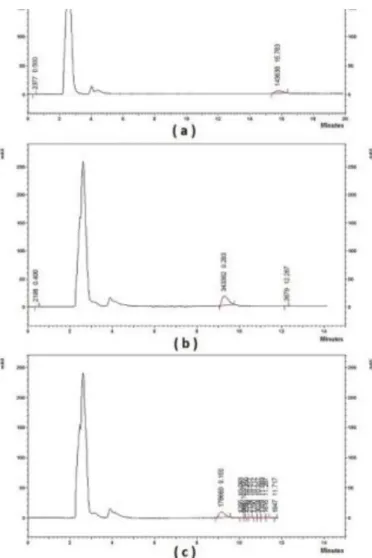
In order to evaluate the effect of reduction of the buffer portion in the mobile phase, volume ratios of 75:25 and 80:20 for methanol: KH2PO4 were examined. The solasodine peak was symmetrical and had a suitable width in the case of 75:25 ratio; however, further decrease in the percentage of KH2PO4 buffer led to the creation of more tailing in the peak. All in all, it was found that the best mobile phase was composed of methanol and aqueous KH2PO4 buffer withthe ratio of 75:25 at pH 2.5 (Figure 2-c).
Selecting the Column Temperature
To choose the optimum heat program for the column oven, different temperatures were applied and the results were evaluated regarding the peak shape and the analysis efficiency parameters. Although solasodine peak was observed earlier at elevated temperatures, it had no significant effect on tailing, band-broadening and peak shape at temperatures above 25°C.
Buffer pH Selection
The results of the study showed that the peaks obtained at pH 2.5 have more suitable tR and symmetric shape compared to the other pHs, which is discussed later.
Validation Results
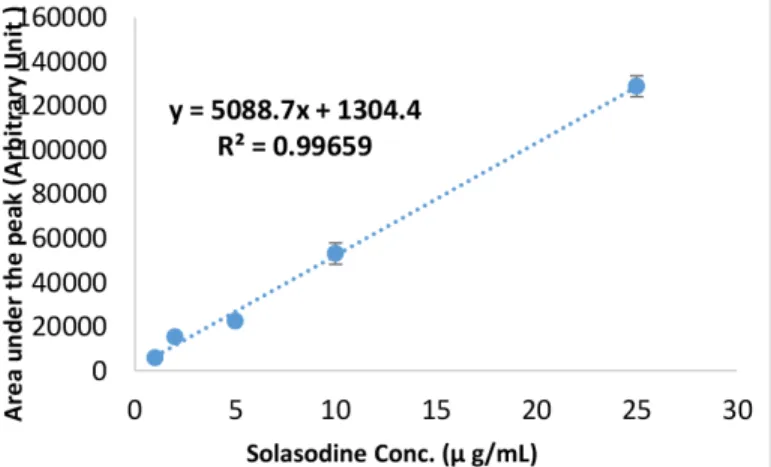
The constructed calibration curve in the range of 1-25 μg/ml is shown in Figure 3 and the linearity parameters of the solasodine analysis method are reflected in Table 2. The correlation coefficient was 0.9966 for tripli-cate analyses of the calibration series which shows high reliability of this validation parameter. The Results of both intra-day and inter-day preci-sions are cited in Table 3. Repeatability of the method was proved to be good at low, medium and high concentration levels i.e. 1, 5 and 25 µg/ml, respectively. For intermediate (inter-day) precision, the method showed very good precision at levels of 5 and 25 µg/ml and acceptable result at level of 1 µg/ml. The accuracy results of the method at examined levels of 1, 10 and 25 µg/ml were 80.9%, 102.5% and 95.6%, respectively (Table 4). Finally, LOD and LOQ values of the method were calculated about 0.2 and 0.7 μg/ml, respectively. Final optimization of RP-HPLC method for determining of solasodine is shown in Table 1.
DISCUSSION
peak was not observed at all during the course of analysis in all threemobile phase ratios. Then, several mobile phases containing methanol and each of the four above-mentioned buffers with similar ratios of 70:30, 60:40 and 50:50 v/v% were examined. Similar to the case of acetonitrile: Tris, the solasodine peak was not observed in any of the methanol: Tris buffer ratios during the considered analysis runtime as well. When using methanol: NaH2PO4 mixture at ratio of 70:30 v/v%, solasodine was observed as a wide peak at 15.8 min with a tailing factor much more above one (Figure 2-a). Solasodine peak was not observed in other two ratios of methanol: NaH2PO4 at all.
The tR of the analyte with the eluents of methanol: (NH4)H2PO4 and methanol: KH2PO4 was higher than that of the mixture of acetonitrile with the same buffers, which is relevant to the greater potency of aceto-nitrile in comparison with methanol in reversed phase chromatography. In contrast, with the replacement of methanol instead of acetonitrile, the shape, width and symmetry of the solasodine peak were considerably improved (Figure 2-b and 2-c).
Methanol: KH2PO4 mixtures in all three ratios had more satisfactory results compared to the results of other examined mobile phase mixtures. Methanol: KH2PO4 at the volume ratio of 70:30 (pH 2.5) resulted in a
Figure 2: Representative HPLC chromatograms of standard solasodine solutions using different composition of mobile phases at 25 °C. (a) methanol: NaH2PO4 (70:30 v/v %), (b) methanol: (NH4) H2PO4 (75:25 v/v %), (c) methanol: KH2PO4 (75:25 v/v %).
Table 1: Details of the final optimized RP-HPLC method for determination of solasodine.
Item/Value Variable
250×4.6 mm Column Dimensions
C18, 5 µm Stationary Phase
25 °C Column Temperature
Aqueous 50 mM KH2PO4 Mobile Phase (A)
Methanol Mobile Phase (B)
25:75 (v/v %) (A) to (B) Ratio
2.5 pH of Mobile Phase
Isocratic Mode of Elution
50 µl Injection Volume
UV at 205 nm Detector
9.1 min Solasodine tR
the Knauer column has a higher level of carbon load and surface
cover-age and furthermore has a longer length, it generates more theoretical plates than that of the Phenomenex column, which in turn leads to the
creation of sharper peaks with smaller width and better symmetry factor. Meanwhile, there could be more interaction of the secondary amine moiety of solasodine with free silanol groups of the stationary phase in the case of Phenomenex column (with lower surface coverage and higher
free silanol groups in comparison with Knauer® column) which can cause a drastic band-broadening of solasodine peak. Eanes et al.18 used
a Nocleosil C18 column for the same purpose. In our study, the carbon
load of Kenaur column was higher than that of Nocleosil stationary
phase24 which makes it more lipophilic, affecting the efficiency of the
solasodine analysis.
To have a suitable capacity factor for the analyte of interest while optimizing RP-HPLC method, the analyst has to select an appropriate organic modifier in the mobile phase. Methanol, acetonitrile and tetra-hydrofuran (THF) are common organic modifiers as strong eluents in RP-HPLC. THF is restricted to certain conditions because of its corrosive effect on HPLC polymeric plumbing and tubing and due to its higher cost in comparison with the other two solvents. The UV cutoff points of methanol and acetonitrile are 205 and 195 nm, respectively; whereas the lack of extended conjugate double bonds in solasodine gives rise to a poor UV absorption 205 nm for the analyte. These issues bring about a challenge when using methanol and acetonitrile in mobile phase. Despite the λmax of analyte is equal to the cutoff point of methanol, it was observed that solasodine peak had much better efficiency parameters while using this solvent in comparison with that of acetonitrile. This was in agreement with Eanes et al.18 findings, as they used 10% methanol
along with acetonitrile and in accordance with Kittipongpatana et al.17
as they used just methanol for organic modifier in the mobile phase. In contrast, Desai et al.19 reported that acetonitrile could give better
chro-matographic efficiency for solasodine when this solvent was used with 10 mM ammonium acetate buffer at pH 7.7 (65:35 v/v%) to elute the analyte from a C18 column kept at 40°C.
In reversed phase chromatography, it is essential to use aqueous mobile phase in mixture with organic solvents in order to have reasonable retention for the analyte. The addition of water increases the polarization of the mobile phase and decreases the ability to break the lipophilic-lipophilic interaction between the lipophilic-lipophilic analyte and hydrophobic packing material in the column. Meanwhile, as a common rule in reversed phase chromatography, if there are ionizable groups (acidic or basic) in the analyte structure, they should be converted into their non-ionized forms by adjusting the pH of the mobile phase during analysis. This matter brings about a comprehensive interaction between nearly all molecules of analyte and C18 sorbent which prevents the tailing of the chromatography peaks and minimizes band-broadening as well in many cases.25 On the other hand, care has to be taken that the regulatory
pH does not damage the silica bonded C18 phase. This kind of phase are usually susceptible to extreme pHs and they tolerate pH range between 2 and 8 (up to 11 are reported for new C18 column generations). Solasodine has a secondary amine group in its structure with a pKa of 7.7;20 thus, a pH of 9.7 is required to suppress ionization of this basic
group up to 99%, which can cause severe damage to the C18 silica bonded phase and reduces the column lifetime dramatically. To overcome this drawback in our research, the pH of the mobile phase was adjusted at 2.5 which is far below the pKa of the compound and makes it ionized instead of being non-ionized while the safety of the column is reassured. At this pH, nearly all molecules of the analyte are in one form and they have their own lipophilic-lipophilic interaction with the C18 phase just through the steroidal rings and the peak tailing is in its lowest amount. In line with our findings in the present study, Kittipongpatana et al.17
Table 2: Linearity parameters of HPLC method for determination of solasodine.
Observations Parameters
1-25 (µgml-1) Linearity range
Y=5088.7X+1304.4 Regression equation
0.9966 Correlation coefficient
5088.7 Slope
1304.4 Intercept
Table 3: Precision results based on standard deviation percentage at intra-day and inter-day levels.
Precision (RSD %) Conc.(µg/ml)
Inter-day Intra-day
11.6 5.7
1
3.1 4.9
5
2.3 3.8
25
Table 4: Accuracy results of the RP-HPLC method for solasodine determination.
Accuracy % Measured Concentration
(µg.ml-1)
Expected Concentration (µg.ml-1)
80.9 0.8
1
102.5 10.2
10
95.6 23.9
25
Figure 3: Calibration curve of solasodine in the range of 1 to 25 μg/ml (n= 3, Mean ± SD).
Generally in chromatography, parameters such as symmetrical peaks with minimum width, appropriate resolution (Rs), reasonable retention time (tR) in a minimum run time are desired. These criteria were under consideration while the HPLC method of solasodine determination was being developed in this study.
Solasodine due to its steroidal structure has considerably lipophilic characteristic (log P∼5);21 hence, a reversed phase chromatography
method is suitable for its determination in pharmaceutical and biological samples.23 As aforementioned, Knauer C
18 column could generate
sharper peaks with tailing factor closer to unit for the analyte of interest in comparison with Phenomenex C
showed that pHs close to pKa of solasodine was inappropriate and the efficiency of the analysis was reduced because ionic and non-ionic forms of the analyte exist simultaneously at pHs about the pKa. But Desai et al.19 adjusted the pH of the buffer at 7.7 which in not in agreement with
above-mentioned theoretic points and Kittipongpatana et al. and our findings in this study as well.
Reversed phase C18 columns usually tolerate temperatures up to 60°C. Increasing the column temperature basically reduces tR and capacity factor while enhancing the separation performance; but at elevated temperatures the damage to the packing material is high due to the dissolution of the silica bonded stationary phase in the aqueous eluents and the temperature should not be set above ambient temperatures with-out rational reasoning.23-25 Our findings showed that analyses carried out
at 25°C resulted in good efficiency parameters which were quite similar to that of higher temperatures. In contrast, Eanes et al.18 and Desai et al.19
set column oven temperature at 50 and 40°C respectively, which can give rise to harm the stationary phase and to increase the cost in long term. From the elution mode of view in HPLC method, the use of the gradient elution can basically cause the baseline drift in the chromatograms which in turn can affect the sensitivity and limits of detection and quantification.13
Meanwhile, gradient elution programs bring about more maintenance cost for pumps and related devices. Therefore, it must be paid attention not to set this kind of elution in HPLC without any sensible reasoning. In the current work, the chosen mode of elution was isocratic which gave more reliable results during the course of the study.
Regarding the validation parameters, the linearity of the method was successfully proved in the range of 1-25 μg/ml, with an excellent correla-tion coefficient of 0.9966. The accuracy of the method was determined between 80% and 102% at low and high concentrations which is quite good for a novel method. LOD and LOQ were determined at 0.2 and 0.7 µg/ml, respectively, showing good capability of the method for identi-fication and determination of solasodine as low as fractions of ppm level.
CONCLUSION
Overall, a repeatable, accurate and linear isocratic RP-HPLC method with UV detection at 205 nm was developed for determination of solaso-dine in herbal medicinal preparations. The analyte retardation was long enough that not to co-elute with early-eluted interfering compounds and was reasonably short enough which could minimize the cost of analysis, especially with using methanol as a low-cost organic solvent in the mobile phase. Therefore, this method could be a good candidate for routine HPLC determination of solasodine in traditional pharmaceutical herbal preparations without any necessity for derivatization of the analyte.
ACKNOWLEDGEMENT
Authors are thankful from Deputy of Research of Kerman University of Medical Sciences for financial support (Grant No.: 94/645 ).
CONFLICT OF INTEREST
The authors declare no conflict of interest.ABBREVIATIONS
HPLC: High Performance Liquidchromatography; RP-HPLC: Reversed
Phase HPLC; TLC: Thin Layer Chromatography; GC: Gas Chroma-tography ; HRGC: High Resolution GC; CE: Capillary Electrophoresis;
AUC: Area Under Curve; LOD: Limit Of Detection; LOQ: Limit Of
Quantification; THF: Tetrahydrofuran; TRIS: Tris(hydroxymethyl)ami-nomethane; RT: Retention Time.
REFERENCES
1. Sun F, Li S, He D, Cao G, Ni X, Tai G, et al. Effects of glycoalkaloids from Solanum plants on cucumber root growth. Phytochemistry. 2010;71(13):1534-8. 2. Aubert S, Daunay M, Pochard E. Saponosides stéroïdiques de l’aubergine (Solanum
melongena L.) I. Intérêt alimentaire, méthodologie d’analyse, localisation dans le fruit. Agronomie. 1989;9(7):641-51.
3. Aubert S, Daunay M, Pochard E. Saponosides stéroïdiques de l’aubergine (Solanum melongena L.) II. Variations des teneurs liées aux conditions de récolte, aux génotypes et à la quantité de graines des fruits. Agronomie. 1989;9(8):751-8.
4. Solouki M, Hoshyar H, Ramroudi M, Tavassoli A. Comparison and evaluation of steroid alkaloid solasodine on in vivo and in vitro cultures of Solanum surattense Burm L. Afr J Microbiol Res. 2011;5(22):3810-4.
5. Eltayeb EA, Al-Ansari AS, Roddick JG. Changes in the steroidal alkaloid solasodine during development of Solanum nigrum and Solanum incanum. Phytochemistry. 1997;46(3):489-94.
6. Chen Z, Miller AR. Steroidal alkaloids in Solanaceous vegetable crops. Hortic Rev. 2001;(25):171-96.
7. Daunter B, Cham BE. Solasodine glycosides. In vitro preferential cytotoxicity for human cancer cells. Cancer Lett. 1990;55(3):209-20.
8. Ren J, Feng G, Wang M, Sun L. Primary study on the anti-tumor effect of ethanol extracts of Solanum lyratum. Zhongguo Zhong Yao Za Zhi. 2006;31(6):497-500. 9. Sun LX, Fu WW, Li W, Bi KS, Wang MW. Diosgenin glucuronides from Sola-num lyratum and their cytotoxicity against tumor cell lines. Z Naturforsch C. 2006;61(3-4):171-6.
10. Shen KH, Hung JH, Chang CW, Weng YT, Wu MJ, Chen PS. Solasodine inhibits invasion of human lung cancer cell through downregulation of miR-21 and MMPs expression. Chem Biol Interact. 2017;268:129-35.
11. Cham BE, Daunter B. Solasodine glycosides. Selective cytotoxicity for cancer cells and inhibition of cytotoxicity by rhamnose in mice with sarcoma 180. Cancer Lett. 1990;55(3):221-5.
12. Cham BE, Daunter B, Evansc RA. Topical treatment of malignant and prema-lignant skin lesions by very low concentrations of a standard mixture (BEC) of solasodine glycosides. Cancer Lett. 1991;59(3):183-92.
13. Crabbe PG, Fryer C. Rapid quantitative analysis of solasodine, solasodine glyco-sides and solasodiene by high-pressure liquid chromatography. J Chromatogr A. 1980;187(1):87-100.
14. Van Gelder W. Determination of the total C27-steroidal alkaloid composition of Solanum species by high-resolution gas chromatography. J Chromatogr A. 1985;331:285-93.
15. Cherkaoui S, Bekkouche K, Christen P, Veuthey JL. Non-aqueous capillary elec-trophoresis with diode array and electrospray mass spectrometric detection for the analysis of selected steroidal alkaloids in plant extracts. J Chromatogr A. 2001;922(1-2):321-8.
16. Hunter IR, Walden MK, Wagner JR, Heftmann E. High-pressure liquid chroma-tography of steroidal alkaloids. J Chromatogr A. 1976;119:223-6.
17. Kittipongpatana N, Porter JR, Hock RS. An improved high performance liquid chromatographic method for the quantification of solasodine. Phytochem Anal. 1999;10(1):26-31.
18. Eanes RC, Tek N, Kirsoy O, Frary A, Doganlar S, Almeida AE. Development of practical HPLC methods for the separation and determination of eggplant steroidal glycoalkaloids and their aglycones. J Liq Chromatogr Relat Technol. 2008;31(7):984-1000.
19. Desai S, Tatke P, Gabhe S. A New Validated HPLC-DAD Method for Estimation of Solasodine from Solanum nigrum Linn. Extracts and Formulations. Nat Prod J. 2014;4(3):196-200.
20. Windholz M. The Merck index: an encyclopedia of chemicals and drugs. 9th ed.
Windholz M, editor. Rahway, New Jersey: Merck and Co. 1976.
21. National Center for Biotechnology Information. PubChem Compound Da-tabase; CID=442985. Available from: https://pubchem.ncbi.nlm.nih.gov/ compound/442985#section=Top
22. ICH harmonisation for better health. ICH Guidelines. Available from: http:// www.ich.org/products/guidelines.html
23. Meyer VR. Practical High-Performance Liquid Chromatography. United Kingdom: John Wiley and Sons. 2004.
24. Nucleodur-Macherey-Nagel GmbH and Co. KG. Available from: http://ftp.mn- net.com/.../Chromatogarphy/HPLC/Nucleodur2011_KATEN200032_www.pdf 25. Watson DG. Pharmaceutical Analysis: A Textbook for Pharmacy Students and
Pharmaceutical Chemists. 4th Ed. Elsvier Churchill Livingstone. 2016.
Article History: Submission Date : 11-05-2018 ; Revised Date : 19-07-2018; Acceptance Date : 03-10-2018.