Multiscale Simulations Approach: Crosslinked Polymer
Matrices
Pavel V. Komarov1,2, Daria V. Guseva3, Vladimir Yu. Rudyak3, Alexander V. Chertovich3
c
The Authors 2018. This paper is published with open access at SuperFri.org
Atomistic molecular dynamics simulations can usually cover only a very limited range in space and time. Thus, the materials like polymer resin networks, the properties of which are formed on macroscopic scale, are hard to study thoroughly using only molecular dynamics. Our work presents a multiscale simulation methodology to overcome this shortcoming. To demonstrate its effectiveness, we conducted a study of thermal and mechanical properties of complex polymer matrices and establish a direct correspondence between simulations and experimental results. We believe this methodology can be successfully used for predictive simulations of a broad range of polymer matrices in glassy state.
Keywords: polymers, networks, atomistic molecular dynamics, mesoscale simulations, multi-scale simulations.
Introduction
In recent years, exciting opportunities associated with the design and fabrication of novel polymer matrices have appeared with the promise to produce a new generation of polymer-based materials having unique mechanical and thermal properties. Crosslinked polymer matrices are complex to design since their precise structure and network topology are generally unknown. Moreover, to optimize technological curing process, it is important to know how the mechanical properties vary during crosslinking. Thus, the development of specific simulation methods for the analysis of processes of polymer network formation is in high demand. Since complex nature of crosslinked polymer matrices with irregular local structures at the atomistic level ultimately manifest itself, in macroscopic properties, to simulate these matrices on a large range of length and time scale, a combination of modelling techniques is required. Mesoscale chemistry (MSC) techniques [1] consider the presence of a discrete mesoscale-level structure in a material and are primarily used to predict structure and topological properties of polymer networks from chemical constitution of initial comonomers. Atomistic molecular dynamics (MD) technique, on the other hand, is able to predict a variety of physical properties of composite materials for a wide range of engineering applications. These two types of techniques must be combined to a multiscale approach that is capable to predict the structure and macroscopic properties of polymer-matrix materials.
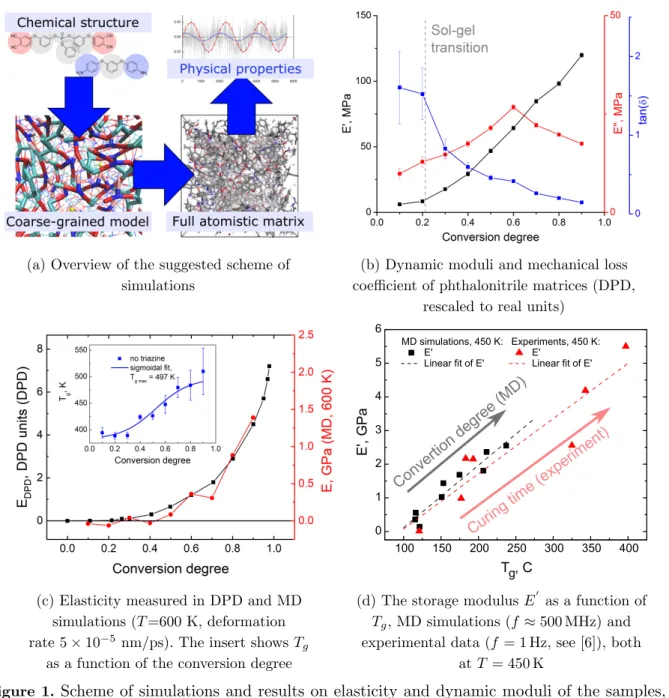
During the last decade, we developed a multiscale simulation methodology that makes it pos-sible to predict various physical properties of highly crosslinked polymer materials [2–6]. In this work, we summarize our simulations methodology combining coarse-grained MSC technique with full atomistic modelling. Here, we apply it to generate fully atomistic model of highly crosslinked networks of phthalonitrile resin, based on the monomer bis(3-(3,4-dicyanophenoxy) phenyl) phenyl phosphate (DPPPP) and the initiator 1,3-bis(4-aminophenoxy)benzene (APB) [5], and to predict their physical properties (see Fig. 1a). The selected resin is one of the most promising examples of thermostable material to retain mechanical properties at elevated temperatures up
1Nesmeyanov Institute of Organoelement Compounds RAS, Moscow, Russian Federation. 2Tver State University, Tver, Russian Federation.
to 450 ◦C and can be already considered as substitution for aluminum and titanium alloys in such applications as jet engine blades, skin of hypersonic aircrafts, etc. [7].
1. Methodology and Implementation
The first stage of our methodology involves the concept of the so-called “mesoscale chem-istry” [1, 3, 6], which is used to study the complex polymerization process of appropriate monomers and to construct and equilibrate polymer networks at the mesoscale level. We intro-duce all molecular structures in terms of the simplified bead-and-spring model. Coarse-grained (CG) representation includes reactive beads that can form new chemical bonds during simula-tion of curing process. We use dissipative particle dynamics (DPD) [3, 8] as simulasimula-tion engine at this level in order to model matrix curing through polycondensation or radical polymerization processes.
On the second stage we perform extensive topological analysis of the networks, first proposed by Khalatur in [3]. This stage is important to refine the adaptive model: (a) to optimize the set of DPD parameters for generation of polymer matrix with correct topology [5], and (b) to modify the network by removing “wrong” bonds leading to internal stresses.
On the third stage, the mechanical properties of constructed CG matrices are analyzed by DPD simulations. A uniaxial deformation of the simulation box along one of the axes is applied keeping the volume of the box constant (NVT ensemble), and stress-strain response curves are measured [6]. The dimensionless units in DPD are rescaled to GPa by the simple linear scaling procedure, the scaling factor depends on CG representation of molecular species.
Then, we construct fully atomistic models of crosslinked samples using an automatic reverse mapping procedure. This procedure extracts the coordinates of all DPD beads and their topolog-ical connections, and replaces the beads with the corresponding molecular fragments according to coarse-graining scheme (see details in [5]). The restored matrix may contain the so-called “spearing” monomers. They may be formed due to spearing of benzene rings by interatomic bonds of the closely situated fragments. Such misalignments are identified and eliminated using special Monte Carlo based procedure of fragment relocation, developed in our group.
Finally, the physical properties (the glass transition temperature,Tg, mechanical properties,
etc.) of the recovered atomistic samples are analyzed through molecular dynamics simulations using standard GROMACS and/or LAMMPS packages with pcff [9] force field for interatomic interactions. The mechanical properties of these samples are investigated by applying uniaxial deformation of small amplitude (either with constant strain rate or cyclic) and measuring its mechanical response. The details on equilibration procedure and the methodology of calculation of Tg and mechanical properties are given in works [5, 6].
2. Results and Discussion
Figure 1b–d presents our results obtained for CG systems and fully atomistic samples with conversion degrees from 0.1 to 0.9. The dynamic properties (storage, E0, and loss, E00, moduli, and the mechanical loss coefficient, tanδ =E0/E00) demonstrate behavior typical for crosslink-ing systems: the transition from viscous behavior at small conversion degrees to elastic behavior at large conversion degrees (Fig. 1b), in full accordance with classical rheological literature data [10]. In addition, one can easily observe that there is good qualitative matching between both simulation techniques: system shows zero moduli for poorly crosslinked system, and elas-ticity (Young’s modulus, E) exponentially grows up soon after sol-gel transition (Fig. 1c).
Figure 1d illustrates the similarity of data from MD simulations and experimental results [5, 6] for thermo-mechanical properties (E0 vs.Tg) of phthalonitrile networks at various conversion
degrees and temperatures. Thus, the suggested scheme of simulation allows us to make reasonable predictions of physical properties for highly crosslinked polymer matrices.
(a) Overview of the suggested scheme of simulations
(b) Dynamic moduli and mechanical loss coefficient of phthalonitrile matrices (DPD,
rescaled to real units)
(c) Elasticity measured in DPD and MD simulations (T=600 K, deformation rate 5×10⁻⁵nm/ps). The insert showsT
g as a function of the conversion degree
100 150 200 250 300 350 400 0
1 2 3 4 5 6
MD simulations, 450 K: Experiments, 450 K:
E' E'
Linear fit of E' Linear fit of E'
Tg, C
E', GPa
Conv ertion
degree (MD)
Curin g tim
e (ex perim
ent)
(d) The storage modulusE0 as a function of
Tg, MD simulations (f ≈500 MHz) and experimental data (f = 1 Hz, see [6]), both
at T= 450 K
Conclusions
This work demonstrates the efficiency of our in silico methodology for predictions of the physical properties of crosslinked polymer matrices on the challenging example of phthalonitrile thermosets. The results show good quantitative agreement with the experimental measurements at temperatures below and near glass transition. We claim that the presented methodology could be used without significant changes as the universal manual to perform computational studies of crosslinked polymer matrices and related nanocomposites constructed from a wide range of compounds and through various crosslinking mechanisms.
Acknowledgments
The reported study was funded by RFBR according to the research project No. 16-33-60215 “mol a dk”. The research is carried out using the equipment of the shared research facilities of HPC computing resources at Lomonosov Moscow State University supported by the project RFMEFI62117X0011.
This paper is distributed under the terms of the Creative Commons Attribution-Non Com-mercial 3.0 License which permits non-comCom-mercial use, reproduction and distribution of the work without further permission provided the original work is properly cited.
References
1. Antonietti, M., Ozin, G.A.: Promises and problems of mesoscale materials chemistry or why meso? Chem. Eur. J. 10 (1), 28–41 (2004), DOI: 10.1002/chem.200305009
2. Komarov, P.V., Chiu, Y.-T., Chen, S.-M., Khalatur, P.G., Reineker, P.: Highly cross-linked epoxy resins: an atomistic molecular dynamics simulation combined with a mapping/reverse mapping procedure. Macromolecules 40(22), 8104–8113 (2007), DOI: 10.1021/ma070702+
3. Gavrilov, A.A., Komarov, P.V., Khalatur, P.G.: Thermal properties and topology of epoxy networks: a multiscale simulation methodology. Macromolecules 48(1), 206–212 (2015), DOI: 10.1021/ma502220k
4. Rudyak, V.Y., Gavrilov, A.A., Guseva, D.V., Chertovich, A.V.: Complex curing pathways and their influence on the phthalonitrile resin hardening and elasticity. Macromol. Theory Simul. 26(4), 1700015 (2017), DOI: 10.1002/mats.201700015
5. Guseva, D.V., Rudyak, V.Y., Komarov, P.V., Sulimov, A.V., Bulgakov, B.A., Chertovich, A.V.: Crosslinking mechanisms, structure and glass transition in phthalonitrile resins: insight from computer multiscale simulations and experiments. J. Polym. Sci. Part B. Polym. Phys. 56(5), 362–374 (2018), DOI: 10.1002/polb.24548
6. Guseva, D.V., Rudyak, V.Yu., Komarov, P.V., Bulgakov, B.A., Babkin, A.V., Chertovich, A.V.: Dynamic and static mechanical properties of crosslinked polymer matrices: multiscale simulations and experiments. Polymers 10(7), 792 (2018), DOI: 10.3390/polym10070792
8. Hoogerbrugge, P.J., Koelman, J.M.V.A.: Simulating microscopic hydrodynamic phenomena with dissipative particle dynamics. Europhys. Lett. 19, 155–160 (1992), DOI: 10.1209/0295-5075/19/3/001
9. Sun, H.: Ab initio calculations and force field development for computer simulation of polysi-lanes. Macromolecules 28(3), 701–712 (1995), DOI: 10.1021/ma00107a006