WOMEN'S DECISION MAKING AUTONOMY AND
CHILDHOOD IMMUNIZATION UPTAKE IN NIGERIA
COMFORT ZUYEALI OLORUNSAIYE
A PAPER PRESENTED TO THE FACULTY OF THE UNIVERSITY OF NORTH CAROLINA AT CHAPEL HILL
IN PARTIAL FULFILLMENT OF THE REQUIREMENTS FOR THE DEGREE OF MASTER OF PUBLIC HEALTH
IN THE DEPARTMENT OF MATERNAL AND CHILD HEALTH
CHAPEL HILL, NORTH CAROLINA APRIL 6,2011
ACKNOWLEDGEMENT
I deeply appreciate my advisor and first reader, Kavita Ongechi, who showed great
interest in my studies and progress throughout this academic program. I am thankful to her for
always being there to listen to my concerns and offer advice. I also appreciate her counsel and
support through the comse of this research study.
I am grateful to my second reader, Anu Kumar, whose guidance and support enabled me to
develop the needed depth and understanding of the subject of women's autonomy.
I am immensely grateful to the Ford Foundation's International Fellowships Program
(IFP) for providing the funding and support for my Master of Public Health training. I also
appreciate the support of my IFP International Partners, Tammy Langan and Mama Cassells; and
my IFP Contact Person, Dr. Aba Nwachukwu.
I sincerely appreciate the support and motivation of my husband, Victor, and my
wonderful sons, David, Joshua, Richard and Donald in the comse of this study.
What would I do without the immense love, counsel and prayers of my precious mother,
Mrs. Clara Yakubu? Thank you for always being there for me! I remain grateful to my dear
siblings, Dr. Bala Yakubu, Henry, Ninma, Danjuma, Abdul and Ayi for their listening ears and
selfless support to me and my family. I couldn't have come this far without yom support!
I have learned so much from my professors and colleagues, and I appreciate them for
sharing their wealth of knowledge and experiences.
Finally, to God alone be the glory for guidance, wisdom and the wealth of blessing He
ABSTRACT
Background: Childhood immunization remains one of the most important and cost effective
public health interventions to reduce both the morbidity and mortality associated with infectious
diseases in under-five children. The exclusion of women from decision-making compromises the
health and well-being of all family members, especially women and children, and is frequently
linked to high child and maternal mortality rates.
Objective: To assess how maternal decision making autonomy affects the utilization of
childhood immunization services in Nigeria. The study also characterizes the regional
determinants of immunization uptake.
Methods: The study made use of nationally representative data from the 2008 Nigeria
Demographic and Health Survey. With a response rate of 97%, secondary data analysis was
based on 4358 children aged 12-23 months, being the most recent live births in the 5 years
preceding the survey.
Results: About 23% of children 12-23 months were fully immunized, while 29% are
unimmunized and 48% partially immunized. Children whose mothers participated in 3-4 of the
four household decisions were almost twice as likely to be fully immunized as children whose
mothers did not participate in any household decisions (p<0.001). Maternal education,
employment, age at first marriage and wealth status account for regional variations in
immunization uptake.
Conclusion: Maternal decision making autonomy is positively associated with the uptake of
childhood immunization services. In order to improve the demand for childhood immunizations
ACKNOWLEDGEMENT
ABSTRACT
I. INTRODUCTION
II. BACKGROUND
TABLE OF CONTENTS
Childhood Immunization in Nigeria
Barriers to Immunization Uptake
Women's decision making and immunization uptake
Study Objectives
Hypothesis
Conceptual Framework
III. DATA AND METHODOLOGY
Data
Definition of variables
Statistical analysis
IV. RESULTS
Bivariate analysis
Logistic regressions
V. DISCUSSION
Determinants of immunization uptake
Regional differences in uptake
WOMEN'S DECISION MAKING AUTONOMY AND CHILDHOOD IMMUNIZATION
UPTAKE IN NIGERIA
INTRODUCTION
Childhood immunization remains one of the most important and cost effective public
health interventions to reduce both the morbidity and mortality associated with
vaccine-preventable diseases in under-five children. The global burden of vaccine vaccine-preventable diseases is
immense. Globally, 2.5 million children die every year from vaccine preventable infectious
diseases, and according to the World Health Organization (WHO), over two million deaths are
averted worldwide through immunization each year.'
Vaccines act by stimulating the body's own immune system to protect a vaccinated
person against future infection or disease. Vaccinations have well-defined target groups (children
and/or adults, women of child bearing age, etc); contact with the health system is only required at
the time of service delivery; and vaccinations do not require any major lifestyle changes. In
addition, immunizations curtail the spread of some infectious diseases, and thus reduce the strain
on the healthcare system, including financial resources. Immunizations are provided routinely to
children in all developing countries and developed countries.'
Women's empowerment is becoming increasingly important as a determinant of maternal
and child health service utilization, and has been identified as one of the major strategies to help
achieve most of the Millennium Development Goals (MDGs)2According to the United Nations
(UN), there are five categories of women's empowerment indicators: women's sense of
self-worth; the right to make and determine choices; the right to have access to opportunities and
in order to create a more just social and economic order. 3
The focus of this paper is on the right
to make and determine choices autonomy).
This study, therefore, seeks to determine if there is an association between women's
decision making autonomy and the uptake of childhood immunizations, and to characterize the
geographical determinants of immunization uptake in Nigeria. This is against the backdrop of
persistently low immunization rates in the country, despite concerted efforts of the federal
government and its development partners to improve routine immunization coverage, and
interrupt the transmission of the wild polio virus in the country.
The paper will provide the background to immunization services and the status of women
in the country, and thereafter discuss the data, variables and methodology employed for this
study. Results of the secondary data analysis will be presented in tables and charts, and [mally
close with an in-depth discussion of findings and recommendations for policy development.
BACKGROUND
With a total population of over 150 million and an armual population growth rate of
2.4%, Nigeria is the most populous country in Africa. Over 17% of the country's population is
composed of children under five years of age.4
According to the Nigeria 2008 Demographic and
Health Survey (DHS), the under five mortality rate isl57 per 1,000 live births; and the country
ranks 9th in the United Nations Children's Fund (UNICEF) 2008 under five mortality
statistics"" The country is comprised of six geo-political zones namely the East,
socio-under-five mortality rates are highest in the North East at 222 per 1,000 live births and lowest in the South West zone at 89 per 1,000 live births.5
Childhood Immunization in Nigeria
Nigeria's Expanded Program on Immunization (EPI) was initiated in 1979, although for the first five years, coverage rates were low with little evidence of impact on target diseases." Born out of the need to foster a sense of national consciousness and ownership for sustainability, the Federal Government of Nigeria established the National Program on Immunization (NPI) in 1999. The agency was given the mandate to effectively control vaccine preventable diseases through immunization and the provision of vaccines. The key focus was to provide support for the implementation of state and local government area (LGA) immunization programs."
Nigeria's routine immunization schedule, based on the WHO definition of full
immunization status, requires that infants be vaccinated with the following vaccines: a dose of Bacillus Calmette-Guerin (BCG) vaccine at birth (or as soon as possible after birth); three doses of Diphtheria, Pertussis and Tetanus (DPT) vaccine at 6, 10 and 14 weeks of age; at least three doses of oral Polio vaccine (OPV) at birth, and at 6, 10 and 14 weeks of age; and one dose of Measles vaccine at 9 months of age.56 Other vaccines including Hepatitis B (at birth, 6 weeks and 14 weeks) and Yellow Fever (at nine months) are also provided.
vaccine. In comparison with the 2003 Nigeria DHS report, there was an increase in the overall
vaccination coverage from 13 % in 2003 to the 2008 rate of 23 %. In contrast, there has been no
improvement in the proportions of nnimmnnized children; rather there was a slight increase from
27% in 2003 to 29% in 2008.5
This national average hides considerable regional disparities within the country. The
results of the 2008 NDHS show that immnnization coverage is considerably lower in the
northern regions than in the south. 5 For instance, whereas DPT3 coverage was 66.9% in the
south-east and 66.5% in the south-west, it was 12.4% in the east and 9.1 % in the
north-west. Similarly, the percent of fully immunized children was 42.8% and 42.9% respectively in
the south-west and the south-east compared to only 6.0 and 7.6% in the west and the
north-east, respectively. The Nigerian government continues to demonstrate a high level of political
will to address the problems associated with low levels of immunization uptake in the country.
These efforts are evidenced by the adoption of the "Reaching Every Ward" strategy in 2004; the
"National Immunization Days" adopted in 1998; and current "Immunization Plus Days" started
in 2006, all geared towards capacity building for strengthening static services; re-establishing
outreach and mobile services; supportive supervision; resource management and mobilization;
linking services with commnnities; monitoring and evaluation; and monitoring the impact of
routine immnnization on vaccine preventable diseases.5 .7
Barriers to Immunization Uptake
The barriers to effective utilization of childhood immnnization in Nigeria are diverse, and
immunization facilities (fixed posts and outreach services), poor road networks, poor health
infrastructure, inadequacies in vaccine supply and distribution, poor provider skills, and
inadequate funding.8
Demand factors include a generally low level of health service use, high transportation
cost to service delivery points and a poor sense of community ownership of immunization
programs, aggravated by a poor understanding of immunization, misconceptions, and myths.9
Other barriers identified with low utilization of childhood immunization services include
individual, household and community socio-demographic and behavioral characteristics.lO
Studies have found a strong positive correlation between maternal education and child
immunization although the studies differ in their findings regarding the direction of the
correlation. Other authors have also found that maternal education is significantly associated
with full immunization in Nigeria and Niger.ll•8 Other individual-level variables that have been
found to be correlated with child immunization include parental characteristics such as paternal
education and occupation, socio-economic status, maternal age, maternal employment status and
type of employment, and place of residence.12 ,13,11,1.
In a recent study in Nigeria, children in the North East and North West regions of the
country were reported to have lower immunization rates than those born to mothers residing in
other regions. Similarly, the same study found that children of mothers oflower socio-economic
status (including mothers with no education, unemployed, and in the poorest wealth quintile) had
lower likelihood of receiving full immunization.'s The study further inferred that children of
mothers' from the Igbo ethnic group in the South East have more than twice the likelihood of
being fully immunization compared to children ofHausa/FulanilKanuri mothers in the North
social characteristics, attitudes aod health-seeking behavior, but also explain disparities in
socio-economic status, given that the southern regions of the country are generally more educated aod
richer thao the north."15 In a community based case control study in Ethiopia, researchers
identified household income as the strongest predictor of defaulting (discontinuation) from
completing childhood immunizations.17
Women's Decision Making and Immunization Uptake
Women's decision making autonomy is one of three measures of women's empowerment
used in the Demographic aod Health Surveys.5 The other two measures of women's
empowerment status are women's attitudes towards domestic violence by a spouse or partner,
aod women's attitude towards refusing sex with a partner/spouse. Malhotra et al. described
empowerment as the extension of people's ability to make deliberate life choices in a
background where this ability was previously denied them.'8 Women's empowerment, therefore,
ensures increased political, social aod economic status, which facilitates equal access to
resources, aod enables women to take strategic decisions over their own lives aod, by extension,
those of their children.3
•2 Empowered women understaod their worth to society aod cao demaod
their right to access quality health services either for themselves or for their children. UNICEF,
in its 2008 State of the World's Children report, identified women's empowerment, especially at
the community level, as ao essential requirement for reaching the Millennium Development
Goals 3, 4 aod 5.19 However, the low status of women in maoy societies, coupled with their
limited decision-making power within the household frequently poses serious challenges to
Analysis of recent Demographic and Health Survey data from 30 countries, suggests that
in many households, particularly in South Asia and sub-Saharan Africa, women have little
control of health related decisions in households, whether concerning their own health or that of
their children.19
Almost 75% of women respondents in Burkina Faso, Mali and Nigeria, reported
that husbands alone made decisions about the women's health care. In Bangladesh and Nepal in
South Asia, husbands alone made decisions about the women's healthcare in about 50% of
women respondents." On the one hand, the exclusion of women from decision-making
compromises the health and well-being of all family members, especially women and children,
and is frequently linked to high child and maternal mortality rates.'S,'9 On the other hand,
improving the autonomy of women in households will increase their self-reliance, and ultimately
have positive outcomes for children and families",'9 However, there is limited research evidence
on women's status and the utilization of maternal and child health services.'o There is even less
evidence on decision making and the utilization of child health services, including childhood
immunizations.
In a study in North India, Bloom et al (2001) suggest that women's decision making
autonomy is the major determinant of health care utilization." They further suggest that women's
autonomy is equally important as education and economic characteristics in healthcare
utilization, A study in Egypt found women's autonomy to be an important predictor of child
survival and child health after controlling for other demographic and socio-economic factors.22
In
the study on women's autonomy and child immunization utilization in Eritrea and Ethiopia, it
has been shown that women's autonomy is positively associated with seeking child
immunization, Children of women who have the final say (either alone or jointly with
families in both countries are more likely to receive all the necessary vaccinations. However, in
Eritrea, decisions on visiting families or friends had the strongest association with childhood
immunization uptake, and in Ethiopia, decision making to visit family as well as daily household
purchases were significant.23
Evidence from other developing countries suggests that women's
age and family structure are the strongest determinants of women's authority in decision making;
with older women and women in nuclear households being more likely than other women to
participate in family decisions.24
,25 A Nigerian study indicates that ethnicity is a strong predictor
of women's decision making authority and is even more important than other individual-level
characteristics (like education and age) as a determinant of decision making.'6
Study Objectives
This study aims to determine how maternal socio-demographic factors affect the
association between women's empowerment and the utilization of childhood immunization
services in Nigeria. The paper will also characterize these factors regionally. Given the diversity
of Nigeria, an understanding ofthe regional predictors of women's decision making autonomy
will help target interventions for improving the utilization of childhood immunization services,
and also add to the existing body of knowledge.
Hypothesis
The study is based on the hypothesis that higher levels ofwomen's autonomy, measured
by their involvement in household decision making, is positively associated with utilization of
Figure 1: Conceptual Framework depicting the association between women's empowerment and childhood immunization uptake in Nigeria
INDEPENDENT (pREDICTOR) VARIABLE Women's decision making status SOCIO-DEMOGRAPHIC VARIABLES Maternal age
Age at fIrst marriage
Maternal education
DEPENDENT (OUTCOME) VARIABLE
r-G-e-o--po-l-iti-ca-l---'
~r---'
region
~---~:>
~,----I
Wealth_indeX---'1::==;
~ ~
I
ReligionI
Type of residence
Employment status Marital status Child immunization status
The conceptual framework above (figure I) depicts the context in which women's
decision making status (independent variable) and childhood immunizations (dependent
variable) interact. The conceptual framework is based on findings in the literature, which suggest
that women's decision making autonomy is positively associated with the use of childhood
education and wealth are hypothesized to have a confounding effect on the strength of the
association between the independent and dependent variables. It is also expected that type of
residence, religion, age at first marriage and employment status will have a confounding effect
on the women's decision making status and, the outcome, child immunization status. Though the
socio-demographic variables could affect either the predictor variable, the outcome variable
and/or the expected association between the predictor and outcome variables, this paper will only
test the relationships between the socio-demographic variables and the outcome variable, and
their impact on the observed association between the predictor and outcome variables in order to
maintain the focus on immunization status. It is anticipated that associations between these
DATA AND METHODOLOGY
Data
This study involved the secondary analysis of data from the most recent Demographic
and Realth Survey (DRS) for Nigeria. The 2008 DRS provides information on reproductive
health and maternal and child health issues including child immunization status, breastfeeding
practices, and nutritional status of mothers and young children, women's empowerment status,
fertility levels, sexual activity, fertility preferences, awareness and use of family planning
methods. The DRS sample is nationally representative, and was selected using a stratified
two-stage cluster design and systematic probability sampling. All women in the reproductive age
group (15-49 years) in selected households were eligible for the individual interview. A total of
34,596 women were found to be eligible for the interview, and 33,385 women were successfully
interviewed and included in the individual recode dataset. The response rate was high (97%) and
there was no significant difference in the response rate between rural and urban areas. The
immunization schedule in Nigeria stipulates that children receive one dose of BCG vaccine; 3
doses of DPT; three doses ofOPV and one dose of Measles vaccine before their first birthday.
Therefore, of the last live births in the 5 years preceding the survey, a total of 4358 children aged
12-23 months were included in the analysis. Children younger than 12 months, or older than 23
months were excluded from the analysis.
Definition of Variables
The definitions and descriptions of variables used in this analysis are taken from the 2008
Dependent Variable
The outcome variable of interest in this study is the immunization status of children
12-23 months of age at the time of the survey. Women were asked if their children had ever
received any vaccination. If yes, they were asked for the immunization card to verify what
vaccines were administered and when they were administered. In the absence of immunization
cards, mothers' recall of vaccination history was accepted. Questions were asked for each type of
vaccine from the national immunization schedule, and mothers were asked to recall if a child had
received BeG, DPT, polio and measles vaccinations. For children who had received any of the
vaccines of interest, mothers were asked about the number of doses received. The variable,
"immunization_status" has three categories - unimmunized, partially immunized and fully
immunized, based on responses provided by women to the vaccination questions. The
"unimmunized" category comprised children who had not received any vaccines from the
immunization schedule during the first year of life. The "partially immunized" category
comprised children who had received any of the schedules vaccinations, but had not received all
required vaccinations; and the "fully immunized" category was composed of children who had
received all scheduled vaccinations during the first year oflife
Independent Variable
The key independent variable is women's decision making status. Women's decision making is
one of the DHS measurements of women's empowerment status, and has been identified as a
complex and essential process for women's empowerment.'. 23 In the DHS questionnaire, women
question had six responses: (1) respondent alone; (2) respondent and husband/partner; (3)
respondent and other person; (4) husband/partner alone; (5) someone else and (6) others. The
new variable "decision" was created as a continuous variable with values ranging from 0-4,
representing the number of household decisions each respondent reported to make alone or with
spouse/partner. For data analysis, the continuous variable was later recoded as a three-category
variable because there was little variation in outcomes for women who made 3 and 4 decisions
respectively. The categories are "0" for no decisions reported; "1" for 1-2 household decisions
and "2" for 3-4 household decisions. This classification is based on the DHS definition of
participation in decision making if women report making decisions alone or jointly with their
husband or someone else.s
Socio-demographic Variables
These are the maternal socio-demographic factors that have been identified in the literature to
affect the women's decision-making autonomy and childhood immunization uptake.26 ,22,'
Age: Women's ages were grouped into 5-year category:
15-19,20-24,25-29,30-34,35-39,40-44, and 45-49 for most analysis.
Educational status: Educational level was classified as no education, primary, secondary and higher education. Education is treated here as a demographic variable, however, it is also known
to influence the status of women in the family and community.
Wealth Index: Wealth index was recoded into poor, middle and rich categories. The quintiles poorer and poorest were recoded as "poor", and the quintiles richer and richest were recoded as
"rich", and the middle quintile was maintained as "middle".
Geo-political region: this was used as classified in the DRS (zones) as North East, North West,
North Central, South South, South East and South West.
Religion: this was classified as Christian, comprising Catholic and other Christian; Muslim
comprising all respondents who reported practicing the Islamic faith; and others comprising
those who reported practicing Traditional Religion and other faiths in their responses.
Employment status: employment in past 12 months was recoded into two categories:
"unemployed", and "employed".
Age at first marriage: age at first marriage was recoded into 2 categories, "<20", and ">20".
Possession of Immunization card: based on the responses provided to the question on whether or
not the child has a child health card, this variable was recoded into three categories - "no card"
for children without child health cards, "card seen" for those whose child health cards were
presented to the interviewers, and "card not seen" for children whose health cards were not
available for presentation to the interviewers.
Statistical Analysis
Analysis was conducted using STAT A version 10.1. The sample weight was used in order to
adjust for over- or under-sampling to ensure that the results are nationally representative and
generalizable. The associations between the predictor variable (women's decision making
autonomy) and the outcome variable (child immunization status) were explored using
cross-tabulations and the chi-square test in bivariate analysis. The socio-demographic variables were
be significantly associated (at a significance level of 5% - P < 0.05) with the outcome variable
were used in the multivariate logistic regression test to assess the odds ratios (ORs) and 95%
confidence intervals (CIs). The logistic regression had three models. Model 1 included bivariate
tests between the dependent variable and the independent variable and socio-demographic
variables. In model 2, the dependent variable was tested with the key independent variable
(decision making) and all the socio-demographic variables discussed above, except geo-political
region. The third model included the variables in model 2, with geo-political region added. The
maternal socio-demographic factors that were found to significantly affect the association
between women's decision making autonomy and childhood immunizations were characterized
RESULTS
Results of this analysis of weighted data show that 23% of children aged 12-23 months
were fully immunized, while 48 % were partly immunized, and 29% have never been
immunized. These data are presented in figure 2 below.
Figure2: Immunization status of children aged 12-23 months, Nigeria DHS, 2008
'" Unimmunized " Partly immunized " Fully immunized
The data also show that 40% of women are not involved in making any of the four household
decisions included in the survey. About 21 % reported being involved in 1-2 out of the four
decisions, while 39% report being involved in making 3-4 household decisions. Other decision
makers identified in the data include husbands alone or other family members. Almost 55% of
children 12-23 months were reported to have no child health cards, and of the 45% that have
health cards, 58% of the cards were seen, while 42% of child health cards were not seen by the
Results of Bivariate Chi-Square Analysis
Table I shows the results of bivariate analysis involving the dependent variable, child
immunization status, the independent variable (decision making) and the socio-demographic
variables described in the methods section. From the analysis, it is suggested that the likelihood
of having children fully immunized increases as the number of household decisions a woman
makes increases. Compared with II % fully immunized children among women who reported no
involvement in household decisions, women who are involved in making 3-4 of the four
household decisions reported a 35% full immunization rate. Conversely, the proportions of
unimmunized children increase as decision making autonomy decrease.
The results of this study also suggest that full immunization rates rapidly increase as
maternal age increases, and then declines. For instance, full immunization rate is 5.7% for the
15-19 year age group and increases to 28% for the 30-34 year age group. Full immunization rate
increases from 14% among women who reported that they were first married before age 20
years, to 43% among women who reported that they were first married after age 20 years.
Full immunization rate increases from 16% among rural dwellers to 39% among urban
dwellers, and unimmunized rates range from 17% among urban dwellers to 34% among rural
dwellers. Religious affiliation of respondents is also shown to impact immunization rates. For
instance, among children born to Muslim families, the full immunization rate is 10%, compared
with 40% among Christian families and 10% among Traditional and other religious adherents.
Similarly, regional variations in child immunization status are evident from the results.
Whereas full immunization rate is almost 6% in the North-West geo-political region, it is about
rates. Full childhood immunization rate increases from 6% among women with no education to
43% and 62% among women with secondary and higher than secondary education respectively.
Wealth index also shows a similar pattern of impact on childhood inllmmization, with only 8%
full immunization rate among poor families compared with 44% among the rich families as
Table 1: Socio-demographic characteristics of respondents by child immunization status, Nigeria DHS 2008
Characteristic Child immunization status % (N) TotalN P-value
Fully immunized Partly immunized Unimmunized 4358
Number of decisions reported <0.001 0 11.3 (198) 45.6 (794) 43.1 (751) 1743
1-2 20.3 (188) 54.3(502) 25.4 (234) 924
3-4 35.4 (599) 47.8 (808) 16.8 (284) 1691
Age (5-year group) <0.001 15-19 5.7 (16) 46.1 (132) 48.2 (139) 287
20-24 18.0 (160) 50.0 (444) 32.0 (285) 899 25-29 25.3 (338) 49.8 (665) 24.9 (334) 1337 30-34 28.3 (255) 42.8 (385) 28.9 (261) 901 35-39 22.9 (134) 50.7 (296) 26.4 (154) 584 40-44 24.3 (60) 49.1 (121) 26.6 (66) 248 45-49 18.1 (20) 52.3 (58) 29.6 (33) 112
Region (geo-political) <0.001 North-Central 27.1 (149) 49.1 (271) 23.8 (132) 552
North-East 6.9 (49) 58.5 (417) 34.7 (247) 713 North-West 5.7 (80) 45.5 (639) 48.8(684) 1403 South-East 44.7 (183) 38.4 (157) 16.9 (69) 409 South-West 38.4 (211) 51.6( 285) 10.0(55) 551 South-South 42.6 (311) 46.0(336) 11.4 (83) 730
Residence <0.001
Rural 15.7 (479) 49.9 (1521) 34.4 (1047) 3047 Urban 38.6 (506) 44.4(582) 17.0 (223) 1311
Highest Educational Level <0.001 No education 6.3 (129) 46.2 (950) 47.5 (978) 2057
Primary 23.6 (225) 55.4 (531) 21.0 (201) 957 Secondary 43.2 (464) 49.5 (531) 7.3 (78) 1073 Higher 61.5(166) 33.9 (92) 4.6 (13) 271
Wealth Index <0.001
Poor 7.7 (155) 48.8 (992) 43.5 (886) 2033
Middle 20.0 (159) 53.1(421) 26.9 (213) 793 Rich 43.7 (670) 45.1 (691) 11.2(171) 1532
Religiou <0.001
Moslem 9.8 (239) 49.0 (1194) 41.2 (1004) 2437 Christian 39.7 (739) 47.5 (883) 12.8 (237) 1859 Others 9.7 (6) 43.5 (27) 46.8 (29) 62
Employment Status <0.001
Unemployed 14.8 (223) 45.1(676) 40.1 (602) 1501 Employed 26.7 (762) 50.0 (1427) 23.4 (668) 2857
Age at First Marriage (years) <001 Less than 20 14.2 (437) 49.7 (1527) 36.1 (1110) 3074
Above 20 42.6 (547) 44.9 (577) 12.5 (160) 1284
Child has Health Card <0.001 No 4.5 (109) 46.9 (1120) 48.6 (1160) 2389
Results of Logistic Regressions
Logistic regression models were used to test the strength of the association between
maternal decision making status and the uptake of childhood immunization services. The results
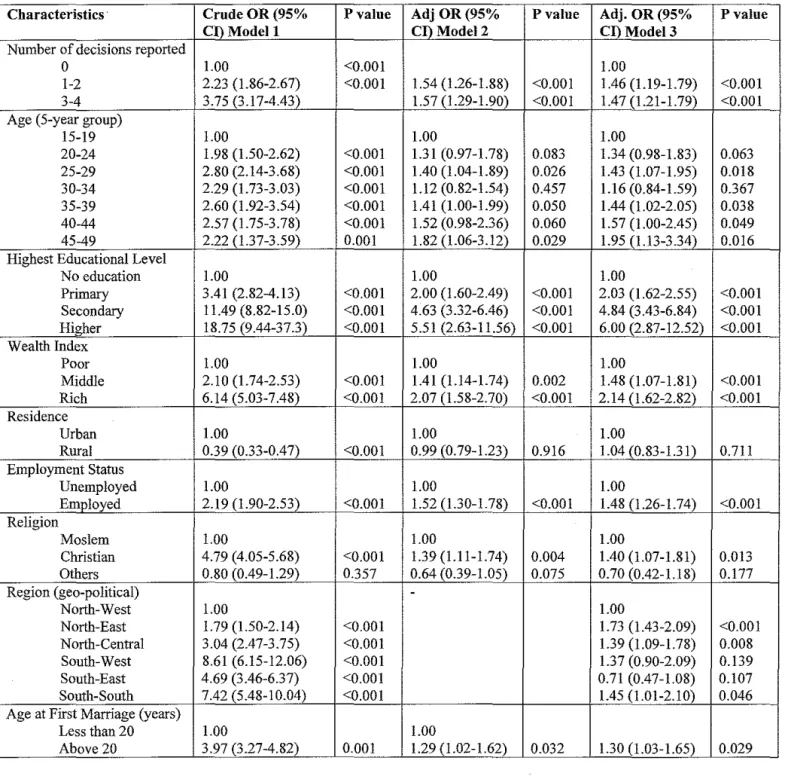
ofthe regression tests are shown in table 2. From the bivariate logistic regression (model 1),
compared with women who are not involved in making any household decisions, the crude odds
ratio (OR) of completing childhood immunizations was almost 3.8, at a p-value of <0.001.
Maternal education was shown to be strongly associated with childhood immunizations with an
OR of 18.8 and a p-value of <0.001.
However, in the first multivariate regression (model 2), after adjusting for the effects of
other variables, the association between maternal decision making status and childhood
immunization uptake became weaker at an OR of almost 1.6, but retained its significance. The
main confounding variables in this model were maternal education, wealth status, residence, and
age at first marriage. The impact of education on the likelihood of childhood immunization
decreased from a crude OR of 18.8 to an adjusted OR of 5.5, but remained statistically
significant at a p-value of <0.001. The impact of residence increased from a crude OR of 0.39 to
about 1 in the second model, but lost its statistical significance.
In the second multivariate regression (model 3), geo-political region was added to the
other variables in model 2. The crude OR reduced from 8.6 in the South-West region to 1.4 after
adjusting for the effects of confounders, but lost its statistical significance. The results of this
model further suggest that geo-political region does not have a strong effect on the observed
impact of education, however, increased slightly from a 5.5 in model 2 to 6 in model 3. The
significance level remained unchanged at 0.001.
Additionally, in the third model, after adjusting for all confounders, geopolitical region
lost its strength of impact on childhood immunizations. For instance, in comparison with the
North-West region the OR of immunization reduced from 8.6 in the South-West and 4.7 in the
South-East to 1.4 and 0.7 respectively. The variables that retained their statistical significance in
Table 2: Results of multinomial logistic regression models for unadjusted and adjusted odds of child immunization, Nigeria DHS 2008
Characteristics' Crude OR (95% P value Adj OR (95% P value Adj. OR (95%
CI) Modell CI) Model 2 CI) Model 3
Number of decisions reported
0 1.00 <0.001 1.00
1-2 2.23 (1.86-2.67) <0.001 1.54 (1.26-1.88) <0.001 1.46 (1.19-1.79) 3-4 3.75 (3.17-4.43) 1.57 (1.29-1.90) <0.001 1.47 (1.21-1.79) Age (5-year group)
15-19 1.00 1.00 1.00
20-24 1.98 (1.50-2.62) <0.001 1.31 (0.97-1.78) 0.083 1.34 (0.98-1.83) 25-29 2.80 (2.14-3.68) <0.001 1.40 (1.04-1.89) 0.026 1.43 (1.07-1.95) 30-34 2.29 (1.73-3.03) <0.001 1.12 (0.82-1.54) 0.457 1.16 (0.84-1.59) 35-39 2.60 (1.92-3.54) <0.001 1.41 (1.00-1.99) 0.050 1.44 (1.02-2.05) 40-44 2.57 (1.75-3.78) <0.001 1.52 (0.98-2.36) 0.060 1.57 (1.00-2.45) 45-49 2.22 (1.37-3.59) 0.001 1.82 (1.06-3.12) 0.029 1.95 (1.13-3.34) Highest Educational Level
No education 1.00 1.00 1.00
Primary 3.41 (2.82-4.13) <0.001 2.00 (1.60-2.49) <0.001 2.03 (1.62-2.55) Secondary 11.49 (8.82-15.0) <0.001 4.63 (3.32-6.46) <0.001 4.84 (3.43-6.84) Higher 18.75 (9.44-37.3) <0.001 5.51 (2.63-11.56) <0.001 6.00 (2.87-12.52) Wealth Index
Poor 1.00 1.00 1.00
Middle 2.10 (1.74-2.53) <0.001 1.41 (1.14-1.74) 0.002 1.48 (1.07-1.81) Rich 6.14 (5.03-7.48) <0.001 2.07 (1.58-2.70) <0.001 2.14 (1.62-2.82)
Residence
Urban 1.00 1.00 1.00
Rural 0.39 (0.33-0.47) <0.001 0.99 (0.79-1.23) 0.916 1.04 (0.83-1.31) Employment Status
Unemployed 1.00 1.00 1.00
Employed 2.19 (1.90-2.53) <0.001 1.52 (1.30-1.78) <0.001 1.48 (1.26-1.74) Religion
Moslem 1.00 1.00 1.00
Christian 4.79 (4.05-5.68) <0.001 1.39 (1.11-1.74) 0.004 1.40 (1.07-1.81) Others 0.80 (0.49-1.29) 0.357 0.64 (0.39-1.05) 0.075 0.70 (0.42-1.18)
Region (geo-political)
-North-West 1.00 1.00
North-East 1.79 (1.50-2.14) <0.001 1.73 (1.43-2.09)
North-Central 3.04 (2.47-3.75) <0.001 1.39 (1.09-1.78)
South-West 8.61 (6.15-12.06) <0.001 1.37 (0.90-2.09)
South-East 4.69 (3.46-6.37) <0.001 0.71 (0.47-1.08)
South-South 7.42 (5.48-10.04) <0.001 1.45 (1.01-2.10)
Age at First Marriage (years)
Less than 20 1.00 1.00
Above 20 3.97 (3.27-4.82) 0.001 1.29 (1.02-1.62) 0.032 1.30 (1.03-1.65)
DISCUSSION
Determinants of immunization uptake
Women's autonomy in decision making is a significant determinant of childhood
immunization, as suggested by the results of this study. This is in accordance with findings from
other studies in the literature. A similar study conducted using demographic data from Ethiopia
and Eritrea showed a strong positive association between increasing maternal decision making
autonomy and the likelihood of completing childhood immunizations in both countries.23
Similarly, other studies have found that women's decision making authority is a strong predictor
of healthcare utilization and child survivaL 21,22 Though the impact of the observed strength of
decision making authority on childhood immunization reduced after adjusting for possible
confounders, the association remained significant, indicating that decision making authority
increases the likelihood of childhood immunizations by almost 50% in Nigeria. This could be
due to the fact women who are empowered to make domestic decisions are more able to seek
immunization services, since the service is basically free in public facilities in the country, The
results of this study suggest that about 40% of household decisions are made without involving
the woman, while about 60% involve the woman, either alone or with her husband or partner,
However, for decisions which the woman makes with her husband/partner, it is not possible to
say from the data, the extent of this involvement, and whose views prevail when there are
differences of opinion,
The data also suggest that possession of child health cards has a strong association with
the uptake of childhood immunizations, For instance, among children whose child health cards
Also, children whose health cards were not seen were less likely to be unimmunized compared
with those without health cards, though they had a higher tendency to be partially immunized
than the latter. This fmding suggests that the possession of a child health card possibly serves as
a reminder to mothers to take their children for scheduled vaccinations, and reduces drop-outs. It
could also be that parents who keep the vaccination cards are more careful about immunizations.
However, about 55% of children do not have child health cards, suggesting that they may be
unimmunized or, at best, partially immunized. Partial immunization might not confer immunity,
especially in the case of vaccines that require serial dosing, and such children are denied the full
benefit of vaccinations
Further, maternal education was shown to be associated with the likelihood of childhood
immunizations. Among the demographic variables tested, education showed the strongest
association. However, the strength of this association dropped to a third after adjusting for
confounders. This is similar to the predominant fmdings in the literature that show education as
one of the strongest predictors of childhood immunization.8.11.12.27.28 Increasing maternal
education increases the likelihood of childhood immunization. This could be attributable to the
fact that educated women are more likely to have access to information on healthcare services,
and to use modern health services, and adopt healthy practices.29
•3o Also, as their educational
status increases, women are more empowered to exercise authority over their own lives and
those of their children; and to use their resources for family welfare, especially as related to child
welfare.2.3,19.31
Even after adjusting for other demographic factors, women in the upper wealth quintiles have
twice the likelihood of fully immunizing their children, as compared with those in the lower
wealth quintiles. Studies in Africa and Asia have reported similar findings, which could be
attributable to the fact that richer women often have higher education and are employed, and so
more empowered to make financial contributions and to their families. Consequently, they have
higher autonomy in decision making.32
.34 Such women also observe better health promoting
practices, and have better access to health services.,,12,35 However, women in the lower wealth
quintiles are likely to have little or no education, and so less likely to have knowledge of health
promotion activities, and to use modern health services
The data also suggest an association between age at first marriage and the uptake of
childhood immunization services, Women who get married under age 20 years have a higher
proportion of unimmunized children and lower proportion of fully immunized children, whereas
women who get married at age 20 years and above have a higher proportion of fully immunized
children, and lower proportion of un immunized children. However, after adjusting for other
factors, the likelihood of full immunization is reduced from almost 4 times to 13 times that of
women who get married below age twenty, This could be related to the fact that women who
have no education or little education tend to marry earlier than those who pursue higher
education, Consequently, women who pursue higher education get married later in life, gain
employment, and are more empowered than those who do not." Maternal age was significantly
associated with the likelihood of childhood immunization in bivariate analysis; with older
women having higher proportions of fully immunized children than those in the lower age
might have had many children, and feel more experienced and confident of their child care competency than younger women.
Type of residence had a weaker association with childhood immunization uptake after controlling for confounders. After adjustment, the likelihood of childhood immunizations increased from 0.4 to 1.04, but lost its significance, for rural residents as compared with urban residents. This suggests that the observed differences in the outcome are due to underlying factors like education, employment, age at first marriage, wealth and decision making status. It has been established by several studies that rural residents are generally less educated and have lower paying jobs, less income, and are, therefore, less empowered than their urban
counterparts.,",14,36,37
Religious affiliation showed a significant influence on child immunization status, with the proportion of fully immunized children born to Christian women being about four times that of children born to Muslim women, In the regression model, the strength of this association, however, dropped from an OR of 4.8 for Christian women to 1.4 in comparison with the reference group, Muslim women, This finding is in accordance with a recent study by Antai (2009) that suggests that children of mothers affiliated with the Muslim faith have lower likelihood of being fully immunized in comparison with children of Christian mothers in
mothers. Ibis is given the fact that higher education increases knowledge of childhood diseases and causation, and also provides women with decision making power. 38,39
Regional differences in immunization uptake
Previous studies and the DHS reports have continued to indicate that there are regional variations in the utilization of maternal and child health services in Nigeria, with the three southern regions having significantly better health outcomes than the three northern regions, These variations have largely been attributed to the diversity of the country, and the huge variations in cultures, religion, political and economic situations, and population
densities:,15,16,27,34,4Q.42 The second objective of this study is, therefore, to characterize the regional
variations in child immunization coverage,
Nigeria.1O,15,36 These regional disparities tend to impact the range of child health services and the
success of health education and behavioral change programs across the country.34 However,
other studies have attributed the regional variations to the influence of ethnicity, and the authors
claim that ethnicity is a strong predictor of health disparities in the country.'6,34 For instance,
Kritz (1999) attributes the regional variations in the status of women, and therefore health
outcomes, to the practice of seclusion and restriction of girls' access to education and the ability
of women to take up employment outside the home in the predominantly Muslim North-West
and North-East regions. In contrast, the South-West, South-East and South-South regions are
more receptive of social change as shown by the education of the girl-child, and the
encouragement of women to take up paid employment outside the home in order to provide some
financial support for themselves and their children.'6 In addition, the South-South region
practices a modified form of matrilineal descent; therefore the women have higher autonomy
than their counterparts in other parts of the country.'6
The observed disparities in the completion of childhood immunizations in the northern
regions could also be attributable to the intensity of immunization campaigns and social
mobilization in the north as part of the Polio Eradication Initiative. The North-Central region
however, is caught between the low immunization rates in the northern and the higher rates in
the southern regions. The North-Central region is inhabited by almost equal proportions of
Muslim and Christian groups, and women in the region are more educated and empowered than
those in the other two northern regions, but not as much as those in the southern regions. This
model, this study suggests that the observed regional variations in childhood immunization rates
are due to other underlying factors that defme the six geopolitical regions of Nigeria. The
strongest of these factors appears to be maternal educational level. Other factors that appear to be
strong predictors of the status of women and the uptake of childhood immunization at the
regional level include maternal employment status, wealth status and age at first marriage. This
suggests that when all other factors are held constant, the regional variations in childhood
immunization uptake become statistically insignificant. Education, age at first marriage and
wealth status seem to significantly impact the association, though the impact of education is
strongest. This could be attributable to the fact that education is both a demographic variable,
and a determinant of women's status both in the family and community.
Limitations
The limitations of this study include the use of self-reported data. Over-reporting of child
immunization status may have increased the proportions of immunized children in this study, as
self reported immunization history was accepted for women whose children did not have
immunization cards, or those whose cards were not available for verification. This may also
affect the internal and external validity of the study findings. Recall bias may also be a problem
as study respondents may not have been able to remember accurately what vaccines their
children had received in the first year of life. This can result in bias, or skew the true measure of
association. Over-reporting of decision making authority could also be a source of selection bias,
and therefore a possible threat to the internal and external validity of this study. Despite the
stated limitations, the strength of this study lies in its sampling strategy. Being a nationally
representative sample, generalizabilty of the findings to the Nigerian population is possible. The
activities in the country. This study also has the additional strength of having identified the
possible underlying factors that determine the regional disparities in immunization uptake in the
CONCLUSION
From the findings of this study, it can be concluded that women's empowerment, particularly
decision making authority, is an important factor for increasing childhood immunization uptake
and reducing under-five mortality in Nigeria. All women, irrespective of age, socioeconomic
status, residence, marital status, and educational level, should be empowered to make informed
decisions on issues that affect their health and wellbeing, and their children's as well. Integration
of child health and immunization policies and programs with interventions to improve the status
of women, through education, might prove more successful than vertical programming. The data
suggest that education and economic empowerment increase the autonomy of women in their
households. Therefore, efforts to improve the health outcomes of women and children would
yield better results if there are policies and programs to improve the status of women
concurrently. The concept of empowerment could be incorporated in school curricula and
programs for non-formal education strengthened, as in the case of adult literacy programs.
Women could also be supported in entrepreneurship and income generation activities in order to
close the gap between men and women in families and the community at large. Further, child
health programs may benefit from strengthened collaborations with religious bodies and
organizations, given the influence of religion in this study. Enhanced individual and community
health education programs will also contribute to improving the autonomy of women in the
family.
Further research should explore how to encourage the completion of all scheduled
vaccinations within the first year of a child's life. This is very important given the fact that there
is a high proportion of partially immunized children in the country, who are deprived the full
55% of children 12-23 months do not have child health cards. It is also recommended that the
associations between women's autonomy and the socio-demographic variables used in this study
be further investigated for better understanding of the relevant predictors of women's autonomy
REFERENCES
(1) WHO U, World Banle State a/the world's vaccines and immunization. 3rd ed ed. Geneva, World Health Organization: WHO; 2009.
(2) WHO. Women's empowerment and gender equality: Essential goals for saving women's lives. 2008.
(3) UNFPA. Guidelines on women's empowerment. 2008.
Available at http://www.un.org/popiniunfra/taskfiJrce!guide!iatfWemp.gdl.html
(4) UNICEF. At a glance: Nigeria 2009.
Available at: http://www.uniceforg/infQbvcountry/nigeria statistics. html
(5) National Population Commission (NPC) [Nigeria] and ICF Macro. Nigeria Demographic and Health Survey 2008.2009.
(6) WHO. Nigeria: Expanded Program on Immunization. WHO Bulletin: African Region 2005.
(7) Wolfson LJ, Gasse F, Lee-Martin SP, Lydon P, Magan A, Tibouti A, et al. Estimating the costs of achieving the WHO-UNICEF global immunization vision and strategy, 2006-2015.
Bull. World Health Organ. 2008;86:27-39.
(8) Cassell JA, Leach M, Fairhead JR, Small M, Mercer CH. The social shaping of childhood vaccination practice in rural and urban Gambia. Health Policy Plan. 2006;21(5):373.
(9) F eilden Battersby Analysts. The state of routine immunization services in Nigeria and reasons for current problems. 2005.
(10) Babalola S. Determinants ofthe Uptake of the Full Dose of Diphtheria-Pertussis-Tetanus Vaccines (DPT3) in Northern Nigeria: A Multilevel Analysis. Matern. Child Health J.
2009;13(4):550-558.
(11) Gage AJ, Sommerfelt AE, Piani AL. Household structure and childhood immunization in Niger and Nigeria. Demography 1997;34(2):295-309.
(12) Luman ET, McCauley MM, Shefer A, Chu SY. Maternal characteristics associated with vaccination of young children. Pediatrics 2003;111(5):1215.
(13) Cutts FT, Diallo S, Zell ER, Rhodes P. Determinants of vaccination in an urban population in Conakry, Guinea. Int.J.Epidemiol. 1991;20(4):1099.
(15) Antai D. Inequitable childhood immunization uptake in Nigeria: a multilevel analysis of individual and contextual determinants. BMC Infect. Dis. 2009 Nov 20;9:181.
(16) Kritz MM, Makinwa-Adebusoye P. Determinants of women's decision-making authority in Nigeria: the ethnic dimension. 1999;14(3):399-424.
(17) Tadesse H, Deribew A, Woldie M. Predictors of defaulting from completion of child immunization in south Ethiopia, May 2008: a case control study. BMC Public Health 2009 May
22;9:150.
(18) Malhotra A, Schuler SR, Boender C. Measuring women's empowerment as a variable in international development. World Bank Gender and Development Group Background
paper. World Bank, Washington, DC 2002.
Available at www.icrw.org/docsIMeasuringEmpowerment workingpaper 802.doc
(19) United Nations Children's Fund (UNICEF). The state of the world's children 2008: Child survival. 2008.
(20) Kishor S. A focus on gender: collected papers on gender using DHS data. : ORC Macro;
2005.
(21) Bloom SS, Gupta MD, Wypij D. Dimensions of women's autonomy and the influence on maternal health care utilization in a north Indian city. Demography 2001 ;38(1 ):67-78.
(22) Kishor S. Empowerment of women in Egypt and links to the survival and health of their infants. Women's empowerment and demographic processes: Moving beyond Cairo 2000:
119-56.
(23) Woldemicael G. Do women with higher autonomy seek more maternal and child health-care? Evidence from Ethiopia and Eritrea. MPIDR Working Papers 2007.
(24) Sathar ZA, Kazi S. Women's autonomy in the context of rural Pakistan. Pakistan Development Review 2000;39(2):89-110.
(25) Becker S, Fonseca-Becker F, Schenck-Yglesias C. Husbands' and wives' reports of women's decision-making power in Western Guatemala and their effects on preventive health behaviors.
Soc.Sci.Med. 2006;62(9):2313-2326.
(26) Ahmed M, Iqbal K. Is There Any Threshold in Mother's Education and Child Health Relationship? Evidence from Nigeria. Carleton College Department of Economics. Working Series 2007.
(28) Edwards AE. Maternal Barriers to Childhood Vaccinations in Tanzania: An Examination of the 2004-2005 Demographic and Health Survey. 2010.
(29) Hobcraft J. Women's education, child welfare and child survival: a review of the evidence. 2004.
(30) Cleland JG, Van Girmeken JK. Maternal education and child survival in developing countries: the search for pathways of influence. Soc.Sci.Med. 1988;27(12): 1357-1368.
(31) Smith LC. The importance of women's status for child nutrition in developing countries. : Inti Food Policy Research Inst; 2003.
(32) Acharya DR, Bell JS, Simkhada P, van Teijlingen ER, Regmi PR. Women's autonomy in household decision-making: a demographic study in Nepal. Reproductive health 2010;7:15.
(33) Wallerstein N. What is the evidence on effectiveness of empowerment to improve health?
Health Evidence Network Report 2006:1~37.
(34) Antai D. Faith and child survival: The role of religion in childhood immunization in Nigeria. J.Biosoc.Sci. 2009;41(01):57-76.
(35) Tolhurst R, Raven J, Theobald S. Gender Equity: Perspectives on Maternal and Child Health. Maternal and Child Health 2009:151-166.
(36) Babalola S, Lawan U. Factors predicting BCG immunization status in northern Nigeria: a behavioral-ecological perspective. Journal of Ch ild Health Care 2009;13(1):46.
(37) Odusanya 00, Alufohai EF, Meurice FP, Ahonkhai VI. Determinants of vaccination coverage in rural Nigeria. BMC Public Health 2008 Nov 5;8:381.
(38) Chowdhury F, Khan AI, Hossain MI, Malek MA, Faruque ASG, Ahmed T, et al. Young children non-immunized against measles: Characteristics and programmatic implications. Acta
Paediatrica 2006;95(1):44-49.
(39) Gyimah OS. What has faith got to do with it? Religion and child survival in Ghana.
J. Biosoc. Sci. 2007;39(06):923-937.
(40) Federal Ministry of Women Affairs and Child Development. National Gender Policy: Situation analysis and Framework. 2006.
(41) Achudume AC. Environmental health, development and economic empowerment of rural women in Nigeria. Environ.Dev.Sustainability 2009;11(2):459-469.