International Journal of Emerging Technology and Advanced Engineering
Website: www.ijetae.com (ISSN 2250-2459, ISO 9001:2008 Certified Journal, Volume 8, Issue 1, January 2018)
265
A Review on Video Coding Standards
Perla Anitha
1, P. Sudhakara Reddy
2, M. N. Giri Prasad
31Full Time Research Scholar, 3Professor, Jawaharlal Nehru Technological University Ananthapur, Ananthapuramu,
Andhra Pradesh, India.
2
Associate Professor, Sri kalhasteeswara Institute of Technology, Sriklahasti, Andhra Pradesh, India.
Abstract— Video compression technology has been advanced from the decades onwards. A comfort zone has been created with video coding standards such as MPEG and H.261/262/263/AVC. Now a days high efficiency video coding standard has created advanced compression ratio with half of the bit rate for video streaming application and video transmission. The ITU has developed such standards H.261, H.262, H.263 and H.264/AVC. The H.264/AVC video coding standard is developed by the JVT of MPEG and ITU have found many successful applications in Video Streaming. The Objective of this paper is to provide an in-depth study of High Efficiency Video Coding (HEVC) standards, evaluates subjectively and provides information related to demand of
HEVC development in video and communication
broadcasting. The objective of this in depth study of video coding standard, encoding and decoding process and its recommendations with hybrid wavelet transformation and also provide an information related to demand of HEVC development in in multimedia and medical application of the video communication systems. This paper contains PSNR compression ratio with existing methods.
Keywords-- hybrid wavelet transform, PSNR, HEVC
I. INTRODUCTION
Accumulating the number of multimedia end users with
portable devices having the feature applications
ofconquering, predominant, recreating the audio, image and video has proved their eloquent exceeding role in the market of digitized systems. The greatness of multimedia
Communication the systems are capable of conquering high definition high resolution (HDHR) with ultrahigh definition (UHD) in tangible span [1-3]. These huge amount of data produced from capturing device in the storage with standardized video format. Video has enhancing an salient data representation in modern data and communications, and in multimedia applications. Channels and video communication with different characteristics, are explored as the offensive for video communication. To engage these, it is fundamental to design and contraption the video codec in the video communication equipment [4].
Now with this paper, the study of the standard video coding and deciphering these standards in to the evaluation of the successful encoding and deciding schemes, to exaggerate the quality of video[7-8]. Prior lot of video codecs are existed for ciphering and deciphering the video for surviving not only multimedia applications and giving lots of scope in the medical field [9]. Now the trend is following High efficiency video coding standard, which is very much helpful for medical video communication systems for high definition and ultra-high definition clarity.
H.120
H.120 is standard which is not successful because it was not able to entrench as a exclusive worldwide standard and also it is not having an adequate price performance ratio. The high data rate is required to deliver the video and also the equipment cost is too high. It is drawback of H. 120
H.261
The next standard to H.120 is H. 261, it is intended to lower at least the transmission costs by giving the freedom to the user to choose the quality of the video and cost of the transmission. However, there is emergency H.261 might be absolute advent of MPEG-1, which offers high functionality and efficiency for video transferring and capturing.MPEG-1 is using from 1991 onwards, its main target is digital storage media, CD-ROM at bit rate 1.5 Mbps.
H.262
Its sometimes referred as MPEG 2,was implemented in1994 its offering flexibility is greater and higher data rates for HDTV(high definition television ) and SDTV (standard definition television) MPEG 2 is using source coding format and its having capability work as digital video disk.
H.263
International Journal of Emerging Technology and Advanced Engineering
Website: www.ijetae.com (ISSN 2250-2459, ISO 9001:2008 Certified Journal, Volume 8, Issue 1, January 2018)
266
The design target is video conferencing applications within mobile devices where low bit rate restrictions exist H.263 [12]. H.263 is utilized by video telephony, video conferencing and internet conferencing and mobile phone codecs, such as H.324, H.323 H.320 RTSP and SIP.H.264
H.264 /MPEG – 4 part 10 is Advanced Video Coding (AVC), it was released in 2002,this standard has been well received. Even now a decoder is specified, this leads the encoder on expected data format for transmission between encoder and decoder is specified, H.264 /AVC standard standard levered heavily prior standards and enhanced known coding techniques, such as motion compensation for variable block. The mail goal is to have a predominant compression performance beyond a wide range of bit rates.H.264 standard has been adopted by numerous well known consumer products such as APPLE, IPOD and Sony play stations, not only that and also several media
products such as HD-DVD and Blu-ray have adopted this
standard for video compression.
HEVC:
Due to the compression efficiency, the visual quality [11] is 50% is reduced compared to H. 264 , HEVC employs a compression technique to improve compression efficiency with high computation complexity [12]. Supporting, In [14], the saliency map detection is employed to adjust the quantization parameter of macro block for H.264. In [15], a model is proposed to reduce the bit rate for the video compression.
II. SUBJECTIVE EVALUATION SURVEY ABOUT HEVC
THROUGH HYBRID WAVELET ANALYSIS
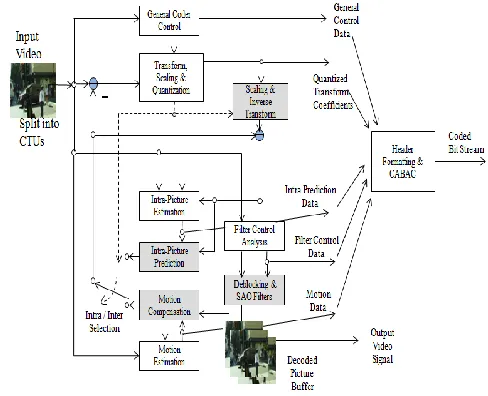
[image:2.612.320.564.142.340.2]High Efficiency Video Coding (HEVC) standard was released by ITU-T VCEG, to achieve same video subjective performance with half the H.264 data rate. For reference, Figure 01 shows the HEVC hybrid video encoder block diagram that can be used for reference for overview
Figure 01: Block Diagram Of HEVC
In the above High efficiency video coding block diagram, containing many functional blocks such as transformation, scaling and quantization, intra picture estimation, intra picture prediction, motion compensation, motion estimation, filter control analysis, deblocking and SAO filter and Header formatting and CABAC. In this paper the main focus is how the hybrid wavelet transformation is applicable and also analysis of frame encoding and decoding.
III. SUBJECTIVE ANALYSIS OF FRAME ENCODING AND
DECODING
International Journal of Emerging Technology and Advanced Engineering
Website: www.ijetae.com (ISSN 2250-2459, ISO 9001:2008 Certified Journal, Volume 8, Issue 1, January 2018)
[image:3.612.57.295.281.456.2]267
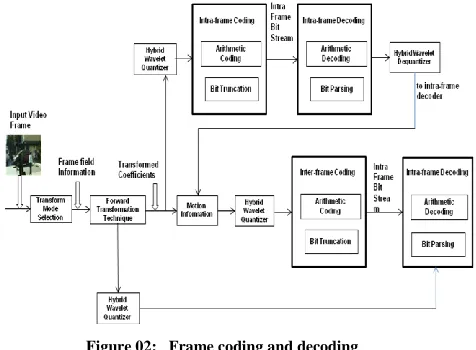
Then the quantized decomposition coefficients are encoded by the Arithmetic coder, each sub band is partitioned into code blocks with the nominal size of either 64 by 64 or 32 by 32 before encoding. Then the coefficients within each individual code block are reorganized into bit stream. The scanning orders of the bit stream determine the visit order of data at each bit plane. Arithmetic coder generally a bit plane quantizer with embedded entropy coder. Hybrid Wavelet utilize the statistical redundancy among DWT coefficients at different decomposition orientations and levels by the construction of the Zero-tree (ZT) data structure.Figure 02: Frame coding and decoding
The bit plane entropy coder belongs to Arithmetic coder, which carries out CABAC at various bit planes. In fact, for each individual code block, the encoder visits the data from the bit plane associated with the Most Significant Bit (MSB) downwards to the one associated with the Least Significant Bit (LSB). Within each individual bit plane, three sub-bit plane passes are adopted instead of just one bit plane coding pass. Each coding pass contains a portion of the total 18 coding context set. A main advantage of this approach is the near-optimal embedding, where the information that results in the largest reduction in the distortion for the smallest increase in the bit stream size is coded first. That is to say, more important information is always coded prior to less important information. Every bit to be encoded is assigned to a coding context according to certain causal information such as the significant information of the current bit’s neighbours, the sign if the significant bit and so on. The output of Arithmetic coder in the intra-frame coder is sent to two recipients. The first one is the intra-frame bits stream and the other one is the built-in decoder built-in the built-intra-frame encoder.
The data sent to the second recipient is decoded, dequantized and fed to the inter-frame coder. That the inputs of the inter-frame coder come from two sources: one is the intra-frame coder and the other is the hybrid wavelet data from the input picture(s). The data from the first source is named as the reconstructed hybrid wavelet data (RHWTD) and the one from the second source is named as the original hybrid wavelet data (OHWTD). The ME and MC are performed between the hybrid wavelet data from these two sources.
In this paper, the size of the node (coefficient block) at the lowest resolution level, i.e. level 1, is 2× 2. Since a hybrid wavelet is used, the size of the coefficient block at each subsequent higher resolution level is increased by a factor of 2. Therefore, at level 2 and 3, the size of the coefficient block is 4 × 4 and 8 × 8, respectively. These related coefficient blocks are grouped together into a wavelet block (WB) with a size 16 by 16. Both the WB and the WT are essentially descriptions of the same set of DWT coefficients from different perspectives.
Two identical independent arithmetic models are used to model the statistics of the horizontal and vertical component of the motion information, respectively. After MC, the residue image is derived by subtracting the motion compensated RHWTD from the OHWTD. Then it is sent to the hybrid wavelet quantization and the arithmetic coder. The Arithmetic coding was used for inter-frame entropy coding with the same set of contexts as in intra-frame coder.
The above technique is implemented on mat lab tool and using for test with several video sequences, to show the efficiency of the technique. The below video sequences are used for frame coding and decoding, these are the example video sequences for my proposed work. The way procedure is given below for frame encoding and decoding process we have implemented the technique by the following steps to execute using mat lab tool.
Step 01: Take a YUV video to AVI video
Step 02: convert input video into frames
Step 03: Apply Hybrid wavelet transform to frames
Step 04: Extract Low and High band coefficients
Step 05: Encode I frame
Step 06: Encode P frame
Step 07: perform GOP structure as IBBPBBPBBP…..
Step 08: Perform motion estimation
International Journal of Emerging Technology and Advanced Engineering
Website: www.ijetae.com (ISSN 2250-2459, ISO 9001:2008 Certified Journal, Volume 8, Issue 1, January 2018)
268
Step 10: Encode bit stream at the encoderStep11: Decode bit stream at the decoder
Step12: Extract I frame
Step 13: Extract P frame
Step 14: Meseasure video quality metrics
[image:4.612.323.570.241.423.2]The proposed technique is implemented on Matlab Tool and tested with several video sequences. To show the efficiency of the proposed technique, we also implemented H.264 and H.265 in Matlab, to compare PSNR values. Proposed technique is tested with different videos as shown in Table 01. It is disclosing the characteristics of video sequences with various formats such as QCIF,CIF, YUV, AVI with different frame quantities. Video sequences considered for analysis of proposed technique
TABLE 01
VIDEO SEQUENCES WITH DEFFIRENT VIDEO FORMATS
IV. RESULTS
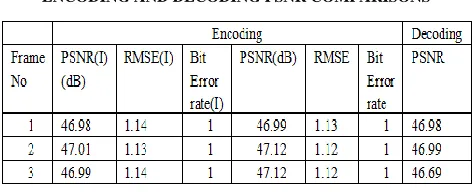
[image:4.612.54.291.354.480.2]For our analysis, we have taken Movies. AVI video file, having 24 frames to extract. The table 02 shows the three frames encoding and decoding for result analysis. Table 02 shows the comparative results with Lucas-Kanade and RDWT
TABLE 02
ENCODING AND DECODING PSNR COMPARISONS
The Lucas –Kanade is a method to find the displacement of the image contents with two nearby frames where it is very small and more or less constant with in proximity of the point p under consideration.
The Redundant Discrete Wavelet Transform (RDWT) is pervasive to the applications of modern digital signal processing. The RDWT is eventually under stated version of discrete wavelet transform. RDWT has energy bounds since it is frame expansion Although the RDWT is a
immensely redundant frame expansion
.
TABLE 03
COMPARATIVE RESULTS BETWEEN LUCAS-KANADE, RDWT AND PROPOSED TECHNIQUE
V. CONCLUSION
In this paper, survey on video coding standard since H.120 to current standard HEVC, clear analysis on the high efficiency video coding with entire block diagram and also analyse the in depth analysis of the frame encoding and decoding subjectively, implementation is performed through the hybrid wave transformation, the proposed technique has to applied in spatial and wavelet sub bands comparison results (PSNR, Execution time) are analysed with Lucas–Kanade and Redundant Discrete Wavelet Transform (RDWT).
REFERENCES
[1] M.T.Pourazad,C.doutre,M.Azimiand P.naisopoulos .HEVC : the gold standarrd for video compression how does HEVC.
[2] J.-R.Ohm , G.J.Suvillan, H.Schwarz, T.K.Tan, and T.Wiegand. Comparison of the coding efficiency of video coding standards - including High Efficiency Video Coding (HEVC). IEEE Trans. Circuits Syst. Video Technol., 22(12):1609-1684, December 2012. [3] Sullivan, G. et al. High Efficiency Video Coding (HEVC). Springer,
2014.
[4] Shen L, Zhang Z, Liu Z. Effective CU size decision for HEVC intra coding [J]. IEEE Transactions on Image Processing A Publication of the IEEE Signal Processing Society, 2014, 23(10):4232-4241. [5] Soo-Young Lee and K. Aggarwal, A System Design and Scheduling
[image:4.612.50.288.568.664.2]International Journal of Emerging Technology and Advanced Engineering
Website: www.ijetae.com (ISSN 2250-2459, ISO 9001:2008 Certified Journal, Volume 8, Issue 1, January 2018)
269
[6] Kamaci. N, Altunbasak.Y. Performance comparison of the emergingH.264 video coding standard with the existing standards, " International Conference on Multimedia and Expo, 2003. ICME'03. Proceedings.2003, vol.1,no.,pp.I,345-8 vol.1,6-9 July 2003. [7] S.Saponara, K.Denolf, G.Lafruit, C.Blanh, J.Bormans, "Performance
and Complexity Co-evaluation of the Advanced Video Coding Standarad for Cost-Effective multimedia communication", EURAPIS Journal on Applied Signal Processing, pp.220-235, 2004 [8] Richardson, I.E. (2004). H.264 And MPEG-4 Video Compression :
Video Coding for Next-Generation Multimedia : John Wiley & Sons.
[9] Kamaci.N & Altunbasak Y (2003). performance Comparison of The Emerging H.264 Video Coding Standard With the Existing Standards. Paper presented at the Multimedia and Expo, 2003. ICME'03.
[10] Richardson,I.E.(2004).H.264 and MPEG-4 video compression: video coding for next generation Multimedia: john wiley and Sons.
[11] Wiegand. T, Sullivan G,Bjontegard .G and Luthura A,(2003),overview of H.264/AVC video coding standard. Circuits and systems for video technology, IEEE transactions on,13(7),560-576.
[12] G. J. Sullivan, J. Ohm, W. J. Han, and T. Wiegand. 2012. "Overview of the High Efficiency Video Coding (HEVC) Standard". IEEE Trans. on Circuits and Systems for Video Technology 22, 12 (2012), 1649–1668.
[13] T. Wiegand, G. Sullivan, B. Bjontegaard, and A. Luthra, “Overview of the h.264/avc video coding standard,” IEEE Trans. on Circuits and Systems for Video Technology, vol. 13-7, pp. 560–576, July 2003.