4780
OPTICAL COLOR IMAGE CRYPTOSYSTEM BASED ON
DISCRETE COSINE TRANSFORM AND DOUBLE RANDOM
PHASE ENCODING
ASHRAF AFIFI1,2
1Department of Computer Engineering, College of Computers and Information Technology, Taif
University, Al-Hawiya 21974, Kingdom of Saudi Arabia
2Department of Electrical Engineering and Computers, Higher Technological Institute, 10th of Ramadan,
Egypt
E-mail: [email protected]
ABSTRACT
This paper introduces an efficient optical color image cryptosystem using the discrete cosine transform (DCT) and the Double Random Phase Encoding (DRPE). The proposed method employs the DCT on input red, green and blue color plain image components. The resulting color image components are then decomposed by the Fourier Transform (FT). A number of test experiments are performed in order to evaluate the proposed method performance mainly the security and the quality of the encryption. The achieved results demonstrated the superiority of the proposed approach with respect to encryption quality, statistical, information entropy, maximum deviation, and irregular deviation, differential, and noise immunity tests.
Keywords: Discrete cosine transform, Double Random Phase Encoding, Color Image Cryptosystem.
1. INTRODUCTION
Nowadays, internet and multimedia networks have increasingly captured attention in information security researches like in optical information processing manners for high computation speed, parameters selection, and parallel processing capability [1-4]. Optical designs are largely used in disguising data, encoding, recognition, correlation, determination, verification, as well as in multimedia watermarking [5-10]. The primary work of Javidi and Refregier in optical image cryptosystem area brought about suggesting DRPE technique as an optical symmetric key encryption technique. For each of the Fourier and spatial domains, the DRPE technique uses 2 phase code keys called random phase masks (RPMs) to code the plain image data. A composite conjugate of the Fourier-plane phase code key are applied to descramble the encrypted image data [11].
Different schemes using multiplexing [12], digital holography [13], FrFt domain [14] Fresnel domain [15], diffractive imaging [16], and polarized light [17] have been proposed. Also, several DRPE based cryptosystems are proposed to obtain efficient security [18-20]. The quantitative
techniques for compression encryption of images are also developed [21-23].
The authors of [24], applied DRPE to single-channel color image ciphering by the Fourier Transform, then it was further extended to the FrFt [25], Arnold and discrete cosine transforms [26], Fresnel transform [27].
This paper is mainly focusing on the optical communications applications with high security levels using DCT based DRPE optical color security scheme. This scheme is worked by splitting the color plain image into red, green, and blue component images. Then, the color component plain images will be independently discrete cosine transformed then multiplied by the first random phase masks and finally Fourier transformed. The complex distribution of three transformed color component images are again multiplied discrete cosine transformed, and Fourier transformed. The three ciphered color component images are generated in output plane and gathered to construct the ciphered color image.
4781 ciphered and deciphered phases of the proposed DCT optical DRPE color image cryptosystem. Section 4 explores the detailed security study of the introduced DCT optical DRPE color image cryptosystem. Ending, section 5 gives the employing remarks.
2. BASIC KNOWLEDGE
This section introduces a literature survey on the DRPE and the discrete cosine transform which were used with the suggested method for color image encryption.
2.1 DRPE
The DRPE includes employing of two 2D random phase masks [11]. Assume that Im(α, β) stands for the digital plain image to be encrypted and F(α, β) denotes the cipher image which is a complex image. θ(α, β) and ω(x, y) stand for the key functions in both frequency and spatial domains and their values range uniformly within [0-1]. The encryption procedure of DRPE can be represented as: ))} , ( 2 exp( ))] , ( 2 exp( ) , [Im( { ) ,
( FTFT j j x y
F
(1) The decryption steps of DRPE can be represented as: )) , ( 2 exp( ))} , ( 2 exp( )) , ( ( 1 [ 1 { ) ,
Im( FT FT F jxy j
(2) Here both the keysexp(j2(,)),
)) , ( 2
exp(j x y , and the encrypted image are
conveyed jointly. FT and FT−1 are the Fourier
transform and its inverse respectively.
2.2 Discrete Cosine Transform (DCT)
The 2-D DCT and the IDCT of N × N image are defined as [27]:
N v y N u x y x f v u N v u C N x N y 2 ) 1 2 ( cos 2 ) 1 2 ( cos ) , ( ) ( ) ( 2 ) , ( 1 0 1 0 (3)
N v y N u x v u C v u N y x f N u N v 2 ) 1 2 ( cos 2 ) 1 2 ( cos ) , ( ) ( ) ( 2 ) , ( 1 0 1 0 (4) Where f (x, y) is the pixel intensity at the image location (x, y), and C (u, v) is the DCT coefficient at the transform location (u, v) [28].
otherwise 1 0 2 / 1 ) ( )(u v u v
(5)
3. THE PROPOSED ALGORITHM
In this section, the suggested DCT optical DRPE color image cryptosystem will be defined in terms of two basic processes namely encryption and decryption.
3.1 Encryption Process
This process can be described in the following steps:
1. The color plain image is separated into red, green, and blue color image components. 2. Each image component is independently
shuffled using the discrete cosine transform. 3. The scrambled components are multiplied with
the first random phase masks and then submitted to the first
FT
.4. The scrambled transformed components are multiplied with the second random phase masks in the FT plane, and then submitted to the second
FT
.5. The three encrypted components are achieved in output plane and multiplexed to obtain the color encrypted image as illustrated in figure (1.a).
3.2 Decryption Process
This process can be described in the following steps:
1. The color cipher image is firstly decomposed into image components.
2. The inverse Fourier transform FT1 is applied
to the encrypted color image components, and then multiplied by the 2nd random phase mask
conjugate in the FT1 plane.
3. The transformed complex components are individually shuffled secondly using the inverse of discrete cosine transform.
4. Another inverse Fourier transform FT1 is
applied to DCT transformed scrambled complex color components, and then multiplied with the conjugate of the first random phase mask in the
1
FT plane.
5. The transformed red, green, and blue components are individually shuffled by applying the inverse discrete cosine transform. 6. The three deciphered image components are
obtained in output plane and multiplexed to get the find decrypted color image Im(i,j) as illustrated in figure ( 1.b).
4782
Figure (1a). Block diagram of encryption process for the proposal system
Figure (1b).Block diagram of proposed decryption process
4. EXPERIMENTS SIMULATION
Measuring experiments are carried out to investigate the proposed DCT optical DRPE color image cryptosystem. Also, its performance is compared with the standard double random phase encoding. Tests are performed using 256x256-sized color Water Lillies, Lichtenstein and Bata images as illustrated in Figure (2).
a) Water Lillies b) Lichtenstein c) Bata
Fig. 2: Color Test Images - Water Lillies, Lichtenstein
and Bata Images
4.1 Visual Measuring
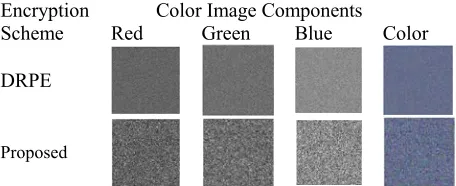
The ciphering outcomes of color plain images employing the proposed DCT optical DRPE color image cryptosystem and conventional DRPE are illustrated in Figures. 3-5 for color images Water Lillies, Lichtenstein and Bata, respectively. It is abvious that ciphering with the proposed DCT optical DRPE color image cryptosystem achieved in concealment of all images in color details.
Encryption
Scheme Red Color Image Components Green Blue Color DRPE
[image:3.612.100.287.250.358.2]Proposed
Fig. 3: Ciphered results of color Water lilies component images employing DRPE and the proposed DCT optical DRPE color
image cryptosystem
Encryption
Scheme Color Image Components Red Green Blue Color DRPE
[image:3.612.313.541.252.345.2]Proposed
Fig. 4: Encryption results of color Lichtenstein component images using DRPE and the proposed DCT based-DRPE
optical color image cryptosystem
Encryption Scheme
Color Image Components
Red Green Blue Color
DRPE
Proposed
Fig. 5: Ciphered results of color Bata component images employing DRPE and the proposed DCT optical DRPE color image cryptosystem
4.2 Measure of Entropy
[image:3.612.313.537.396.501.2]The Entropy measure is conducted for investigating the ciphered image components. It calculates the information included in the ciphered image components. The entropy is defined as [30-32]:
) ( 1 ( )log )
(
i E P n
i P Ei
E
Entropy
(6)
where
E
iof the th [image:3.612.93.302.505.575.2]4783 1. The results of entropy verified the effectivity of the proposed DCT optical DRPE color image cryptosystem in term of its outcomes entropy results for image channels correspond with its comparing entropy outcomes achieved by DRPE. Finally, the entropy outcomes of ciphered image channels of color images resulted by the proposed DCT optical DRPE color image cryptosystem is greaer than their comparing values in color plain images.
4.3 Measure of Histogram
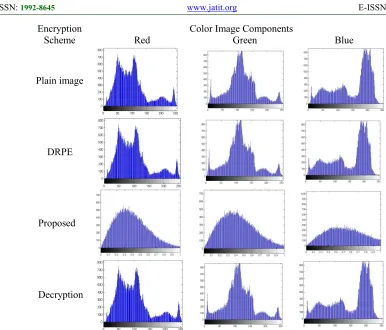
Measure of histogram of encrypted image components is performed to measure and ensure the proposed DCT optical DRPE color image
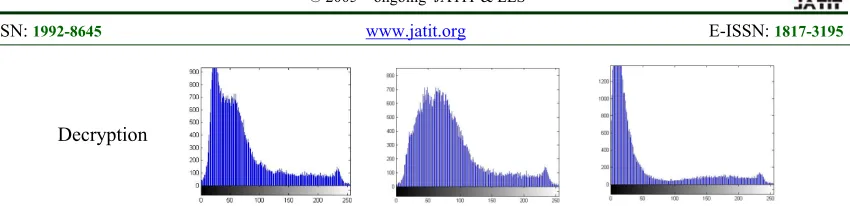
[image:4.612.97.503.300.695.2]cryptosystem. For good ciphering, the encryption imagecomponents histograms must be completely distinguished from the image components histograms of plain images. Figures. 6-8 show the histograms of encrypted Water Lillies, Lichtenstein and Bata image components and the histogram of their deciphered versions. The histograms of encrypted Water Lillies, Lichtenstein and Bata image components employed DRPE and the proposed DCT optical DRPE color image cryptosystem are completely different from the histograms of red, green and blue Water Lillies, Lichtenstein and Bata component plain images.
Table 1: Entropy outcomes of ciphered Water Lillies, Lichtenstein and Bata image components employing DRPE and the proposed DCT optical DRPE color image cryptosystem
Image Plain image
Encrypted image in Optical Encryption Techniques
DRPE Proposed
R G B R G B R G B
Water lilies 7.3916 7.3642 5.7566 7.538 7.5990 7.7134 7.5404 7.5986 7.6117 Lichtenstein 7.3520 7.4734 7.4925 7.464 7.7250 7.7641 7.4585 7.7139 7.8240 Bata 7.3222 7.4494 6.5965 7.366 7.4851 7.5630 7.3666 7.4924 7.5803
Encryption
Scheme Red Color Image Components Green Blue
Plain image
DRPE
Proposed
Decryption
4784 Encryption
Scheme Red Color Image Components Green Blue
Plain image
DRPE
Proposed
[image:5.612.94.480.71.401.2]Decryption
Fig. 7: Histogram outcomes of encrypted color Lichtenstein component images using DRPE and the proposed DCT optical DRPE color image cryptosystem
Encryption Scheme
Color Component Images
Red Green Blue
Plain image
DRPE
4785 Decryption
Fig. 8: Histogram results of ciphered color Bata component images using DRPE and the proposed DCT based-DRPE optical color image cryptosystem
4.4 Measures of Encryption Quality
The ciphered quality measures like correlation coefficient rxy, irregular deviation DI and
histogram deviation DH, are conducted for
comparing the ciphered quality of different ciphered schemes. The correlation coefficient
)
(Im,
E
r
is estimated between the original and ciphered image components that arranged like 1-D sequences as [29-31]:, ) ( ) ( ) cov(Im, ) (Im, E D I D E E r
(7) , )) ( ) ( ( (Im)) ) (Im( 1 ) cov(Im, L l i E Mean lm E Mean l L E (8) L l
i l Mean
L
D (Im( ) (Im))2,
1 (Im)
(9) L l
i E lm Mean E
L E
D ( ( ) ( ))2,
1 ) (
(10) where L is the number of pixels within the image. The objective is to get tiny correlation values between the original
Im(
x
i,
y
j)
and encrypted)
,
(
x
iy
jE
image components. Table 2 shows the correlation coefficient calculations among the original and encrypted image components using DRPE and the proposed DCT optical DRPE color image cryptosystem. The outcomes domenstrated that the porposed DCT optical DRPE color image cryptosystem verify correlation coefficient values that are close to tiny value than DRPE in all WaterLillies, Lichtenstein and Bata image components. This verifies the superiority of the proposed DCT optical DRPE color image cryptosystem with respect to correlation coefficient test. The histogram deviation estimates the ciphering quality with respect to how it increases the difffence between the plain and the encrypted image components. The histogram deviation
H
d can beestimated as [29-31]:
, 255
0 ( ) )
(Im,
MxN
i d i
E d H (11)
where
d
(
i
)
points the absolute difference between the histograms of original and the encrypted image components at pixel leveli
. TheM
andN
denote dimensions of image. The main objective is to verify higherH
d value to ensure that the ciphered image components are deviated from their corresponding image components. Table 3 shows theH
dtest calculations for the original and encrypted image components using DRPE and the proposed DCT optical DRPE l color image cryptosystem. The outcomes of the proposed DCT optical DRPE color image cryptosystem give largerd
H
values compared with DRPE.The irregular deviation estimates the encryption quality in terms of how much the deviation resulted by encryption is irregular [30-32]. The irregular deviation can be computed as [30-32]:
, 255
0 ( ) )
, ( Im
MxN
i hd i
E I d (12) , ) ( ) ( h M i h i d
h (13)
4786 main aim is to achieve lower
Im
d values that indicate a better encryption quality. Table 3 illustratesIm
d values for DRPE and the proposed DCT based-DRPE optical color image cryptosystem. The porposed DCT optical DRPE [image:7.612.93.519.204.350.2]color image cryptosystem have low
Im
dvalues against DRPE which ensures their achieved ciphered quality.Table 2: Deviation metrics and Correlation coefficient values for the encrypted Water Lillies, Lichtenstein and Bata images using DRPE and the proposed DCT optical DRPE color image cryptosystem
Image Metrics Ciphered image in Optical Encryption Techniques DRPE Proposed
R G B R G B
Water lilies DrxyH -9.9*10-4 0.6108 -0.0019 0.5699 -0.0012 1.4303 0.0036 0.6083 0.5714 0.0011 -8.3*10-4 1.4313
DI 0.7829 0.8648 0.8198 0.7850 0.8552 0.8222
Lichtenstein DrxyH -0.0027 0.3119 -0.0037 0.5035 0.0013 0.7012 2.7*10-4 0.0808 0.1206 0.0029 0.0010 0.1748
DI 0.8413 0.8564 0.6231 0.2129 0.2174 0.1575
Bata DrxyH 2.6*10-4 0.1397 -0.0025 0.0799 0.0069 0.3091 -8.6*10-4 0.1412 0.0785 0.0026 -0.0030 0.3099
DI 0.2231 0.2270 0.2055 0.2232 0.2276 0.2053
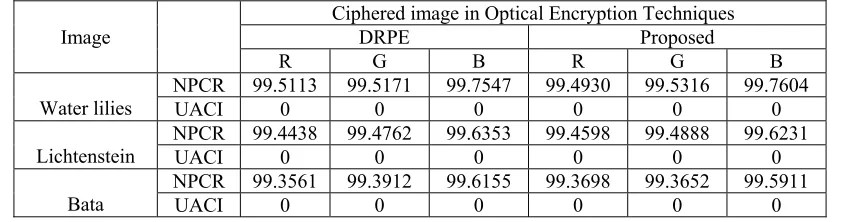
Table 3: NPCR and UACI using DRPE and the proposed DCT optical DRPE color image cryptosystem.
Image
Ciphered image in Optical Encryption Techniques
DRPE Proposed
R G B R G B
Water lilies NPCR UACI 99.5113 0 99.5171 0 99.7547 0 99.4930 0 99.5316 0 99.7604 0 Lichtenstein NPCR UACI 99.4438 0 99.4762 0 99.6353 0 99.4598 0 99.4888 0 99.6231 0 Bata NPCR UACI 99.3561 0 99.3912 0 99.6155 0 99.3698 0 99.3652 0 99.5911 0
4.5 Differential Measure
The differential measure is emploed to measure the effect of one-pixel modification on the whole encrypted image with baker mapping, DRPE and the proposed DCT optical DRPE color image cryptosystem. Two common tests are employed; number-of pixels changing rate (NPCR) and unified average changing Intensity (UACI). Assume two ciphered images
E
1andE
2 whose corresponding plain images have only one-pixel difference. The values of pixels at index(
x
i,
y
j)
inE
1and2
E
areE
1(
x
i,
y
j)
andE
2(
x
i,
y
j)
, respectively.If a pipolar array
D
(
x
i,
y
j)
with the same ciphered images size . TheD
(
x
i,
y
j)
is computedwith
E
1(
x
i,
y
j)
andE
2(
x
i,
y
j)
. If)
,
(
1
x
iy
jE
=E
2(
x
i,
y
j)
, thenD
(
x
i,
y
j)
1
;otherwise,
D
(
x
i,
y
j)
0
. The NPCR can beestimated as [29-31]:
,
% 100, ( , )
) 2 , 1
(
N M j
i yj
i x D E
E NPCR
[image:7.612.96.517.377.488.2]4787 %, 100 255 ) , ( 1 ) , ( 1 1 ) 2 , 1 (
j y i x j y i x E j y i x E N M E E UACI (15)The UACI calculates the average intensity of difference among the two encrypted color images. The results of number-of pixels changing rate and unified average changing Intensity measures are shown in table 3. The results encures that the proposed DCT optical DRPE color image cryptosystem is very sensitive to small modifications in image components, but the DRPE encryption is sensitive to small modifications in image components.
4.6 Measure of Noise Immunity
The robustness of DRPE and the proposed DCT optical DRPE color image cryptosystem in existence of Additive White Gaussian Noise (AWGN), Salt&peppers and Speckle existence are examined in the decryption process.
4.6.1 The peak signal to noise ratio (PSNR)
The Peak Signal to Noise Ratio (PSNR) is conducted to estimate the deciphered image components.
The Peak Signal to Noise Ratio can be defined as [32-33]: 1 0 1 0 2 )] , ( ) , [Im( 2 ) 255 ( log 10 ) (Im, W i H
j xi yj Dxi yj
D PSNR
(16) where
Im(
x
i,
y
j)
is the pixel value of color plainimage location
(
x
i,
y
j)
, andD
(
x
i,
y
j)
is thedecrypted of pixel value color image at location
)
,
(
x
iy
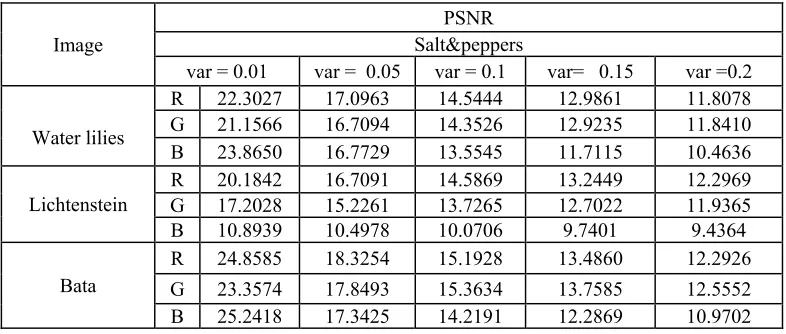
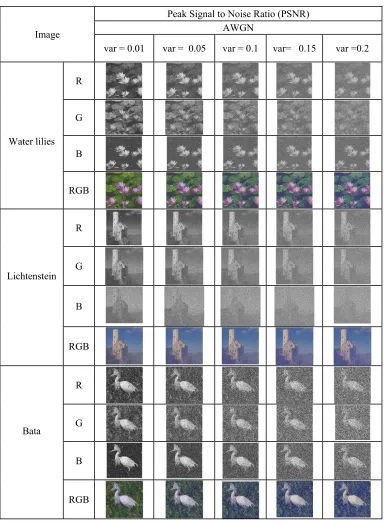
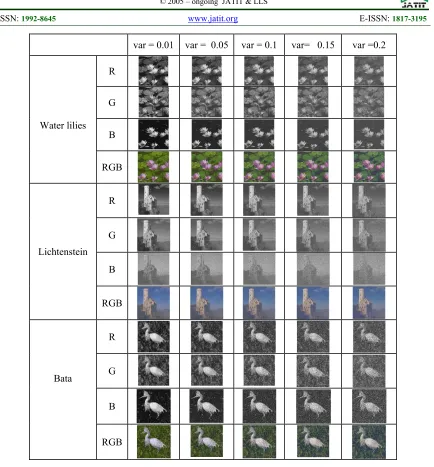
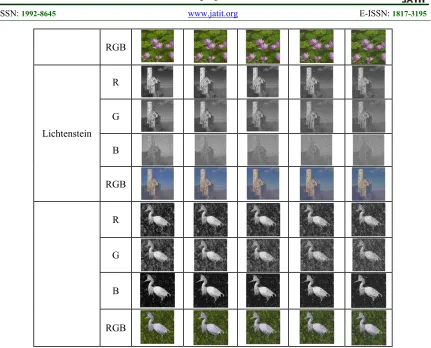
j . High PSNR values indicate goodimmunity against noise. The noise immunity results are given in Tables 4,5,6,7,8 and 9. The results demonstrate that the proposed DCT optical DRPE color image cryptosystem has better immunity against noise than DRPE which verifies it a best
choice for ideal optical telecommunication applications which can cancelling the noise effects.
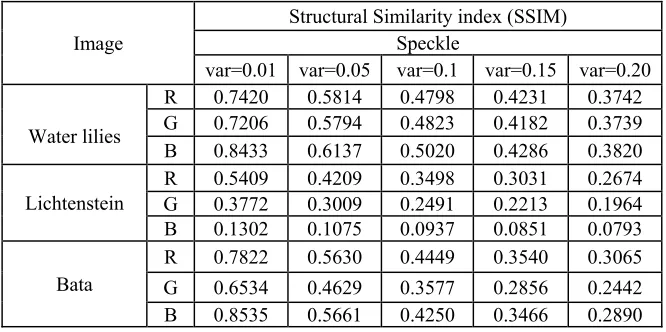
4.6.2 The Structural Similarity (SSIM)
The SSIM is computed to estimate the decrypted red, green and blue components.
The SSIM can be computed as [33]:
(17)
where, C1, C2 are minor constants, and are
the average of and regions, respectively. is the variance of region and is covariance among two regions . The SSIM test results are given in Tables 10,11 and 12. The results demonstrate that the proposed DCT based-DRPE optical color image cryptosystem has good resistance against noise.
4.6.3 The Feature Similarity Index (FSIM)
The FSIM estimates the decrypted red, green and blue components.
The SSIM can be computed as [33]:
(18)
4788
Table 4: Peak Signal to Noise Ratio (PSNR) values of the deciphered Water Lillies, Lichtenstein and Bata images using the proposed DCT optical DRPE color image cryptosystem in the excitance of AWGN noise with different variances
(var) on the encrypted images.
Image
PSNR AWGN
var = 0.01 var = 0.05 var = 0.1 var= 0.15 var =0.2
Water lilies
R 14.6064 11.8063 10.1885 9.1293 8.4097 G 14.2552 11.7532 10.3585 9.4343 8.7664 B 14.0415 10.8038 9.0007 7.8425 7.0153 Lichtenstein R 14.4901 12.0559 10.6245 9.7062 9.0010 G 13.3891 11.6358 10.5730 9.8548 9.3025
B 9.8104 9.1715 8.7834 8.4596 8.2084
Bata R 15.6171 12.3209 10.5778 9.3952 8.5785
[image:9.612.110.503.356.523.2]G 15.4682 12.5313 10.8348 9.7710 9.0262 B 14.6890 11.2465 9.4431 8.2239 7.4330
Table 5: Peak Signal to Noise Ratio (PSNR) values of the deciphered Water Lillies, Lichtenstein and Bata images using the proposed DCT optical DRPE color image cryptosystem in the excitance of Salt&peppers noise with
different variances (var) on the encrypted images
Image
PSNR Salt&peppers
var = 0.01 var = 0.05 var = 0.1 var= 0.15 var =0.2
Water lilies
R 22.3027 17.0963 14.5444 12.9861 11.8078
G 21.1566 16.7094 14.3526 12.9235 11.8410
B 23.8650 16.7729 13.5545 11.7115 10.4636
Lichtenstein
R 20.1842 16.7091 14.5869 13.2449 12.2969
G 17.2028 15.2261 13.7265 12.7022 11.9365
B 10.8939 10.4978 10.0706 9.7401 9.4364
Bata
R 24.8585 18.3254 15.1928 13.4860 12.2926
G 23.3574 17.8493 15.3634 13.7585 12.5552
B 25.2418 17.3425 14.2191 12.2869 10.9702
Table 6: Peak Signal to Noise Ratio (PSNR)values of the deciphered Water Lillies, Lichtenstein and Bata images using the proposed DCT optical DRPE color image cryptosystem in the excitance of Speckle noise with different variances
(var) on the encrypted images
Image
PSNR Speckle
var =0.01 var = 0.05 var = 0.1 var= 0.15 var =0.2
Water lilies
R 22.8564 18.8908 16.6980 15.4729 14.4877 G 21.1890 17.7256 15.8119 14.6641 13.8811 B 31.9634 24.7476 21.5646 19.35424 17.9088 Lichtenstein
R 19.7610 17.0235 15.5422 14.5421 13.7974 G 16.5384 14.8396 13.7313 13.1105 12.6271 B 10.5300 9.9767 9.6577 9.4716 9.3337 Bata
[image:9.612.121.492.568.739.2]4789
Table 7: Peak Signal to Noise Ratio (PSNR) values of the deciphered Water Lillies, Lichtenstein and Bata images using the proposed DCT optical DRPE color image cryptosystem in the exitance of AWGN noise
with different variances (var) on the encrypted images
Image
Peak Signal to Noise Ratio (PSNR) AWGN
var = 0.01 var = 0.05 var = 0.1 var= 0.15 var =0.2
Water lilies R
G
B
RGB
Lichtenstein R
G
B
RGB
Bata
R
G
B
RGB
Table 8: Peak Signal to Noise Ratio (PSNR)values of the deciphered Water Lillies, Lichtenstein and Bata images using the proposed DCT optical DRPE color image cryptosystem in the excitance of Salt&peppers noise with different
variances (var) on the encrypted image components
Image Peak Signal to Noise Ratio (PSNR)
4790
var = 0.01 var = 0.05 var = 0.1 var= 0.15 var =0.2
Water lilies R
G
B
RGB
Lichtenstein R
G
B
RGB
Bata
R
G
B
[image:11.612.93.527.60.527.2]RGB
Table 9: Peak Signal to Noise Ratio (PSNR)values of the deciphered Water Lillies, Lichtenstein and Bata images using the proposed DCT optical DRPE color image cryptosystem in the excitance of Speckle noise with different variances
(var) on the encrypted image components
Image
PSNR Speckle
var = 0.01 var = 0.05 var = 0.1 var= 0.15 var =0.2
Water lilies R
G
4791 RGB
Lichtenstein R
G
B
RGB
R
G
B
[image:12.612.93.524.65.413.2]RGB
Table 10: SSIM values of the deciphered Water Lillies, Lichtenstein and Bata images using the proposed DCT optical DRPE color image cryptosystem in the excitance of AWGN noise with zero mean and different variances
(var)on the ciphered red, green and blue component images
Image
Structural Similarity index (SSIM) AWGN
var = 0.05 var = 0.1 var= 0.15 var = 0.20 var =0.25
Water lilies
R 0.3979 0.2762 0.2080 0.1661 0.1333
G 0.4183 0.2912 0.2157 0.1721 0.1326
B 0.2815 0.2025 0.1553 0.1271 0.1045
Lichtenstein R 0.3110 0.2149 0.1645 0.1330 0.1070
G 0.2456 0.1739 0.1373 0.1140 0.0962
B 0.1025 0.0846 0.0645 0.0561 0.0523
Bata R 0.2671 0.1544 0.1036 0.0744 0.0567
G 0.2545 0.1464 0.0996 0.0729 0.0560
4792
Table 11: SSIM values of the decrypted red, green and blue Water Lillies, Lichtenstein and Bata images using the proposed DCT based-DRPE optical color image cryptosystem in the excitance of Salt&peppers noise different
variances (var) on the encrypted image components
Image
Structural Similarity index (SSIM) Salt&peppers
var=0.01 var=0.05 var=0.1 var=0.15 var=0.20
Water lilies
R 0.7221 0.5028 0.3815 0.3113 0.2526 G 0.7191 0.5312 0.4133 0.3323 0.2658 B 0.5822 0.3486 0.2604 0.2090 0.1735 Lichtenstein
R 0.5598 0.4061 0.3084 0.2520 0.2099 G 0.4086 0.3196 0.2558 0.2115 0.1757 B 0.1457 0.1296 0.1129 0.1029 0.0884 Bata
[image:13.612.140.473.349.515.2]R 0.6632 0.3652 0.2332 0.1688 0.1298 G 0.5987 0.3443 0.2356 0.1725 0.1308 B 0.5849 0.2679 0.1734 0.1245 0.0900
Table 12: SSIM values of the deciphered Water Lillies, Lichtenstein and Bata images using the proposed DCT optical DRPE color image cryptosystem in the excitance of Speckle noise with different variances (var) on the encrypted image
components .
Image
Structural Similarity index (SSIM) Speckle
var=0.01 var=0.05 var=0.1 var=0.15 var=0.20
Water lilies
R 0.7420 0.5814 0.4798 0.4231 0.3742 G 0.7206 0.5794 0.4823 0.4182 0.3739 B 0.8433 0.6137 0.5020 0.4286 0.3820 Lichtenstein
R 0.5409 0.4209 0.3498 0.3031 0.2674 G 0.3772 0.3009 0.2491 0.2213 0.1964 B 0.1302 0.1075 0.0937 0.0851 0.0793 Bata
R 0.7822 0.5630 0.4449 0.3540 0.3065 G 0.6534 0.4629 0.3577 0.2856 0.2442 B 0.8535 0.5661 0.4250 0.3466 0.2890
Table 13: FSIM values of the deciphered Water Lillies, Lichtenstein and Bata images using the proposed DCT optical DRPE color image cryptosystem in the excitance of AWGN noise with zero mean and different variances (var)on the
encrypted image components.
Image
Feature Similarity index (FSIM) AWGN
var = 0.05 var = 0.1 var = 0.15 var = 0.20 var =0.25
Water lilies
R 0.7295 0.6499 0.6010 0.5675 0.5440
G 0.7242 0.6433 0.5903 0.5619 0.5429
B 0.7830 0.6913 0.6246 0.5854 0.5516
Lichtenstein
R 0.6711 0.5982 0.5557 0.5275 0.5082
G 0.6165 0.5583 0.5262 0.5063 0.4885
B 0.4721 0.4546 0.4401 0.4326 0.4277
Bata
R 0.6377 0.5499 0.5081 0.4802 0.4629
G 0.6069 0.5291 0.4891 0.4633 0.4485
[image:13.612.122.496.560.728.2]4793
Table 14: FSIM values of the deciphered Water Lillies, Lichtenstein and Bata images using the proposed DCT optical DRPE color image cryptosystem in the excitance of Salt&peppers noise with different variances (var) on the encrypted
image components .
Image
Feature Similarity index (FSIM) Salt&peppers
var=0.01 var=0.05 var=0.1 var=0.15 var=0.20
Water lilies
R 0.9008 0.7930 0.7187 0.6721 0.6336 G 0.8901 0.7919 0.7232 0.6687 0.6264 B 0.9407 0.8395 0.7558 0.7011 0.6547 Lichtenstein
R 0.8290 0.7375 0.6270 0.6293 0.6001 G 0.7393 0.6769 0.6243 0.5881 0.5604 B 0.5115 0.4996 0.4816 0.4730 0.4618 Bata
[image:14.612.151.465.342.564.2]R 0.8574 0.7077 0.6271 0.5764 0.5461 G 0.8200 0.6698 0.6001 0.5562 0.5254 B 0.8709 0.7052 0.6214 0.5676 0.5278
Table 15: FSIM values of the deciphered Water Lillies, Lichtenstein and Bata images using the proposed DCT optical DRPE optical color image cryptosystem in the excitanse of Speckle noise with different variances (var) on the
encrypted image components.
Image
Feature Similarity index (FSIM) Speckle
var=0.01 var=0.05 var=0.1 var=0.15 var=0.20
Water lilies
R 0.9098 0.8341 0.7768 0.7436 0.7142 G 0.8881 0.8192 0.7655 0.7238 0.6973 B 0.9808 0.9481 0.9172 0.8860 0.8613
Lichtenstein
R 0.8164 0.7443 0.7022 0.6665 0.6925 G 0.7156 0.6627 0.6209 0.5992 0.5815 B 0.4996 0.4814 0.4710 0.4676 0.4609
Bata
R 0.9073 0.8104 0.7511 0.6977 0.6693 G 0.8455 0.7446 0.6830 0.6374 0.6097 B 0.9574 0.8651 0.8012 0.7561 0.7190
4.7 Occlusion measure
The cipher image may be attached during transmission and strong So, its resistance to occlusion test must be considered. The decryption phase is performed on the occluded ciphered Water Lillies and Lichtenstein. The occluded encrypted
4794
a) Encrypted image Water Lilies with
occlusion 25%
b) Decrypted image Water Lilies with
occlusion 25%
c) Encrypted image Lichtenstein with
occlusion 25%
d) Decrypted image Lichtenstein with
occlusion 25%
e) Encrypted image Water Lilies with
occlusion 50%
f) Decrypted image Water Lilies with
occlusion 50%
g) Encrypted Lichtenstein image with occlusion 50%
h) Decrypted Lichtenstein image with occlusion 50%
i) Encrypted image Water Lilies with
occlusion 75%
j) Decrypted image Water Lilies with
occlusion 75%
k) Encrypted image Lichtenstein with
occlusion 75%
l) Decrypted image Lichtenstein with
[image:15.612.98.528.61.496.2]occlusion 75% Fig. 9: Immunity of the proposed encryption syatem to occlusion measure for the encrypted images
Water Lilies and Lichtenstein with occlusion (25, 50, and 75%).
5. CONCLUSION
An efficient DCT- optical color image encryption using DCT and DRPE, is the main finding of this paper. In the proposed technique, the image components are discrete cosine transformed and modulated the first random diffuser, then Fourier transformed. The complex color image components are then by discrete cosine transformed modulated by a second random diffuser and Fourier transformed again. A set of experiments have been performed in order to study the performance of the proposed DCT optical-DRPE color image cryptosystem. The outcomes verifie the effectivity of the proposed DCT optical DRPE color image cryptosystem
.
REFRENCES:
[1]
R. Tao, J. Lang, Y. Wang, "Optical image encryption based on the multipleparameter fractional Fourier transform," Opt. Lett. 33, pp. 581–583, 2008[2]
H.M. Ozaktas, A. Koc, I. Sari, M.A. Kutay, "Efficient computation of quadraticphase integrals in optics," Opt. Lett. 31, pp. 35–37, 2006.[3]
Z. Liu, S. Liu, "Randomization of the Fourier transform," Opt. Lett. 32, pp. 478–480, 2007.[4]
Z. Liu, S. Liu, "Double image encryption based on iterative fractional Fourier transform," Opt. Commun. vol. 275, pp. 324–329, 2007.4795 in gyrator transform domains," Opt. Lasers Eng., vol. 57, pp. 9-13, 2014.
[6]
Abuturab MR., "An asymmetric color image cryptosystem based on Schur decomposition in gyrator transform domains," Opt. Lasers Eng., vol. 58, pp. 39-47, 2014.[7]
Abuturab MR., "Single-channel color information security system using LU decomposition in gyrator transform domains," Opt. Commun., vol. 323, pp. 100-109, 2013.[8]
Abuturab MR., "Color image security system based on discrete Hartley transform in gyrator transform domain, " Opt. Lasers Eng., vol. 51, pp. 317-324, 2013.[9]
Liu Z, Dai J, Sun X, Liu S., "Color image encryption by using the rotation of color vector in Hartley transform domains," Opt. Laser Eng., vol. 48, pp. 800–805, 2010.[10]
Liu Z, Dai J, Sun X, Liu S., "Optical color image hiding scheme based on chaotic mapping and Hartley transform," Opt. Laser Eng., vol. 51, pp. 967-72, 2013.[11]
P. Refregier and B. Javidi, "Optical image encryption based on input plane and Fourier plane random encoding" Opt. Lett., vol. 20, pp. 767-769, 1995.[12]
Matoba O, Javidi B., "Encrypted optical storage with angular multiplexing," Appl. Opt., vol. 38, pp. 7288–7293, 1999.[13]
Javidi B, Takanori N., "Securing information by use of digital holography," Opt. Lett. vol. 25, pp. 28-30, 2000.[14]
Liu Z, Liu S., "Random fractional Fourier transform," Opt. Lett. vol. 32, pp. 2088-2090, 2007.[15]
Hwang H-E, Chang HT, Lie W-N., "Multiple-image encryption and multiplexing using a modified Gerchberg–Saxton algorithm and phase modulation in Fresnel-transform domain," Opt. Lett., vol. 34, pp. 3917–3919, 2009.[16]
Chen W, Chen X, Sheppard CJR. "Optical image encryption based on diffractive imaging," Opt. Lett., vol. 35, pp. 3817-3819, 2010.[17]
Alfalou A, Brosseau C., "Dual encryption scheme of images using polarized light," Opt. Lett., vol. 35, pp. 2185–2187, 2010.[18]
Chen L, Zhao D., "Optical image encryption with Hartley transforms, " Opt. Lett. vol. 20, pp. 767-769, 2006.[19]
Hwang HE. "An optical image cryptosystem based on Hartley transform in the Fresnel transform domain, " Opt. Commun., vol. 284, pp. 3243–3247, 2011.[20]
Chen J, Zhu Z, Liu Z, Fu C, Zhang L, Yu H., "A novel double-image encryption scheme based on cross-image pixel scrambling in gyrator domains," Opt. Express, vol. 22, pp. 7349–7361, 2014.[21]
Alfalou A, Elbouz M, Mansour A, Keryer G., "New spectral image compression method based on an optimal phase coding and the RMS duration principle," J. Opt., vol. 12, 115403, 2010.[22]
Alfalou A, Brosseau C, Abdallah N, Jridi M., "Simultaneous fusion, compression, and encryption of multiple images," Opt. Express, vol. 19, 24023, pp. 2402-2409, 2013.[23]
Alfalou A, Brosseau C, Abdallah N, Jridi M., "Assessing the performance of a method of simultaneous compression and encryption of multiple images and its resistance against various attacks," Opt. Express, vol. 21, 8025-8043, 2013.[24]
Zhang SQ, Karim MA., "Color image encryption using double random phase encoding," Microw. Opt. Technol. Lett. vol. 21, pp. 318-323, 1999.[25]
Joshi M, Shakher C, Singh K., "Logarithms-based RGB image encryption in the fractional Fourier domain: a non-linear approach," Opt. Lasers Eng., vol. 47, pp. 721-727, 2009.[26]
Liu Z, Xu L, Liu T, Chen H, Li P, Lin C, et al., "Color image encryption by using Arnold transform and color-blend operation in discrete cosine transform domains," Opt. Commun. vol. 284, pp. 123-128, 2011.[27]
Chen W, Chen X, Sheppard CJR. "Optical color-image encryption and synthesis using coherent diffractive imaging in the Fresnel domain," Opt. Express, vol. 20, pp. 3853-3865, 2012.[28]
G. Strang, “The Discrete Cosine Transform”, SIAM Review, Volume 41, Number 1, pp.135-147, 1999.4796