5153
A SURVEY: CHALLENGES OF IMAGE SEGMENTATION
BASED FUZZY C-MEANS CLUSTERING ALGORITHM
1WALEED ALOMOUSH, 2AYAT ALROSAN, 3NORITA NORWAWI, 4YAZAN ALOMARI,
5DHEEB ALBASHISH, 6AMMAR ALMOMANI, 7MOHAMMED ALQAHTANI
1, 4, 7 Imam Abdulrahman Bin Faisal University, Department of Computer Science, Saudi Arabia 2,3Universiti Sains Islam Malaysia, Department of Computer Science, Malaysia
5,6Al-Balqa' Applied University, Department of Computer Science, Jordan
E-mail: 1[email protected]
ABSTRACT
Image segmentation is the method of dividing an image into many segments that comprise groups of pixels. In many real applications such as images segmentation there are issues such as limited spatial resolution, poor contrast, overlapping intensities, noise and intensity in homogeneities. The semi and fully automatic image segmentation are a difficult and complicated process due to several reasons such as the different appearance of intensity level, patterns of objects inside image, overlapping among different regions (segments), and partial volume effects (noise level). Fuzzy c-means (FCM) algorithm is the most popular method used in image segmentation due to its robust characteristics for ambiguity. Although, the conventional FCM algorithm suffer from some weaknesses such as initialize clusters center, determine the optimal number of clusters and sensitive to noise. This paper presents the review challenges of image segmentation based FCM algorithm and describe how solve these kinds of FCM problems.
Keywords: Image Segmentation, Fuzzy Clustering, FCM, Metaheuristic Search Algorithms, Fitness Functions
1. INTRODUCTION
Image segmentation is process used to determine objects within the image. The outcome of image segmentation is a group of segments that cover all the objects in image. The objects (pixels) within a segment are similar with regard to some features or computed property, such as intensity, color and texture. Adjacent segments are significantly different with regard to some features [1-3].
Image segmentation is successful in many aspects, such as medical images segmentation can be used to extract tumors and other pathologies. Image segmentation plays a crucial role in a number of operations, surgical emulation, therapy estimate, anatomical structure review and also treatment strategy [4, 5]. Also, in the pattern recognition area, image segmentation is used to separating ROIs (regions of interest) from images that contain ROIs such as faces recognitions, fingerprints, signatures, satellite images (roads, forests, crops, etc.), but segmentation of such images is difficult [1, 6]. Manual segmentation of images is possible, it is involves manually finding the boundaries the region of interest (ROIs), such as drawing the
region of anatomic structures with various labels. In manual image segmentation, human experts and operators (radiologists/anatomists/trained technologists) are determined the information given in the image and support of additional knowledge such as structure of segment. Manual segmentation need to software applications with complicated graphical user interfaces to simplify finding regions of interest and image show. In practice, the selection of the region of interest (ROI), is a uninteresting and time consuming task in manual segmentation [2, 4].
During the last several decades different algorithms have been proposed in the literature [2, 7, 8]. These algorithms, which normally work with intensity (gray level) images, can be categorized into different groups as follows: clustering based, thresholding-based, region-based, edge-based, and deformable-based approaches. Many studies review for image segmentation method are discuses in the literature [2, 3, 7, 8].
5154 an image into regions of interest, based on specific characteristic of these pixels. In accordance with this concept, several of the clustering algorithms have been employed to solve the image segmentation problems [9-12]
As well as, in many real image applications, limitations such as problems in spatial resolution, poor contrast, overlapping between boundaries and intensity inhomogeneities make the methods of segmentation a difficult task. To avoid this obstacle, fuzzy set theory was presented, with the idea of partial membership of containing described by a membership objective function. Fuzzy clustering approach as a segmentation method was most frequently studied and useful applied in image segmentation [1, 12-14].
Among the fuzzy clustering methods, fuzzy c-means (FCM) algorithm is a well-known method used in image segmentation as it has robust characteristics for ambiguity and can keep much more information than hard segmentation methods. In this perspective, fuzzy clustering-based segmentation techniques offer significant advantages, because most images exhibit unclear boundaries between their regions and the majority of the images display ambiguous restrictions between regions [1, 4, 13, 15, 16].
The main purpose of this paper is review the main challenges in FCM clustering algorithms, which are represented as follow, firstly the conventional FCM algorithm works well on most noise-free images but it has a serious limitation: it does not incorporate any information about spatial context, which causes it to be sensitive to noise and imaging artefacts [13, 17-19]. The pixels on a gray image are highly overlapping, i.e. the pixels in the immediate neighborhood possess nearly the same feature data. Secondly, the selection of initial clusters center is considered one of the most challenging tasks in FCM clustering algorithm. Thirdly, determine the optimal number of clusters (regions) in each (image) [1, 4, 20-22]. The map of literature in this research is providing as in figure .1.
The rest of this paper is organized as follows. Section 2 data clustering, Section 3 image segmentation based clustering approaches. The main finding from this survey is presented in Section 4. Finally, conclusion in Section 6.
2. DATA CLUSTERING
Data clustering is a statistical approach used for managing large data volume. It is a multivariate statistical approach, which identifies patterns and relationships that exist amongst data. By data clustering, user could divide data into
groups that are relatively homogeneous, and by reorganizing these groups, user may be able to
Figure 1: the map of literature in this research
efficiently utilize original data volume. Clustering accuracy is crucial because, using clustered data that do not accurately denote the original data will lead to adverse consequences [1, 23]. Data clustering is a set of patterns or points that are usually described as vectors of features, measurements, or points existing in a multidimensional space [24].
2.1 Notation and Terminology
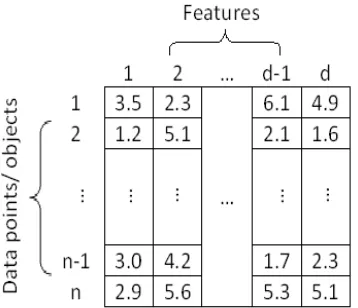
The algorithms of clustering have conventionally been represented on a set of n objects or patterns, which denote the constituents of a X, where X={x1,x2,…xn} each of which,
d i
X , is a feature vector, that contains d
real-valued measurements, which demonstrate the object’s characteristics that xi represents.
An individual cluster can be distinguished from others by certain representative point(s) and most methods of clustering employ this type of characterizations such that, for a specified cluster I, an ideal point vi is in existence, such that,
d i
v , that best symbolizes the members of
cluster i. This point is termed as the cluster’s centre, centroid or prototype. Therefore, the problem of clustering is in terms of discovering a set of c centroids, V={v1,v2,…,vc} where
1,2,..., c i
d i
v
best denotes the structure of clustering in X. As indicated by [25, 26], the aforementioned clusters vi are comprised
Challenges of Image Segmentation based
Fuzzy C-Means FCM Sensitive to noise
Initialize Clusters Centroids
5155 of data points (patterns) which are identical amongst them. As such, the similarity measuring process between the dataset’s patterns becomes a crucial process as it is the base of data points’ clustering. It is possible that the measure of similarity shows a sign of relationship, likeness, closeness or understanding, and the higher the degree of similarity shown by two data objects, the bigger the indicator of similarity will be, and vice versa. Figure 2 an example of a data clustering.
FIGURE 2: An example of a dataset clustering.
It is possible to find datasets that do not have numeric data, that is, the datasets may hold different data forms for instance, nominal, binary, missing, non-continuous, heterogeneous data forms, just to name a few. As such, it is imperative that the similarity measure is carefully selected for instance, according to Nayak, et al. [23], the Euclidean distance is the frequently proposed measure for continuous numeric data. In particular, the Euclidean distance amongst two data vectors is an index of dissimilarity. Meanwhile, the index of similarity makes up the correlation. The Euclidean distance d between two objects xi and xj is illustrated as in Equation (1):
d
1 k
2 k , j x , k , i x j
x i x j x , i x 2
d . (1)
The Minkowski metric is a more generalized Euclidean distance particularly when 2. As indicated by Jain (2010), the Minkowski metric is expressed as in Equation 2:
d
k j k
x k i x j
x i x j x i x d
1 ,
, , ,
(2). Further, Kaufman and Rousseeuw [27] term the
measure as the Manhattan distance in the situation where 2. However, from the literature available, there are numerous methods of distance
measure which can be employed as similarity measure for instance, the aforementioned Manhattan distance, the Mahalanobis distance, the cosine distance, matching coefficients and so on, and when choosing the appropriate method, the type of data of the dataset will be used as the determining factor. Further, the common methods of similarity measures’ extractions for diverse types of data have been introduced by [28].
2.2 Fuzzy Partitional Clustering
The algorithms of clustering are generally divided into two sets namely, the partitional clustering which generates a number of partitions and the hierarchical clustering which generates only one partition [24]. As indicated by Nayak, et al. [23] in pattern recognition applications, the partitional clustering is the more widely employed because it is free from issues such as static-behaviour of which elements of data of a cluster is unmovable to another cluster. Additionally, this type of clustering also does not have the problem of overlapping clusters’ separation inability, a problem that is common in hierarchical clustering. There are two groups of partitional clusteringcrisp (hard) clustering, in this type each data elements belongs to only one cluster.
a. Crisp/ hard clustering, in which each element of data belongs to one cluster.
b. Fuzzy/ soft clustering, in which element of data could belong to more than one cluster at one time in accordance to the degree of membership of a particular fuzzy.
According to Bezdek, et al. [29] the central goal in crisp clustering is partitioned dataset Y to non-overlapping and non-null partitions(Y1,Y2,..., Yc ),
where
c
signifies the number of clusters that dataset is partitioned to, such as2 c n . Itsdefinition as in Equations 3, 4 and 5
Y Y i c
i1 ; (3)
Wher
j i j Y i
Y
; (4) and
; 1 , i c i
Y
5156 n c ij u U
where the fuzzy membership of fuzzy is denoted U ij 0,1 of the ith element
to the jth fuzzy cluster. As indicated by some scholars [23, 30] the use of fuzzy on the datasets with uncertain boundaries between regions or clusters is more fitting than the use of crisp clustering. The approach and also the characteristics of partitional fuzzy are highlighted below.
Fuzzy clustering is a technique of partitional clustering grounded on the fuzzy soft set theory’s objects. According Nayak, et al. [23], the fuzzy soft set theory stipulates that for a particular discourse’s universe, each object in the aforesaid universe have its place in a differing point to all sets expressed in the universe. Meanwhile, in fuzzy clustering, the discourse universe comprises of every object in a particular dataset and the sets that are expressed on the universe make up the clusters. With regards to objects, they do not belong to just one cluster; rather, each has certain membership degree with all clusters.
By employing the framework of fuzzy sets, user could deal with issues relating to source inaccuracy in describing the class membership criteria. In fact, fuzzy clustering can efficiently solve these kinds of problems, fuzzy clustering has been successfully employed in numerous problems relating to pattern recognition as well as image analysis whose datasets have uncertain boundaries amongst regions. As an example, images generated by the MRI typically contain regions that have fuzzy and unclear boundaries. However, via the use of fuzzy clustering, user could significantly cope with such type of data. Particularly the FCM, since, as documented by Bezdek, et al. [29], it is the most commonly employed fuzzy clustering algorithm. The next sections will describe FCM alongside its strengths and shortcomings and discuss the clustering techniques of fuzzy validation.
2.3 Fuzzy C-means clustering
FCM is a unsupervised learning approach that is capable of partitioning identical data elements based on level of similarity, which increases the similarity of elements within a group and decreases the similarity among elements between various groups[23, 29]. A clustering algorithm for grouping fuzzy data is carried out on a collection of n elements (i.e pixels), and each of these elements is
d i
X
a characteristic vector which consists of d real-valued dimensions that reveal the characteristics of the element depicted by Xi . A
fuzzy membership matrix, referred to as fuzzy partition as in Equation 6
c j n i c j ij u and n n i ij u ij u cn U fcn M 1 1 ; 1 ; 1 , 0 , 1 0 , 1 (6)represents the fuzzy clusters c of the elements, where signifies the fuzzy membership of the ith elements to the jth fuzzy cluster. For example, each and every data element is related to a specific (probably zero) degree of every single fuzzy cluster. A FCM algorithm is a repetitive technique capable of locally decreasing the following objective functions as in Equation 7
c i n j j i m ij
m u x v
J
1
2
1 (7)
where v j cj1 is the centroids of the clusters c,
which indicates the standard of the inner product
. (e.g., Euclidean distance) from the data point
i
x to the jth cluster centre; furthermore, the
parameter
m
1
,
is a distort proponent on each fuzzy membership, which ascertains the level of fuzziness of the ensuing classification. The following is a summary of the FCM steps: Choose the number of fuzzy clusters c.
Select initial cluster centers
v
i,
v
2,...,
v
c . Estimate the components of the fuzzy partitionmatrix as in Equation 8
c k m k i j i ij v x v x U 1 1 2 1 (8) Calculate the cluster centers as in Equation 9
n i m ij n i i m ij j u x u v 1 1 . (9) Repeat until the number of iterations (t) surpasses the set limit, or a termination criterion is met as in Equation 5
old newv
v
(10) where
0
.
001
3 IMAGE SEGMENTATION BASED
CLUSTERING APPROACHES
5157 such features of data. Consequently, it is not unusual that the FCM algorithm is the most extensively employed algorithm [13, 15, 16]. During the past thirty years, a lot of strategies based upon the FCM algorithm have been proposed, to resolve the problems of image segmentation in various fields. Some of these studies have been aimed at enhancing the effectiveness of FCM in segmenting image, to minimize the influence of image relics, such as, noise and outliers. The FCM still endured a significant disadvantage, which is, lack of potential to deliver a completely automatic segmentation structure (number of clusters) and location centroid. The ideal number of regions (clusters) in each image is believed to be identified and entered by the operator, which tends to make the system semi-automatic, and subject to operator variation. However, little effort has been made in the direction of different types of approaches based FCM during the last several years.
3.1 Image segmentation based FCM suffer from initialize cluster centroids and number of clusters.
Image segmentation by clustering based approach still has major weaknesses such as in the capability to obtain a fully automatic segmentation approach without prior knowledge and location centroid. Meanwhile, the optimal clusters number in each image is supposed to be known and provided by the experts or operators, making this approach a semi-automatic segmentation method which consumes time because of the experts’ availability. In the image segmentation that is cluster based, determining the number of clusters in a given dataset is considered as a main challenge. In fact, many researchers have worked during the last several years on the development of a clustering approach which could determine the appropriate number of clusters without experts, operators and any prior knowledge. A fuzzy clustering approach based on metaheuristic optimization search algorithms is considered a suitable choice to solve the problems of fuzzy clustering based. In this paper, many methods are discussed to solve this problem as follows
.
3.1.1 FCM based Artificial Bee Colony
Ouadfel and Meshoul [31] proposed the fuzzy clustering FCM based on a modified Artificial Bees Colony algorithm MoABC which is called MoABC-FCM. It is a mutation method is inspired by the Differential Evolution DE developed in order to enhance the exploitation process. The outcomes show that the MoABC-FCM algorithm enhances the effectiveness of the original FCM and
it is better than other related works that are based on optimization search algorithm. They compared the MoABC-FCM method performance with the original FCM, the standard ABC, modified ABC and the particle swarm optimization PSO. All these methods were applied on a set of gray scale images. The outcomes show that the MoABC-FCM is more efficient.
Salima, et.al [32] presented a new spatial fuzzy clustering algorithm optimized by the Artificial Bee Colony (ABC) algorithm called ABC-SFCM. It has two major characteristics. First, it tackles noisy image segmentation better by making use of the spatial local information into the membership function. Secondly, it improves global performance by taking advantage of the global search capability of ABC. Experiments with synthetic and real images show that ABC-SFCM is robust to noise compared to other methods.
Balasubramani and Marcus [33] used artificial bee colony algorithm to improve the segmentation efficiency of FCM on abnormal MRI images. Additionally, Shokouhifar and Abkenar [34] presented modified matrix of intensity by ABC before performing fuzzy c-means clustering algorithm and a probability of noise for each pixel (voxel) within the image; then according to their probability of noise, the artificial bee colony algorithm classified pixels into two sets: normal and noisy. They reduced the time of response with a quality better than that of other related work algorithms. The proposed approach is efficient in performance and speed and prevents stuck in local optimum. From the obtained experimental results, ABC showed better performances compared with GA and ACO algorithms. Also, the ABC is quicker in finding optimal solution.
Hancer, et al. [35] presented an image segmentation method using ABC algorithm to detect brain tumors from the MRI brain image which is one of the most useful tools used for diagnosing and treating medical cases. The proposed methodology comprises three steps: preprocessing of the input MRI image, processing which is segmentation using the ABC based fuzzy clustering method, and post-processing that leads to extraction of brain tumors. The proposed methodology is compared and analyzed on MRI images in different locations of a patient’s brain with the methodologies using K-means, FCM and GA algorithms. It is observed from the experimental studies that the segmentation process with the ABC algorithm obtains the best results both visually and numerically.
5158 combined the artificial bee colony optimization and the original FCM. FABC used fuzzy membership fitness function to find the optimum cluster centers by ABC. The FABC reduced the weaknesses of FCM as it didn’t depend on the selection of initial cluster centers. The FABC is more efficient because its take the capability of ABC randomized for the centroids initialization. In the experiments, the authors applied FABC, GA, PSO and EM on various gray scale images including synthetic, medical and texture images. The segmentation of these images is difficult because of the low contrast and noise The FABC is more efficient when compared with other related work for both quantitative and qualitative measures.
3.1.2 FCM based Differential Evolution
A new algorithm for fuzzy dynamic clustering called AFDE algorithm for the problem of image segmentation was proposed by [36]. This algorithm is grounded on the algorithm of DE optimization, and was conducted on 6 different types of images which include satellite image, MRI brain image and natural image. A modified DE-based technique of fuzzy clustering called the MoDEFC was proposed by [20]. In this algorithm, the standard DE’s mutation process was modified via the utilization of local best (b-best) and global best (g-best) concepts of PSO algorithm presented in the course of the mutation process in order to quickly push the trial vector towards global optima. In this method, the vector of (G-Best) amongst the entire generations of DE and the vector of local best (LBest) amongst the present generation were presented as replacement to the random selection of the aforementioned vectors in the process of mutation. The algorithm that Maulik and Saha [20] had proposed was employed as the algorithm for image segmentation algorithm. Apart from that, some actual and synthetic datasets alongside several benchmark functions were utilized in demonstrating the extensive applicability of the aforementioned algorithm.
3.1.3 FCM based Ant Colony Optimization
Yu, et al. [37] introduced a new ant colony optimization ACO based fuzzy clustering algorithm FCM and it was applied in image segmentation field. They assumed that every ant in search space as pixel in the image and the fuzzy membership function is calculated using heuristic information and ant pheromone on each centroid. Also, the fuzzy memberships function is modified based on spatial information which improved the algorithm accuracy and performance for image segmentation. The experiments results are selected to investigate the performance of ACO-FCM algorithm and the
results of segmentation accuracy indicate that the ACO-FCM has the capability to become an established fuzzy clustering approach for image segmentation. Also, Karnan and Logheshwari [38] proposed the method of ACO hybrid with FCM to segment image. Firstly, the ACO Hybrid with FCM method is used to segment an MRI brain image to extract the abnormal tissues. Secondly, the method was used to calculate the similarity between images segmented by ACO-FCM algorithm and the ground truth image (Radiologist report).
Krishnan and Ramamoorthy [39] proposed a new method to initialize the cluster centroids before using the fuzzy c-means, to order that the computation time is reduced and the iteration efficiency is increased. The main goal of this approach is to utilize ACO to initialize the centroids, and the fuzzy clustering is made using the initial values. So, it is used to reduce the noisy pixels which have been wrongly placed in any of the clusters during the iterative process of FCM algorithm. Also, a better segmentation method of MRI brain images which are obtained from tumors extraction is achieved. The method is successful for MRI brain images and efficient segmentation method is carried out on MRI brain tumor images. According to Raghtate and Salankar [40], the low accuracy of fuzzy c-means is due to initialization sensitivity. Thus, the ant colony optimization algorithm is used to solve the FCM initialization problem and increase the segmentation method’s accuracy. However, the method is more time consuming. The maximum and minimum ant system is used to decrease the computational time. The method suggested is found to be giving better performance than that by FCM.
Han and Shi [41] proposed a new image segmentation method based on ACO; the method uses the fuzzy clustering algorithm. It’s focused on some features such as gray intensity value, gradient and the pixels neighborhood, which are used for the searching and fuzzy clustering process. Somehow, the experiments show that it has high computational time when applied on the big size image. This approach is improved by initializing the centroids and by improving the fitness function to increase the searching process’s speed. Based on the outcomes and comparisons, the performance of ACA-based FCM for image segmentation is efficient in segmentation accuracy, but has high computational time.
5159 proposed to solve image noise problem. Meanwhile, the performance of PCM is much sensitive to the initialize centroids, and usually, it suffers initialize centroids clustering problem. To overcome these problems, they proposed the hybrid fuzzy clustering approach that combines the ant colony optimization ACO with the PCM clustering approach, which is called ACOPCM; it is used for noisy image segmentation. The ACOPCM solves the coincident fuzzy clustering problem using the pre-classed based pixel information and determines the near optimal number of clusters and centroids location. Validity indices and accuracy measurements are performed on many gray scale images with different noise levels. Experimental results are showing that the ACOPCM algorithm has high accuracy than that of PCM and other related works.
Gu and Hall [43] proposed a dynamic fuzzy clustering based on ACO algorithm. In their approach, the Euclidean distance, which is usually employed as measurement of similarity in FCM with the kernel-induced distance metric, is replaced. Such alteration is for overcoming the shortcoming of FCM particularly in the situation where the shapes of the cluster are not hyper-spherical. In order to measure the optimization improvement process, which is the fitness function, this study proposes a reformulated kernel-induced distance-based XB index, which is based on just the cluster centers’ computation without the fuzzy membership matrix calculation. The coordinates of ants to move centroids in search space are to reach the optimal centroids location. The ACO-based clustering algorithm was applied over three datasets namely, a synthetic five classes’ dataset, the Iris data and a one-feature MRI image containing CSF, WM, and GM classes. The results obtained were encouraging.
Hall and Kanade [44] also proposed an identical technique, which is, the technique of swarm-based fuzzy clustering by the XB partition validity metric. This technique effectively finds the clusters number for many datasets. Further, rather than employing the kernel-induced distance metric as had been done by Gu and Hall [43], Hall and Kanade [44] had maintained the use of the Euclidean distance as similarity measurement. The metric of XB validity that this work employed was grounded on the modified fitness function of the FCM algorithm, which does not necessitate the computation of the membership matrix [45].
3.1.4 FCM based Particle Swarm Optimization
An automatic hard clustering algorithm called DCPSO was proposed by [22, 46, 47]. In order to start the algorithm process, the dataset is partitioned into a fairly large clusters number in order to lessen the initialization’s influence. Further, an optimal clusters number is selected via the use of binary PSO and numerous cluster validity indices, for instance, the Dunn index, S Dbw index and Turi index, the fitness function for the evolving process’s measurement. Finally, the selection clusters’ centroids are refined using the technique of K-means. Here, the method for segmentation of multi-spectral, natural, synthetic images was employed by the authors.
Liu, et al. [48] proposed FCM based on PSO algorithm and the Markov Random Field MRF approach which use the global best (Gbest) searching ability of PSO. Meanwhile, the spatial information neighborhood was for integrating the ability of MRF for image segmentation. In this approach, the image segmentation based FCM is converted to optimize problem, which set up the objective function to contain the spatial information based on the spectral value and the neighboring pixels by MRFs. The segmentation results are obtained during the PSO iterations based on the newly designed fuzzy membership function of FCM where the spatial information is integrated. The experiments reported better performance of this method than that of the original FCM and the PSO algorithms.
Mekhmoukh and Mokrani [49] proposed a novel image segmentation approach using the Particle Swarm algorithm PSO and cooperation between the outlier rejection and level set. The FCM technique is sensitive to image of noise and in-homogeneities in the same image. Furthermore, the FCM is very sensitive to centroids initialization. To reduce the noise sensitivity of original FCM clustering technique, it used the outlier rejection. Also, the new approach considered the spatial neighborhood pixel information. This information is used in the cost objective function to be optimized. For brain MR images, the outcomes of FCM are used to set the initial level set contour. The outcomes are compared with those of state-of-art methods, and it shows more effectiveness with high computational time.
3.1.5 FCM based Harmony Search Algorithm
5160 cluster centers for the FCM algorithm called HS-FCM. In order to show the effectiveness of this approach, it was experimented on the problem of MRI segmentation and the outcomes generated were promising. In particular, the approach had generated stable clustering for the problem, which is not the case when FCM is used with randomly initialized cluster centers.
Alia, et al. [4] proposed a novel dynamic fuzzy clustering algorithm (DC) using the hybrid harmony search HS algorithm with FCM to produce automatic segment method which is called DCHS for real and simulated MRI brain images. They used the original harmony search capability to determine the appropriate number of clusters automatically without prior knowledge as well as the centroids locations, by combining the variable length encoding concept in each harmony memory (HM) vector. Evaluation of the DCHS was conducted by real MRI image from (IBSR) and simulated MRI image (SBD). The outcomes and analysis show the capability of DCHS approach to find the suitable number of clusters (regions) in brain MRI images.
3.1.6 FCM based Genetic Algorithm
An algorithm called Fuzzy Variable String Length Genetic Algorithm FVGA to automatically find a fitting clusters number with the matching fuzzy clustering outcomes has been proposed by [50]. In this algorithm, the authors utilized the GA associated with the index of XB cluster validity to be the fitness function to ascertain the chromosome that would be evolved. In order to encode each candidate partition, a real scheme is used by this algorithm such that all genotypes (chromosomes) contain candidate cluster centers.
Further, in order for give FVGA the ability to decide the fitting number of cluster centers, for every chromosome, a concept of variable length was used by the authors where every chromosome in the population has the ability to encode a diverse number of cluster centers. As such, every chromosome possesses a number of cluster centers which extend over the values that are already defined [min, max]. Aside from that, the authors had employed and modified the single point crossover operator as assurance that the offspring possesses two cluster centers, at least, the range’s minimum value. Meanwhile, the mutation operator, which is the other operator of GA, is exposed to every gene (cluster center) within the chromosome when its location is inside the probability of mutation mm. In the end, the authors hybridized the FVGA with one step clustering centers’ re-computation via the utilization of the FCM’s cluster
center as a device for fine-tuning every candidate partition.
A new fuzzy dynamic clustering algorithm called the fuzzy variable string length genetic point symmetry Fuzzy-VGAPS was presented by [20, 51, 52]. In fact, the aforesaid algorithm is grounded on the same foundation of that of FVGA algorithm with the exception of the certain alteration which was made to the objective function employed in the computation of the evolved chromosomes’ quality and also of the certain alterations to the operators of GA. The new fitness function based point symmetry with index called fuzzy Sym-index is used. This is the fuzzy form of the Sym-index that the same authors had proposed. In actuality, the index is a modified form of the original PS-index that [53] had proposed. Aside from that, for every data point to a specific cluster center, the grade of membership is computed in accordance to a conditional parameter known as Q to employ either the Euclidean distance or a point symmetry distance.
Further, variable string length genetic point symmetry distance algorithm VGAPS is identical with Fuzzy-VGAPS with the exception of the use of the hard version by VGAPS for the objective function known as the Sym-index. The authors had made a comparison between the results generated from the Fuzzy-VGAPS and those by other approach comprising both crisp and fuzzy techniques on four actual and four synthetic datasets which comprise of the magnetic resonance image (MRI) of a brain suffering from multiple sclerosis lesions, and Fuzzy-VGAPS showed encouraging results. However, there are a number of limitations to this approach as briefly explained below:
Fuzzy-VGAPS will possibly not succeed if there is no symmetry property to the clusters considering the fact that the measure of similarity employed in this algorithm is grounded on this feature.
The fixed near value which entails the unique nearest neighbor of symmetric point that this algorithm employs may lead to various shortcomings.
It is time consuming to use Fuzzy-VGAPS. The limitations that Fuzzy-VGAPS suffers from are identical to those of GA operators, as discussed in FVGA algorithm.
3.1.7 FCM based Firefly algorithm
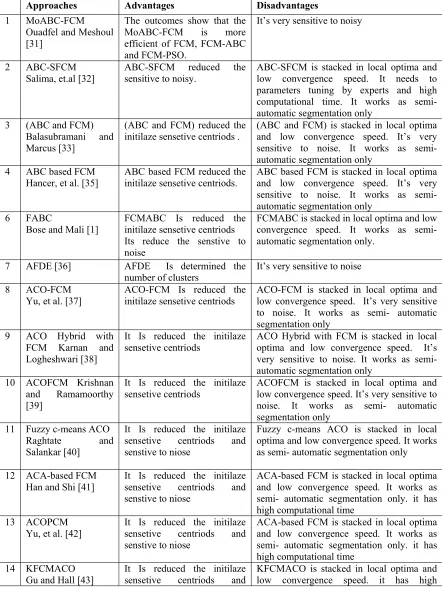
5161 FFCM to produce a new segmentation method for real and simulated MRI brain images. The FFCM approach used the ability of FA to find the optimal initial centroids location for fuzzy c-means. The FFCM approach is evaluated by executing it on simulated brain dataset and real MRI brain image. The experiments and comparison proved its encouraging results when it’s compared with the outcomes of state-of the-art methods. However, FFCM could not overcome the main weakness of FCM which is sensitive to noise. Also, the summaries of Image segmentation based Fuzzy clustering with metaheuristic search algorithms are reviewed in Table 1as in index.
3.2 Image Segmentation based FCM Suffer from Noise
The original FCM algorithm is used well on most noise-free images. However, FCM has a serious limitation in noise images: it hasn’t any information about spatial context, which leads to sensitivity to imaging artifacts and noise. To reduce the drawbacks of FCM, the clear way is to smooth the image (pre-processing) before segmentation. However, the standard smoothing filters can result in loss of important image information, especially boundaries between regions or edges in image. In fact, there is no method that has rigorous control on the trade-off between the smoothing and clustering [13, 17].
Other different approaches have been proposed Pham [54] enhanced the original FCM fitness function by integrating the smooth membership function, and a parameter has been set to manage the compromise between them. Ahmed, et al. [55] proposed a spatial FCM algorithm named FCM_S, in which the objective function of the traditional FCM has been modified by introducing a regularization term to enable the labelling of a pixel (voxel) to be influenced by the labels in its immediate neighborhood. The objective function of FCM_S is defined as follows:
c 1 k N N r 2 r m ki c 1 k N 1 i R 2 i m ki m i vk y u N a vk y u J 11where Ni denotes the set of neighboring pixels
falling into a window around yi, and NR is its
cardinality. The parameter a is controls the effect of the neighborhood term, which is usually determined by trial-and-error experiments. To reduce the time complexity of FCM_S, Zhang and Chen [56] proposed an improved version of FCM_S by introducing the extra mean filtered image algorithm FCM_S1 and median-filtered image algorithm FCM_S2 to replace the neighborhood term of
FCM_S. Szilagyi, et al. [57] proposed enhanced fuzzy c-means clustering EnFCM, to accelerate FCM_S. The EnFCM used on gray level histogram of input MR image. A linearly weighted sum image ζ between the original image and its mean-filtered image is firstly calculated
Ni
j i R i
i 11a y Na y
12
where ζi denotes the gray level value of the ith pixel
in image ζ. Then, clustering is performed on the gray level histogram of the newly generated image ζ instead of the original image Y. Thus, the objection function of EnFCM can be written as follow
2L 1 i c 1 K i m ki i
m u vk
J
13
where L is the number of gray levels of the image ζ. It is generally much smaller than the image size N. γi is the number of pixels having the same gray
level value I [58] proposed the Fast generalized fuzzy c-means clustering FGFCM algorithm. Its Motivated by EnFCM, FGFCM has the similar form by generating a sum image and performing clustering on the gray level histogram of this sum image. However, the difference between EnFCM and FGFCM is that a novel non-linearly weighted sum image ζ is defined Eq.14
i i N j ij Nj ij j
i
S y S
14
in FGFCM, which introduces a local pixel-similarity measure Sij. Sijincorporates both the local
gray level relationship used in EnFCM and the local spatial relationship
j i , j i , 0 eSi,j max p p .q q / y y / ,
2 i g 2 j i s j i j i 15
where (pi, qi) is a spatial coordinate of pixel i. λs
and λg are the scale parameters of gray and spatial information, which play a similar role with parameter a.
5162 FPCM needs more time than FCM to compute the new fitness function, because the fuzzy degree and decision are based on fitness function.
The method of FCM initializes, in this case the membership function is calculated randomly and this process when used with different times may give different outcomes. As outcomes, the initialization in other area in search space may improve the FCM. The membership initialization for FCM is introduced by [59]. Also, the FCM with initialized centroids is introduced by [60]. The search space included grids and a list of grids with best density is obtained. Based on the list, the best density grid is selected iteratively. Then, the grids with similar properties are chosen to be deleted from the list. This phase is worked until the list is empty. Finally, the centroids are initialized at the centers of the chosen grids. This method needs time which makes FCM more time consuming.
The original FCM didn’t use spatial information in clustering process. Therefore, many researchers try to incorporate spatial information into the original FCM process [8, 13]. Tolias and Panas [61]presented a spatial constraint rule-based system which is called the smooth fuzzy membership function to improve the outcomes of FCM. The fuzzy membership smoothing process requires a lot of time. Meanwhile, Pham [62] introduced robust FCM (RFCM) based on modified FCM objective function by incorporating a spatial penalty. Chuang, et al. [63] proposed the FCMSI method that incorporates the fuzzy membership summation at each pixel neighborhood into the fuzzy membership value of that pixel. Meanwhile, the enhanced FCM (FCM) still has drawback specifically in the control parameters which are control of the trade-off between the original image (input image) and the filtered image. The parameters usually are selected by experience or by trial-and-error experiments. Wang, et al. [64] proposed the modified fuzzy C-means algorithm called MFCM to segment the MRI brain image. The method incorporated the local and non-local neighborhood information for MFCM to support the robustness and reduce noise. Sikka, et al. [65] presented a fully automated image segmentation based MFCM for brain MR image. They are reduced in-homogeneity correction by entropy driven homomorphic filter. Also, they proposed initialize centroids by histogram-based local peak merger with adaptive window. Here, the Image is segmented by the MFCM approach which is used the neighborhood information. Beevi and Sathik [66] presented a method that utilizes histogram based FCM for medical images segmentation. To reduce noise and improve
robustness, the FCM objective function was integrated with spatial information probability, from the neighboring pixels. The authors made comparison between the original FCM and the FCM based histogram approach. The outcomes obtained from the experimentations show that the FCM based histogram approach is more reliable and segmentation accuracy when compared to FCM.
Feng, et al. [67] introduced new image segmentation method for SAR images, which is called non-local FCM algorithm with edge Preservation (NLEP-FCM). The NLEP-FCM is used new patch-similarity measure to construct SAR images It’s had edge parts of the sum image were ratified to preserve accuracy of the geometric structure. The NLEP-FCM is obtained more reliable segmentation outcomes when compared with others related works. But, the disadvantage of NLEP-FCM method is high computational time. Gong, et al. [68] presented FCM algorithm based on the kernel metric for image segmentation which are Suffers from noise and intensity inhomogeneities. They proposed algorithm called KWFLICM by improved FLICM using hybrid a trade-off weighted fuzzy factor and kernel method. In this method a reformulated spatial constraint, with the trade-off weighted fuzzy factor are used as a local similarity measurement. KWFLICM is conducted on synthetic images, medical images and natural images. The outcomes show that KWFLICM improved image segmentation performance when compared with other related works. Zhou, et al. [69] presented a new method which is fuzzy clustering information for images segmentation. It is considered as the measure of medium similarity based on the measure of medium truth degree called MMTD. It uses the pixel correlation and the pixel neighbors to determine the fuzzy medium membership function.
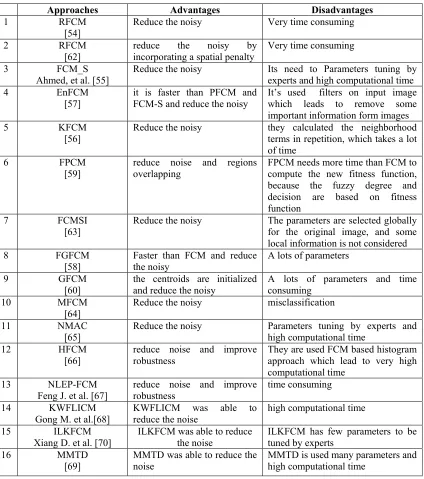
Xiang, et al. [70] proposed an unsupervised segmentation algorithm called (ILKFCM) for SAR image. They considered the spatial and intensity distances of the neighboring pixels simultaneously by modified objective function and incorporating it with a weighted fuzzy factor. The proposed method is performed a kernel metric to evaluate the wavelet feature similarity. The ILKFCM has few parameters to be tuned by experts, which leads to difficult segmentation method. The summaries of FCM’s approaches to reduce the sensitive to noise are reviewed in Table 2 as in index.
4 MAIN FINDING FROM REVIEW
5163 problems and challenges associated with the image segmentation based fuzzy c-means (FCM) algorithms. These challenges related to the FCM such as sensitive to initialize clusters center and outlier noise, and determine number of cluster.
4.1 Image segmentation based FCM sensitive to initialize clusters centre
Semiautomatic image segmentation is necessary because some difficult cases of image segmentation need expert interfaces such as the complicated case in brain tumor extraction to investigate the outcomes from the segmentation process or to determine the number of interest regions (number of clusters). It’s important in some cases and the time consumed is less than that of manual segmentation.
Fuzzy clustering algorithm FCM is the most frequently used in image segmentation method (semi or fully) [4]. The selecting of initial clusters center is considered one of the most challenging tasks in FCM clustering algorithm. One way to overcome these shortcomings is to use metaheuristic optimization algorithms as clustering techniques. This approach is feasible and practical due to the NP-hard nature of partitional clustering problems. Although many metaheuristic algorithms for solving fuzzy clustering problems have been proposed [1, 5, 21, 37, 39-41, 71], the results are still unsatisfactory. Therefore, an improvement to the optimization algorithms for solving clustering problems is still required.
4.2 Image segmentation based FCM suffer from determine clusters number
One of the main challenges in Fuzzy c-means is in determining the optimal number of clusters (regions) in each image. It is assumed to be known and entered by the expert, which makes the system semi-automatic image segmentations and thus remains time-consuming and subject to expert variability. Nonetheless, FCM still suffered from a main weakness which was their loss of capability to achieve a fully automatic image segmentation system that could manipulate image data.
Many efforts have been shown to solve the problem of FCM by determining the suitable number of clusters based Metaheuristic search algorithms. For instance, Ouadfel and Meshoul [31] proposed a new fuzzy clustering approach based on a modified Artificial Bees Colony algorithm called MoABC-FCM while Hancer, et al. [35] presented a new image segmentation methodology based on artificial bee colony algorithm ABC to extract brain tumors from magnetic reasoning imaging (MRI). Further, Gu and Hall [43] proposed a dynamic fuzzy clustering based on Ant Colony algorithm
while Mekhmoukh and Mokrani [49] proposed a new image segmentation method based on Particle Swarm Optimization whereas Alia, et al. [4] presented a new dynamic clustering algorithm based on the hybridization of harmony search HS and fuzzy c-means to automatically segment MRI brain images.
4.3 Image segmentation based FCM sensitive to noise
The conventional FCM algorithm works well on most noise-free images, it has a serious limitation, and the FCM does not incorporate information about spatial context, because it is sensitive to noise. The pixels on a gray image are highly overlapping, i.e. the pixels in the immediate neighborhood possess nearly the same feature data. Thus, the spatial relationship between neighboring pixels is a very important characteristic that may be of great aid in imaging segmentation. The spatial function is the weighted summation of the membership fitness function in the neighborhood of each pixel under consideration [64, 66, 69]. However, the original FCM doesn’t take into account spatial information, which makes it very sensitive to noise. In a standard FCM technique, a noisy pixel is wrongly classified because of its abnormal feature data.
Finally, the main limitation of this work is covered domain grayscale image segmentation based FCM only, where many domains and clustering applications need to review, which are contribute to guide researchers to fill gaps in weaknesses of recent studies, also this work uncovered others clustering algorithms such as K-means with application.
5 CONCLUSION
This paper gives an overview of images segmentation based fuzzy c-means method, images segmentation methods, basic definitions of terms will be provided about the topic followed by explanations about data clustering with an emphasis on image segmentation based fuzzy clustering approaches. Furthermore, the related work of the three main issues that image segmentation based fuzzy clustering approaches: sensitive to noise, initialization sensitivity of cluster centres and unknown number of actual clusters in the images dataset. Consequently, these algorithms leading researchers to enhance on its performance to be in directions with the requirements of the developing applications
5164 balance between exploration and exploitation research process. Also a future target of this research since to improve FCM objective function without time consuming and sensitive to noise. Furthermore, to improve cluster validity index that is used to measure the goodness of each solution produced by metaheuristic algorithms based clustering algorithms has a major impact on the performance of these algorithms. Actually, it is well-known that each cluster validity index has its own strength characteristics as well as vulnerability characteristics. Accordingly, using a multi-objective approach that combines two or more cluster validity indices as an objective function may add some extra strength to this algorithm and overcome any unexpected weaknesses.
6 ACKNOWLEDGEMENTS
Many thanks to the Deanship of Scientific Research at Imam Abdulrahman Bin Faisal University. Where this research is funded by Imam Abdulrahman Bin Faisal University, with grant titled “Dynamic Fuzzy C-Mean Based Firefly Photinus Search Algorithm For MRI Brain Tumor Image Segmentation” , No. 2016-483-PYSS.
7 REFERENCES
[1]A. Bose and K. Mali, "Fuzzy-based artificial bee colony optimization for gray image segmentation," Signal, Image and Video Processing, pp. 1-8, 2016.
[2] N. Gordillo, E. Montseny, and P. Sobrevilla, "State of the art survey on MRI brain tumor segmentation," Magnetic resonance imaging, vol. 31, pp. 1426-1438, 2013.
[3] B. Akay and D. Karaboga, "A survey on the applications of artificial bee colony in signal, image, and video processing," Signal, Image and Video Processing, vol. 9, pp. 967-990, 2015.
[4] O. Alia, R. Mandava, and M. E. Aziz, "A hybrid harmony search algorithm for MRI brain segmentation," Evolutionary Intelligence, vol. 4, pp. 31-49, 2011. [5] W. Alomoush, S. N. H. S. Abdullah, S.
Sahran, and R. I. Hussain, "MRI BRAIN SEGMENTATION VIA HYBRID FIREFLY SEARCH ALGORITHM," Journal of Theoretical & Applied Information Technology, vol. 61, 2014. [6] D. Karaboga, B. Gorkemli, C. Ozturk, and
N. Karaboga, "A comprehensive survey: artificial bee colony (ABC) algorithm and
applications," Artificial Intelligence Review, vol. 42, pp. 21-57, 2014.
[7] M. W. Khan, "A survey: Image segmentation techniques," International Journal of Future Computer and Communication, vol. 3, p. 89, 2014. [8] M. A. Balafar, A. R. Ramli, M. I. Saripan,
and S. Mashohor, "Review of brain MRI image segmentation methods," Artificial Intelligence Review, vol. 33, pp. 261-274, 2010.
[9] S. Kannan, "A new segmentation system for brain MR images based on fuzzy techniques," Applied Soft Computing, vol. 8, pp. 1599-1606, 2008.
[10] J. Kang, L. Min, Q. Luan, X. Li, and J. Liu, "Novel modified fuzzy c-means algorithm with applications," Digital Signal Processing, vol. 19, pp. 309-319, 2009.
[11] S. Naz, H. Majeed, and H. Irshad, "Image segmentation using fuzzy clustering: A survey," in Emerging Technologies (ICET), 2010 6th International Conference on, 2010, pp. 181-186.
[12] C. Ozturk, E. Hancer, and D. Karaboga, "Improved clustering criterion for image clustering with artificial bee colony algorithm," Pattern Analysis and Applications, vol. 18, pp. 587-599, 2015. [13] M. Balafar, "Fuzzy C-mean based brain
MRI segmentation algorithms," Artificial Intelligence Review, vol. 41, pp. 441-449, 2014.
[14] W. K. Alomoush, S. N. H. S. Abdullah, S. Sahran, and R. I. Hussain, "Segmentation of MRI brain images using FCM improved by firefly algorithms," Journal of Applied Sciences, vol. 14, p. 66, 2014.
[15] P. Hore, L. O. Hall, D. B. Goldgof, Y. Gu, A. A. Maudsley, and A. Darkazanli, "A scalable framework for segmenting magnetic resonance images," Journal of signal processing systems, vol. 54, pp. 183-203, 2009.
[16] D. J. Withey and Z. J. Koles, "A review of medical image segmentation: methods and available software," International Journal of Bioelectromagnetism, vol. 10, pp. 125-148, 2008.
5165 [18] W. Alomoush and K. Omar, "Dynamic
Fuzzy C-Mean Based Firefly Photinus Search Algorithm for MRI Brain Tumor Image Segmentation," PhD, Computer science, Universiti Kebangsaan Malaysia, Malaysia, 2015.
[19] W. Alomoush and A. Alrosan, "Metaheuristic Search-Based Fuzzy Clustering Algorithms," arXiv preprint arXiv:1802.08729, 2018.
[20] U. Maulik and I. Saha, "Modified differential evolution based fuzzy clustering for pixel classification in remote sensing imagery," Pattern Recognition, vol. 42, pp. 2135-2149, 2009.
[21] O. M. Alia, R. Mandava, D. Ramachandram, and M. E. Aziz, "Dynamic fuzzy clustering using harmony search with application to image segmentation," in Signal Processing and Information Technology (ISSPIT), 2009 IEEE International Symposium on, 2009, pp. 538-543.
[22] M. G. Omran, A. Salman, and A. P. Engelbrecht, "Dynamic clustering using particle swarm optimization with application in image segmentation," Pattern Analysis and Applications, vol. 8, pp. 332-344, 2006.
[23] J. Nayak, B. Naik, and H. Behera, "Fuzzy C-means (FCM) clustering algorithm: a decade review from 2000 to 2014," in Computational Intelligence in Data Mining-Volume 2, ed: Springer, 2015, pp. 133-149.
[24] A. K. Jain, "Data clustering: 50 years beyond K-means," Pattern recognition letters, vol. 31, pp. 651-666, 2010.
[25] D. A. Viattchenin, "Validity measures for heuristic possibilistic clustering," Information Technology and Control, vol. 39, 2015.
[26] W. Wang and Y. Zhang, "On fuzzy cluster validity indices," Fuzzy sets and systems, vol. 158, pp. 2095-2117, 2007.
[27] L. Kaufman and P. J. Rousseeuw, Finding groups in data: an introduction to cluster analysis vol. 344: John Wiley & Sons, 2009.
[28] R. Xu and D. Wunsch, "Survey of clustering algorithms," Neural Networks, IEEE Transactions on, vol. 16, pp. 645-678, 2005.
[29] J. C. Bezdek, C. Coray, R. Gunderson, and J. Watson, "Detection and characterization
of cluster substructure i. linear structure: Fuzzy c-lines," SIAM Journal on Applied Mathematics, vol. 40, pp. 339-357, 1981. [30] H. Zhou and G. Schaefer, "An overview of
fuzzy C-means based image clustering algorithms," in Foundations of Computational Intelligence Volume 2, ed: Springer, 2009, pp. 295-310.
[31] S. Ouadfel and S. Meshoul, "Handling fuzzy image clustering with a modified ABC algorithm," International Journal of Intelligent Systems and Applications, vol. 4, p. 65, 2012.
[32] O. Salima, A. Taleb-Ahmed, and B. Mohamed, "Spatial information based image clustering with a swarm approach," IAES Int. J. Artif. Intell.(IJ-AI), vol. 1, pp. 149-160, 2012.
[33] K. Balasubramani and K. Marcus, "Artificial bee colony algorithm to improve brain MR image segmentation," International Journal on Computer Science and Engineering, vol. 5, p. 31, 2013. [34] M. Shokouhifar and G. S. Abkenar, "An
artificial bee colony optimization for mri fuzzy segmentation of brain tissue," in 2011 international conference on management and artificial intelligence, 2011, pp. 6-10.
[35] E. Hancer, C. Ozturk, and D. Karaboga, "Extraction of brain tumors from MRI images with artificial bee colony based segmentation methodology," in Electrical and Electronics Engineering (ELECO), 2013 8th International Conference on, 2013, pp. 516-520.
[36] S. Das and A. Konar, "Automatic image pixel clustering with an improved differential evolution," Applied Soft Computing, vol. 9, pp. 226-236, 2009. [37] Z. Yu, W. Yu, R. Zou, and S. Yu, "On
ACO-Based Fuzzy Clustering for Image Segmentation," in Advances in Neural Networks–ISNN 2009, ed: Springer, 2009, pp. 717-726.
[38] M. Karnan and T. Logheshwari, "Improved implementation of brain MRI image segmentation using Ant Colony System," in Computational Intelligence and Computing Research (ICCIC), 2010 IEEE International Conference on, 2010, pp. 1-4.
5166 ALGORITHM FOR MR BRAIN IMAGE SEGMENTATION," Journal of Theoretical & Applied Information Technology, vol. 65, 2014.
[40] G. S. Raghtate and S. S. Salankar, "Brain Tumor Segmentation Using Fuzzy C Means With Ant Colony Optimization Algorithm," 2014.
[41] Y. Han and P. Shi, "An improved ant colony algorithm for fuzzy clustering in image segmentation," Neurocomputing, vol. 70, pp. 665-671, 2007.
[42] J. Yu, S.-H. Lee, and M. Jeon, "An adaptive ACO-based fuzzy clustering algorithm for noisy image segmentation," International Journal of Innovative Computing Information and Control, vol. 8, pp. 3907-3918, 2012.
[43] Y. Gu and L. O. Hall, "Kernel based fuzzy ant clustering with partition validity," in Fuzzy Systems, 2006 IEEE International Conference on, 2006, pp. 61-65.
[44] L. O. Hall and P. M. Kanade, "Swarm based fuzzy clustering with partition validity," in Fuzzy Systems, 2005. FUZZ'05. The 14th IEEE International Conference on, 2005, pp. 991-995. [45] R. J. Hathaway and J. C. Bezdek,
"Optimization of clustering criteria by reformulation," Fuzzy Systems, IEEE Transactions on, vol. 3, pp. 241-245, 1995. [46] M. G. Omran, "Particle swarm optimization methods for pattern recognition and image processing," Citeseer, 2004.
[47] M. G. Omran, A. P. Engelbrecht, and A. Salman, "Dynamic Clustering using Particle Swarm Optimization with Application in Unsupervised Image Classification," in Proceedings of world academy of science, engineering and technology, 2005.
[48] G. Liu, A. Wang, and Y. Zhao, "An Efficient Image Segmentation Method Based on Fuzzy Particle Swarm Optimization and Markov Random Field Model," in Wireless Communications, Networking and Mobile Computing (WiCOM), 2011 7th International Conference on, 2011, pp. 1-4.
[49] A. Mekhmoukh and K. Mokrani, "Improved Fuzzy C-Means based Particle Swarm Optimization (PSO) initialization and outlier rejection with level set methods for MR brain image segmentation,"
Computer methods and programs in biomedicine, vol. 122, pp. 266-281, 2015. [50] U. Maulik and S. Bandyopadhyay, "Fuzzy
partitioning using a real-coded variable-length genetic algorithm for pixel classification," Geoscience and Remote Sensing, IEEE Transactions on, vol. 41, pp. 1075-1081, 2003.
[51] S. Saha and S. Bandyopadhyay, "MRI brain image segmentation by fuzzy symmetry based genetic clustering technique," in Evolutionary Computation, 2007. CEC 2007. IEEE Congress on, 2007, pp. 4417-4424.
[52] S. Saha and S. Bandyopadhyay, "A new point symmetry based fuzzy genetic clustering technique for automatic evolution of clusters," Information Sciences, vol. 179, pp. 3230-3246, 2009. [53] C.-H. Chou, M.-C. Su, and E. Lai, "A new
cluster validity measure and its application to image compression," Pattern Analysis and Applications, vol. 7, pp. 205-220, 2004.
[54] D. L. Pham, Statistical estimation and pattern recognition methods for robust segmentation of magnetic resonance images (medical imaging): The Johns Hopkins University, 1999.
[55] M. N. Ahmed, S. M. Yamany, N. Mohamed, A. A. Farag, and T. Moriarty, "A modified fuzzy c-means algorithm for bias field estimation and segmentation of MRI data," Medical Imaging, IEEE Transactions on, vol. 21, pp. 193-199, 2002.
[56] D.-Q. Zhang and S.-C. Chen, "A novel kernelized fuzzy c-means algorithm with application in medical image segmentation," artificial intelligence in medicine, vol. 32, pp. 37-50, 2004. [57] L. Szilagyi, Z. Benyo, S. M. Szilágyi, and
H. Adam, "MR brain image segmentation using an enhanced fuzzy c-means algorithm," in Engineering in Medicine and Biology Society, 2003. Proceedings of the 25th Annual International Conference of the IEEE, 2003, pp. 724-726.
[58] W. Cai, S. Chen, and D. Zhang, "Fast and robust fuzzy c-means clustering algorithms incorporating local information for image segmentation," Pattern Recognition, vol. 40, pp. 825-838, 2007.
5167 classifier," Asian Journal of Information Technology, vol. 4, pp. 981-985, 2005. [60] K. Zou, Z. Wang, and M. Hu, "An new
initialization method for fuzzy c-means algorithm," Fuzzy Optimization and Decision Making, vol. 7, pp. 409-416, 2008.
[61] Y. A. Tolias and S. M. Panas, "Image segmentation by a fuzzy clustering algorithm using adaptive spatially constrained membership functions," Systems, Man and Cybernetics, Part A: Systems and Humans, IEEE Transactions on, vol. 28, pp. 359-369, 1998.
[62] D. L. Pham, "Fuzzy clustering with spatial constraints," in Image Processing. 2002. Proceedings. 2002 International Conference on, 2002, pp. II-65-II-68 vol. 2.
[63] K.-S. Chuang, H.-L. Tzeng, S. Chen, J. Wu, and T.-J. Chen, "Fuzzy c-means clustering with spatial information for image segmentation," computerized medical imaging and graphics, vol. 30, pp. 9-15, 2006.
[64] J. Wang, J. Kong, Y. Lu, M. Qi, and B. Zhang, "A modified FCM algorithm for MRI brain image segmentation using both local and non-local spatial constraints," Computerized Medical Imaging and Graphics, vol. 32, pp. 685-698, 2008. [65] K. Sikka, N. Sinha, P. K. Singh, and A. K.
Mishra, "A fully automated algorithm under modified FCM framework for improved brain MR image segmentation," Magnetic Resonance Imaging, vol. 27, pp. 994-1004, 2009.
[66] Z. Beevi and M. Sathik, "A robust segmentation approach for noisy medical images using fuzzy clustering with spatial probability," methods, vol. 29, p. 38, 2009. [67] J. Feng, L. C. Jiao, X. Zhang, M. Gong, and T. Sun, "Robust non-local fuzzy c-means algorithm with edge preservation for SAR image segmentation," Signal Processing, vol. 93, pp. 487-499, 2013/02/01/ 2013.
[68] M. Gong, Y. Liang, J. Shi, W. Ma, and J. Ma, "Fuzzy c-means clustering with local information and kernel metric for image segmentation," IEEE Transactions on Image Processing, vol. 22, pp. 573-584, 2013.
[69] N. Zhou, T. Yang, and S. Zhang, "An improved FCM medical image
segmentation algorithm based on MMTD," Computational and mathematical methods in medicine, vol. 2014, 2014.
[70] D. Xiang, T. Tang, C. Hu, Y. Li, and Y. Su, "A kernel clustering algorithm with fuzzy factor: Application to SAR image segmentation," IEEE Geoscience and remote sensing letters, vol. 11, pp. 1290-1294, 2014.