Study of Mobile Ad hoc Networks
Priya Shrivastava Sushil Kumar Manish Shrivastava
LNCT Bhopal, M.P. LNCT Bhopal, M.P. LNCT Bhopal, M.P.
ABSTRACT
Mobile Ad-hoc networks (MANET) are usually defined as a set of wireless mobile nodes dynamically self organizing a temporary network without any central administration or existing infrastructure. This is mainly due to the mobility of the nodes .Much of this work is targeted to increase the network performance on the network layer and finding a feasible route from a source to a destination without considering current network traffic or application requirements. Due to their decentralized, self-configuring and dynamic nature, MANETs offers several advantages and disadvantages. In this paper we present an overview of (MANET) by presenting their characteristics, functionality, challenging applications and routing protocols.
Keywords
: MANET, Routing Protocols, characteristic, applications.1.
INTRODUCTION
A MANET is an autonomous collection of mobile users that communicate over relatively bandwidth constrained wireless links. In view of the fact that the nodes are mobile, the network topology may vary rapidly and indeterminable over time. The network is decentralized where all network activity including discovering the topology and delivering messages must be executed by the nodes themselves, i.e. routing functionality is integrated into mobile nodes [1].
Figure 1: A Mobile Ad hoc network of three nodes
For example, in Figure, to establish communication between nodes A and C the network must enlist the aid of node B to relay packets between them. The circles indicate the nominal range of each node’s radio transceiver. Nodes A and C are not in the direct transmission range of each other, while A’s circle does not cover.
1.1 Applications of MANET:
There are some applications in MANET which is used in daily purposes-
1.1.1
Home and enterprise networking
i. Home/office wireless networking. ii. Networking Conferences, meeting rooms.
iii. Personal area networks (PAN), Personal networks (PN). iv. Networks at construction sites.
1.1.2 Emergency services
i. Conducts search and rescue operations. ii. Disaster recovery planning.
iii. Replacement of fixed infrastructure in case of environmental catastrophes.
iv. Police and fire fighting teams are available. v. Supporting doctors and nurses in hospitals.
1.1.3 Civilian & commercial environments
i .E-commerce: electronic payments anytime and anywhere. ii. Business: Right to use dynamic database, mobile offices. iii. Vehicular services: road or accident guidance, transmission of road and weather situation, taxi cab system, inter-vehicle networks.
iv. Sports stadiums, employment fairs, shopping malls. v. Networks of visitors at airports.
1.1.4 Tactical networks
i. Military communication and operations. ii. Automated battlefields.
1.1.5 Education
i. Universities and campus scenes
ii. Evaluating the virtual classroom.
iii. Ad hoc communications during meetings or lectures.
1.1.6
Entertainment
i. Multi-user games. ii. Wireless P2P networking. iii. Outdoor Internet access. iv. Robotic pets.
v. Theme parks.
1.2 Features of MANET:
There are some features in a mobile ad hoc network that
is-1.2.1
Autonomous Terminal
In a MANET, each mobile terminal is an autonomous mode, which may function as both a server and a router. In other words, beside the fundamental processing ability as a host, the mobile nodes can also achieve switching functions as a router. So usually endpoints and witches are indistinguishable in MANET.
1.2.2 Distributed Operation
Since there is no background network for the central control of the network operations, then organize and management of the network is distributed among the terminals. The nodes involved in a MANET should cooperate with each other amongst themselves and each node acts as a relay as needed to implement functions like security and routing.
1.2.3 Multihop Routing
Basic types of Ad hoc routing algorithms can be single-hop and multihop, based on special link layer attributes and routing protocols. Single-hop MANET is simpler than multihop in terms of structure and implementation, with the lesser cost of functionality and working. When delivering data packets from a source to its destination out of the direct wireless transmission range, the packets should be forwarded passing through one or more intermediate nodes.
1.2.4 Dynamic Network Topology
Since the nodes are mobile, the network topology may change rapidly and unpredictably and the connectivity among the terminals may vary with time. MANET should adjust to the traffic and propagation conditions as well as the mobility patterns of the mobile network nodes. The mobile nodes in the network energetically establish routing among themselves as they move on, forming their individual network on the fly. Moreover, a user in the MANET can not only operate within the Ad hoc network, but may necessitate access to a public fixed network (e.g. Internet).
1.2.5 Fluctuating Link Capacity
The nature of high bit-error rates of wireless connection might be more reflective in a MANET. One end-to-end path can be shared by several sessions. The channels over which the terminals communicate are subjected to noise, fading, and noise, and have less bandwidth than a wired network. In some scenarios, the path between any pair off of users can traverse multiple wireless links and the link themselves can be heterogeneous.
1.2.6 Light Weight Terminals
In most of the cases, the MANET nodes are mobile devices with less CPU processing capability, small memory size,
and low power storage space. Such devices require optimized algorithms and mechanisms that implement the computing and communicating purposes.
1.3 Characteristics of MANET:
MANET (Mobile Ad hoc Network) is an active infra-structure-less network in which nodes are free to go anywhere, anytime without any prior knowledge. Due to dynamic topology it is mandatory that each node has updated route table having proper routes to other nodes. For this each node has to communicate with other nodes time to time. The main characteristics of MANET are [2]:
1.3.1 Dynamic Topology: MANET is highly active in
nature i.e. Nodes are free to move anywhere at any moment according to its transmission range.1.3.2 Limited Bandwidth
:
In MANET radio band will be limited and hence data rates are much lower than a wired network. So the routing protocols must optimally use the proposed bandwidth to reduce operating cost.1.3.3 Higher Packet loss:
Due to unstable links, transmission errors there are more chances of packet loss in MANET which is not desirable.1.3.4 Energy constrained operation:
The nodes are portable devices and are dependent on batteries. This is the most important design consideration of the MANET [3].1.3.5 Security:
Wireless networks are more prone to threats than wired networks. The increased possibility of various security attacks like eavesdropping, denial of service should be handled carefully.1.4 Advantages of MANET:
There are some advantages of MANETS:
They present access to information and services regardless of geographic location.
These networks can be arranged at any place and time.
These networks operate without any pre-existing
infrastructure.
1.5
Dis
advantages of MANET:
There are some disadvantages of MANETS:
Limited resources.
Limited physical security.
Intrinsic mutual trust defenseless to attacks, lack of authorization facilities.
2.
CLASSIFICATION OF ROUTING PROTOCOLS
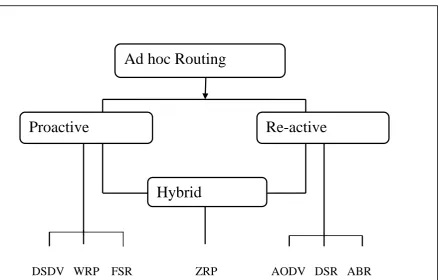
Figure 2: classification of routing protocols The routing protocols in Mobile Ad Hoc networks are
normally categorized as proactive protocols, reactive protocols, and hybrid protocols.
2.1
Proactive protocols
These protocols require each node to maintain one or more tables to store update routing information and to propagate updates throughout the network. These protocols try and maintain valid routes to all communication mobile nodes all the time, which means before a route is really needed. Periodic route updates are swapped in order to synchronize the tables.
A few examples of table driven ad hoc routing protocols include Dynamic Destination Sequenced Distance-Vector Routing Protocol (DSDV) [4], Optimized Link State Routing protocol (OLSR) [5] and Fisheye State Routing Protocol (FSR) [6].
2.1.1 Destination sequenced distance vector
Routing protocol (DSDV)
DSDV is developed on the basis of Bellman–Ford Routing algorithm with some modifications. Each node maintains a routing table which stores next hop, cost metric nears each destination and a sequence number that is created from the destination itself. In DSDV each node periodically forwards routing table to neighbors and increment its sequence number when sending its local routing table. Each path is tagged with a sequence number; routes with greater sequence numbers are favored. When a node decides that a route is broken, it increases the sequence number of the route and advertises it with infinite metric.
2.1.2 Optimized Link State Routing (OLSR)
Due to its proactive nature, it has an advantage of having the routes immediately accessible when needed. In a pure link state protocol, all the links to neighbor nodes are declared and are flooded in the whole network. OLSR protocol is an optimization of a pure link state protocol for mobile ad hoc networks. First, it decrements the size of control packets: instead of all links, it declares simply a subset of links with its neighbors who are its multipoint relay selectors. Secondly, it minimizes flooding of this control traffic by using only the selected nodes, called multipoint relays (MPR), i.e. Shown in fig 3 to circulate its messages in the network. Single the multipoint relays of a node retransmit its broadcast messages. This technique significantly reduces the number of retransmissions in a flooding or broadcast procedure [7.8].
2.1.3 Fisheye State Routing Protocol (FSR)
Fisheye Source Routing (FSR) is based on a method to divide each node’s neighborhood to blurred zones so that the information details and accuracy is better for nodes to be closed. In FSR zones are classified according to the distance, measured by hops, from the node .FSR is a protocol to be built on top of another protocol FSR is an improvement of GSR. In GSR link state packets are not flooded but nodes maintain a link state table based on the up-to-date information received from neighboring nodes and periodically exchange it with their local neighbors. The drawbacks of GSR are the large size update messages and the latency of the link state change propagation. FSR is applied to improve that situation by reducing the size of update messages without seriously affecting routing accuracy. The reduction of update message size is obtained by using different exchange periods for different entries in the table. The imprecise knowledge of the best path to a
DSDV WRP FSR ZRP AODV DSR ABR
Ad hoc Routing
Protocols
Proactive
protocols
Re-active
Protocols
distant destination is compensated by the fact that the route becomes progressively more accurate as the packet gets closer to its destination [9].
Figure 3: Flooding packets using MPR
2.2 Reactive or on-demand routing
protocol
This protocol, don’t maintain routing information or routing activity at the network nodes if there is no communication. If a node wishes to send a packet to another node then this protocol searches for the route in an on-demand manner and establishes the connection to transmit and receive the packet. DSR, AODV are the examples of reactive protocols
If a node wishes to send a packet to another node then this protocol searches for the route in an on-demand manner and establishes the connection to transmit and receive the packet. DSR, AODV are the examples of reactive protocols.
2.2.1 Dynamic Source Routing (DSR)
Dynamic source routing protocol (DSR) is an on-demand, source routing protocol, where all the routing information is maintained (continually updated) at mobile nodes. The protocol composed of the two main mechanisms of "Route Discovery" and "Route Maintenance", which work mutually to allocate nodes to discover and maintain routes to arbitrary destinations in the ad hoc network [10]. Optimum path for a communication between a source node and target node is determined by the Route Discovery process. Route
Maintenance checks that the communication path remains optimum and loop-free according the change in network conditions, even if this requires changing the route during a transmission. Route Reply would only be created if the message has reached the projected destination node.
2.2.2 AODV (Ad-hoc On-Demand Distance
Vector Routing
)
The Ad-hoc On-Demand Distance Vector (AODV) routing protocol builds on the DSDV algorithm, it is an on demand routing algorithm, but in comparison to DSR it is a net source based routing scheme rather every hop of a route maintains the next hop information by its own. Procedure of the protocol here is also divided into two functions, route discovery and route maintenance. Firstly all the nodes send Hello messages on its interface and receive Hello messages from its neighbors. This process repeats periodically to determine neighbor connectivity. When a route is required to some destination, the protocol starts route discovery. The source transmits Route Request Message to neighbors. If a neighbor has no information on the destination, it will send messages to every of its neighbors and so on. Once a request arrives at a node that has information about the
destination, that node sends Route Reply Message to the Route Request Message initiator. Since each node forwards Route Request Message to all of its neighbors, more than one replica of the original Route Request Message can arrive at a node. When a Route Request Message is produced at the initiator, it is assigned a unique id. When a node receives the Route Request Message, it will verify this id and the address of the initiator and discard the message if it had already processed that request When Route Reply Message reaches the initiator, the route is prepared, and the initiator can start sending data packets. If one of the links on the forward path breaks, the middle node just above the link that failed sends new Route Reply Message to all the sources that are using the forward path to inform them of the link fails. In a proposed work it will use AOMDV protocol which provides alternative path in a multipath when a large amount of congestion is occurred.
Maintenance checks that the communication path remains optimum and loop-free according the change in network conditions, even if this requires changing the route during a
Table1: comparing of existing and proposed AOMDV Protocol
AOMDV EXISTING PROPOSED
Packet loss High Due to queue technique its packet loss is negligible. Throughput Number of received
packet is low so its throughput is low.
Number of received packet is high so its throughput is high.
Speed fixed random
Queue size Limited (static queue)
Size is Increment according to need(dynamic queue) Packet delivery ratio (PDR) When congestion occurred its packet delivery ratio is low that is 72 %
By using queue techniques we increase packet delivery ratio may be 80-90%.
2.2.3 Associativity-Based Routing (ABR)
sighted. Associativity ticks are updated by the data link layer.
2.3 Hybrid protocols:
Hybrid routing protocols have the potential to provide higher scalability than pure reactive or proactive protocols. This is because they attempt to minimize the number of rebroadcasting nodes by defining a structure, which allows the nodes to work together in order organize how routing is to be performed. By working together the best suitable nodes can be used to perform route discovery [12]. For example ZRP.
2.3.1 ZRP (Zone Routing Protocol)
It is based on the qualities of both proactive and reactive routing protocols. The nodes of a zone are divided into peripheral nodes and interior nodes .The routing inside the zone i.e. Intra-zone is done by using a proactive approach. For intra-zone routing a node must know about its neighbors. The neighbors of nodes are defined as the nodes which are one hop away from exacting node. The neighbor discovery is done by neighbor discovery protocol (NDP) so as to proactively monitor the network for intra-zone routing. The intra-zone routing is done by intra-zone routing Protocol (IARP). The IARP proactively monitors the network and maintains routes inside the zone. Outside the zone route discovering based on reactive approach is done to maintain routes. Route discovery is completed through a process called boarder casting. It is a packet delivery method through which nodes deliver packets to their peripheral nodes. In the route discovery system source nodes initiate the route discovery it first checks whether the destination is inside the zone or outside it, if it is within the
zone then the route is already available in the source node otherwise it send the query packet to its peripheral nodes[3].Its diagram is shown in Figure 4.
3. CONCLUSIONS
Mobile ad-hoc network has very inventive applications in this modern world, with fast growing technology mobile laptop computers and wireless hardware costs are becoming very affordable. In this paper we have provided huge information about mobile ad hoc networks and its various modifications and routing protocols. Each protocol has specific advantages and disadvantages which is well suited in a certain situation. In this survey mainly worked to improve its performance using different network parameters and also enhance the packet delivery ratio, throughput and reduce send-to-end delay, packet drop rate, routing load and jitter.
4. REFRENCES
[1] Simardeep Kaur, Anuj k. Gupta.”Position Based Routing in Mobile Ad-hoc Networks: An Overview”, RIMT IET, Punjab, India, Dept. of CSE, RIMT IET, Punjab, India IJCST, Vol-3, PP 792-796, Oct - Dec 2012.
[2] Dr. P.K.Suri, Satmeet Kaur,” Optimal DSR and Load Balancing in MANET”, International Journal of Engineering Research and Applications, Vol- 2, pp 2076-2079 , Sep- Oct 2012.
[3] Robinpreet Kaur & Mritunjay Kumar Rai” A Novel Review on Routing Protocols in MANETs”, Undergraduate Academic Research Journal (UARJ), Vol-1, pp 103-108, 2012.
Figure 4: the different components of the ZRP
[4] P. Bhagwat, C. E. Perkins, 1994 “Highly Dynamic Destination –Sequenced Distance-Vector Routing (DSDV).for Mobile Computers”, Proceedings of ACM SIGCOMM, pp 234-244, 1994.
[5] P.Jacquet , P. Muhlethaler , T. Clausen, A. Laouiti, A. Qayyum, L. Viennot, “Optimized Link State Routing protocol for Routing protocol”, IEEE INMIC 2001 ,pp 1-7, 2001.
[6] M. Gerla, X. Hong, G. Pei, “Fisheye State Routing Protocol (FSR) for Ad Hoc Networks”, Work in
Progress, Internet Draft, MANET Working Group, 2001.
[7] A. Qayyum, L. Viennot, and A. Laouiti,”Multipoint relaying: An efficient technique for flooding in mobile wireless networks ,Technical Report RR-3898 ,INRIA, pp 1-16, Mar 2000.
[9] Petteri Kuosmanen,”Classification of Ad Hoc Routing Protocols” Finnish Defence Forces, Naval Academy.
[10] http://www.networksorcery.com/enp/protocol/dsr.htm-- Dynamic source routing protocol (DSR).
[11]CHAI-KEONG TOH “Associativity-Based Routing for Ad-Hoc Mobile Networks”, Wireless Personal
Communications Journal, vol.-2, pp. 103-139, Mar1997.