Volume 2011, Article ID 271987,6pages doi:10.1155/2011/271987
Research Article
On the Absolute Sum of Chromatic Polynomial
Coefficient of Graphs
Shubo Chen
Department of Mathematics, Hunan City University, Yiyang, Hunan 413000, China
Correspondence should be addressed to Shubo Chen,[email protected]
Received 1 December 2010; Accepted 9 February 2011
Academic Editor: Dalibor Froncek
Copyrightq2011 Shubo Chen. This is an open access article distributed under the Creative Commons Attribution License, which permits unrestricted use, distribution, and reproduction in any medium, provided the original work is properly cited.
The absolute sum of chromatic polynomial coefficient of forest, q-tree, unicyclic graphs, and quasiwheel graphs, are determined in this paper.
1. Introduction
For a century ago, one of the most famous problems in mathematics was to prove the
Four-Color Problem. During the period that the Four-Four-Color Problem was unsolved, which spanned
more than a century, many approaches were introduced with the hopes that they would lead to a solution of this famous problem. In 1913, Birkhoff 1defined a function PM, λthat gives the number of properλ-colorings of a mapMfor a positive integerλ. As we will see, PM, λis a polynomial inλfor every mapMand is called the chromatic polynomial ofM. Consequently, if it could be verified thatPM,4>0 for every mapM, then this would have established the truth of the Four-Color Conjecture. In 1932, Whitney2expanded the study of chromatic polynomials from maps to graphs. While Whitney obtained a number of results on chromatic polynomials of graphs and others obtained results on the roots of chromatic polynomials of planar graphs, this did not contribute to a proof of the Four-Color Conjecture. Renewed interest in chromatic polynomials of graphs occurred in 1968 when Read3wrote a survey paper on chromatic polynomials. LetG be a graph and λ ∈ . A mapping f :
VG → {1,2, . . ., λ}is called aλ-coloring ofGiffu/fvwhenever the verticesuandv are adjacent inG. For a positive integerλ, the number of different properλ-colorings ofGis denoted byPG, λand is called the chromatic polynomial ofG. By convention,PG,0 0, andPG, λ≥1 if and only ifGisλ-colorable. More precisely, we have
There are many results about the coefficient of the chromatic polynomials of graphs, see related references4–8. In5, the authors characterized the absolute sum of chromatic
polynomial of trees, 2-trees, cycles, wheels and completed graphs, and obtained the sharp upper and lower bounds for the absolute sum of chromatic polynomial coefficients of any connected graphs. In this paper, we investigate absolute sum of chromatic polynomial coefficients of forest,q-tree, unicyclic graphs and quasiwheel graphs.
2. Preliminaries
LetG V, Ebe a graph whose sets of vertices and edges areVGandEG, respectively, n |VG|,m |EG|are the number of vertices and edges ofG.E ⊆EG, we denote by G−EG Ethe subgraph ofGobtained by deletingaddingthe edges ofE.W ⊆ VG,
G−WG Wdenote the subgraph ofGobtained by deletingaddingthe vertices ofWand the edges incident with them.G·xyis the graph obtained fromGby contractingxandyand removing any loop and all but one of the multiple edges, if they arise, wherex, y ∈ VG. Terminologies and notations not defined here can be found in9. The following basic results
will be used and can be found in the references cited.
Lemma 2.1see9. iLetxandy be two nonadjacent vertices in a graphG. ThenPG, λ
PG xy, λ PG·xy, λ.
iiLete∈EG, thenPG, λ PG−e, λ−PG·e, λ.
iiiFor the empty graphOn of ordern, it is clear thatPOn, λ λn. More generally, if
Gk
i1Gi, then
PG, λ k
i1
PGi, λ. 2.1
Lemma 2.2see5. iLetG be an arbitrary graph withnvertices, then the sum of chromatic
polynomial ofPG, λ ni1aiλiis
n
i1
ai ⎧ ⎨ ⎩
0, m / 0,
1, m0. 2.2
iiLetT be an arbitrary tree withnvertices andPT, λ i1n aiλi λλ−1n−1. Then,
n
i1|ai|2n−1.
iiiLetT2
nbe an arbitrary 2-tree withnvertices andPTn2, λ ni1aiλiλλ−1λ−2n−2.
Then,ni1|ai|2·3n−2.
ivLetCn be an arbitrary graph with nvertices andPCn, λ ni1aiλi λ−1n
−1nλ−1. Then,i1n |ai|2n−2.
vLetWnbe an arbitrary graph withnvertices andPWn, λ ni1aiλiλλ−2n−1
−1n−1λλ−2. Then,n
viLetKnbe an arbitrary graph withnvertices andPKn, λ ni1aiλi λλ−1λ−
2· · ·λ−n 1. Then,i1n |ai| ni1i.
viiLetGbe an arbitrary connected graph withn(n >1) vertices andPG, λ ni1aiλi,
then
2n−1≤
n
i1
|ai| ≤ n
i1i.
2.3
The left equality holds if and only ifG∼Tnand the right equality holds if and only ifG∼Kn.
Givenq∈, the class ofq-treesT q
n is defined recursively as follows: any complete graphKqis
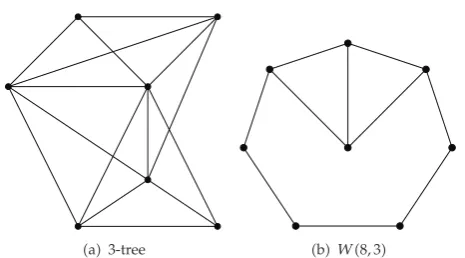
aq-tree, and anyq-tree of ordern 1 is a graph obtained from aq-treeGof ordern, wheren≥q, by adding a new vertex and joining it to each vertex of aKq inG. As an example, a 3-tree is depicted in
Figure 1(a).
Lemma 2.3see9. LetTnqis aq-tree withnvertices, then
PTnq, λ
λλ−1· · ·λ−q 1. 2.4
Lemma 2.4see6. LetUnmis a unicyclic graph ordernand girthm, then
PUnm, λ λ−1n −1mλ−1n−m 1. 2.5
For 1 ≤ s ≤ n− 2, we denote by Wn, s the graph obtained from Wn by deleting all
but sconsecutive spokes. For convenience, we call Wn, s as the quasiwheel graphs, as shown in
Figure 1(b).
Lemma 2.5see9. LetWn, sis a quasiwheel graph withnvertices, then
PWn, s, λ λ−2s−1λ−1n−s 1 −1n−s −1n−1λλ−2. 2.6
3. Main Results
In this section, we investigate the absolute sum of chromatic polynomial coefficients of forests,q-trees, unicyclic graphs, and quasiwheel graphs.
Theorem 3.1. Let F be the forest of order n and c components and PF, λ ni1aiλi. Then
n
i1|ai|2n−c.
Proof. It is a direct result of the combination ofLemma 2.1iiiandLemma 2.2ii.
Theorem 3.2. Let Tnq is a q-tree of ordern (n ≥ q) and PTnq, λ ni1aiλi. Then ni1|ai|
a3-tree b W8,3 Figure 1: The graphs 3-tree andW8,3.
Proof. We prove the result inductively onn.
inq. In this caseTnq ∼Kq.
PTqq, λ
λλ−1· · ·λ−q 1
v
i1
aiλi, 3.1
thenvi1|ai| qi1iq!.
iiAssume thatnkk≥q, letPTkq, λ ki1biλi, we haveki1|bi|q!×q 1k−q.
iiiWhennk 1, letPTk 1q , λ k 1i1 ciλi.uis a vertex with degreeq, and the edges connectinguaree1,e2, . . . , eq, respectively. ByLemma 2.1ii, we have
PTk 1q , λPTk 1q −e1, λ
−PTk 1q ·e1, λ
PTk 1q −e1
−e2, λ
−PTk 1q −e1
·e2, λ
−PTk 1q ·e1, λ
· · ·
λPTkq, λ−qPTkq, λ
λk
i1
biλi−q k
i1
biλi.
3.2
Then,k 1i1 |ci|ki1|bi| qi1k |bi| q 1×q!×q 1k−qq!×q 1k 1−q.
Combining above, the results follows.
Theorem 3.3. LetUnmis a unicyclic graph ordernand girthmandPUnm, λ ni1aiλi.
Proof. FromLemma 2.3, we have
PUnm, λ λ−1n −1mλ−1n−m 1
n
i0
Ci
nλn−i−1i −1m
n−m 1
i0
Ci
n−m 1λn−m 1−i−1i
m−2
i0
Ci
nλn−i−1i
n
im−1
Ci
n−1i Cn−m 1i 1−m−1i 1
λn−i.
3.3
Letλ−1n −1mλ−1n−m 1 ni1aiλi, then
n
i0
|ai|
m−2 i0 Ci n n im−1 Ci
n−Ci 1−mn−m 1
m−2 i0 Ci n n im−1 Cn−i
n −Cn−m 1n−i
m−2 i0 Ci n n im−1 Cn−i n − n im−1 Cn−i n−m 1
2n−2n−m 1.
3.4
Theorem 3.4. LetWn, s is a quasiwheel graph withnvertices andPWn, s, λ ni1aiλi.
Then,ni1|ai|3s−12n−s 1−1−3.
Proof. FromLemma 2.5, we have
PWn, s, λ λ−2s−1λ−1n−s 1 −1n−s −1n−1λλ−2 λs−1 · · · C1
s−1λ−2s−2 −2s−1, λn−s 1 · · · C2n−s 1λ2−1n−s−1
C1
n−s 1λ−1n−s
−1n−1λ2−2λ
λn · · · C1
s−12s−2Cn−s 11 −1n−2 C2n−s 12s−1−1n−2 −1n−1
λ2
C1
n−s 12s−1−1n−1 2−1n
λ.
3.5
Letλ−2s−1λ−1n−s 1 −1n−s ni1biλi, thenni1|bi|3s−12n−s 1−1.
Moreover,
n
i1
biλiλn · · ·
C1
s−12s−2C1n−s 1−1n−2 Cn−s 12 2s−1−1n−2
λ2
C1
n−s 12s−1−1n−1λ.
Thus,
n
i1
|bi| n
i3
|bi| Cs−11 2s−2Cn−s 11 C2n−s 12s−1 C1n−s 12s−1,
n
i1
|ai| n
i3
|bi| Cs−11 2s−2C1n−s 1−1 Cn−s 12 2s−1 Cn−s 11 2s−1−2
3s−12n−s 1−1−3.
3.7
This completes the proof.
Acknowledgment
Researches are supported by the Education Bureau of Hunan Province, China Grant no. 10B015.
References
1 G. D. Birkhoff, “The Reducibility of Maps,” American Journal of Mathematics, vol. 35, no. 2, pp. 115–128, 1913.
2 H. Whitney, “The coloring of graphs,” Annals of Mathematics. Second Series, vol. 33, no. 4, pp. 688–718, 1932.
3 R. C. Read, “An introduction to chromatic polynomials,” Journal of Combinatorial Theory, Series A, vol. 4, pp. 52–71, 1968.
4 H. Whitney, “Congruent graphs and the connectivity of graphs,” American Journal of Mathematics, vol. 54, no. 1, pp. 150–168, 1932.
5 N. Liu, “Research on the sum of chromatic coefficients,” Operation Transactions, vol. 7, pp. 67–74, 2003 Chinese.
6 G. Haggard and T. R. Mathies, “Using thresholds to compute chromatic polynomials,” Ars
Combinatoria, vol. 58, pp. 85–95, 2001.
7 E. J. Farrell, “On the derivative of the chromatic polynomial,” Bulletin of the Institute of Combinatorics
and Its Applications, vol. 29, pp. 33–38, 2000.
8 F. Van Bussel, C. Ehrlich, D. Fliegner, S. Stolzenberg, and M. Timme, “Chromatic polynomials of random graphs,” Journal of Physics, vol. 43, no. 17, Article ID 175002, 2010.
Submit your manuscripts at
http://www.hindawi.com
Hindawi Publishing Corporation
http://www.hindawi.com Volume 2014
Mathematics
Journal ofHindawi Publishing Corporation
http://www.hindawi.com Volume 2014
Hindawi Publishing Corporation http://www.hindawi.com
Differential Equations
International Journal of
Volume 2014
Applied MathematicsJournal of
Hindawi Publishing Corporation
http://www.hindawi.com Volume 2014
Hindawi Publishing Corporation
http://www.hindawi.com Volume 2014
Hindawi Publishing Corporation
http://www.hindawi.com Volume 2014
Mathematical PhysicsAdvances in
Complex Analysis
Journal ofHindawi Publishing Corporation
http://www.hindawi.com Volume 2014
Optimization
Journal ofHindawi Publishing Corporation
http://www.hindawi.com Volume 2014
Combinatorics
Hindawi Publishing Corporation
http://www.hindawi.com Volume 2014 International Journal of
Hindawi Publishing Corporation
http://www.hindawi.com Volume 2014
Journal of
Hindawi Publishing Corporation
http://www.hindawi.com Volume 2014
Function Spaces
Abstract and Applied Analysis Hindawi Publishing Corporation
http://www.hindawi.com Volume 2014
International Journal of Mathematics and Mathematical Sciences
Hindawi Publishing Corporation http://www.hindawi.com Volume 2014
The Scientific
World Journal
Hindawi Publishing Corporationhttp://www.hindawi.com Volume 2014
Hindawi Publishing Corporation
http://www.hindawi.com Volume 2014
Discrete Dynamics in Nature and Society
Hindawi Publishing Corporation
http://www.hindawi.com Volume 2014 Hindawi Publishing Corporation
http://www.hindawi.com Volume 2014
Discrete Mathematics
Journal ofHindawi Publishing Corporation
http://www.hindawi.com Volume 2014
Hindawi Publishing Corporation
http://www.hindawi.com Volume 2014