
© 2015, IRJET.NET- All Rights Reserved
Page 14
Using Gravitational Search Algorithm to Design of an Optimal Active
Power Controller for AC-DC Transmission Systems
Mehdi Shafiee
1, Mohammad Mahdi Tafarroj
2, Mehdi Sajadinya
31
PhD Student, Department of Electrical Engineering, Ferdowsi University of Mashhad, Mashhad, IRAN
2PhD Student, Department of Mechanical Engineering, Ferdowsi University of Mashhad, Mashhad, IRAN
3Research Scholars, Department of Electrical Engineering, Bu Ali Sina University of Hamedan, Hamedan, IRAN
---***---Abstract -
AC transmission systems suffer fromseveral disadvantages such as flow of reactive power and difficulty in controlling both power flow and stability. Although the initial investment cost for HVDC transmission systems is high, its controllability allows the overcoming of these inherent limitations of AC transmission systems. The HVDC transmission systems also enhance the stability of the AC transmission systems they are connected to. They also allow interconnection of AC transmission systems with differing system frequencies. When interconnecting power systems, the short circuit capacity of the AC transmission systems will not increase. Moreover HVDC link is effective for frequency control and improves the stability of the system using fast load flow control. The importance of AC–DC transmission systems regarding improvement of stability has been subject to much research. In this paper, a methodology for the optimal active power controller design using the Gravitational Search Algorithm (GSA) is proposed to improve the transient stability of AC–DC transmission systems after faults. The proposed method is verified using computer simulation. The results show that the application of GSA tuned controller in AC–DC transmission systems will improve the transient stability.
Key Words:
HVDC, GSA, VSC Control System.
1. INTRODUCTION
In contrast to line-commutated HVDC transmission system, the polarity of the DC link voltage remains the same with the DC current being reversed to change the direction of power flow. The principal characteristic of VSC-HVDC transmission system is its ability to independently control the reactive and real power flow at
each of the AC systems to which it is connected. Power system controllers based on modern controllers theory [1, 2, and 3] show better performances to the dynamic disturbances than conventional controllers. However the practical application of modern control theory in real HVDC system is difficult because of it is a highly nonlinear system depending on ignition angle of converter and AC system voltage. Different researchers used different methods in this field. Huang and Krishnaswamy in [4] discuss the impact of HVDC on Power System Stability and propose a control mechanism to augment the system angle stability. Chung in [5] present new techniques for fast transient stability of power system embedded HVDC based on corrected transient energy function approach. Gjerde et al [6] used HVDC and FACTS components for enhancement the power system stability. Hammad [7] analyzed stability of HVDC and AC lines in parallel. Anderson et al [8] improved voltage stability in power systems with HVDC converters. Hammad et al [9] and Liu et al [10] analyzed active and reactive power controls in AC-DC systems. Nosaka et al [11] did simulation studies on control and protection scheme of hybrid multi-terminal HVDC systems.
2. SIMULATED NETWORK
VSC-HVDC transmission system shown on Fig. 1 represents a 200 MVA, with +/- 100 kV. AC systems are modeled by damped R-L equivalents with an angle of 80 degrees at 50 Hz. The VSC converters are three level bridge blocks using close to ideal switching device model of IGBT. VSC Control system contains three parts as follow: a)
Outer Active and Reactive Power and Voltage
Loop
b)
Inner Current
c) DC Voltage Balance Control
© 2015, IRJET.NET- All Rights Reserved
Page 15
Fig -1: Simulated Network.3. Gravitational Search Algorithm
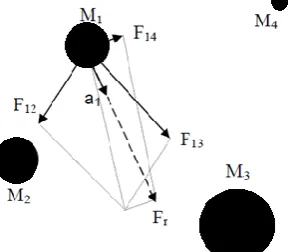
Gravitational Search Algorithm (GSA) is one of the recently developed evolutionary algorithms which are based on the law of gravity. In GSA, agents are considered as objects and their performances are measured by their masses [13]. Each mass represents a solution and every object attracts the other objects by the gravity force. Hence, with respect to the law of motion, objects try to move towards the heavier objects as it is illustrated in Fig. 2. The heavier masses represent good solutions and they move slower than the lighter ones representing worse solutions.
Fig -2: Total force acting on an object and its acceleration.
Two well known equations are used in GSA. The first one is the gravitational force equation between the two particles, which is directly proportional to their masses and inversely proportional to the square of distance between them [13]:
1 2 2
M M
F G
R
(1)
In the algorithm R is used instead of R2 since the authors of [13] reported that this case provided better results. The second one is the equation of acceleration of a particle when a force is applied to it.
F
a
M
(2)Gravitational constant value is proportional to the ratio of the initial time with respect to the actual time as shown in (3). G(t0)
in (3) is the value of the gravitational constant at the initial time.
0 0
( )
( ) ( )
t
G t
G t
t
(3)Active gravitational mass, passive gravitational mass, and inertial mass are defined in physics. Active gravitational force is a measure of the strength of the gravitational field due to a particular object [13]. Passive gravitational force is a measure of the strength of an object’s interaction with the gravitational field [13]. Steps of GSA can be given as follows:
1) Initialize gravitational constant G. Decide the number of agents, N, to use in GSA.
2) Initialize the positions of a system with N masses as follows.
1
(
,...,
d,...,
n)
1, 2,...,
i i i i
X
x
x
x
for
i
N
(4)where, d i
x
represents the initial position of theith
mass in thed
th
dimension.3) Decrease gravitational constant according to the following equation.
0
( )
t T
G t
G e
(5)where α is a user specified constant, T is the total number of iterations (time steps), and t is the current iteration.
4) Evaluate the fitness of each object. Calculate the gravitational and inertial masses by using the following equations.
1,...,
ai pi ii i
M
M
M
M
i
N
1
( )
( )
( )
( )
( )
( )
( )
( )
i ii
i N
j j
fitness t
worst t
m t
best t
worst t
m t
M t
m t
© 2015, IRJET.NET- All Rights Reserved
Page 16
In (6),fitness t
i( )
represents the fitness value of theith
massat time t, worst(t) and best(t) are the minimum value of the all fitness values and maximum value of the all fitness values for a minimization problem respectively. For maximization problems the opposite of this expression applies.
5) Compute the force acting on mass i from mass j at time t as shown below.
where,
M
ajis the active gravitational mass of object j,M
piis thepassive gravitational mass of object i, G(t) is the gravitational constant at time t,
is a small constant, Rij is the Euclidean distance between two objects i and j.6) Compute the total force that acts on object i in dimension d as follows.
where d i
rand is a random number between 0 and 1, and Kbest is
the set of first K objects with the best fitness value and biggest mass.
8) Compute the velocity and the position of the object for time t + 1 by using the following equations.
)
9) If the norm of two consecutive best values of
xi
is smaller than a specified tolerance value, or the best values don’t change for a specified number of iterations stop, otherwise go to step 3. GSA parameters are set according to Table. 1 and fitness function is shown as following equation1
© 2015, IRJET.NET- All Rights Reserved
Page 17
5. Comparison with Bees Algorithm
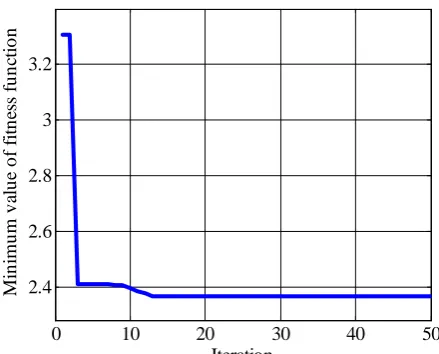
To verify the effectiveness of the GSA algorithm in handling this problem, i.e. design of an optimal active power controller, the obtained results are compared with the results provided by the Bees Algorithm (BA) [14]. In the current application, the population and iterations of the Bees are considered equal to the population and iterations of GSA, i.e. 20 and 50, respectively (Bees parameters are set according to Table. 2). Comparing this result, i.e. minimum value of fitness function in each iteration, with Fig. 5 indicates that GSA converges to the better global optimum solution than the BA. Table. 3 compares GSA and BA in terms of best fitness function.
Table -2: Bees Parameters [14].
ngh
nsp
nep
m
e
Iteration NTable -3: Compression of GSA and BA.
Algorithm Optimal power control coefficient
Fitness function
GSA [8.6322, 0, 0.6889] 2.3643
BA [76.0557, 0.0621, 29.9995] 2.40769
6. CONCLUSION
In this paper a method for design controller of active power of VSC-HVDC line based on GSA for improving stability of system during fault condition introduced. The effect of this method on a typical network is simulated and results show that design of controller by proposed algorithm will work properly. The results are compared with those provided by the Bees Algorithm. This comparison (for this case) study testifies that GSA converges to the better global optimum solution than the BA.
REFERENCES
[1] I. Ngamroo, "A stabilization of frequency oscillations using a power modulation control of HVDC link in a parallel AC-DC interconnected system," in Proc. 2002 IEEE Power Conversion Conf., pp. 1405-1410, 2002.
[2] J. Y. Yoon, G. H. Hwang and J. H. Park, "A genetic algorithm approach to design an optimal fuzzy controller for rectifier current control in HVDC system," in Proc. 1998 IEEE Evolutionary Computation Conf., pp. 404-409, 1998.
[3] A. Daneshpooy, A. M. Gole, D. G. Chapman, and J. B. Davies, "Fuzzy logic control for HVDC transmission," IEEE Trans. Power Delivery, vol. 12, pp. 1690-1697, Oct. 1997.
[4] G. M. Huang, and V. Krishnaswamw, "HVDC controls for power system stability," in Proc. 2001 IEEE Power Engineering Society Summer Meeting, pp. 597-602, 2001.
[5] T. S. Chung, "Assessment of stability effects of HVDC link by an improved energy function method," in Proc. 1999 IEEE Power Electronics and Drive Systems Conf., vol. 2, pp. 837-342, 1999.
[6] J. O. Gjerde, R. Flolo and J. T. Gjengedal, "Use of HVDC and FACTScomponents for enhancement of power system stability ," in Proc. 1996 IEEE Electrotechnical Conf., vol. 2, pp. 802-808, 1996.
[7] A. E. Hammad, "Stability and control of HVDC and AC transmissions in parallel," IEEE Trans. Power Delivery, vol. 14, pp. 1545-1554, Oct. 1999.
[8] G. Anderson and G. Liss, "Improving voltage stability in power systems with HVDC converters," in Proc. 1991 IEE International Conference on Advances in Power System Control, Operation and Management, vol. 2, pp. 698-703, 1991.
[9] A. Hammad, H. Koelsch and P. Daehler, "Active and reactive power controls for the Gezhouba-Shanghai HVDC transmission scheme," in Proc. 1991 IEEE AC and DC Power Transmission Conf., pp. 279-284, 1991.
[10] H. Liu, Z. Xu and Z. Gao, "A control strategy for three-level VSCHVDC system," in Proc. 2002 IEEE Power Engineering Society Summer Meeting, vol. 1, pp. 480-485, 2002.
[11] N. Nosaka, Y. Tsubota, K. Matsukawa and K. Sakamoto, "Simulation studies on a control and protection scheme for hybrid multi-terminal HVDC systems," in Proc. 1999 IEEE Power Engineering Society 1999 Winter Meeting, vol. 2, pp. 1079-1084, 1999.
[12] O. A. Sadaba, P. S. Gurpide, J. L. Taberna, I. M. Morales and L. M. Palomo, "Voltage harmonics generated by 3-level converters using PWM natural sampling," in Proc. 2001 IEEE Power Electronics Specialists Conf., vol. 3, pp. 1561-1565, 2001.
[13] E. Rashedi, H. Nezamabadi-pour, S. Saryazdi, " GSA: A Gravitational Search Algorithm," Information Sciences 179 (2009), pp. 2232–2248.
© 2015, IRJET.NET- All Rights Reserved
Page 18
Zaidi, " The Bees Algorithm – A Novel Tool for ComplexOptimisation Problems ", Intelligent Production Machines and Systems (2006), pp. 454-459.
BIOGRAPHIES
Mehdi Shafiee was born in Kerman, Iran, in 1983. He received the B.S. in electrical engineering from Shahid Bahonar University, Kerman, Iran, in 2006 and the M.S. degree in electrical engineering from Amirkabir University of Technology, Tehran, in 2008. Currently, he is pursuing the Ph.D. degree with the Department of Electrical Engineering at Ferdowsi University of Mashhad, Mashhad, Iran. His main fields of research are high voltage, electrical insulation, power system transient, FACTS devices and Renewable energies.
Mohammad Mahdi Tafarroj is currently a Ph.D. student of mechanical engineering at Ferdowsi University of Mashhad. He obtained his degree in mechanical engineering from ShahidChamran University of Ahvaz (2008) and MSc. from Islamic Azad University of Ahvaz (2011). His main research interests are in the field of welding, artificial neural networks, optimization, artificial intelligence and fault detection and diagnosis.
![Table -2: Bees Parameters [14]. nspnep](https://thumb-us.123doks.com/thumbv2/123dok_us/976764.1120200/4.595.40.288.272.507/table-bees-parameters-nspnep.webp)
