R E S E A R C H
Open Access
Spectrum sharing on interference channels
with a cognitive relay
Qiang Li
1, Ashish Pandharipande
2, See Ho Ting
3and Xiaohu Ge
1*Abstract
In this paper, an interference channel with a cognitive relay (IFC-CR) is considered to achieve spectrum sharing between a licensed primary user and an unlicensed secondary user. The CR assists both users in relaying their messages to the respective receivers, under the constraint that the performance of the legacy primary user is not degraded. Without requiring any non-causal knowledge, the CR uses a successive interference cancellation to first decode the primary and secondary messages after a transmission phase. A power allocation is then performed to forward a linear weighted combination of the processed signals in the relaying phase. Closed-form expressions of the end-to-end outage probability are derived for both primary and secondary users under the proposed approach. Furthermore, by exploiting the decoded primary and secondary messages in the first phase, we propose the use of dirty paper coding (DPC) at CR to pre-cancel the interference seen at the secondary (or primary) receiver in the second phase, which results in a performance upper bound for the secondary (or primary) user without affecting the other user. Simulation results demonstrate that with a joint consideration of the power control at the secondary transmitter and the power allocation at CR, performance gains can be achieved for both primary and secondary users.
Keywords: Cognitive spectrum sharing; Interference channel with a cognitive relay; Successive interference cancellation; Dirty paper coding
1 Introduction
1.1 Background and related work
Consider a spectrum sharing system, as shown in Fig. 1, where two interfering users co-exist with a cognitive relay in the same frequency band. For both users to operate properly, the cognitive relay [1, 2] assists in forwarding the messages from both transmitters to their respec-tive receivers [3–6] and at the same time coordinates the mutual interference. This constitutes an interference channel with a cognitive relay (IFC-CR), which has been intensively studied from an information-theoretic per-spective [7–15].
A two-user symmetric Gaussian IFC-CR was first intro-duced in [7], where the CR was assumed to be full duplex and adopt a decode-and-forward (DF) process-ing. Through rate splitting [16] at both sources and joint decoding at each destination, an achievable rate region was obtained. Then, this achievable rate was improved
*Correspondence: [email protected]
1School of Electronic Information and Communications, Huazhong University of Science and Technology, Wuhan, China
Full list of author information is available at the end of the article
in [8] by performing sophisticated coding strategies that require non-causal information of both transmitters at the CR prior to information transmission. By combining the Han-Kobayashi coding scheme [16] for interference chan-nels with dirty paper coding (DPC) [17], a generalization of the achievable rate region obtained in [8] was derived in [9]. In [10], an outer bound for the capacity of a general IFC-CR was first derived. New inner and outer bounds for the capacity of IFC-CR were derived later in [11–15], under various conditions.
A Gaussian interference channel with an out-of-band relay was investigated in [18, 19] where the relay was assumed to operate over orthogonal bands to the under-lying interference channel. In [18], the entire system was characterized by two parallel channels, namely a Gaus-sian interference channel and a GausGaus-sian relay channel. To characterize the capacity, relay operations were opti-mized with separable or nonseparable encoding between the interference channel and the out-of-band relay chan-nel. In [19], the impact of the out-of-band relay channel and the corresponding signal interactions on the capacity were investigated under general channel conditions.
Fig. 1An interference channel with a cognitive relay (IFC-CR) where the CR has perfect non-causal knowledge of the messages originated from both transmitters
In the above works, the two interfering users are assumed to be part of the peer users in the same radio system. A question that arises is as follows: what if the two interfering users belong to different radio systems that are of different priorities. In view of the mutual interfer-ence between the two users and the inherent cognition and cooperation ability equipped at the CR, it is natural to evaluate IFC-CR under a cognitive spectrum shar-ing setup between, e.g., a licensed primary user and an unlicensed secondary user [20–23]. Under such circum-stances, we assume that the CR belongs to the secondary system or a third-party agent. Then, instead of character-izing the capacity or sum rate of the entire system as in [7–15], it is more pragmatic to enhance the performance of the secondary user under the constraint that no harm is caused to the legacy primary user [24–26].
A spectrum sharing protocol was proposed on the inter-ference channel in [26]. With the assumption that the secondary transmitter has non-causal knowledge of the codewords originated at the primary transmitter, achiev-able rates of the secondary user were characterized under the constraint that no rate degradation was created for the primary system. As a variant of [26], a spectrum sharing protocol was proposed between a primary and a sec-ondary user on an IFC-CR in [27]. With the assumption that non-causal knowledge of the primary codewords is available at both the secondary transmitter and the CR, an enhanced throughput was achieved for the secondary user without degrading the throughput of the primary user. In [28], a spectrum sharing protocol was proposed on an IFC-CR where the CR helps both the primary and sec-ondary transmissions. A DF relay protocol was considered where only whenboth primary and secondary messages are successfully decoded at CR, they are forwarded in the second phase with a certain power allocation. Condi-tioned on the decoding results at CR, the received SNR at each receiver was analyzed, through which an upper bound of the outage probability was derived. In [29], an opportunistic adaptive relaying protocol is proposed on IFC-CR, where CR is able to determine when to coop-erate with the primary user, when to coopcoop-erate with the secondary user, and when to cooperate with both users
simultaneously. An upper bound of the secondary outage probability was derived under a primary outage prob-ability threshold. In [30], an amplify-and-forward (AF) relay protocol was performed at CR to help relay the signals of both primary and secondary users over indepen-dent Nakagami-mfading channels. Assuming there are no cross links between primary and secondary users, end-to-end outage probabilities of the primary and secondary users were obtained. Simulation results demonstrated a performance gain for both primary and secondary users.
1.2 Our contributions
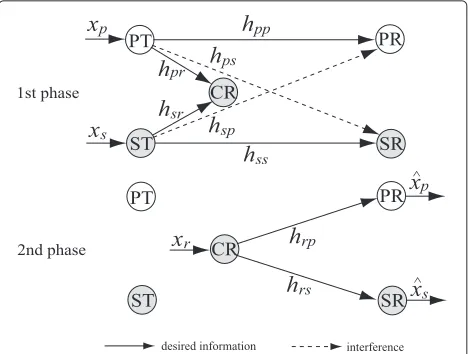
Motivated by the above works, we propose a causal cog-nitive spectrum sharing protocol on a fading IFC-CR [31]. As depicted in Fig. 2, both primary transmitter (PT) and secondary transmitter (ST) transmit simultaneously in the first phase. Without requiring non-causal knowledge of the messages from PT or ST, CR attempts to decode both messages using successive interference cancellation (SIC) [32]. To compensate the interference seen at the primary receiver (PR) that is caused by cross talk, we consider a power allocation scheme at CR. To be specific, a hybrid AF-DF relay protocol [33] is considered such that when at least one of the two messages is successfully decoded, a fraction α, 0 < α < 1, of the transmit power of CR is used to forward the primary signal, with the remain-ing power to forward the secondary signal, in the second phase. If however, neither of the messages is decoded, the CR simply stays silent and both PT and ST perform a retransmission simultaneously in the second phase.
At the end of the second phase, by exploiting the received signals in two phases, maximal-ratio combining (MRC) is employed at PR to decode the desired mes-sage. Without incurring additional overhead to the legacy
primary system, we assume that PR is only aware of a relay terminal but oblivious of the secondary system [20–23], thus the component of the secondary signal is simply treated as noise at PR [24–26]. This provides a perfor-mance lower bound for the primary system compared to the cases with sophisticated decoding strategies. On the other hand, at the secondary receiver (SR), by exploit-ing the received signals in two phases, SIC is employed to decode the desired message. The contributions of this paper are summarized as follows.
• In decoding the mixed signals using SIC, we define an event to describe whether a specific message can be successfully recovered. In order to illustrate the correlation between the successive events in decoding mixed signals, we introduce a graphical representation by which each event can be represented by the corresponding region in a 2-dimensional (or 3-2-dimensional) graph. On this basis, by integrating over the respective regions of events, accurate closed-form expressions of the end-to-end outage probability can be derived for both primary and secondary users under the proposed protocol. • Without requiring non-causal knowledge, CR
attempts to decode both primary and secondary messages after a first transmission phase in the proposed protocol. For the case where both messages are successfully recovered at CR after the first transmission phase, in order to further mitigate the mutual interference, we propose using DPC at CR to pre-cancel the interference seen at PR or SR in the subsequent relaying phase. Numerical results demonstrate a performance upper bound for the primary (or secondary) user, without affecting the performance of the other user.
• To guarantee that no harm is caused to the primary system, besides the power allocation performed at CR to forward the primary and secondary messages respectively, we find that a power control at ST is also needed to facilitate the SIC decoding at CR as well as to limit the interference caused to PR. Numerical results demonstrate that with a proper design of the power allocation at CR and the transmit power at ST, the secondary user is allowed to access the licensed spectrum and at the same time performance gains can be achieved for both primary and secondary systems.
The rest of this paper is organized as follows. Section 2 describes the system model, where the two successive phases are discussed and the end-to-end outage proba-bility of IFC-CR is defined. In Section 3, based on the possible decoding results at CR in the first transmis-sion phase, the corresponding performance at PR and SR in the second phase is analyzed. By exploiting the
decoded messages, in Section 4, we propose using DPC at CR, which provides a performance upper bound. Simula-tion results are presented in SecSimula-tion 5 where the effects of different parameters are evaluated. Finally, Section 6 concludes the paper.
2 System model and protocol description
As shown in Fig. 2, we consider an IFC-CR where a ST/SR pair co-exists with a PT/PR pair in the same frequency band with the assistance of a CR. It is assumed that all nodes operate in half-duplex mode and the channels expe-rience independent block Rayleigh fading. For notational simplicity, we let hpp andhss denote the coefficients of the direct channels from PT→PR and ST→SR, let hps and hsp denote the coefficients of the cross interfering channels from PT→SR and ST→PR, and lethpr,hsr,hrp, andhrsdenote the coefficients of the relay channels from PT→CR, ST→CR, CR→PR, and CR→SR, respectively. Then, we have the channel coefficienthij ∼CN
0,δ−ij1,
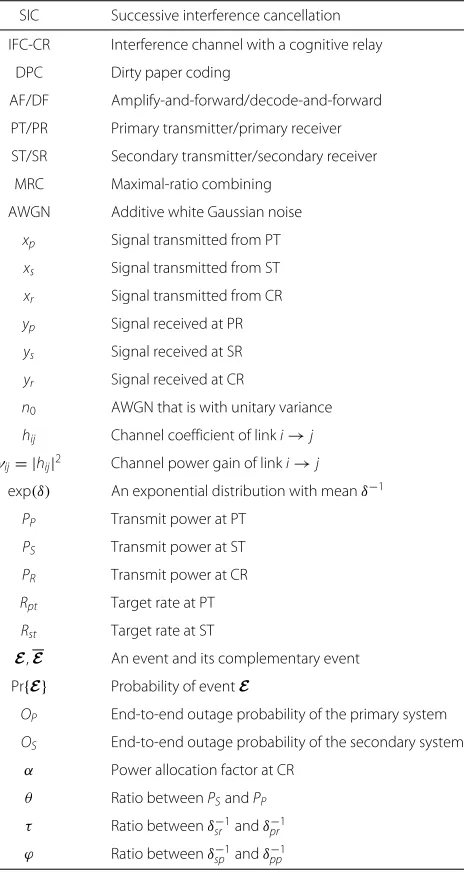
where ij ∈ {pp,ss,ps,sp,pr,sr,rp,rs} and δij−1 denotes the corresponding average channel power gain. By letting γij = |hij|2, γij follows an exponential distribution that γij ∼ expδij [34]. For ease of exposition, we assume that the additive white Gaussian noise (AWGN)n0is of zero mean and with unitary variance at each receiver. Any channel can be reduced to this normalized form. The transmit powers at PT, ST, and CR are denoted as PP, PS, andPR, respectively.xp andxs denote the messages originated at PT and ST, with target rates Rpt and Rst, respectively. For easy reference, we summarize the abbre-viations, notations, and symbols that appear in this paper in Table 1.
As shown in Fig. 2, in order to maintain the causality of the system, we divide the entire transmission process into two phases as discussed in the following.
2.1 First transmission phase
In the first phase, both PT and ST transmit their respec-tive messages simultaneously. Then, the corresponding received signal at PR, SR, and CR is given as
yj(1)=hpj
PPxp+hsj
PSxs+n0, j∈ {p,s,r}. (1)
In order to recoverxpandxsthat are mixed together, SIC is performed at CR. Then, for the decoding results ofxp andxs, we define the following possible events that are mutually exclusive:
1. E(1)= {Bothxpandxsare successfully decoded at CR};
2. E(2)= {Onlyx
pis successfully decoded at CR}; 3. E(3)= {Onlyx
sis successfully decoded at CR}; 4. E(4)= {Neither ofx
Table 1A summary of abbreviations, notations, and symbols
SIC Successive interference cancellation
IFC-CR Interference channel with a cognitive relay
DPC Dirty paper coding
AF/DF Amplify-and-forward/decode-and-forward
PT/PR Primary transmitter/primary receiver
ST/SR Secondary transmitter/secondary receiver
MRC Maximal-ratio combining
AWGN Additive white Gaussian noise
xp Signal transmitted from PT
xs Signal transmitted from ST
xr Signal transmitted from CR
yp Signal received at PR
ys Signal received at SR
yr Signal received at CR
n0 AWGN that is with unitary variance
hij Channel coefficient of linki→j
γij= |hij|2 Channel power gain of linki→j
exp(δ) An exponential distribution with meanδ−1 PP Transmit power at PT
PS Transmit power at ST
PR Transmit power at CR
Rpt Target rate at PT
Rst Target rate at ST
E,E An event and its complementary event Pr{E} Probability of eventE
OP End-to-end outage probability of the primary system
OS End-to-end outage probability of the secondary system α Power allocation factor at CR
θ Ratio betweenPSandPP τ Ratio betweenδ−1
sr andδpr−1 ϕ Ratio betweenδ−1
sp andδpp−1
The corresponding probabilities are defined as PrE(1), PrE(2), PrE(3), and PrE(4)that will be derived in Section 3.1.
2.2 Second transmission phase
When at least one ofxpandxsis successfully decoded by CR, a power allocation is performed to forward a linear weighted combination ofxp andxs in the second phase. Otherwise, CR simply stays silent and both PT and ST perform retransmissions simultaneously.
2.2.1 Conditioned on eventE(1)
In the second phase, CR broadcasts a composite message
xr=
αPRxp+
(1−α)PRxs, (2)
whereα∈(0, 1)is the power allocation factor for relaying the primary messagexp. Then, the corresponding received signal at PR and SR is given as
yj(2)=hrj
αPRxp+hrj
(1−α)PRxs+n0, j∈ {p,s}.
(3)
2.2.2 Conditioned on eventE(2)
In the second phase, CR broadcasts a composite message
xr =
αPRxp+β
hsr
PSxs+n0
, where
β = (γ1−α)PR srPS+1 .
(4)
Then, the corresponding received signal at PR and SR is given as
yj(2)=hrj
αPRxp + hrjβ
hsr
PSxs+n0
+n0, j∈ {p,s}.
(5)
2.2.3 Conditioned on eventE(3)
In the second phase, CR broadcasts a composite message
xr =β
hpr
PPxp+n0
+(1−α)PRxs, where
β = αPR
γprPP+1 .
(6)
Then, the corresponding received signal at PR and SR is given as
yj(2)=hrjβ
hpr
PPxp + n0
+ hrj
(1−α)PRxs+n0, j∈ {p,s}.
(7)
2.2.4 Conditioned on eventE(4)
CR simply stays silent and PT and ST retransmitxpandxs respectively in the second phase. Then, the corresponding received signal at PR and SR is given as
yj(2)=hpj
PPxp+hsj
PSxs+n0, j∈ {p,s}. (8)
2.3 End-to-end performance
For the decoding at PR at the end of the second phase, MRC is performed to decodexpby utilizing the received signals in two successive phases, i.e.,yp(1)andyp(2), while treating the secondary component ofxs simply as noise. Then, depending on the decoding resultsE(1),E(2),E(3), andE(4), at CR at the end of the first phase, we defineO(P1),
Similarly, we defineO(S1),O(S2),O(S3), andO(S4)as the cor-responding outage probabilities at SR at the end of the second phase.
Theorem 1.In the proposed spectrum sharing proto-col on IFC-CR, taking into account all possible decoding results at CR at the end of the first phase, the overall end-to-end outage probabilities of the primary and secondary systems can be respectively derived as
OP = Pr
E(1)O(1)
P +Pr
E(2)O(2)
P +Pr
E(3)O(3)
P
+PrE(4)O(P4), (9)
OS = Pr
E(1)O(1) S +Pr
E(2)O(2) S +Pr
E(3)O(3) S
+Pr
E(4)O(4)
S . (10)
Next, we proceed to analyze the decoding performance at CR as well as PR and SR in two successive phases, respectively.
3 Numerical analysis
3.1 Decoding performance at CR in the first phase
At the end of the first phase, CR attempts to decode both
xp and xs fromyr(1) using SIC. From (1), if the power level of xp is higher than that of xs, then CR attempts to decodexpfirst by considering the component ofxsas noise. Defining C( ) = 12log2(1+ ), the achievable rate ofxpis given as
R1,p=C
PPγpr PSγsr+1
. (11)
Thus,xpcan be first decoded if event
E1,p=
R1,p≥Rpt
=
γpr≥ RptPS
PP γsr+ Rpt
PP
(12)
occurs, where Rpt = 22Rpt − 1. By reconstructing and removing the component ofxpfromyr(1), the achievable rate of the remainingxsis given as
R2,s=C(PSγsr), (13)
which can be decoded successively if event
E2,s=
R2,s≥Rst
=
γsr≥ Rst PS
(14)
occurs, whereRst=22Rst−1.
Conversely, if the power level ofxsis higher than that of xp, then CR attempts to decodexsfirst by considering the
component ofxpas noise. Then, the achievable rate ofxs that is subject to the interference fromxpis given as
R1,s=C
PSγsr PPγpr+1
, (15)
which can be first decoded if event
E1,s=
R1,s≥Rst
=
γpr≤ PS RstPPγsr−
1
PP
(16)
occurs. Similarly, by reconstructing and removing the component of xs from yr(1), the achievable rate of the remainingxpis given as
R2,p=C
PPγpr
, (17)
which can be decoded successively if event
E2,p=R2,p≥Rpt=
γpr≥ Rpt
PP
(18)
occurs.
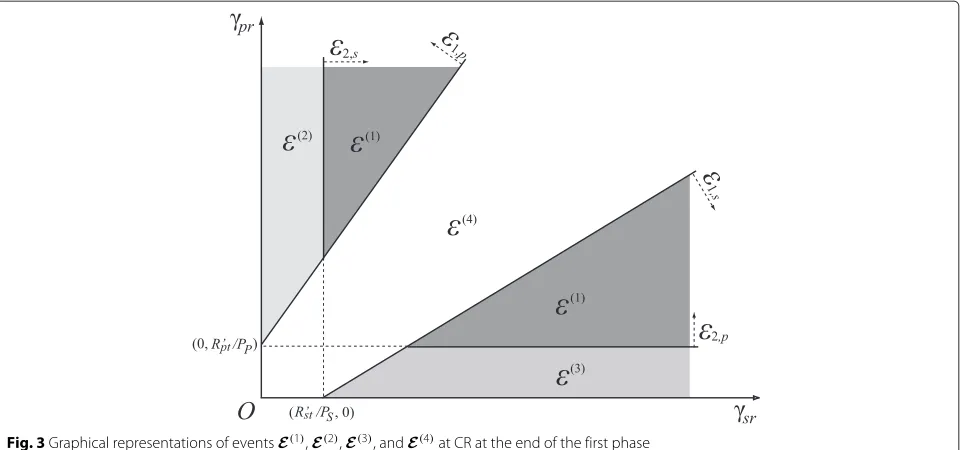
Thus, from (12), (14), (16), and (18), all possible decod-ing results at CR usdecod-ing SIC can be expressed as
E(1) = E
1,p∩E2,s
∪E1,s∩E2,p
, (19a)
E(2) = E
1,p∩ ¯E2,s
, (19b)
E(3) = E
1,s∩ ¯E2,p
, (19c)
E(4) = E¯
1,p∩ ¯E1,s. (19d)
Take a close look at (12), (14), (16), and (18); since the multiple-access channelshsrandhprare independent with each other, we can draw a 2-dimensional graph of γsr andγpr where the events defined in (19a)–(19d) are rep-resented by their respective regions, as shown in Fig. 3. Here, we assume thatRpt,Rst ≥ 1 such that there is no intersection between the regions of eventsE1,p andE1,s. With the respective regions defined by{γsr,γpr}, the cor-responding probability of each event can thus be obtained by
{γsr,γpr}
f(γsr,γpr)dγprdγsr
=
{γsr} f(γsr)
{γpr}
f(γpr)dγpr
dγsr,
(20)
Fig. 3Graphical representations of eventsE(1),E(2),E(3), andE(4)at CR at the end of the first phase
Lemma 1. By employing SIC at CR to decode both xp and xs, the respective probabilities of the events defined in (19a)–(19d) can be obtained as
Pr
E(1) = δsre −
δsr Rst
PS +
δpr Rpt(1+Rst) PP
δsr+
δprRptPS PP
+δpre −
δ pr Rpt
PP +
δsr Rst(1+Rpt) PS
δpr+ δsrR stPP PS
, (21a)
PrE(2) = δsr
⎡ ⎣e−
δpr Rpt PP −e−
δsr Rst
PS +
δpr Rpt(1+Rst) PP
⎤ ⎦
δsr+δ prRptPS
PP
, (21b)
PrE(3) = δpr
⎡ ⎣e−
δsr Rst PS −e−
δ pr Rpt
PP +
δsr Rst(1+Rpt) PS
⎤ ⎦
δpr+ δsrR stPP PS
, (21c)
PrE(4) = 1− δsre −δpr Rpt
PP
δsr+δ prRptPS
PP
− δpre −δsr Rst
PS
δpr+δsrR stPP PS
. (21d)
Please find in Appendix A for the detailed derivations.
3.2 Decoding performance at PR in the second phase 3.2.1 Conditioned on eventE(1)
Together with (1) and (3), MRC is performed at PR to decode the desired messagexp. Then, the corresponding achievable rate is given as
R(p1) = C
PPγpp PSγsp+1+
α 1−α+ PR1γ
rp
≈ C
PPγpp PSγsp+1+
α 1−α
, (22)
where the approximation is obtained assuming PR 1 [24, 25].
Lemma 2.Conditioned on eventE(1)that both xpand xs are successfully decoded at CR at the end of the first phase, the corresponding outage probability at PR at the end of the second phase can be derived as
O(P1) = Pr
R(p1)<Rpt
≈ ⎧ ⎪ ⎪ ⎪ ⎪ ⎨ ⎪ ⎪ ⎪ ⎪ ⎩
0, α≥ R
pt Rpt+1
1− δspe −δpp
Rpt−1−αα
PP
δsp+
Rpt−1−ααPSδpp PP
, α < R pt Rpt+1
. (23)
3.2.2 Conditioned on eventE(2)
Together with (1) and (5), by employing MRC at PR, the achievable rate ofxpis given as
R(p2) = C
PPγpp PSγsp+1 +
αPRγrp γrpβ2(PSγsr+1)+1
= C
PPγpp PSγsp+1+
α (1−α)+PR1γ
rp
, (24)
which is exactly the same (22). This is because in both cases,xp is successfully decoded and forwarded by CR with powerαPR. Thus, the corresponding outage proba-bility at PR at the end of the second phase is
O(P2)=O(P1). (25)
3.2.3 Conditioned on eventE(3)
Together with (1) and (7), by employing MRC at PR, the achievable rate ofxpis given as
R(p3) = C
PPγpp PSγsp+1+
γrpβ2PPγpr (1−α)PRγrp+γrpβ2+1
= C
PPγpp PSγsp+1
+ α
(1−α)+PP1γ pr +
1 PRγrp +
1 PPγprPRγrp
≈ C
PPγpp PSγsp+1 +
α 1−α
, (26)
where the approximation in (26) is obtained assuming
PP,PR1 [24, 25]. Since (26) is of the same form as (22), the corresponding outage probability at PR at the end of the second phase is
O(P3)≈O(P1). (27)
3.2.4 Conditioned on eventE(4)
Together with (1) and (8), by employing MRC at PR, the achievable rate ofxpis given as
R(p4)=C
2PPγpp PSγsp+1
. (28)
Lemma 3.Conditioned on eventE(4)that neither of xp and xsis successfully decoded at CR at the end of the first
phase, the corresponding outage probability at PR at the end of the second phase can be derived as
O(P4)=Pr
R(p4)<Rpt
=1− δspe −δppRpt
2PP
δsp+
δppRptPS 2PP
. (29)
Please find in Appendix C for the detailed derivations. Substituting (23), (25), (27), and (29) into (9), we can thus obtain the end-to-end outage probabilityOP of the primary system.
Theorem 2.Take a close look at (23), (25), and (27), all O(P1), OP(2), and O(P3) approach 0 whenα ≥ R
pt
Rpt+1. Then, from (9), the termPr{E(4)}O(P4)dominates the end-to-end outage probability OP. In other words, the component of Pr{E(4)}OP(4) brings a lower bound to OP. Definingα∗ =
Rpt
Rpt+1, the end-to-end outage performance of the primary system is thus optimized whenα≥α∗, i.e.,
arg min
α {OP} =
α|α≥α∗, and
min
α {OP} ≥Pr
E(4)O(4) P .
(30)
Remark 1. From Theorem 2, CR may simply select a power allocation factor α = α∗ = Rpt
Rpt+1 such that a reasonably good performance is achieved for the pri-mary system, without requiring the CSI or other relevant information.
Remark 2. For comparison purposes, we consider a benchmark case for the primary system without spectrum sharing, where PT transmits to PR directly without a relay. Then, with target rate Rpt, the corresponding outage prob-ability is
OP =1−e−
δpp
2Rpt−1
PP . (31)
The details are omitted here for the sake of brevity. Together with (9) and (31), in order to provide the primary system an incentive to participate in the spectrum sharing, the following condition has to be satisfied
Remark 3.From (30) and (31), ifPrE(4)O(P4) ≤ OP, then it is possible to find a suitable power allocation factor α, e.g., α ≥ α∗, such that the condition in (32) is satis-fied. If however, PrE(4)O(4)
P > OP, then the primary system experiences a performance loss compared to the benchmark case even whenα→1. Thus, in order to guar-antee the performance of the legacy primary system, apart from selecting a proper power allocation factor α ≥ α∗ at CR, the transmit power PS also needs to be properly designed.
For the power control ofPS, it is assumed that the sta-tistical CSI of hsp and hpp is available at ST, which is a common assumption made in existing works [20–23]. Assuming that the channels are reciprocal, the CSI can be acquired at ST through a feedback channel from PR [35–37]. In addition, other relevant information is also required, i.e.,PP andRpt, which is usually inserted in the header of a packet that can be overheard by ST. With these information, both PrE(4)O(4)
P ≤ OPandOPcan be estimated at ST. Furthermore, we assume that the probability PrE(4) is available at ST through a
feed-back channel from CR. Thus, although it is intractable to analytically derive PS such that OP ≤ OP, as long as a suitable PS is found to make sure that Pr
E(4)O(4)
P ≤
OP, it is possible to achieve cognitive spectrum shar-ing while provshar-ing a performance gain to the primary system.
3.3 Decoding performance at SR in the second phase 3.3.1 Conditioned on eventE(1)
Together with (1) and (3), SR attempts to decode the desired messagexs from the the mixed signals ofxsand xp using SIC. Similar to (11), (13), and (15), we have the following achievable rates in decoding xp and xs successively
where the approximations in (33a) and (33c) are obtained assuming PR 1 [24, 25]. Here, R(1,1p) denotes the achievable rate of decoding xp directly by considering the component of xs simply as noise. Upon successfully decoding and removing xp, R(2,1s) denotes the achievable rate of decoding the remainingxssuccessively. Conversely, R(1,1s) denotes the achievable rate of decodingxs directly that is subject to the interference from xp. Then, sim-ilar to (12), (14), and (16), we have the corresponding events in decoding the mixed signals of xp and xs by using SIC
From (34), the event of successfully decodingxsby using SIC can thus be expressed as
E(1) are successfully decoded at CR at the end of the first phase, the corresponding outage probability at SR at the end of the second phase can be derived as
Pr
Please find in Appendix D for the detailed derivations. where
3.3.2 Conditioned on eventE(2)
Together with (1) and (5), SR attempts to decode the desired messagexsusing SIC. Similarly, we have the fol-lowing achievable rates in decodingxpandxssuccessively
R(1,2p) = C
where the approximation in (38a) is obtained assuming
Similarly, the outage probability at SR at the end of the second phase can be derived as
O(S2)=1−PrE1,(2s)−PrE1,(2p)∩E2,(2s)
Then, by integrating over the corresponding region of eventE1,(2p)∩E2,(2s), we can obtain
Together with (1) and (7), SR attempts to decode the desired messagexsusing SIC. Similarly, we have the fol-lowing achievable rates in decodingxpandxssuccessively
R(1,3p) = C
where the approximation in (44a) is obtained assuming
PP,PR 1 and the approximation in (44c) is obtained assumingPR1 [24, 25], respectively.
From (44) and (33), since in both casesxsis successfully decoded and forwarded by CR with power(1−α)PR, we have
O(S3)=O(S1). (45)
3.3.4 Conditioned on eventE(4)
Again, SIC is performed at SR to decode the desired mes-sage xs by exploiting the received signals in (1) and (8). Then, we have the following achievable rates in decoding
xpandxssuccessively
R(1,4p) = C
Correspondingly, we have the following events in decod-ingxpandxssuccessively
E(4)
For the considered scenario whereRpt,Rst ≥1, there is no intersection between eventsE1,(4p)andE1,(4s). Thus, from Lemma 4, the corresponding outage probability at SR can be derived as
4 A performance upper bound
Conditioned on event E(1) that both x
p and xs are suc-cessfully decoded at CR at the end of the first phase, we propose using DPC at CR to pre-cancel the interference seen at SR (or PR) in the second phase.
4.1 A performance upper bound for secondary user
We propose using DPC [17] at CR that transmits a com-posite message
xr =αPRxp+xs (49) in the second phase. Employing a similar coding scheme as in [26, Eq. (15)],xsis encoded using DPC by treating the component of√αPRxpas the known interference that will corrupt the reception at SR in the second phase. Thus, after dirty paper decoding, the effectively received signal at SR in the second phase is given as
ys(2)=hrs
(1−α)PRxs+n0. (50) That is, SR sees no interference in the second phase. Then, together with (1) and (50), SR attempts to decodexsusing SIC. Following the same steps as in Lemma 4, the corre-sponding outage probability at SR at the end of the second phase can be similarly derived. The details are omitted here for the sake of brevity.
On the other hand, with the same power αPR allo-cated to forwardxpat CR, the outage performance of the primary user is the same as that in (23).
4.2 A performance upper bound for primary user
The interference seen at PR can be also pre-cancelled by performing DPC at SR, where a composite message
xr =xp+(1−α)PRxs (51) is transmitted in the second phase. Similarly,xpis encoded using DPC by treating the component of √(1−α)PRxs as the known interference that will corrupt the reception at PR. Thus, after dirty paper decoding, the effectively received signal at PR in the second phase is given as
yp(2)=hrp
αPRxp+n0. (52)
That is, PR sees no interference in the second phase. Again, together with (1) and (52), MRC is employed at PR to decodexp. The details are omitted here for the sake of brevity.
On the other hand, with the same power(1−α)PR allo-cated to forwardxsat CR, the outage performance of the secondary user is the same as that in (36).
Remark 4.From the above analysis, with a DPC per-formed at CR to exploit the successfully decoded messages received in the first phase, the interference seen at SR (or PR) in the second phase can be pre-cancelled, thus obtaining a performance upper bound for the secondary
(or primary) user without affecting the performance of the other user.
5 Simulation results
In this section, we illustrate the outage performance of both primary and secondary users in the proposed spec-trum sharing protocol. In order to limit the interference caused to the primary user, we consider a power control at ST wherePS = θPP. To evaluate the SIC decoding at CR at the end of the first phase, we letδ−sr1 = τδ−pr1for the multiple-access channelshsr andhpr at CR. To eval-uate the interference seen at PR due to cross talk, we let δ−1
sp = ϕδ−pp1for the multiple-access channelshspandhpp at PR. Unless otherwise specified, we let PP = 30 dB, PS = 10 dB,PR = 40 dB, andRst = Rpt = 1. In order to reflect the geometric structure of the considered network shown in Fig. 2, we letδ−pp1 = δss−1 = 0 dB for the direct links,δ−sp1=δps−1= −10 dB for the cross links, andδpr−1= δ−1
sr =δ−rp1=δrs−1=10 dB for the relay links, respectively. Simulation results are presented in Figs. 4, 5, 6, 7, 8, 9, 10, and 11 where lines denote the analytical results obtained in this paper and markers denote the results of Monte Carlo simulations.
5.1 SIC decoding at CR
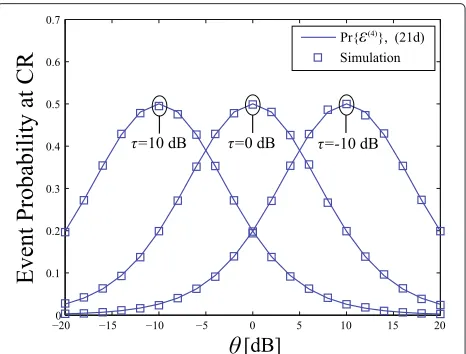
From Theorem 2, in order to fully exploit the relay trans-missions, eventE(4)that neither ofxpandxsis decoded at CR should be avoided as much as possible. Figure 4 dis-plays the probability of PrE(4)with respect toθ where
PS = θPP. Various channel conditions are considered whereδpr−1=10 dB andδsr−1=τδpr−1. As can be seen from Fig. 4, with an increase inθ, the probability of PrE(4) first increases and then decreases. This is reasonable as when there is a significant difference between the power levels ofxpandxsreceived at CR, e.g.,τθ1 orτθ1,
Fig. 5The end-to-end outage probabilityOPwith respect toϕwhere δ−1
pp =0 dB andδsp−1=ϕδpp−1, whenPP=30 dB andPS=θPP
SIC is facilitated and it would be easy to decode xpand xs successively. In contrast, if the components ofxpand xsare of comparable power levels, e.g.,τθ ≈ 1, then the SIC decoding is limited by the mutual interference and it would be difficult to decode either ofxpandxs. This can be observed in Fig. 4 where PrE(4)takes peak values at θ = −10, 0, 10 dB forτ =10, 0,−10 dB, respectively.
5.2 End-to-end outage performance of the primary user
Firstly, we evaluate how the interference due to cross talk affects the end-to-end performance of the primary sys-tem. Letδ−1
sp = ϕδpp−1,OP is plotted with respect toϕ in Fig. 5. The outage probabilityOPof the benchmark case considered in Remark 1 is also demonstrated. With an increase inϕ, since the interference link ST→PR becomes
stronger, the corresponding performance of the primary system is impaired. On the other hand, with an increase in θ, ST transmits at a higher power that impedes the SIC decoding at CR as well as cause more interference to PR, thus similarly impairing the performance of the primary system. In addition, it is observed that a perfor-mance improvement is achieved for the primary system with a higher power allocation factorα. Whenα = 0.4, even though ST transmits at a low power, e.g.,θ = −20 dB, and the interference link ST→PR is very weak, e.g., ϕ = −20 dB, the primary user experiences a perfor-mance loss, i.e., OP > OP. Whereas when α = 0.9, with all other parameters being the same, a significant performance improvement is achieved for the primary system. This means that besides the power control at ST, the power allocation at CR also needs to be designed to compensate the interference caused to the primary system due to secondary transmissions.
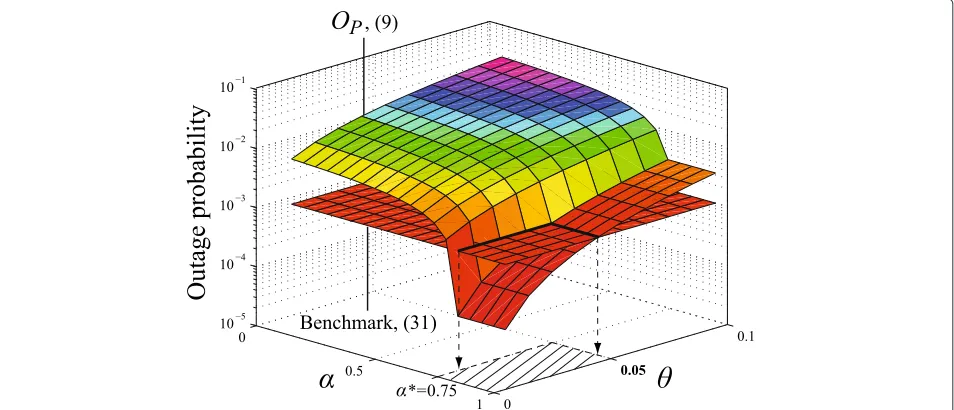
To further illustrate the effects ofPSand power alloca-tion factorα,OPis plotted with respect toθandαin Fig. 6. The outage probabilityOP of the benchmark case (31) is also illustrated. It is observed that when θ takes values smaller than 0.05 AND whenαtakes values greater than 0.75, even subject to the interference from the secondary transmissions, the condition in (32) is always satisfied and a performance gain is achieved for the primary system. Otherwise, ifθ >0.05, then we haveOP >OPeven when α→1.
This can be better observed in Fig. 7 where a cross-sectional view of Fig. 6 is demonstrated. With an increase in θ, since the SIC at CR is impeded meanwhile more interference is caused to PR, the corresponding outage performance of the primary user is degraded. When θ = −20,−15 dB, it is observed that we can always find
Fig. 7A cross-sectional view of Fig. 6 whenθ= −10, −15, −20 dB, respectively
a suitable power allocation factor α ≥ α∗ = Rpt Rpt+1 = 0.75 such that a performance gain is achieved for the pri-mary system. However, whenθ is increased to −10 dB, it is observed that OP > OP even when α → 1. Sim-ilar phenomena can be observed for a benchmark case considered in [28], where a linear weighted combination of primary and secondary messages is forwarded by CR only when both messages are successfully decoded. Other-wise, CR simply stays silent and both PT and ST perform a retransmission in the second phase. It is observed that with the same system parameters, a better performance is achieved by the proposed approach compared to that in [28]. This is reasonable as in the proposed approach, CR
Fig. 8The end-to-end outage probabilityOPwith respect toRpt
wherePS=10 dB andRst=1
Fig. 9The end-to-end outage probabilityOPwith respect toPP
whereα=α∗
is able to help forward the received messages more fre-quently, which is more beneficial compared to a retrans-mission by PT and ST simultaneously that will cause severe interference to one another.
Furthermore, from Figs. 6 and 7, it is observed that when αtakes values greater thanα∗= R
pt
Rpt+1=0.75,OP experi-ences a floor. This validates Theorem 2 that whenα≥α∗,
OP(1),O(P2), andOP(3)all approach 0 and thus PrE(4)O(P4), which is irrelevant to α, dominates the overall outage performance. For a better illustration, the outage per-formance using DPC at CR is also presented in Fig. 7. Conditioned on event E(1) that both xp and xs are suc-cessfully decoded at CR, by using DPC to pre-cancel the interference seen at PR, it is observed that a performance upper bound is achieved for the primary system.
Fig. 10The end-to-end outage probabilityOSwith respect toα
Fig. 11The end-to-end outage probabilityOSwith respect toRpt
whereα=α∗andPS=10 dB
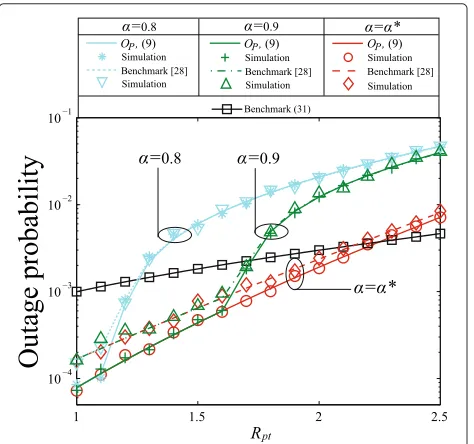
For a better illustration of Theorem 2,OPis plotted with respect toRptin Fig. 8. With an increase inRpt, the cor-responding outage performance of the primary system is degraded. Whereas with an increase in α, a better
out-age performance is achieved. Whenα = α∗ = R pt Rpt+1, the corresponding performance outperforms that with fixed power allocation factor, e.g., α = 0.8, 0.9, thus validat-ing Theorem 2 that the end-to-end outage performance of the primary system is optimized with respect toα when α ≥ α∗. Similar results can be observed for the bench-mark case [28]. Again, a better performance is achieved by the proposed approach compared to that in [28]. Furthermore, in modest rate region whereRpt < 2.2, the condition in (32) is satisfied and a performance gain is achieved for the primary system compared to the bench-mark case. Whereas in the high rate region, since both the SIC decoding at CR and the decoding at PR become more difficult, the primary user experiences a performance loss. Figure 9 displaysOPwith respect toPP where a power allocation factor ofα =α∗is adopted at CR. WhenPS = 10 dB, it is observed that a diversity order of 2 is achieved for the primary system whenPP→ ∞. This is reasonable as in the proposed protocol, two independent copies ofxp are received at PR from PT→PR and CR→PR respectively in two successive phases. However, when there is a fixed power ratio between PP and PS, i.e., PS = θPP, it is observed that the performance of the primary system is limited by the interference from secondary transmissions and no diversity gain is achieved.
5.3 End-to-end outage performance of the secondary user
In Fig. 10, the end-to-end outage probability of the sec-ondary userOSis plotted with respect toαwherePP =30 dB andPS = θPP. It is observed thatOS experiences a plateau whenαtakes the values between 0.3 and 0.7. And
whenαis less than 0.25 or greater than 0.75, a reasonably good outage performance is achieved for the secondary user. This is because of the employment of SIC at SR. In the regions whereα ≤ 0.25 andα ≥ 0.75, there is a sig-nificant difference between the power levels ofxpandxs received at SR in the second phase, thusxscan either be first decoded or successively decoded using SIC with a high probability. Conversely, whenαtakes values between 0.3 and 0.7, SIC is limited by the comparable interfer-ence betweenxpandxs, which makes it difficult to decode either of them. For comparison purposes, the outage per-formance of the secondary user in the benchmark case [28] is also presented, where SR attempts to recover the desired signalxsby using MRC of the received signals in two phases and considers the primary component sim-ply as noise. As illustrated in Fig. 10, with an increase in α, since more power is allocated to forward the pri-mary signal meanwhile higher interference is seen at SR, the outage performance of the secondary user is severely degraded.
Furthermore, it is observed from Fig. 10 that the per-formance of the secondary system is degraded with an increase in θ. This is because with a higher θ, e.g.,θ is increased from −20 to −15 dB, from (34a), it becomes difficult to first decode and removexp and then decode xssuccessively using SIC. In other words, it is not always beneficial to adopt a high transmit power at ST, even if the condition in (32) is met. Again, the outage performance using DPC at CR is illustrated in Fig. 10. Conditioned on event E(1), by using DPC to pre-cancel the interference seen at SR, it is observed that a performance upper bound is achieved for the secondary user.
Together with Figs. 7 and 10, whenα ≥ α∗, it is pos-sible to bring a performance gain for the primary system and at the same time achieve a reasonably good outage performance around 10−2for the secondary system by the proposed approach. Whereas for the benchmark case con-sidered in [28], although it is also possible to provide a performance gain to the primary user whenα≥α∗, the s econdary messagexscan be hardly delivered from ST to SR.
In Fig. 11,OSis plotted with respect toRptwhenα=α∗. Similarly, with an increase inRpt, from (34a), it becomes difficult to decodexpfirst and then decodexssuccessively using SIC, thus the corresponding outage performance of the secondary system is degraded. On the other hand, with other parameters being the same, it is observed that a performance degradation is experienced by the secondary system with an increase inRst.
user meanwhile the secondary user gains an opportunity to access the spectrum. Furthermore, with the same sys-tem parameters, performance gains are achieved for both primary and secondary systems by the proposed approach compared to a benchmark case in [28].
6 Conclusions
In this paper, the interference channel with a cognitive relay is exploited to achieve spectrum sharing between a licensed primary user and an unlicensed secondary user. A causal cognitive two-phase spectrum sharing protocol is proposed and closed-form expressions of the end-to-end outage probability are derived. In view of the inherent interference-limited property of the system, to guarantee the performance of the primary system, we consider a power control at ST together with a power allocation at CR to forward the processed primary and secondary mes-sages, respectively. Simulation results demonstrate that by designing both the power control at ST and power allo-cation at CR, spectrum sharing is achieved between the primary and secondary systems and performance gains can be achieved for both parties.
Appendix A: Derivations ofPrE(1),PrE(2),
PrE(3), andPrE(4)
From Fig. 3, upon determining the region of event E(1) that is defined in (19a), the corresponding probability can be derived by
Pr{E(1)} =PrE
For eventE(2)defined in (19b), the corresponding prob-ability can be derived by
Pr{E(2)} =PrE1,p∩ ¯E2,s
For eventE(3)defined in (19c), the corresponding prob-ability can be derived by
Pr{E(3)} =PrE1,s∩ ¯E2,p
Then the integrations in (53)–(55) can be solved to obtain the results in (21a)–(21c). Since eventsE(1), E(2), E(3), and E(4) are mutually exclusive, the corresponding
probability of eventE(4)can be readily obtained by
Pr{E(4)} =1−Pr
E(1)−PrE(2)−PrE(3). (56)
Appendix B: Derivations ofO(P1)
From (22), with target rateRpt, we have the corresponding outage probability at PR
O(P1)=PrR(p1)<Rpt
P by integrat-ing over the correspondintegrat-ing region
Pr PDFs ofγspandγpp. Then, this integration can be solved to obtain the results in (23).
Appendix C: Derivations ofO(P4)
From (28), with target rateRpt, we have the corresponding outage probability at PR
O(P4) = Pr{R(p4)<Rpt}
By integrating over the corresponding region defined in (59),O(P4)can be derived by
Appendix D: Derivations ofO(S1)
From (35), the outage probability at SR can be expressed as [34]
O(S1) = 1−PrE1,(1s)∪E1,(1p)∩E2,(1s)
From (34), by integrating over the corresponding regions of the events in (62), we have
Pr
certain event, Rpt
Rpt+1≤α≤
Competing interests
The authors declare that they have no competing interests.
Acknowledgements
The authors would like to acknowledge the support from the Ministry of Science and Technology (MOST) of China under the grants 2014DFA11640 and 2015DFG12580, the National Natural Science Foundation of China (NSFC) under the grants 61301128, 61461136004, and 61271224, the NFSC Major International Joint Research Project under the grant 61210002, the Hubei Provincial Science and Technology Department under the grants 2011BFA004 and 2013BHE005, the Fundamental Research Funds for the Central Universities under the grant 2015XJGH011, and the Special Research Fund for the Doctoral Program of Higher Education (SRFDP) under the grant 20130142120044. This research is partially supported by EU FP7-PEOPLE-IRSES, project acronym S2EuNet (grant no. 247083), project acronym WiNDOW (grant no. 318992), and project acronym CROWN (grant no. 610524).
Author details
1School of Electronic Information and Communications, Huazhong University of Science and Technology, Wuhan, China.2Philips Research, High Tech Campus, 5656 AE Eindhoven, Netherlands.3Ruckus Wireless, Singapore, Singapore.
Received: 29 September 2014 Accepted: 3 June 2015
References
1. H Cheng, Y-D Yao, Cognitive-relay-based intercell interference cancellation in cellular systems. IEEE Trans. Veh. Tech.59(4), 1901–1909 (2010) 2. D Li, Cognitive relay networks: opportunistic or uncoded
decode-and-forward relaying. IEEE Trans. Veh. Tech.63(3), 1486–1491 (2014)
3. JN Laneman, DNC Tse, GW Wornell, Cooperative diversity in wireless networks: efficient protocols and outage behavior. IEEE Trans. Inf. Theory.
50(12), 3062–3080 (2004)
4. G Kramer, M Gastpar, P Gupta, Cooperative strategies capacity theorems for relay networks. IEEE Trans. Inf. Theory.51(9), 3037–3063 (2005) 5. X Zhang, W Wang, X Ji, Multiuser diversity in multiuser two-hop
cooperative relay wireless networks: system model and performance analysis. IEEE Trans. Veh. Tech.58(2), 1031–1036 (2009)
6. F Yang, M Huang, M Zhao, S Zhang, W Zhou, Cooperative strategies for wireless relay networks with cochannel interference over time-correlated fading channels. IEEE Trans. Veh. Tech.62(7), 3392–3408 (2013) 7. O Sahin, E Erkip, inProceedings of IEEE Global Telecommunications
Conference (GLOBECOM). Achievable rates for the gaussian interference relay channel (IEEE Washington, DC, 2007), pp. 1627–1631
8. O Sahin, E Erkip, inProceedings of 41st Asilomar Conference on Signals, Systems and Computers (ACSSC). On achievable rates for interference relay channel with interference cancelation (IEEE Pacific Grove, CA, 2007), pp. 805–809
9. S Sridharan, S Vishwanath, S Jafar, S Shamai, inProceedings of IEEE International Symposium on Information Theory (ISIT). On the capacity of cognitive relay assisted Gaussian interference channel (IEEE Toronto, ON, 2008), pp. 549–553
10. S Rini, D Tuninetti, N Devroye, inProceedings of IEEE Information Theory Workshop (ITW). Outer bounds for the interference channel with a cognitive relay (IEEE Dublin, Ireland, 2010), pp. 1–5
11. Y Tian, A Yener, The Gaussian interference relay channel: improved achievable rates and sum rate upperbounds using a potent relay. IEEE Trans. Inf. Theory.57(5), 2865–2879 (2011)
12. S Rini, D Tuninetti, N Devroye, New inner and outer bounds for the memoryless cognitive interference channel and some new capacity results. IEEE Trans. Inf. Theory.57(7), 4087–4109 (2011)
13. S Rini, D Tuninetti, N Devroye, Inner and outer bounds for the Gaussian cognitive interference channel and new capacity results. IEEE Trans. Inf. Theory.58(2), 820–848 (2012)
14. H Charmchi, GA Hodtani, M Nasiri-Kenari, A new outer bound for a class of interference channels with a cognitive relay and a certain capacity result. IEEE Commun. Lett.17(2), 241–244 (2013)
15. S Rini, D Tuninetti, N Devroye, AJ Goldsmith, On the capacity of the interference channel with a cognitive relay. IEEE Trans. Inf. Theory.
60(4), 2148–2179 (2014)
16. TS Han, K Kobayashi, A new achievable rate region for the interference channel. IEEE Trans. Inf. Theory.27(1), 49–60 (1981)
17. M Costa, Writing on dirty paper. IEEE Trans. Inf. Theory.29(3), 439–441 (1983)
18. O Sahin, O Simeone, E Erkip, Interference channel with an out-of-band relay. IEEE Trans. Inf. Theory.57(5), 2746–2764 (2011)
19. Y Tian, A Yener, Symmetric capacity of the gaussian interference channel with an out-of-band relay to within 1.15 bits. IEEE Trans. Inf. Theory.
58(8), 5151–5171 (2012)
20. S Haykin, Cognitive radio: brain-empowered wireless communications. IEEE J. Select Areas Commun.23(2), 201–220 (2005)
21. Y Xing, CN Mathur, MA Haleem, R Chandramouli, KP Subbalakshmi, Dynamic spectrum access with QoS and interference temperature constraints. IEEE Trans. Mobile Comput.6(4), 423–433 (2007)
22. A Goldsmith, SA Jafar, I Mari´c, S Srinivasa, Breaking spectrum gridlock with cognitive radios: an information theoretic perspective. Proc. IEEE.
97(5), 894–914 (2009)
23. Y-C Liang, K-C Chen, GY Li, P Mahonen, Cognitive radio networking and communications: an overview. IEEE Trans. Veh. Tech.60(7), 3386–3407 (2011)
24. Y Han, A Pandharipande, TS Ting, Cooperative decode-and-forward relaying for secondary spectrum access. IEEE Trans. Wireless Commun.
8(10), 4945–4950 (2009)
25. Q Li, SH Ting, A Pandharipande, Y Han, Cognitive spectrum sharing with two-way relaying systems. IEEE Trans. Veh. Tech.60(3), 1233–1240 (2011) 26. A Joviˇci´c, P Viswanath, Cognitive radio: an information-theoretic
perspective. IEEE Trans. Inf. Theory.55(9), 3945–3958 (2009) 27. M Cheng, J Mao, L Li, inProceedings of 4th International Conference on
Wireless Communications Networking and Mobile Computing (WiCOM). Investigation of mutual interference channel with relay in cognitive transmission (IEEE Dalian, China, 2008), pp. 1–4
28. W Jaafar, W Ajib, D Haccoun, inProceedings of IEEE Global Communications Conference (GLOBECOM). A novel relay-aided transmission scheme in cognitive radio networks (IEEE Houston, TX, 2011), pp. 1–6 29. W Jaafar, W Ajib, D Haccoun, inProceedings of IEEE International
Conference on Communications (ICC). Opportunistic adaptive relaying in cognitive radio networks (IEEE Kyoto, Japan, 2012), pp. 1811–1815 30. TMC Chu, H Phan, H-J Zepernick, inProceedings of 23rd IEEE International
Symposium on Personal, Indoor and Mobile Radio Communications (PIMRC). Amplify-and-forward relay assisting both primary and secondary transmissions in cognitive radio networks over nakagami-m fading (IEEE Sydney, Australia, 2012), pp. 932–937
31. Q Li, A Pandharipande, SH Ting, inProceedings of IEEE Wireless
Communications and Networking Conference (WCNC). Spectrum sharing on interference channels with a cognitive relay (IEEE Shanghai, China, 2013), pp. 2982–2987
32. TM Cover, JA Thomas,Elements of Information Theory, 2nd edition. (John Wiley & Sons, Inc., Hoboken, New Jersey, 2006)
33. Q Li, SH Ting, A Pandharipande, Y Han, Adaptive two-way relaying and outage analysis. IEEE Trans. Wireless Commun.8(6), 3288–3299 (2009) 34. A Papoulis, SU Pillai,Probability, Random Variables and Stochastic Processes,
4th Edition. (McGraw Hill, New York, 2002)
35. V Asghari, S Aissa, End-to-end performance of cooperative relaying in spectrum-sharing systems with quality of service requirements. IEEE Trans. Veh. Tech.60(6), 2656–2668 (2011)
36. K Tourki, KA Qaraqe, M-S Alouini, Outage analysis for underlay cognitive networks using incremental regenerative relaying. IEEE Trans. Veh. Tech.
60(2), 721–734 (2013)