Group Signatures with Efficient Concurrent Join
Aggelos Kiayias∗ Moti Yung†
Abstract
A group signature is a basic privacy mechanism. The group joining operation is a critical component of such a scheme. To date all secure group signature schemes either employed a trusted-party aided join operation or a complex joining protocol requiring many interactions between the prospective user and the Group Manager (GM). In addition no efficient scheme employed a join protocol proven secure against adversaries that have the capability to dynamically initiate multiple concurrent join sessions during an attack.
This work presents the first efficient group signature scheme with a simple Joining protocol that is based on a “single message and signature response” interaction between the prospective user and the GM. This single-message and signature-response registration paradigm where no other actions are taken, is the most efficient possible join interaction and was originally alluded to in 1997 by Camenisch and Stadler, but its efficient instantiation remained open till now.
The fact that joining has two short communication flows and does not require secure channels is highly advantageous: for example, it allows users to easily join by a proxy (i.e., a security officer of a company can send a file with all registration requests in his company and get back their certificates for distribution back to members of the company). It further allows an easy and non-interactive global system re-keying operation as well as straightforward treatment of multi-group signatures. We present a strong security model for group signatures (the first explicitly taking into account concurrent join attacks) and an efficient scheme with a single-message and signature-response join protocol.
The present manuscript is a full version containing proofs, minor corrections as well as a more flexible and efficient protocol construction compared to the proceedings version [28].
∗
Computer Science and Engineering Dept., University of Connecticut, Storrs, CT, USA,[email protected]. Research partly supported by NSF CAREER Award CNS-0447808.
†
RSA Laboratories, Bedford, MA, USA and Computer Science Dept., Columbia University, NY, USA
Contents
1 Introduction 3
1.1 Our result . . . 4
2 Preliminaries 5
3 Group Signatures with Concurrent Join : Modeling 6
3.1 Syntax . . . 6 3.2 Correctness . . . 8 3.3 Security . . . 8
4 Group Signatures with Efficient Concurrent Join : Construction 10
5 Proof of Security 14
1
Introduction
Group signatures is a useful anonymous non-repudiable multi-use credential primitive that was in-troduced by Chaum and Van Heyst [18]. It involves a group of users, each holding a membership certificate that allows a user to issue a publicly verifiable signature while hiding the identity of the actual signer within the group. The public-verification procedure employs only the public-key of the group. Furthermore, in the case of any dispute or abuse, it is possible for the group manager (GM) to “open” an individual signature and reveal the identity of its originator.
Constructing an efficient group signature has been a research target for many years, see e.g., [19, 17, 14, 15, 10, 29, 4, 2, 12, 26, 9, 3, 11, 13]. A scalable scheme that provides constant signature size and has resistance to attacks by coalitions of users was given in [2]. Earlier constructions were designed without a formal model and definition of security of such schemes, and thus with partial security proofs at the best case (while many were actually broken).
A central issue in group signatures has been the way by which users join the group. Recently, [6] gave the first formal model of a somewhat “relaxed” group signature primitive where a trusted party generates and hands out all users’ keys. They also produced a generic solution thus demonstrating the polynomial-time plausibility of their notion of trusted-party aided join group signatures. This is in contrast with users who dynamically join the system and get their individual keys by interacting with the group manager (as in the protocol of [2]). Dynamic joins that allow users to register sequentially were studied formally in [25, 27] where efficient constructions were given and in [6, 7] where a generic plausibility proof was provided.
The most efficient and conceptually simple joining procedure for a group signature scheme (what we will call the “single-message and signature-response paradigm”) was illustrated by Camenisch and Stadler [17] who sketched a generic solution (which was followed in careful details in [6, 7]). In this type of joining protocol, the prospective user has an appropriately distributed secretx0and it computes a one way function f on it to obtain x = f(x0). The user sends x to the GM who, in turn, signs
xand returns the signature σ to the user using an appropriate signing algorithm. This completes the interaction of the join protocol. The possession of the signatureσ onx =f(x0)enables a user to sign anonymously a messagemby simply encryptingxprobabilistically intoψ(under the GM’s public key or whatever entity is supposed to execute the opening algorithm) and by providing a zero-knowledge proof of (i) the fact that theψ is an encryption of some xknown to the prover, (ii) the fact that the prover knowsx0a preimage of thatxunderf, (iii) the fact that the prover knows a signature issued by the GM on thatx.
While the Camenisch-Stadler approach is elegant and advantageous (as we argue below), its in-stantiation by an efficient scheme turned out to be elusive, since the many schemes that have been suggested in the last eight years approximated it but none really employed it. In fact, all the efficient schemes in the non-trusted-party-aided joining setting that were not broken used additional communi-cations during the join protocol usually to assure that certain constraints and certain knowledge of the joining user is present, i.e., the prospective user had to engage in an interactive zero-knowledge proof with the GM. It was not at all apparent whether the single-message and signature-response join would actually be instantiable in an efficient manner in a provably secure scheme. Moreover the employment of such proofs of knowledge has the usual shortcomings with respect to adversaries operating in the concurrent setting (namely, rewinding cannot be employed and a “straight-line” approach needs to be followed that makes the joining protocols even more involved).
To conclude the motivation for our result, we summarize the advantages of a group signature em-ploying a single-message and signature-response joining protocol:
time. This enables group managers over the Internet (where servers are multi-thread machines).
2. Proxy Join: Users can be joined by a proxy collecting all their requests and then collecting the responses from the group manager; this is a very effective way to enroll companies and organizations by delegating collection and distribution to security officers. It is highly effective in enrolling to an identity escrow scheme without the need for random oracle proofs.
3. Multi-Group Scenario: There may be a number of groups; since single-message and signature-response joins require essentially no interaction between the GM and the prospective user, users may accumulate many GM membership signatures on the samex value non-interactively thus easily becoming members of multiple-groups.
1.1 Our result
In this work we implement the first group signature scheme with a single-message and signature-response join protocol to be exploited for concurrent joins and other advantages as above, thus im-plementing efficiently the Camenisch-Stadler approach for the first time1.
We start by presenting the first model of “group signature with concurrent joins” which builds on the recent formal models and consists of a set of attacks. We note that in a privacy primitive interacting users may be conducting simultaneous attacks against each other and these need to be captured formally. We call our attacks: misidentification attack, framing attack and anonymity attack and is an extension of our sequential-join formal model for group signatures in [27]. We then implement a scheme based on specific assumptions and prove its security. The scheme allows adversarial opening of signatures and its signature size is only about twice the size of the scheme of [2] (that did not allow for adversarial opening or concurrent join attacks).
From a technical viewpoint we employ a number of complex primitives including the digital sig-nature scheme of Boneh and Boyen [8] (hence referred to as the BB sigsig-nature) as well as verifiable encryption for discrete-logarithms that are based on the Paillier encryption function [31, 21, 16, 24].
A novelty of our technical approach (and perhaps a partial explanation why we manage to achieve an efficient single-message and signature-response join) is that we deviate from most of recent group signature literature by instantiating the one-way function employed by the prospective user during the join with multiplication instead of exponentiation. Our general design approach is outlined in figure 1: users sample an RSA modulus and then obtain a short chain of BB certificates on it (numbering from one to five signatures). This modest interaction (which is simply a PKI registration in a domain employing RSA moduli with a BB signature for certification) allows users to sign as group members.
Our security proofs follow a modular approach: in a nutshell, a misidentification adversary is turned into a BB-forger, a framing adversary is turned into a factoring algorithm and an anonymity attacker is turned into a CCA2 adversary against the encryption algorithm we employ. The group signature itself is based on the Fiat-Shamir paradigm, by essentially turning an identity escrow (anonymous identification) system into a signature and employing a random oracle. We note that the interactive version of our group signature yields an identity escrow scheme in a straightforward manner that can also have concurrent group signing by employing general transformation techniques forΣ-protocols, e.g. [23].
1
User Join Dialog
GM: BB Signer x = RSA modulus
(s,r)=BB(x)
Group signature is
CCA2-Paillier encryption of x coupled with
1. encryption of s.
2. proof of knowledge of r s.t. (s,r) is valid BB signature on x 3. proof of knowledge of x1 and x2
4. well-formedness
User Database User 1: x, (s,r) User 2: x, (s,r) User 3: x, (s,r) .
. .
(x1,x2) = factorization
of x
Figure 1: Overview of our general group signature design. The BB signature can be substituted by potentially other signatures that are suitable for algebraic encryption with efficient validity proof.
The present manuscript is a full version containing proofs, minor corrections as well as a more flexible and efficient protocol construction compared to the proceedings version [28].
2
Preliminaries
Interactive Turing Machines and Concurrent Executions. A two-party protocol is a pair of
proba-bilistic polynomial-time bounded Interactive Turing machineshA,Bi. Each ofA,Bhas a private input tape, work-tapes, a (joint) communication tape and a private output tape. An execution of a protocol
hA,Bion inputsx, yfor the two players will be denoted by[A(x),B(y)]. For an execution of a protocol we will consider the following random variables: (i)Trans[A(x),B(y)]is the contents of the commu-nication tape after the two parties terminate. (ii)OutA[A(x),B(y)]is the contents of the private output tape of playerAafter termination. (iii)OutB[A(x),B(y)]is the contents of the private output tape of playerBafter termination.
Now suppose thatP = hA,Bi is a protocol. An “interface oracle” for concurrent simulation of playerB, denoted byI[P↔B(y)], is an oracle that accepts the following queries:
Q1. Start−Session: The interface oracle I[P↔B(y)] initiates a session for the protocol P: it
selects a session identifiersand ifBis the player that goes first in the protocolP, the interface simulates the first move ofBon inputy; the interface returns as answer to theStart−Session
query the session identifiersand the output of the simulation of playerB’s first move (if any). The interface keeps a database with the state of playerB for the session identifiers; the state includes all coin tosses ofB, and the contents of all tapes including the communication tape.
Q2. Advance−Session(s, msg) The interface oracle looks up the table of sessions and recovers the state of player Bfor the session with identifier s(if there is no such session the interface returns ⊥as answer to the oracle query). If sessionsexists the interface appendsmsg to the communication tape of the session and continues the simulation of playerB(as ifmsg is the message that is written to the communication tape of playerBby playerA).
an interface oracle as defined above. Note that the interface oracleI[P↔A(x)](for concurrent executions of player A in the protocol P) can be defined in the same fashion as above. Frequently protocol executions are stateful, e.g. there is a database, or state St in general that an instantiation of the protocolP may consult. This stateStwill be maintained by the interface oracleI. In this case we will writeISt[P↔B(·)]. In the case that a TMM has access to a stateful interface oracle I we will
writeMISt[P↔B(·)]. Depending on the case, I may modify the stateStor even allow read and write
access toStby M. In such cases we will writeMISt[P↔B(·),READSt,MODIFYSt], where READ
Stis an
oracle interfaced toM throughI that given a fixed input returns the contents of theStand similarly MODIFYStis an oracle that allowsM to modify the contents ofStusing some standard encoding and
addressing scheme.
Bilinear Maps. LetG1,G2 two groups of prime orderp so that (i)G1 = hg1i andG2 = hg2i; (ii) τ :G2 → G1is an isomorphism withτ(g2) =g1 and (iii)e:G1×G2 → GT is a bilinear map. We
remark that in many cases it can be thatG1 =G2(and in this caseψwould be the identity mapping).
LetG1=hg1i,G2 =hg2igroups as above with|G1|=|G2|=p; a bilinear map is a mapes.t. for all
(u, v)∈G1×G2 it holds thate(ux, vy) =e(u, v)xy ande(g1, g2)6= 1.
Intractability Assumptions. We will employ the following intractability assumptions:
The Strong Diffie Hellman Assumption (SDH) was put forth by Boneh and Boyen [8]. Theq-SDH problem over two groupsG1,G2 is defined as follows: given a(q+ 2)-tuplehg1, g2, gγ2, . . . , g
(γ)q
2 ias
input, output a pair(g 1
γ+x
1 , x) wherex ∈ Z∗p. The q-SDH assumption suggests that any probabilistic
polynomial-time (PPT) algorithm solving theq-SDH problem has negligible success probability. When
qis any polynomial-time function on the security parameter we will write simply SDH.
The Strong-RSA problem [5] is as follows: given n, z ∈ QR(n), whereQR(n) is the group of quadratic residues ofZ∗nasks for two integersu, e >1so thatue ≡nz. The Strong-RSA assumption
suggests that any PPT algorithm solving the Strong-RSA problem has negligible success probability. The Decisional Composite Residuosity (DCR) assumption [31] is defined as follows: it is compu-tationally hard to distinguish between the distributions of tuples of the form(N, uN modN2) where N is an RSA safe composite modulus andu←RZ∗N2 and the distribution of tuples of the form(N, v)
whereN is an RSA safe composite modulus andv←RZ∗
N.
3
Group Signatures with Concurrent Join : Modeling
In this section we give the formal definition of group signatures with concurrent join. First we start with the syntax of the signature. The parties that are involved in the scheme include the Group Manager (GM), the Users and the Verifiers.
3.1 Syntax
Definition 3.1 A group signature scheme with concurrent joins is a digital signature scheme that is
comprised of the following five procedures:
SETUP: it is a probabilistic algorithm that on input a security parameter 1ν, it outputs the group public key Y (including all system parameters) and the secret key S for the GM. SETUP ini-tializes a public state string St = (Stusers, Stjoin−trans) with two components Stusers =
andStjoin−trans = . The public state stringSt will hold the user identity database and the
JOIN: A protocol between the GM and a user that results in the user becoming a new group member. The user’s output is a membership certificate and a membership secret. We will denote thei-th user’s membership certificate bycerti and the corresponding membership secret byseci.
SinceJOIN is a two-party protocol, its specification includes the description of two interactive Turing Machines (ITM)Juser,JGM. OnlyJuser will have a private output.
According to the notations of section 2 an execution of the protocol is denoted as[Juser(St,Y)↔ JGM(St,Y,S)]and has two “output” components:
1. the user private output,hi,certi,secii ←User[Juser(St,Y)↔JGM(St,Y,S)], and
2. the public transcript,transcripti ←Trans[Juser(St,Y)↔JGM(St,Y,S)].
After a successful execution ofJOINthe following updates are made:Stusers=Stusers||hiiand Stjoin−trans=Stjoin−trans|| hi,transcriptii. The identity-tagiwill be selected from a space of
possible identity tags denoted byID.
SIGN: A probabilistic algorithm that given the group’s public-key, a membership certificate, a mem-bership secret and a message m, it outputs a group signature for the message m. We write
SIGN(Y,certi,seci, m)to denote the application of the signing algorithm on the messagem.
VERIFY: An algorithm for establishing the validity of an alleged group signature on a message with re-spect to a group public-key. Ifσis a signature on a messagem, then we haveVERIFY(Y, m, σ)∈ {>,⊥}.
OPEN: An algorithm that, given a message, a valid group signature on it, a group public-key, the GM’s secret-key and the public-state it determines the identity of the signer. In particular
OPEN(m, σ, St,Y,S)∈Stusers∪ {⊥}.
Notation. Below we will introduce a helpful notation for describing the relationship between transcripts and membership certificates and secrets. GivenhY,Si ←SETUP(1ν)we define the following relations over strings based onY and some public stateSt,
hi,cert,seci(Y,St)transcriptif there exist coin tossesρforJGMandJUserso that
hi,cert,seci=User[JUser(St,Y)↔JGM(St,Y,S)](ρ)
and
transcript=Trans[JUser(St,Y)↔JGM(St,Y,S)](ρ)
Similarly we will definecertY sec, if there exist coin tossesρforJGMandJUserand a stateStso that
hi,cert,seci=User[JUser(St,Y)↔JGM(St,Y,S)](ρ)
Finally we define the set of all valid public statesValidas follows:St0∈Validif there exists a PPT
Turing machineM andhY,Si ← SETUP(1ν) so that whenMISt[JOIN↔GM(St,Y,S),READSt]terminates it holds thatSt =St0 and the interface oracle I given toM initializesSt = (, ) and allowsM to
have read access toStthroughREADqueries. IfIStinitializesStto someSt0 ∈Validthat is not(, )
then this defines the set of all valid extensions of the public-stateSt0that will be denoted byValidSt0.
3.2 Correctness
Below we define the correctness of a group signature scheme that satisfies the above syntax. Note that a group signature is a tuplehSETUP,JOIN,SIGN,VERIFY,OPENiwithJOIN=hJUser,JGMi.
Definition 3.2 A group signature with concurrent join is correct if the following are true:
C1. (users are assigned unique names) For anySt∈ Validit holds thatStuserscontains no multiply
defined identity-tags, i.e., ifStusers=hi1i||. . .||hiKiit holds thatj6=j0 ⇒ij 6=ij0.
C2. (signing is correct) For anyhY,Si ←SETUP(1ν), any stringscert
Y secand anym∈ {0,1}∗, it holds thatVERIFY(Y, m,SIGN(Y,cert,sec, m)) =>.
C3. (open is correct) For any hY,Si ← SETUP(1ν), any St ∈ Valid, any m ∈ {0,1}∗, and any
hi,cert,seci (Y,St) transcript it holds thatOPEN(m,SIGN(Y,cert,sec, m), St00,Y,S) = i,
whereSt00 ∈ValidSt0 andSt0is defined as follows: Stusers0 =Stusers||hiiandSt0join−trans =
Stjoin−trans||hi,transcripti.
Property C1 requires that theJOIN protocol assigns a different identity tag to all users. Property C2 ensures the correctness of the underlying signing and verification for any valid signing key (that includes a membership secret and a membership certificate). Finally, property C3 ensures that theOPEN
algorithm correctly identifies all signers: in particular it says that if a user is introduced at some moment in the system’s operation and the public-stateStis updated with the user’s identity tag resulting to state
St0then it holds that whenever this user issues a group signature the user will be correctly identified for every public stateSt00that succeeds the public-stateSt0 of the system. We note that it may be viable to collapse C1 and C3 but, given the intuitiveness of the formulation, we keep them as separate properties.
3.3 Security
Security against group signatures with concurrent join, will be broken into three basic properties fol-lowing the model designs of [25, 27]. The properties are formalized as games between the adversary and an entity called the interface, denoted byIthat represents the uncorrupted aspect of the system in each attack.
Misidentification. In a misidentification attack, the adversary joins the system through possibly many
concurrent sessions of theJOINprotocol and it attempts to produce a signature that cannot be opened to any of the users that are adversarially controlled. We note that without loss of generality we will assume that all users introduced in the system are adversarially controlled; this means that the goal of the adversary is to simply make theOPENalgorithm to fail. We remark that adversaries that make the
OPENalgorithm to point to an innocent user will be handled in the framing attack (next paragraph). Below,ISt[JOIN↔GM]will denote the interface oracle for concurrent simulation of theGMparty in
the protocolJOIN(refer to section 2 for the definition). Note that the interfaceIhas access to the public state string Stand it updates it accordingly whenever a new user (the adversary that is) successfully completes theJOINdialog. Also, an oracleREADStis provided to the adversary that allows him to read
the contents of the public state database that contains the identification transcripts and user identity tags. Finally, an oracle OPEN is provided to the adversary that allows him to submit signatures and obtain the output of the opening algorithm.
The Misidentification-Attack GameGAmis(denoted byGAmis(1ν)): 1. hY,Si ←SETUP(1ν);St= (Stusers, Stjoin−trans) = (, );
2. hm, σi ← AISt[JOIN↔GM(St,Y,S),READSt,OPEN](Y);
We will say that a group signature is secure against misidentification attacks with concurrent join provided that for allAit holds thatProb[GAmis(1ν) =>] = 1−negl(ν).
Framing. In a framing attack the adversary plays the role of the system where the interface represents
a handful of innocent users. A framing attack is meant to capture any adversarial behavior that allows the adversary to make the open algorithm point to an innocent user. We remark that this captures the notion of exculpability as well as any other adversarial behavior that frames an innocent user. In the concurrent setting, we allow the adversary to initiate many concurrent executions of theJOIN dialog playing the role of a malicious GM. The goal of the adversary now is to produce a signature that opens to one of the innocent users.
Naturally in modeling such an attack we cannot allow to the adversary to do all the bookkeeping for the user database himself (otherwise anOPENoperation would be without meaning). Every time the adversary successfully terminates aJOINdialog with an innocent user that is controlled by the interface
I, the interface will add the user identity into theStusers and will append the whole communication
transcript toStjoin−trans. Moreover it will keep a private database containing the secrets of the
inno-cent users that will have the formathi,secii(these will not be accessible to the adversary). In addition
to the above, we will allow the adversary to submit queries to aSIGNoracle that will be handled by the interfaceIand will accept the identity of one of the innocent users and a message and will return a signature of this message with the signing mechanism of the named user.
We allow the adversary to have appropriately restricted modify access to the public-stateSt; this access will be handled by I in the form of the MODIFYSt oracle query. As mentioned already we
will not give to the adversary full write capability to the public stateStsince if he is allowed to this, opening any signature correctly would be meaningless (e.g., if the adversary erases the database of
JOINtranscripts it is straightforward that the opening capability is cancelled). The restrictions are as follows: MODIFYSt will not permit the adversary to insert a join transcript that reuses an identity tag
(this restriction is essential to maintain the semantics of theOPEN unambiguous) and will not allow the adversary to modify any of the identity tags or join transcripts of the innocent users (to these the adversary will have read-only access). Any other modification of the public-state will be allowed byI
(in particular the adversary is allowed to introduce users to the public-state as well as erase them — for this reason there is no need for a “corrupt” oracle).
We will use the notation StIusersto denote all innocent users in the system that are introduced by the execution of the concurrentJOINoracle and are managed by the interface oracleI.
The Framing-Attack GameGAfra (denoted byGAfra(1ν)): 1. hY,Si ←SETUP(1ν);St= (Stusers, Stjoin−trans) = (, );
2. hm, σi ← AI[JOIN↔U ser(Y),SIGN,READSt,MODIFYSt](Y,S) 3. i=OPEN(m, σ, St,Y,S);
4. If(VERIFY(Y, m, σ) =>)∧(i∈StIusers)then return>else return⊥;
We say that a group signature satisfies security against framing attacks with concurrent join pro-vided that for allAit holds thatProb[GAfra(1ν) =>] = 1−negl(ν).
Anonymity. Finally, anonymity is modeled as a sort of CCA2 attack against the identity encryption
The Anonymity-attack GameGAanon(denoted byGAanon(1ν)): 1. hY,Si ←SETUP(1ν);St= (Stusers, Stjoin−trans) = (, );
2. haux, m,cert1,sec1,cert2,sec2,i ← AI[JOIN↔GM(St,Y,S),READSt,OPEN](play,Y)
3. if¬((cert1 Y sec1)∧(cert2Y sec2))orcert1 =cert2then terminate; return⊥;
4. Chooseb←R{1,2};
5. ψ←SIGN(Y,certb,secb, m);
6. b∗ ← AI[JOIN↔GM(St,Y,S),READSt,OPEN¬ψ](guess, aux); 7. ifb=b∗return>else return⊥;
We note that theOPEN¬ψ oracle operates as theOPENoracle with the usual restriction that it should return⊥if the adversary submitsψas the signature to be opened.
A group signature is said to be secure against anonymity attacks with concurrent join provided that for allAit holds that2Prob[GAanon(1ν) =>]−1 =negl(ν).
Based on all the above we will say that a group signature with concurrent join is secure provided that it is secure against misidentification, framing and anonymity attacks.
4
Group Signatures with Efficient Concurrent Join : Construction
In this section we describe our efficient group signature construction. Our construction below is an optimized and more flexible variant of the scheme presented in the proceedings version of this work, [28]. A number of primitives proved to be instrumental in our construction including: Integer commit-ments [22], BB signatures [8] and a CCA2 variant of Pailier encryption [31, 24, 16]. We first begin by describing the public-parameters our system will employ.
Public-parameters. The public parameters of the scheme are as follows:
p1 A (small) integer parameterv(1 ≤v≤5) andvpairs of groups of orderptwhereptis a`p-bit
prime, pt > 2`p−1, denoted by G1,t = hg1,ti andG2,t = hg2,ti, so that there is a mapping et
and a groupGtandet : G1,t×G2,t → Gtis a bilinear map. Note thattranges in{1, . . . ,v}.
It is assumed that allp1, . . . , pvare distinct. These groups will be assumed to satisfy the Strong
Diffie Hellman assumption.
p2 an RSA-modulusn, of`nbits;nis selected so that Strong-RSA will be infeasible overQR(n).
p3 Four integer rangesS, S0, Sf, Sf0 over the parameters`, `p,v, k, k
0; note that `is an integer pa-rameter suitable for the selection of RSA moduli. IntuitivelyS0will be a range of integers from which RSA moduli will be chosen andSf0 will be a range of integers from which the factors of such moduli will be chosen; the rangesS, Sf will be extensions of these two ranges that will be
used in the construction.
The integer ranger S is defined as S =df S(2`−1,2v(`p−1)−1); we recall that the notation
S(a, b) =df {a−b, . . . , a +b} (we call this an integer sphere centered at a). Observe that ifx, y ∈ S andx ≡pt y for allt = 1, . . . ,v then it holds thatx = y; indeed, the given
con-dition implies thatx ≡p1...pv y (cf. Chinese remaindering). But sincep1. . . pv > 2v(`p−1) =
2·2v(`p−1)−1, which is the length of the sphereS, it follows thatx=y.
Now for two parameters k, k0 ∈ Zwe select the range S0 as follows: S0 =df S(2` 0
,2µ0) = S(2`−1,2v(`p−1)−1−k−k0). Moreover we select the range Sf =df S(2`f,2µf) = S(2`/2−1,
2`/2−1+k+k0)andSf0 =S(2`0f,2µ 0
Note that all ranges S, S0, Sf, Sf0 are assumed subsets of {1, . . . , φ(n)}. Moreover note that Sf0 =S(2`/2−1,2`/2−1) ={0, . . . ,2`/2}contains all`/2-bit numbers; as a result, any`-bit RSA modulus that belongs to the rangeSand splits to two equal size factors of`/2bits will have its factors insideSf0.
p4 a safe RSA-modulusN of`N bits withN = P QandP = 2P0 + 1, Q = 2Q0 + 1, so that in
the groupZ∗N2 it holds that the DCR assumption is hard, and the valueG = (G0)2N(modN2)
is selected withG0 ←R Z∗N2. Note that with overwhelming probabilityhGiis the subgroup of
quadratic residues moduloN2 that are simultaneouslyN-th residues; note that#hGi =P0Q0. It will be assumed thatZN contains the rangeS.
SETUP. The procedure first generates the public-parameters p1 and p2 andp3 as described above. Then, it executes the following steps:
It selectsvpairs of valuesγt, δt←RZpand setswt=g2γ,tt andvt =g2δt,tfort= 1, . . . ,v; this is the
setup for BB signatures, cf. [8].
It selectsg, f1, f2, f3, f4←RQR(n). These values will be used for integer commitments.
(Opening functionality) the public parametersN, Gaccording top4are selected as well asH1, H2, H3∈ hGiwithHi=Gai,ai←RZbN/4cfori= 1,2,3and a hash-keyhkfor a universal one-way hash function familyUOHF. We remark that this step can be entirely separated from the GM’s setup phase and executed by an opening authority. Nevertheless for convenience and simplification of the presentation we do not make further distinction in the present version of the paper.
The public-keyYis set to
hg1,t, g2,t, wt, vt,desc(G1,t||G2,t||Gt)||etivt=1||hUOHF, g, f1, f2, f3, f4, n, N, G, H1, H2, H3,hki
and the secret keyS is set to tohγt, δtivt=1||ha1, a2, a3i. Note that the factorization ofnis not needed
and thus it can be discarded.
JOIN. In the join protocol execution, the user will obtain av-long chain of BB signatures on an RSA modulus that he selects. A user’s membership certificate is the signature-chain together with the RSA modulus; a user’s membership secret on the other hand is the factorization of the modulus. The join procedure between a prospective user and the GM is described in detail below:
• (User→GM) The user initiates the procedure and selectsx∈S0to be an`-bit RSA modulus with
x1, x2its two`/2-bit long prime divisors, so thatx6∈Sf andx1, x2 ∈Sf0. The User transmitsx
to the GM.
• (GM→User) The GM checks whetherx ∈ S0− {0,1} and whetherx is unique in the system (i.e., it was not submitted by another user in a previous or concurrent JOIN instantiation); if either check fails the GM terminates the JOIN protocol; otherwise (i) it reads the public-state
St, selectsi ∈ ID so thati 6∈ Stusers and in such a manner that iis distinct from any other
concurrent executions that he may be involved simultaneously and writes to its communication tape the valueshi, σ1, . . . σv, riwherer ←R Zp1...pv andσt = g
1/(γt+x+δtr)
1,t fort = 1, . . . ,v;
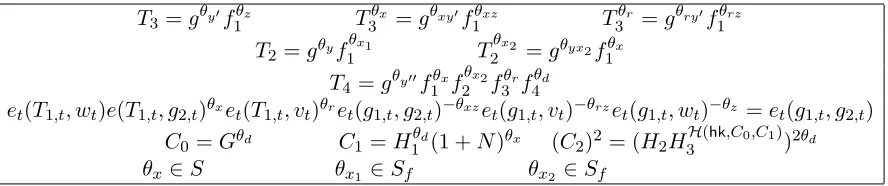
T3=gθy0f1θz T3θx =gθxy0f1θxz T3θr =gθry0f1θrz T2 =gθyf
θx1
1 T
θx2
2 =gθyx2f θx
1 T4 =gθy00f1θxf
θx2
2 f θr
3 f θd
4
et(T1,t, wt)e(T1,t, g2,t)θxet(T1,t, vt)θret(g1,t, g2,t)−θxzet(g1,t, vt)−θrzet(g1,t, wt)−θz =et(g1,t, g2,t) C0=Gθd C1 =H1θd(1 +N)θx (C2)2 = (H2H
H(hk,C0,C1)
3 )2θd
θx∈S θx1 ∈Sf θx2 ∈Sf
Figure 2: The relations defining the signature of knowledge. Note that the parametertis running from
1, . . .v.
• The user verifies that et(σt, wtgx2,tvrt) = et(g1,t, g2,t) for t = 1, . . . ,vand that i 6∈ Stusers;
if a test fails the user fails the JOIN dialog. Otherwise, it terminates successfully by setting his membership certificate tocert = hx, σ1, . . . , σv, rivt=1 and his membership secret tosec = hx1, x2i.
Observe that the user does not prove that xwas selected appropriately; Perhaps surprisingly, we show that this is still sufficient for security in the concurrent setting. Naturally if the user choosesx
inappropriately two things may happen: (i) the user may not be able to issue group signatures, e.g., this may happen whenxis a prime; this naturally is of no concern to the GM, (ii) the user selectsxas an integer that is easy to factor; while this is of concern there is nothing that can be done about it: this case is conceptually the same as the case that the user just leaks its secret-key; while this possibility is annoying there is little that can be done to prevent this in any group signature scheme (and it is beyond the scope of the present paper at any rate).
SIGN. We present the signing algorithm. The user possesses the following: a membership certificate
hx, σ1, . . . , σv, ri and the corresponding membership secret x1, x2. The signing algorithm will be
obtained by applying the Fiat-Shamir Heuristic on an appropriately designed proof of knowledge. First, the signer computes the following values:
T1,t =g1z,tσt, t= 1, . . . ,v z←RZp1...pv inG1,1, . . . ,G1,v T2 =gyf1x1 y ←RS(1,2`n−2) inQR(n) T3 =gy
0
f1z y0 ←RS(1,2`n−2) inQR(n)
T4 =gy
00
f1xfx2
2 f3rf4d y00 ←RS(1,2`n−2) inQR(n) C0 =Gd d←RS(1,2`N−2) inZ∗N2
C1 =H1d(1 +N)x inZ∗N2
C2 =||(H2H
H(hk,C0,C1)
3 )d|| inZ∗N2
Note that ||x|| = x if x ≤ N2/2 and ||x|| = N2 −x otherwise. Also recall that S(a, b) =df
{a−b, . . . , a+b}. Subsequently the signer will construct the signature “of knowledge” on the given message m by providing a proof of knowledge for the relations given in figure 2 that involve the fourteen witnessesθz, θx, θxz, θr, θrz, θx1, θx2, θy, θy0, θy00, θxy00, θry0, θyx2, θd.
Given the coin tosses of the signer for the selection ofT1,1, . . . , T1,v, T2, T3, T4, C0, C1, the
wit-nesses needed in figure 2 are selected as follows:θz =z, θx =x, θxz =x·z, θr=r, θrz =r·z, θx1 = x1, θx2 =x2, θy =y, θy0 =y
0, θ
y00 =y00, θxy0 =x·y0, θry0 =r·y0, θyx
2 =y·x2, θd=d. Now, given
1. (choose blindings) the valuesρz←R±{0,1}v`p+k+k
0
,ρx ←R±{0,1}µ
0+k+k0
,ρxz←R±{0,1}v`p+µ
0+k+k0 ,
ρr ←R±{0,1}v`p+k+k
0
,ρrz←R±{0,1}2v`p+k+k
0
ρx1 ←R±{0,1} µ0
f+k+k0,ρ
x2 ←R±{0,1} µ0
f+k+k0,
ρy, ρy0, ρy00 ←R ±{0,1}`n−2+k+k 0
,ρxy0 ←R ±{0,1}`n−2+µ 0+k+k0
ρry0 ←R ±{0,1}`n−2+v`p+k+k 0
ρyx2 ←R ±{0,1}
`n−2+µ0f+k+k 0
ρt ←R ±{0,1}`N−2+k+k
0
are selected. Using these values the fol-lowing are computed (wheretruns1, . . . ,v):
R1 =gρy0f1ρz R2 =T3−ρxgρxy
0
fρxz
1 R3 =T3−ρrgρry
0
fρrz
1
R4 =gρyf ρx1
1 R5=T
−ρx2
2 gρyx2f ρx
1
R6 =gρy00f1ρxf ρx2
2 f ρr
3 f ρd
4
R7,t =et(T1,t, g2,t)ρxet(T1,t, vt)ρret(g1,t, g2,t)−ρxzet(g1,t, vt)−ρrzet(g1,t, wt)−ρz
R8 =Gρd R9 =H1ρd(1 +N)ρx R10= (H2H3H(hk,C0,C1))2ρd
2. (calculate challenge) using a hash function denoted byHASHthe value
c←HASH(m||T1||. . .||T4||R1||. . .||R9, R10)
is computed. The range ofHASHis considered to be{0,1}k.
3. (calculate response) Subsequently the following values are computed:
sz =ρz−cz inZ sx =ρx−c(x−2`
0
) inZ
sxz =ρxz−cxz inZ sr =ρr−cr inZ srz =ρrz−crz inZ sx1 =ρx1−c(x1−2
`00) in
Z sx2 =ρx2−c(x2−2
`/2−1) in
Z sy =ρy−cy inZ
sy0 =ρy0−cy0 inZ sy00 =ρy00−cy00 inZ
sxy0 =ρxy0−cx·y0 inZ sry0 =ρry0−cr·y0 inZ
syx2 =ρyx2 −cy·x2 inZ sd=ρd−cd inZ
The output of the signing algorithm is the tuple:hT1,1, . . . , T1,v, T2, T3, T4, C0, C1, C2, c, sz, sx, sxz, sr, srz, sx1, sx2, sy, sy0, sy00, sxy0, sry0, syx2, sdi.
VERIFY. Signature verification is achieved by the following tests:
sx ?
∈ ±{0,1}µ0+k+k0+1 ∧ s x1, sx1
?
∈ ±{0,1}µ0f+k+k 0+1
∧ C0, C1, C2 ?
∈Z∗N2 ∧ C2 ? ≤N2/2
c=? HASH m||T1,1|| . . .||T1,v||T2||T3||T4||
||gsy0fsz
1 T3c||T
−sx+c2` 0
3 g
sxy0fsxz
1 ||T
−sr
3 g
sry0fsrz
1
||gsyfsx1−c2
`00
1 T2c||T
−sx2+c2`/2−1
2 gsyx2f
sx−c2` 0
1 ||gsy00fsx−c2`
0
1 f
sx2−c2`/2−1
2 f
sr
3 f sd
4 T4c ||t=1,...,v et(T1,t, g2,t)sx−c2
`0
et(T1,t, vt)sret(g1,t, g2,t)−sxz et(g1,t, vt)−srzet(g1,t, wt)−szet(g1,t, g2,t)cet(T1,t, wt)−c ||C0cGsd||Cc
1H sd
1 (1 +N)sx−c2
`0
||C2c(H22H2H(hk,C0,C1)
3 )sd
OPEN. Given a signature as described above: first the signature is verified as well as the relation
(C2)2 = C02(a2+θH(hk,C0,C1) is checked. If any check fails OPEN returns ⊥. Otherwise,OPEN
com-putesm˜ =C12C−2a1
thatx = ( ˜m2−1modN −1)/N. Then, theOPENalgorithm searchesStjoin−trans for transcripts of
the formhj, xj, σj,1, . . . , σj,v, rjiwithxj =x; the identityjof the signer is thus recovered. If no such xj is found,OPENreturns⊥.
Length of the signature. It is easy to verify based on the above description that the length of the
signature (in bits) is approximately 11 ·v·`p + 9·`n + 6·`N + 12k+ 11k0 +`. We note that
several optimizations can be applied potentially to decrease the above size Still at this present form, the protocol, is clearly within practical limits (cf. next paragraph as well).
Parameter Selection. The parameters employed in the construction above are as follows: (i)v, the length of the BB signature chain, (ii)`p :the size of the elliptic curve groupsG1,t that are employed
in the BB signatures, (iii)`n :an RSA modulus size that is used for commitments. (iv)` :the RSA
modulus size that is selected by users. (v) k0 andk0: parameters affecting the soundness and zero-knowlege properties of the non-interactive proof of knowledge that is employed in the scheme. (vi)
`N :an RSA modulus suitable for the Paillier-like encryption employed in the construction.
A possible choice of the parameters will then be as follows: `p = 236, `n = 1024, ` = 1000,
k = k0 = 80, `N = 1024 and v = 5. With this selection, a chain of 5 BB signatures will be
employed over elliptic curve groups of 201-bit prime order and each user will be selecting RSA moduli fromS0 = S(2999,2999) (i.e., arbitrary1000-bit RSA moduli) so that the two factors should belong toSf0 = S(2499,2499). Based on these parameters the total signature length is about 32 Kb. In fact one can choose much more efficient parameters if RSA moduli of some specific form are selected; for example, a much more tight parameter choice would be as follows: `p = 195,`n = 1024,` = 1000, k = k0 = 50, `N = 1024,v = 3. In this case, there will be only three BB signatures over elliptic
curves of size 181 bits and users will select RSA moduli fromS0 =S(2999,2481). Note that this will result to RSA moduli of the special form2999±t, something that according to [30] does not appear to give an advantage to known factoring methods (nevertheless such tighter parameter selections should be used with caution). In this setting the total signature size drops to 24 Kb.
We note that the the parameter selection of `p in [28] (who usedv = 1) was incorrect due to an
oversight that resulted in weak keys. A possible parameter selection forv = 1(that employs special RSA keys as above) is`p = 483,`n = 1024,`= 1000,k= k0 = 50and`N = 1024; nevertheless,
increasingvas suggested here, allows one to use smaller curves something that in turn allows for faster operations.
5
Proof of Security
The proof of security is described here, it relies on the random oracle model (we prove the group signature rather than the interactive identity escrow variant of the scheme).
Proposition 5.1 Suppose that one possesses the witnessesθz, θx, θxz, θr, θrz, θx1, θx2, θy, θy0, θy00, θxy0, θry0, θyx
2, θdfor the relations of figure 2 regarding the valuesT1,1, . . . , T1,v, T2, T3, T4, C0, C1, C2 as
well as it holdsC2 ≤N2/2. Then the following hold true: (i) Each of thevpairs(T1,tg−1,tθz, θr modpt)
fort= 1, . . . ,vis a BB signature onθx under the public-keyg1,t, g2,t, wt, vt, et :G1,t×G2,t →Gt.
(ii)hC0, C1, C2iis a valid ciphertext encryptingθx.
Proof. For notational simplicity set θξ = ξ for all possible ξ and we drop the subscripts t fort =
1, . . . ,v. Let us consider now the relation that enforces the signature validity from figure 2. We have that
=e(T1, wg2xvr)e(g1−z, wg2xvr) =e(T1g1−z, wg2xvr)
by employing the properties of the bilinear map. Then we have that if we callσ =T1g−1z it holds
thate(σ, wgx
2vr) =e(g1, g2), i.e.,σ, ris a valid BB signature onx.
Finally, observe that(C0)2 = (G2)tmodN2,(C1)2 = (H12)t(1 +N)2x, so clearly it holds that C12C−2a1
0 = (1 +N)2x and as a result the decryption will be eitherx or⊥. Moreover observe that
(C2)2 = (H2H3H(hk,C0,C1))2d. The ciphertext C0, C1, C2 would be a valid ciphertext provided that C2 = ||C2|| as well asC02 = C
2(a2+a3H(hk,C0,C1))
0 . Now it holds thatC22 = (H2H
H(hk,C0,C1)
3 )2t =
G2da2+2da3H(hk,C0,C1)=C2(a2+a3H(hk,C0,C1))
0 .
Theorem 5.2 The signature of knowledge that specifies theSIGN algorithm satisfies: completeness, special soundness under the Strong-RSA assumption and statistical honest verifier zero-knowledge.
Proof.Consider two accepting conversations as folows:
hT1,1, . . . , T1,v, T2, T3, T4, C0, C1, C2, c, sz, sx, sxz, sr, srz, sx1, sx2, sy, sy0, sy00, sxy0, sry0, syx2, sdi
and
hT1,1, . . . , T1,v, T2, T3, T4, C0, C1, C2, c∗, s∗z, s
∗
x, s
∗
xz, s
∗
r, s
∗
rz, s
∗
x1, s
∗
x2, s
∗
y, s
∗
y0, s∗y00, sxy∗ 0, s∗ry0, s∗yx
2, s
∗
di
We will show how to recover the corresponding witnesses for the relation of figure 2. First observe that,
gsy0fsz
1 T3c =g s∗y0
fs
∗ z
1 Tc
∗
3 (1)
from which we obtain that
T3c−c∗ =gs
∗
y0−sy0fs∗z−sz
1 (2)
Using lemma 5.9 we obtain that based on the Strong-RSA assumption, c−c∗ should divide both
s∗y0 −sy0 ands∗z−sz. As a resultTc−c ∗
3 = (g
s∗ y0 −sy0
c−c∗ f s∗z−sz
c∗−c
1 )c−c
∗
; now given that (i) the order ofT3
dividesλ(n), (ii)nis a safe RSA modulus, (iii)c, c∗is a2knumbers wherekis smaller thanblog2nc,
we have thatT32 = (g
s∗ y0 −sy0
c−c∗ f s∗z−sz
c−c∗
1 )2which is easily seen to imply that
T3 =±g
s∗ y0 −sy0
c−c∗ f s∗z−sz
c−c∗
1 (3)
(otherwise we can turn the prover into a factorization algorithm). Using the above we setθz = s
∗ z−sz
c−c∗ andθy0 =
s∗y0−sy0
c−c∗ .
Next we consider the following equation:
gsy00fsx−c2` 0
1 f
sx2−c2`/2−1
2 f
sr
3 f sd
4 T4c =g
s∗y00fs∗x−c2` 0
1 f
s∗
x2−c2`/2−1
2 f
s∗r
3 f s∗d 4 Tc
∗
4
which implies that,
T4c∗−c =gs∗y00−sy00fs∗x−sx+(c−c∗)2` 0
1 f
s∗x2−sx2+(c−c
∗)2`/2−1
2 f
s∗r−sr
3 f
s∗d−sd
4
T4 =±g
s∗ y00 −sy00
c−c∗ f s∗x−sx
c−c∗ +2 `0
1 f
s∗x
2−sx2
c−c∗ +2 `/2−1
2 f
s∗r−sr c−c∗
3 f
s∗ d−sd c−c∗
4
We set θy00 =
s∗ y00−sy00
c−c∗ , θx = s
∗ x−sx
c−c∗ + 2` 0
, θx2 =
s∗x2−sx2
c−c∗ + 2`/2−1, θr = s
∗ r−sr
c−c∗, θd = s∗
d−sd
c−c∗ . Observe that based on the fact that s∗x, sx ∈ ±{0,1}µ
0+k+k0+1
it will hold that with overwhelming probability,θx∈S(2`
0
,2µ0+k+k0) =S. In a similar fashion it can be shown thatθx2 ∈Sf.
Next we have that,
T−sx+c2` 0
3 g
sxy0fsxz
1 =T
−s∗ x+c∗2`
0
3 g
s∗
xy0fs ∗ xz
1
which implies that,
Ts∗x−sx+(c−c∗)2` 0
3 =g
s∗xy0−sxy0fs∗xz−sxz
1
and conditioning on the steps we have executed so far, it holds that
(Tθx
3 )c
−c∗=gs∗xy0−sxy0fs∗xz−sxz
1
Using again lemma 5.9 we obtain thatc−c∗ dividess∗xy0−sxy0 ands∗xz−sxz simultaneously and as a result,
Tθx
3 =±g
s∗ xy0 −sxy0
c−c∗ f s∗xz−sxz
c−c∗
1 (4)
We setθxy0 =
s∗ xy0−sxy0
c−c∗ andθxz= s
∗ xz−sxz
c−c∗ and based on the fact thatT3is already specified, using
eqations 3 and 4 we can obtain the following relation :
(gθy0fθz
1 )θx =gθxy
0
fθxz
1 =⇒gθxθy
0
fθxθz
1 =gθxy
0
fθxz
1
something that can be easily seen to imply thatθxy0 =θxθy0 andθxz =θxθz. We proceed now to the next relation,
T−sr
3 gsry
0
fsrz
1 =T
−s∗r
3 g
s∗ry0
fs
∗ rz
1
proceeding in identical fashion as above we obtain thatθry0 =θrθy0 andθrz =θrθz. We proceed now to the next relation; we have that:
gsyfsx1−c2`
00
1 T
c 2 =gs
∗ yfs
∗ x1−c2
`00
1 T
c∗
2 (5)
which implies that
T2c−c∗ =gs∗y−syfs ∗
x1−sx1+(c−c∗)2` 00
1 (6)
Using similar reasoning as in equation 2 we obtain that
T2=±g
s∗y−sy c−c∗ f
s∗x
1−sx1
c−c∗ +2 `00
1
We set the witnesses θy = s∗
y−sy
c−c∗ andθx1 = s∗
x1−sx1
c−c∗ + 2` 00
. Observe that due to the condition
sx1, s
∗
x1 ∈ ±{0,1}
µ0f+k+k0+1it follows that with overwhelming probabilityθ
x1 ∈Sf.
T−sx2+c2
`/2−1
2 g
syx2fsx−c2` 0
1 =T
−s∗x2+c∗2`/2−1
2 g
s∗yx2fs
∗ x−c2`
0
1 =
This implies that
Ts
∗
x2−sx2+(c−c
∗)2`/2−1
2 =g
s∗yx2−syx2fsx∗−sx+(c−c∗)2` 0
1
conditioning on the already reconstructed values we have that the above is written as :
Tθx2(c−c∗)
2 =g
s∗yx2−syx2fθx(c−c
∗)
1
and using similar arguments as in equation 2
Tθx2
2 =±gθyx2f1θx
Using the fact thatT2 =±gθyf θx1
1 (as shown above) we can easily derive that it must be the case
thatθyx2 =θyθx2 andθx =θx1θx2.
Next we consider the v relations over the elliptic curves. Observe that all witnesses for these relations have been reconstructed already over the integers and there are no witnesses dependent on the parametert= 1, . . . ,v. For convenience and readability we drop the subscriptstand we have that
e(T1, g2)sx−c2
`0
e(T1, v)sre(g1, g2)−sxze(g1, v)−srze(g1, w)−sze(g1, g2)ce(T1, w)−c
=e(T1, g2)s
∗ x−c∗2`
0
e(T1, v)s
∗ re(g
1, g2)−s
∗ xze(g
1, v)−s
∗ rze(g
1, w)−s
∗ ze(g
1, g2)c
∗
e(T1, w)−c
∗
which implies:
e(T1, g2)s
∗
x−sx+(c−c∗)2` 0
e(T1, v)s
∗ r−sre(T
1, w)c−c
∗
=e(g1, g2)c−c
∗
e(g1, g2)s
∗
xz−sxze(g
1, v)s
∗
rz−srze(g
1, w)s
∗ z−sz
conditional on all the above witness reconstructions we have that:
e(T1, g2)θxe(T1, v)θre(T1, w) =e(g1, g2)e(g1, g2)θxθze(g1, v)θrθze(g1, w)θz
which implies that
e(T1, wgθ2xvθr)e(g1, g2) =e(gθ1z, wgθ2xvθr) =⇒e(T1g−1θz, wg2θxvθr) =e(g1, g2)
This implies thatT1g1−θzmodp, r( modp)would be a valid signature for the underlying BB-signature
scheme.
Finally, we turn to the relations regarding the public-key encryption. First we have that
C02cG2sd =C2c∗
0 G2s
∗ d
which implies,
(G2)s∗d−sd = (C2
0)c
−c∗
Since we have already reconstructedθd= s∗
d−sd
c−c∗ we can rewrite the above as:
(G2)θd(c−c∗) = (C2
0)c−c
Note thatGgenerates the subgroup of squares withinZ∗N2 that are simultaneouslyN-th residues.
MoreoverC02is of course a square insideZ∗N2. Given thatP, Q, P0, Q0 >2kwe have thatc−c∗cancels
in the above equation and thus it holds thatC02 =G2θd modN2. In a similar fashion we have that
C12cH2sd
1 (1 +N)
2(sx−c2`0)
=C12c∗H2s
∗ d
1 (1 +N) 2(s∗
x−c∗2` 0
)
From which we obtain that,
(C12)c−c∗= (H12)sd∗−sd((1 +N)2)s∗x−sx+2` 0
(c−c∗)
and using the already reconstructed witnesses we obtain that,
(C12)c−c∗ = (H12)(c−c∗)θd((1 +N)2)θx(c−c∗)
Similarly as before we obtain that
C12=H2θd
1 (1 +N)2θx
Finally, we have that
C22c(H22H2H(hk,C0,C1)
3 )sd =C2c
∗
2 (H22H
2H(hk,C0,C1)
3 )s
∗ d
which implies that,
(C22)c−c∗ = (H22H2H(hk,C0,C1)
3 )
s∗ d−sd
given that we have thats∗d−sd= (c−c∗)θdwe rewrite the above equation as,
(C22)c−c∗ = (H22H2H(hk,C0,C1) 3 )θd(c
−c∗)
from which we obtain that
(C2)2= (H22H
2H(hk,C0,C1)
3 )θd
It is easy to see that the ciphertext(C0, C1, C2)with the above structure in conjunction to the relation C2≤N2/2will decrypt to the valueθx. This completes the soundness proof.
Regarding the statistical honest verifier zero-knowledge consider the following simulator for any randomly selectedT1,1, . . . , T1,v, T2, T3, T4, C0, C1, C2 from the respective groups and then form an
accepting conversation as follows:
hT1,1, . . . , T1,v, T2, T3, T4, C0, C1, C2, c, sz, sx, sxz, sr, srz, sx1, sx2, sy, sy0, sy00, sxy0, sry0, syx2, sdi
wherec←R{0,1}k, ands
z ←R±{0,1}v`p+k+k
0
,sx ←R±{0,1}µ
0+k+k0
,sxz ←R±{0,1}v`pµ
0+k+k0 ,
sr←R±{0,1}v`p+k+k
0
,srz ←R±{0,1}2v`p+k+k
0
sx1 ←R±{0,1} µ0
f+k+k0,s
x2 ←R±{0,1}
`/2−1+k+k0, sy, ρy0, ρy00 ←R ±{0,1}`n−2+k+k
0
, sxy0 ←R ±{0,1}`n−2+µ 0+k+k0
sry0 ←R ±{0,1}`n−2+v`p+k+k 0
syx2 ←R±{0,1}
`n−2+`/2−1+k+k0 s
t←R±{0,1}`N−2+k+k
0
are selected.
and the valuesR1, . . . , R10will be defined as they are determined inside theHASHapplication in the
Misidentification Adversary
BB adaptive chosen message
attacker
RO
JOIN
Forking
Forged BB signature
BB public-key
GS Public
Key
BB SIGN Oracle
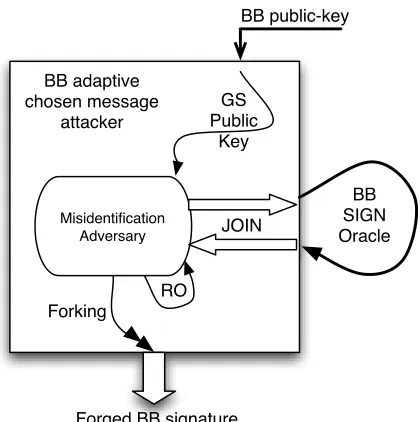
Figure 3: Overview of the reduction in the proof of security for the misidentification attack.
5.1 Misidentification
Theorem 5.3 Any misidentification attacker in the random oracle model against our group signature
can be transformed to an adaptive chosen message attacker in the standard model against the BB signature assuming the Strong-RSA assumption.
Proof. — see figure 3 for an overview of the transformation performed in this proof. In this proof we will assume thatv = 1; the case wherev > 1is identical (in this case, the adversary would break at least one of the underlying BB-signature instantiations).
LetAbe a misidentification adversary as specified in the misidentification attack game that also has access to a random oracleH. We will reduce this adversary to an adaptive chosen message adversary for the BB digital signature.
Let us describe now an adversaryBfor the Boneh-Boyen digital signature. First the adversary is given the public-key of the signature which includes the description of the groupsG1,G2,GT as well as
the description of the bilinear mape:G1×G2→GT and the valuesg1, g2andw, v∈G2. The forger Busing this information samples all remaining public parameters for the group signature including the parameters for the CCA2 encryptionp4, i.e., the valuesN, G.Bnow forms the public-key of the group signature scheme:
Y=hg1, g2, w, v,desc(G1,G2,G||e)||hUOHF, g, f, n, N, G, H1, H2, H3,hki
note thatBknows the secret-key of the GM in the group signature with the exception of the signing key for the BB signature, i.e.,Bdoes not knowγ = logg2wandδ = logg2v.
Prior to beginning the simulation ofAtheBinitializes a tableHfor the simulation of the random oracle that is employed byA. The public-stateStis initialized as described in the attack game (empty).
Random Oracle queries: these are simulated using the tableHas usual: if the query is already on the tableBreturns the corresponding value; if not,Bsamples a random element of{0,1}k, it places
it to the table and returns it.
READSt:Breturns the whole contents of theStstrings.
JOIN↔GM;Start−Sessionqueries:Breceives the start session command from the adversary. As
the GM does not goes first in theJOINprotocol,Bsimply selects a session id and returns is to the adversary.
JOIN↔GM;Advance−Session queries: Btakes a messagehs, xifrom the adversary. Recall that
theJOINprotocol has only two communication flows. Breturns fail in the following cases: (i)s
is not a valid session identifier, (ii)sis a valid session identifier butxis not an integer in the range
S0; in this case the sessionsis marked byBas invalid and is terminated. Now ifxis an integer in the rangeS0,Bsubmitsx to his signing oracle for the BB signature, and obtains through it a signature(σ, r) such thate(σ, wg2xvr) = e(g1, g2). Breturns to the adversaryhi, σ, ri where i= maxStusers+ 1and updatesStusersandStjoin−transaccordingly.
OPEN: B knows the secret-keys for the encryption thus opening queries are also straightforward to answer.
Continuing as above the adversary terminates by producing a messagemand a valid group signa-turehm, σiwhere,σis equal to
hT1,1, T2, T3, T4, C0, C1, C2, c, sz, sx, sxz, sr, srz, sx1, sx2, sy, sy0, sy00, sxy0, sry0, syx2, sdi
Assume now that the above passes the verification test and moreover it satisfiesOPEN(m, σ,Y,S, St) =
⊥(i.e., the adversary wins the misidentification attack game); note thatOPENemploys only the encryp-tion secret-key and as a result it can be applied byB. Now using rewinding and the forking lemma of Pointcheval and Stern [32], we can obtain with non-negligible probability aσ∗ on the same message
m, such thatσ∗is equal to
hT1,1, T2, T3, T4, C0, C1, C2, c∗, s∗z, s∗x, s∗xz, s∗r, s∗rz, s∗x1, s
∗
x2, s
∗
y, s∗y0, s∗y00, s∗xy0, s∗ry0, s∗yx
2, s
∗
di
so that the above is also a valid signature of knowledge. Now based on theorem 5.2 we can reconstruct the witnesses (this is where the Strong-RSA assumption is needed) and based on proposition 5.1 we have thathT1,1g1−,1θz, θriis a valid BB signature onθx. Now observe thatOPEN(m, σ,Y,S, St) = ⊥;
due to proposition 5.1, the ciphertext C0, C1, C2 must be valid and decrypts to the value θx; since OPEN(m, σ,Y,S, St) = ⊥this means that θx is not among thex-values that were submitted by the
adversary in the concurrent protocolJOINdialogs with the interface. As a resultBnever queried the valueθxto its signing oracle. Bterminates by returninghθx;T1,1g1−,1θz, θrias a forgery against the BB
signature scheme. Note that due to the fact that the integer rangeS is selected appropriately (see the parameter selectionp3) it cannot be the case that the adversary submitted some valuen0to the signing
oracle for which it holdsθx ≡p1 n0butθx 6=n0 as integers (with Chinese remaindering this carries to
the casev>1.
From the above it follows thatBoutputs a forged signature and thus it is an adaptive chosen message
Framing Adversary
Factoring algorithm
RO
JOIN
Forking
factorization of the RSA modulus
RSA Modulus
GS Public
Key
GM
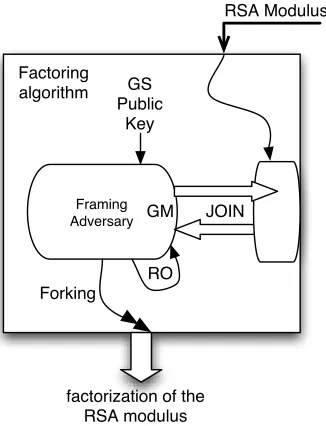
Figure 4: Overview of the reduction in the proof of security for the framing attack.
5.2 Framing
Theorem 5.4 Any framing attacker in the random oracle model against our group signature can be
transformed to a factoring algorithm in the standard model assuming the Strong-RSA assumption.
Proof. — consult figure 4 for an overview of the transformation.
Let A be a framing adversary as specified in the framing attack game that also has access to a random oracleH. We will transform this adversary to a factoring algorithmB(that will work for RSA moduli according to the specifications of the selection ofxin step 1 of theJOINdialog, i.e.,x∈S0−Sf
such thatx1, x2∈Sf0). Again without loss of generality we assume thatv = 1.
We describe below howBoperates given an integern0 ∈S0. Bwill sample the public-keyY and
the secret-keySof the system exactly as it is specified in theSETUPalgorithm.
Y=hg1, g2, w, v,desc(G1,G2,G||e)||hUOHF, g, f, n, N, G, H1, H2, H3,hki
Prior to beginning the simulation ofA,Bwill initialize a tableHfor the simulation of the random oracle that is employed byA. The public-stateStis initialized as described in the attack game (empty). Now, B starts the simulation of the adversary A; suppose that the adversaryA makes q0 JOIN
dialog initiations. B selectsj0 ←R {1, . . . , q0}. Then, in the simulation of A, B has the following
queries to answer:
Random Oracle queries: these are simulated using the tableHas usual: if the query is already on the tableBreturns the corresponding value; if not,Bsamples a random element of{0,1}k, it places
it to the table and returns it.
READSt:Breturns the whole contents of theStstrings.
MODIFYSt: Ballows A to modify join transcripts and identity tags to theStusers andStjoin−trans
JOIN↔U ser; Start−Session queries: B receives the start session command from the adversary.
Suppose this is thej-th time that the adversary issued aStart−Sessionquery. As the user does go first in JOIN protocol, B selectsxj an RSA modulus inS0, unless it is the case that j = j0 whereBselectsxj =n0 (the challenge RSA modulus). Balso selects a session id and
returns the id andxj to the adversary.
JOIN↔U ser;Advance−Session queries: Btakes a messagehs, msgi from the adversary. Recall
that theJOINprotocol has only two communication flows. Breturns fail in the following cases: (i)sis not a valid session identifier, (ii)sis a valid session identifier butmsgis not a tuple of the formhi, σ, riwithe(σ, wg2xjvr) =e(g1, g2)or it holds thati∈Stusers; in this case the session sis marked byBas invalid and is terminated. OtherwiseBwrites in the public-stateStthe user
i, i.e., it modifiesStusers =Stusers||hiiandStjoin−trans =Stjoin−trans||hi, xj, σ, ri.
Note that we do not require from the adversary to follow the same numbering of users that the GM performs during normal protocol executions.
Continuing as above the adversary terminates by producing a messagemand a valid group signa-turem, σwhereσis equal to:
hT1,1, T2, T3, T4, C0, C1, C2, c, sz, sx, sxz, sr, srz, sx1, sx2, sy, sy0, sy00, sxy0, sry0, syx2, sdi
that passes the verification test and moreover it satisfies OPEN(m, σ,Y,S, St) ∈ StIusers; note thatOPEN employs only the public-key encryption secret-key and as a result it can be applied byB. Now using rewinding and the forking lemma of Pointcheval and Stern [32], we can obtain with non-negligible probability a signatureσ∗on the same messagem, whereσ∗is equal to
hT1,1, T2, T3, T4, C0, C1, C2, c∗, s∗z, s∗x, s∗xz, s∗r, s∗rz, s∗x1, s
∗
x2, s
∗
y, s∗y0, s∗y00, s∗xy0, s∗ry0, s∗yx
2, s
∗
di
so that the above is also a valid signature of knowledge. Now based on theorem 5.2 we can re-construct the witnesses (this is where the Strong-RSA assumption is needed); based on the properties of the reconstruction we have thatθx1, θx2 is a factorization ofθx so that θx1, θx2 ∈ Sf (this range
constraint is enforced by the proof).
Now recall thatOPEN(m, σ,Y,S, St)∈StIusers; this means thatθxis among thex-values that were
selected byBin the concurrent protocolJOINdialogs and as a result with probability1/q0it holds that θx = n0. In this case,θx1, θx2 is a non-trivial split ofn0 (due to the fact thatn0 6∈ Sf) and thusB
terminates successfully by returningθx1, θx2.
5.3 Anonymity
Theorem 5.5 Any anonymity adversary against our group signature in the random oracle model can
be transformed to a CCA2 attacker against the public-key encryption that is employed in our scheme; this is conditional on the validity of (i) the assumption that the digital signature scheme employed (BB-signature) satisfies strong existential unforgeability (which is true assuming the Strong Diffie Hellman Assumption). (ii) the DLOG assumption over the subgroup of2N-th residues insideZ∗N2.
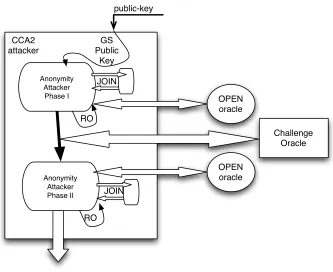
Proof. — consult figure 5 for an overview of the transformation described in this proof.
LetAbe an anonymity adversary as specified in the anonymity attack gameGAanon(1ν). Note that
Anonymity Attacker Phase I
CCA2 attacker
RO
public-key
GS Public
Key
Anonymity Attacker Phase II
RO JOIN JOIN
OPEN oracle
OPEN oracle
Challenge Oracle
Initially,Bis given the public-keyN, G, H1, H2, H3,desc(UOHF),hkfor the encryption scheme. B will use these values to form the public-key of the group signature scheme. In particular, B will select
Y=hg1, g2, w, v,desc(G1,G2,G||e)||hUOHF, g, f, n, N, G, H1, H2, H3,hki
as in theSETUPprotocol with the exception of the public-key of the encryption. Moreover,Bwill initializeStto empty and initializes tables for the random oracle simulation as usual.
The simulation ofAwill proceed as follows: Theplayphase ofAwill correspond to the plaintext selection of the CCA2 adversaryB.Bhas to simulate the following oracle queries ofA:
Random Oracle queries: these are simulated using the tableHas usual: if the query is already on the table,Breturns the corresponding value; if not,Bsamples a random element of{0,1}k, it places
it to the table and returns it.
READSt:Breturns the whole contents of theStstrings.
JOIN↔GM;Start−Sessionqueries:Breceives the start session command from the adversary. As
the GM does not go first in theJOINprotocol,Bsimply selects a session id and returns is to the adversary.
JOIN↔GM;Advance−Session queries: Btakes a messagehs, xifrom the adversary. Recall that
theJOINprotocol has only two communication flows. Breturns fail in the following cases: (i)
sis not a valid session identifier, (ii)sis a valid session identifier butx is not an integer in the range S0; in this case the session sis marked by B as invalid and is terminated. Now if x is an integer in the rangeS0,B computes a BB signature forx(Bis in possession of the signing key); as a resultBobtains a signature(σ, r)such thate(σ, wgx2vr) =e(g1, g2). Breturns to the
adversaryhi, σ, riwherei= maxStusers+ 1and updatesStusersandStjoin−transaccordingly.
OPEN. A signature is given to be opened. FirstBverifies the signature; if verification fails,Breturns
⊥. Then,Bparses the signature for the valuesC0, C1, C2 and submitshC0, C1, C2ito its open
oracle. If the open oracle returns ⊥thenB returns ⊥as well. Otherwise the oracle returns a plaintextx. B searches intoStjoin−trans for a join transcript of the formhi, x, σ, ri and if it is found it returnsi; otherwise it returns⊥. Observe that this is indistinguishable operation from the point of view of the adversary to the operation of the regular attack game.
The simulation of theplayterminates andBreceiveshaux, m,cert1,sec1,cert2,sec2i; ifBreceives
certi,secithat are not valid certificates and secrets it terminates with⊥.
Observe the following now: the certificates returned by Aare of the form: cert1 = hx1, σ1, r1i
andcert2 = hx2, σ2, r2i. Moreover, it must be thatx1 6= x2. We note that if it is the casex1 = x2
butcert1 6= cert2 then this means that the adversary obtained two BB signatures on the same integer x1 =x2. As the signing oracle would never provide such a signature (it keeps a record of what values,
users have submitted before) it must be the case that the adversary came up with two different signatures on the same message. This violates the strong existential unforgeability (see [1]) of the BB signature and thus it can be considered a negligible event.
The CCA2 adversaryBterminates its guess stage by outputingaux0 =aux||cert1||sec1||cert2||sec2
andx1, x2as its choices for the two plaintexts for the CCA2 challenge.
NowB, given the challenge ciphertextC0, C1, C2, must build the group signatureψgsthat will be