David B. Reuben, MD
Susan Magasi, PhD
Heather E. McCreath,
PhD
Richard W. Bohannon,
EdD, PT
Ying-Chih Wang, PhD,
OT
Deborah J. Bubela, PhD,
PT
William Z. Rymer, MD,
PhD
Jennifer Beaumont, MS
Rose Marie Rine, PT,
PhD
Jin-Shei Lai, PhD,
OTR/L
Richard C. Gershon, PhD
Correspondence to Dr. Reuben:
Motor assessment using the NIH Toolbox
ABSTRACT
Motor function involves complex physiologic processes and requires the integration of multiple
sys-tems, including neuromuscular, musculoskeletal, and cardiopulmonary, and neural motor and
sen-sory-perceptual systems. Motor-functional status is indicative of current physical health status,
burden of disease, and long-term health outcomes, and is integrally related to daily functioning
and quality of life. Given its importance to overall neurologic health and function, motor function
was identified as a key domain for inclusion in the NIH Toolbox for Assessment of Neurological
and Behavioral Function (NIH Toolbox). We engaged in a 3-stage developmental process to: 1)
iden-tify key subdomains and candidate measures for inclusion in the NIH Toolbox, 2) pretest candidate
measures for feasibility across the age span of people aged 3 to 85 years, and 3) validate candidate
measures against criterion measures in a sample of healthy individuals aged 3 to 85 years (n
5
340).
Based on extensive literature review and input from content experts, the 5 subdomains of dexterity,
strength, balance, locomotion, and endurance were recommended for inclusion in the NIH Toolbox
motor battery. Based on our validation testing, valid and reliable measures that are simultaneously
low-cost and portable have been recommended to assess each subdomain, including the 9-hole peg
board for dexterity, grip dynamometry for upper-extremity strength, standing balance test, 4-m walk
test for gait speed, and a 2-minute walk test for endurance.
Neurologyâ2013;80 (Suppl 3):S65–S75GLOSSARY
FRSTST55-repetition sit-to-stand test;ICC5intraclass correlation coefficient;RFI5request for information;6MWT56-minute walk test.
Motor function, the ability to use and control muscles and movements, is integrally related to daily
functioning and quality of life. Motor function is a complex physiologic process and requires the
inte-gration of multiple inputs and systems, including the neuromuscular, neurosensory, musculoskeletal,
and cardiopulmonary systems. Impairments in motor function are often indicative of disorders of the
central or peripheral nervous systems and can lead to increased risk of activity limitations,
participa-tion restricparticipa-tions, and mortality in people across the lifespan.
1,2Accordingly, assessment of motor
function was included as a major domain of the NIH Toolbox Assessment of Neurological and
Behavioral Function (NIH Toolbox)
—
an initiative of the NIH Blueprint for Neuroscience Research
that seeks to develop a brief but comprehensive set of standard measures of motor, cognitive, sensory,
and emotional function across the age span from 3 to 85 years
3for use in epidemiologic, longitudinal,
and clinical research.
Assessing change in motor function across the lifespan is a complex measurement task. Precise
measures of motor function frequently require specialized testing environments and costly
equip-ment.
4Performance-based measures of motor function have demonstrated prognostic and diagnostic
value at the individual and population levels
1,2,5; however, there is a lack of consistency in how motor
function is measured across studies and across the age span that limits the generalizability of research
findings. Hence, it is essential to develop a brief, valid, and reliable assessment tool that can be used
From the Division of Geriatrics (D.B.R., H.E.M.), David Geffen School of Medicine, University of California, Los Angeles, CA; Department of Medical Social Sciences (S.M., W.Z.R., J.B., J.-S.L., R.C.G.), Northwestern University Feinberg School of Medicine, Chicago, IL; Program in Physical Therapy (R.W.B., D.J.B.), Department of Kinesiology, University of Connecticut, Storrs, CT; Department of Occupational Science and Technology (Y.-C.W.), University of Wisconsin, Milwaukee; Sensory Motor Processing Program (W.Z.R.), Rehabilitation Institute of Chicago, IL; and Specialty Therapy Source, LLC (R.M.R.), Jacksonville, FL.
Go to Neurology.org for full disclosures. Funding information and disclosures deemed relevant by the authors, if any, are provided at the end of the article.
across diverse study designs and populations and
can also characterize developmental and lifespan
trajectories.
The development of the motor domain of
the NIH Toolbox project occurred in 3 stages.
First, an inventory of specific areas of motor
function (subdomains) was created and rated
by experts for importance and relevance.
Sec-ond, a pretesting phase was conducted to
eval-uate the feasibility of candidate measures across
the age span using a convenience sample of
healthy individuals aged 3 to 85 years, with
oversampling in the oldest and youngest age
co-horts. Finally, a validation phase was conducted
during which the most promising candidate
measures in each subdomain were compared
against criterion measures in a convenience
sample of healthy individuals, stratified by age.
METHODS Standard protocol approvals, registrations, and patient consents.IRB approval was obtained at NorthShore University HealthSystem; University of California, Los Angeles; University of Connecticut; and Northwestern University. All par-ticipants or their guardians were consented using age-appropriate procedures.
Phase 1: Identifying subdomains.The subdomain structure was developed based on extensive literature reviews; results from an online request for information (RFI) field survey of 147 researchers with experience in conducting large-cohort preclinical and clinical studies (described in more detail within this supplement), 62 of whom self-identified as having sufficient knowledge of motor func-tion to provide rankings; and in-depth interviews with 9 motor-func-tion experts. Through this process, 8 subdomains were identified as the most relevant areas of motor functioning: locomotion (84% by RFI respondents and 92% by experts, respectively), strength (65%, 67%), coordination (60%, 36%), balance (56%, 50%), endurance (53%, 58%), dexterity (47%, 46%), hand and upper-extremity func-tion (53%, 92%), and flexibility (29%, 8%). At a follow-up consen-sus meeting involving NIH staff, an external group of consultants, and the NIH Toolbox Steering Committee, participants reviewed the RFI results to identify and rank key components/constructs to include for measurement of motor function both conceptual and clinical perspectives. The following subdomains were identified:
Dexterity: the ability to coordinate the fingers and manipulate objects in a timely manner.
Strength: the capacity of a muscle to produce the force and power necessary for maintaining posture, initiating movement, or con-trolling movement during conditions of loading the musculo-skeletal system.
Balance: the ability to orient body parts in space and maintain an upright posture under both static and dynamic conditions, and following internal or external disturbances. Methods and results from balance testing and validation are reported by Rine et al. in this supplement.
Locomotion: the act of moving the body from one place to another, reflecting ambulation ability including walking dis-tance, velocity, and quality of gait with different environments and ground surfaces. The NIH Toolbox focused on walking gait speed across a flat surface.
Endurance: the ability to sustain effort that requires conjoint work capacities from cardiopulmonary, biomechanical, and neuromuscular function. This measure focuses on overall physical fitness instead of individual muscle endurance.
Phase 2: Pretesting phase.Several versions of the subdomain tasks were pretested for feasibility, with emphasis on evaluating per-formance among children and older adults (table 1). Tests of dex-terity and strength were conducted at one site (the Rehabilitation Institute of Chicago) including 51 participants aged 4 to 78 years (mean530, SD523), whereas locomotion and endurance were pretested at another site (University of California, Los Angeles) with 70 participants aged 3 to 85 years. For locomotion and endurance, English and Spanish instruction sets were evaluated.
Dexterity.Five pegboard tests were evaluated: 1) Rolyan 9-hole pegboard (Sammons Preston Rolyan, Bolingbrook, IL); 2) 9-hole wooden pegboard; 3) Lafayette 25-hole pegboard (Lafay-ette Instrument Company, Lafay(Lafay-ette, IN); 4) Lafay(Lafay-ette 25-hole grooved pegboard; and 5) a custom-built, 9-hole electronic peg-board (designed at the Rehabilitation Institute of Chicago).
Strength: upper extremity.Four grip dynamometers were evaluated: 1) Jamar hydraulic hand dynamometer (Sammons Preston Rolyan); 2) J-Tech Commander GripTrack hand dyna-mometer (J-Tech Medical, Salt Lake City, UT); 3) Lafayette In-strument’s 100-kg/220-lb Hand Grip Dynamometer; and 4) Lafayette Instrument’s 50-kg/110-lb Hand Grip Dynamometer.
Strength: lower extremity.Two tasks were evaluated: 1) knee-extension strength measured by handheld dynamometer (Lafayette Manual Muscle Testing System); and 2) 5-repetition sit-to-stand test (FRSTST). Several versions of knee-extension strength were evaluated, including the traditional method with the administrator opposing the extension force and a variety of methods with the dynamometer externally stabilized by belts or cables.
Locomotion.Three forms of gait speed were evaluated: 1) 20-ft walk using a straight course, 2) 4-m walk using a straight course, and 3) 20-ft walk using an out-and-back course (U-turn at 10-ft distance).
Endurance.Four forms of endurance tasks were evaluated: 1) 6-minute walk (100-ft course), 2) 6-minute walk (50-ft course), 3) 2-minute walk (50-ft course), and 4) 3-minute step test.
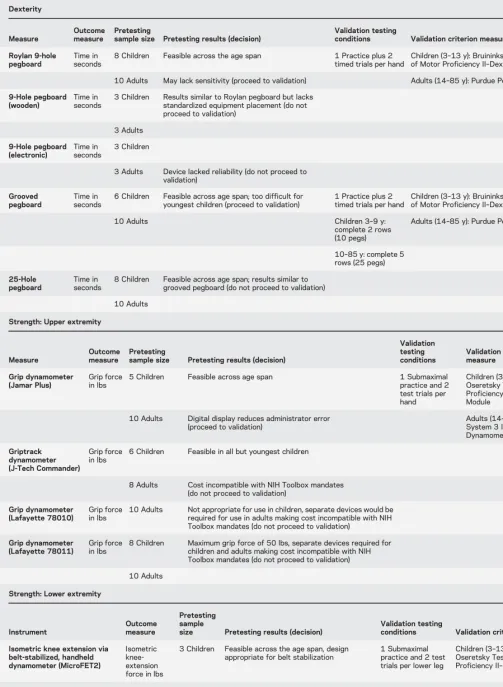
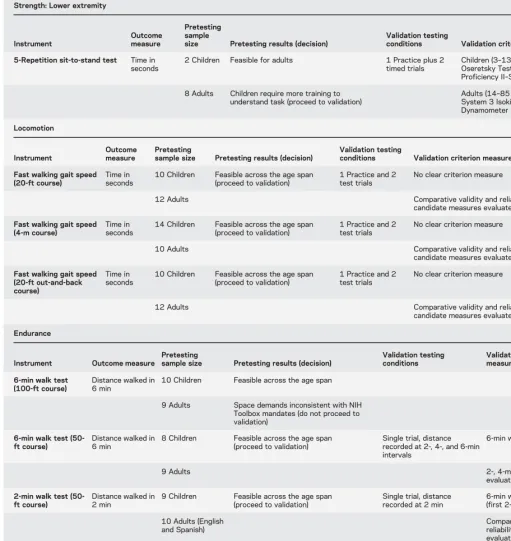
Most tasks were deemed feasible for participants to perform (table 1). In addition to information provided by administrators, results were reviewed with an expert panel to select a subset of these instruments for the validation phase.
Two pegboards, wooden and electronic, presented problems with standardization and reliability, respectively. Although both the 25-hole pegboard and 25-hole grooved pegboard performed sim-ilarly, the grooved version was selected for validation because of the additional challenge posed by the unique shape of the pegs enabling observation of the influence of participants’perceptual and fine motor coordination abilities on dexterity. Upon recommendation of the pediatric experts, the 9-hole pegboard was also included in validation because it is considered to be adequately challenging for children.
Table 1 Candidate motor measures by subdomain and level of evaluation Dexterity Measure Outcome measure Pretesting
sample size Pretesting results (decision)
Validation testing
conditions Validation criterion measure Roylan 9-hole
pegboard
Time in seconds
8 Children Feasible across the age span 1 Practice plus 2 timed trials per hand
Children (3–13 y): Bruininks-Oseretsky Test of Motor Proficiency II–Dexterity Module
10 Adults May lack sensitivity (proceed to validation) Adults (14–85 y): Purdue Pegboard
9-Hole pegboard (wooden)
Time in seconds
3 Children Results similar to Roylan pegboard but lacks standardized equipment placement (do not proceed to validation)
3 Adults 9-Hole pegboard (electronic) Time in seconds 3 Children
3 Adults Device lacked reliability (do not proceed to validation)
Grooved pegboard
Time in seconds
6 Children Feasible across age span; too difficult for youngest children (proceed to validation)
1 Practice plus 2 timed trials per hand
Children (3–13 y): Bruininks-Oseretsky Test of Motor Proficiency II–Dexterity Module
10 Adults Children 3–9 y:
complete 2 rows (10 pegs)
Adults (14–85 y): Purdue Pegboard
10–85 y: complete 5 rows (25 pegs)
25-Hole pegboard
Time in seconds
8 Children Feasible across age span; results similar to grooved pegboard (do not proceed to validation)
10 Adults
Strength: Upper extremity
Measure
Outcome measure
Pretesting
sample size Pretesting results (decision)
Validation testing conditions Validation criterion measure Grip dynamometer (Jamar Plus) Grip force in lbs
5 Children Feasible across age span 1 Submaximal
practice and 2 test trials per hand
Children (3–13 y): Bruininks-Oseretsky Test of Motor Proficiency II–Strength Module
10 Adults Digital display reduces administrator error (proceed to validation)
Adults (14–85 y): Biodex System 3 Isokinetic Dynamometer Griptrack dynamometer (J-Tech Commander) Grip force in lbs
6 Children Feasible in all but youngest children
8 Adults Cost incompatible with NIH Toolbox mandates (do not proceed to validation)
Grip dynamometer (Lafayette 78010)
Grip force in lbs
10 Adults Not appropriate for use in children, separate devices would be required for use in adults making cost incompatible with NIH Toolbox mandates (do not proceed to validation)
Grip dynamometer (Lafayette 78011)
Grip force in lbs
8 Children Maximum grip force of 50 lbs, separate devices required for children and adults making cost incompatible with NIH Toolbox mandates (do not proceed to validation)
10 Adults
Strength: Lower extremity
Instrument
Outcome measure
Pretesting sample
size Pretesting results (decision)
Validation testing
conditions Validation criterion measure Isometric knee extension via
belt-stabilized, handheld dynamometer (MicroFET2)
Isometric knee-extension force in lbs
3 Children Feasible across the age span, design appropriate for belt stabilization
1 Submaximal practice and 2 test trials per lower leg
Children (3–13 y): Bruininks-Oseretsky Test of Motor Proficiency II–Strength Module
3 Adults Digital display (proceed to validation) Adults (14–85 y): Biodex System 3 Isokinetic Dynamometer
Isometric knee extension via belt-stabilized, handheld dynamometer (Lafayette)
Isometric knee-extension force in lbs
3 Children High profile and location of testing pad make it inappropriate for belt-stabilized testing (do not proceed to validation)
3 Adults
timed-chair rise involved more dimensions than lower-extremity strength, the experts encouraged the retention of FRSTST for valida-tion because of the low cost, common use by clinicians (particularly in geriatrics), and functional relevance.6
All locomotion tasks were retained as candidate measures, even though performance was similar, because the 20-ft distance is favored in US studies and the 4-m distance is favored in non-US studies. For endurance, the 100-ft course was deemed too long for the variety of settings for which the NIH Toolbox battery is designed. A hybrid version of the 6-minute, 50-ft course was developed and tested to assess performance at each 2-minute interval. The 3-minute step was feasible for most participants
and had the advantage of prior research validating it with tradi-tional exercise stress tests.7,8
Phase 3: Validation phase.A convenience sample of English-speaking participants who did not use assistive devices for walking was recruited for the validation study according to the age (years) bands 3–4, 5–6, 7–10, 11–13, 14–20, 21–30, 31–45, 46–65, 66–75, and 76–85. For all age bands (except 76–85 years), 30 participants were recruited, with some age bands having more than 30. Recruitment targeted those in the youngest and oldest age ranges to allow adequate evaluation of tasks with those most likely to demonstrate difficulty with tasks.
Table 1 Continued
Strength: Lower extremity
Instrument
Outcome measure
Pretesting sample
size Pretesting results (decision)
Validation testing
conditions Validation criterion measure 5-Repetition sit-to-stand test Time in
seconds
2 Children Feasible for adults 1 Practice plus 2 timed trials
Children (3–13 y): Bruininks-Oseretsky Test of Motor Proficiency II–Strength Module
8 Adults Children require more training to understand task (proceed to validation)
Adults (14–85 y): Biodex System 3 Isokinetic Dynamometer
Locomotion Instrument
Outcome measure
Pretesting
sample size Pretesting results (decision)
Validation testing
conditions Validation criterion measure Fast walking gait speed
(20-ft course)
Time in seconds
10 Children Feasible across the age span (proceed to validation)
1 Practice and 2 test trials
No clear criterion measure
12 Adults Comparative validity and reliability of
candidate measures evaluated
Fast walking gait speed (4-m course)
Time in seconds
14 Children Feasible across the age span (proceed to validation)
1 Practice and 2 test trials
No clear criterion measure
10 Adults Comparative validity and reliability of
candidate measures evaluated
Fast walking gait speed (20-ft out-and-back course)
Time in seconds
10 Children Feasible across the age span (proceed to validation)
1 Practice and 2 test trials
No clear criterion measure
12 Adults Comparative validity and reliability of
candidate measures evaluated
Endurance
Instrument Outcome measure
Pretesting
sample size Pretesting results (decision)
Validation testing conditions
Validation criterion measure 6-min walk test
(100-ft course)
Distance walked in 6 min
10 Children Feasible across the age span
9 Adults Space demands inconsistent with NIH Toolbox mandates (do not proceed to validation)
6-min walk test (50-ft course)
Distance walked in 6 min
8 Children Feasible across the age span (proceed to validation)
Single trial, distance recorded at 2-, 4-, and 6-min intervals
6-min walk test
9 Adults 2-, 4-min intervals were
evaluated
2-min walk test (50-ft course)
Distance walked in 2 min
9 Children Feasible across the age span (proceed to validation)
Single trial, distance recorded at 2 min
6-min walk test (first 2-min interval)
10 Adults (English and Spanish)
Comparative validity and reliability were evaluated
3-min step test 1-min recovery heart rate (total beats)
8 Children Feasible across the age span (proceed to validation)
Cadence:,13 and.65 y: 88 steps/min, 14–64 y: 96 steps/min; Step height: 8 in.: people,57 in. tall, 12 in.: people$58 in. tall
6-min walk test
Tasks were organized by subdomain, and order of administra-tion within each subdomain was randomized. Subdomains were ordered from fine to gross motor with the exception of endur-ance. Endurance in final NIH Toolbox testing will be performed last because it imposes the greatest energy demand on the partic-ipant and may be expected to affect performance in other motor tasks, particularly among people with lower motor-functional capacity. Tasks, test conditions, outcomes, and validity measures are presented in table 1.
Reliability assessment.A subset of participants (approximately 5 per age band) were invited for a second visit within 7 to 21 days of the first visit. At the second visit, participants completed all of the can-didate measures but not the validation measures.
Statistical methods.Distributional characteristics were exam-ined for each measure (mean, SD, range) overall and by age band. To determine comparative validity of the measures, Pearson corre-lation coefficients (r) were computed between all candidate and validation tasks within a subdomain. For test-retest reliability, intra-class correlation coefficients (ICCs) were calculated for values from visits 1 and 2 for each measure. A priori criteria for validity and test-retest were established based on standards in the field of motor-functional testing asr$0.70 and ICC.0.80, respectively.9,10
RESULTS
A total of 340 participants were enrolled in
the validation study across 3 testing sites.
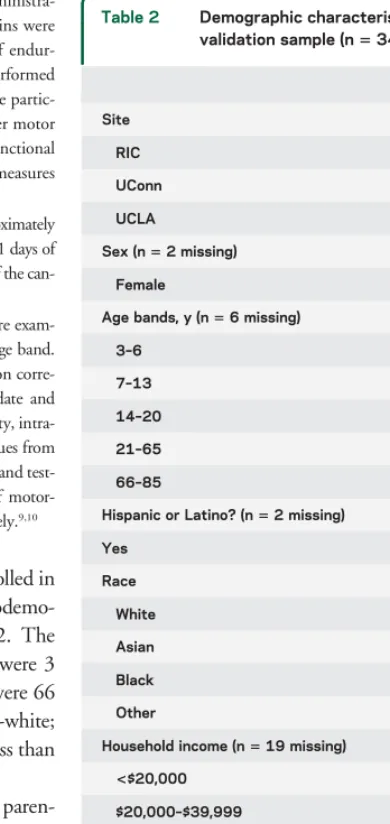
Sociodemo-graphic characteristics are provided in table 2. The
mean age of the sample was 30.7 years, 19% were 3
to 6 years, 23% were 7 to 13 years, and 19% were 66
to 85 years; 54% were female; 36% were non-white;
and 29% had an annual household income of less than
$40,000.
The following numbers of participants (in
paren-theses) experienced difficulty complying with
adminis-tration guidelines and/or completing the task demands
for the following measures: grooved pegboard (6),
timed chair rise (6), 3-minute step test (50), and
6-minute walk test (6MWT) (6).
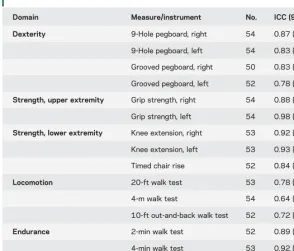
Test-retest reliability.
Test-retest reliability of all candidate
measures (table 3) was good with all measures meeting
the predefined criterion for ICC
$
0.80, except for the
grooved pegboard (left hand) and the 3 locomotion
measures. Within each domain, there were no
differ-ences among measures/instruments in reliability.
Validity.
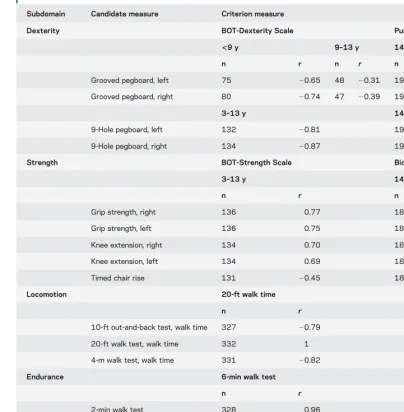
Validity of the candidate measures was
gen-erally good and met the predefined criterion (
r
.
0.70) of Pearson correlations with criterion measures
(table 4) for all measures except for grooved pegboard
as a measure of dexterity in children younger than 14
years, timed chair rise as a measure of strength across
age groups, and the 3-minute step test as a measure of
endurance across all ages. The 2-minute walk test and
4-minute walk test correlated exceptionally highly
(
r
.
0.96) with the 6MWT.
DISCUSSION
This study evaluated the conceptual and
clinical relevance of key aspects of motor function
(sub-domain) and established the preliminary validity and
reliability of candidate measures of motor function
recommended for inclusion in the motor battery of
the NIH Toolbox. The 5 subdomains identified
(dex-terity, strength, balance, gait speed, and endurance) have
public health and scientific importance.
Dexterity is a central component of hand function
and relates to both the speed and accuracy of hand
movements during the manipulation of objects in
the environment.
11Dexterity in children is correlated
with school performance and is a predictor of quality
of handwriting,
12which, in turn, is associated with
upper-limb coordination and some cognitive
func-tions (e.g., visual memory, spatial relation, visual
sequential memory, visual-motor integration, and
sustained attention
13). Fine-motor-skill deficits are
correlated with global psychosocial functioning in
both children and adults.
14–17Decline in manual
dex-terity is a common phenomenon in older adults and is
associated with performance of activities of daily
liv-ing and independent livliv-ing.
18,19Table 2 Demographic characteristics of validation sample (n5340)
No. (%) Site
RIC 121 (35.6)
UConn 81 (23.8)
UCLA 138 (40.6)
Sex (n52 missing)
Female 182 (53.8)
Age bands, y (n56 missing)
3–6 64 (19.2)
7–13 75 (22.5)
14–20 33 (9.9)
21–65 99 (29.6)
66–85 63 (18.9)
Hispanic or Latino? (n52 missing)
Yes 40 (11.8)
Race
White 217 (63.8)
Asian 51 (15.0)
Black 29 (8.5)
Other 43 (12.6)
Household income (n519 missing)
<$20,000 35 (10.9)
$20,000–$39,999 57 (17.8)
$40,000–$99,999 120 (37.4)
‡$100,000 93 (29.0)
Don’t know 16 (5.0) Abbreviations: RIC5Rehabilitation Institute of Chicago; UCLA5University of California, Los Angeles; UConn 5
University of Connecticut.
Muscle strength is an essential element for humans
to move against gravity and provide sufficient force to
perform movements within the full range of motion.
Although grip strength has been used to characterize
total body strength and predict mortality, postsurgical
complications, and future disability,
20some research
suggests that it may be more accurate to measure a
representative muscle group for each limb (e.g., lower
extremity as well as grip strength) if the strength of
that limb is of interest.
21For example, knee extensor
muscles have been identified as representative of
lower-extremity strength because of their central role
in key functional tasks, such as walking, standing
from a chair, and climbing stairs.
22–24Muscle strength
of the limbs and trunk declines with age and is
asso-ciated with an increased risk of falls,
25hip fractures,
26loss of bone mineral density,
27–30and long-term
sur-vival in severe congestive heart failure,
31functional
dependence in people aged 75 years,
32and loss of
functional status in hospitalized patients.
33Balance allows humans to be able to orient the
body in space, maintain an upright posture under
static and dynamic conditions, and move without
fall-ing. The ability to respond to internal and external
disturbance, realign body segments, as well as protect
oneself from falling is essential and inherent in every
daily task. Examination of balance is important
because it predicts people
’
s ability to safely and
inde-pendently function in a variety of environments.
Maintaining stance stability under varying sensory
environments is an essential function for the elderly
to avoid falling and among patients for better
functional outcomes.
34Several studies have found
that changes in balance ability correlate significantly
with changes in function.
35–39Gait speed as a measure of bipedal locomotion is
both a good way to summarize the overall burden of
disease as well as a generic indicator of health status,
prognosis, and the comorbid burden of disease in older
persons.
40The speed at which older individuals walk is
relevant to their functioning in the community.
41,42Moreover, gait speed is an important predictor of
out-comes such as length of stay and discharge disposition
of patients admitted for acute rehabilitation after
stroke,
35mortality,
36,37incident ischemic stroke,
38and incident dementia.
39Cardiorespiratory and muscle endurance are
impor-tant components of physical fitness and contribute to
both performance and health status. People with better
endurance are able to complete daily tasks, pursue leisure
activities, and accomplish higher-intensity workloads.
The clinical significance of endurance, as measured by
timed walk tests, to morbidity and mortality outcomes
has been extensively reported in healthy and clinical
pop-ulations across the age span.
43–49Although the findings of this study advance the field
of motor assessment, the limitations of the study must
be recognized. The sample size was relatively small
and included only a few geographical sites. Test
admin-istrators were highly trained, and reproducibility of
results with nonexpert administrators (as envisioned by
the NIH Toolbox) needs to be evaluated. Simplification
of administration and clear safety protocols may be
required for administrators who lack clinical expertise
and judgment. Moreover, healthy volunteers were used
for the feasibility and validation testing. The validation
data may not apply to persons with specific diseases.
The measures of balance and endurance require
stand-ing and walkstand-ing and may not be appropriate for people
with mobility limitations; alternate measures are needed
for people who are nonambulatory. Similarly, the visual
demands of the dexterity measure make it inappropriate
for administration to people with severe visual
impair-ments. Given that a major goal of the NIH Toolbox
is to develop a brief but comprehensive assessment
bat-tery of motor function and performance, compromises
had to be made between brevity and specificity.
Further-more, although the motor battery meets NIH Toolbox
requirements for portability and low cost, the
equip-ment costs and space demands are not trivial. Finally,
the motor battery does not assess all aspects of motor
performance. For the sake of time and cost of
adminis-tration, choices needed to be made about which
subdo-mains could be included.
Final recommendations for inclusion in the NIH
Toolbox Motor Domain are described below. For
all measures, we have developed administration
pro-tocols that include task description, demonstration,
Table 3 Test-retest reliability statisticsDomain Measure/instrument No. ICC (95% CI) Dexterity 9-Hole pegboard, right 54 0.87 (0.79–0.92)
9-Hole pegboard, left 54 0.83 (0.73–0.90)
Grooved pegboard, right 50 0.83 (0.72–0.90)
Grooved pegboard, left 52 0.78 (0.65–0.87)
Strength, upper extremity Grip strength, right 54 0.88 (0.80–0.93) Grip strength, left 54 0.98 (0.97–0.99)
Strength, lower extremity Knee extension, right 53 0.92 (0.87–0.95) Knee extension, left 53 0.93 (0.88–0.96)
Timed chair rise 52 0.84 (0.74–0.90)
Locomotion 20-ft walk test 53 0.78 (0.65–0.87) 4-m walk test 54 0.64 (0.45–0.77)
10-ft out-and-back walk test 52 0.72 (0.56–0.83)
Endurance 2-min walk test 52 0.89 (0.82–0.93) 4-min walk test 53 0.92 (0.87–0.95)
6-min walk test 52 0.92 (0.87–0.95)
3-min step test 53 0.84 (0.74–0.90)
and practice before scored trial (available at www.
nihtoolbox.org).
Dexterity.
The Rolyan 9-hole pegboard, single trial per
hand, is recommended as the dexterity measure for
inclusion in the NIH Toolbox. The 9-hole pegboard
confers the advantages of acceptable reliability and
validity, the ability to be completed by all age groups,
and minimization of extraneous functional task
de-mands (especially the visual perceptual components).
The grooved pegboard has widespread use in
neuro-psychological testing and evidence of sensitivity.
How-ever, it has greater visual perceptual task demands and
required modifications and nonstandard testing
proto-cols to ensure completion in very young children. The
grooved pegboard was recommended for further
valid-ity testing and norming with the aim of possible
inclusion among a wider group of valid instruments
that assess motor domain function (the NIH Toolbox
Supplemental Measures).
Strength.
Grip strength dynamometry with the Jamar
Plus Digital Hand Dynamometer, single trial per hand,
is recommended as the strength measure for inclusion
in the NIH Toolbox. Grip strength dynamometry
confers the advantages of excellent reliability and
valid-ity, ease of administration, and documented predictive
abilities. It is already well established in epidemiologic
research.
50–52Analyses of the validation data indicate
that in healthy individuals, grip and knee-extension
strength reflect a common underlying construct.
53Although the NIH Toolbox requirements for portability
and low cost justified selection of a single measure of
strength, the correlation between grip and knee-extension
Table 4 Validity statisticsaSubdomain Candidate measure Criterion measure
Dexterity BOT-Dexterity Scale Purdue Pegboard
<9 y 9–13 y 14–85 y
n r n r n r
Grooved pegboard, left 75 20.65 48 20.31 193 20.78
Grooved pegboard, right 80 20.74 47 20.39 192 20.77
3–13 y 14–85 y
9-Hole pegboard, left 132 20.81 194 20.72
9-Hole pegboard, right 134 20.87 193 20.72
Strength BOT-Strength Scale BioDex 3–13 y 14–85 y
n r n r
Grip strength, right 136 0.77 187 0.78
Grip strength, left 136 0.75 187 0.77
Knee extension, right 134 0.70 187 0.86
Knee extension, left 134 0.69 185 0.86
Timed chair rise 131 20.45 183 20.34
Locomotion 20-ft walk time
n r
10-ft out-and-back test, walk time 327 20.79
20-ft walk test, walk time 332 1
4-m walk test, walk time 331 20.82
Endurance 6-min walk test
n r
2-min walk test 328 0.96
4-min walk test 328 0.98
6-min walk test 328 1
3-min step test 314 20.15
Abbreviation: BOT5Bruininks-Oseretsky Test of Motor Proficiency. aAll
p,0.05.
strength decreases with age and possibly in the presence
of neurologic impairments. Therefore, isometric
knee-extension force measured by a portable device will be
included in the NIH Toolbox Supplemental Measures.
Equivalency testing between belt-stabilized, handheld
dynamometry of knee-extension force measured using
the MicroFET2 handheld dynamometer and an
inte-grated tension-based load cell device showed good
relia-bility and validity across the age span.
The FRSTST has a strong legacy of use in geriatrics
research and practice as a quick and portable measure
of functional lower-extremity strength. Sit-to-stand
tests are composite functional measures that integrate
lower-extremity strength, balance, and endurance.
Validity statistics indicate that the FRSTST is tapping
into underlying constructs other than pure
lower-extremity strength. Although not recommended for
inclusion in the NIH Toolbox, the FRSTST will be
normed for possible inclusion in the NIH Toolbox
Supplemental Measures for adults.
Balance.
The NIH Toolbox Standing Balance Test is
the recommended balance measure for inclusion in
the NIH Toolbox. The NIH Toolbox Standing
Bal-ance Test (described in detail by Rine et al. in this
supplement as the Balance Accelerometry Measure)
uses accelerometer measures of anterior-ventral
pos-tural sway to evaluate balance under 6 testing
condi-tions (feet together, eyes open; feet together, eyes
closed; feet together on foam, eyes open; feet together
on foam, eyes closed; tandem stance, eyes open; and
tandem stance, eyes closed).
Locomotion.
The 4-m walk test, 2 trials (1 at usual
pace and 1
“
as quickly as possible
”
), are
recommen-ded for inclusion in the NIH Toolbox. All of the
candidate locomotion measures had acceptable
reli-ability and validity, but based on practical
consider-ations for portability and the emerging international
standard of the 4-m walk as a criterion measure of
locomotion, we balanced reliability considerations
with practical and logistical consideration to
recom-mend the 4-m walk. The 4-m test will reconcile the
NIH Toolbox measure of gait speed with
interna-tional standards and facilitate testing across a variety
of clinical and research settings where space might be
limited. In an effort to increase the distribution of
scores across the age span, the motor domain team
made the decision early on to do all tests
“
as quickly
as possible.
”
However, after consultation with
exter-nal reviewers and experts in locomotion testing and a
subsequent updated review of the literature, the
rec-ommendation has been made to add a trial at the
usual pace. In prior research, locomotion testing of
usual pace was used twice as often as measuring
locomotion as quickly as possible.
54,55Endurance.
The 2-minute walk test (2MWT), 1 trial on
a 50-ft course, is recommended for inclusion in the
NIH Toolbox. The 2MWT was highly correlated with
the criterion measure of the 6MWT without
compro-mising validity and reliability. The 2MWT was both
easy and safe for administration to people across the
age span from 3 to 85 years.
General motor function testing guidelines.
The
recom-mended test order, proceeding from upper-extremity
to lower-extremity function, is dexterity,
upper-extremity strength, standing balance, bipedal
loco-motion, and endurance. Because many of the motor
functions build on each other, especially in the lower
extremity, this test order was deemed a safe and
effi-cient means of determining whether the person
should proceed for testing in subsequent
subdo-mains. For example, if a person is unable to complete
the locomotion test, the examiner should evaluate
the feasibility of assessing endurance. In our
rela-tively healthy sample, we had few people who were
unable to proceed with testing of all subdomains;
therefore, precise safety cut-points have not yet been
established.
By its nature, motor function testing has inherent
safety risks such as falls, physical discomfort, and
car-diovascular concerns. Therefore, safety protocols will
be developed that are easily interpreted by lay
admin-istrators including safety precautions and cut-points
for the discontinuation of both individual tests as well
as subsequent motor tasks.
The next step in developing the Motor Domain
Battery of the NIH Toolbox was a norming of the
recommended measures of dexterity, strength,
bal-ance, locomotion, and endurance along with
cogni-tive, sensory, and emotional health batteries in a
national sample of healthy individuals aged 3 to 85
years. Additional development was conducted to
streamline the administration protocols, including
simplification of instructions to participants and
ad-ministrators to increase efficiency and decrease the
demands on participants.
In summary, an NIH Toolbox Motor Domain
Bat-tery has been created with 5 subdomains (gait speed,
balance, dexterity, strength, and endurance) that have
public health and scientific importance. The
instru-ments selected to measure these subdomains are
feasi-ble and valid, but practical and inexpensive.
AUTHOR CONTRIBUTIONS
supervision. J. Beaumont: study concept and design, analysis and interpreta-tion, writing of the manuscript. R.M. Rine: study concept and design, acqui-sition of data, analysis and interpretation, writing of the manuscript, study supervision. J.-S. Lai: study concept and design, writing of the manuscript. R.C. Gershon: study concept and design, study supervision.
ACKNOWLEDGMENT
The authors express appreciation to Phoebe Block, Caroline Marchand, and Michael Jesselson at the Rehabilitation Institute of Chicago, Jessica Crocker, at the University of California, Los Angles, and Alissa Dall, Bri-ana Hoganson, Nicole LaChance, Aaron Morales, and Katherine Taft at the University of Connecticut for data collection assistance. The authors thank the subdomain consultants and select members of the NIH pro-ject team, Suzann Campbell, PhD, Christine Chen, ScD, OTR, Jack Guralnik, MD, PhD, Mark Hallett, MD, Jane Clark, PhD, Allen Hei-nemann, PhD, William Evans, PhD, Dallas Anderson, PhD, Diane Damiano, PhD, PT, Marjorie Garvey, MD, Elizabeth Moberg-Wolff, MD, for expert consultation. Finally, the authors acknowledge Edward Wang, PhD at Northwestern University for early leadership critical to domain development.
STUDY FUNDING
This study is funded in whole or in part with Federal funds from the Blueprint for Neuroscience Research and Office of Behavioral and Social Sciences Research, NIH under contract no. HHS-N-260-2006-00007-C.
DISCLOSURE
D. Reuben is funded by multiple grants from NIH (P30 AG028748, K12AG001004, R21HS017621, R01AG036776, U01AG034661, R01AG023555), the Archstone Foundation, the John A. Hartford Foun-dation, the Donald W. Reynolds FounFoun-dation, the SCAN FounFoun-dation, the UniHealth Foundation, the California Breast Cancer Research Pro-gram, and the Association of Directors of Geriatric Academic Programs. He is an academic geriatrician and is chair of the Board of Directors of the American Board of Internal Medicine, and lead author of "Geriatrics at Your Fingertips." S. Magasi is funded by multiple grants and contracts from the NIH (HHS-N-260-2006-00007-C, 1U5AR057951-01, U01 AR 052177), the National Institute of Disability and Rehabilitation Research (H133B090024), Agency on Healthcare Research and Quality (RFA-HS-11-001), with minor funding from Forest-Ironwood Pharma-ceuticals and Daiicho-Sankyo, Inc. H. McCreath is funded by multiple grants from NIH (P30AG028748, P30AG017265, R01NR010736, RC1AG035664, R03HS018098, RC2MD004770), DHHS/BHPr (2 D01HP00003, HHSH230-200432029C), the Archstone Foundation, the John A. Hartford Foundation, the Donald W. Reynolds Foundation, the UniHealth Foundation, the California HIV Research Program, as well as an investigator-initiated study funded by Merck Pharmaceuticals (MK 05-0518). R. Bohannon is a consultant for Hoggan Health Indus-tries, INC Research, and Celtic Pharma Research and Saebo. He received honoraria from Hoggan Health Industries and Saebo. Y.-C. Wang serves as an Assistant Professor at the University of Wisconsin–Milwaukee, an adjunct Assistant Research Professor at the Feinberg School of Medicine, Northwestern University, a senior data analyst in the Focus on Thera-peutic Outcomes, Inc., and serves as an editorial board member of the
American Journal of Occupational Therapy(AJOT), and received research support from NIH as research scientist (HHS-N-260-2006-00007-C) and NIDRR (H133B080031). D. Bubela did not receive any corporate or government funding. Her research has been supported by the Univer-sity of Connecticut as part of her faculty appointment. W. Rymer serves as a member of the Scientific Advisory Board of Hocoma International, a rehabilitation technology company, and the Neilsen Foundation, a spinal cord injury not-for-profit. Dr. Rymer has served as a consultant for Allergan, a pharmaceutical company. He is a member of the Editorial Board of theJournal of Neural Engineering and Rehabilitationand of the
Archives of Physical Medicine and Rehabilitation.J. Beaumont served as a consultant for NorthShore University HealthSystems, FACIT.org, and Georgia Gastroenterology Group PC. She received funding for travel as an invited speaker at the North American Neuroendocrine Tumor Symposium. R.M. Rine has been an invited speaker for the British Audiological Society, the Royal Society of Medicine, the Hong Kong
Physical Therapy Association, and the American Physical Therapy Association, currently serves on the Scientific Review Committee of the Foundation for Physical Therapy Research, and was funded by NIH grant 5R44DC8022-3. J.-S. Lai’s time is supported by the NIH (HHS-N-260-2006-00007-C; PI: Dr. Gershon) and received research support from Pfizer, Inc. R. Gershon has received personal compensa-tion for activities as a speaker and consultant with Sylvan Learning, Rockman, and the American Board of Podiatric Surgery. He is supported through several grants and contracts awarded by NIH: N01-AG-6-0007, 1U5AR057943, HHSN260200600007, U01DK082342, U01NS056 975, K23HL085766, RC2AG036498; and through the NIDRR: H133B090024. Go to Neurology.org for full disclosures.
Received June 6, 2012. Accepted in final form September 26, 2012.
REFERENCES
1. Gill TM, Williams CS, Mendes de Leon CF, Tinetti ME. The role of change in physical performance in determining risk for dependence in activities of daily living among nondisabled community-living elderly persons. J Clin Epidemiol 1997;50: 765–772.
2. Guralnik JM, Ferrucci L, Simonsick EM, Salive ME, Wallace RB. Lower-extremity function in persons over the age of 70 years as a predictor of subsequent disability. N Engl J Med 1995;332:556–561.
3. Gershon RC, Cella D, Fox NA, Havlik RJ, Hendrie HC, Wagster MV. Assessment of neurological and behaviou-ral function: the NIH Toolbox. Lancet Neurol 2010;9: 138–139.
4. Ohtake PJ. Field tests of aerobic capacity for children and older adults. Cardiopulm Phys Ther J 2005;16:5–11. 5. Reuben DB, Seeman TE, Keeler E, et al. Refining the
cat-egorization of physical functional status: the added value of combining self-reported and performance-based measures. J Gerontol A Biol Sci Med Sci 2004;59:1056–1061. 6. Bohannon RW. Reference values for the five-repetition
sit-to-stand test: a descriptive meta-analysis of data from eld-ers. Percept Mot Skills 2006;103:215–222.
7. Liu CM, Lin KF. Estimation of VO2max: a comparative
analysis of post-exercise heart rate and physical fitness index from 3-minute step test. J Exerc Sci Fit 2007;5:118–123. 8. Santo AS, Golding LA. Predicting maximum oxygen
uptake from a modified 3-minute step test. Res Q Exerc Sport 2003;74:110–115.
9. Rikli RE, Jones CJ. Development and validation of a func-tional fitness test for community-residing older adults. J Aging Phys Act 1999;7:129–161.
10. Portney LG, Watkins MP. Foundations of Clinical Research: Applications to Practice. Upper Saddle River, NJ: Prentice Hall; 2000.
11. Yancosek KE, Howell D. A narrative review of dexterity assessments. J Hand Ther 2009;22:258–270.
12. Volman MJM, van Schendel BM, Jongmans MJ. Handwrit-ing difficulties in primary school children: a search for under-lying mechanisms. Am J Occup Ther 2006;60:451–460. 13. Tseng MH, Chow SM. Perceptual-motor function of
school-age children with slow handwriting speed. Am J Occup Ther 2000;54:83–88.
14. Skinner RA, Piek JP. Psychosocial implications of poor motor coordination in children and adolescents. Hum Mov Sci 2001;20:73.
15. Bloch MH, Sukhodolsky DG, Leckman JF, Schultz RT. Fine-motor skill deficits in childhood predict adulthood tic severity and global psychosocial functioning in Tourette’s syndrome. J Child Psychol Psychiatry 2006;47:551–559.
16. Lehoux C, Everett J, Laplante L, et al. Fine motor dexter-ity is correlated to social functioning in schizophrenia. Schizophr Res 2003;62:269–273.
17. Lee AT, Tsang HW. Validation of the Complete Minne-sota Dexterity Test for adults with moderate graded men-tal retardation in Hong Kong. Int J Rehabil Res 2001;24: 153–156.
18. Falconer J, Hughes SL, Naughton BJ, Singer R, Chang RW, Sinacore JM. Self report and performance-based hand func-tion tests as correlates of dependency in the elderly. J Am Geriatr Soc 1991;39:695–699.
19. Williams ME, Hadler NM, Earp JA. Manual ability as a marker of dependency in geriatric women. J Chronic Dis 1982;35:115–122.
20. Bohannon RW. Dynamometer measurements of hand-grip strength predict multiple outcomes. Percept Mot Skills 2001;93:323–328.
21. Bohannon RW. Is it legitimate to characterize muscle strength using a limited number of measures? J Strength Cond Res 2008;22:166–173.
22. Hughes MA, Myers BS, Schenkman ML. The role of strength in rising from a chair in the functionally impaired elderly. J Biomech 1996;29:1509–1513.
23. Hortobágyi T, Mizelle C, Beam S, DeVita P. Old adults perform activities of daily living near their max-imal capabilities. J Gerontol A Biol Sci Med Sci 2003; 58:453–460.
24. Ploutz-Snyder LL, Manini T, Ploutz-Snyder RJ, Wolf DA. Functionally relevant thresholds of quadriceps femoris strength. J Gerontol A Biol Sci Med Sci 2002;57:B144–B152. 25. Campbell AJ, Borrie MJ, Spears GF. Risk factors for falls
in a community-based prospective study of people 70 years and older. J Gerontol 1989;44:112–117.
26. Aniansson A, Zetterberg C, Hedberg M, Henriksson KG. Impaired muscle function with aging: a background factor in the incidence of fractures of the proximal end of the femur. Clin Orthop Relat Res 1984;(191):193–201. 27. Sinaki M, McPhee MC, Hodgson SF, Merritt JM,
Offord KP. Relationship between bone mineral density of spine and strength of back extensors in healthy post-menopausal women. Mayo Clin Proc 1986;61:116–122. 28. Taaffe DR, Pruitt L, Lewis B, Marcus R. Dynamic muscle strength as a predictor of bone mineral density in elderly women. J Sports Med Phys Fitness 1995;35:136–142. 29. Snow-Harter C, Bouxsein M, Lewis B, Charette S,
Weinstein P, Marcus R. Muscle strength as a predictor of bone mineral density in young women. J Bone Miner Res 1990;5:589–595.
30. Iki M, Saito Y, Kajita E, Nishino H, Kusaka Y. Trunk muscle strength is a strong predictor of bone loss in postmenopausal women. Clin Orthop Relat Res 2006;443:66–72. 31. Hülsmann M, Quittan M, Berger R, et al. Muscle strength
as a predictor of long-term survival in severe congestive heart failure. Eur J Heart Fail 2004;6:101–107. 32. Rantanen T, Avlund K, Suominen H, Schroll M,
Frändin K, Pertti E. Muscle strength as a predictor of onset of ADL dependence in people aged 75 years. Aging Clin Exp Res 2002;14:10–15.
33. Humphreys J, de la Maza P, Hirsch S, Barrera G, Gattas V, Bunout D. Muscle strength as a predictor of loss of functional status in hospitalized patients. Nutrition 2002;18:616–620. 34. Hu MH, Hung YC, Huang YL, Peng CD. Validity of force
platform measures for stance stability under varying sensory conditions. Proc Natl Sci Counc Repub China B 1996;20:78.
35. Rabadi MH, Blau A. Admission ambulation velocity pre-dicts length of stay and discharge disposition following stroke in an acute rehabilitation hospital. Neurorehabil Neural Repair 2005;19:20–26.
36. Ostir GV, Kuo YF, Berges IM, Markides KS, Ottenbacher KJ. Measures of lower body function and risk of mortality over 7 years of follow-up. Am J Epidemiol 2007;166:599–605. 37. Rolland Y, Lauwers-Cances V, Cesari M, Vellas B, Pahor M,
Grandjean H. Physical performance measures as predictors of mortality in a cohort of community-dwelling older French women. Eur J Epidemiol 2006;21:113–122.
38. McGinn AP, Kaplan RC, Verghese J, et al. Walking speed and risk of incident ischemic stroke among postmenopau-sal women. Stroke 2008;39:1233.
39. Waite LM, Grayson DA, Piguet O, Creasey H, Bennett HP, Broe GA. Gait slowing as a predictor of incident dementia: 6-year longitudinal data from the Sydney Older Persons Study. J Neurol Sci 2005;229/230:89–93.
40. Studenski S, Perera S, Chandler J, et al. How fast you walk predicts how long you live: pooled data from 34,370 older adults. In: International Association of Gerontology and Ger-iatrics XIXth World Congress of Gerontology and GerGer-iatrics; July 2009; Paris.
41. Robinett CS, Vondran MA. Functional ambulation veloc-ity and distance requirements in rural and urban commu-nities: a clinical report. Phys Ther 1988;68:1371–1373. 42. Langlois JA, Wallace RB, Marottoli RA, Foley DJ,
Guralnik JM, Keyl PM. Characteristics of older pedes-trians who have difficulty crossing the street. Am J Public Health 1997;87:393–397.
43. Moriello C, Mayo NE, Feldman L, Carli F. Validating the six-minute walk test as a measure of recovery after elective colon resection surgery. Arch Phys Med Rehabil 2008;89: 1083–1089.
44. Montgomery PS, Gardner AW. The clinical utility of a six-minute walk test in peripheral arterial occlusive disease patients. J Am Geriatr Soc 1998;46:706–711.
45. Pankoff B, Overend T, Lucy D, White K. Validity and responsiveness of the 6 minute walk test for people with fibromyalgia. J Rheumatol 2000;27:2666–2670. 46. Schoenmakers MAGC, de Groot JF, Hillaert JLM,
Helders PJM, Takken T, Gorter JW. Muscle strength, aerobic capacity and physical activity in independent ambulating children with lumbosacral spina bifida. Disabil Rehabil 2009;31:259–266.
47. Kosak M, Smith T. Comparison of the 2-, 6-, and 12-minute walk tests in patients with stroke. J Rehabil Res Dev 2005;42:103–108.
48. Jenkins SC. 6-Minute walk test in patients with COPD: clinical applications in pulmonary rehabilitation. Physio-therapy 2007;93:175–182.
49. Peeters P, Mets T. The 6-minute walk as an appropriate exercise test in elderly patients with chronic heart failure. J Gerontol A Biol Sci Med Sci 1996;51:147–151. 50. Sasaki H, Kasagi F, Yamada M, Fujita S. Grip strength
predicts cause-specific mortality in middle-aged and elderly persons. Am J Med 2007;120:337–342.
51. Forrest KY, Zmuda JM, Cauley JA. Patterns and correlates of muscle strength loss in older women. Gerontology 2007;53:140–147.
53. Bohannon RW, Magasi S, Bubela DJ, Wang YC, Gershon RC. Grip and knee extension muscle strength reflect a common construct among adults. Muscle Nerve 2012;46:555–558. 54. Graham JE, Ostir GV, Kuo YF, Fisher SR, Ottenbacher KJ.
Relationship between test methodology and mean velocity
in timed walk tests: a review. Arch Phys Med Rehabil 2008; 89:865–872.
55. Bohannon RW. Comfortable and maximum walking speed of adults aged 20–79 years: reference values and determi-nants. Age Ageing 1997;26:15–19.