Two-Round MPC: Information-Theoretic and Black-Box
Sanjam Garg∗
University of California, Berkeley [email protected]
Yuval Ishai† Technion
[email protected] Akshayaram Srinivasan
University of California, Berkeley [email protected]
Abstract
We continue the study of protocols for secure multiparty computation (MPC) that require only two rounds of interaction. The recent works of Garg and Srinivasan (Eurocrypt 2018) and Benhamouda and Lin (Eurocrypt 2018) essentially settle the question by showing that such protocols are implied by the minimal assumption that a two-round oblivious transfer (OT) protocol exists. However, these protocols inherently make a non-black-box use of the underlying OT protocol, which results in poor concrete efficiency. Moreover, no analogous result was known in the information-theoretic setting, or alternatively based on one-way functions, given an OT correlations setup or an honest majority.
Motivated by these limitations, we study the possibility of obtaining information-theoretic and “black-box” implementations of two-round MPC protocols. We obtain the following results:
• Two-round MPC from OT correlations. Given an OT correlations setup, we get protocols that make a black-box use of a pseudorandom generator (PRG) and are secure against a malicious adversary corrupting an arbitrary number of parties. For a semi-honest adversary, we get similar information-theoretic protocols for branching programs.
• New NIOT constructions. Towards realizing OT correlations, we extend the DDH-basednon-interactive OT(NIOT) protocol of Bellare and Micali (Crypto ’89) to the mali-cious security model, and present new NIOT constructions from the Quadratic Residuosity Assumption (QRA) and the Learning With Errors (LWE) assumption.
• Two-round black-box MPC with strong PKI setup. Combining the two previous results, we get two-round MPC protocols that make a black-box use of any DDH-hard or QRA-hard group. The protocols can offer security against a malicious adversary, and require a PKI setup that depends on the number of parties and the size of computation, but not on the inputs or the identities of the participating parties.
• Two-round honest-majority MPC from secure channels. Given secure point-to-point channels, we get protocols that make a black-box use of a pseudorandom generator
∗
Research supported in part from 2017 AFOSR YIP Award, DARPA/ARL SAFEWARE Award W911NF15C0210, AFOSR Award FA9550-15-1-0274, and research grants by the Okawa Foundation, Visa Inc., and Center for Long-Term Cybersecurity (CLTC, UC Berkeley). The views expressed are those of the author and do not reflect the official policy or position of the funding agencies.
†
(PRG), as well as information-theoretic protocols for branching programs. These protocols can tolerate a semi-honest adversary corrupting a strict minority of the parties, where in the information-theoretic case the complexity is exponential in the number of parties.
1
Introduction
There is an enormous body of work on the round complexity of protocols for secure multiparty computation (MPC). While the feasibility ofconstant-roundMPC has been established a long time ago [Yao86, BB89, BMR90], some of the most basic questions about the exact number of rounds required for MPC remained wide open until recently.
A single round of interaction is clearly insufficient to realize the standard notion of MPC. The focus of this work is on MPC protocols that require only two rounds. Two-round MPC protocols are not only interesting because of the quantitative aspect of minimizing the number of rounds, but also because of the following qualitative advantage. In a two-round MPC protocol, a party can send its first round messages and then go offline until all second-round messages are received and the output can be computed. (In fact, for two-round protocols over insecure channels, the first round messages can be publicly posted.) Moreover, the first round messages can be potentially reused for several computations in which the receiver’s input remains the same. Indeed, in the two-party setting, such two-round protocols are sometimes referred to as “non-interactive secure computation” [IKO+11].
The state of the art on two-round MPC can be briefly summarized as follows. Unless otherwise specified, we restrict our attention tosemi-honestadversaries, who may non-adaptively corrupt an arbitrary subset of parties, and allow the protocols to use a commonrandomstring.
In the information-theoretic setting, 2-round protocols over secure point-to-point channels are known to exist witht < n/3 corrupted parties [IK00], leaving open the existence of similar protocols with an optimal threshold of t < n/2. These information-theoretic protocols, like all current general constant-round protocols in the information-theoretic setting, have complexity that grows polynomially withnand with thebranching programsize of the function being computed, and thus can only efficiently apply to rich but limited function classes such as NC1,NL, or other log-space classes.
Settling for computational security, the above information-theoretic protocols imply (via the multi-party garbling technique of [BMR90]) similar protocols forcircuits, capturing all polynomial-time computable functions, where the protocols only require a black-box use of any pseudorandom generator (PRG), or equivalently a one-way function. In this setting too, it was open whether the optimal1 threshold of t < n/2 can be achieved.
Under stronger cryptographic assumptions, a lot of recent progress has been made on two-round MPC protocols that tolerate an arbitrary number of corrupted parties. The first such protocols required a public-key infrastructure (PKI) setup, where each party can post a public key before its input is known, and were based on the Learning With Errors (LWE) assumption via threshold fully homomorphic encryption [AJW11]. This was followed by protocols without PKI setup, first under indistinguishability obfuscation [GGHR14] or witness encryption [GLS15], and later under LWE via multi-key fully homomorphic encryption [MW16] or spooky encryption [DHRW16]. Using PKI
1
setup, two-round protocols could also be constructed under the Decisional Diffie-Hellman (DDH) assumption via homomorphic secret sharing [BGI17, BGI+18].
In recent works, a new general technique for collapsing rounds via “protocol garbling” [GS17] has been used by Garg and Srinivasan [GS18] and Benhamouda and Lin [BL18] to settle the minimal assumptions required for two-round MPC. These works show that general two-round MPC can be based on any two-round protocol for oblivious transfer (OT) [Rab81, EGL85], namely a protocol allowing a receiver to obtain only one of two bits held by a sender without revealing the identity of the chosen bit. This assumption is clearly necessary, since two-round OT is an instance of two-round general MPC.
Remaining challenges. Despite apparently settling the problem of two-round MPC, many chal-lenges still remain. First and foremost, the recent OT-based protocols from [GS18, BL18] inherently make a non-black-box use of the underlying OT protocol. This results in poor concrete efficiency, which is unfortunate given the appealing features of two-round MPC discussed above. Second, the recent results leave open the possibility of obtaining information-theoretic security, or alter-natively, computational security using symmetric cryptography, in other natural settings. These include protocols for the case of an honest majority (t < n/2) using secure point-to-point chan-nels,2 or alternatively protocols for dishonest majority based on an ideal OT oracle. Finally, the two-round MPC protocols from [GS18, BL18] did not seem to apply to the more general client-serversetting, where only clients hold inputs and receive outputs, and communication only involves messages from clients to servers and from servers to clients.3
1.1 Our Contribution
In this work we address the above challenges, focusing mainly on the goal of constructing information-theoretic and “black-box” implementations of two-round MPC protocols. We obtain the following results:
Two-round MPC from OT correlations. We start by studying two-round MPC using an
OT correlations setup, which can be viewed as a minimal4 setup for MPC with no honest majority under assumptions that are weaker than OT. An OT correlation setup allows each pair of parties to share many independent instances of correlated randomness where partyPi gets a pair of random bits (or strings) (s0, s1) and party Pj gets a random bit b and the bit sb. Using such an OT correlations setup, we get protocols that make a black-box use of a PRG and are secure against either a semi-honest5 or malicious adversary corrupting an arbitrary number of parties. For a
2A recent work of Ananth, Choudhuri, Goel, and Jain [ACGJ18] obtains honest-majority, two-round MPC
proto-cols from one-way functions satisfying the notion of security with abort against malicious adversaries. Our work was done in part following a public announcement of this result.
3
An additional disadvantage of the protocols from [GS18, BL18] compared to most earlier protocols is that their communication complexity is always bigger than the circuit size of the function being computed. However, breaking this circuit size barrier under general assumptions such as OT would require a major breakthrough, regardless of round complexity.
4Two-round MPC was previously known to follow from aglobalcorrelated randomness setup that includes garbled
circuits [CEMY09, IMO18] or truth-tables [IKM+13] whose keys are secret-shared between all parties. Our setup assumption is weaker in that it only involves a simplepairwisecorrelation.
5
semi-honest adversary, we get similar information-theoreticprotocols for branching programs. This OT correlation setup can be implemented with good concrete efficiency via OT exten-sion [IKNP03], requiring roughly 128 bits of communication per string-OT. Alternatively, the com-munication complexity of the setup can be made independent of the circuit size (at a much higher computational cost) by using homomorphic secret sharing based on LWE, DDH, or DCRA [BGI16, DHRW16, FGJI17, BCG+17]. Finally, a fully non-interactive option for implementing the OT correlation setup is discussed next.
New NIOT constructions. An appealing method of realizing the OT correlation setup is via
non-interactive OT (NIOT) [BM90]. An NIOT protocol is the OT analogue of non-interactive
key exchange: it allows two parties to obtain a joint OT correlation via a simultaneous message exchange. We present several new constructions of NIOT. First, we extend the DDH-based con-struction from [BM90] to the malicious security model, improving over an earlier concon-struction based on bilinear maps from [GS17]. Second, we present new NIOT constructions from the Quadratic Residuosity Assumption (QRA) and from LWE.
Two-round black-box MPC with strong PKI setup. Combining the protocols based on OT correlations and the NIOT constructions, we get two-round MPC protocols that make ablack-box
use of any DDH-hard or QRA-hard group. The protocols can offer security against a malicious adversary, and require a strong PKI setup that depends on the number of parties and the size of computation, but not on the inputs or the identity of the participating parties. This is arguably the first “black box” two-round MPC protocol that does not rely on an honest majority or a correlated randomness setup. Our DDH-based protocol can be compared with previous DDH-based two-round MPC protocols from [BGI+18] that require a weaker PKI setup and have better asymptotic communication complexity, but make a non-black-box use of the underlying group except when there arenclients and 2 servers.
Two-round honest-majority MPC from secure channels. Given secure point-to-point chan-nels, we get protocols that make a black-box use of a PRG, as well as information-theoretic protocols for branching programs. These protocols can tolerate a semi-honest adversary corrupting a strict minority of the parties, where in the information-theoretic case the complexity of the protocol grows exponentially with the number of parties. Our work leaves open the question of eliminating this slightly super-polynomial dependence as well as the question of obtaining similar results for malicious adversaries. This question has been resolved in the concurrent and independent work of Applebaum, Brakerski and Tsabary [ABT18].
From standard MPC to client-server MPC. Finally, we present a general (non-black-box) transformation that allows converting previous two-round MPC protocols (including the recent OT-based protocols from [GS18, BL18]) to the stronger client-server model. Concretely, we use a PRG to transform anyn-party, two-round, MPC protocol with security against semi-honest adversaries corrupting an arbitrary subset of parties to a similar protocol withnclients andmservers, where in the first round each client sends a message to each server and in the second round each server sends a message to each client. The resulting protocol is secure against a semi-honest adversary that
corrupts an arbitrary subset of clients and a strict subset of the servers. This setting is particularly appealing when clients would like to be offline except when their input changes or they would like to receive an output.
1.2 Overview of Techniques
In this subsection, we describe the main techniques used to obtain our results.
1. We start with a high-level overview of the OT correlations model and describe the technical challenges in constructing a non-interactive OT protocol.
2. Later, we will show how to use OT correlations to make the compiler of Garg and Srini-vasan [GS18] information theoretic. This gives efficient, two-round protocols in the OT corre-lations model with information theoretic security for branching programs and computational security for circuits making black-box use of a pseudorandom generator.
3. We then explain the main ideas in constructing a two-round, protocol in the honest majority setting with secure point-to-point channels.
OT Correlations Model. The OT correlation is modeled by a two-party ideal functionality. When this functionality is invoked by a (sender, receiver) pair, it samples three bits (s0, s1) and b
uniformly at random and provides (s0, s1) to the sender and (b, sb) to the receiver. For simplicity, we focus only for the case where sender’s output (s0, s1) are bits as there are perfect, round-preserving
reductions from bit OT correlations to string OT correlations (refer [BCS96, BCW03]). Given such OT correlations, there is an information theoretic, two-round OT protocol as follows. In the first round, the receiver sendsu=b⊕cto the sender wherecis the choice bit and in the second round, the sender computes (x0, x1) = (m0⊕su, m1⊕s1⊕u) and sends them to the receiver. The receiver outputsxc⊕rb.
Bellare-Micali Non-Interactive Oblivious Transfer. Bellare and Micali [BM90] gave an efficient, single-round protocol based on Decisional Diffie-Hellman (DDH) assumption [DH76] for computing OT correlations when the adversary corrupting either of the two parties is semi-honest. The protocol is in the common reference string model and is as follows. Let us assume that G is
a DDH hard group and g is a generator. The CRS is an uniform group element X. The sender chooses a ← Z∗p and sends A = ga to the receiver. The receiver chooses a random b ← Z∗p and sends (B0, B1) = (gb, X/gb) in a randomly permuted order. The sender computes (B0a, B1a) and
outputs it and the receiver computes Ab and outputs it. The receiver’s choice bitb is statistically hidden from an adversarial sender and the strings1−b is computationally hidden from the receiver based on the DDH assumption. However, this protocol only works in the semi-honest model as there is no efficient way to extract the receiver’s choice bit or the sender’s correlations. In [GS17], Garg and Srinivasan additionally used Groth-Sahai proofs [GS08] to enable efficient extraction of the correlations from a malicious adversary but this construction relies on bilinear maps.
the common reference string can be in one of two indistinguishable modes: namely, the receiver extraction mode or the sender extraction mode. In the receiver extraction mode, the CRS trapdoor enables the simulator to extract the receiver’s correlationb and in the sender extraction mode, the it enables the simulator to extract the sender’s correlation (s0, s1) from the malicious party. In
either of the two modes, the secrets of the honest party are statistically hidden. We give efficient instantiations of this framework from DDH, Quadratic Residuocity assumption [GM82] and the Learning with Errors assumption [Reg05]. Our DDH and QR based constructions make black-box use of the underlying group. We stress that constructions of dual-mode cryptosystem in [PVW08] do not yield non-interactive oblivious transfer and we need to come up with new constructions. We refer the reader to Section 3.1 for the details.
Round-Collapsing Compiler in the OT Correlations Model. Independent works by Ben-hemouda and Lin [BL18] and Garg and Srinivasan [GS18] gave a “round-collapsing” compiler that takes an arbitrary multi-round MPC protocol and collapses it to two-rounds assuming the existence of a two-round oblivious transfer and garbled circuits. The compiler makes use of the code of the underlying protocol and thus, if the underlying protocol performs cryptographic operations then the resultant two-round protocol makes non-black box use of cryptography. In this work, we will use OT correlations to modify the compiler of [GS18] so that the resulting protocol makes black-box use of cryptography even if the underlying protocol performs cryptographic operations. Let us see how this is done.
Two-round Protocol in the Honest Majority Setting. To construct a two-round protocol in the plain model (with secure point-to-point channels) when the adversary corrupts a strict minority of the parties, we use the same high level idea of the [GS18] compiler. That is, we take a larger round protocol secure with honest majority and round-collapse it to two-rounds. Two immediate issues arise: (1) The first issue is that the round-collapsing compiler requires the existence of two-round oblivious transfer, (2) the second issue is that two-round-collapsing compiler could only compress protocols in the presence of a broadcast channels and fails for protocols with secure channels. To address the first issue, we construct a perfectly secure, two-round OT protocol in the presence of honest majority (building on the work of [IKP10]) and to address the second issue, we give a generalization of the [GS18] compiler to compress protocols that may require secure channels. We then use this OT protocol in parallel with the round-collapsing compiler of [GS18] (enhanced to work for protocols with secure channels) to obtain a two-round protocol in the honest majority setting. However, the resulting communication complexity of the protocol grows super-polynomially with the number of partiesn. Still, for constant n, the protocol is efficient.
2
Preliminaries
We recall some standard cryptographic definitions in this section. Let λ denote the security pa-rameter. A functionµ(·) :N→R+ is said to be negligible if for any polynomialpoly(·) there exists λ0 such that for all λ > λ0 we have µ(λ) < poly(1λ). We will use negl(·) to denote an unspecified
negligible function and poly(·) to denote an unspecified polynomial function.
For a probabilistic algorithm A, we denote A(x;r) to be the output ofA on input x with the content of the random tape being r. When r is omitted,A(x) denotes a distribution. For a finite set S, we denote x← S as the process of sampling x uniformly from the set S. We will use PPT to denote Probabilistic Polynomial Time algorithm.
2.1 Decomposable Randomized Encoding
We recall the definitions of randomized encoding [Yao86, IK00, AIK04].
Definition 2.1 (Randomized Encoding) Let f :{0,1}n→ {0,1}m be some function. We say
that a function fb:{0,1}n× {0,1}ρ → {0,1}m is a perfect randomized encoding of f if for every
inputx∈ {0,1} , the distributionfb(x;r) induced by an uniform choice ofr
$
← {0,1}ρ, encodes the
string f(x) in the following sense:
• Correctness. There exists a decoding algorithmDecsuch that for everyx∈ {0,1}n, it holds
that:
Pr r←{$ 0,1}ρ
[Dec(fb(x;r)) =f(x)] = 1
• Privacy: There exists a randomized algorithm S such that for every x ∈ {0,1}n and
uni-formly chosen r← {$ 0,1}ρ it holds that
Definition 2.2 (Decomposable Randomized Encoding) We say thatfb(x;r) is decomposable
if fbcan be written asfb(x;r) = (fb0(r),fb1(x1;r), . . . ,fbn(xn;r))where fbi is chooses between two
vec-tors based onxi , i.e., it can be written asai,xi and(ai,0,ai,1) arbitrarily depend on the randomness
r. We will use fb(;r) to denote (fb0(r),(a1,0,a1,1), . . . ,(an,0,an,1)).
We will recall the following two constructions of randomized encoding.
Lemma 2.3 ([Kil88, IK00]) Let f :{0,1}n → {0,1}m be a function computable in NC0. Then
f has a perfectly secure decomposable randomized encoding fb where the size of the encoding is
2O(d)(n+m) where d is the depth of the circuit.
Lemma 2.4 ([Yao86]) Let f :{0,1}n→ {0,1}m be a function computable by an arbitrary circuit.
Assuming the existence of one-way functions,f has a computationally secure randomized encoding
b f.
2.2 Universal Composability Framework
We work in the the Universal Composition (UC) framework [Can01] to formalize and analyze the security of our protocols. (Our protocols can also be analyzed in the stand-alone setting, using the composability framework of [Can00], or in other UC-like frameworks, like that of [PW00].) We give the details in Appendix A. We only focus on static (non-adaptive) adversaries but we note that our perfectly secure protocols are also secure against adaptive adversaries.
3
OT Correlations Functionality
In this section, we define theFOTCorfunctionality in Figure 1. Intuitively, theFOTCorfunctionality
obtains a bit b from the receiver and samples two bits (s0, s1) randomly from {0,1} and outputs
(s0, s1) to the sender and sb to the receiver.6 In the definition, we focus on the case where the sender’s output are just two bits (s0, s1) instead of two strings as there are efficient reductions
from 1-out-of-2 string OTs to 1-out-of-2 bit OTs using self-intersecting codes or randomness ex-tractors [BCS96, BCW03]. By abusing notation, we will interchangeably use the same functionality to sample two strings instead of two bits.
We first discuss two generic ways from literature for realizing FOTCor functionality and then give two new ways for realizing it.
OT Extension. We first note that any OT protocol can be used to realize FOTCor
functional-ity. A more efficient way would be to use an oblivious transfer extension protocol [Bea96, IKNP03, ALSZ13, ALSZ15, KOS15]. Any OT extension protocol with security against semi-honest/malicious adversaries can be used to realize the FOTCor functionality against semi-honest/malicious
adver-saries. The only downside of this approach is that it involves multiple rounds of interaction (which is inherent if we want to make black-box use of cryptography [GMMM18]).
6
Parametrized with parties P1, . . . , Pn and an adversary S controlling a subset of the parties. Let H be the set of parties not controlled by the adversary.
On receiving (sid,receiver, pid, b) (where b∈ {0,1}) or (sid,sender, pid) from a party with id pid, store this message.
On receiving (sid, pid1, pid2) from a party with id pid1, check if (sid,receiver, pid2, b) and
(sid,sender, pid1) are stored. If not stored, then do nothing. Else, do the following:
• If bothpid1, pid2∈H, sample (s0, s1) $
← {0,1}, send (s0, s1) to the partypid1 and
sb to the party pid2.
• If pid1 6∈H butpid2 ∈H then send the message (sender, pid1) to Sand receive
(s0, s1) fromS. Send sb to the party pid2.
• If pid1 ∈H butpid2 6∈H, send the message (receiver, pid2) to Sand receive sb
from S. Samples1−b ← {$ 0,1}and send (s0, s1) to the partypid1.
• If bothpid1, pid26∈H, ignore the message.
Figure 1: OT Correlations FunctionalityFOTCor.
Homomorphic Secret Sharing/ Threshold FHE. A reusable and a non-interactive approach to realize the weaker formulation wherein the receiver’s choice bit is sampled randomly by the func-tionality is to use Homomorphic Secret Sharing (HSS) [BGI16, BGI17, BGI+18, BCG+17]. Using Homomorphic Secret Sharing, each party can generate a HSS encoding of a randomly chosen PRG seed and broadcasts this encoding to all other parties. When an OT correlation is to be generated, the parties (using the encodings) locally compute a functionality that expands the receiver’s and the sender’s PRG seed to the required length and samples the prescribed OT correlation from the ex-panded seeds. At the end of this local computation, the parties hold an additive secret sharing of the OT correlation and the actual correlation can be obtained non-interactively by sending these addi-tive shares to the receiver. This approach is reusable as the encodings just needs to be sent once and can be resused to generate fresh correlations each time.7 We also note that we can replace the above homomorphic secret sharing with any threshold FHE construction [MW16, DHRW16, BGG+18]. The downsides of using HSS or threshold FHE is that they make non-black box use of one-way functions in expanding the short seed to a pseudorandom string and they are computationally ex-pensive when compared to the OT extension. Additionally, HSS requires the use of secure channels between every pairs of parties.
In Section 3.1, we describe a non-interactive approach to realize FOTCor. The advantage of this
approach over HSS/threshold-FHE is that it makes black-box use of a groups where either DDH or QR is hard (we also provide an efficient construction from the LWE assumption). However, unlike HSS/threshold-FHE they are not reusable. In Section 3.2, we give a two-round, information theoretic protocol (with security against semi-honest adversaries) in the client-server model for realizing FOTCor when a majority of the servers are honest.
7
The HSS constructions in [BGI16, BGI17, BGI+18, BCG+17] have a polynomial error probability and this might leak information about the correlations to an adversary. [BCG+17] mentions two ways to prevent such leakages:
3.1 Realizing FOTCor: Non-Interactive Oblivious Transfer
In this subsection, we define a Non-Interactive Oblivious Transfer (NIOT) and show how to realize FOTCor functionality from NIOT. Later, we give constructions of NIOT based on the Decisional Diffie-Hellman (DDH), Quadratic Residuocity (QR) and Learning with Errors (LWE).
Definition. A Non-Interactive Oblivious Transfer (NIOT) is a tuple of algorithms (KR,KS,Sen,Rec,
outS,outR) having the following syntax, correctness and security guarantees.
• KR andKS are randomized algorithms that take as input the security parameter (encoded in
unary) and output a common random stringσ along with some trapdoor informationτ.
• Sen is a randomized algorithm that takes σ as input and outputs msgS along with secret randomnessω.
• Recis a randomized algorithm that takesσand a bitbas input and outputsmsgR along with secret randomness ρb.
• outS is a deterministic algorithm that takes as input σ, msgR and the secret randomness ω
and outputs two bits k0, k1.
• outR is a deterministic algorithm that takes as σ, msgS and the secret randomness ρb and outputs a bitk0b.
Correctness. We require that for all b∈ {0,1},
Prk0b=kb : (σ, τ)←KR(1λ),(msgS, ω)←Sen(σ),(msgR, ρb)←Rec(σ, b), (k0, k1)←outS(σ, ω,msgR), kb0 ←outR(σ, ρb,msgS)
≥1−negl(λ)
Security. We require the following security properties to hold.
• CRS Indistinguishability. We require that
n
σ : (σ, τ)←KR(1λ)
o c
≈nσ : (σ, τ)←KS(1λ)
o
• Sender Security. We require that there exists a PPT algorithm ExtR such that for all
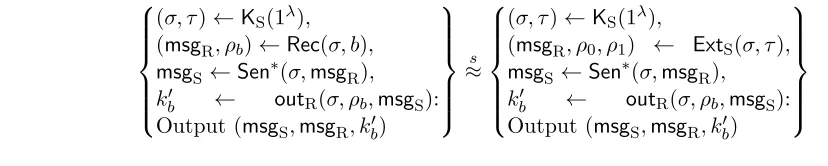
non-uniform PPT adversarial Rec∗ the following two distributions are statistically close.
(σ, τ)←KR(1λ),
(msgS, ω)←Sen(σ), msgR ←Rec∗(σ,msgS) (k0, k1)←outS(σ, ω,msgR):
Output (msgS,msgR, k0, k1)
s ≈
(σ, τ)←KR(1λ),
(msgS, ω)←Sen(σ), msgR←Rec∗(σ,msgS)
b0 ←ExtR(σ,msgR, τ):
(k0, k1)←outS(σ, ω,msgR),
`b0 :=kb0, `1−b0 ← {0,1}: Output (msgS,msgR, `0, `1).
• Receiver Security. We require that there exists a PPT algrithm ExtS such that for all
non-uniform PPT adversarial Sen∗ and for all b∈ {0,1}, the following two distributions are statistically close.
(σ, τ)←KS(1λ),
(msgR, ρb)←Rec(σ, b), msgS←Sen∗(σ,msgR),
k0b ← outR(σ, ρb,msgS):
Output (msgS,msgR, kb0)
s ≈
(σ, τ)←KS(1λ),
(msgR, ρ0, ρ1) ← ExtS(σ, τ),
msgS←Sen∗(σ,msgR),
kb0 ← outR(σ, ρb,msgS):
Output (msgS,msgR, k0b)
3.1.1 NIOT ⇒ FOTCor
In this subsection, we give a realization of theFOTCorfunctionality from any non-interactive
obliv-ious transfer.
Theorem 3.1 Assuming the existence of non-interactive oblivious transfer, there is a single round protocol for realizing FOTCor against malicious adversaries in the common reference string model.
Construction. We give a construction realizing the FOTCor functionality in Figure 2.
Let (KR,KS,Sen,Rec,outS,outR) be a non-interactive oblivious transfer.
Inputs: PartyPi fori∈[n], receives a session id sid.
Common Reference String: For everyi, j ∈[n], sample (σi,j, τi,j)← KR(1λ). Publish{σi,j}i,j∈[n]
as the common reference string.
Let us assume thatPi is the sender andPj is the receiver.
Message sent byPi→Pj: Compute (msgS, ω)←Sen(σi,j) and sendmsgSto Pj.
Message sent byPj→Pi: On inputb∈ {0,1}, compute (msgR, ρb)←Rec(σi,j, b). SendmsgRtoPi. Computation: Pi sets (s0, s1) :=outS(σi,j, ω,msgR). Pj setssb :=outR(σi,j, ρb,msgS).
Figure 2: Realizing theFOTCor functionality
Description of the Simulator. We assume thatAis static and hence the set of honest parties
H is known before the execution of the protocol. Recall the properties of ExtR and ExtS from the
definition of non-interactive oblivious transfer.
Simulating the CRS. For everyi∈[n],
• IfPi∈H, sample (σi,j, τi,j)←KR(1λ) for everyj ∈[n]\ {i}.
• IfPi6∈H, sample (σi,j, τi,j)←KS(1λ) for everyj∈[n]\ {i}.
Simulating the interaction withZ. For every input value for the set of corrupted parties that S receives from Z,S writes that value to A’s input tape. Similarly, the output of A is written as the output on S’s output tape.
Simulating the interaction withA: For every concurrent interaction with the session identifier
sidthat Amay start and for every choice of sender Pi and the receiverPj, the simulator does the following:
• Both Pi, Pj ∈H:
1. Compute (msgS, ω)←Sen(σi,j) on behalf of Pi and sendmsgS toPj.
2. Sampleb← {0,1}and compute (msgR, ρb)←Rec(σi,j, b) on behalf ofPj. Send msgR to
Pi.
• Pi ∈H and Pj 6∈H:
1. Compute (msgS, ω)←Sen(σi,j) on behalf of Pi and sendmsgS toA.
2. Aoutputs msgR.
3. Run b0←ExtR(σi,j, τi,j,msgR).
4. Compute (s0, s1) :=outS(σi,j, ω,msgR).
5. Send sb0 to theFOTCor functionality and output whateverA outputs.
• Pi 6∈H and Pj ∈H:
1. Compute (msgR, ρ0, ρ1)←S(σi,j, τi,j) and sendmsgR toA.
2. Aoutputs msgS.
3. Compute sb :=outR(σi,j, ρb,msgS) for all b∈ {0,1}.
4. Send (s0, s1) to theFOTCor functionality and output whateverA outputs.
Lemma 3.2 Assuming the security of non-interactive oblivious transfer, for every Z that obeys the rules of interaction for UC security we have EXECF,S,Z
c
≈EXECπ,A,Z.
Proof We now show that no environment can distinguish the real world execution with adversary A and an ideal world execution with adversaryS. We consider three cases.
• Case-1: Pi, Pj ∈H. Note thatEXECF,S,Zis identically distributed to ({σi,j}i,j∈[n],msgS,msgR,
(`0, `1), `b) where msgS and msgR are obtained as in the description of the simulator and
(`0, `1)← {0,1}. EXECπ,A,Z is identically distributed to ({σi,j}i,j∈[n],msgS,msgR,
(s0, s1), sb) where (msgR, ρb)←Rec(σi,j, b), (msgS, ω)←Sen(σi,j) and (s0, s1)←outS(σi,j, ω,msgR)
We show through a sequence of hybrids thatEXECπ,A,Z is computationally indistinguishable toEXECF,S,Z.
Hybrid2 : This hybrid is same as Hybrid1 except that we generate σi,j as (σi,j, τi,j)←KS(1λ).
Hybrid1 is computationally indistinguishable toHybrid1 from the CRS indistinguishability.
Hybrid3 : This hybrid is same as Hybrid2 except that the receiver’s message encodes 1−b
instead ofb. Hybrid3 is statistically close toHybrid2 from receiver security of non-interactive oblivious transfer.
Hybrid4 : This hybrid is same asHybrid3 except that we generateσi,j as (σi,j, τi,j)←KR(1λ).
Again,Hybrid4 is computationally indistinguishable toHybrid3 from the CRS indistinguisha-bility.
Hybrid5 : This hybrid is same as Hybrid4 except that we choose a random `b ← {0,1} and the sender outputs it instead of sb. Hybrid4 is statistically close to Hybrid4 from the sender
security of non-interactive oblivious transfer.
Hybrid6 : This hybrid is same as Hybrid5 except that we generate σi,j as (σi,j, τi,j)←KS(1λ).
Again,Hybrid5 is computationally indistinguishable toHybrid6 from the CRS indistinguisha-bility.
Hybrid7 : This hybrid is same asHybrid6except that the receiver’s message encodes a randomly chosen c instead of b. Hybrid3 is statistically close to Hybrid2 from receiver security of non-interactive oblivious transfer. Notice thatHybrid5 is distributed identically toEXECF,S,Z. • Case-2: Pi ∈H andPj 6∈H. It follows from the sender security of non-interactive oblivious
transfer thatEXECF,S,Z is statistically close toEXECπ,A,Z.
• Case-3: Pi6∈HandPj ∈H. It follows from the receiver security of non-interactive oblivious transfer thatEXECF,S,Z is statistically close toEXECπ,A,Z.
3.1.2 NIOT from Decisional Diffie-Hellman
In this subsection we give a construction of non-interactive oblivious transfer from the Decisional Diffie-Hellman (DDH) assumption. Bellare and Micali in [BM90] gave a protocol in the semi-honest setting from DDH assumption. Garg and Srinivasan [GS17] gave a protocol against malicious adversaries from bilinear maps. We review the DDH assumption below.
Decisional Diffie-Hellman Assumption [DH76]. Let SetupDDH be a randomized algorithm that takes a security parameter as input and outputs (p,G, g) such that p is a prime, G is a
descriptions of group of order pand g is a random generator of G.
Definition 3.3 (Decisional Diffie-Hellaman Assumption) We say the Decisional Diffie-Hellman
have
Pr
(p,G, g)←SetupDDH(1λ);x, y←Z∗p :A(p,G, g, gx, gy, gxy) = 1
−
Pr(p,G, g)←SetupDDH(1λ);x, y, z ←Z∗p :A(p,G, g, gx, gy, gz) = 1
≤negl(λ)
Theorem 3.4 Assuming the DDH assumption, there exists a construction of non-interactive obliv-ious transfer.
We give our construction in Figure 3.
Correctness. We first argue correctness of the construction given in Figure 3. Note that (gb)r= (gsb
b h tb
b )r= (grb)sb(hrb)tb =gsbhtb. Thus, it follows thatkb is indeed the first bit of (gb)r.
Security. CRS indistinguishability follows directly from the DDH assumption. We show sender and receiver security.
• Sender Security. We give details on the ExtR algorithm. On input σ := (g0, h0, g1, h1),
trapdoor τ := (x0, x1) := (z, zy/x) and an adversarially generated message (g, h), it checks
ifx0 =x1. If yes, it aborts. If it does not abort, it checks if h =gx0. If that is the case, it
outputs 0. Else, it checks if h =gx1 in which case it outputs 1. If h 6=gx0 or if h 6=gx1, it outputs 0.
We first notice that sincex and y are sampled randomly, the probability that ExtR aborts is
negligible. So, we can condition on the event that ExtR does not abort (or, in other words,
x6=y). We consider the following cases.
– Case-1: h=gx0. In this case, it is sufficient to show that for randomly chosens
1, t1 ←
Z∗p,gs1ht1 is distributed uniformly inGconditioned ong s1
1 h
t1
1 . Letg:=gr0 andh0 :=gz0.
Since,h=gx0, we haveh:=hr
0. Thus, gs1ht1 :=g0rs1h
rt1
0 . Notice that sincex6=y, for a
randomly chosens1, t1 ←Z∗p,xs1+zyt1 and rs1+zrt1 are random and independent of
each other. It now follows that gs1
1 h
t1
1 := g
xs1+zyt1
0 and gs1ht1 := g
rs1+zrt1
0 are random
and independent of each other.
– Case-2: h = gx1. It can be shown via an identical argument to Case-1 that for a randomly chosens0, t0 ←Z∗p,gs0ht0 is distributed uniformly inGconditioned ong
s0
0 h
t0
0.
– Case-3: h 6= gx0 and h 6= gx1. In this case, let g := gr
0 and h := hr
0
0 for some r 6= r0
sinceh6=gx0. As in Case-1, it can be easily seen that for a randomly chosens
1, t1 ←Z∗p
xs1+zyt1 and rs1+zr0t1 are random and independent of each other unlessr:=x and
r0=y. If r:=x andr0 =y then h:=gx1 which contradicts our assumption.
• Receiver Security. We give details on the ExtS algorithm. On input σ := (g0, h0, g1, h1)
and the trapdoorτ :=x,ExtS choosesr ←Z∗p and outputsmsgR = (g, h) := (g0r, hr0) and sets
ρ0 := (r,0) and ρ1:= (r/x,1).
Notice thatmsgR is identically distributed to Rec(σ, b) for anyb∈ {0,1}. Let (g0, g1) be any adversarially chosen msgS. Let s0, s1, t0, t1 be such that gb :=g
sb b h
tb
b . It is sufficient to prove that gs1ht1 := (g
1)r/x. Note that g1 := g0x and h1 := hx0. Thus, (g1)r/x := (gs11h
t1
1)r/x :=
- KR(1λ) :
1. (p,G, g)←SetupDDH.
2. Setg0 :=g and choose z←Z∗p. 3. Seth0:=gz0.
4. Choose x, y←Z∗p.
5. Setg1 :=g0x and h1 :=hy0.
6. Outputσ := (g0, h0, g1, h1) and the trapdoor τ := (z, zy/x).
- KS(1λ) :
1. (p,G, g)←SetupDDH.
2. Setg0 :=g and choose h0 ←G.
3. Choose x←Z∗p.
4. Setg1 :=g0x and h1 :=hx0.
5. Outputσ := (g0, h0, g1, h1) and the trapdoor τ :=x.
- Sen(σ) :
1. Choose s0, t0, s1, t1 ←Z∗p. 2. OutputmsgS:= (gs0
0 h
t0
0 , g
s1
1 h
t1
1) and secret randomness ω:= (s0, t0, s1, t1).
- Rec(σ, b) :
1. Choose r←Z∗p.
2. OutputmsgR:= (gbr, hrb) and the secret randomness ρb := (r, b).
- outS(σ, ω,msgR) :
1. ParsemsgR as (g, h) and ω as (s0, t0, s1, t1).
2. Outputk0 and k1 to be the first bit ofgs0ht0 and gs1ht1 respectively.
- outR(σ, ρb,msgS) :
1. ParsemsgS as (g0, g1) and ρb as (r, b).
2. Output the first bit of (gb)r.
3.1.3 NIOT from Quadratic Residuocity
In this section we present a construction of non-interactive oblivious transfer from the quadratic residuocity (QR) assumption. We will begin by reviewing the assumption, then describe the con-struction, and finally prove its correctness and security.
Notations For a positive integer N, we use J(N) to denote the set {x ∈ Z/NZ : Nx = 1},
where Nx
is the Jacobi symbol of x in Z/NZ. We use QR(N) to denote the set of quadratic
residues inJ(N). The security of our scheme is based on the following computational assumption.
Definition 3.5 (Quadratic Residuocity (QR) Assumption [GM82]) LetQRgen(·)be a PPT algorithm that generates two equal size primes p, q and N = pq. The following two distributions are computationally indistinguishable:
n
(p, q, N)←QRgen(1λ);V ← QR(N) : (N, V)o≈c n(p, q, N)←QRgen(1λ);V ← J(N)\ QR(N) : (N, V)o
In the construction and the proof of security, we make use of the the notion IBE compatible algorithm proved in [BGH07].
Definition 3.6 ([BGH07]) LetQbe a deterministic algorithm that takes as input(N, S, R)where N ∈Z+ and R, S ∈Z/NZ. The algorithm outputs two polynomials f, g ∈Z/NZ[x]. We say that
Q is IBE-compatible if the following two conditions hold:
1. (Condition 1) If S and R are quadratic residues then f(s)g(r) is a quadratic residue for all square roots r of R and sof S.
2. (Condition 2) IfS is a quadratic residue thenf(s)f(−s)Ris a quadratic residue for all square roots sof S.
Boneh et al. [BGH07] showed a concrete instantiation of such an IBE-compatible algorithm.
Theorem 3.7 Assuming the Quadratic Residuocity assumption, there exists a construction of non-interactive oblivious transfer.
The Construction. We give the construction of non-interactive oblivious transfer in Figure 4.
Correctness. We start with the correctness proof. Notice that if b= 0 then msgR is a quadratic residue and otherwise,u·msgRis a quadratic residue. Let us first consider the case where msgR is a quadratic residue. In that case, Condition 1 in Lemma 3.6 implies that fN(s)=gN(r). Hence,
k00 = k0. A similar argument can be used to show that if u·msgR is a quadratic residue then
k01=k1.
• KR(1λ) :
1. (p, q, N)←QRgen(1λ)..
2. Sample a random u← J(N)\ QR(N).
3. Outputσ := (N, u), τ := (p, q).
• KS(1λ):
1. (p, q)←QRgen(1λ).
2. Sample a random u← QR(N).
3. Outputσ := (N, u), τ := (p, q).
• Sen(σ):
1. Pick a randoms∈Z/NZ.
2. S:=s2.
3. OutputmsgS:=S, ω:=s.
• Rec(σ, b):
1. Pick a randomr ∈Z/NZ.
2. Ifb= 0, letmsgR:=r2, otherwise let msgR :=r2u.
3. OutputmsgR and ρb:= (r, b,msgR).
• outS(σ, ω,msgR):
1. Parseω ass, and let S:=s2.
2. (f, g)← Q(N, S,msgR), ( ¯f ,¯g)← Q(N, S, u·msgR).
3. Outputk0:=
f(s)
N
, k1 :=
f¯(s)
N
.
• outR(σ, ρb,msgS):
1. Parseρb as (r, b,msgR); parsemsgS asS.
2. Ifb= 0, let (f, g)← Q(N, S, r2) and kb0 :=gN(r); otherwise let ( ¯f ,¯g)← Q(N, S,(ru)2) and k0b:=¯g(Nru). 3. Outputk0b.
Figure 4: Non-Interactive Oblivious Transfer from QR
Sender Security. We first give the description of the extractor ExtR. On input msgR, the extractor uses the trapdoor τ = (p, q) to check if msgR is a quadratic residue. It outputs b0 = 0 if it is the case and 1 otherwise. We now need to show thatk1−b0 is statistically indistinguishable to random and this follows directly from the following lemma given in [BGH07].8
8
Lemma 3.8 ([BGH07]) Let N = pq be a QR modulus, X ∈ QR(N) and R 6∈ QR(N). Let x
be a random variable uniformly chosen among the four square roots of X. Let f be a polynomial
such that f(x)f(−x)R is a quadratic residue for all four values of x. Then,
f(x)
N
is uniformly distributed in {±1}.
Proof Some parts of the proof are taken verbatim from [BGH07]. Let x, x0 be two square-roots of X such that x = x0 mod p and x = −x0 mod q. Then, the four square roots of X
are {±x,±x0}. By definition, we have that f(px) = f(px0) and f(qx0) = f(−xq ). Also, from the fact that f(x)f(−x)R is a quadratic residue, we have that f(px) f(−xp ) Rp= 1 and
f(x)
q
f(−x)
q R
q
= 1. Since R 6∈ QR(N) either Rp = −1 or Rq = −1. We consider two cases:
• Case-1: Rq = −1. In this case, f(qx) = −f(−xq ) = −f(qx0). Thus, fN(x) =
−f(Nx0). Similarly, one can show thatf(N−x)=−1f(−xN 0). Thus, amongf(x), f(x0), f(−x), f(−x0), the first two have different Jacobi symbols and the last two have different Jacobi symbols
modulo N. Thus, fN(x)is uniformly distributed over {±1}.
• Case-2:
R p
= −1. In this case,
f(x)
p
= −f(−xp ) = −f(−xp 0). Thus,
f(x)
N
=
−f(−xN 0). Similarly, one can show that
f(x0)
N
=−f(N−x). Thus, amongf(x), f(−x0), f(−x), f(x0), the first two have different Jacobi symbols and the last two have different Jacobi symbols
modulo N. Thus,
f(x)
N
is uniformly distributed over {±1}.
Receiver Security. We first give the description of the extractorExtS. On input σ, τ, it uses τ
to find the square rootu0 of u. It samples a random r and setsmsgR=r2u,ρ0 =ru0 and ρ1 =r.
It is easy to see that this extractor satisfies the receiver security definition.
3.1.4 NIOT from Learning with Errors
In this section, we will provide a construction of non-interactive oblivious transfer from Learning with Errors (LWE) assumption.
We will begin by recalling the LWE assumption. In the following description, we will use nas the security parameter.
Lemma 3.9 (Lattice Trapdoors [Ajt99, GPV08, MP12]) There is an efficient randomized algorithm TrapSamp(1n,1m, q) that, given any integers n ≥ 1, q ≥ 2, and sufficiently large m = Ω(nlogq), outputs a parity check matrix A ∈Znmq and a trapdoor matrix T ∈Zmm such that the
distribution of A isnegl(n)-close to uniform.
Definition 3.10 (B-Bounded Distribution) A family of distribution χ := {χn}n∈N is said to
Definition 3.11 (Learning with Errors [Reg05, Pei09]) For an integer q =q(n) ≥2 and a B-bounded error distribution χ=χ(n) over Zq, the learning with errors problemdLWEn,m,q,χ is to
distinguish between the following pairs of distributions:
{A,ATs+e} and {A,y}
where A←Zn×m
q , s←Znq,e←χm andy←Zmq .
Theorem 3.12 Assuming LWE, there exists a construction of non-interactive oblivious transfer.
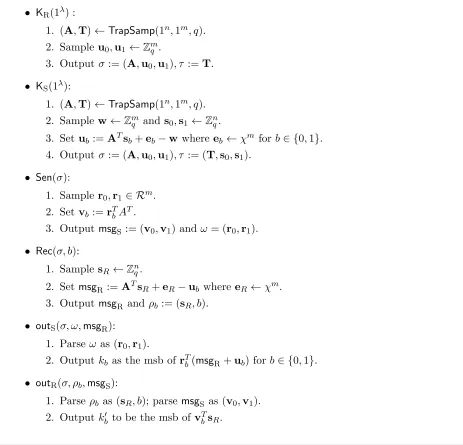
The Construction. We give the construction of non-interactive oblivious transfer in Figure 5. In the construction, we will fix an integer 2√q≤R≤ 4mBq and denoteR:= [0, R−1].
Correctness. The receiver output kb0 is the msb of rbTATsR and kb output by the sender is the msb of rTbATsR+rTbeR. Note that|rTbeR| ≤mRB ≤q/4. Thus, msb of rTbATsR is same as the msb ofrTbATsR+rTbeR.
CRS Indistinguishability. The CRS indistinguishability follows directly from the LWE as-sumption.
Sender Security. The proof of sender security follows almost directly from [PVW08]. We now sketch the details.
For a fixed (A,v) ∈ Zn×m
q ×Zmq , following [PVW08], we define δ(A,v) to be the statistical distance between (rTAT,rTv) where r ← Rm and the uniform distribution over
Znq ×Zq. The following lemma was shown in [PVW08].
Lemma 3.13 ([PVW08, GPV08]) Let m ≥ 2(n+ 1) logq and let ε= q(n+1)1 /2. Then, with all
but negligible probability over the random choices of (A,u0,u1), for every msgR∈Zmq , there exists
b∈ {0,1} such that δ(A,msgR+ub) ≤ε. Furthermore, given the trapdoor matrix T, there exists
an efficient algorithm that finds such a bgiven msgR.
The sender security follows from a straightforward application of this lemma.
Receiver Security. We describe the algorithm ExtS. This algorithm outputs msgR = w and
ρb = sb for each b ∈ {0,1}. It is easy to see that this extractor satisfies the receiver security requirement.
3.2 Realizing FOTCor: Honest Majority Case
• KR(1λ) :
1. (A,T)←TrapSamp(1n,1m, q).
2. Sampleu0,u1←Zmq .
3. Outputσ := (A,u0,u1), τ :=T.
• KS(1λ):
1. (A,T)←TrapSamp(1n,1m, q).
2. Samplew←Zm
q and s0,s1 ←Znq.
3. Setub:=ATsb+eb−wwhereeb ←χm forb∈ {0,1}. 4. Outputσ := (A,u0,u1), τ := (T,s0,s1).
• Sen(σ):
1. Sampler0,r1 ∈ Rm.
2. Setvb :=rTbAT.
3. OutputmsgS:= (v0,v1) andω = (r0,r1).
• Rec(σ, b):
1. SamplesR←Znq.
2. SetmsgR:=ATsR+eR−ub where eR←χm.
3. OutputmsgR and ρb:= (sR, b).
• outS(σ, ω,msgR):
1. Parseω as (r0,r1).
2. Outputkb as the msb of rTb(msgR+ub) for b∈ {0,1}.
• outR(σ, ρb,msgS):
1. Parseρb as (sR, b); parsemsgS as (v0,v1).
2. Outputk0b to be the msb of vTbsR.
Figure 5: Non-Interactive Oblivious Transfer from LWE
Client-Server Model. In the client-server model for computing FOTCor, there are two clients: the sender and the receiver of the FOTCorfunctionality. There are 2t+ 1 servers and at most t of
them are corrupted. In the two-round protocol, a single message is sent from both the sender and the receiver to the 2t+ 1 servers (via a private channel) and a single message is sent from all the 2t+ 1 servers to the receiver (again via a private channel) which enables the receiver to obtain the output of the function.
FOTCor in the client-server model where the majority of the servers are honest and the adversary is semi-honest. We state the theorem here and for completeness we give a proof in Appendix B.
Theorem 3.14 There is a protocol that securely realizesFOTCorin the client-server model against adversaries who can corrupt an arbitrary number of clients and a minority of the servers.
4
Two-round Semi-Honest MPC in the
F
OTCorModel
In this section, we give our construction of two-round MPC against semi-honest adversaries in the FOTCor model when the adversary is allowed to corrupt an arbitrary subset of the parties. The results we obtain against semi-honest adversaries are as follows (all our results are in the FOTCor
model):
1. We first give a perfectly secure, two-round protocol for constant-size functionalities.
2. Next, using s result in [BGI+18] and the protocol from Step 1, we will give a protocol with perfectly (resp. statistical) secure, two-round protocol for functionalities with perfect (resp. statistical) randomized encodings with constant degree. Following [AIK04], we will denote the class of functions with perfectly (resp. statistically) secure constant degree randomized encodings asPREN(resp. SREN). Applebaum et al. [AIK04] showed that some of the natural complexity classes such as NC1 and mod-2 branching programs ⊕L/poly are contained in PREN. A complexity class that is inSREN but not known to be inPREN isNL.
3. Next, using the result in [BMR90] and the protocol from Step 1, we will give a protocol for all circuits making black-box use of a pseudorandom generator.
4.1 Protocols for Constant-Size Functionalities
For a constantn, letf :{0,1}n→ {0,1}be a function with constant circuit size.9 For eachi∈[n],
the party Pi has input bit xi and the parties want to securely compute f(x1, . . . , xn).10 We give perfectly secure, two-round protocols for computingf both in the dishonest majority setting in the FOTCorhybrid model.
To construct a two-round protocol in the dishonest majority setting, we will use the same high level idea of Garg and Srinivasan [GS18]. To be more precise, we will take an arbitrary round protocol that securely computes the functionf and compress it to two-rounds. However, to construct a perfectly secure protocol we will make the following changes to the round-collapsing compiler of [GS18],
1. All the executions of two-round oblivious transfer used by the round-collapsing compiler in [GS18] are replaced with perfectly secure, two-round oblivious transfer from OT correlations.
9
For simplicity, we restrict ourselves to functions that output a single bit. We note that all our results can be generalized to functions with multiple bits with efficiency growing linearly with this number. We also assume that all the parties get the output of this functionality. We can also generalize our result for the case where some specific parties get the output.
10Again, for simplicity we restrict ourselves to parties with a single input bit and our results naturally generalize
2. The garbled circuits used in [GS18] compiler are replaced with perfectly secure, decomposable randomized encodings forNC0 circuits (cf. Definition 2.2).
3. The underlying multi-round protocol that we want to round-compress might use cryptographic operations (which is necessary in the dishonest majority setting) and this creates the following two problems: (i) we can no longer argue perfect/statistical security, (ii) a subtle but a more important problem is that the compiler in [GS18] makes use of the code of the underlying protocol and hence if the underlying protocol involves cryptographic operations then the resultant two-round protocol makes non-black box use of cryptographic primitives. To solve the first problem, we will only round-compress perfect/statistical protocols in the OT-hybrid model (e.g., [GMW87, Kil88, IPS08]). Notice that any protocol in the OT-hybrid model can be reduced information theoretically to a protocol in theFOTCor functionality. To make the operations performed by all the parties information theoretic, we will generate OT correlations and make these correlations as part of the party’s input. For example, consider two parties
P1 andP2 who wish to do an OT in some round of the underlying protocol. Now,P1 andP2
will use the OT correlations from their input to perform an information theoretic OT.
The rest of the subsection is organized as follows. We will first recall the notion of conforming protocols from [GS18]. Intuitively, conforming protocols are MPC protocols with some additional structure. [GS18] showed that any MPC protocol can be transformed to a conforming protocol (with some efficiency loss). We give a generalization of the notion of conforming protocols to work inFOTCormodel. Then, we will describe our construction of two-round MPC in theFOTCorhybrid model.
Conforming Protocol. We will now recall the notion of conforming protocols from [GS18]. We introduce an additional parameter s such that in each round of the conforming protocol, a single party computessNAND gates and broadcasts the output of these NAND gates to every party. We note that in the formulation of [GS18], the parameterswas set to 1. We introduce this parameter for better concrete efficiency.
Consider a n-party deterministic11 MPC protocol Φ between parties P1, . . . , Pn with inputs
x1, . . . , xn, respectively. For each i ∈ [n], we let xi ∈ {0,1}m denote the input of party Pi (xi’s also include the randomness used in the protocol and hence they are m bits long). A conforming protocol Φ in the FOTCor is defined by functionspre,post, and a OT correlations generation phase and computations steps or what we callactions φ1,· · ·φT. The protocol Φ proceeds in four stages: the OT correlations generation phase, the pre-processing stage, the computation stage and the output stage.
• OT correlations generator: For every instance of the OT to be performed in the protocol, interact with theFOTCorfunctionality to generate OT correlations.
• Pre-processing phase: For eachi∈[n], partyPi computes
(zi, vi)←pre(i, xi)
wherepre is a randomized algorithm and the input xi is now augmented with the OT corre-lations generated in the previous step. The algorithm pre takes as input the index i of the
party, its input xi and outputs zi ∈ {0,1}`/n and vi ∈ {0,1}` (where `is a parameter of the protocol). Finally, Pi retains vi as the secret information and broadcasts zi to every other party. We require thatvi,k = 0 for all k∈[`]\ {(i−1)`/n+ 1, . . . , i`/n}.
• Computation phase: For eachi∈[n], partyPi sets
sti := (z1k · · · kzn).
Next, for eacht∈ {1· · ·T} parties proceed as follows:
1. Parse action φt as (i,(a1, b1, c1), . . . ,(as, bs, cs)) where i∈ [n] and aj, bj, cj ∈ [`] for all
j∈[s].
2. PartyPi computes s NANDgates as
sti,cj =NAND(sti,aj ⊕vi,aj,sti,bj⊕vi,bj)⊕vi,cj
for all j∈[s] and broadcasts {sti,cj}j∈[s]to every other party.
3. Every party Pk fork6=iupdates stk,cj for all j∈[s] to the bits received fromPi.
We require that for all t, t0 ∈ [T] such that t=6 t0, if φt = (·,(·,·, c1), . . . ,(·,·, cs)) and φt0 = (·,(·,·, c01), . . . ,(·,·, cs0)) then{cj} ∩ {c0j}=∅. We useAi ⊂[T] to denote the set of rounds in which the party Pi sends a message. Namely, Ai={t∈T |φt= (i,(·,·,·), . . . ,(·,·,·))}.
• Output phase: For eachi∈[n], party Pi outputspost(i,sti, vi).
We now show the following lemma which is a generalization of the lemma proved in [GS18].
Lemma 4.1 For s = 1, any MPC protocol Π in the OT hybrid model can be transformed into a conforming protocol Φ in the FOTCor model while inheriting the correctness and the security of the original protocol. Furthermore, there exists a choice of s such that the number of rounds of the resulting conforming protocol is O(n·dmax·r) where dmax is the maximum depth of the boolean
circuit computing the next message function of any party and r is the number of rounds of the
original protocol Π.
We prove the lemma in Appendix C.
Remark 4.2 We note that if thei-th party’s output is public then the algorithm postneed not take vi as input.
Compiled Protocol. We describe the compiled protocol in Figure 6 and give an informal overview below.
Overview. Our construction involves a pre-preprocessing phase followed by the two-rounds of interaction (described in Figure 6) and a local evaluation phase (described below). In the pre-processing phase, the parties interact with the FOTCor functionality to generate two sets of OT
Evaluation. To compute the output of the protocol, each partyPi does the following:
1. For eachk∈[n], let bxk,1 be the input encoding received fromPk at the end of round 2.
2. foreach tfrom 1 to T do:
(a) Parseφt as (i∗,(a1, b1, c1), . . . ,(as, bs, cs)). (b) Compute ({(ξj, ωj)}j∈[s],xb
i∗,t+1) :=Dec(
e fi,t,xb
i,t).
(c) Setsti,cj :=ξj.
(d) foreach k6=i∗ do: i. Compute ({ots2
j}j∈[s],{xb
k,t+1
h }h∈[`]\{cj}j∈[s]) :=Dec(fe
i,t,
b xi,t).
ii. For everyj∈[s]: A. Parse ots2
j as (Y0, Y1) andωj as {γjk}k∈[n]\{i∗}. B. Recoverxbk,tcj+1 :=Yξj⊕γ
k j. iii. Set bx
k,t+1 :={
b
xk,th +1}h∈[`].
3. Compute the output as post(i,sti, vi).
Asymptotic cost. Since the function f is constant size, the number of rounds of the underly-ing protocol and the maximum depth of the next message functions are constant (e.g., if we use [GMW87] as the underlying protocol). As a result of Lemma 4.1, the number of rounds of the conforming protocol is also a constant since k is a constant. Hence, the asymptotic cost of our protocol is a constant (though concretely it grows as 2O(T) whereT is the number of rounds of the conforming protocol).
Security. The only changes that we make when compared to the protocol in [GS18] is that we use information theoretic, two-round oblivious transfer (based on OT correlations) and perfectly secure DRE in place of garbled circuits. For completeness, we show the proof of the following theorem in Appendix D.
Theorem 4.3 For every constant size function f, the protocol in Figure 6 perfectly computes f against a semi-honest adversaries who might corrupt an arbitrary subset of the parties.
Extensions. We will now describe two-extensions to the protocol in Figure 6.
• f need not be known until the second round. We will now describe how to augment the protocol so that the functionf to be computed need not be known until the beginning of the second round and only the size of these functions need to be known before the first round. Let us assume for simplicity that,|f|=m0. We define a (k+m0k)-party functionalityC that takes xi from partyPi for everyi∈[k] and takes a bit yi`from partyPi`for each i∈[k] and
`∈[m0] and does the following: it checks if for eachi, i0 ∈[n] and`∈[m0],yi,`
?
two-Let Φ be ann-party conforming semi-honest MPC protocol (withT rounds in the computation phase) andfbbe a DRE (See Definition 2.2).
Pre-processing Phase: On input the number of partiesn, the number of functionss, the size of each of these functions and the size of each party’s inputm, the partyPi does the following:
1. For eachj ∈[s] andα, β∈ {0,1}:
(a) For eacht∈Ai(recall the definition ofAifrom the description of conforming protocol), send ((t, j, α, β),receiver, i, rt,j,α,β) (where rt,j,α,β is chosen randomly) and for each
t∈[T]\Ai, send ((t, j, α, β),sender, i) toFOTCorfunctionality.
(b) Receive ωt,j,α,β ={γt,j,α,βk }k∈[n]\{i} for eacht∈Ai and (γt,j,α,β0 , γ
1
t,j,α,β) ift∈[T]\Ai fromFOTCor.
2. Execute the OT correlations generation phase of the conforming protocol Φ.
Round-1: Each partyPi does the following:
1. Compute (zi, vi)←pre(i, xi).
2. For eacht∈Ai, for eachj∈[s] andα, β∈ {0,1}, compute
ots1t,j,α,β← vi,cj⊕NAND(vi,aj⊕α, vi,bj⊕β)
⊕rt,j,α,β,
whereφt= (i,(a1, b1, c1), . . . ,(as, bs, cs)). 3. Sendzi,{ots1t,j,α,β}t∈Ai,j∈[s],α,β∈{0,1}
to every other party.
Round-2: In the second round, each partyPi does the following: 1. Setsti:= (z1k. . .kzik. . .kzn).
2. Setai,Tk,0+1 =ak,i,T1+1=⊥for allk∈[`]. 3. foreacht fromT down to 1,
(a) Parseφtas (i∗,(a1, b1, c1), . . . ,(as, bs, cs)). (b) If i=i∗ then
i. Letfi,t be aNC0function that takesstas input, updatesst
cj as per the action for every j ∈[s] and outputsωt,j,staj,stbj for every j ∈[s] along with a
i,t+1
k,stk for every
k∈[`].
(c) If i6=i∗ then for everyα, β∈ {0,1},
i. Compute ots2t,j,α,β := (ai,tcj,+10 ⊕X0,ai,tcj,+11 ⊕X1) whereXb =γ b⊕ots1
t,j,α,β
t,j,α,β for every
j ∈[s].
ii. Let fi,t be a NC0 function that takes st as input and outputs ai,t+1
k,stk for all k ∈ [`]\ {cj} andots2t,j,staj,stbj for everyj∈[s].
(d) Compute (fei,t,{(a
i,t k,0,a
i,t
k,1)}k∈[`])←fbi,t(;r).
4. Send {fbi,t}t∈[T],{a
i,1
k,stk}k∈[`]
to every other party.
We will use an underlying conforming protocol that securely computes the constant size circuit
C. In the compiled protocol, we will let each party Pi to additionally emulate the parties {Pi`}`∈[m0]. To be more precise, in the first round of the protocol, for each ` ∈ [m0], the party Pi sends two first round messages on behalf of party Pi`; the first message assuming the bit yi` = 0 and the second message assuming the bit yi`0 = 1. In the beginning of the second round, all the parties know the description of the functionsf and hence can choose the first round message corresponding to the correct value of yi` and ignore the other message. Based on the chosen messages, the parties generate the second round message in the compiled protocol.
• Extension to the Client-Server setting. We now describe an extension of our two-round protocol to the client-server setting. In the client server setting, there aren-input clients who holds the inputs, m servers who do not have any input and one output client. The input clients send a single message to each of themservers and the servers send a single message to the output client and the output client learns the output of the function based on the server’s message. We will assume that any number of clients can be corrupted but there is at least one server who is uncorrupted. We will transform our 2-round protocol in theFOTCor model to one in the client-server model. Later, in Section 5, we give a general transformation from any two-round MPC protocol with security against semi-honest adversaries who might corrupt an arbitrary subset of the parties to a protocol in the client-server model. However, this general transformation might make non-black-box use of cryptography but the transformation we give here is specific to protocol in Figure 6 and is information theoretic.
1. Thei-th input client computes the first round messagezi,{ots1t,j,α,β}t∈Ai,j∈[s],α,β∈{0,1}
of our two-round protocol and sends it to each of the servers.
2. In addition to the protocols first round message, the client will generate a randomized encoding of NC0 circuits fi,t for every t ∈ [T], and sends these randomized encodings along with an additive secret share of the input encoding (ai,01,ai,11) to the servers. Let us now describe the functionality computed by fi,t. The functionality takes in the first round messages of all parties and reconstructs sti. If t ∈ Ai, then it computes the same function as that of fi,t (described in Figure 6). If t 6∈Ai, it will use ots1t,j,α,β (obtained from the first round messages of the parties) and will generateots2t,j,α,βexactly as described in the protocol. Then, it computes the same functionality as that offi,t.
3. The servers on receiving the first round messages from all the input clients, choose the secret share of the input encodings corresponding to the first round messages from all the clients and sends the chosen secret shares to the output client.
4. The output client reconstructs the input encodings from the shares and decodes the ran-domized encodings exactly as given the evaluation procedure of our two-round protocol to obtain the output.
4.2 Protocols for PREN and SREN
dMULTPlus((x1, z1), . . . ,(xd, zd)) =x1·. . .·xd+ d
X
i=1
zi.
We recall the following lemma from [BGI+18].
Lemma 4.4 ([BGI+18]) Let g :{0,1}n → {0,1} be a constant degree function i.e., there exists
a constant d such that g(x1, . . . , xn) =
P a`i1...i
dxi1xi2. . . xid. There exists a perfectly secure,
two-round protocol in the presence of secure channels between every pair of parties for computing g
against semi-honest adversary (corrupting an arbitrary subset of parties) in the FdMULTPlus hybrid model. The efficiency of the protocol isO(m+n2) where m is the number of monomials in g.
We obtain the following corollary of our Theorem 4.3.
Corollary 4.5 There exists a perfectly secure, two-round protocol for realizing FdMULTPlus func-tionality against semi-honest adversary (corrupting an arbitrary subset of parties) in the FOTCor
hybrid model. The efficiency of the protocol is 2poly(d).
Combining Lemma 4.4 and Corollary 4.5 and the observation thatFOTCorimplies secure chan-nels, we get the following lemma.
Lemma 4.6 Let g :{0,1}n → {0,1} be a constant degree function i.e., there exists a constant d
such that g(x1, . . . , xn) =
P a`i1...i
dxi1xi2. . . xid. There exists a perfectly secure, two-round protocol
for computing g against semi-honest adversary (corrupting an arbitrary subset of parties) in the
FOTCor hybrid model. The efficiency of the protocol is O(m +n2) where m is the number of monomials in g.
We now show our main theorem regarding securely computing functions in PREN andSREN.
Theorem 4.7 Every f :{0,1}n→ {0,1} in PREN (resp. SREN) has an efficient, perfectly secure
(resp., statistically secure) two-round protocol in theFOTCor model against a semi-honest adversary corrupting an arbitrary subset of parties. The computational cost incurred by each party isO(m+n2)
where m is the size of the randomized encoding for f.
Proof Let fb:{0,1}n× {0,1}ρ → {0,1} be the randomized encoding of the function f. Each
partyPi choosesri uniformly at random from{0,1}ρ and the parties wish to securely compute the functionality fb(x1, . . . , xn;r1⊕r2. . .⊕rn) (i.e., the input of partyPi is set as (xi, ri)).
Let fb(x1, . . . , xn;r1⊕r2. . .⊕rn) = P
a`i
1i2...idvi1vi2. . . vid where each vid is either some input bit xj or a bit of some random string rj. We will use the protocol from Lemma 4.6 to securely computefb.
It now follows from the privacy of randomized encodings and the security of the protocol for computing fbthe above protocol securely computes f against semi-honest corruptions.