ISSN(Online): 2319-8753 ISSN (Print) : 2347-6710
I
nternational
J
ournal of
I
nnovative
R
esearch in
S
cience,
E
ngineering and
T
echnology
(An ISO 3297: 2007 Certified Organization)
Vol. 5, Issue 3, March 2016
Analyze and implementation of TEEN
Protocol in Wireless Sensor Network
Tamanna1, Anshu Sharma2
P.G. Student, Department of Computer Engineering, CTITR Engineering College, Jalandhar, Punjab, India1
Assistant Professor, Department of Computer Engineering, CTITR Engineering College, Jalandhar, Punjab, India2
ABSTRACT:Now a day's wireless sensor network has turned into an intriguing research field. Network life time and energy proficiency are one of the primary concerns toward wireless sensor networks. Sensors are compelled as far as battery power, storage, constrained processing limit and so on. Because of these reasons new protocols are proposed the network which is wireless sensor networks. This paper just cluster group based various hierarchical protocol TEEN (Threshold Sensitive Energy Efficient Sensor Network Protocol). The sensor network architecture in TEEN depends on a various hierarchical clustering. TEEN is information driven, reactive, event driven convention which is most appropriate for time basic application. It transmits information in hard threshold and soft threshold values. If the thresholds that are not achieved, then nodes will never communicate.In this paper we assess the execution of TEEN protocols in various node densities as far as throughput,PDR and delay.
KEYWORDS: TEEN, routing protocols,clustering.
I. INTRODUCTION
Sensor networks have developed as a promising tools for checking the physical world, utilizing self-sorting out networks of battery-powered wireless sensors that can sense, process and communicate. In sensor systems, vitality is a critical resource, while applications show a constrained arrangement of attributes. A sensor system is a network of numerous tiny dispensable low power devices, called nodes, which are spatially distributed with a specific end goal to perform an application-arranged global task. These nodes frame a network by communicating with one another either specifically or through different nodes. One or more nodes among them will serve as sink(s) that are fit for communicating with the client either specifically or through the current wired systems. The essential part of the system is the sensor, fundamental for observing genuine physical conditions, for example, sound, temperature, dampness, power, vibration, weight, movement, contaminations and so on at various locations.The primary sensor nodes, which comprise of detecting, on board processor for information preparing, and conveying segments, influence the thought of sensor systems in view of cooperative exertion of alarge number of nodes. Each node ordinarily comprises of the four segments: sensor unit, central processing unit (CPU), power unit, and commnication unit. They are relegated with various task. The sensor unit comprises of ADC (Analog to Digital Converter). The sensor unit is in charge of gathering data as the ADC requests, and returning the analog information it sensed. ADC is an interpreter that tells the CPU what the sensor unit has sensed, furthermore illuminates the sensor unit what to do.Communication unit is tasked to get order or query from and transmit the information from CPU to the outside world. CPU is the most complex unit. It translates the command or query to ADC, screens and controls power if essential, processes received data, computes the next hop to the sink and so forth. Power unit supplies energy to sensor unit, process the unit and communication unit.
1) Routing protocols in wsn:
ISSN(Online): 2319-8753 ISSN (Print) : 2347-6710
I
nternational
J
ournal of
I
nnovative
R
esearch in
S
cience,
E
ngineering and
T
echnology
(An ISO 3297: 2007 Certified Organization)
Vol. 5, Issue 3, March 2016
location-based routing, sensor nodes' positions are exploited to course information in the system. A routing protocol is viewed as versatile if certain system parameters can be controlled order to adapt the end goal to adjust to the present system conditions and available energy levels. Moreover, these protocols can be arranged into multipath-based, query based, negotiation based, QoS-based, or coherent-based routing methods depending with respect to the convention operation. The above, routing protocols can be characterized into three classifications: in namely, proactive, reactive,and hybrid protocols depending upon how the source finds a route to the destination. In proactive protocols, all routes are processed before they are truly required, while in reactive protocols, routes are computed on demand. Hybrid protocols utilize a mix of these two thoughts. At the point when sensor nodes are static, it is desirable over have table driven routing protocols as opposed to utilizing reactive protocols. A lot of vitality is utilized as a part of routes protocols and setup of cooperative protocols. Another class of routing is known as the helpful cooperative protocols. In helpful routing, nodes send information to a central node where information can be amassed and might be liable to further processing, consequently decreasing routes cost as far as vitality use.
2) Classification of Sensor Networks
Here, we show a basic order of sensor systems on the premise of their method of working and the kind of target application.:
•Proactive Networks
The nodes in this system occasionally switch on their sensors and transmitters, sense the earth and transmit the information of interest. Along these, they give a depiction of the important parameters at consistent intervals. They are appropriate for applications requiring intermittent information monitoring.
•Reactive Networks
In this plan the nodes respond instantly to sudden and drastic changes in the estimation of a detected quality. Thusly, they are appropriate for time basic applications.
II. RELATED WORK
1.TEEN: A Routing Protocol for Enhanced Efficiency in Wireless Sensor Networks:- In this paper, author introduce a formal characterization of sensor systems. Author additionally present another system protocol,TEEN for receptive systems. TEEN is appropriate for time basic applications and is additionally entirely effective as far as vitality utilization and reaction time. It additionally permits the client to control the vitality utilization and precision to suit the application. The execution of TEEN is studied in two modes, one with just the hard edge (hard mode) and the other with both the hard limit and the delicate edge (soft mode). The hard limit is set at the normal estimation of the most minimal and the most elevated conceivable temperatures.
2. Dead node recognition in TEEN protocol SURVEY :- This paper just manages cluster based hierarchical protocol TEEN (Threshold Sensitive Energy Efficient Sensor Network Protocol). The sensor system architecture in TEEN depends on a various hierarchical clustering. TEEN is information driven, event-driven protocol which is most appropriate for time basic application. It transmits information in hard edge and soft threshold values. In the event that the edges are not achieved, then nodes will never communication. The client won't get any information from system and won't come to know whether every one of the nodes die. Along these, client won't have the capacity to recognize what number of nodes are alive or dead in system and won't have the capacity about system lifetime. This paper manages that hub will have the capacity to tell base station or sink before leaving system and base station will know about alive and dead nodes in the system.
ISSN(Online): 2319-8753 ISSN (Print) : 2347-6710
I
nternational
J
ournal of
I
nnovative
R
esearch in
S
cience,
E
ngineering and
T
echnology
(An ISO 3297: 2007 Certified Organization)
Vol. 5, Issue 3, March 2016
has extremely viable results over other DEEC and TEEN variations since uncommon element of T-absolute i.e. it treats all heterogeneous sensor nodes with same race likelihood when every node has lesser vitality than T-absolute.
4. Performance Evaluation of Proactive and Reactive Routing Protocols in Wireless Sensor Networks: In this paper, author have considered the diverse routing protocols which utilize these directing mechanisms and have thought about them.Author have additionally taken the homogenous and heterogeneous kind of systems furthermore see the impact of homogeneity and heterogeneity on the routing in the system. Thus, Author have taken LEACH and SEP routing protocols for homogenous and heterogeneous system separately utilizing proactive component for routing and TEEN and TADEEC protocols for homogenous and heterogeneous utilizing reactive mechanisms.
5. Key Schemes for Security Enhanced TEEN Routing Protocol in Wireless Sensor Networks:- In this paper, author proposed a hybrid key plan uncommonly for the TEEN protocol: a symmetric key plan for the intracluster and an open key plan for the intercluster.The reproduction results demonstrate that system lifetime of the proposed crossover key plan diminishes around 8% than the TEEN convention and around 4% contrasted and the TEEN convention with symmetric key plan. Then again, a hybrid key plan gives preferred successful transmission over that of the symmetric key plan.
III. REACTIVE NETWORK PROTOCOL TEEN (Threshold sensitive Energy Efficient sensor Network protocol)
The principal protocol created for responsive systems is TEEN (Threshold sensitive Energy Efficient sensor Network protocol). TEEN depends on group based various leveled approach and uses information driven strategy. TEEN is occasion driven, receptive protocol which is most appropriate for time basic application. It transmit information in hard threshold and soft threshold values as it uses information driven methodology in which information is essential and asked for in view of quality worth. The use of this protocol, for example, intrusion detection, explosion detection and so on . In TEEN protocol cluster head development procedure depends on LEACH (Low Energy Adaptive clustering in Hierarchy). To start with the cluster are framed, and after that CH telecasts two edges to the every part hub: hard threshold (HT), and soft threshold (ST). At each bunch change time this two traits are likewise telecast by CH. The working of TEEN is,
•Hard threshold (HT): This is a limit esteem for the detected characteristic. It is the total estimation of the property past which, the node detecting this quality must switch on its transmitter and report to its cluster head
•Soft Threshold (ST): This is a little change in the estimation of the detected property which triggers the node to switch on its transmitter and transmit.
As it says in definition, just when the detected characteristic is in the scope of interest the hard threshold permits the nodes to transmit information and by doing as such they decrease the quantity of transmissions essentially. Soft Threshold additionally essentially facilitate diminish the quantity of transmission of detected information as it eliminates information transmission if there is practically no adjustment in the detected characteristic. In this methodology, in view of the end client's advantage the sensor nodes will just transmits information taking into hard threshold value and soft threshold value which leads to the more energy savings. These two quality qualities can be balanced with a specific end goal to control number of information packet transmission.
1)Important Features:
The main features of this scheme are as follows:
ISSN(Online): 2319-8753 ISSN (Print) : 2347-6710
I
nternational
J
ournal of
I
nnovative
R
esearch in
S
cience,
E
ngineering and
T
echnology
(An ISO 3297: 2007 Certified Organization)
Vol. 5, Issue 3, March 2016
2. Message transmission expends considerably more vitality than information detecting. Along these lines, despite the fact that the nodes sense constantly, the vitality utilization in this plan can possibly be a great deal not exactly in the proactive system, since information transmission is done less much frequently.
3. The soft threshold can be varied, contingent upon the criticality of the detected trait and the objective application.
4. A smaller estimation of the soft threshold gives a more precise picture of the system, to the detriment of expanded vitality utilization. Consequently, the client can control the exchange off between energy productivity and accuracy.
5. . At each cluster change time, the characteristics are show once again thus the client can transform them as required.
The principle downside of this plan is that, if the edges are not achieved, the nodes will never impart, the client won't get any information from the system at all and won't come to know regardless of the possibility that every one of the nodes bite the dust. Therefore, this plan is not appropriate for applications where the client needs to get information all the time. Another conceivable issue with this plan is that a handy execution would need to guarantee that there are no crashes in the cluster.TDMA booking of the nodes can be utilized to keep away from this issue. This will however present a deferral in the reporting of the time-basic information. CDMA is another conceivable
answer for this issue
IV. SIMULATION ENVIRONMENT
With the assistance of Network Simulation (NS-2) we created the system with irregular nodes . A UDP is utilized to make association in source and destination. With the assistance of Constant Bit Rate (CBR) traffic is generated. The simulation has been taken out in NS-2 tool and the parameters used for the validation are discussed below:
Parameter Value
Terrain Area 2000 m x 2000 m
Simulation Time 150 millisecond
MAC Type 802.11
Application Traffic CBR
Routing Protocol TEEN
Data Payload 512 Bytes/Packet
Pause Time 2.0 s
Number of Nodes Random
Number of Sources 1
Performance metrics:
1. Throughput:- The throughput is the ratio of total amount of information which achieves the receiver from the sender to the time it takes for the receiver to receive the last packet. It is represented to in bits every second or packets every seconds. Throughput is influenced by different changes in topology, limited bandwidth and limited power. Unreliable correspondence is additionally one of the elements which adversely influence the throughput parameter.
2. Packet delivery ratio : the ratio of the quantity of conveyed information packet to the destination. This represents the level of conveyed information to the destination.
∑ Number of packet receive/∑ Number of packets send
ISSN(Online): 2319-8753 ISSN (Print) : 2347-6710
I
nternational
J
ournal of
I
nnovative
R
esearch in
S
cience,
E
ngineering and
T
echnology
(An ISO 3297: 2007 Certified Organization)
Vol. 5, Issue 3, March 2016
4. Packet loss: Packet loss happens when one or more Packets of information bridging a PC system neglect to achieve their destination. Packet loss is normally brought about by system blockage. Packet loss is measured as a rate of Packet lost as for Packet sent. To analyze the performance of teen we implemented it into two scenarios:
Scenario 1: In this the number of nodes vary and we calculate its effect on metrices :throughput,delay and pdr
Fig 4.1 Throughput graph
With the increase in the no.of nodes throughput first increases and then it decreases. On the average the throughput remains same in the network.
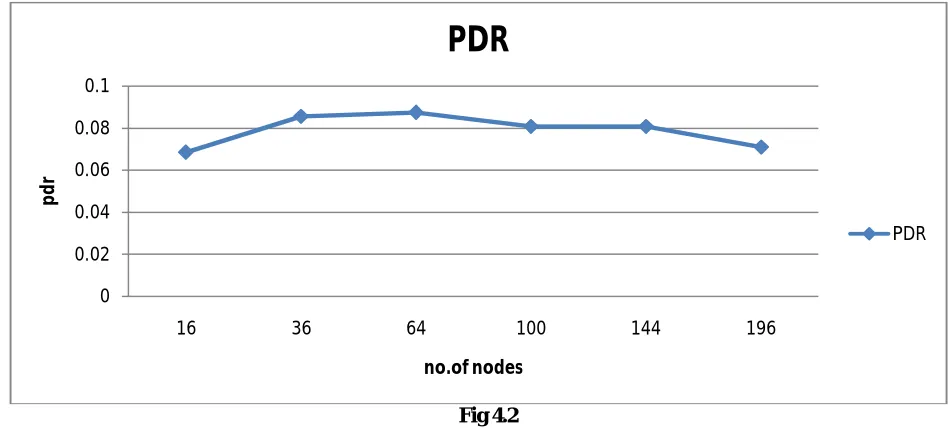
Fig 4.2
With the increase in no. of nodes PDR first increases then remains constant and then decreases. On the average the PDR remains constant over the period of time by increasing the no of nodes.
0 0.02 0.04 0.06 0.08 0.1
16 36 64 100 144 196
p
d
r
no.of nodes
PDR
ISSN(Online): 2319-8753 ISSN (Print) : 2347-6710
I
nternational
J
ournal of
I
nnovative
R
esearch in
S
cience,
E
ngineering and
T
echnology
(An ISO 3297: 2007 Certified Organization)
Vol. 5, Issue 3, March 2016
Fig 4.3
As we increase the number of nodes in the network then delay remain on average same with little it fluctuations which are ignorable
Scenario 2: Here the size of packet is varied
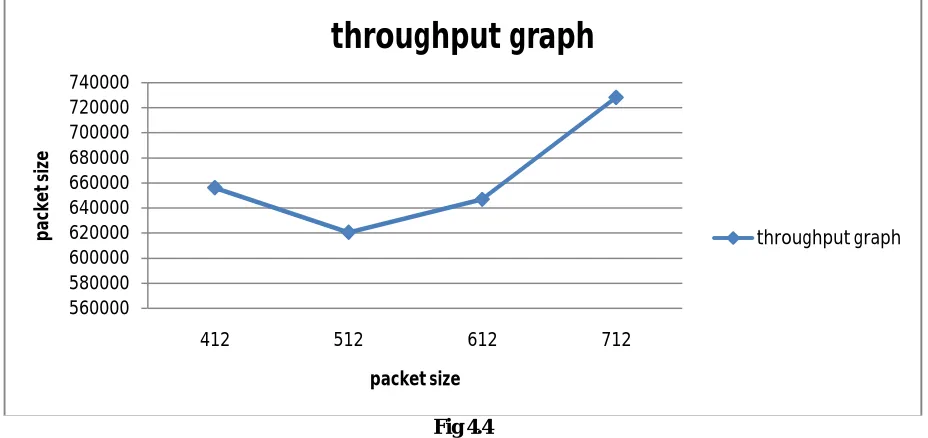
Fig 4.4
As the packet size increases throughput first decreases and then increases. Overall throughput of the protocol is good as we have seen in the graph where by increasing the packet size the throughput get increases.
0 20 40 60 80 100 120
16 36 64 100 144 196
d
el
ay
no. of nodes
delay graph
delay graph
560000 580000 600000 620000 640000 660000 680000 700000 720000 740000
412 512 612 712
p
ac
ke
t
si
ze
packet size
throughput graph
ISSN(Online): 2319-8753 ISSN (Print) : 2347-6710
I
nternational
J
ournal of
I
nnovative
R
esearch in
S
cience,
E
ngineering and
T
echnology
(An ISO 3297: 2007 Certified Organization)
Vol. 5, Issue 3, March 2016
Fig 4.5
As the packet size increases pdr decreases and then with the increase in packet size it also increases. Also seen in the packet loss graph where we can finish that by increase in packet loss then visibly the packet delivery ratio will get affected. So we will try to make improved in the proposed work by using enhanced version of existing protocol
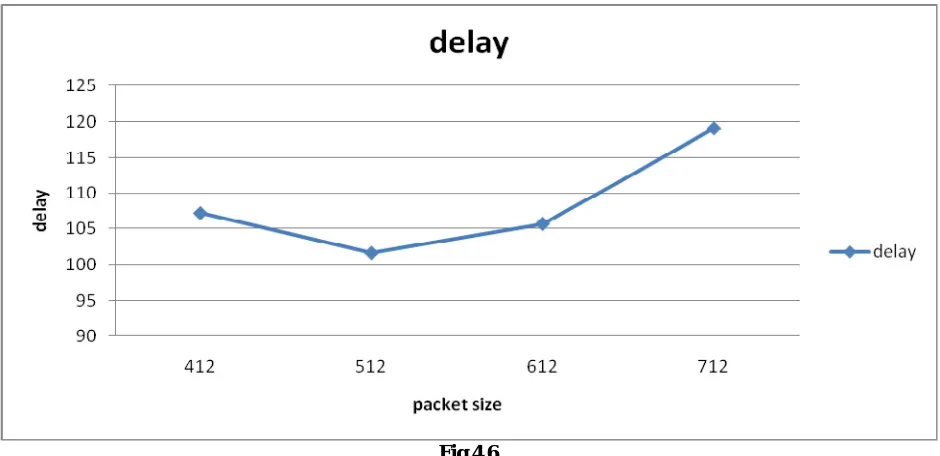
Fig 4.6
As the packet size increments firstly the deferral reductions and after that increments. It is comprehended by expanding the packet measure the handling time get expansion and subsequently the deferral will get influenced and in this way the general delay will likewise get influenced.
0 0.02 0.04 0.06 0.08 0.1 0.12 0.14 0.16 0.18 0.2
412 512 612 712
p
d
r
no. of packets
PDR
ISSN(Online): 2319-8753 ISSN (Print) : 2347-6710
I
nternational
J
ournal of
I
nnovative
R
esearch in
S
cience,
E
ngineering and
T
echnology
(An ISO 3297: 2007 Certified Organization)
Vol. 5, Issue 3, March 2016
V. CONCLUSION
This research work needs to done by executing a wireless sensor network with correspondence convention utilizing TEEN (Threshold sensitive Energy Efficient sensor Network protocol). Utilizing this protocols takes puts just when the threshold values which are isolated into two sections called hard threshold value and soft threshold value. Utilizing this stretagy the protocol get to be responsive and might turn out to be less proficient if any deficiency happen in the network on account of limit qualities don't coordinate certain criteria. So the investigation has been taken by calculating so as to actualize TEEN in the system different parameters, for example, correspondence delay for protocol, packet delivery ratio and overall throughput. In proposed work we will attempt to enhance the proficiency and different parameters by utilizing imporoved protocol over existing protocol
REFERENCES
[1] Rajashree.V.Biradar , V.C .Patil , Dr. S. R. Sawant , Dr. R. R. Mudholkar,” Classification and comparison of routing protocols in wireless sensor networks” UbiCC Journal – Volume 4
[2]A.Manjeshwar and D.P. Agarwal, "TEEN : A Protocol for Enhanced Efficiency in Wireless Sensor Networks", in the Proceedings of the I st International Workshop on Parallel and Distributed Computing Issues in Wireless Networks and Mobile Computing, San Francisco, CA, April 2001 [3] Shio kumar singh,M.P Singh and D.K Singh,”Routing Protocols in Wireless Sensor Networks- A Survey” International Journal of Computer Science & Engineering Survey (IJCSES) Vol.1, No.2, November 2010 pp: 63-83.
[4] Amit K. Kaushik,” Performance Evaluation of Proactive and Reactive Routing Protocols in Wireless Sensor Networks”International Journal of Computer Applications (0975 – 8887) Volume 110 – No. 16, January 2015 pp: 35-40
[5] Avani Patel ,Chandresh R. Parekh,” Dead Node Detection in Teen ProtocolL: SURVEY” IJRET: International Journal of Research in Engineering and Technology eISSN: 2319-1163 | pISSN: 2321-7308 pp:445-449
[6] Neha Singh and Vinita Mathur,” International Journal of Advanced Research in Computer Science and Software Engineering” Volume 2, Issue 5, May 2012 ISSN: 2277 128X pp:224-228
[7] Bhavna Sharma, Dr. Rajiv Mhajan,” Performance Evaluation of the DEEC, Teen & EDCS Protocols for Heterogeneous WSNS” International Journal of Advanced Research in Computer Science and Software Engineering Volume 4, Issue 10, October 2014 ISSN: 2277 128X pp:561-567 [8] Azzedine Boukerche and Anahit Martirosyan,” An Energy-Aware and Fault Tolerant Inter-Cluster Communication based Protocol for Wireless Sensor Networks” IEEE GLOBECOM 2007 proceedings
[9] Naveen Sharma and Anand Nayyar,” A Comprehensive Review of Cluster Based
Energy Efficient Routing Protocols for Wireless Sensor Networks”International Journal of Application or Innovation in Engineering & Management Volume 3, Issue 1, January 2014 ISSN 2319 – 4847