www.ijiset.com
Cloud Computing :An Introduction to SMAC
Merugu.GopichandP 1
P
1
P
, Professor & Head, Department of IT, Vardhaman College of Engineering, Shamshabad, Hyderabad, Telengana, India
Abstract
SMAC is an acronym for Social Mobile Analytics Cloud. SMAC being a combination of disruptive technologies can solve the problems in the future IT industry. Social networking media and mobile devices have become an integrated part in everyday life. SMAC can thus be considered as a future for IT industry. Social media helps the businesses to be in contact with various customers and with one another. From various sources information can be received with the help of mobile devices. The received/created data being increasing laid to the raise of Analytics. Cloud acts as a platform to provide/deploy the services globally and at low cost.
Keywords: Cloud Computing, Mobile Cloud Computing, Social, Mobile, Analytics, Cloud
1. Introduction
Ever since 15 years there has been many changes in the IT industry. Many IT industries like Coognizant and Capgemini have their own SMAC stack. The future of IT industry is based upon the various disruptive technologies like cloud, mobile devices/smart phones, bigdata/ data analytics, social networking media, etc… Hence these four technologies are being built upon a single stack known as SMAC stack. The future of Indian IT industry is dependent on this fifth generation SMAC stack.
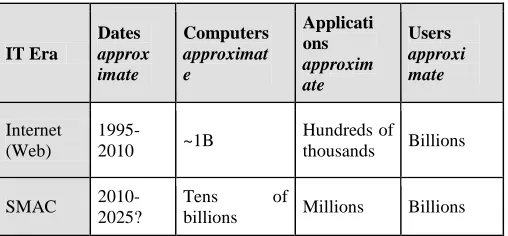
There are different eras in the IT industry which include the mainframe era, mini-computing era, PC era, the Internet/ Web era and now the fifth era SMAC era came into existence. The following is the table which shows the different IT era,
IT Era Dates approx imate Computers approximat e Applicati ons approxim ate Users approxi mate Mainfram e
1950-1965 ~100,000 Thousands Millions
Mini-Computin g
1965-1980 ~10M Thousands
Tens of millions PC & Client/Ser ver
1980-1995 ~100M
Tens of thousands Hundreds of millions IT Era Dates approx imate Computers approximat e Applicati ons approxim ate Users approxi mate Internet (Web)
1995-2010 ~1B
Hundreds of
thousands Billions
SMAC 2010-2025?
Tens of
billions Millions Billions
Table 1: Various IT era
By 2020, many computing devices will be connected across the web and 50 times the current data need to be managed by the corporate sectors. By using SMAC the productivity of the businesses in any organization can be increased.
2. Related work
1. DISTRIBUTED SYSTEM:
A distributed system is a collection of various computer machines with different configurations that includes mainframes, personal computers, laptops, workstations, minicomputers, and so on which aims at performing a single coherent task. The computers can be connected either physically using a LAN (local area network) or geographically by using a WAN (wide area network).
The benefits of distributed systems includes the following,
Incremental growth: Computing power can be added in small increments.
Reliability: Even if one system crashes the system as a whole can survive.
Scalability: Systems grow with time or become obsolete. Speed: Distributed system has more computed power when compared to centralized systems.
Openness: This is considered as one of the important characteristic and as it is an open system it can communicate other systems.
www.ijiset.com
2. COMPUTING:
The process of completion of the tasks by making use of computer technology is referred to as Computing. Computing may involve either hardware or software or both but must involve some form of computing system. It is used in our day-to-day lives whether we realize it or not. Some of the computing can be considered as swiping of a debit card, use of mobile phone, or sending an e-mail ,etc…
Various types of Computing: Types of Computing may include,
i. Utility Computing:
The package of computer resources which includes computation, storage, and services as a metered service is referred to as Utility Computing. The utility model seeks to maximize the efficient use of resources and/or minimize associated costs like the other types of on-demand computing.
Fig 1: Utility Computing
ii. Grid Computing:
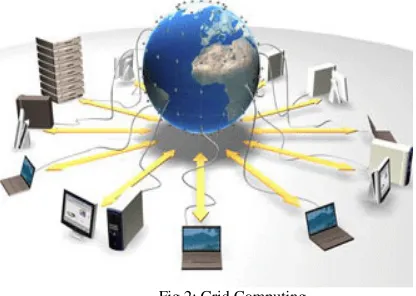
The grid computing can be considered as a distributed computing system where group of computers are connected to work as a single large computational power, storage, service database and application. Hence t is considered as aggregation, hosting and offering services to the man-kind across the world. It makes use of WAN connection.
Fig 2: Grid Computing
iii. Cluster Computing:
A cluster can be defined as a collection of various computers connected together and works as a single system. The components of a cluster are connected to each other by making use of fast LAN connection. This type of computing can be used to improve the performance and availability of a system when compared to a single system and is cost-effective.
Fig 3: Cluster Computing
iv. Parallel Computing:
The computing where multiple computing resources run on multiple processors to compute a problem where the problem can be broken into different parts which can be solved concurrently. Each part may be further broken into series of instructions and the instructions from each part can be executed simultaneously on different processors.
www.ijiset.com
Fig 4: Parallel Computing
3. Mobile Cloud Computing:
Mobile computing and cloud computing combine together can be termed as Mobile cloud Computing. First let’s see in brief about mobile computing, cloud computing and then mobile cloud computing.
i) Mobile Computing:
The computation performed on mobile devices is referred to as Mobile Computing[1]. This includes mobile communication, mobile hardware and software. Communcation includes operations and protocols between various adhoc mobile devices in a network, hardware includes mobile devices and software includes the characteristics and requirements of mobile applications.
Fig 5: Mobile Computing
Features of Mobile Computing:
The features of mobile computing[2] include,
a. Mobility: Movement of mobile devices among the mobile nodes with in a fixed or mobile network
b. Portability: It is easy to move mobile device from one learning environment to another environment.
c. Social Interactivity: It is nothing but allowing data transfer/share between different users .
d. Connectivity: Ability to be digitally connected for the purpose of communication of data in any environment.
ii) Cloud Computing:
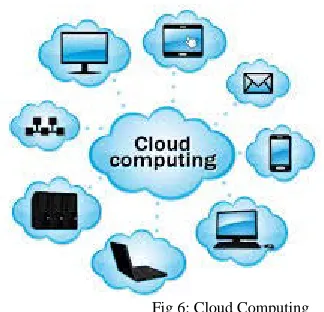
Basically cloud can be defined as a virtual space where users can deploy their applications. Cloud is a collection of interconnected servers and developers can run, deploy
their applications, store and retrieve data. The computing performed on cloud is referred to as Cloud Computing.
Cloud Computing is defined as a “metaphor” for the Internet. Cloud computing has become advantageous which allows users to use the infrastructure (such as servers, networks, and networks), platforms such as operating system, software which are application programs and application service providers.
Fig 6: Cloud Computing Characteristics of Cloud Computing:
the "five essential characteristics":
a) On-demand self-service. A consumer can unilaterally provision computing capabilities, such as server time and network storage, as needed automatically without requiring human interaction with each service provider.
b) Broad network access. The network capabilities are accessed through standard mechanisms that promote use by heterogeneous thin or thick client platforms.
c) Resource pooling. This allows to serve multiple consumers using a multi-tenant model where different physical and virtual resources dynamically assigned and reassigned according to consumer demand
d) Rapid elasticity. . To the consumer, the capabilities available for provisioning often appear unlimited and can be appropriated in any quantity at any time.
e) Measured service. We pay for what we use.
Types of Models:
Deployment Models
Private Cloud: It is a cloud infrastructure operated solely for a single organization, whether managed internally or by a third-party and hosted internally or externally
www.ijiset.com
Community Cloud0T: It 0Tshares infrastructure between several organizations from a specific community with common concerns (security, compliance, jurisdiction, etc.), whether managed internally or by a third-party and hosted internally or externally.
Hybrid cloud: It is a composition of two or more clouds (private, community or public) that remain unique entities but are bound together, offering the benefits of multiple deployment models
Service Models
The service models are as follows:
Iaas (Infrastructure-as-a-Service): In the most basic cloud-service model, providers of IaaS offer computers – physical or (more often) virtual machines – and other resources
Paas (Platform-as-a-Service): In the PaaS models, cloud providers deliver a0T computing platform0T, typically including operating system, programming language execution environment, database, and web server.
Saas (Software-as-a-Service): In the SaaS model, cloud providers install and operate application software in the cloud and cloud users access the software from cloud clients
iii) Mobile Cloud Computing (MCC):
The MCC forum defines MCC as follows [3]:
‘Mobile cloud computing at its simplest refers to’ an infrastructure where both the data storage and data processing happen outside of the mobile device. Mobile cloud applications move the computing power and data storage away from mobile phones and into the cloud, bringing applications and MC to not just smartphone users but a much broader range of mobile subscribers’.
Aepona [4] describes MCC as a new paradigm for mobile applications whereby the data processing and storage are moved from the mobile device to powerful and centralized computing platforms located in clouds. These centralized applications are then accessed over the wireless connection based on a thin native client or web browser on the mobile devices.
Alternatively, MCC can be defined as a combination of mobile web and CC [5, 6], which is the most popular tool for mobile users to access applications and services on the Internet. Briefly, MCC provides mobile users with the data processing and storage services in clouds.
The mobile devices do not need a powerful configuration (e.g., CPU speed and memory capacity) because all the
complicated computing modules can be processed in the cloud.
Architecture of Mobile Cloud Computing:
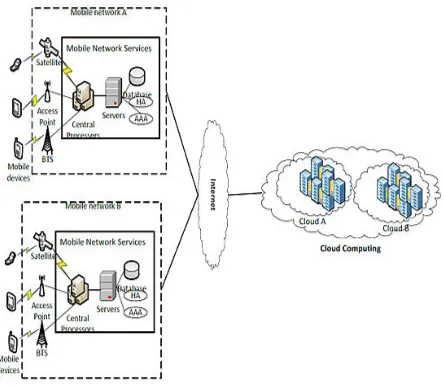
From the concept of MCC, the general architecture of MCC can be shown in Figure 7[7].
In Figure 3, mobile devices are connected to the mobile networks via base stations (e.g., base transceiver station, access point, or satellite) that establish and control the connections (air links) and functional interfaces between the networks and mobile devices. Mobile users’ requests and information (e.g., ID and location) are transmitted to the central processors thatare connected to servers providing mobile network services. Here, mobile network operators can provide services to mobile users as authentication, authorization, and accounting based on the home agent and subscribers’ data stored in databases. After that, the subscribers’ requests are delivered to a cloud through the Internet. In the cloud, cloud controllers process the requests to provide mobile users with the corresponding cloud services. These services are developed with the concepts of utility computing, virtualization, and service-oriented architecture (e.g., web, application, and database servers).
Fig 7: Architecture of MCC
Advantages of MCC:
The following are the advantages of mobile cloud computing,
• Extending battery lifetime
www.ijiset.com
• Improving reliability and availability
• Dynamic provisioning and Scalability
• Multi-tenancy
• Ease of Integration
4. Introduction to SMAC:
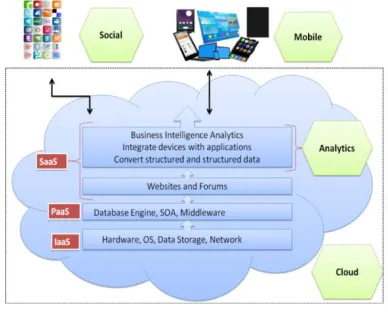
SMAC[8] is the new enterprise IT model delivering an organization that is more connective, collaborative, real-time and productive.
SMAC can be defined as a collection of various individual technologies and platforms which have shown growth in past few years. With the help of SMAC the Indian-IT companies can play a huge role in helping the organizations to transform their business models across the world. The following are the 4 technologies related to SMAC,
• Social
• Mobile
• Analytics
• Cloud
The following is the figure to demonstrate the SMAC stack[9]
Fig 8: Four Disruptive Technologies
There is no use of traditional business design as the new technologies came into existence.
With the help of SMAC it is easy to bring products and services into the market by maintaining relationship with customers and interaction with employees.
Social:
As per comScore an average Indian spent 25% of his/her online time on social networking sites such as Facebook, LinkedIn, Twitter and Google+. Hence the social media
works regardless of the industry whether is large/small business owner..
As per research firm Gartner, by 2015, India is pegged to have more Facebook users than any other country in the world. As the smartphones, tablet PC’s came into existence the social network can operate at 24*7 environment. As the lots of data is created at social networking sites through the exchanging of video’s, images, messages, and so on. All this data can be analyzed where the Analytics cane into existence.
Mobile:
Data access at anytime, anywhere has been playing an important role in today’s enterprises. Hence enterprise mobility came into existence to bridge the gap between ‘people’ and
‘process’ by providing access to critical data in real time. many enterprises will be interested in deploying mobility solutions to tap into the rapidly growing user base.
Analytics:
The analytics correspond to Big Data. The data generation is mainly because of mobile apps, click streams and social media. Every day, 2.5 billion GB of data is generated. The social media apps like Facebook generate 500 TB and Twitter generates 12 TB of data every day.
The 3 characteristics of Big Data are a) Volume (large quantity of data) b) Variety (diverse sets of data) c) Velocity (high speed of data)
Big Data analytics is the process of applying advanced analytics and visualization techniques to large datasets to uncover hidden patterns and unknown correlations for effective decision making. The IT services segment which primarily comprises of the Big Data technology implementation, including data collection, integration, and designing of Big Data architecture and data analytical tools, comprises of 83% while the Big Data analytics services accounts for 17%. In order to strengthen the Big Data portfolio’s the leading companies such as Oracle, IBM, SAP are acquiring small service providers.
Cloud:
Cloud Computing delivers the services where the customers and businesses makes use of hardware and software which were monitored by third parties at remote location over the internet. Cloud is a collection of different resources such as data storages, networks, central processing power, etc…The benefits of cloud computing include pay-per-use, on-demand access, flexibility, scalability, reliability, efficiency, low cost, etc…
www.ijiset.com
a) Cloud Service Subscriber: Access anduse IT services on a cloud hosted either partially on premise or remotely. Examples include NYSE, Disney
b) Cloud Service Broker: Aid customers to source, deploy and manage cloud solutions and relationships. Examples include apigee, accenture
c) Cloud Service Integrator: Enable Cloud solution integration with client‘s existing IT infrastructure, process & systems. Examples include Capgemini, IBM, Infosys
d) Cloud Service Enabler: Provide technologies, products and solutions which enable development of cloud solutions by provider. Examples include Microsoft, cisco, airtel
e) Cloud Service Provider: Provide private and/or public cloud solutions often with implementation & management expertise. Examples include Infosys, amazon, wipro
If we use SMAC technologies then the businesses can be beneficial, secure, and connected. Connected comes under the communication among various firms, customers. Security deals with the access rights, risk management, access management and threat management, etc… Hence the enterprises turn out to be the winners if they make use of the SMAC technologies .
34T
SMAC0T34T0Ttechnology is spreading faster than any other in the
recent past. Some experts in the field have predicted that by 20200T0T34TSMAC0T34T0Twill account for $5 trillion of the total
spending by customers.[10]
5. Conclusion:
In this paper we have seen definition for distributed system, computing and different types computing such as utility, grid, cluster and parallel computing. Mobile Cloud computing is nothing but the combination of mobile web (collection of mobile devices) and cloud computing (computing in cloud environment).
We also introduced the new concept called SMAC which is an acronym for Social Mobile Analytics Cloud. Social media and mobile are turned out to be important in our day-to-day life. SMAC has turned out to be the emerging technology to be used in the IT industry.34TSMAC0T34T0Ttechnology will help companies to move into high-margin businesses due to its global reach, low overheads and high availability.
References:
[1] Challenging Issues and Limitations of Mobile Computing: Deepak G et al,Int.J.Computer Techology & Applications,Vol 3 (1),177-181
[2].http://www.wiu.edu/MobileComputing/mc-blog/?page_id=10 [3]. http://www.mobilecloudcomputingforum.com/.
[4]. White Paper. Mobile Cloud Computing Solution Brief. AEPONA, 2010.
[5]. Christensen JH. Using RESTful web-services and cloud computing to create next generation mobile applications, In Proceedings of the 24th ACM SIGPLANconference companion on Object orientedprogramming systems languages and applications(OOPSLA), 2009; 627–634.
[6]. Liu L, Moulic R, Shea D. Cloud service portal for mobile device management, In Proceedings of IEEE7th International Conference on e-Business Engineering(ICEBE), 2011; 474. [7].A Survey of Mobile Cloud Computing: Architecture, Applications, and Approaches Hoang T. Dinh, Chonho Lee, DusitNiyato, and Ping Wang
[8]. http://www.cognizant.com/smac
[9].http://www.cogno-sys.com/cognosys-technologies- partners/social-mobile-analytics-cloud-smac-technology-business/
[10].http://blogs.computerworld.com/it-transformation/23244/smac-and-evolution-it