DOI: 10.1051/epjconf/201610604009
C
Owned by the authors, published by EDP Sciences, 2016
BUGJEFF311.BOLIB (JEFF-3.1.1) and BUGENDF70.BOLIB
(ENDF/B-VII.0) – Generation Methodology and Preliminary
Testing of two ENEA-Bologna Group Cross Section Libraries
for LWR Shielding and Pressure Vessel Dosimetry
Massimo Pescarini1, a
, Valentin Sinitsa2
, Roberto Orsi1
, and Manuela Frisoni1 1ENEA, CR “E. Clementel”, via Martiri di Monte Sole 4, 40129, Italy 2
NRC “Kurchatov Institute”, 1, Academica Kurchatova pl., 123182 Moscow, Russian Federation
Abstract. Two broad-group coupled neutron/photon working cross section libraries in FIDO-ANISN format, dedicated to LWR shielding and pressure vessel dosimetry applications, were generated following the methodology recommended by the US ANSI/ANS-6.1.2-1999 (R2009) standard. These libraries, named BUGJEFF311.BOLIB and BUGENDF70.BOLIB, are respectively based on JEFF-3.1.1 and ENDF/B-VII.0 nuclear data and adopt the same broad-group energy structure (47 n + 20 ) of the ORNL BUGLE-96 similar library. They were respectively obtained from the ENEA-Bologna VITJEFF311.BOLIB and VITENDF70.BOLIB libraries in AMPX format for nuclear fission applications through problem-dependent cross section collapsing with the ENEA-Bologna 2007 revision of the ORNL SCAMPI nuclear data processing system. Both previous libraries are based on the Bondarenko self-shielding factor method and have the same AMPX format and fine-group energy structure (199 n+ 42 ) as the ORNL VITAMIN-B6 similar library from which BUGLE-96 was obtained at ORNL. A synthesis of a preliminary validation of the cited BUGLE-type libraries, performed through 3D fixed source transport calculations with the ORNL TORT-3.2 SN code, is included. The
calculations were dedicated to the PCA-Replica 12/13 and VENUS-3 engineering neutron shielding benchmark experiments, specifically conceived to test the accuracy of nuclear data and transport codes in LWR shielding and radiation damage analyses.
1. Introduction
The ENEA-Bologna Nuclear Data Group generated the NEA-1866/BUGJEFF311.BOLIB [1] and the NEA-1870/BUGENDF70.BOLIB [2] multi-group coupled neutron/photon working cross section libraries in FIDO-ANISN format, respectively based on the OECD-NEADB JEFF-3.1.1 [3,4] and the US ENDF/B-VII.0 [5] evaluated nuclear data libraries. These twin libraries dedicated to LWR radiation shielding and pressure vessel dosimetry applications are presently freely distributed by OECD-NEADB and ORNL-RSICC and have the same energy group structure (47 n +20) and general features as the ORNL DLC-0185/BUGLE-96 [6] (ENDF/B-VI.3) reference library, generated with a similar data
aCorresponding author:[email protected]
processing methodology and internationally used with success for a long time. Concerning the free availability of updated BUGLE-type libraries, it is noted that at present BUGJEFF311.BOLIB is the first and only one released library of this type based on JEFF data. Moreover BUGENDF70.BOLIB is not a duplication of the ORNL DLC-0245/BUGLE-B7 [7] library based on ENDF/B-VII.0 data since the latter was processed in a different way, i.e., it was exclusively generated through the ORNL AMPX-6.1 nuclear data processing system not freely released.
BUGJEFF311.BOLIB and BUGENDF70.BOLIB were preliminarily tested, through three-dimensional (3D) fixed source transport calculations performed with the ORNL TORT-3.2 [8,9] discrete ordinates (SN) code, on the PCA-Replica 12/13 (H2O/Fe) [10] and VENUS-3 [11] low-flux engineering neutron shielding benchmark experiments included in the SINBAD [12] database of reactor shielding experiments and specifically conceived to test the accuracy of nuclear data and transport codes used in LWR shielding and radiation damage analyses.
This contribution is mainly dedicated to promote the use of 3D deterministic transport codes in the cited LWR applications, permitting in parallel a consistent comparison between results obtained with different nuclear data. In fact in this kind of calculations these codes are highly competitive with the stochastic codes (e.g. the Monte Carlo codes) also when complex geometries are involved, if they are supported by dedicated pre/post-processor systems based on combinatorial geometry, as the freely released ENEA-Bologna BOT3P-5.3 [13,14] system, able to provide the spatial mesh automatic generation and the geometrical model and result visualization.
2. Library General Features and Data Processing Methodology
BWR Core Spectrum PWR Core Spectrum Concrete Spectrum 1/4T PV Spectrum Downcomer Spectrum 47/20 AMPX Master Lib. BWR Core Nuclides 47/20 AMPX Master Lib. PWR Core Nuclides 47/20 AMPX Master Lib. PWR Downcomer Nuclides 47/20 AMPX Master Lib. Pressure Vessel Nuclides 47/20 AMPX Master Lib. C & S Steel Nuclides
47/20 AMPX Master Lib.
Concrete Nuclides
NITAWL NITAWL NITAWL NITAWL NITAWL NITAWL
ALPO + Binary ANISN to BCD Converter 47/20 AMPX Working Lib. BWR Core Nuclides 47/20 AMPX Working Lib. PWR Core Nuclides 47/20 AMPX Working Lib. PWR Downcomer Nuclides 47/20 AMPX Working Lib. Pressure Vessel Nuclides 47/20 AMPX Working Lib. C & S Steel
Nuclides 47/20 AMPX Working Lib. Concrete Nuclides 47/20 BUGJEFF311. BOLIB FIDO-ANISN BCD File BWR Core Nuclides 47/20 BUGJEFF311. BOLIB FIDO-ANISN BCD File PWR Core Nuclides 47/20 BUGJEFF311. BOLIB FIDO-ANISN BCD File PWR Downcomer Nuclides 47/20 BUGJEFF311. BOLIB FIDO-ANISN BCD File Pressure Vessel Nuclides 47/20 BUGJEFF311. BOLIB FIDO-ANISN BCD File
C & S Steel Nuclides 47/20 BUGJEFF311. BOLIB FIDO-ANISN BCD File Concrete Nuclides 199/42 AMPX Master Lib. BWR Core Nuclides 199/42 AMPX Master Lib. PWR Core Nuclides 199/42 AMPX Master Lib. PWR Downcomer Nuclides 199/42 AMPX Master Lib. Pressure Vessel Nuclides 199/42 AMPX Master Lib. C & S Steel Nuclides 199/42 AMPX Master Lib. Concrete Nuclides 199/42 Self-Shielded
AMPX Master Library Derived from VITJEFF311.BOLIB
AJAX AJAX AJAX AJAX AJAX
MALOCS MALOCS MALOCS MALOCS MALOCS MALOCS AJAX
ALPO + Binary ANISN to BCD Converter
ALPO + Binary ANISN to BCD Converter
ALPO + Binary ANISN to BCD Converter
ALPO + Binary ANISN to BCD Converter
ALPO + Binary ANISN to BCD Converter
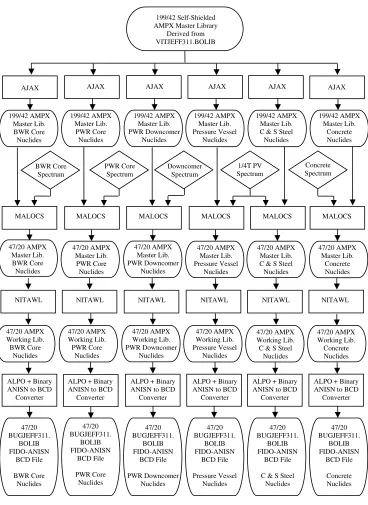
Figure 1.Procedure for generating the BUGJEFF311.BOLIB library self-shielded and collapsed cross sections using BWR- and PWR-specific flux spectra.
fine-group cross sections of the corresponding VITAMIN-type mother library through group collapsing with the MALOCS module of SCAMPI, using a fine-group n/ PWR spectrum pre-calculated in a concrete biological shield. The other six blocks contain (see [1,2]) broad-group self-shielded cross sections which were generated from the fine-group cross sections of the corresponding VITAMIN-type mother library, self-shielded with the BONAMI module of SCAMPI at the operative temperatures and material composition background cross sections, typical of PWR and BWR material mixtures. These fine-group cross sections were then collapsed with MALOCS (see Fig.1) using fine-group n/spectra, pre-calculated in specific representative spatial locations of five typical LWR regions: PWR core, PWR downcomer, PWR pressure vessel, reactor biological shield and BWR core. The cited specific pre-calculated fine-group n/spectra required for the cross section collapsing from each VITAMIN-type mother library were obtained from two transport calculations with the XSDRNPM one-dimensional (1D) discrete ordinates module of SCAMPI, simulating the simplified in-vessel and ex-vessel 1D radial geometries, typical of a PWR and of a BWR. The neutron spectrum calculations were performed using self-shielded neutron cross sections in the fine-group energy structure, separately derived from VITJEFF311.BOLIB and VITENDF70.BOLIB.
NJOY-99.259, differently from BUGLE-B7 and its fine-group mother library VITAMIN-B7 which were both generated through AMPX-6.1.
3. Preliminary Library Validation
As previously reported, BUGJEFF311.BOLIB, BUGENDF70.BOLIB and BUGLE-96 were preliminarily tested using the TORT-3.2 deterministic transport code on the PCA-Replica 12/13 (H2O/Fe) and VENUS-3 neutron shielding benchmark experiments.
The PCA-Replica experimental array simulates the ex-core radial geometry of a PWR with alternate regions of water and steel, including a mild steel PWR pressure vessel simulator, irradiated by a thin highly enriched (93.0 w% in U-235) uranium fission plate alloyed with aluminium. Transport calculations in Cartesian (X,Y,Z) geometry and in P3-S8approximation (being P3 the order of the expansion in Legendre polynomials of the scattering cross section matrix and S8the order of the flux angular discretization) were performed using flat weighting dosimeter cross sections for the Rh-103(n,n)Rh-103 m, In-115(n,n)In-115 m and S-32(n,p)P-32 threshold activation dosimeters used in PCA-Replica. The calculated reaction rates for all the cited dosimeters are within the desired target accuracy of±10–15% with respect to the experimental data (see [25] for more details).
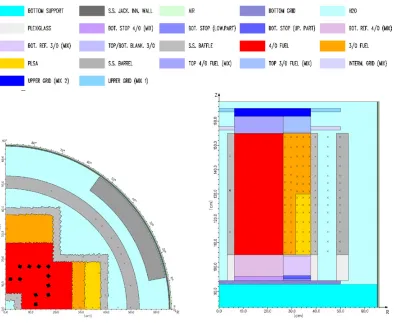
With respect to VENUS-3, a reactor with a cruciform core with typical PWR fuel assemblies and neutron spectrum, 3D transport calculations were performed in cylindrical (R,,Z) geometry, as commonly carried out in LWR pressure vessel dosimetry calculations. Fixed source calculations with one source (outer) iteration were performed in P3-S8approximation. Fully symmetrical quadrature sets were introduced. The theta-weighted difference approximation was selected for the flux extrapolation model. In all the calculations the same numerical value (1.0E-04) for the point-wise flux convergence criterion was employed. The BOT3P-5.3 pre/post-processor system provided the automatic generation of the spatial meshes of the geometrical model together with the relative graphical visualizations. In particular it was described (see Fig. 2) a horizontal plane section of VENUS-3 between 0◦ and 90◦ (i.e. the first quadrant up to a radius of 66.0 cm) containing the barrel, the neutron pad and the jacket inner wall with a 111×113×71 (R,,Z) fine spatial mesh grid. The jacket outer wall and the external regions beyond the jacket outer wall were not included since it was considered that they could only slightly affect the results. The following boundary conditions were selected: reflection at the left, inside and outside boundaries and vacuum at the right, bottom and top boundaries. The neutron source and the calculated equivalent fission fluxes, needed for the Calculated/Experimental (C/E) result comparison, were separately calculated with the consistent nuclear data library set of U-235 fission spectrum () data (i.e. with BUGJEFF311.BOLIBtotal, BUGENDF70.BOLIBtotal and BUGLE-96prompt data). In particular, to obtain the equivalent fission fluxes, the calculated dosimeter reaction rates (activities) were divided by the corresponding value of the flat weighting dosimeter cross section, averaged on the specific U-235 fission spectrum. The following flat weighting corresponding values (see Table1) were used in all the calculations in order to treat simultaneously both water and steel dosimeter locations.
Figure 2. VENUS-3 – Geometrical and compositional model horizontal section at Z=114.50 cm, dosimeter locations “×”, TORT-3.2 (R,,Z) with 111R×113× 71Z spatial meshes.
Figure 3.VENUS-3 – Geometrical and compositional model vertical section at= 0◦, dosimeter locations “×”, TORT-3.2 (R,,Z) with 111R×113×71Z spatial meshes.
Table 1. VENUS-3 – IRDF-2002 dosimeter cross sections averaged on the U-235 neutron fission spectra taken from the BUGJEFF311.BOLIB, BUGENDF70.BOLIB and BUGLE-96 libraries.
Library In115(n,n) [barns] Ni-58(n,p) [barns] Al-27(n,) [barns]
BUGJEFF311.BOLIB 1.8742E-01 1.0835E-01 7.8148E-04
BUGENDF70.BOLIB 1.8746E-01 1.0836E-01 7.8151E-04
BUGLE-96 1.8853E-01 1.0906E-01 7.8671E-04
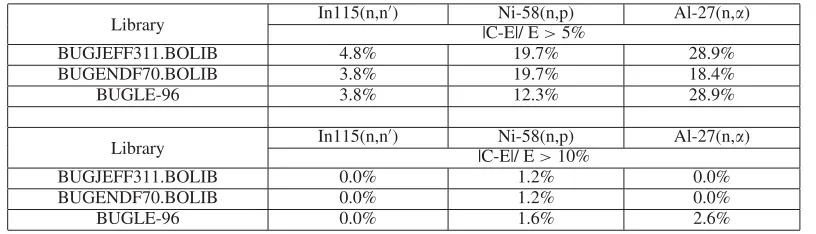
Table 2. VENUS-3 – Percentagesaof the calculated (C) equivalent fission fluxes with deviations exceeding 5%
and 10% the corresponding experimental (E) ones.
Library In115(n,n
) Ni-58(n,p) Al-27(n,)
|C-E|/ E>5%
BUGJEFF311.BOLIB 4.8% 19.7% 28.9%
BUGENDF70.BOLIB 3.8% 19.7% 18.4%
BUGLE-96 3.8% 12.3% 28.9%
Library In115(n,n
) Ni-58(n,p) Al-27(n,)
|C-E|/ E>10%
BUGJEFF311.BOLIB 0.0% 1.2% 0.0%
BUGENDF70.BOLIB 0.0% 1.2% 0.0%
BUGLE-96 0.0% 1.6% 2.6%
(a) % calculated on the total number of each dosimeter type: 104 for In, 244 for Ni and 38 for Al.
equivalent fission fluxes corresponding to each of the three dosimeters is±5%. Deviations contained within±5% from the 386 dosimeter experimental data were obtained in about 83% of the calculated results with BUGJEFF311.BOLIB, 85% of the results with BUGENDF70.BOLIB and 88% of the results with BUGLE-96. The calculated equivalent fission flux results obtained with the three libraries for the 386 In-115(n,n)In-115 m, Ni-58(n,p)Co-58 and Al-27(n,)Na-24 threshold activation dosimeters are within the desired target accuracy of±10–15% with respect to the experimental data (see Table2).
The list of the main regions of the VENUS-3 calculation model are reported herewith.
• the CENTRAL HOLE (water);
• the INNER BAFFLE (stainless steel thickness: 2.858 cm);
• the 4/0 FUEL REGION: 4% enriched uranium fuel rods and 11 pyrex control rods, typical of PWR poison clusters;
• the 3/0 FUEL REGION: 3.3% enriched uranium fuel rods and PLSA rods;
• the OUTER BAFFLE (stainless steel thickness. 2.858 cm);
• the REFLECTOR (water minimum thickness: 2.169 cm);
• the BARREL (stainless steel thickness: 4.99 cm);
• the WATER GAP (water thickness: 5.80 cm);
• the NEUTRON PAD (stainless steel average thickness: 6.72 cm);
• the VENUS environment, i.e., the jacket (air filled), the reactor vessel (stainless steel) and the reactor room (air).
4. Conclusion
working library based on JEFF data and permits a consistent comparison of dose results with those obtained using the BUGENDF70.BOLIB (ENDF/B-VII.0) twin library. BUGENDF70.BOLIB is not a duplication of BUGLE-B7 (ENDF/B-VII.0) since it was derived, as BUGJEFF311.BOLIB, from a mother library generated using NJOY-99.259 and from the ENEA-Bologna 2007 revision of SCAMPI whereas AMPX-6.1 (not freely released) was exclusively employed in the production of BUGLE-B7 (ENDF/B-VII.0). Anyway it seems fully confirmed the convenient applicability of modern broad-group working libraries and three-dimensional deterministic transport codes like TORT, assisted by the ENEA-Bologna BOT3P system, to complex geometry problems. Cross section covariance data can always be added in future to the ENEA BUGLE-type libraries to perform uncertainty and sensitivity analyses, as increasingly recommended also within the activities of the industrial organizations and by OECD-NEA expert groups.
References
[1] M. Pescarini, V. Sinitsa , R. Orsi, M. Frisoni, ENEA Int. Report UTFISSM-P9H6-2 Rev.1 (2013) [2] M. Pescarini, V. Sinitsa , R. Orsi, M. Frisoni, ENEA Int. Report UTFISSM-P9H6-8 (2013) [3] The JEFF-3.1.1 Nuclear Data Library, JEFF Report 22, OECD-NEA Data Bank (2009) [4] The JEFF-3.1 Nuclear Data Library, JEFF Report 21, OECD-NEA Data Bank (2006) [5] M.B. Chadwick et al., Nuc. Data Sheets,107, 12, pp. 2931–3060 (December 2006) [6] J.E. White et al., ORNL-6795/R1, NUREG/CR-6214, Revision 1 (January 1995) [7] J.M. Risner et al., ORNL/TM-2011/12, NUREG/CR-7045 (September 2011) [8] W.A. Rhoades, D.B. Simpson, TORT Version 3, ORNL/TM-13221 (October 1997) [9] DOORS3.1, ORNL, RSIC CCC-650 (August 1996)
[10] J. Butler et al., UKAEA, AEE Winfrith Report AEEW-R 1736 (January 1984) [11] L. Leenders, SCK/CEN Report FCP/VEN/01 (September 1988)
[12] SINBAD, OECD-NEADB/ORNL-RSICC, SINBAD REACTOR, NEA-1517 (2009 Edition) [13] R. Orsi, ENEA Int. Report FPN-P9H6-011 (2008)
[14] R. Orsi, Nuc. Sci. and Eng., Technical Note,142, pp. 248–255 (2004) [15] Am. Nat. Standard, ANSI/ANS-6.1.2-1999 (R2009) (2009)
[16] R.E. MacFarlane, D.W. Muir, The NJOY Nuclear Data Processing System, Version 91, LA-12740-M (April 1994)
[17] M. Pescarini, V. Sinitsa, R. Orsi, ENEA Int. Report UTFISSM-P9H6-003 Rev.1 (2011) [18] M. Pescarini, V. Sinitsa, R. Orsi, M. Frisoni, ENEA Int. Report UTFISSM-P9H6-005 (2012) [19] R.E. MacFarlane, NJOY-99, “README0”, ORNL, RSIC PSR-0480/02 (December 1999) [20] I.I. Bondarenko et al.,Group constants for nuclear reactors calculations(Cons. Bureau, 1964) [21] SCAMPI, ORNL, RSIC PSR-352 (September 1995)
[22] V. Sinitsa, M. Pescarini, ENEA Int. Report FPN-P9H6-006 (2007)
[23] O. Bersillon et al., IRDF-2002, IAEA, Tech. Reports Series No. 452 (2006) [24] D.E. Cullen, PREPRO 2007, IAEA Report IAEA-NDS-39 Rev.13 (March 2007)
[25] M. Pescarini, R.Orsi, M. Frisoni, Three Dimensional (X,Y,Z) Deterministic Analysis of the PCA-Replica (H2O/Fe) Neutron Shielding Benchmark Experiment Using the TORT-3.2 Code and Group Cross Section Libraries for LWR Shielding and Pressure Vessel Dosimetry, Proceedings of ISRD-15, Aix-en-Provence, F, May 18–23, 2014 (to be published)