Theses and Dissertations
8-9-2014
Social Movements, Media, and Democratization in
Georgia
Maia Mikashavidze
University of South Carolina - Columbia
Follow this and additional works at:https://scholarcommons.sc.edu/etd Part of theCommunication Commons
This Open Access Dissertation is brought to you by Scholar Commons. It has been accepted for inclusion in Theses and Dissertations by an authorized administrator of Scholar Commons. For more information, please [email protected].
Recommended Citation
Mikashavidze, M.(2014).Social Movements, Media, and Democratization in Georgia.(Doctoral dissertation). Retrieved from
by
Maia Mikashavidze
Specialist Diploma
Tbilisi State Conservatory of Music, 1989
Master of Arts
Georgian Institute of Public Affairs, 2007
__________________________________________________________________
Submitted in Partial Fulfillment of the Requirements
For the Degree of Doctor of Philosophy in
Mass Communications
College of Mass Communications and Information Studies
University of South Carolina
2014
Accepted by:
Kathy Roberts Forde, Major Professor
Sei-Hill Kim, Major Professor
Robert McKeever, Committee Member
Barry Markovsky, Committee Member
John Besley, Committee Member
ii Dedication
To my mom, Nunu Giorgadze, and my dad, Jemal Jejelava, who taught me to pursue my
iii
Acknowledgements
I would like to acknowledge the help and guidance I received from the prominent
scientists and members of my committee: Dr. Kathy Roberts Forde, Dr. Sei-Hill Kim, Dr.
Barry Markovsky, Dr. John Besley, and Dr. Robert McKeever. They taught me skills and
gave knowledge and advice that were essential to this dissertation. I want to stress moral
support and encouragement by co-chairs of the committee, Dr. Forde and Dr. Kim, who
helped me focus on the goal and stay on course.
I would also like to acknowledge the support from Dean Bierbauer, Dr. Carol
Pardun, and Dr. Keith Kenney, who did their best to make my studies efficient and
productive, and from other members of the School of Journalism and Mass
Communications at the University of South Carolina, especially Nancy Twohey and
Sandra Hughes. I am deeply grateful for the scholarship from the Government of the
United States, and personal involvement from U.S. Embassy Public Affairs Officer
Cynthia Whitesley, and public affairs staff Nana Kiknadze and Nino Gagua.
I am thankful to my great research team – Teona Kavtaradze, Ana Bochorishvili
and Nino Beridze – who helped obtain and analyze the data, and managers of the
Terramedia database, Teona Kevlishvili and Maka Mzareulishvili, who have also drawn
support. I received invaluable help from old and new friends, Dave Bloss, Margie
iv
others. I am also grateful to the Georgian activists and journalists who sat in interviews
for the study. I also want acknowledge here friendship and support from three Georgian
scholars at the University of South Carolina, Anna Keshelashvili, Nino danelia, and
Mariam Dekanozishvili.
Finally, I would like to thank my husband, Ivane Tskhomelidze, who
accompanied me to the United States and stood behind me during these intense three
years. His support and encouragement helped me stay strong and move forward. Our
close-knit family –Tsia Giorgadze, Guram Khomeriki, Nata Mukhatgverdeli, Alexander
Jejelava, Medea Tsintsadze, and David Tskhomelidze -- supported and helped in every
way possible. My four-year-old son, Aleksandre, is the most important person in my life,
v Abstract
A purpose of the study was to analyze the construction of reality around the
Georgian media democratization movement in 2010-12. The qualitative analysis of
movement statements (n=17) and in-depth interviews with movement activists (n=12)
found that the movement relied on mobilizing master frames linked to the concept of
democracy: free speech, access to information, fair elections, transparency, plurality, and
devised an innovative frame, it concerns you. The movement pursued two goals with its
framing efforts: improvements in the media environment and mobilization of citizen
participation.
The quantitative analysis of news stories about the movement (n=552) by six
pro-opposition, pro-government, and independent news organizations found that the news
organizations used movement-advanced frames, and, in general, used more mobilizing
than demobilizing frames. The marginalization of the movement, a dominant mode of
news coverage of social movements based on the literature, did not occur. However, the
study found differences in coverage based on news organizations’ ties with the
government and the opposition, or lack thereof. The pro-opposition and independent TV
stations covered the movement more frequently, aired reports at better viewing times,
gave greater voice to the activists and their key frame, it concerns you, and used more
pro-vi
opposition newspaper used a more positive tone and lengthier stories, and the
independent newspaper more frequent coverage, than the pro-government newspaper.
However, the pro-government newspaper featured the coverage more prominently and
used activists’ key frame more often. Both pro-government news organizations used
government sources more often, than other media, and focused on those movement issues
that were eventually endorsed by the government.
In-depth interviews with news journalists (n=5) in these news organizations found
that journalists in the pro-opposition and independent media supported movement issues,
engaged in supportive reporting, and approved of advocacy journalism when press
freedoms were in danger. Journalists in pro-government media supported most of the
movement’s demands, but were suspicious of political motives behind movement
activism (the movement mobilized ahead of the Parliamentary Elections 2012) and did
vii
Table of Contents
Dedication ... ii
Acknowledgements ... iii
Abstract ...v
List of Tables ... viii
Chapter 1: Introduction ...1
Chapter 2: Literature Review ...20
Chapter 3: Method ...54
Chapter 4: Movement Statements and Interviews with Activists: Qualitative Analysis ...67
Chapter 5: Movement Coverage in the Georgian Media: Quantitative Analysis ...122
Chapter 6: Conclusions ...156
References ...172
Appendix A: Codebook ...189
Appendix B: Coding Sheet ...197
Appendix C: Statements by MDM ...198
Appendix D: Frames in MDM statements ...200
viii List of Tables
Table 4.1. Research questions, themes and sub-themes in in-depth interviews ...79
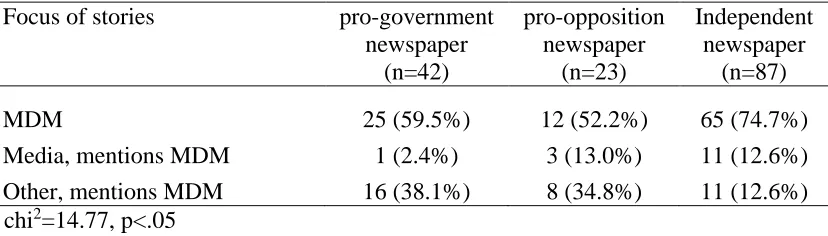
Table 5.1. Focus of coverage of MDM by newspapers ...124
Table 5.2. Focus of coverage of MDM by TV stations ...124
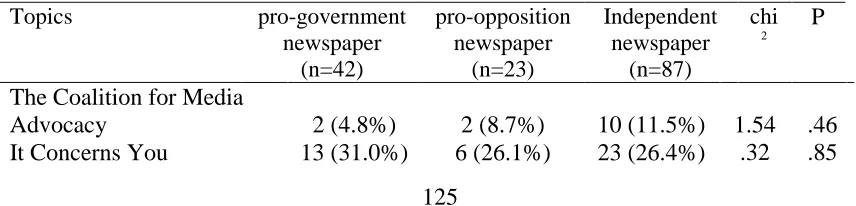
Table 5.3. MDM organization, campaign and issues by newspapers ...125
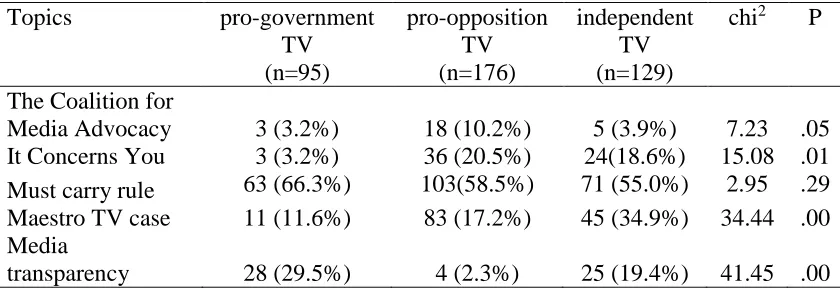
Table 5.4. MDM organization, campaign and issues by TV stations ...126
Table 5.5. Tone by newspapers...128
Table 5.6 Tone by TV stations ...128
Table 5.7. Presence of mobilizing and demobilizing frames in newspapers ...129
Table 5.8. Presence of mobilizing and demobilizing frames in TV stations ...129
Table 5.9. Mobilizing and demobilizing frames by newspapers ...130
Table 5.10. Mobilizing and demobilizing frames by TV stations ...130
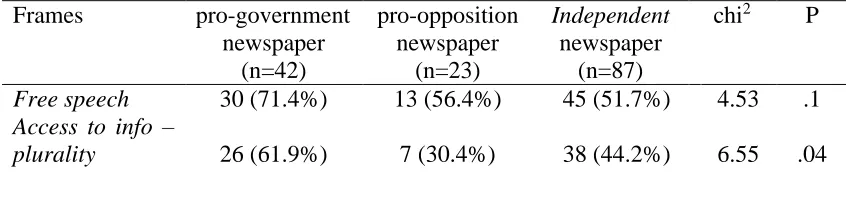
Table 5.11. Mobilizing master frames by newspapers ...132
Table 5.12. Mobilizing master frames by TV stations...133
Table 5.13. Demobilizing frames by newspapers ...134
Table 5.14. Demobilizing frames by TV stations ...135
Table 5.15. Sources by newspapers ...137
Table 5.16. Sources by TV stations ...138
ix
Table 5.18. Government officials and activists as sources by TV stations...140
Table 5.19. Frequency of coverage of MDM by newspapers and TV stations ...141
Table 5.20. Genre by newspapers ...143
Table 5.21. Genre by TV stations ...143
Table 5.22. Brief news and longer stories by newspapers ...144
Table 5.23. Brief news and longer stories by TV stations ...144
Table 5.24. Story placement by newspapers ...146
Table 5.25. Story placement by TV stations ...146
Table C1. Statements by MDM ...198
Table D1. Frames in MDM statements ...200
1 Chapter 1
Introduction
Social movements and activism are on the rise in Georgia. Grown out of protests
over violations of civic and human rights in past years, activist groups have moved from
disorganized expression of grievances to sustained and coordinated collective action.
While there are a few activist groups around the country, the groups pursuing a broad
agenda of democratic rights and values, with backing from major local human rights
organizations and democratically-minded citizens, are by far the best organized and
articulate. These groups are engaged in coordinated and sustained collective action and
are emerging as social movements. They cluster together, forming the force of
democratization in the country1. The proposed study intends to analyze one of these
movements, which we call the media democratization movement, and its activism to
democratize the media sector of Georgia carried out from 2010 through 20122.
1 The term is admittedly broad. Many groups see themselves as contributing to
democracy, but few interpret democracy holistically, as a system of rights and values.
2 MDM activists, interviewed by this study, referred to their struggle variously as “media
advocacy”, “media activism, and “a coalition.” The literature has referred to speech and
media rights movements as “free speech movements” (Postigo, 2012), but also as “media
2
The democratization of media became a pressing issue before the 2012
parliamentary elections in Georgia, in which the government’s control of the country’s
biggest TV stations created uneven and unfair competition among those running for
elected office (IREX, 2013). The media democratization movement’s activism to ensure
greater transparency of broadcast media ownership and equal access to diverse content
produced spectacular results. The government introduced legislative amendments in the
broadcast and election laws to require the disclosure of ownership structure in the
broadcast outlets, and mandatory distribution of all broadcast signals by cable operators
during the two months prior to Election Day. Georgian citizens gained immediate access
to both government and opposition campaigns and the plurality of factual information
and opinion. The Parliamentary Elections of 2012 were held in a free and fair
environment, and resulted in “the first peaceful, democratic transfer of power since the
country’s independence in 1991” (U.S. Department of State, 2012). The government
ceded power to a coalition of opposition parties.
While media democratization movement (MDM)3 employed a range of
institutional and extra-institutional tactics, it has greatly benefited from securing
extensive and mostly positive media coverage. The activists produced effective frames
that resonated with the public and, arguably, members of the media. The movement
presented proposed media reforms as serving citizens’ democratic right to free speech,
access to plural sources of information and transparency, a strategy that has proven
successful in other countries (Mauersberger, 2012). The frames fit well with Georgian
journalists’ professional values of free speech, access to information, and transparency.
3
The media democratization movement partnered with the media by forming a coalition
with journalists’ associations and watchdog groups.
The purpose of this study is three-fold: 1) to identify the dominant tone and
frames of coverage of the Georgian media democratization movement across the
dominant news organizations in the country, 2) to analyze whether and perhaps how
political factors and frames constructed by the media democratization movement
influenced the news coverage, and 3) to interpret meanings attached to the media
democratization movement by movement actors and the news media. At a more abstract
level, the study intends to enhance our theoretical knowledge about how media covers
social movements, and how social movements can influence news coverage. Current
theory holds that movements opposed to the status quo have little leverage over news
coverage, and that they generally receive negative and marginalizing media coverage
because the media tend to protect the status quo (Herman & Chomsky, 1988; Gitlin,
1980). This study will explore if some media outlets in transitional political and media
systems, such as Georgia, are likely to report on social movements in a fair and
substantive manner. The core argument is that dynamic changes in emergent
democracies, such as Georgia, lead to great disparities among political elites and the
media, and the emergence of a new type of independent media, open to change. These
media are new forces in civil society, and were outside the circle of social and political
power during the previous, totalitarian regimes. In general, these media develop and gain
strength as a result of the process of transition (Spark, 2008). These media occupy
disadvantageous positions in relation to other media and thus experience undue
4
Transparency International – Georgia, 2011). These media are expected to question the
status quo rather than support it, and sympathize with social movements advocating
change. Social movements in these environments have the independent media, but also
pro-opposition media, as their allies against the government and the system. Since
media’s support for the status quo is the key premise of negative coverage of social
movements (Herman & Chomsky, 1988; Gitlin, 1980), media sectors that oppose the
status quo are not expected to be negatively biased towards social movements. Social
movements that manage to exploit tensions in the “media-state dynamics”
(Mauersberger, 2012, p. 588) and differences in the media (Weaver & Scacco, 2013)
have a chance to gain good access to audiences and fair coverage.
In more established and stable political and media systems, productive interaction
between social movements and media and fair coverage of social movements are rare.
Media propaganda (Herman and Chomsky, 1988), media hegemony (Gitlin, 1980), and
media and conflict theories (Olien et al, 1995), developed in the 1970s and onwards,
explain media’s negative framing of social movements by media’s entrenched ties with
the elites and their interest in maintaining the status quo. In the media and community
conflict perspective (Olien et al, 1989, 1995), media act as “guard dogs” for the elites,
helping them fend off challenges emanating from social movements. The media
propaganda model (Herman and Chomsky, 1988) considers the media to be an integral
part of the elite hegemony, opposed to any change in the existing social structure and
order advocated by social movements. Gitlin (1977, 1980) explained that structural
5
journalists’ professional codes (fetishism of facts, objectivity, newsworthiness) and
invariably lead to negative and marginalizing framing of social movements.
The protest paradigm, advanced by Chan and Lee (1984), builds on Gitlin’s ideas.
It posits that journalists’ coverage of protests is determined by their ideologically-based
“reporting paradigms,” which inform “where to look (and where not to look), and …
what to discover” (p. 187), and whether to support or denounce protests. These reporting
paradigms tend to emphasize social controversy or violence surrounding protest
activities, rather than the issues being protested. Yet, contrary to strong hegemony
models, the protest paradigm seems to suggest that an ideologically-inspired “reporting
paradigm” might offer positive news coverage of protest that is ideologically aligned with
the movement at hand. More recently, scholars found greater diversity in the coverage of
protests. As Weaver and Scacco (2013) argue, the recent trend of media diversification,
fueled, in part, by the diffusion of the Internet and media’s greater ideological posturing,
leads to greater opportunities for social movements to secure neutral and even positive
media coverage. This idea is echoed in Harlow and Johnston (2011), who found that the
coverage of Egyptian protests in social media and blogosphere broke away from
formulaic, marginalizing coverage. This holds true in other non-Western contexts
(Mauersberger, 2012; McCarthy et al, 2008; Yuan, 2013). In these contexts, those outlets
in the media landscape oriented towards social change are more sympathetic towards
movement causes.
By quantitatively analyzing Georgian newspaper and TV news content, the study
will look for instances of negative and demobilizing news coverage of the media
6
science and political communication literature, across the dominant news media in the
country’s news ecosystem. It also intends to examine the extent to which the media have
employed “mobilizing” frames. The study hypothesizes that negative coverage of the
media democratization movement will appear in pro-government news media. However,
it hypothesizes that opposition-aligned news media will provide positive coverage of the
movement. The study will explore the nature of coverage of social movements in the
independent news media. The divergent news camps are expected to grant different levels
of prominence to the movement in terms of the length and substance of the coverage and
to use different sources and frames. The study expects to find frames pushed by
movement actors in the news coverage of independent and opposition-aligned news
media.
The qualitative part of the study will further clarify the construction of meanings
around the media democratization movement. What were its goals and mobilizing frames
it has used? What was the rationale behind framing choices? The study will answer these
questions by interviewing activists and activist journalists4 in the media democratization
4 The term “activist journalist” refers to professional journalists, working in the media,
who joined the media democratization movement and openly engaged in activism as
volunteers. “Activist journalist” is different from “news producers” and “news reporters,”
the terms reserved for professionals working in the media but not engaged with the
movement. The study has interviewed both “activist journalists” and “news producers”
7
movement. Interviews with news producers and reporters will answer the question about
their possible support of the movement through advocacy reporting.
This study relies on the framing theory and social constructivist framework to
explain how social actors, such as social movements and media, engage in meaning
construction, that is, framing, to advance their interpretation of issues in the discourse
(Entman, 1993; Gamson & Modigliani, 1989). The critical perspective informs the
study’s conceptualization of social movements, political elites, and media as potential
parties in social conflict, engaged in mobilizing and demobilizing framing (Herman &
Chomsky, 1988; Gitlin, 1980; Olien et al, 1995).
The study hopes to make important contributions to the scholarly literature on the
news media’s interaction with social movements in non-Western contexts. In these
contexts, Western structural and ideological models may not apply, as ownership patterns
are different, political ideologies are not fully formed, social movements and independent
media maintain close ties, and some types of news media are more susceptible to
government control efforts than others. Independent media have emerged as strong
mobilizing forces in the color revolutions in Georgia and other formerly Soviet republics
(Manning, 2007). Their role in less radical collective action, such as lobbying for
democratic improvements in the media and electoral process, warrants attention. Greater
understanding of the successful media democratization movement in Georgia will help
media scholars understand more fully the news media’s interaction with social
movements in transitional democracies and, in general, the role of social movements and
8
The first chapter of this dissertation provides background on the media
democratization movement. The chapter will also outline the media and political
environment in the country. The second chapter deals with the concept of framing, its
psychological and sociological roots and its current uses in mass media and political
communication studies. Further, the second chapter summarizes the current thinking
about the framing of social movements in media, including critical perspectives on
media’s role in the functioning of social movements, and the framing strategies applied
by social movements to reach their audiences, including the media. The third chapter
outlines the hypotheses and research questions advanced by the study and the methods it
used. The fourth chapter presents findings and discusses the qualitative analysis of
movement statements and in-depth interviews. The fifth chapter presents quantitative
findings and discussion of the media coverage of MDM. The sixth chapter synthesizes
findings in chapters four and five, and presents conclusions.
Before proceeding to the discussion of the substance and scholarly knowledge in
the area of proposed analysis, the author wishes to acknowledge her personal
involvement in the media democratization movement in Georgia, understanding this may
have influenced the selection and treatment of the subject of this study.
Media Democratization Movement
In modern politics, social movements are increasingly seen as engines of social
innovation and change, counteracting forces of social control as embodied by the state
(Goodwin, 2013). Emergent movements in Georgia, united around the democratization
agenda, have scored some spectacular victories in their struggle to secure rights to free
9
freedoms make the country one of the most progressive transitional democracies of the
former Soviet Union. These movements cluster together, and form the force of
democratization in the country. Georgia’s democratization movements are political
rights-oriented programs. They advocate for new rights but also for the protection and
implementation of the constitutional rights promised to the citizens of Georgia. While
democracy, as a system, enjoys widespread popularity in Georgia5, with groups across
the political spectrum voicing support, only some of these groups, united by the
democratization agenda, interpret democracy holistically, as a system of rights and
values, and act consistently in its service.
The origins of these movements can be traced to the declaration of Georgian
independence from the Soviet Union and the installation of a democratic system of
governance in April, 1991, but their roots are deeper. These roots reach back into the
distant past to the courageous and daring activism of Soviet dissidents and Georgia’s
national liberation movement. By employing the master frames of human and citizen
rights, constructed across years of struggle, emergent movements tap into Georgians’
long standing desire to secure rights and freedoms, withheld during almost two centuries
of Imperial and Communist rule.
5 The recent public opinion poll by the National Democratic Institute in Georgia
established that 13% of Georgians considered freedom of speech and independence of
media as the most important issues facing the country, ahead of jobs and territorial
10
The media democratization movement has emerged out of a long-standing goal of
democratically-minded groups to open and improve the Georgian media environment and
the media themselves. The country has a partially free media system (Freedom House,
2013), which means censorship and other repressive tools are not in place, but the
government still has the power to manipulate the media. The former governments have
maintained close ties with the owners of nationally-distributed TV stations; if a station
owner did not cooperate with the government, the government often helped find the
station new “loyal” owners. Government’s control of big media businesses has allegedly
stripped independent newspapers and broadcast stations of advertising funds
(Transparency International - Georgia, 2011), and its manipulation of the broadcast
regulatory body led to withholding licenses from unwanted stations in the past (Freedom
House, 2011).
Over the years, the media democratization movement has pressed the government
for reforms to improve the media environment. The democratization of media became a
pressing issue ahead of the 2012 Parliamentary Elections in Georgia, which was regarded
as a litmus test for the young Georgian statehood and its democratic credentials.
Democratically-oriented groups have been actively advocating for a peaceful and
constitutional transition of power through competitive, free and fair elections. However,
the government was suspect in his desire to use all available means, including the
bureaucratic apparatus and the control of country’s biggest TV stations, to create an
uneven ground for contenders. Government-dominated major broadcast stations provided
news to 95% of the population, while access to alternative news outside big cities was
11
The media democratization movement has focused on two goals, transparency of
ownership and equal access to diverse media content, as key to its action program. Not
only were these goals important for the freedom and health of the media system, they
were essential to holding free and fair elections. Letting the audience know who stood
behind media messages and bias, while simultaneously providing it with diverse sources
of facts and views, equalized the chances of both the government and opposition forces
for a successful campaign. The movement was fully aware that the access to diverse
content was a prerequisite for meaningful and deliberative process (Dahlgren, 1995).
The recent activism started around summer 2010, when activists formed informal
working groups and sketched the program of media democratization (S. S., personal
interview, March 12, 2014; Z. K., personal interview, March 13, 2014). As the first step,
these groups started identifying problems and putting pressure on the government to
introduce changes. The government started discussing, and, in April, 2011, enacted
legislative amendments requiring the disclosure of the ownership structure in broadcast
media. Next, the activists initiated a coalition of major local human rights organizations,
professional journalists’ unions, media development organizations and pressure groups,
with the backing of the Open Society Georgia Foundation, also known as the Soros
Foundation. On April 13, 2011, the Coalition for Media Advocacy was officially
launched. “We publicly declare that we will take all appropriate measures to improve the
media regulatory legislation, establish control over the implementation of all laws and
protect the rights of journalists and the financial independence of the press,” stated the
founding document. The coalition was made up of key non-governmental organizations,
12
Georgia, Civic Development Institute, Non-governmental organization for Civil Society,
Media Club, Open Society – Georgia Foundation, Eurasia Partnership Foundation, and
the independent journalists’ associations, including the Georgian Regional Media
Association, Georgian Regional Broadcasters Association, Regional Broadcasters
Network and the Georgian Charter of Journalism Ethics. These non-governmental
organizations and unions occupied a position similar to that held by advocacy, pressure
and interest groups in Western societies, which hold critical middle ground between
political elites and the public and represent the views of a particularly engaged segment
of the public (McCluskey & Kim, 2012). The coalition became the social movement
organization (SMO) in the media democratization movement.
That the Coalition for Media Advocacy brought watchdog organizations and
media unions together was one of its best strategies. This helped forge ties with the
independent media, but also with the pro-opposition media, which were the members in
the unions. The independent media, have always supported the democratization cause.
The first independent media organizations were started by democratically-minded young
journalists, who distanced themselves from the Soviet media and their propagation of the
Soviet system, and by activists from civil organizations (Topuria, 2000). Over the years,
independent media and civil sector groups have existed almost symbiotically, with human
rights groups lobbying for the freedom of the press and the press emphasizing a human
rights agenda. The independent media have relied on the support of the civil sector
organizations when faced with legal troubles and government pressure.
The coalition started a sustained, high-tension, high-profile campaign which used
13
to legislatively enforce a mandatory distribution of all TV stations around Georgia to
active denouncement of government’s media policies and violations of journalists’ rights
in the news media and protest rallies outside government buildings. From April, 2011 to
October, 2012, the Coalition for Media Advocacy actively lobbied the government for
media reforms: it made regular statements on the progress of its media democratization
movement; it was visibly engaged in all cases of media rights violations; it engaged in
direct action, staging protests, and worked to secure supportive statements and actions
from international human rights watchdogs and friendly governments. The coalition
engaged in effective negotiations with the opposition and the government. This activism
produced spectacular results. The government agreed, in June, 2012, to adopt into law the
“must-carry” rule, requiring cable operators to carry all broadcast signals during the two
months prior to Election Day. These were major improvements, contributing to greater
freedom, diversity and viability in the Georgian media (IREX, 2013).
Georgia: The Overview of Political and Media Systems
To put the media democratization movement in context, this study will describe
Georgia’s political and media environment. Georgia is one of three nations in the South
Caucasus. Its transitional political system has been variously described as “centralized”
(Laverty, 2008), “hybrid” (Freedom House, 2011), and “flawed democracy” (Zielis,
2010). The country of 4.5 million inhabitants secured independence on April 9, 1991,
shortly before the Soviet Union declared itself defunct. The first years of independence
were marred by street violence, military coups and civil wars. The wars in Abkhazia and
Ossetia, territories of Georgia, resulted in their secession and de-facto independence. In
14
corruption delayed development. In a defining historical moment, Georgians staged mass
protests against rigged parliamentary elections and deposed the “neo-patrimonial
government” of President Shevardnadze in November 2003 (Laverty, 2008). The event,
which became known as the Rose Revolution, brought to power the government of
Michael Saakashvili. Saakashvili, who served two terms as the President of Georgia, and
his team of young politicians launched an impressive program of reforms with the near
total backing of the population. These reforms helped radically reduce corruption,
streamline the government apparatus and produce sustained economic growth. On the
negative side, the government’s weakening of the Parliament and the civil sector,
imposition of control on independent television stations and harassment of political
opponents and business owners damaged the country’s human rights record. The 2008
war with Russia over disputed territories led to the questioning of government’s
leadership and a new burst of activism. In years following the war, political life became
extremely polarized (Caucasus Resource and Research Centers, 2012). The opposition
parties formed a coalition, initiated by billionaire philanthropist and political newcomer
Bidzina Ivanishvili, in April 2012, which defeated President Saakashvili’s National
Movement party in the 2012 Parliamentary Elections and the 2013 Presidential Elections.
Georgia’s social movements. In the tense and polarized political environment
ahead of the 2012 parliamentary elections, citizens and organizations in Georgia’s civil
sector stepped up activism, engaging the public in the discussion of social and political
problems. Coalition building became a good strategy to follow. The activists organized
around human rights and civil society agenda pushed for greater individual and political
15
values. Other groups have formed conservative agendas, and introduced hard-core
nationalist and chauvinist discourse. Church-based conservative groups follow an agenda
premised on strengthening the Georgian Orthodox Church and repealing liberal reforms,
such as gay and abortion rights. They have distanced themselves from the mainstream
civil society organizations, which they criticize as grant-driven, Western projects.
Georgian media environment. Georgian media outlets reflect the political and
social flux in the country. Pending research on Georgia’s media system, the country
clearly belongs to the type described as “television-centric.” The comparative media
research (Hallin & Mancini, 2004, Norris, 2002, Shehata & Stromback, 2011) defines
media systems by “the relative roles of print and electronic media” (Hallin & Mancini,
2004, p.24). In Georgia, newspaper readership is meager (with leading dailies selling up
to 10,000 copies and weeklies no more than 35,000 copies), while TV reaches 95% of the
population (Caucasus Resource and Research Centers, 2009, 2012, IREX, 2013).
TV-centric systems are more common in “pluralist and polarized” political systems (Norris,
2002, p. 84).
Politically, the news media are one of the most influential institutions in Georgia
(Caucasus Resource and Research Centers, 2012). Big TV stations have mass viewership.
Print press, with its limited circulation, targets the elites. The media are deeply polarized.
In the recent years, they have “essentially split into two opposing camps, leaving little
room for neutrality and balance in the news” (IREX, 2009, Introduction section, para. 1).
The Georgian media are assessed as “partially free” (Freedom House, 2013).
There is greater independence in the print press than in the TV sector. Most newspapers,
16
Western media, in which the nature of ownership (profit-oriented firms, community
media, public media) and ideology (conservative, liberal, and centrist) are key influences
on news reporting (Scheufele, 1999), the Georgian news coverage is best explained by
news organizations’ level of dependence or independence from the government or the
opposition.
In 2010 through 2012, three TV stations, Rustavi 2, Imedi and Georgian Public
Broadcaster, dominated the market, spreading their signal around the country via
terrestrial lines. Rustavi 2 and TV Imedi, and, to a lesser extent, the Georgian Public
Broadcaster, supported the government. The popularity of these TV stations stemmed
from their accessibility around the country at no material or technological cost to viewers.
Smaller independent TV stations were either stationed in Tbilisi or in regional centers
and were unavailable to large parts of the population. Two Tbilisi-based stations,
Kavkasia TV and Maestro, voiced opinions of the opposition. Ahead of the Parliamentary
elections 2012, the key opposition figure, billionaire Bidzina Ivanishvili, started the 9th
Channel on April 30, 2012. Maestro, Kavkasia and 9th Channel distributed their signals
via cable and satellite, and reached primarily the population in Tbilisi and other big cities.
Private ownership of TV stations has been “non-transparent” (Freedom House, 2012).
The ownership of the biggest TV station, Rustavi 2, was not clearly stated, while another
big station, TV Imedi, was the object of a legal battle over ownership. The Georgian
Public Broadcaster, Georgia’s only publicly funded TV station, has been much criticized
in the past for having grown “more friendly with the authorities” (Eurasia Partnership
17
Newspapers enjoy the most freedom in Georgia, apart from Internet-based media.
They provide diverse views, but reach a tiny segment of the population. Tbilisi-based
dailies Resonance, 24 Saati and Kviris Palitra, lead the list of serious print newspapers.
They have loyal readership, diverse content and modern management. Other popular
newspapers -- Alia, Akhali Taoba, Versia and Asaval-Dasavali -- have less stringent
professional standards. Tbilisi dailies carry much political content, and engage in
ideological posturing. Regional newspapers come out once a week. Precise data on
newspaper circulation are not available, but in the regions sales rarely reach 4,000 copies.
Local newspapers outside of Tbilisi and Internet-based publications are less politicized
than Tbilisi-based dailies (Mikashavidze, 2010).
Economically, the Georgian media face many challenges. The media business is
hampered by limited advertising. Newspapers rely on newsstand sales. Most news
organizations are poor and cannot invest in development. News journalists, with the
exception of few TV personalities, have moderate incomes, are not unionized, and often
do not even have labor contracts. Politically, Georgian journalists, as a group, are
considered to be powerful and influential. While the public views journalists as mostly
biased and manipulated by the government and the opposition (Caucasus Resource and
Research Centers, 2012), journalists’ self-concepts stress independence, professional
esteem and civic responsibility (Mikashavidze, 2009).
Georgian media legislation is liberal and progressive. Article 19 of the
Constitution states: “Every individual has the right to freedom of speech, thought,
conscience, religion and belief.” Article 24 of the Constitution guarantees the freedom of
18
the Rose Revolution in 2004, is the key legislation guaranteeing freedom of the press. It
has replaced the earlier law on the Press and Other Means of Mass Media, introduced
shortly after independence in 1991 (Freedom House, 2005). The 1991 law abolished
censorship of the press and introduced some other guarantees for free speech (IREX,
2001). The 2004 law improved the legislative framework by decriminalizing libel, one of
the most widely used tools against free press in repressive regimes (Freedom House,
2005). The law on broadcasting, adopted in 2005, established rules for obtaining licenses
for air frequencies and the code of conduct for broadcast entities. The Georgian National
Communications Commission (GNCC) regulates the broadcast sector and is in charge of
implementing the Broadcast Law (IREX, 2005). Provisions that are pertinent to the
freedom of press and information are included in other legislation, such as the Election
Law, the Administrative Code, and the Criminal Code (Mikashavidze, 2009).
While Georgia has exemplary media laws, governments in the past have done
little to ensure they are implemented. Government-controlled courts have rarely ruled in
favor of greater media freedoms (IREX, 2005). One of the most controversial cases of
selective enforcement of media-related laws happened during the 2012 election
campaign, when the police seized, on court orders, 140,000 satellite dishes that had been
distributed to viewers by Maestro TV, an opposition-leaning TV station, and Global TV,
an opposition-owned programming distribution company. The antennas were needed to
transmit the signal of Maestro TV and Channel 9, another opposition-aligned station, to
the regional population to break the government’s effective stranglehold over nationwide
news. Prosecutors claimed that Ivanishvili, the opposition leader, paid for the distribution
19
rights advocacy groups described the move as illegal. The satellite dishes were returned
to the television companies immediately after Ivanishvili’s Georgian Dream Coalition
defeated the ruling party in the October 2012 elections (Freedom House, 2013; IREX,
2013).
Chapter Summary
The Georgian political and media environment is in transition from totalitarianism
and authoritarianism to democracy. Before the watershed Parliamentary Elections of
2012, the system was deeply polarized and divided. The chapter has outlined key
characteristics of Georgia’s political and media systems. Georgia’s media system is
television-centric and has uneven patterns of freedom, professionalism and independence
in the media. The 2012 elections consolidated Georgia’s democracy by facilitating the
democratic transfer of office through free and fair elections. Georgia’s activists moved
from spontaneous protests to sustained and coordinated action, built around the agenda of
democratic rights and values. The media democratization movement mobilized around
2010, and stepped up activism in 2011 and 2012 -- ahead of the 2012 Parliamentary
elections – to press for greater transparency of media ownership and mandatory
distribution of all broadcast stations, including opposition-aligned stations, around the
20 Chapter 2
Literature Review
Concept of Framing
Definitions of framing and the framing Process. In exploring the research
questions and hypotheses introduced earlier, this study will rely on the framing theory,
rooted in the social constructivist perspective. Social constructivism posits that there is no
single, “objective” reality, but that there are multiple, socially constructed and perceived
realities. These realities are continually created, reproduced and recreated by human
beings (Berger & Luckman, 1967; McQuail, 2005). Frames are tools used in constructing
and perceiving the reality.
The concept of framing is widely used in the fields of psychology, sociology,
political science, linguistics and mass communication. As a downside to its breadth and
popularity, the concept of framing lacks theoretical and empirical clarity. The definition
provided by Entman (1993) captures the sociological approach to framing. According to
Entman, “to frame is to select some aspects of a perceived reality and make them more
salient in a communicating text, in such a way as to promote a particular problem
definition, causal interpretation, moral evaluation, and/or treatment recommendation for
the item described” (p.52). Frames, in his view, are products of framing, and exist in at
least four locations: a) communicator, who consciously or unconsciously uses them in its
21
(p. 53). Entman proposed to treat framing as a paradigmatic approach explaining just
how a communicated text exerts its power6.
Next, Entman (1993) defines framing effects. In his view, framing effects are
salience-based. By highlighting certain aspects and diminishing others, framing makes
some aspects more salient, i.e. “more noticeable, meaningful, or memorable to
audiences,” than others, and increases the probability that a receiver perceives, processes
and stores information in memory (Fiske & Taylor, 1991). Making the element salient
would not necessarily lead to effects. Salience is achieved if frames connect with
receivers’ schemata, which may or may not happen. Therefore, the presence of frames in
text does not guarantee their influence. When effective, framing “determines whether
most people notice and how they understand and remember a problem, as well as how
they evaluate and chose to act upon it” (Entman, 1993, p.54).
Framing in mass communication studies. Mass communication studies are
primarily interested in framing done by the media. Scheufele (1999) offered the model of
media framing process. He divides the process into frame building, frame setting,
individual-level framing processes and a feedback loop between individual and media
frames. Frame building refers to processes whereby media frames are influenced by
6 D’Angelo (2002) argued against a single paradigm of framing. In his view, there existed
at least three framing paradigms: a) the cognitive model, in which frames are embodied
in the thoughts and words of those affected by a text, b) the constructionist variant, which
emphasizes creation of frames as interpretive packages, c) the critical paradigm, which
22
various influences, such as journalist-centered, organizational routines (Gans, 1979;
Schoemaker & Reese, 1996) and external influences. Frame setting is concerned with the
transmission of framing effect. The literature is looking into two explanations: that
framing transmits salience, making certain frames more accessible for individuals to
retrieve from their memory, and that what gets transmitted is frames’ importance,
resulting in higher perceived importance of frames for an individual. Individual-level
effects of framing include media’s influence on individual frames, that is, schemata, and
the links between individual frames and various behavioral, attitudinal and cognitive
variables. Finally, a feedback loop refers to the interaction between individually-held
frames and the way individual journalists frame media content.
Scheufele and Tewksbury (2007) connected the framing process with three stages
in the news process: news production, news consumption, and news effects. The news
production stage is described in frame building. Broadly speaking, news production is
contingent upon sociological, economic, critical and psychological factors, and so are
news frames. Building frames refers to journalists and other elites advancing their
“modes of presentations” (p. 12) in an effort to relay information in ways that best fit the
audience schema. According to Scheufele and Tewksbury (2007), journalists are not
trying to spin or deceive receivers of information. They rely on the use of frames to
reduce complexity of information and meet time and space constraints. Unlike an
agenda-setting effect, which refers to “whether we think about an issue”, framing describes “how
we think about an issue” (p.14). Framing effect comes from the description of an issue or
a label attached to it. Contrary to Entman’s (1993) view, Scheufele and Tewksbury
23
Applicability effect refers to the fit between news frames and concepts attached to an
issue in a receiver’s own mental schema of the issue.
Sociological perspective on framing. The definitions of framing originating in
sociology stress human agency and purpose behind framing, and are primarily interested
in framing of contentious issues by social actors, such as social movements,
governments, specialists, and media. Media are seen as both producers of frames and
sites of framing contests. A framing contest is a contentious process to construct a
definition of an issue. Framing is defined as “signifying work or meaning construction”
(Benford & Snow, 2000, p. 614; See also, Gamson et al, 1982; Snow et al, 1986; Snow &
Benford, 1988). While frames operate at different levels, sociology is primarily interested
in the meso and macro levels of framing. In a seminar study (1989), Gamson and
Modigliani explained how issues are framed and how “issues cultures” are created (p. 2).
In their view, public discourse produces various frames of an issue, and frames’ relative
“careers,” i.e. progress relative to each other, determines issue culture. Individuals’
interpretation of that issue and any related events depends on their pre-existing
knowledge, held in cognitive schemata, which are heavily influenced by issue culture.
Frames originate in various discourses, such as media, specialist, challenger (social
movements and interest groups), and policy-maker discourses. While media discourse is
not the only contributor of frames, it is the only platform for the various discourses to
interact and contest for the issue definition. It is also the key link to public opinion, both
in terms of its formation and reflection. Gamson and Modigliani (1989) also discuss
media framing technique. In their view, media tend to organize information in
24
contains a frame, or an interpretive angle, a range of positions within that angle, and
supportive devices, such as catchphrases, metaphors, causal links and other symbolic and
reasoning devices.
Scheufele and Iyengar (2012) have raised concern about the sociological
perspective on framing and similar approaches in the mass communication literature.
They described the dominant sociological approach as “emphasis framing,” which, in
scholars’ views, is different from the original concept of framing in experimental
psychology (Kanneman and Twersky, 1977). The original concept, “equivalence
framing,” is defined as differential presentation or labeling of identical information. By
contrast, “emphasis framing” refers to selective presentation of different content
elements. Scheufele and Iyengar (2012) think these two approaches to framing cause
confusion and inconsistency in the literature. The scholars themselves adhere to
“equivalence framing.”
Psychological perspective on framing. Lakoff clarifies frames are “mental
structures that shape the way we see the world” (2004, xv). This definition obviously
refers to the cognitive-level frames, which, for clarity’s sake, are termed as “schema” in
this study. The definition by Tannen (1993) also refers to the cognitive processes,
whereby frames act as structures of expectation. “On the basis of one’s experience of the
world in a given culture (or combination of cultures), one organizes knowledge about the
world and uses this knowledge to predict interpretations and relationships regarding new
information, events, and experiences (Tannen, 1993, p. 16). Tannen (1993) traces the
lineage of the term “frame” to Bateson (1972), who used it to describe a meta
25
who defined frames as “schemata of interpretation,” helping people to “locate, perceive,
identify and label a seemingly infinite number of concrete occurrences” (p.21).
Political and critical perspectives on framing. Nelson and colleagues (1997)
define political framing as "the process by which a source defines the essential problem
underlying a particular social or political issue and outlines a set of considerations
purportedly relevant to that issue" (p. 222). Because frames create certain definitions of
reality and cause audiences to have different reactions, they play a role in how power is
exerted. Frames are therefore highly contested in the political discourse (Entman, 1993).
The text, in Entman’s view, is “the imprint of power,” identifying actors and
interests that contested for its domination (p. 55). The contestants aim to sponsor the
dominant frame, which refers to the meaning most heavily supported by frames in text
and congruent with most common audience schemata (Entman, 1993). According to
critical perspective scholars, dominant frames reflect the elite views and are used as tools
of the hegemonic power (D’Angelo, 2002; Gitlin, 1977; Herman & Chomsky, 1988).
Social Movements
Social movements as forces of change. Social movements are agents of social
change and innovation in a society. Historically, social movements have been responsible
for the majority of progressive legislative and cultural changes. Goodwin (2013) defined
social movements as “conscious, concerted, and sustained efforts by ordinary people to
change (or preserve) some aspect of their society by using extra-institutional means” (p.
391). Other definitions (Lofland, 1985; Snow & Benford, 1992) interpret social
26
underscoring that movements often utilize institutional channels of decision-making and
pressure.
Ideas about movements have evolved across time, from earlier theorizing about
movements as fearsome deviations from normality, dangerous mobs (LeBon, 1897;
Mackey, 1841[1980]) and irrational, contagious behavior (Blumer, 1969; Park, 1924) to
understanding the rationality behind their formation and action (Olson, 1966). Current
literature on social movements relies primarily on three theoretical perspectives: the
social psychological or constructivist perspective, the conflict perspective and the
functionalist perspective. The social constructivist approach is focused on meanings and
perceptions. The conflict perspective emphasizes destabilizing factors, such as social
inequalities and social change (Markovsky, 2011), and is particularly useful in studying
the issues of power, domination and social conflict. The functionalist perspective treats
social movements as sub-structures of an interconnected system, and focuses on their
function, such as social movements’ role in the setting of political agendas or in the
formation of new political parties. This study draws its ideas from social constructivist
and conflict perspectives, as relevant to complex, multilayered interaction between social
movements and media.
Social constructivist perspective. The Social constructivist perspective on social
movements posits that social movements affect social change by influencing the
construction of individual and shared social reality. This approach pays close attention to
individual-level, micro processes, meaning-making, beliefs, identity and other cultural
orientations. The approach has gained greater currency in the social movement literature
27
“knowledge societies.” In this environment, movements attain their goals by asserting
and maintaining the control over societies’ symbols and self-understandings (Goodwin,
2013). The adoption of the constructivist approach has also been a reaction to
hyper-rationalism of earlier theories, such as the resource mobilization theory, and their neglect
of social psychological and ideational factors (Cohen, 1985; Gamson, 1988;
Klandermans, 1984).
Benford (1993) argued in favor of the constructivist approach to social movement,
stressing the importance of meaning-making associated with interpreting and perceiving
grievances, collective identities, structural opportunities and resource availability for
action. Movements “frame” and articulate the grievances and ways to attend to them for
potential recruits, supporters, by-standers and targets. Framing, which is synonymous
with “meaning construction,” is the essential process in social movements’ operations
(Gamson, 1982; Snow & Benford, 1992, p.614).
Arguing against cost-benefit calculations as the sole basis for involvement in
collective action, as posited in the rational choice and resource mobilization theories,
Gamson (1992b) emphasized the importance of collective identity, collective
consciousness and solidarity, which helped “to blur the distinction between individual
and group interest, undermining the premises on which such utilitarian models operate”
(p. 57). He urged to consider cultural and ideational elements in the micro-mobilization
and other social movement processes to explain movement dynamics.
Klandermans (1997) further articulated the role of social construction of
collective meaning for the transformation of individual and collective discontent into
28
mobilization”. The former refers to the generation of ideological or consensus support for
a collective action, and “implies a ‘struggle’ for the mind of the people”, while the latter
refers to the generation of behavioral support for the collective action, and is “a ‘struggle’
for their resources – their [people’s] money, time, skills” (1997, p. 7). To achieve both
types of mobilization, a social movement must tap into the attitudes and ideologies of its
target audiences (Klandermans & Tarrow, 1988, p. 10).
Conflict perspective. Championed by Marx, conflict perspective on social
movements emphasizes the conflict between social groups. Resource mobilization theory,
theories of social revolutions, and breakdown theories of social movements all have roots
in conflict perspective (Markovsky, 2011).
Media and Their Framing of Social Movements: Demobilizing Frames
Media as agents of social control. If social movements are forces of social
change, the media’s role in a society has long been recognized as a force of social
scrutiny and social control (Duster & Manza, 2013, p.455). This understanding dates
back to 18th and 19th century ideas about the press as the Fourth Estate of power,
exercising oversight over other branches on behalf of the public (McQuail, 2005). This
view is still widely held, but is contested. Critical scholars suggest that the mass media
today support corporate power, militarism, and the interests of the wealthiest elites
(Klinenberg & Wachsmuth, 2013). The essence of right-wing criticism is mass media’s
“leftist agenda,” geared towards promulgation of liberal, post-modern values of
feminism, environmentalism, global culture, and acceptance of homosexuality and
atheism (Klinenberg & Wachsmuth, 2013). What connects these criticisms is the belief
29
pertinent to this study, is about media’s motives and “purposes which underlie the
strategies of creating one reality instead of another” (Molotch & Lester, 1974, p.111;
Tuchman, 1978).
Media’s “watchdog” function. The beliefs about media’s watchdog function, the
oldest and most widely-held way of thinking about the press (Boyce, 1978; McQuail,
2005), treat the media as an independent, powerful institution, exercising control over
branches of power on behalf of the public. The media monitor and scrutinize society, and
circulate facts and information for the formulation of public opinion that holds the
government accountable and exercises democratic self-rule. This thinking still dominates
the public policy and public opinion about the press, justifying many legislative and
practical freedoms and privileges available to the press corps.
Organizational and structural perspective – gatekeeper studies. Gatekeeper
studies appeared as media scholars started paying attention to internal and external
factors influencing news reporting (Gans, 1976; Schoemaker & Reese, 1996). These
factors are journalist-centered influences (journalists’ ideologies, norms, and values),
organizational influences (journalistic routines, ownership patterns) and external
pressures (political actors, authorities, interest groups and other elites). The gatekeeper
studies emphasize media’s role in defining what makes news. In his seminal book,
Deciding What’s News, Gans (1979) applied the concept of perspectives (Mannheim,
1936) to the work of the news media and concluded that journalists and the news media
saw “the country from their position in society,” that is, their class perspective (p.3).
Media’s lack of interest in grassroots politics and social movements and hyper-emphasis
30
who typically held educated, white, middle class views (Gans, 2011). The framework of
organizational routines and professional standards of journalism shaped how that
perspective was expressed in the news. The journalists were also guided by a set of
structural preconditions, such as working for profit-making firms and having to capture
the interest of large, not very informed and not very interested audiences in a limited
amount of time and space. These conditions led journalists to compress and simplify
news, emphasize the conflict and drama, and attempt to remain neutral on controversial
items. Deficiencies in coverage, such as an excessive attention to government’s doings
and wrongdoings, stereotypes, atypical happenings and extreme behavior, and the lack of
analysis and reflexivity, stemmed from these conditions. The gatekeeper studies are
criticized (Gamson, 1991) for treating media as “isolated worlds” and failing to embed
them in the broader political and economic context.
Media as “guard dogs” of elites. The influence of structural orientations on
media’s coverage of social conflicts (Tichenor et al, 1970; Olien et al, 1989, 1994, 1995)
is elaborated in the media and social conflict theory and its perspective on the media as
“guard dogs.” The theory posits that the media protect power structures, acting as sentries
for powerful elites. Unlike the media hegemony perspective, “guard dog” perspective
puts media outside the power structure, but subservient to this structure. In homogenous
and consensual structures, such as small local communities, (Olien et al, 1995) media’s
alliance with the local elite prevents reporting on social conflict. In more pluralistic
structures, such as big cities, the presence of several power groups, each protected by its
own “guard dog” media, leads to greater likelihood of social conflict reporting (Olien et
31
power, as the media are focused on the elites. The “guard dog” perspective rejects the
belief about media’s watchdog actions on behalf of the larger public, as well as the more
submissive role as a “lapdog” of power or media’s membership in the powerful elite
(Olien et al, 1994, 1995).
Media propaganda model. Media propaganda model, rooted in the political
economy perspective, views media as an integral part of the power elite (Herman &
Chomsky, 1988), entrenched in political and economic relations. Herman and Chomsky’s
propaganda model posits that the role of media is to inform, entertain and ingrain citizens
with national values and to suppress dangerous oppositional perspectives. While
propaganda is ubiquitous in totalitarian and authoritarian regimes, in developed
democracies the propaganda is less manifest but nonetheless pervasive. The
concentration of media ownership in the hands of small but powerful elites, media’s
excessive reliance on advertising income and on government officials and corporate
leaders for information, coupled with the power of governments and corporations to
subdue and discipline critical media, all contribute to media’s instrumental participation
in the elite rule (Herman & Chomsky, 1988). Media’s opposition to social movements
stem from their interest in preserving the existing institutions and social order. The media
propaganda model is criticized for overestimating the deterministic role of power in
media production, and rejecting the opportunity for social movements to advance their
messages through the media (Ryan, 1991).
Media hegemony perspective. Relying on Gramschian ideas of hegemony, the
media hegemony perspective views media as part of the hegemonic cultural power.
32
works its magic in ways so subtle that the operation of power is thoroughly veiled.”
Gitlin (1977) analyzed media practice in great detail, and the patterns of media’s
reporting about social movements, and concluded that the way media shaped and
“certified” (p. 797) the reality for social movements left no chance for their success. The
media diminished importance of social movements and crippled their development. Gitlin
offered a two-part explanation: one deals with journalists’ unspoken “journalistic codes,”
rooted, at the level of practitioners, in their assumptions about “objectivity,”
“newsworthiness,” “timeliness,” and their “fetishism of facts” (p. 793); the second
explanation is structural as the codes journalists use reflect media’s integration with the
power elite and their interest in maintaining social stability and the status quo. A typical
coverage of a social movement starts with the media raising the awareness of a
movement and popularizing it, but the media focus on movement’s style and manner
rather than its issues; Next, the media polarize a movement by contrasting it with more
moderate groups while also trivializing, stereotyping, and marginalizing it; Finally, when
a movement gains the power and its “facts will be speaking very loudly for themselves,”
the media “seals off” a movement by censoring most of its news or barring it from
airwaves (p. 797). Among demobilizing frames used by the media against movements are
overemphasizing movements’ reliance on violence, flashy symbols, imagery, and radical
rhetoric, and stressing protesters’ emotional deviance (Gitlin, 1977, 1980). Gitlin
concludes that social movements are “caught in a fundamental, an inescapable dilemma:”
if they use radical tactics, they are marginalized and trivialized by the media, their issues
‘sealed off’ and the movement obscured. If they adopt moderate tactics, they are
33
blunted’ ” (1980, p. 291). Gitlin thinks more moderate movements, which appear to be
working within the system, get more favorable coverage but stand a lesser chance to
defeat hegemonic powers. While recognizing the role of power in the production of news,
media hegemony perspective recognizes active contestation of meaning in the media,
thereby allowing greater agency for social movements to counter-hegemonic forces
(Ryan, 1991).
Protest paradigm. The protest paradigm is an idea, based on Gitlin’s views
(1977, 1980), that the media marginalize movements by relying on generic “reporting
paradigms” or frames of coverage, which draw attention away from movements’ core
concerns and demobilize their supporters. This formulaic coverage is structurally and
ideologically-based. The more structurally and ideologically aligned the media with the
ruling class, the stronger their tendency to cover social movements negatively to weaken
their challenge.
In their seminal study credited with the emergence of “the protest paradigm,”
Chan and Lee (1984) found that journalists covered civil protests through ideological
prisms, which informed journalists “where to look (and where not to look)… what to
discover,” (p. 189) “what type of cause-effect relationship” to anticipate (p.199), and how
to treat protesters. The more ambiguous the conflict and the more radical the protest, the
more journalists relied on generic frames of coverage. Chan and Lee (1984) analyzed the
coverage of teachers and student protests over the closure of the Golden Jubilee School in
Hong Kong, and found that the leftist, centrist, and rightist newspapers covered the
protests in radically different ways. The rightist newspapers, supported by neighboring