10-Round Feistel is Indifferentiable from
an Ideal Cipher
Dana Dachman-Soled∗ Jonathan Katz† Aishwarya Thiruvengadam† September 8, 2015
Abstract
We revisit the question of constructing an ideal cipher from a random oracle. Coron et al. (Journal of Cryptology, 2014) proved that a 14-round Feistel network using random, inde-pendent, keyed round functions is indifferentiable from an ideal cipher, thus demonstrating the feasibility of such a construction. Left unresolved is the best possible efficiency of the transfor-mation. We improve upon the result of Coron et al. and show that 10 rounds suffice.
1
Introduction
The security of practical block ciphers—i.e., families of pseudorandom permutations—is not cur-rently known to reduce to well-studied, easily formulated, computational problems. Nevertheless, modern block-cipher constructions are far from ad-hoc, and a strong theory for their construc-tion has been developed. An important area of research is to understand the provable security guarantees offered by these classical paradigms.
One of the well-known approaches for building practical block ciphers is to use a Feistel net-work [Fei73], an iterated structure in which key-dependent, “random-looking” round functions on
{0,1}n are applied in a sequence of rounds to yield a permutation on {0,1}2n. In analyzing the
security that Feistel networks provide, it is useful to consider an information-theoretic setting in which the round functions are instantiated by independent, truly random (keyed) functions. The purpose of such an analysis is to validate the structural robustness of the approach. Luby and Rackoff [LR88] proved that when independent, random round functions are used, a three-round Feistel network is indistinguishable from a random permutation under chosen-plaintext attacks, and a four-round Feistel network is indistinguishable from a random permutation under chosen plaintext/ciphertext attacks.
In the Luby-Rackoff result, the round functions are secretly keyed and thus the adversary does not have direct access to them; the security notion considered—namely, indistinguishability—is one in which the key of the overall Feistel network is also unknown to the adversary. A stronger
∗
Dept. of Electrical and Computer Engineering, University of Maryland. Email: [email protected]. Work supported in part by NSF CAREER award #1453045. This work was done in part while the author was visiting the Simons Institute for the Theory of Computing, supported by the Simons Foundation and by the DIMACS/Simons Collaboration in Cryptography through NSF grant #1523467.
†
notion of security, called indifferentiability [MRH04], applies even when the round functions are public, and aims to show that a block cipher behaves like an ideal cipher, i.e., an oracle where each key defines an independent, random permutation. Proving indifferentiability is more complex than proving indistinguishability: to prove indifferentiability of a block-cipher construction BC
that relies on an ideal primitive O from an ideal cipherIC, one must exhibit a simulator S such that that the view of any distinguisher interacting with (BCO,O) is indistinguishable from its view when interacting with (IC,SIC). In the context of Feistel networks, it is known (see [CHK+14]) that one can simplify the problem and focus on indifferentiability of the Feistel network when using independent, random,unkeyed round functions from a public random permutation; an ideal cipher can then be obtained by keying the round functions.
In a landmark result building on [CPS08, Seu09, HKT11], Coron et al. [CHK+14] proved that when using independent, random round functions, a 14-round Feistel network is indifferentiable from a public random permutation. The key question left open by the work of Coron et al. is one ofefficiency: how many rounds are needed in order for indifferentiability to hold? It is known from prior work [CHK+14] that 5 rounds are not sufficient, while (as we have just noted) 14 rounds are. In this work, we narrow this gap and show that a 10-round Feistel network is indifferentiable from a random permutation.
We provide an overview of our proof, and the differences from that of Coron et al., in Section 2.
Concurrent work. Concurrent with our own work, Dai and Steinberger [DS15] have also claimed a proof of indifferentiability of a 10-round Feistel network from an ideal cipher. We have been in communication with them in order to coordinate the release of our results, but as of this writing neither team has seen the technical details of the other’s work.
1.1 Other Related Work
Ramzan and Reyzin [RR00] proved that a 4-round Feistel network remains indistinguishable from a random permutation even if the adversary is given access to the middle two round functions. Gentry and Ramzan [GR04] showed that a 4-round Feistel network can be used to instantiate the random permutation in the Even-Mansour cipher [EM93] and proved that such a construction is a pseudorandom permutation, even if the round functions of the Feistel network are publicly accessible. Dodis and Puniya [DP07] studied security of the Feistel network in a scenario where the adversary learns intermediate values when the Feistel network is evaluated, and/or when the round functions are unpredictable but not (pseudo)random.
Coron et al. [CDMP05] adapted the notion of indifferentiability to the framework of inter-active Turing machines. Various relaxations of indifferentiability, such as public indifferentiabil-ity [DP07, YMO08], or honest-but-curious indifferentiability [DP06], have also been considered. Dodis and Puniya [DP06] proved that a Feistel network with super-logarithmic number of rounds is indifferentiable from an ideal cipher in the honest-but-curious setting. Mandal et al. [MPS12] proved that the 6-round Feistel network is publicly indifferentiable from an ideal cipher.
1.2 Organization of the Paper
2
Overview of Our Proof
We first describe the proof structure used by Coron et al., and then describe how our proof differs.
2.1 The Techniques of Coron et al.
Consider a naive simulator for an r-round Feistel construction, which responds to distinguisher queries to each of the round functions F1, . . . ,Fr, by always returning a uniformly random value.
Unfortunately, there is a simple distinguisher who can distinguish oracle access to (FeistelFr,F) from oracle access to (P,SP): The distinguisher will query (x0, x1) to the first oracle, receiving
(xr, xr+1) in return and will use oracle access to the second oracle to evaluate the r-round Feistel
and compute (x0r, x0r+1) on its own, creating a chain of queries, (x1, . . . , x0r). Note that in the
first case (xr, xr+1) = (x0r, x0r+1) with probability 1, while in the second case the probability that
(xr, xr+1) = (x0r, x0r+1) is negligible, so security is broken.
The following is an approach to fixing the above attack, which essentially gives the very high-level intuition for how a successful simulator works: If the simulator can find out the value of
P(x0, x1) = (xr, xr+1) before the distinguisher queries the entire chain, then the simulator can assign
values for the remaining queriesFi(xi), conditioned on the restrictionFeistelFr(x0, x1) = (xr, xr+1).
More specifically, if there are two consecutive rounds (i, i+ 1), where i∈ {1, . . . , r−1}which have not yet been queried, the simulator can adapt its assignments toFi(xi),Fi+1(xi+1) to be consistent
withP(x0, x1) = (xr, xr+1). When the simulator adapts the assignment ofFi(xi) to be consistent
with a constraint P(x0, x1) = (xr, xr+1), we say that this value of Fi(xi) has been assigned via a
ForceVal assignment. We next discuss further details of the Coron et al. [CHK+14] construction.
Partial chain detection and preemptive completion. To allow the simulator to preemptively discover P(x0, x1) = (xr, xr+1), Coron et al. fix two “detect zones” which are sets of consecutive
rounds{1,2,13,14},{7,8}. Each time the simulator assigns a value toFi(xi), it also checks whether
there exists a tuple of the form (x1, x2, x13, x14) such that (1) F1(x1), F2(x2), F13(x13), F14(x14)
have all been assigned and (2)P(F1(x1)⊕x2, x1) = (x14,F13(x13)⊕x14); or whether there exists
a tuple of the form (x7, x8) such that F7(x7) and F8(x8) have both been assigned. We call such
a sequence of consecutive assignments a “partial chain,” and when a new partial chain is detected it is “enqueued for completion” and will later be dequeued and preemptively completed. When a partial chain includes both x1 and xr, we say it is a “wraparound” chain. Note that preemptive
completion of a chain can cause new chains to be detected and these will then be enqueued for completion. This means that in order to prove indifferentiability, it is necessary to argue that for xi that fall on multiple completed chains, all restrictions on the assignment of Fi(xi) can be
simultaneously satisfied. In particular the “bad case” will be when some assignmentFi(xi) must be
adapted via a ForceVal assignment, but an assignment toFi(xi) has already been made previously.
If such a case occurs, we say the value at an adapt position has been “overwritten.” It turns out that to prove indifferentiability, it is sufficient to prove that this occurs with negligible probability.
4-Round buffer zone. In order to ensure that overwrites do not occur, [CHK+14] introduce the notion of a 4-round buffer zone. The simulator of [CHK+14] has two 4-round buffer zones, corresponding to rounds {3,4,5,6} or {9,10,11,12}. Within the buffer zones, positions {3,6}
(respectively {9,12}) are known as the set uniform positions, and positions {4,5} (respectively
completed, the set uniform positions of the buffer zone are always unassigned. This means that the simulator will always assign uniformly random values to F3(x3) and F6(x6) (respectively F9(x9)
andF12(x12)) immediately before assigning values toF4(x4) andF5(x5) (respectivelyF10(x10) and F11(x11)) using ForceVal. This will ensure that ForceVal never overwrites sincex4=x2⊕F3(x3) is
only determined at the moment F3(x3) is assigned and so the probability thatF4(x4) has already
been assigned is negligible (a similar argument holds for the other adapt positions).
Rigid structure. The rigid structure of [CHK+14] is used in their proof in two ways: First, since all assignments, across all completed chains are uniformly random except in the fixed adapt positions{4,5}and{10,11}, it is easier to argue about “bad events” occurring. In particular, since the adapt zone of one chain ({4,5} or {10,11}) cannot overlap with the detect zone of another chain ({1,2,13,14} or {7,8}), they can argue that if a “bad event” occurs in a detect zone of a chainC, the bad event must have been caused by a uniform random setting of Fi(xi) either during
a direct distinguisher query toxi, or during completion of some other chainD.
Bounding the simulator’s runtime. The approach of [CHK+14] (originally introduced in
[CPS08]) is to bound the total number of partial chains that get completed by the simulator. Note that in order to create a partial chain of the form (x1, x2, x13, x14), it must be the case that P(F1(x1)⊕x2, x1) = (x14,F13(x13)⊕x14) and so, intuitively, the distinguisher had to query either PorP−1 in order to achieve this. Thus, the number of partial chains of the form (x1, x2, x13, x14)
(i.e. wraparound chains) that have will get detected and completed by the simulator is at most the total number of queries made by the distinguisher. Since there is only a single middle detect zone
{7,8}, once we have a bound on the number of wraparound chains that are completed, we can also bound the number of completed partial chains of the form (x7, x8).
2.2 Our Techniques
We next briefly discuss how our techniques differ from the techniques of [CHK+14] in the four main
areas discussed above.
Separating detection from completion for wrap-around chains. When the distinguisher makes a query Fi(xi) to the simulator, our simulator proceeds in two phases: In the first phase,
the simulator does not make any queries, but enqueues for completion all partial chains which it predicts will require completion. In the second phase, the simulator actually completes the chains and detects and enqueues only on the middle detect zone (which in our construction corresponds to rounds {5,6}). This simplifies our proof since it means that after the set of chains has been detected in the first phase, the simulator can complete the chains in a manner that minimizes “bad interactions” between partial chains. In particular, in the second phase, the simulator first completes chains with the property that one of the set uniform positions has already been assigned. (Although this contradicts the strong set uniform property of [CHK+14], in our proof we are able to relax this requirement. See the discussion of the weak set uniform property below for further details.) The simulator then proceeds to complete (and detect and enqueue) other chains. This allows us to reduce the complexity of our analysis.
Relaxed structure. Requiring only the weak set uniform property allows us to consider a more relaxed structure for detect zones and 4-round buffer zones. Instead of requiring that for every chain that gets completed the 4 round buffer positions ({3,4,5,6} or {9,10,11,12} in the case of [CHK+14]) are always unassigned, we allow more flexibility in the position of the 4-round buffer. For example, depending on whether the detected chain is of the form (x1, x2, x10), (x1, x9, x10),
or (x5, x6), our 4-round buffer will be one of: {3,4,5,6} or {6,7,8,9}, {2,3,4,5} or {5,6,7,8}, {1,2,3,4} or {7,8,9,10}, respectively. This flexibility allows us to reduce the number of rounds. However, now, the adapt zone of one chain may coincide with the detect zone of another chain. In order to reason about bad events occurring due to the fact that positions do not have dedicated roles and due to the fact that partial chains in the middle detect zone are detected during the completion of other chains, we introduce the new bad eventsBadlyHitFV and BadlyCollideFV. Furthermore, in order to prove that a wraparound chain that has not been detected does not get created during the completion of other chains we introduce the new bad event BadlyCollideP. (See Section 5.3.1 for a list of the bad events).
Balancing detection with the simulator’s runtime. In these proofs, there is a clear trade-off between the achieved security bound and the running time of the simulator. If the simulator is too “aggressive” and detects too many chains too early, then we may perhaps achieve better security at the cost of extremely high simulator complexity. In comparison to the construction of [CHK+14], our construction has more detect zones and, moreover, for wraparound chains, we detect on partial chains consisting of three consecutive queries instead of four consecutive queries. Nevertheless, at a high-level, our proof that the simulator runtime is bounded follows very similarly to [CHK+14]. As
in [CHK+14], we can first bound the number of completed partial chains of the form (x1, x2, x10)
and (x1, x9, x10) (such chains are wraparound chains since they contain both x1 and x10). Once
we have done this, we again have only a single non-wraparound detect zone and so we can follow the argument of [CHK+14] to bound the number of completed partial chains of the form (x5, x6).
Once we have a bound on the number of completed partial chains, it is fairly straightforward to bound the simulator complexity.
3
Background
We use the definition of indifferentiability used by Coron et al. [CHK+14], based on the definition
of Maurer, Renner, and Holenstein [MRH04].
Definition 1. Let C be a construction that, for any n, accesses functions F = (F1, . . . ,Fr)
over {0,1}n and implements an invertible permutation over {0,1}2n. (We stress that C allows
evaluation of both the forward and inverse direction of the permutation.) We say that Cis indif-ferentiable from a random permutation if there exists a simulator S and a polynomial t such that for all distinguishers D making at most q=poly(n) queries, S runs in timet(q) and
|Pr[DCF,F(1n) = 1]−Pr[DP,SP(1n) = 1]|
is negligible, whereFare random, independent functions over{0,1}nand Pis a random
permuta-tion over {0,1}2n. (We stress that Pcan be evaluated in both the forward and inverse direction.)
The r-round Feistel construction, given access to F = (F1, . . . ,Fr), is defined as follows. Let
F1
F2
F3
F4
F5
F6
F7
F8
F9
F10
L0 R0
L10 R10
Figure 1: The 10-round Feistel construction with detect zones labeled.
output (Li, Ri) of the i-th round of the construction is given by Li := Ri−1 and Ri := Li−1 ⊕ Fi(Ri−1). So, for a r-round Feistel, if the 2n-bit input is (L0, R0), then the output is given by
(Lr, Rr) as illustrated in Figure 1.
4
Our Simulator
4.1 Informal Description of the Simulator
The queries to F1, . . . ,F10 are answered by the simulator through the procedure S.F(i, x) for
i= 1, . . . ,10. When the distinguisher asks a queryF(i, x), the simulator checks to see if the query
has already been set. The queries that are already set are held in tablesG1, . . . , G10 as pairs (x, y)
such that ifF(i, x) is queried, and ifx∈Gi, thenyis returned as the answer to queryF(i, x). If the
query of the distinguisher. The simulator then checks if i∈ {1,2,5,6,9,10}where these mark the endpoints of the detect zones and if so, checks to see if any new partial chains of the form (x9, x10,9),
(x1, x2,1) and (x5, x6,5) need to be enqueued. If no new partial chains are detected, the simulator
just sets the value of Gi(x) uniformly at random and returns that value. If new partial chains are
detected and enqueued in Qenq, then the simulator evaluates these partial chains “forward” and
“backward” as much as possible (without setting any new values of Gi0(xi0)). Say the evaluation stopped withxi0 ∈/ Gi0. Then, the simulator addsxi0 toAj
i0 and checks ifi0 ∈ {1,2,5,6,9,10}and if so, detects any additional partial chains that form with (xi0, i0) and enqueues them for completion if necessary and repeats the process again until no more partial chains are detected.
The chains enqueued for completion during this process are enqueued in queues Q1,Q5,Q6,Q10
andQall. Any chain that has been enqueued inQenq is also enqueued inQall. The chains enqueued
in Qb for b ∈ {1,5,6,10} are those that exhibit the weak set uniform property. Specifically, say
C = (xk, xk+1, k, `, g, b) is a chain that is enqueued to be adapted at position ` i.e. the “adapt”
positions forCare at`, `+1 and the “set uniform” positions are at`−1, `+2 with the “set uniform” position that is adjacent to the query that caused C to be enqueued being at “good” set uniform positiongand the other “set uniform” position atb. If, at the time of enqueueing, the chainCcan be evaluated up to the “bad” set uniform position b and the value of chain C atb, say xb, is such
thatxb ∈/Gb, thenCis enqueued inQb. (Note that there are chains that exhibit this property but
are not enqueued for completion in Qb and are not even dequeued for completion. These are the
chains that belong to the set MidEquivChains. The reason for this is only to simplify the analysis for the bound of the complexity of the simulator. We will later show that ignoring these chains does not affect the simulation and in fact, these chains belong to CompletedChains at the end of the simulator’s run while answeringD’sjth query.)
The completion of enqueued chains starts with the completion of the chains enqueued in
Qb for b ∈ {1,5,6,10}. A chain C is dequeued from Qb and if C /∈ CompletedChains and
C /∈ MidEquivChains, the simulator “completes” the chain. This process proceeds similarly to the completion process in [CHK+14]. The simulator evaluates the chain forward/backward upto the 4-round buffer setting Gi(xi) values uniformly at random for anyxi∈/ Gi that comes up in the
evaluation forward/backward. In the 4-round buffer consisting of the “set uniform” positions and the “adapt” positions, the simulator sets the values of C at the set uniform positions uniformly at random (if it has not already been set) and forces the values at the adapt positions such that evaluation of the Feistel is consistent with the random permutation. (Note that this could possibly lead to a value in Gi(·) getting overwritten. A major technical part of the proof is to show that
this happens with negligible probability.) Once the simulator has completed the chainC, it places
C in the set CompletedChains along with the chains that are got by evaluatingC forward that are in the detect zone positions i.e. chains of the form (xk, xk+1, k) for k= 1,5,9.
Once the simulator completes the chains enqueued in Qb for all b∈ {1,5,6,10}, the simulator
completes the remaining chains enqueued inQall. The completion process for the remaining chains
enqueued in Qall is the same as the completion process described above except that the simulator
detects additional partial chains of the form (x5, x6,5) during the completion and enqueues them
in the queue Qmid i.e. during the completion of a chain C in Qall, if an assignment occurs such
that xk ∈Gk for some k∈ {5,6} due to the assignment and xk ∈/ Gk before the assignment, then
the simulator enqueues the partial chain (x5, x6,5) in Qmid for all xk0 ∈Gk0 such that k0 ∈ {5,6} and k6=k0. (Note that the assignment could be aForceValassignment as well.)
The completion process again is the same as the process described for chains enqueued inQb. The
simulator then returns the answer Gi(x) to the query F(i, x).
4.2 Formal Description of the Simulator
The simulator S internally uses hashtables G1, . . . , G10 to store the function values. Additionally,
it uses sets A1, . . . , A10 to detect partial chains that need to be completed; these sets store values
that would be added to Gi in the future. The simulator uses a queueQenq to detect partial chains
that need to be completed and stores a copy ofQenq in a queueQallthat is used during completion.
Queues Q1,Q5,Q6,Q10 are used to store the chains in Qenq whose “bad” set uniform position is
known at the time of detection. Additionally, a queueQmid is used to store new chains of the form
(x5, x6,5) that are enqueued during the completion of chains from Qall. A set CompletedChains is
used to remember the chains that have been completed already. Finally, a set MidEquivChains is used to hold chains of the form (x1, x2,1) and (x9, x10,9) that are detected due toP/P−1 queries
made by the simulator. This set is needed only for the purpose of analyzing the complexity of the simulator.
Variables: Queues Qenq, Qall, Q1, Q5, Q6, Q10, Qmid, Hashtables G1, . . . , G10, Sets Aji := ∅ for
i= 1, . . . ,10 andj = 1, . . . , qwhereqis the maximum number of queries made by the distinguisher, SetCompletedChains:=∅ and SetMidEquivChains:=∅. Initializej:= 0.
The procedure F(i, x) provides the interface to a distinguisher.
1 procedure F(i, x): 2 j :=j+ 1
3 for i∈ {1, . . . ,10} do 4 Aji :=∅
5 FENQ(i, x)
6 while ¬Qenq.Empty()do
7 (xk, xk+1, k, `, g, b) :=Qenq.Dequeue() 8 if (xk, xk+1, k)∈/ CompletedChains then
9 (xr, xr+1, r) :=EvalFwdEnq(xk, xk+1, k, `−2) 10 if r+ 1 =b∧xr+1 ∈/ Gr+1 then
11 Qb.Enqueue(xk, xk+1, k, `, g, b)
12 (xr, xr+1, r) :=EvalBwdEnq(xk, xk+1, k, `+ 2) 13 if r=b∧xr∈/ Gr then
14 Qb.Enqueue(xk, xk+1, k, `, g, b)
15 for each Q∈ hQ1, Q5, Q6, Q10, Qall, Qmidi do . processed in that order
16 while¬Q.Empty() do
17 (xk, xk+1, k, `, g, b) :=Q.Dequeue()
18 if (xk, xk+1, k)∈/CompletedChains then
19 (x`−2, x`−1) :=EvalFwdComp(Q, xk, xk+1, k, `−2) 20 (x`+2, x`+3) :=EvalBwdComp(Q, xk, xk+1, k, `+ 2)
21 Adapt(Q, x`−2, x`−1, x`+2, x`+3, `, g, b) 22 (x1, x2) :=EvalBwdComp(⊥, xk, xk+1, k,1) 23 (x5, x6) :=EvalFwdComp(⊥, x1, x2,1,5)
24 (x9, x10) :=EvalFwdComp(⊥, x1, x2,1,9)
26 FCOMP(i, x) 27 return Gi(x)
28 procedure EvalFwdEnq(xk, xk+1, k, m): 29 if k= 5 then
30 flagForMid:= 1
31 while (k6=m)∧((k= 10)∨(FENQ(k+ 1, xk+1)6=⊥))do 32 if k= 10then
33 (x0, x1) :=P−1(x10, x11)
34 k:= 0 35 else
36 if k= 9∧flagForMid= 1 then
37 MidEquivChains:=MidEquivChains∪ {(xk, xk+1, k)}
38 xk+2:=xk⊕G(k+ 1, xk+1) 39 k:=k+ 1
40 flagForMid:= 0 41 return (xk, xk+1, k)
42 procedure EvalBwdEnq(xk, xk+1, k, m): 43 if k= 5 then
44 flagForMid:= 1
45 while (k6=m)∧((k= 0)∨(FENQ(k, xk)6=⊥))do 46 if k= 0 then
47 (x10, x11) :=P(x0, x1) 48 k:= 10
49 else
50 if k= 1∧flagForMid= 1 then
51 MidEquivChains:=MidEquivChains∪ {(xk, xk+1, k)}
52 xk−1:=xk+1⊕G(k, xk)
53 k:=k−1
54 flagForMid:= 0 55 return (xk, xk+1, k)
56 procedure FENQ(i, x):
57 if x∈Gi then 58 return Gi(x) 59 else if x∈Aji then
60 return ⊥
61 else
62 Aji :={x} ∪Aji
63 if i∈ {1,2,5,6,9,10}then 64 EnqNewChains(i, x)
66 procedure EnqNewChains(i, x): 67 if i= 1 then
68 for all(x9, x10, x1)∈(G9∪Aj9)×G10× {x} do
69 if CheckBwd(x10, G10(x10)⊕x9, x1) then 70 if (x9, x10,9)∈/ MidEquivChains then 71 Qenq.Enqueue(x9, x10,9,3,2,5) 72 Qall.Enqueue(x9, x10,9,3,2,5)
73 if i= 2 then
74 for all(x10, x1, x2)∈(G10∪Aj10)×G1× {x}do
75 if CheckFwd(x2⊕G1(x1), x1, x10) then 76 if (x1, x2,1)∈/ MidEquivChainsthen 77 Qenq.Enqueue(x1, x2,1,4,3,6)
78 Qall.Enqueue(x1, x2,1,4,3,6)
79 if i= 5 then
80 for all(x5, x6)∈ {x} ×(G6∪Aj6)do
81 Qenq.Enqueue(x5, x6,5,2,4,1) 82 Qall.Enqueue(x5, x6,5,2,4,1)
83 if i= 6 then
84 for all(x5, x6)∈(G5∪Aj5)× {x}do 85 Qenq.Enqueue(x5, x6,5,8,7,10) 86 Qall.Enqueue(x5, x6,5,8,7,10)
87 if i= 9 then
88 for all(x9, x10, x1)∈ {x} ×G10×(G1∪Aj1) do 89 if CheckBwd(x10, G10(x10)⊕x9, x1) then
90 if (x9, x10,9)∈/ MidEquivChains then 91 Qenq.Enqueue(x9, x10,9,6,8,5) 92 Qall.Enqueue(x9, x10,9,6,8,5)
93 if i= 10then
94 for all(x10, x1, x2)∈ {x} ×G1×(G2∪Aj2) do 95 if CheckFwd(x2⊕G1(x1), x1, x10) then
96 if (x1, x2,1)∈/ MidEquivChainsthen 97 Qenq.Enqueue(x1, x2,1,7,9,6) 98 Qall.Enqueue(x1, x2,1,7,9,6)
99 procedure CheckFwd(x0, x1, x10): 100 (x010, x011) :=P(x0, x1)
101 return x010
?
=x10
102 procedure CheckBwd(x10, x11, x1): 103 (x00, x01) :=P−1(x10, x11)
104 return x01
?
=x1
106 while k6=m do
107 if k= 10then
108 (x0, x1) :=P−1(x10, x11) 109 k:= 0
110 else
111 xk+2:=xk⊕FCOMP(Q, k+ 1, xk+1) 112 k:=k+ 1
113 return (xm, xm+1)
114 procedure EvalBwdComp(Q, xk, xk+1, k, m):
115 while k6=m do 116 if k= 0 then
117 (x10, x11) :=P(x0, x1)
118 k:= 10 119 else
120 xk−1:=xk+1⊕FCOMP(Q, k, xk)
121 k:=k−1
122 return (xm, xm+1)
123 procedure FCOMP(Q, i, x): 124 if x /∈Gi then
125 Gi(x)← {0,1}n
126 if Q6=⊥ ∧Q=Qall∧i∈ {5,6} then 127 EnqNewMidChains(i, x)
128 return Gi(x)
129 procedure EnqNewMidChains(i, x):
130 if i= 5 then
131 for all(x5, x6)∈ {x} ×G6 do 132 Qmid.Enqueue(x5, x6,5,2,4,1)
133 if i= 6 then
134 for all(x5, x6)∈G5× {x}do 135 Qmid.Enqueue(x5, x6,5,8,7,10)
136 procedure Adapt(Q, x`−2, x`−1, x`+2, x`+3, `, g, b):
137 flagMidAdapt0:= 0 138 flagMidAdapt1:= 0 139 FCOMP(Q, `−1, x`−1)
140 x`:=x`−2⊕G`−1(x`−1)
141 if (Q=Qall)∧(`= 5∨`= 6)∧(x`∈/ G`)then 142 flagMidAdapt0:= 1
143 FCOMP(Q, `+ 2, x`+2) 144 x`+1:=x`+3⊕G`+2(x`+2)
146 flagMidAdapt1:= 1
147 ForceVal(x`, x`+1⊕x`−1, `) 148 if flagMidAdapt0= 1 then 149 EnqNewMidChains(`, x`)
150 ForceVal(x`+1, x`⊕x`+2, `+ 1) 151 if flagMidAdapt1= 1 then
152 EnqNewMidChains(`+ 1, x`+1)
153 procedure ForceVal(x, y, `): 154 G`(x) :=y
5
Proof of Indifferentiability
LetFeisteldenote the 10-round Feistel construction, letFbe 10 independent random functions with domain and range {0,1}n, and let P denote a random permutation on {0,1}2n. We letS denote
the simulator from the previous section. This section is dedicated to proving the following result:
Theorem 5.1. The probability that a distinguisher D making at most q queries outputs 1 in an interaction with (P,SP) and the probability that it outputs 1 in an interaction with (FeistelF,F) differ by at mostO(q12/2n). Moreover, S runs in time polynomial in q.
For the remainder of the paper, fix some distinguisherD making at most q queries.
5.1 Proof Overview
Our proof structure utilizes four hybrid experiments H1, . . . , H4 as in the proof of Coron et
al. [CHK+14]. Hybrid H1 denotes the scenario in which D interacts with (P,SP), and H4
de-notes the scenario in which D interacts with (FeistelF,F). To prove indifferentiability, we show that the difference between the probabilityD outputs 1 in H1 and the probability D outputs 1 in
H4 is at most poly(q)/2n.
In H2, we replace the random permutationP inH1 with a two-sided random function R that
also implements R.CheckFwd and R.CheckBwd. Following [CHK+14], we first upper bound
the simulator complexity in hybrid H2. In order to bound the simulator’s complexity in H1, we
would like to then argue that the simulator’s views are indistinguishable inH1 and H2. However,
in H1 the simulator itself implements CheckFwd and CheckBwd, while in H2 the procedures R.CheckFwd and R.CheckBwd are provided by the two-sided random function R. Thus, we
introduce an additional hybrid H1.5 in which D interacts with (P,SˆP
+
), where P+ denotes a random permutation equipped with additional procedures CheckFwdand CheckBwdthat are implemented as in the simulatorS. The simulator ˆSinH1.5implements the proceduresCheckFwd
and CheckBwd by simply calling P+.CheckFwd and P+.CheckBwd. Thus, the difference in
hybrids H1 and H1.5 is purely conceptual. To bound the simulator’s complexity in H1 we then
argue that (1) the number of queries made by the simulator is essentially the same inH1 andH1.5;
and (2) the views of the simulator in H1.5 and H2 are indistinguishable.
certain “good” properties; in particular, we can prove that for every call toForceVal(x,·, j) that
occurs in the execution, we have thatx /∈Gj before the call. If this is true, we say that “ForceVal
does not overwrite.” This is the main technical part of the proof.
In H3, we replace the two-sided random function R from H2 with the 10-round Feistel
con-structionFeistel. Then, the distinguisherD interacts with (Feistel,SˆFeistel+) whereFeistel+(similar to P+) denotes the Feistel construction with additional procedures CheckFwd and CheckBwd
and the Feistel construction and the simulator share the same randomness. Given the property that ForceValdoes not “overwrite”, we prove that the distinguishing advantage ofD is exactly
the probability with which the “bad events” occur by explicitly mapping the randomness used in
H2 and H3. The mapping and the proof follows exactly along the lines of the proof in [CHK+14].
Finally, in H4, the distinguisher accesses the random functions Fdirectly instead of accessing
them through the simulator.
5.2 Indistinguishability of the First and Second Experiments
Recall that in experimentH1, the distinguisherD interacts with (P,SP). We define an
intermedi-ate hybrid experimentH1.5 in whichDinteracts with (P,SˆP
+
), whereP+is a random permutation which provides procedures CheckFwd and CheckBwd that are implemented as in the
simula-tor S. Also, the simulator ˆS in experiment H1.5 differs from S in that ˆS.CheckFwdsimply calls P+.CheckFwdand ˆS.CheckBwdsimply calls P+.CheckBwd.
The difference between experiments H1 and H1.5 is only conceptual, as all we have done is to
move theCheckFwdandCheckBwdprocedures from the simulator into the oracle to which the
simulator has access. The following is thus immediate.
Lemma 5.2. The probability that D outputs 1 in H1 is equal to the probability it outputs 1
in H1.5. Moreover, the number of queries S makes to P plus the number of times S internally
runsCheckFwdandCheckBwdinH1 is equal to the number of queriesSˆ makes toP+ inH1.5.
ExperimentH2 differs fromH1.5 in that we replace the random permutationP+with a random
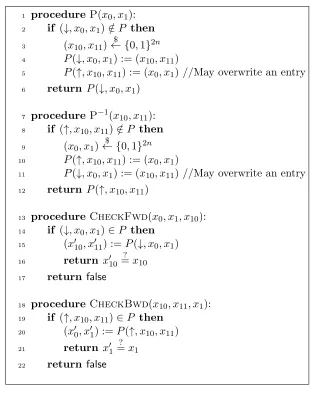
two-sided function R. This two-sided function maintains a hashtable P containing elements of the form (↓, x0, x1) and (↑, x10, x11). Whenever the procedure R.P(x0, x1) is queried, R checks if
(↓, x0, x1)∈P and if so, answers accordingly. Otherwise, an independent uniform output (x10, x11)
is picked and (↓, x0, x1) as well as (↑, x10, x11) are added toP, mapping to each other.
In addition to procedures P and P−1, R contains procedures CheckFwd(x0, x1, x10) and CheckBwd(x10, x11, x1).1 Procedure CheckFwd(x0, x1, x10) works as follows: If (↓, x0, x1)∈P,
it returns true if (↓, x0, x1) maps to (x10, x11) for some value of x11 ∈ {0,1}n and false otherwise.
The procedure CheckBwd(x10, x11, x1) works as follows: If (↑, x10, x11) ∈ P, it returns true if
(↑, x10, x11) maps to (x0, x1) for some value of x0 ∈ {0,1}n and false otherwise.
1
The pseudocode for the two-sided random function R, using hashtableP, is as follows:
1 procedure P(x0, x1): 2 if (↓, x0, x1)∈/ P then
3 (x10, x11)← {$ 0,1}2n
4 P(↓, x0, x1) := (x10, x11)
5 P(↑, x10, x11) := (x0, x1) //May overwrite an entry
6 return P(↓, x0, x1)
7 procedure P−1(x10, x11): 8 if (↑, x10, x11)∈/ P then
9 (x0, x1)
$
← {0,1}2n
10 P(↑, x10, x11) := (x0, x1)
11 P(↓, x0, x1) := (x10, x11) //May overwrite an entry
12 return P(↑, x10, x11)
13 procedure CheckFwd(x0, x1, x10): 14 if (↓, x0, x1)∈P then
15 (x010, x011) :=P(↓, x0, x1)
16 return x010=? x10
17 return false
18 procedure CheckBwd(x10, x11, x1): 19 if (↑, x10, x11)∈P then
20 (x00, x01) :=P(↑, x10, x11)
21 return x01=? x1
22 return false
Figure 2: Random Two-sided FunctionR
In the following section, we show thatH2 andH1.5 are indistinguishable.
5.2.1 Indistinguishability of H2 and H1.5
We first bound the effect of replacing P+ with R as a function of the total number of queries q0
made to this oracle. Note, however, that both the simulator and D make queries to this oracle. Thus, to conclude the proof of indistinguishability, we bound the number of queries to the oracle as a function of the total number of queriesq made by D.
Theorem 5.3. Let S0 be an algorithm that makes at most q0 queries to an oracle. Then the difference between the probability that S0 outputs 1 when interacting with P+, and the probability thatS0 outputs 1 when interacting withR is at most 12q02/2n.
CheckFwd/CheckBwdmade by both the simulator and the distinguisher. In order to prove this
theorem, we consider experimentsE0, E1, . . . , E3, whereE0 corresponds toS0 interacting withP+,
and E3 corresponds to S0 interacting with R.
Experiment E0: S0 interacts with P+.
Experiment E1: S0 interacts with P1 where procedureP1.P is defined as follows:
1 procedure P1.P(x0, x1) 2 if (↓, x0, x1)∈/ P then
3 (x10, x11)
$
← {0,1}2n
4 if (↑, x10, x11)∈P then
5 (x10, x11)← {$ 0,1}2n\ {(x010, x011)|(↑, x010, x011)∈P}
6 P(↓, x0, x1) := (x10, x11) 7 P(↑, x10, x11) := (x0, x1)
8 return P(↓, x0, x1)
ProcedureP1.P−1 is defined analogously. Procedures P1.CheckFwdand P1.CheckBwdare
defined as follows.
1 procedure CheckFwd(x0, x1, x10):
2 if (↓, x0, x1)∈P then 3 (x010, x011) :=P(↓, x0, x1)
4 return x010=? x10
5 (x010, x011) :=P(x0, x1) //Note that procedureP1.Pis called
6 return x010=? x10
7 procedure CheckBwd(x10, x11, x1): 8 if (↑, x10, x11)∈P then
9 (x00, x01) :=P(↑, x10, x11)
10 return x01 =? x1
11 (x00, x01) :=P−1(x10, x11) //Note that procedureP1.P−1 is called
12 return x01 =? x1
Claim 5.4. The probabilities that S0 outputs 1 in E0 and E1 are identical.
Proof. The values assigned through procedures P and P−1 are chosen uniformly at random from
the set of values that have not been assigned so far in both E0 and E1. Also, the procedures CheckFwd and CheckBwdare implemented in a similar manner in both experiments. So, the experiments E0 and E1 behave identically.
Experiment E2: S0 interacts withP2 where the proceduresP2.PandP2.P−1 are defined exactly
asR.Pand R.P−1 respectively while procedures P2.CheckFwdand P2.CheckBwdare defined
Claim 5.5. The probability that S0 outputs 1 in E1 differs from the probability that it outputs 1
in E2 by at most q02/22n.
Proof. The proof of the claim follows exactly along the lines of [CHK+14, Lemma 3.8].
Experiment E3: S0 interacts with R.
Claim 5.6. The probability that S0 outputs 1 inE2 differs from the probability that it outputs 1 in
E3 by at most 11q02/2n.
Proof. In order to prove this claim, we introduce events BadCheckForward, BadCheckBackward,
BadOverwrite, andBadBackwardQuery and prove that these events occur with probability at most 11q02/2n. We proceed to argue that if none of these events occur the experimentsE2andE3 behave
exactly the same.
The event BadCheckForwardoccurs if P0.CheckFwdreturns true in the last line in E2.
Simi-larly, the eventBadCheckBackwardoccurs ifP0.CheckBwdreturns true in the last line inE2. The
probability of the eventsBadCheckForward andBadCheckBackward is at mostq0/2n.
The event BadOverwriteoccurs if either inE2 or inE3, in any call to the proceduresP orP−1,
an entry of P is overwritten. The probability that BadOverwrite occurs in E2 and E3 is at most
2(q0)2/22n.
The event BadBackwardQuery occurs if in E2 either one of the two following events occur.
(1) There exists (x0, x1),(x∗10, x∗11) such that all of the following hold:
(i) The query P(x0, x1) is issued in the last line of a CheckFwd query, and P(↓, x0, x1) is set
to (x∗10, x∗11).
(ii) After (i), the queryP−1(x∗10, x∗11), orCheckFwd(x0, x1, x∗10) or CheckBwd(x1, x∗10, x∗11) is
issued.
(iii) The query P(x0, x1) is not issued by the distinguisher between point (i) and point (ii).
(2) There exists (x∗0, x∗1),(x10, x11) such that all of the following hold:
(i) The query P−1(x10, x11) is issued in the last line of a CheckBwd query, and P(↑, x10, x11)
is set to (x∗0, x∗1).
(ii) After (i), the query P(x∗0, x∗1), or CheckFwd(x∗0, x∗1, x10) or CheckBwd(x∗1, x10, x11) is
is-sued.
(iii) The query P−1(x10, x11) is not issued by the distinguisher between point (i) and point (ii).
Consider the event (BadBackwardQuery∧ ¬BadCheckForward∧ ¬BadCheckBackward) occurs. To analyze the probability of this event, let us consider the first case by which BadBackwardQuery
can occur. Consider any pair (x0, x1, x∗10, x∗11) such that (i) of event (1) holds. Since
BadCheck-Forward does not occur, we have that the CheckFwd query returns false. Now, as long as the
queriesP(x0, x1),P−1(x∗10, x∗11),CheckFwd(x0, x1, x∗10) orCheckBwd(x1, x∗10, x∗11) are not made
by the distinguisher, the value (x∗10, x∗11) is distributed uniformly in the set of all pairs (x010, x011) for which CheckFwd(x0, x1, x010) and CheckBwd(x1, x010, x011) was not queried. Thus, the
prob-ability that in a single query, the distinguisher queries a) P−1(x∗10, x∗11) is at most q0
CheckFwd(x0, x1, x∗10) is at most q0
2n−q0 or c)CheckBwd(x1, x∗10, x∗11) is at most q0
22n−q0. By a sim-ilar argument for event (2) and by assumingq0 <2n/2 and since there are at mostq0 queries made by the distinguisher, probability of (BadBackwardQuery∧¬BadCheckForward∧¬BadCheckBackward) is at most 2∗(2(q0)2/22n+ 2q02/2n)≤8(q0)2/2n.
If the bad events defined above do not occur, the scenarios E2 and E3 behave identically.
Theorem 5.3 follows from Claims 5.4–5.6.
Theorem 5.3 bounds the effect of replacingP+withRin terms of the total number of queriesq0
made to the P+/R oracle. In the following sequence of claims, we show thatq0 =poly(q) (where, recall,q is the total number of queries made by the original distinguisherD).
Claim 5.7. In H2, the simulator dequeues a partial chain of the form (x1, x2,1, `, g, b) such that
(x1, x2,1)∈/CompletedChains at mostq times in total from the queueQenq.
Proof. Consider such a dequeue call and let (x1, x2,1, `, g, b) be the chain dequeued from Qenq.
The chain must have been enqueued in Qenq when CheckFwd(x2 ⊕G1(x1), x1, x10) = true for
a fixed x10 in lines 75 and 95 of the simulator. Since G1(x1) is never overwritten (as 1 is not
an adapt position for any chain), there is a tuple (x0, x1, x10) where x0 =x2⊕G1(x1) such that CheckFwd(x2 ⊕G1(x1), x1, x10) = true when the chain was enqueued. This implies that there
must have been a call either to P(x0, x1) such that (x10, x11) was chosen uniformly at random in
line 3 of R or to P−1(x10, x11) such that (x0, x1) was chosen uniformly at random in line 9 of R
for some x11 ∈ {0,1}n. This call to P or P−1 was made by the distinguisher or the simulator.
Now if (x1, x2,1)∈/ CompletedChains, we claim that this call was made by the distinguisher. This
is because, by definition, the simulator queriesP orP−1 only in the following cases:
1. in a call to EvalFwdEnqorEvalBwdEnq
2. in a call to EvalFwdComporEvalBwdComp
Consider the case where the simulator queriedP/P−1during a call toEvalFwdEnq(xk, xk+1, k, m)
or EvalBwdEnq(xk, xk+1, k, m). If m ∈ {1,9}, then the query to P/P−1 is such that the triple
(↑, x10, x11) or (↓, x0, x1) is already in P. This is because CheckFwd/CheckBwd must have
returned true for these chains to have been enqueued. If m = 5, then the partial chain resulting from a query toP/P−1 is added to the setMidEquivChainsand chains belonging to that set are not
enqueued in any of the queues by definition of the simulator.
In case 2, the partial chain (x1, x2,1) resulting from a query to P/P−1 is immediately added
to CompletedChains by definition of the simulator. So, if (x1, x2,1)∈/ CompletedChains when it is
dequeued, it is due to a query made by the distinguisher. We also claim that there is a unique distinguisher query corresponding to the chain (x1, x2,1). Say this is not the case and there is
another chain (x01, x02,1) that has been enqueued such thatCheckFwd(x02⊕G1(x01), x01, x010) =true
due to the same distinguisher query. If D’s query was (↓, x0, x1) that returned (x10, x11), we have
thatx010=x10, x1 =x10 andG1(x01)⊕x02 =x2⊕G1(x1) givingx2 =x02. IfD’s query was (↑, x10, x11)
that returned (x10, x11), we have the same result again. So, there is a unique distinguisher query
corresponding to the chain (x1, x2,1). Since D makes at most q queries, we have that there are
mostq such partial chains dequeued.
Claim 5.8. In H2, the simulator dequeues a partial chain of the form (x9, x10,9, `, g, b) such that
(x9, x10,9)∈/ CompletedChains at mostq times in total from the queueQenq.
For a hashtable Gwe let |G|denote the number of entries in G.
Claim 5.9. InH2, at most 90q2 partial chains of the form (x5, x6,5)are enqueued.
Proof. Before we bound the number of partial chains of the form (x5, x6,5), we will bound the
size of |G5| and |G6|. The size of G5 can increase only in the following ways: (a) distinguisher
queriesF(5,·) (b) during the completion of a (x9, x10,9) partial chain (c) during the completion of
a (x1, x2,1) partial chain (d) during the completion of a (x5, x6,5) partial chain wherex5∈/ G5 and
x5 ∈Aj5.
There are at most q queries that the distinguisher makes. The simulator only completes (x9, x10,9) such that (x9, x10,9) ∈/ CompletedChains. By Claim 5.7, we have that there are at
most q such chains dequeued from Qenq and hence, at most q such chains can be dequeued from
the queues Q1,Q5,Q6,Q10 and Qall. Similarly, by Claim 5.8, we have that there are at most q
completions of a partial chain of the form (x1, x2,1).
For the last case, a value x5 ∈ {0,1}n gets added to A5j for j = 1, . . . , q only when x5 ∈/ G5.
So, a bound on Pj
i=1A j
5 gives a bound on x5 added to G5 due to a completion of a (x5, x6,5)
partial chain. A value x5 ∈ {0,1}n gets added to Aj5 for j = 1, . . . , q only in one of the following
ways: (i) the distinguisher queried F(5, x5) (ii) the simulator made a call to EvalFwdEnq or EvalBwdEnq during the completion of a (x9, x10,9) chain where (x9, x10,9)∈/ CompletedChains
(iii) the simulator made a call to EvalFwdEnq or EvalBwdEnq during the completion of a
(x1, x2,1) chain where (x1, x2,1)∈/ CompletedChains. Thus, we have Pji=1A j
5 ≤3q by Claims 5.7
and 5.8. So, putting everything together, we have that |G5| ≤ 6q and by a similar argument, |G6| ≤6q.
Now, the number of partial chains of the form (x5, x6,5) that are enqueued inQall can be bound
by Pq
j=1|A j
5|.|G6∪Aj6|+
Pq
j=1|G5∪A j 5|.|A
j
6|and hence can be bound by 54q2. And, the number
of partial chains of the form (x5, x6,5) partial chain that are enqueued in Qmid can be bound by |G5| · |G6|and hence can be bound by 36q2.
Claim 5.10. In H2, we have |Gi| ≤93q2 for all i.
Proof. The size of Gi can only increase in the following ways: (a) distinguisher queries F(i,·)
(b) during the completion of a (x9, x10,9) partial chain (c) during the completion of a (x1, x2,1)
partial chain (d) during the completion of a (x5, x6,5) partial chain.
There are at most q distinguisher queries and at most q completions each of partial chains of the form (x9, x10,9) and (x1, x2,1) by Claims 5.7 and 5.8. There are at most 90q2 completions of
a (x5, x6,5) partial chain by Claim 5.9. So, |Gi| ≤90q2+ 3q≤93q2.
Claim 5.11. In H2, the simulator makes at most 644q2 queries toR.P andR.P−1.
Proof. The simulator makes calls toR.P/R.P−1only in proceduresEvalFwdEnq,EvalBwdEnq, EvalFwdComp and EvalBwdComp. By bounds on the number of partial chains that are en-queued for completion given in Claims 5.7, 5.8 and 5.9 and by definition of the simulator, the number of calls to P/P−1 is bounded by 92q2·7 = 644q2.
Claim 5.12. InH2, the simulator makes at most3,166,000q6queries to the proceduresR.CheckFwd
Proof. The number of CheckFwd queries made by the simulator is bounded by Pqj=1|(G10∪
Aj10| × |G1| × |Aj2|) +
Pq
j=1|(G2∪A j
2| × |G1| × |Aj10|).
A valuex10∈ {0,1}ngets added toAj10forj= 1, . . . , qonly in one of the following ways: (a) the
distinguisher queriedF(10, x10) (b) the simulator made a call toEvalFwdEnqorEvalBwdEnq
during the completion of a (x1, x2,1) chain where (x1, x2,1)∈/ CompletedChains (c) the simulator
made a call toEvalFwdEnq orEvalBwdEnq during the completion of a (x5, x6,5) chain.
There are at most q distinguisher queries and by Claims 5.8 and 5.9, there are at most q and 90q2 such calls to EvalFwdEnq and EvalBwdEnq. So, Pqj=iA
j
10 ≤ 90q2 + 2q ≤ 92q2. In a
similar manner, we can boundPq
j=iA j
2 ≤90q2+ 2q≤92q2.
So, the number of CheckFwd queries made by the simulator is bounded by 1582860q6. By
a similar argument, the number of CheckBwd queries made by the simulator is bounded by
1582860q6. Hence, there are at most O(q6) queries toR.
CheckFwd andR.CheckBwd.
Corollary 5.13. In H1.5 and H1, the simulator makes at most 3.2×10⁶q6 queries to P+ and P
respectively except with probability at most 10152nq12·
Proof. For the sake of contradiction, assume that there exists a distinguisher D that makes at most q queries such that in H1.5 the simulator makes more than 3.2×10⁶q6 queries to P+ with
probability greater than 10152nq12·By Claims 5.11 and 5.12, the simulator makes at most 3,166,644q6
queries toR inH2. Now, consider a distinguisher S0 which aims to distinguish P+ and R making
only r0(q) queries. The distinguisherS0 consists of D and the simulator together. S0 outputs 1 if
D and the simulator make more than 3.2×(10q)6 queries. Then, S0 issues at most 3.2×(10q)6
queries and distinguishes R from P+ with probability greater than 10152nq12 ≥
12·(3.2×(10q)6)2 2n which
contradicts Theorem 5.3. Hence, the simulator makes at most 3.2×10⁶q6 queries to P+ except
with probability 10152nq12·Combining this with Lemma 5.2, we get the result.
Lemma 5.14. The probability that D outputs 1 in H1 differs from the probability that it outputs 1
in H2 by at most 2·10
15q12
2n ·
Proof. By Lemma 5.2, we have that the distinguisher D outputs 1 in H1 and H1.5 with the same
probability. Now, for the sake of contradiction, assume that D distinguishes H1.5 from H2 with
advantage greater than 2·10215nq12·We construct a distinguisherS0that consists ofDand the simulator
whereS0 makes at most 3.3×(10q)6 queries and distinguishesR fromP+. S0 works as follows: S0
outputs 1 if the number of queries issued by D and the simulator exceeds 3.3×(10q)6; otherwise, it outputs whatever is output by D. By Corollary 5.13, the simulator makes at most 3.2×(10q)6 queries in H1.5 except with probability 10
15q12
2n and by Claims 5.11 and 5.12, the simulator makes
at most 3,166,644q6 queries in H2. So, distinguisher S0 making at most 3.3×(10q)6 queries can
distinguish R and P+ with probability greater than 10152nq12 ≥
12·(3.3×(10q)6)2
2n which contradicts
Theorem 5.3.
Extending the analysis, we also bound the overall running time of the simulator.
Claim 5.15. In H2, the simulator runs in time O(q6).
Proof. We analyze the running time of the procedures of ˆS. ProcedureFENQruns in timeO(1)
run in time O(1) except for the run-time of procedure FENQ. Procedures EvalFwdComp and EvalBwdComprun in timeO(1) except for the run-time of procedureFCOMP. ProcedureAdapt
runs in time O(1) except for the run-time of proceduresFCOMP and EnqNewMidChains.
Pro-cedure FCOMP runs in timeO(1) except for the run-time of procedure EnqNewMidChains.
Pro-ceduresCheckFwd,CheckBwdand ForceValrun in timeO(1).
ProcedureEnqNewChainsruns in timeO(q4) by the bounds on|Gi|given by Claim 5.10 and
by the bounds on Pq
j=1|A j
i| for i ∈ {1,2,5,6,9,10} derived in Claims 5.9 and 5.12. Procedure EnqNewMidChains runs in time O(q2) by the bounds on|G5|and |G6|derived in Claim 5.9.
Calls toFENQare made either by a direct query by the distinguisher, or in calls toEvalFwdEnq
or EvalBwdEnq. There are at most O(q2) calls to EvalFwdEnq and EvalBwdEnq by the
bounds established on the number of partial chains enqueued inQenq given by Claims 5.7, 5.8 and
5.9. So, the maximum number of calls to FENQ is bounded by O(q2). Calls to EnqNewChains
are made only during calls toFENQ. So, there are at most O(q2) calls to EnqNewChains. Calls
toCheckFwd and CheckBwd are only made inEnqNewChains - so there are at most O(q6)
calls toCheckFwd andCheckBwd.
There are at mostO(q2) calls toEvalFwdComp,EvalBwdCompandAdaptby the bounds
on the number of partial chains enqueued inQenqandQmid given by Claims 5.7, 5.8 and 5.9. There
are at mostO(q2) calls toFCOMP sinceFCOMPis called only inEvalFwdComp,EvalBwdComp, Adaptor as a result of a direct distinguisher query. Calls to EnqNewMidChainsare made only
during calls to FCOMP and Adapt. So, there are at most O(q2) calls to EnqNewMidChains.
There are at mostO(q2) calls toForceValsinceForceValis called only duringAdapt. Putting
all of this together, the simulator runs in time O(q6).
Corollary 5.16. In H1.5 (and hence H1), the simulator runs for at most O(q6) steps and makes
at most3.2×(10q)6 queries except with probability at most 10152nq12·
Proof. By Claims 5.11 and 5.12, the simulator makes at most 3.2×(10q)6 queries toR inH2 and
by Claim 5.15, runs in time at mostr(q)∈O(q6) inH2. For the sake of contradiction, assume that
there exists a distinguisherDthat makes at most q queries such that inH1.5 the simulator runs in
time greater thanr(q) or makes more than 3.2×(10q)6queries toP+with probability greater than 1015q12
2n · Now, consider a distinguisher S0 which aims to distinguish P+ and R making only r0(q)
queries. The distinguisherS0consists ofDand the simulator together. S0outputs 1 if the simulator runs for more thanr(q) steps or ifDand the simulator make more than 3.3×(10q)6 queries. Then,
S0 issues at most 3.3×(10q)6 queries and distinguishesR from P+ with probability greater than 1015q12
2n ≥
12·(3.3×(10q)6)2
2n which contradicts Theorem 5.3. Combining this with Lemma 5.2, we get
the result.
5.3 Properties of H2
Before we define the third hybrid experiment, we introduce some definitions and establish some properties of executions in the second experimentH2. The definitions here follow closely along the
lines of the definitions in [CHK+14]. A partial chain is a triple (xk, xk+1, k)∈ {0,1}n× {0,1}n× {0, . . . ,10}. IfC = (xk, xk+1, k) is a partial chain, we let C[1] =xk,C[2] =xk+1, and C[3] =k.
Definition 2. Fix tables G= ˆS.G and P =R.P in an execution ofH2, and let C = (xk, xk+1, k)
1 procedure next(xk, xk+1, k):
2 if k <10 then
3 if xk+1 ∈/Gk+1 then return ⊥
4 xk+2 :=xk⊕Gk+1(xk+1) 5 return (xk+1, xk+2, k+ 1)
6 else if k= 10then
7 if (↑, x10, x11)∈/P then return ⊥
8 (x0, x1) :=P(↑, x10, x11)
9 return (x0, x1,0)
10 procedure prev(xk, xk+1, k): 11 if k >0 then
12 if xk ∈/Gk then return ⊥
13 xk−1 :=xk+1⊕Gk(xk)
14 return (xk−1, xk, k−1)
15 else if k= 0then
16 if (↓, x0, x1)∈/P then return ⊥
17 (x10, x11) :=P(↓, x0, x1) 18 return (x10, x11,10)
19 procedure val+i (C):
20 while (C 6=⊥)∧(C[3]∈ {/ i−1, i}) do 21 C:=next(C)
22 if C=⊥then return ⊥ 23 if C[3] =ithen return C[1] 24 else return C[2]
25 procedure val−i (C):
26 while (C 6=⊥)∧(C[3]∈ {/ i−1, i}) do
27 C:=prev(C)
28 if C=⊥then return ⊥ 29 if C[3] =ithen return C[1]
30 else return C[2]
31 procedure vali(C):
32 if val+i (C)=6 ⊥ then return val+i (C) 33 else return val−i (C)
We say that ⊥∈/ Gi for i∈ {1, . . . ,10}. So, if vali(C) ∈/ Gi, then either vali(C) =⊥orvali(C) 6=⊥
and vali(C)∈/ Gi.
Definition 3. For a given set of tables G, P, two partial chains C, D are equivalent (denoted
So, two chains C andD are equivalent ifC=D, or ifDcan be obtained by applyingnext and
prev finitely many times toC.
Definition 4. The set of table-defined chains contains all chains C for which next(C) 6=⊥ and
prev(C)6=⊥.
Definition 5. A chain C = (xk, xk+1, k, `, g, b) is called an enqueued chain if C is enqueued for
completion. For such an enqueued chain, we define next(C) as the procedure next applied to the partial chain (xk, xk+1, k) i.e. next(C) :=next(xk, xk+1, k). The proceduresprev,val+,val−and val
on an enqueued chain C are defined in a similar manner.
Definition 6. The setQ∗all contains chains that are enqueued inQall but not inQ1,Q5,Q6,Q10.
Definition 7. We say that auniform assignment toGk(xk) occurs when the simulator setsGk(xk)
through an assignment Gk(xk) ← {0,1}n i.e. a uniform random value is chosen from the set of
n-bit strings and Gk(xk) is assigned that value.
A uniform assignment to Gk(xk) occurs in line 125 of the simulator’s execution. In particular,
ifGk(xk) is set through aForceVal(xk,·, k) call, then it is not a uniform assignment.
Definition 8. We say that auniform assignment toP occurs in a call toR.P(x0, x1) if (↓, x0, x1)∈/
P when the call is made and P(↓, x0, x1) is set through the assignment P(↓, x0, x1) := (x10, x11)
where (x10, x11) is chosen at random from the set of 2n-bit strings.
Similarly, it occurs in a call to R.P−1(x10, x11) if (↑, x10, x11) ∈/ P when the call is made and
P(↑, x10, x11) is set through the assignment P(↑, x10, x11) := (x0, x1) where (x0, x1) is chosen at
random from the set of 2n-bit strings.
A uniform assignment toP(↓, x0, x1) occurs in line 4 ofRin Figure 2 and a uniform assignment
toP(↑, x10, x11) occurs in line 10 of R in Figure 2.
We define a set of “bad” events, and show that these occur with negligible probability. Following that, we analyze execution of the experiment assuming that none of these bad events occur.
In the remainder of the section, we let T =O(q2) be an upper bound on the sizes ofGi and P
as well as the upper bound on the number of enqueued chains and hence, the number of calls to theAdapt procedure in an execution ofH2. The bound on T is derived from Claims 5.7–5.11.
5.3.1 Bad Executions
Definition 9. We say that eventBadPoccurs in H2 if either:
• Immediately after choosing (x10, x11) in a call toR.P(·,·), either (↑, x10, x11)∈Porx10∈G10.
• Immediately after choosing (x0, x1) in a call toR.P−1(·,·), either (↓, x0, x1)∈P orx1 ∈G1.
Lemma 5.17. The probability of eventBadP in H2 is at most 2T2/2n.
Proof. The proof follows exactly as in [CHK+14, Lemma 3.18].
Definition 10. We say that eventBadlyHit+ occurs inH
2 if either:
• Immediately after a uniform assignment toGk(xk), there is a partial chain (xk, xk+1, k) such
• Immediately after a uniform assignment to Gk(xk), there is a partial chain (xk−1, xk, k−1)
such thatnext(next(xk−1, xk, k−1))6=⊥.
and the relevant partial chain is either table-defined or an enqueued chain inQall.
Lemma 5.18. The probability of eventBadlyHit+ in H2 is at most 40T3/2n.
Proof. Consider the case where a uniform assignment toGk(xk) occurs and immediately after the
as-signment, there exists an enqueued chainC= (xk, xk+1, k) inQallsuch thatprev(prev(xk, xk+1, k))6=⊥.
For this to occur, xk−1 := xk+1⊕Gk(xk) should take one of T values (for k ∈ {2, . . . ,10}, xk−1
should be such that xk−1 ∈Gk−1 and fork = 1, (↓, xk−1, xk) should be in P). The probability of
this is at mostT /2n. The analysis for the case whereC is table-defined is exactly the same. There are at mostT enqueued chains and at mostT options forxk+1 such thatC is table-defined. So, the
total probability of the first case is 2T2/2n. The second case can be analyzed in a similar fashion. So, the total probability of BadlyHit+ for a uniform assignmentGk(xk) is 4T2/2n. Since there can
be at most 10T such assignments, the probability of BadlyHit+ is 40T3/2n.
Definition 11. We say that eventBadlyCollide+ occurs inH2 if a uniform assignment toGi(xi) is
such that there exist two partial chainsCandDsuch that for some`∈ {0, . . . ,11}andσ, ρ∈ {+,−}
all of the following are true:
• Immediately before the assignment, C and Dare not equivalent.
• Immediately before the assignment, valσ`(C) =⊥orvalρ`(D) =⊥.
• Immediately after the assignment,valσ`(C) =valρ`(D)6=⊥.
and one of the following is true:
• Immediately after the assignment,C and D are table-defined.
• Immediately after the assignment,C is table-defined and Dis a chain enqueued in Qall.
• C and D are chains enqueued inQall.
Lemma 5.19. The probability of event (BadlyCollide+∧ ¬BadlyHit+∧ ¬BadP) in H2 is at most
21160T5/2n.
Proof. Case 1: After the assignment C and D are table-defined. The proof for this case follows exactly as in [CHK+14, Lemma 3.21].
Case 2: C is a chain enqueued in Qall and D is table-defined after the assignment. Consider
the case that the enqueued chainC is of the form (xk, xk+1, k) wherexk∈Ajk andxk+1 ∈Ajk+1 for
somej∈ {1, . . . , q}. Letval`−(C) =val−` (D) =⊥before the assignment andval−` (C) =val−`(D)6=⊥
after the assignment. For val−`(C) to changei=k. Since BadlyHit+ does not occur, we have that
val−`+1(C) =val−`+1(D) and`+ 1 =kBut, since Cis not equivalent toDbefore the assignment, we can’t have that val−` (C) =val−` (D)6=⊥after the assignment and hence this case has probability 0. Let val−` (C) =⊥and val−` (D) 6=⊥ before the assignment and val−` (C) = val−` (D) 6=⊥after the assignment. For val−` (C) to change i= k. Since BadlyHit+ does not occur and val−` (D) does not change due to the assignment, we have thatxk+1⊕Gk(val−k(C)) =val
−
k−1(D) where`+ 1 =k. The
Let val+`(C) =val−`(D) =⊥ before the assignment and val+` (C) =val−` (D) 6=⊥afterward. For
val+` (C) to change after the assignment, it must be the case that ` = k+ 2 and i = k+ 1 since
BadlyHit+ does not occur. But for val−` (D) to change when ` = k+ 2, we need i = k+ 3 since
BadlyHit+does not occur asDis table-defined after the assignment. So, we see thatval+` (C) cannot change in this case.
Let val+` (C) =⊥and val−` (D) 6=⊥ before the assignment and val+` (C) = val−` (D) 6=⊥after the assignment. Forval+` (C) to changei=k+ 1. SinceBadlyHit+does not occur andval−` (D) does not change due to the assignment, we have that xk⊕Gk+1(val+k+1(C)) = val−k+2(D) where `=k+ 2.
The probability of this is 1/2n.
The remaining four cases follow similarly. The case for xk ∈ Gk, xk+1 ∈ Ajk+1 and xk ∈
Ajk, xk+1 ∈Gk+1 and xk ∈Gk, xk+1 ∈ Gk+1 where C = (xk, xk+1, k) is the enqueued chain follow
in a similar fashion. So, the total probability of this event can be computed as follows. There are at mostT enqueued chains and at most 11T2 table-defined chains before the assignment and there are at most 2T chains that were not table-defined before the assignment but were table-defined after. There are at most 10T such assignments of the formGi(xi) :=f(i, xi) and there are at most
4 possibilities for σ, ρ. Thus, the probability is 10T·T·(11T2+ 2T)·4·4/2n≤2080T4/2n. Case 3: The proof follows similar to the proof of Case 2.
Definition 12. We say that eventBadlyCollideP occurs in H2 if either:
• A uniform assignment P(↓, x0, x1) := (x10, x11) is such that there exist partial chains C and
Dsuch that for some σ, ρ∈ {+,−}the following are all true:
– Immediately before the assignment, C and Dare not equivalent.
– Immediately before the assignment, valσ10(C) =⊥orvalρ10(D) =⊥.
– Immediately after the assignment,valσ10(C) =val10ρ (D) =x106=⊥.
and one of the following conditions hold:
– Before the assignment,C and D are chains inQ∗all.
– Immediately after the assignment,C and D are table-defined.
– Before the assignment,C is a chain enqueued inQall and immediately after the
assign-ment, Dis table-defined.
• A uniform assignment P(↑, x10, x11) := (x0, x1) is such that there exist two partial chainsC
and Dsuch that for some σ, ρ∈ {+,−}the following are all true:
– Immediately before the assignment, C and Dare not equivalent.
– Immediately before the assignment, valσ1(C) =⊥orvalρ1(D) =⊥.
– Immediately after the assignment,valσ1(C) =val1ρ(D) =x16=⊥.
and one of the following conditions hold:
– Before the assignment,C and D are chains inQ∗all.
– Immediately after the assignment,C and D are table-defined.
– Before the assignment,C is a chain enqueued inQall and immediately after the