ISSN(Online) : 2319-8753
ISSN (Print) : 2347-6710
I
nternational
J
ournal of
I
nnovative
R
esearch in
S
cience,
E
ngineering and
T
echnology
(An ISO 3297: 2007 Certified Organization)
Vol. 4, Special Issue 13, December 2015
Static Analysis and Topology Optimization of
Steering Knuckle by Using Finite Element
Method
R.Prem Raj, K.Palpandi
Assistant Professor,Dept. of Mechanical Engineering, Sasurie College of Engineering,Tirupur,Tamilnadu,
India
Assistant Professor,Dept. of Mechanical Engineering, Sasurie College of Engineering,Tirupur,Tamilnadu,
India
ABSTRACT: The main objective of this paper is to reduce the weight of a steering knuckle by applying the topology optimization technique and minimized the mass of steering knuckle. Steering knuckle is an important component of the vehicle and it’s connected to the suspension system. CAD Model of steering knuckle has been done in Catia V5. 3D model has been meshed in HYPERWORKS. Static analysis part was done in HYPERWORKS V12 with the help of RADIOSS. We have applied load in different load s in the steering arm. Another part is topology optimization and it’s been carried out in HYPERWORKS with help of Optistruct solver. Topology optimization is the systematic approach that optimized the material, layout with given the limited design space. Finally, we conclude compared the two different loads in maximum stress and deformation was taken and also topology optimization analysis has been achieved 2.84% reduction the weight.
KEYWORDS: Static analysis, topology optimization and HYPERWORKS.
I. INTRODUCTION
ISSN(Online) : 2319-8753
ISSN (Print) : 2347-6710
I
nternational
J
ournal of
I
nnovative
R
esearch in
S
cience,
E
ngineering and
T
echnology
(An ISO 3297: 2007 Certified Organization)
Vol. 4, Special Issue 13, December 2015
II. OBJECTIVE
The main objective of this paper istopology optimization process which involves in weight reductionof the steering knuckle.
III. METHODOLOGY
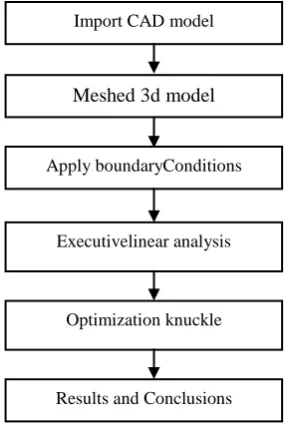
The process involved in static analysis and optimization of steering knuckle by using finite element analysis. CAD Model of steering knuckle designed in Catia V5 and was imported in HYPERWORKS. The static analysis was done in RADIOSS such as linear analysis and optimization done by using OPTISTUCT solver.
Fig.1 Optimization of flow chart 3.1 Material selection
There are different materials used in manufacturing processes such as grey cast iron, spheroidal graphite iron (SG Ductile Iron) and white cast iron. The grey cast iron mostly has been used, becausedemand the forged steel for this application. Now a present day’s automobile industry has been put effort in Spheroidal graphite (SG)
iron, due to its less density, low ductility and high hardness.
Table 1 Physical and Mechanical properties of SG iron
Young’s modulus (MPA)
1.62
Poisson Ratio 0.26
Density(Kg/m3) 2770
Ultimate strength(MPA)
620
Yield strength(MPA) 420
Import CAD model
Meshed 3d model
Apply boundaryConditions
Executivelinear analysis
Optimization knuckle
ISSN(Online) : 2319-8753
ISSN (Print) : 2347-6710
I
nternational
J
ournal of
I
nnovative
R
esearch in
S
cience,
E
ngineering and
T
echnology
(An ISO 3297: 2007 Certified Organization)
Vol. 4, Special Issue 13, December 2015
3.2 Meshing
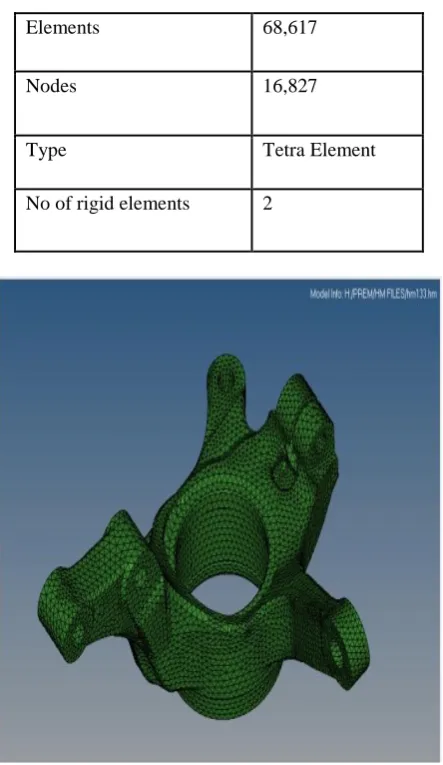
CAD model of steering knuckle has been converted into IGES file. . It consists of stub hole, brake calliper mounting points, steering tie-rod mounting points, suspension upper and lower A-arm mounting points the model is imported into HYPERWORKS V12 simulation and also 3D meshed has been done in HYPERWORKS.
Table 2 Number of nodes and element model
Elements 68,617
Nodes 16,827
Type Tetra Element
No of rigid elements 2
Fig.2Meshing of model at SG iron
3.3 Force Reaction on Steering Knuckle
ISSN(Online) : 2319-8753
ISSN (Print) : 2347-6710
I
nternational
J
ournal of
I
nnovative
R
esearch in
S
cience,
E
ngineering and
T
echnology
(An ISO 3297: 2007 Certified Organization)
Vol. 4, Special Issue 13, December 2015
Fig. 3 Force reaction on steering knuckle 3.4 Loading conditions
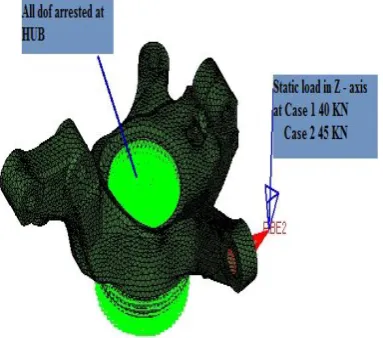
The steering knuckle hub is arrested and the boundary condition was applied in steering arm for different loadsat case 40KN and 45KN as shown in fig 4.
Fig. 4Applying boundary conditions
ISSN(Online) : 2319-8753
ISSN (Print) : 2347-6710
I
nternational
J
ournal of
I
nnovative
R
esearch in
S
cience,
E
ngineering and
T
echnology
(An ISO 3297: 2007 Certified Organization)
Vol. 4, Special Issue 13, December 2015
Fig. 6VonmissesStress at 40 KN
ISSN(Online) : 2319-8753
ISSN (Print) : 2347-6710
I
nternational
J
ournal of
I
nnovative
R
esearch in
S
cience,
E
ngineering and
T
echnology
(An ISO 3297: 2007 Certified Organization)
Vol. 4, Special Issue 13, December 2015
IV. TOPOLOGY OPTIMIZATION
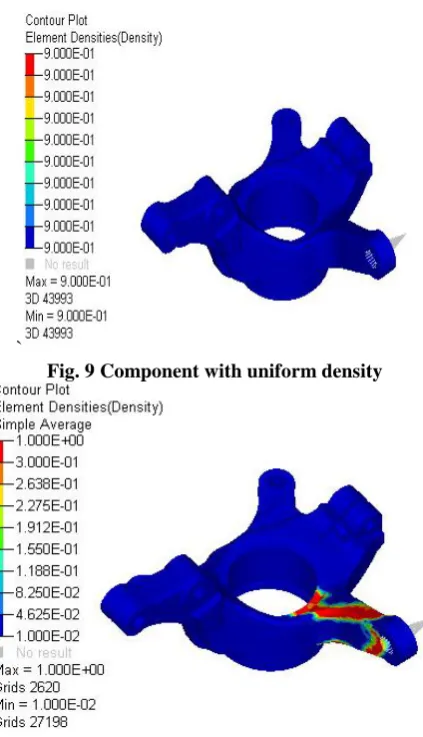
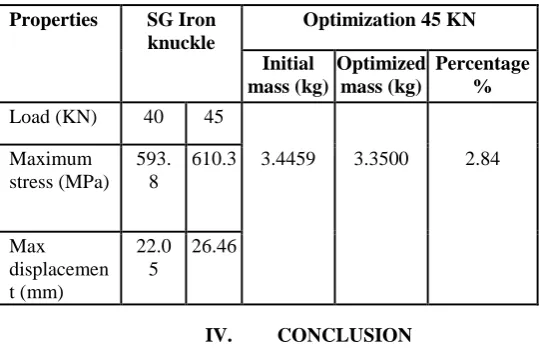
The maximum stress value for steering arm at 45 KN load is 610.3 MPA which is below the ultimate strength, therefore the knuckle has more strength and ductility. Hence the topology optimization has been done with the maximum stress value obtained.
`
Fig. 9 Component with uniform density
Fig. 10 Optimized component
ISSN(Online) : 2319-8753
ISSN (Print) : 2347-6710
I
nternational
J
ournal of
I
nnovative
R
esearch in
S
cience,
E
ngineering and
T
echnology
(An ISO 3297: 2007 Certified Organization)
Vol. 4, Special Issue 13, December 2015
Table 3 Analysed results for both different loads and optimized mass
IV. CONCLUSION
In this paper, the static analysis has been done in steering arm with the load of 40 and 45 KN. From the analysis result has been concluded that, the values obtained for the SG iron in maximum stresses (610.3 MPa) and maximum displacement (26.46) of the steering arm. SG iron is good material for high strength and ductility with safe limit. Topology optimization of the steering knuckle generates an optimized material distribution pattern set of constraints and loads within a given limited design space. Optimization reduces weight initial weight of mass 3.4459 (KG) and optimized mass 3.3500 (KG).
REFERENCES
1. Babu.B, Prabhu.M, Dharmaraj.P, Sampath.R (2014),‘Stress Analysis On Steering Knuckle Of The Automobile Steering System’, International Journal of Research in Engineering and Technology, Vol.3, No.3, PP.363-366
2. Chang Yong Songa, Jongsoo Lee .b, (2011),‘Reliability-based design optimization of knuckle component using conservative method of moving least squares meta-models’, Probabilistic Engineering Mechanics Vol. 26, PP. 364-369.
3. Jungang Wu, SiqinZhang,Qinglong Yang (2012),‘Deformation Effect Simulation and Optimization for Double Front Axle Steering Mechanism’, International Conference on Computer Modelling and Simulation Vol.22, PP.27-31.
4. Khairnar H. P, MahendraShelar . L (2014),‘Design Analysis and Optimization of Steering Knuckle Using Numerical Methods and Design of Experiments’, International Journal of Engineering Development and Research Vol.2, No.3, PP. 2958-2967.
5. Mahesh Sharma.P, DenishMevawala.S, Harsh Joshi, DevendraPatel.A (2014), ‘Static Analysis of Steering Knuckle and Its Shape Optimization’,Journal of Mechanical and Civil Engineering Vol. 3, PP.34-38
6. MahendraRathi.G, NileshJakhade.A (2014), ‘An optimization of forging process parameters by using Taguchi method : An Industrial case study’, International Journal of Scientific and Research Publications, Vol. 4, No. 6,PP.1-7
7. Nassir S. Al-Arifi, Abu S. Zamani, and Jalaluddin Khan (2011),‘Billet Optimization for Steering Knuckle Using Taguchi Methodology’, International Journal of Computer Theory and Engineering, Vol. 3, No. 4, PP. 552-557.
8. PurushottamDumbre A. K., Mishra V. S (2014), ‘Structural Analysis of Steering Knuckle for Weight Reduction’, International Journal of Emerging Technology and Advanced Engineering Vol. 4, No. 6, PP.552-557
9. Sharad Kumar Chandrakar, DheerajLalSoni and ShohelGardia (2013) “FEA of A Steering Knuckle for Life Prediction’, International Journal of Engineering Research and Technology, ISSN 0974-3154 Vol. 6, No. 5, PP. 681-688.
10. VinayakKulkarni, Anil Jadhav, Basker.P (2012), ‘Finite Element Analysis and Topology Optimization of Lower Arm of Double Wishbone Suspensionusing RADIOSS and Optistruct’, International Journal of Science and Research Vol. 3 No. 5,PP. 639 – 643.
11. VirajRajendraKulkarniAmeyGangaramTambe(2013) Altair technology conference Optimization and Finite Element Analysis of Steering Knuckle
Properties SG Iron knuckle
Optimization 45 KN
Initial mass (kg) Optimized mass (kg) Percentage %
Load (KN) 40 45
Maximum stress (MPa)
593. 8
610.3 3.4459 3.3500 2.84