Computational Linguistics and Chinese Language Processing
Vol. 11, No. 1, March 2006, pp. 87-100 87
© The Association for Computational Linguistics and Chinese Language Processing
[Received May 13, 2005; Revised Oct. 8, 2005; Accepted Oct. 17, 2005]
Voice Activity Detection Based on Auto-Correlation
Function Using Wavelet Transform and
Teager Energy Operator
Bing-Fei Wu
∗and Kun-Ching Wang
+Abstract
In this paper, a new robust wavelet-based voice activity detection (VAD) algorithm derived from the discrete wavelet transform (DWT) and Teager energy operation (TEO) processing is presented. We decompose the speech signal into four subbands by using the DWT. By means of the multi-resolution analysis property of the DWT, the voiced, unvoiced, and transient components of speech can be distinctly discriminated. In order to develop a robust feature parameter called the speech activity envelope (SAE), the TEO is then applied to the DWT coefficients of each subband. The periodicity of speech signal is further exploited by using the subband signal auto-correlation function (SSACF) for. Experimental results show that the proposed SAE feature parameter can extract the speech activity under poor SNR conditions and that it is also insensitive to variable-level of noise.
Keywords: Voice Activity Detection, Auto-Correlation, Wavelet, Teager Energy
1. Introduction
Voice activity detection (VAD) refers to the ability to distinguish speech from noise and is an integral part of a variety of speech communication systems, such as speech coding, speech recognition, hand-free telephony, and echo cancellation. In the GSM-based communication system, a VAD scheme is used to lengthen the battery power through discontinuous transmission when speech-pause is detected [Freeman et al. 1989]. Moreover, a VAD algorithm can be used under a variable bit rate of the speech coding system in order to control the average bit rate and the overall quality of speech coding [Kondoz et al. 1994]. Perviously,
∗
Department of Electrical and Control Engineering, National Chiao-Tung University, HsinChu, Taiwan E-mail: [email protected]
+
Information & Communications Research Laboratories, Industrial Technology Research Institute, HsinChu, Taiwan
Voice Activity Detection Based on Auto-Correlation Function Using 89 Wavelet Transform and Teager Energy Operator
applied in the envelope of each SSACF. First, the Delta SSACF, similar to the delta-cepstrum evaluation, is used to measure the local variation of each SSACF. Next, since the DSSACF is averaged over its length, the value of the Mean DSSACF (MDSSACF) can almost describe the amount of periodicity in each subband. Eventually, by only summing the values of the four MDSSACFs, we can apply a robust feature parameter, called the speech activity envelope (SAE) parameter. Experimental results show that the envelope of the SAE feature parameter can accurately indicate the boundary of speech activity under poor SNR conditions and that it is also insensitive to variable-level noise. In addition, the proposed wavelet-based VAD can be performed on-line.
This paper is organized as follows. Section 2 describes the proposed algorithm based on DWT and TEO. In addition, the proposed robust feature parameter is also discussed. Section 3 evaluates the performance of the proposed algorithm and compares it with that of other wavelet-based VAD algorithms and ITU-T G.729B VAD. Finally, Section 4 presents conclusions.
2. The Proposed Algorithm Based on DWT and TEO
In this section, each part for the proposed VAD algorithm is discussed in turn.
2.1
Discrete Wavelet Transform
The wavelet transform (WT) is based on time-frequency signal analysis. This wavelet analysis adopts a windowing technique with variable-sized regions. It allows the use of long time intervals when we want more precise low-frequency information, and shorter regions where we want high-frequency information. It is well known that speech signals contain many transient components and exhibit the non-stationary property. When we make use of the MRA property of the WT, better time-resolution is needed in the high frequency range to detect the rapid changing transient component of a signal, while better frequency resolution is needed in the low frequency range to track slowly time-varying formants more precisely. Through MRA analysis, the classification of speech into voiced, unvoiced or transient components can be accomplished. An efficient way to implement this DWT using filter banks was developed in 1988 by Mallat [Mallat 1989].
90 Bing-Fei Wu and Kun-Ching Wang
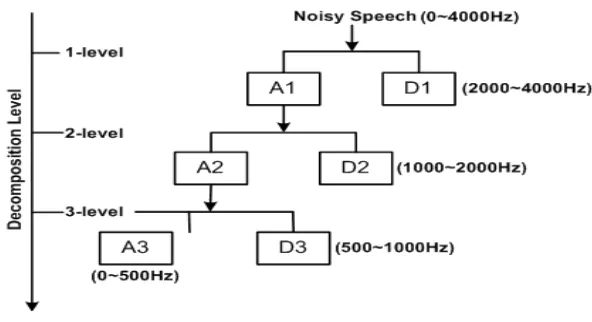
extract speech activity. In addition, the periodicity is almostly concentrated in low frequency bands, so we let the low frequency bands have high resolution in order to enhance the periodic property by decomposing only low bands in each level. Figure 2 employed the used structure of three-level wavelet decomposition. By using DWT, we can divide the speech signal into four non-uniform subbands. The wavelet decomposition structure can be used to obtain the most significant periodicity in the subband domain.
Figure 1. Discrete wavelet transform (DWT) using filter banks
Figure 2. Structure of three-level wavelet decomposition
2.2
Teager Energy Operator
92 Bing-Fei Wu and Kun-Ching Wang
In this subsection, the ACF will be defined in the subband domain and called the “Subband Signal Auto-Correlation Function (SSACF).” It can be derived from the wavelet coefficients on each subband following TEO processing.
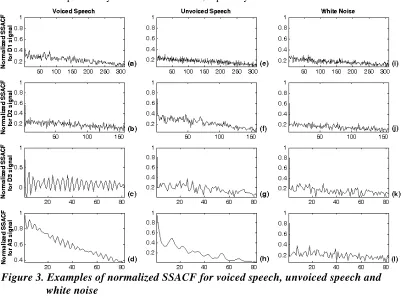
Figure 3 displays that the waveform of the normalized SSACFs ( (0)R =1) of each subband, respectively. It is observed that the SSACF of voiced speech has more obvious peaks than that of unvoiced speech and white noise does. In addition, for unvoiced speech, the ACF has more intense periodicity than white noise does, especially in the A3 subband.
Figure 3. Examples of normalized SSACF for voiced speech, unvoiced speech and white noise
2.4
Mean of the absolute values of the DSSACF (MDSSACF)
To evaluate the periodic intensity of subband signals, a Mean-Delta method is applied here to each SSACF. First, a measure similar to delta cepstrum evaluation is used to estimate the periodic intensity of the SSACF, namely, the “Delta Subband Signal Auto-Correlation Function (DSSACF),” as shown below:
2
( )
( )
M
m M
M M
m M
mR k m
R k
m
=−
=−
+ =
∑
∑
Voice Activity Detection Based on Auto-Correlation Function Using 93 Wavelet Transform and Teager Energy Operator
where RM is the DSSACF over an M -sample neighborhood.
For a particular frame, it is computed by using only the frame’s SSACF (intra-frame processing), while the delta cepstrum is computed by using cepstrum coefficients from neighboring frames (inter-frame processing). It is observed that the DSSACF value is almost similar to the local variation over the SSACF.
Second, the delta of the SSACF is averaged over an M -sample neighborhood RM, where the mean of the absolute values of the DSSACF (MDSSACF) is given by
1
0
1
( )
b N
M M
k b
R R k
N
−
=
= ∑ , (9)
where Nb indicates the length of the subband signal.
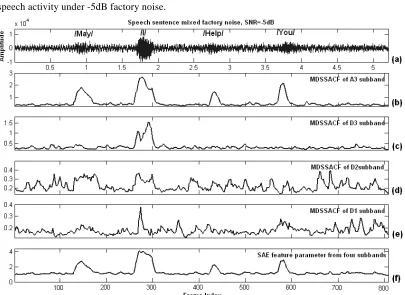
Figure 4 shows that the SAE feature parameter is developed by summing the four MDSSACF values. Each subband can provide information for extracting voice activity precisely. It is found that the SAE feature parameter accurately indicates the boundary of speech activity under -5dB factory noise.
94 Bing-Fei Wu and Kun-Ching Wang
2.5
Block Diagram of the Proposed Wavelet-Based VAD
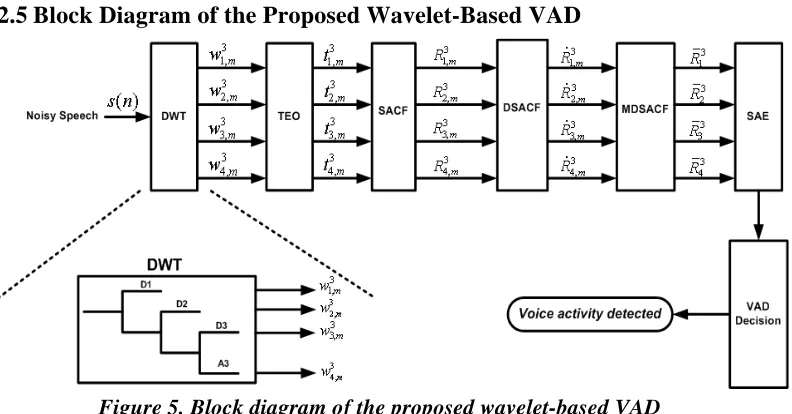
Figure 5. Block diagram of the proposed wavelet-based VAD
A block diagram of the proposed wavelet-based VAD algorithm is displayed in Figure 5. For a given level j , the wavelet transform decomposes the noisy speech signal into j+1 subbands corresponding to wavelet coefficients sets, wk nj, . In this case, for level j=3,
3
, { ( ), 3}, 1.... , 1....4
k m
w =DWT s n n= N k= , (10)
where w3k m, denotes the mth coefficient of the kth subband. N denotes the window length. The decomposed length of each subband is N 2k . If k=1, w1,3m corresponds to the D1th subband signal.
In TEO processing,
3 3
, [ , ], k=1...4
k m d k m
t =ψ w . (11) The SSACF is derived from the Teager energy of noisy speech as follows:
3 3
, [ , ]
k m k m
R =R t , (12)
where R[ ]⋅ denotes the auto-correlation operator. Next, the DSSACF is given by
3 3
, [ , ]
k m k m
96 Bing-Fei Wu and Kun-Ching Wang
2 2 2
[SAEbuffer ]mean( )t = ⋅γ [SAEbuffer ]mean(t− + − ⋅1) (1 γ) SAE t( ) . (21)
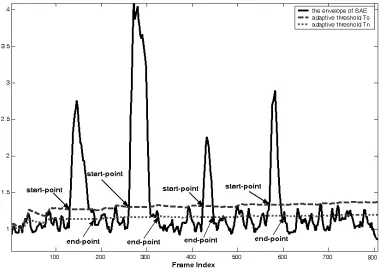
Here, [SAEbuffer2]mean(t−1) is a mean of the buffer of the SAE value during a noise-only frame. We then update the thresholds by using the updated mean and variance of the values of the SAE parameters. Figure 6 displays the VAD decision, based on the adaptive threshold strategy. It is clearly seen that the boundary of voice activity has been accurately extracted. The two thresholds are updated during voice-inactivity but not during voice-activity.
Figure 6. Adaptive thresholding strategy for extracting the boundary of voice activity
3. Simulation Results
The proposed wavelet-based VAD algorithm operates on a frame-by-frame basis (frame size = 256 samples/frame, overlapping size = 64 samples, M =8 , αs =5 , βn = −1 and
0.95
98 Bing-Fei Wu and Kun-Ching Wang
Table 2. The computing time required by the three VAD algorithms
VAD type Feature Extraction Processing Voice Activity Decision
G.729B 0.048 s 0.023 s
Chen’VAD 4.126 s 0.098 s
Proposed VAD 0.23 s 0.12 s
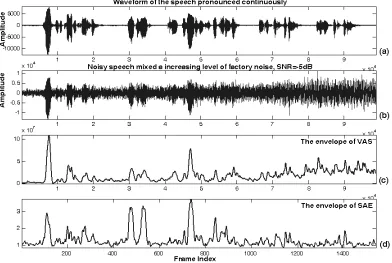
Figure 7 shows the performance of the proposed VAD for an utterance produced continuously under variable-level noise. We decreased and increased the level of background noise and set the SNR value to 0 dB. Compared with the envelope of the VAS parameter, it is observed that the envelope of the SAE parameter was more robust against the variable noise-level and able to extract the exact boundary of the voice activity. This can be mainly attributed to the fact that the value of each MDSSACF depends on the amount of variation of the ACF, not on the energy level of the signal.
Voice Activity Detection Based on Auto-Correlation Function Using 99 Wavelet Transform and Teager Energy Operator
4. Discussion
Compared with Chen’s wavelet-based VAD, our experimental results shows that the proposed wavelet-based VAD algorithm is more suitable for on-line work. In terms of complexity, Chen’s wavelet-based VAD algorithm [Chen et al. 2002] requires five-level wavelet decomposition to decompose the speech signal into 17 critical-subbands by using PWPT. In addition, it uses more extra computing time to complete wavelet reconstruction. In tests with non-stationary noise, it was found that each MDSSACF depends only on the amount of variation of the normalized ACF, not on the energy level of the signal, so the envelope of the proposed SAE feature parameter is insensitive to variable-level noise. Conversely, in Chen’s wavelet-based method, the VAS feature parameter closely depends on the subband energy, so the achieved performance is poor under variable-level noise.
Acknowledgments
This work was supported by National Science Council of Taiwan under grant no. NSC 94-2213-E-009-066.
Reference
Benyassine, A., E. Shlomot, H. Y. Su, D. Massaloux, C. Lamblin, and J. P. Petit, “ITU-T Recommendation G.729 Annex B: a silence compression scheme for use with G.729 optimized for V.70 digital simultaneous voice and data applications,” IEEE Communications Magazine, 35(9), 1997, pp.64-73.
Beritelli, F., S. Casale, and A. Cavallaro, “A robust voice activity detector for wireless communications using soft computing,” IEEE Journal on Selected Areas in Communications, 16(9), 1998, pp.1818-1829.
Bovik, A. C., P. Maragos, and T. Quatieri, “AM-FM energy detection and separation in noise using multiband energy operators,” IEEE Transactions on Signal Processing, 41(12), 1993, pp.3245-3265.
Chen, S.H., and J.F. Wang, “A Wavelet-based Voice Activity Detection Algorithm in Noisy Environments,” International Conference on 9th Electronics, Circuits and Systems, 2002, pp.995-998.
Cho, Y. D., and A. Kondoz, “Analysis and improvement of a statistical model-based voice activity detector,” IEEE Signal Processing Letters, 8(10), 2001, pp.276-278.
Freeman ,D. K., G. Cosier, C. B. Southcott, and I. Boyd, “The voice activity detector for the pan European digital cellular mobile telephone service,” International Conference on Acoustics, Speech, and Signal Processing, 1989, pp.369-372.
100 Bing-Fei Wu and Kun-Ching Wang
Jabloun, F., A. E. Cetin, and E. Erzin, “Teager energy based feature parameters for speech recognition in car noise,” IEEE Signal Processing Letters, 6(10), 1999, pp.259-261. Kaiser, J. F., “On a simple algorithm to calculate the ‘energy’ of a signal,” International
Conference on Acoustics, Speech, and Signal Processing, 1990, pp.381-384.
Kondoz, A. M., Digital Speech Coding for Low Bit Rate Communications Systems, John Wiley & Sons Ltd., 1994.
Mallat, S., “A theory for multiresolution signal decomposition: the wavelet representation,” IEEE Transactions on Pattern Analysis and Machine Intelligence, 11(7), 1989, pp.674-693.
Nemer, E., R. Goubran and S. Mahmoud, “Robust voice activity detection using higher-order statistics in the LPC residual domain,” IEEE Transactions on Speech and Audio Processing, 9(3), 2001, pp.217-231.
Ouzounov, A., “A Robust Feature for Speech Detection,” Cybernetics and Information Technologies, 4(2), 2004, pp.3-14.
Sohn, J., and W. Sung, “A voice activity detector employing soft decision based noise spectrum adaptation,” International Conference on Acoustics, Speech, and Signal Processing, 1998, pp.365-368.
Strang, G., and T. Nquyen, Wavelet and Filter Banks, Wellesley-Cambridge Press, 1996. Varga, A., and H. J. M. Steeneken, “Assessment for automatic speech recognition: II.
![Table 1. Performance of the proposed wavelet-based approach, Chen’s wavelet-based approach [9] and G.729B VAD](https://thumb-us.123doks.com/thumbv2/123dok_us/1094957.1138364/11.539.65.479.448.673/table-performance-proposed-wavelet-based-approach-wavelet-approach.webp)