Computational Man-Machine
Interaction in Simple Natural Language
A b stra ct
For a wide variety o f semantic theories we shall present a common method o f calculating the semantic representation when starting from the input text and a grammar covering the syntactic description o f the text. It appears that the so-called data-flow trees play a huge and central role in this kind o f analysis and translation into a semimtic representation. The method here seems particularly well fit for the analysis o f natural language queries to database systems. The considerations here are rather tentative and reflect research in progress.
Introduction
T h is p a p e r in v estig a tes m e t h o d s a n d t o o ls fo r d e v e lo p in g a s p e c ific k in d o f m o d e l o f h u m a n la n g u a g e lea rn in g ca p a b ility , b y p re s e n tin g a p e r fo r m a t iv e s im u la tio n m o d e l (h e re te r m e d a c o m p u ta tio n a l lo g ic o -s e m a n tic in d u c tio n s y s te m [16, 1 8 ]).
T h e s£tme m e t h o d s a n d t o o ls m a y b e a p p lie d fo r th e p u r p o s e o f im p le m e n tin g a w id e v a rie ty o f c o m p u ta tio n a l s y s te m s in c lu d in g c e r ta in k in d s o f r u le -b a s e d e x p e r t s y ste m s a n d ce rta in k in d s o f m o d e r n g ra m m a rs (in p a r tic u la r th e s o - ca lle d u n ifica tio n g r a m m a r s ) [17].
T h e a d v a n ta g e o f lo g ic o -s e m a n tic in d u c tio n is its a p p lic a b ility in th e c o n t e x t o f c o n s tr u c tin g n a tu ra l la n g u a g e in te rfa ce s as w ell as a v a rie ty o f o th e r u ser- frie n d ly ty p e s o f in te rfa ce s t o e x p e r t s y s te m s a n d o th e r c o m p u t e r sy s te m s .
W e a re s tu d y in g th e p r o b le m o f c o n s tr u c tin g la n g u a g e a c q u is itio n m o d e ls fr o m s p e cific d a ta . T h a t is, w e c o u ld b e c la im e d t o b e m o d e llin g a n e x tr e m e ly a d v a n ce d ty p e o f in fo r m a tio n p r o c e s s in g s y s te m s , v iz . h u m a n b e in g s in th e ro le o f a cq u irin g la n g u a g e ca p a b ilitie s . H o w e v e r, w e a re m o d e llin g th e p e r fo r m a t iv e a s p e cts on ly . N o c la im w h a ts o e v e r is m a d e as t o th e p o s s ib le d e s c r ip t iv e p o w e r o f th e resu ltin g m o d e ls fr o m a p s y c h o lo g ic a l p o in t o f v ie w (s o w e m ig h t c a ll it p u rely a n tr o p o m o r p h ic in fo r m a tio n t e c h n o lo g y ).
T h e fo c u s o f th is p a p e r is o n lo g ic o -s e m a n tic in d u c tio n w h ich is a m e t h o d fo r th e s y s te m a tic p a tte r n id e n tific a tio n a n d e x t r a c t io n in lin g u is tic d a t a s e q u e n ce s.
Figure 1:
r.
Np (•
Prop(
)
V
p
C
Vp.
that
S (
)
Mary
Figure 3:
h a v in g th e relev a n t w o r d as its t o p v e r te x , is b e in g c o n s tr u c te d as th e resu lt a t t r ib u t e o f th e v e rte x .
S te p 4: C o n s t r u c t th e flo w fr o m th e s o -c a lle d fo c u s v a ria b le s (fo r m a n ew vari a b le f o r e a c h N p p h ra se , as in flg u re 2 ).
S te p 5: C o n s t r u c t th e flo w in th e le x ic a l rules.
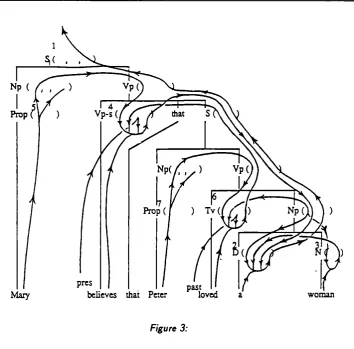
S te p 6: C o n n e c t e a c h p a ir o f n u m b e rs c o r r e s p o n d in g t o an e d g e in th e resu lt s tr u c tu r e (h e r e th e tr e e s tr u c tu r e s h o u ld b e r e s p e c te d , as in flgu re 3 w h e re th e fo llo w in g p a irs a re c o n n e c t e d : 7 - 6 , 5 - 4 , 6 - 4 , 3 - 2 , 4 - 2 , 2 - 1 ) .
S te p 7: C h e c k th e c o n s is t e n c y c o n c e r n in g a r ity a n d lo c a l flow .
In o u r e x a m p le th e a u g m e n te d s y n t a c t ic s tr u c tu r e w ill b e like fig u re 3.
T h e re s u ltin g lo g ic g r a m m a r w ill b e th e fo llo w in g :
( 7 ) S ( V ,W ,U ) N p ( X , Y , Z ) , V p ( X , W , V , U ) N p ( X , Y , Z ) P r o p ( X )
N p ( X , Z , W ) ^ D ( X , Y , Z , W ) , N ( X , Y )
V p ( Y , X l , Y l , V ) ^ V p - s ( X ,Y ,Z ,W ) ,[ t h a t ] ,S ( W , Z ,V ) V p ( Y , W , V , U ) ^ T v ( X , Y , Z , W ) , N p ( Z , V , U )
D ( X , Y , Z , a ( X , Y , Z ) ) ^ [a]
Concluding Remarks and Perspectives
A s t o w h ich re p re s e n ta tio n la n g u a g e s a re a c c e p ta b le w ith r e s p e c t t o th is m e t h o d , th ere seem s t o b e a h ig h d e g r e e o f fr e e d o m s o th a t w e seem t o b e n e a r th e im p le m e n ta tio n o f a gen era l in fo r m a tio n th e o r e tic a l o r c o m p u t e r s c ie n c e p a r a d ig m like th is:
A n y w a y , th ere e x is ts a req u ire m e n t th a t a k in d o f h o m o m o r p h y p r o p e r ty , a k in d o f c o m p o s it io n a lit y s h o u ld b e a v a ila b le in th e re la tio n s h ip b e tw e e n in p u t a n d o u tp u t. O n e o r a n o th e r va ria n t o f F re g e ’s p r in c ip le o f c o m p o s it io n a lit y sh o u ld b e o b ta in e d :
T o th e e x te n t th a t o u r ru les axe o f th e fo r m
P o ( G ( y i , ... ,y n ) ) - > p i ( y i ) ,. .. ,P n ( y n )
w e k n ow a b o u t th e se m a n tic re p re se n ta tio n fu n c tio n S em th a t
S e m ( P o ) = G ( S e m ( P i ) ,. .. ,S e m ( P n ) )
w h ere P o = P i ^ P
2
^ Pnp r o v id e d th a t P^ is th e fra g m e n t o f th e in p u t te x t b e lo n g in g t o th e s y n ta x c a t e g o r y pk fo r all k e { 0 , l , . . , n } .
A n d th is p r o p e r ty is p re cise ly o n e w a y o f e x p r e s s in g P reg ea n c o m p o s itio n a lity . O n e p e r s p e c tiv e o f th is a p p r o a c h is th a t it a llo w s a g e n e ra lis a tio n in to w h a t w e te n d t o c a ll c o m p u ta tio n a l lo g ic o -s e m a n tic a b s tr a c t io n [18]. In th is c o n te x t it is p r o fita b le t o m a k e u se o f ce rta in resu lts fr o m th e m o d e r n c o m p u te r s c ie n c e d iscip lin es o f lo g ic p r o g r a m m in g , a tt r ib u te g ra m m a rs , a n d d e n o ta tio n a l s e m a n tic th eories.
A n o t h e r p e r s p e c tiv e c o n c e r n s a u to m a t e d le a rn in g . C o m p u t a tio n a l lo g ic o - s em a n tic in d u c tio n has th e p r o p e r ty th a t th e sy s te m w ill b e a b le t o im p r o v e its lin g u istic p e r fo r m a n c e (i.e ., h a n d lin g n e w in fo r m a tio n o f a s e m a n tic n a tu re ) b y a d o p tio n fr o m a sin g le o c c u r r e n c e o f a g r a m m a t ic a l ru le. T h a t m u st b e e ffe c tiv e a u to m a te d lea rn in g p a r e x ce lle n ce !
[21] M. McCord. 1982. Using Slots and Modifiers in Logic Grammars for Natural Lan guage. Artificial Intelligence. 18,3:327-367.
[22] M. McCord. 1987. Natural Language Processing in Prolog. A. Walker [ed.]. Knowl
edge Systems and Prolog. Addison-Wesley.
[23] F.C.N. Pereira. 1983. Logic fo r Natural Language Analysis. SRI International. Technical Note 275.
[24] F.C.N. Pereira & D.H.D. Warren. 1983. Parsing as Deduction. SRI Technical Re port 293. Stanford Research Institute.
[25] F. Pereira ii D. Warren. 1980. Definite Clause Grammars for Language Analysis — A Survey o f the Formalism and a Comparison with Augmented Transition Networks. Artificial Intelligence. 13,3:231-278.
[26] U. Reyle W . Frey. 1983. A Prolog Implementation o f Lexical-Functional Gram
mar. Proc. IJCAI, International Joint Conference on Artificial Intelligence. 693-
695.
[27] P. Saint-Dizier. 1985. On Syntax and Semantics o f Modifiers in Natural Language
Sentences. In [15].
[28] P. Saint-Dizier. 1986. An Approach to Natural Language Semantics in Logic Pro gramming. The Journal o f Logic Programming. 3(4):329-356.