Topic-based Multi-document Summarization using Differential Evolution
for Combinatorial Optimization of Sentences
Haruka Shigematsu
Graduate School of Humanities and
Sciences, Ochanomizu University
Bunkyo-ku, Tokyo 112-8610 Japan
[email protected]
Ichiro Kobayashi
Graduate School of Humanities and
Sciences, Ochanomizu University
Bunkyo-ku, Tokyo 112-8610 Japan
[email protected]
Abstract
This paper describes a method of multi-document summarization with evolutionary computation. In automatic document sum-marization, the method to make a summary by finding the best combination of important sentences in target documents is popular ap-proach. To find the best combination of sen-tences, explicit solution techniques such as in-teger linear programming, branch and bound method, and so on are usually adopted. How-ever, there is a problem with them in terms of calculation efficiency. So, we apply evolution-ary computation, especially differential evo-lution which is regarded as a method having a good feature in terms of calculation cost to obtain a reasonable quasi-optimum solution in real time, to the problem of combinatorial op-timization of important sentences. Moreover, we consider latent topics in deciding the im-portance of a sentence, and define three fitness functions to compare the results. As a result, we have confirmed that our proposed meth-ods reduced the calculation time necessary to make a summary considerably, although pre-cision is more worse than the method with an explicit solution technique.
1 Introduction
As a general method of automatic multi-document summarization, we often use the important sen-tence extraction method which obtains the most proper combination of important sentences in tar-get documents for a summary, avoiding redundancy in the generated summary. The explicit solution techniques, e.g., integer programming, branch and
bound method, for optimal combination are often used under some constraints for the best combina-tion of sentences. They have however a problem in terms of calculation costs. In general, if the size of target data sets is huge, the problem of combinatorial optimization becomes NP-hard. On the other hand, as an optimization method to obtain quasi-optimum solution in real time, it is reported that evolution-ary computation is useful for realistic solutions. In this context, we employ differential evolution (DE) known as superior to other evolutionary computa-tion algorithms in terms of calculacomputa-tion costs and the accuracy of solution, and apply it to multi-document summarization. Besides, under an assumption that multiple topics are included in documents, latent topics in documents are extracted by means of latent Dirichlet allocation, we make a summary, consider-ing the latent topics.
2 Related studies
the objective function of selecting best combination of important sentences, and got a good result.
On the other hand, as an optimization method to obtain approximate solution, it has been reported that evolutionary computation is useful – Petkovic et al. (2011) and Nieminen et al. (2003) have compared the ability between explicit solution tech-niques, and dynamic programming and genetic al-gorithm (GA) (Holland, 1975), and confirmed that GA is superior to the explicit techniques in terms of calculation cost. Furthermore, in the experiments in Chandrasekar et al. (2012), differential evolution (DE) (Storn et al., 1996) is superior to GA and par-ticle swarm (Kennedy et al., 1995) in terms of the precision of solution and calculation speed.
As for document summarization using combina-torial optimization techniques, the number of the studies using evolutionary computation has been gradually increasing. Nandhini (2013) applied GA for the combinatorial optimization of sentences so that a generated summary realizes good readability, cohesion, and rich contents, and then showed that their method provided stable precision rather than other methods using explicit solution techniques. Alguliev et al. (2011) proposed a method using dif-ferential evolution to make a summary taking ac-count of covering the whole contents of target docu-ments and removing redundancy of the contents in a generated summary.
As for combinatorial optimization of sentences, the way of deciding an important sentences is es-sential. In general, the importance of a sentence is often decided by the words included in the sentence. As the way of deciding the important words, in ad-dition to the conventional way of using tf-idf, the way of using latent information has been recently regarded as useful. To estimate latent topics in docu-ments, latent Dirichlet allocation (LDA) (Blei et al., 2003) is often used and applied to various NLP ap-plication, e.g., clustering, summarization, informa-tion retrieval, informainforma-tion recommendainforma-tion, etc. As for document summarization, Murray et al. (2009) and Arora et al. (2008) employed LDA to extract important sentences based on latent topics. Gao et al. (2012) have proposed a method employing LDA to make a topic-based similarity graph of sentences, and shown that the method provides high precision. Considering these prior studies, in this study we
propose a multi-document summarization method employing latent topics for deciding the importance of sentences and differential evolution for combina-torial optimization of sentences.
3 Differential evolution
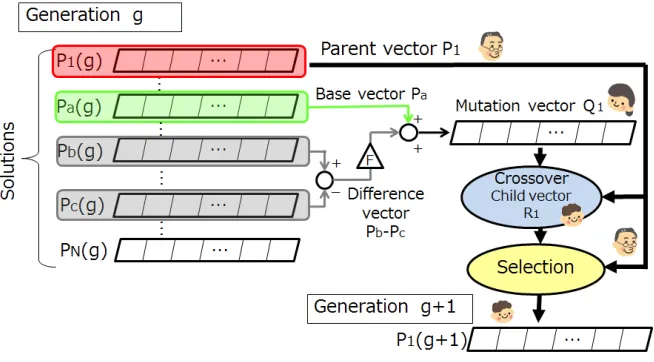
Differential evolution (DE) (Storn et al., 1996) is a kind of evolutionary computation and a population-based stochastic search algorithm to solve a combi-natorial optimization problem. DE has a special fea-ture in mutation operation compared to simple GA (Holland, 1975). It performs based on differences between pairs of solutions for the purpose of decid-ing the orientation in search space by followdecid-ing the distribution of solutions in the current population. DE is regarded as a useful method for optimal so-lution in terms of simplicity, calculation speed and precision. The general DE algorithm is shown as follows:
Step 1. Initialization: N solutions are randomly generated in the initial population.
G(0)={P1(0),P2(0), . . . ,PN(0)}.
Step 2. Completion of judgment: Complete the pro-cess if the number of generation has reached to the predefined number,gmax.
Step 3. Mutation: For each individualPi(g), three unique solutions,Pa(g),Pb(g),Pc(g), are
se-lected from the populationG(g). And then a mutation vectorQi(g)is obtained from a base
vectorPa(g)and a difference vectorPb(g)− Pc(g)as follows:
Qi(g)=Pa(g)+F(Pb(g)−Pc(g)) (1) Here,F is an adjustment parameter for the dif-ference.
Step 4. Crossover:A parent vectorPi(g)and a mu-tation vector Qi(g) are crossed over and a
child vectorRi(g)is generated.
Step 5. Selection of solutions: Compare a parent vectorPi(g)and a child vectorRi(g), the
bet-ter solution is selected for the next generation. This process is adopted to all solutions in the current generation.
Step 6. Return to Step 2.
Figure 1: The DE process from step 3 to step 5
4 Document summarization using DE
Let us assume that target documents consisting of n sentences, and a summary is made by the com-bination of important sentences extracted from the documents. To encode the phenotype of this setting into the genotype, we employ an-length binary vec-tor in which 1 indicates the state of the sentence be-ing selected and 0 is not the state. As for optimal combination of sentences uisng DE, each solution is regarded as the combination of sentences, and there-fore, the best combination of sentences for a sum-mary is found by solving the problem under some constraint such as the length of a summary, etc.4.1 Process of document summarization using DE
A summary is made based on the best solution ob-tained in all generations of DE process. There are some specific processes added to general DE process for document summarization, for example, convert-ing real number vectors into binary vectors which indicates the states of sentence selection, solution selection based on constraint on the length of a sum-mary, etc. Each modified DE process is shown in the following.
4.1.1 Generation of the initial population In DE process, the population G(g) consist-ing of N solutions is evolved in generations g =
0,1, . . . , gmax. Here, thei-th solution at generation g, i.e.,Pi(g), is expressed as follows:
Pi(g)= [pi,1(g), pi,2(g), . . . , pi,n(g)]
In general, the initial populationG(0)is provided by the following equation so as it should be diverse in search space.
pi,s(0) =pmins + (psmax−pmins )·randi,s (2)
Here,pmins andpmaxs are the predefined minimum and the maximum values, respectively. randi,sis a random value of [0,1]. By equation (2), ran-dom values of[pmin
s , pmaxs ]are provided topi,s(s= 1, . . . , n).
4.1.2 Mutation
In general, equation (3) is used to obtain muta-tion vectorQi, however, there are many studies to propose other new vectors in order to obtain a better solution (Mallipeldi et al., 2007; Storn, 1996; Qin et al., 2009; Iorio et al., 2004; Ali, 2011). In our study, we adopt the equation employed by Alguliev et al.(2011) because they have got a good result for document summarization with the equation.
Qi(g)=Pa(g)+F·(Pbest(g)−Pb(g)) +F·(Pbest(g)−Pc(g)) (3)
distri-the initial solutions. As for difference parameter and crossover rate, we setF = 0.45andCR(0) = 0.7, respectively, referring to the study by Alguliev et al. (2011).
5.2 Change of the equation for the initial population
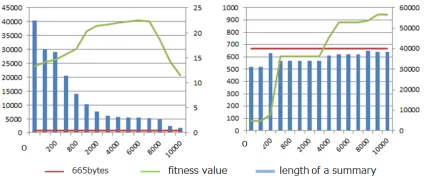
In general, we often generate the initial population randomly by following in equation (2), however, in the case of document summarization, we have con-firmed that most of the solutions in the initial popu-lation generated by equation (2) do not satisfy the given constraint, i.e., the length of a summary is within 665 bytes, in preliminary experiments (see, the left figure in Figure2).
Figure 2: Operation to the generation of the initial popu-lation
If most of the solutions do not satisfy the con-straint, it is difficult to obtain solutions with high fit-ness value satisfying the constraint, even if they are evolved. In this context, we define a new equation to generate the initial population so that the solutions satisfy the constraint at an early generation. Because
ofpmins =−10andpmaxx = 10, the new equation
for the initial population is defined as shown in equa-tion (13).
pi,s(0) = 10−20(1−randi,s)1/(n+1) (13)
With a random value,randi,s(0≤randi,s≤1),
the value of [-10,10] is provided to each locus of Nsolutions. Here,nis an adjustment parameter for occurrence probability of value of [-10,10]. The big-gernis, the closer the value is to -10. By employing equation (13), we have confirmed that solutions tend to satisfy the constraint and fitness value increases as the number of generation increases (see, the right figure of Figure 2).
5.3 Results and consideration
Table 1 shows the precision of the proposed ods and of other methods regarded as baseline meth-ods. In the table, Topic-DEf it1, Topic-DEf it2, and
Topic-DEf it3are the methods using fitness function
1, 2 and 3, respectively. As for the baseline meth-ods, Topic-OPT adopts the same index for the im-portance of a sentence and coverage ratio as well as Topic-DEf it1and employs an explicit solution
tech-nique with CPLEX solver1. CLASSY (Conroy et al., 2005) is the method which provided the highest score at DUC’04.
Methods with without time (sec.) Topic-DEf it1 0.345 0.249 458
Topic-DEf it2 0.337 0.232 447
Topic-DEf it3 0.287 0.145 451
Topic-OPT 0.389 0.326 9548
CLASSY 0.382 0.309
-Table 1: Precision with DUC’04 data set
Compared the results among the three proposed methods, Topic-DEf it1got the highest score for both
cases of with and without stop words – compared Topic-DEf it1with Topic-DEf it2, in terms of
decid-ing the importance of a sentence, we see that it is useful for calculating the importance of a sen-tence based on the total value of words included in the sentence rather than the value of similarity of the topic vector among all sentences. Further-more, as for comparison between Topic-DEf it2and
Topic-DEf it3, in terms of removing redundancy, we
see that it is useful for considering how much the combination of sentences in a generated summary covers the contents of target documents rather than the similarity among the sentences in a summary. Furthermore, compared Topic-OPT with the pro-posed methods, in terms of calculation time, it de-creases considerably by using DE, as we see that ev-ery proposed method takes approximately 450 sec-onds, while Topic-OPT takes approximately 9500 seconds. On the other hand, we also see that the val-ues of ROUGE-1 of the proposed methods are lower than that of Topic-OPT. We think the reason for the difference in precision is that the importance and
1http://www-01.ibm.com/software/commerce/optimization/
objec-Lin, Hui and Bilmes, Jeff, 2010. Multi-document Sum-marization via Budgeted Maximization of Submodular Functions, Human Language Technologies: The 2010 Annual Conference of the North American Chapter of the Association for Computational Linguistics, Los Angeles, California, pp. 912–920.
R. Mallipeldi, P.N. Suganthan, Q.K. Pan, M.F.
Tasge-tiren, 2011 Differential evolution algorithm with
en-semble of parameters and mutation strategies, Ap-plied SoftComputing 11 (2) pp.1679-1696.
Ryan Mcdonald. 2007. A Study of Global Inference
Algorithms in Multi-Document Summarization. Proc. of the 29th European Conference on Information Re-trieval, pp557-564.
Kenton W. Murray. 2009. Summarization by Latent
Dirichlet Allocation: Superior Sentence Extraction through Topic Modeling. A senior thesis for Bache-lors degree, Princeton University.
K. Nandhini and S. R. Balasundaram. 2013. Use of
Genetic Algorithm for Cohesive Summary Extraction to Assist Reading Difficulties. Applied Computational Intelligence and Soft Computing Volume 2013 Article ID 945623, 11 pages.
K. Nieminen, S. Ruuth, and I. Maros. 2003. Genetic
algorithm for finding a good first integer solution for
MILP. Department of Computing, Imperial College
Departmental Technical Report 2003/4, ISSN 1469-4174.
Hitoshi Nishikawa, Tsutomu Hirao, Yoshihiro Matsuo
and Toshiro Makino. 2012. Text Summarization
Model based on Redundancy Constrained Knapsack Problem. In Proc. of the 24th International Con-ference on Computational Linguistics (COLING), pp. 893-902.
Masaaki Nishino, Norihito Yasuda, Tsutomu Hirao, Jun
Suzuki and Masaaki Nagata. 2013.
Summariza-tion while Maximizing Multiple Objectives with La-grangian Relaxation. In Proc. of the 35th European Conference on Information Retrieval (ECIR), pp. 772-775.
Dusan Petkovic 2011. Dynamic Programming
Al-gorithm vs. Genetic AlAl-gorithm: Which is Faster?. Research and Development in Intelligent Systems XXVII, pp 483-488.
A.K. Qin, V.L. Huang, P.N. Suganthan, 2009.
Differ-ential evolution algorithm with strategy adaptation for global numerical optimization, IEEE Transactions on Evolutionary Computation 13 (2) pp.398-417.
R. Storn and K. Price. 1996. Minimizing the Real
Func-tions of the ICEC96 Contest by Differential Evolution. Proc. of the International Conference on Evolutionary Computation, pp. 842-844.
R. Storn 1996, On the usage of differential evolution
for function optimization, Proceedings of the Biennial
Conference of the North American Fuzzy Information Processing Society, Berkeley, USA, June 19.22, pp. 519-523.
Haruka Shigematsu and Ichiro Kobayashi, 2012. Text
Summarization based on Latent Topic Distribution, The 26th Annual Conference of the Japanese Society for Artificial Intelligence, 4I1-R-9-1 (in Japanese)
Hiroya Takamura and Manabu Okumura 2009. Text
summarization model based on the budgeted median problem, Proceedings of the 18th ACM conference on Information and knowledge management CIKM ’09, Hong Kong, China, pp.1589–1592.
Dingding Wang, Shenghuo Zhu, Tao Li and Yihong
Gong, 2009. Multi-Document Summarization
us-ing Sentence-based Topic Models, Proc. of the ACL-IJCNLP 2009, pp.297-300.
Yih, Wen-tau and Goodman, Joshua and
Vander-wende, Lucy and Suzuki, Hisami, 2007.