Clustering Sentences with Density Peaks for Multi-document
Summarization
Yang Zhang
Shenzhen Graduate School Peking University, China [email protected]
Yunqing Xia
Dept. of Comp. Sci. and Tech. Tsinghua University, China [email protected]
Yi Liu
IMSL, PKU-HKUST Shenzhen Hong Kong Institution, China
Wenmin Wang
Shenzhen Graduate School Peking University, China [email protected]
Abstract
Multi-document Summarization (MDS) is of great value to many real world applications. Many scoring models are proposed to select appropriate sentences from documents to form the summary, in which the clustering-based methods are popular. In this work, we propose a unified sentence scoring model which mea-sures representativeness and diversity at the same time. Experimental results on DUC04 demonstrate that our MDS method outper-forms the DUC04 best method and the ex-isting clustering-based methods, and it yields close results compared to the state-of-the-art generic MDS methods. Advantages of the proposed MDS method are two-fold: (1) The density peaks clustering algorithm is firstly adopted, which is effective and fast. (2) No external resources such as Wordnet and Wikipedia or complex language parsing al-gorithms is used, making reproduction and deployment very easy in real environment.
1 Introduction
Document summarization is the process of gener-ating a generic or topic-focused summary by re-ducing documents in size while retaining the main characteristics of original documents(Wang et al., 2011). The summary may be formed in a variety of different ways, which are generally categorized as abstractive and extractive(Shen et al., 2007). In this paper, we address the problem of generic multi-document summarization (MDS). An effective sum-marization method should properly consider the fol-lowing three important issues: representativeness,
diversity, conciseness.
Many scoring models are proposed to select ap-propriate sentences from documents to form the summary, in which the clustering-based methods are popular. Some researchers address the sentence scoring task in an isolation manner(Radev et al., 2004; Wang et al., 2008; Wan and Yang, 2008) (i.e., clustering and ranking are two independent steps). Others handle the sentence ranking task in a mutuality manner(Cai and Li, 2013; Cai et al., 2010; Wang et al., 2011) (i.e., clustering improves ranking and vice versa). Two drawbacks of the existing clustering-based methods are worth noting. First, extra algorithms are required to determine the number of clusters beforehand. Second, models are required to rank or score sentences within and across the clusters after clustering.
Our proposed MDS method is inspired by the recent work on density peaks clustering (DPC) al-gorithm published onScience(Rodriguez and Laio, 2014). The underlying assumption is that clus-ter cenclus-ters are characclus-terized by a higher density than their neighbors and by a relatively large dis-tance from points with higher densities. In this paper, we adapt the density peaks clustering algo-rithm(Rodriguez and Laio, 2014) to simultaneously cluster sentences and rank them in the mutuality manner. Thanks to the density peaks clustering algorithm, we do not need to set the number of clusters and do notneed a post-processing module to reduce redundancy. From the view of summa-rization task, DPC is superior to other clustering methods because it can not only find the best cluster centers, but also do rank all data points, including
cluster centers, within and across clusters at the same time. Experimental results on the DUC2004 demonstrate that our method outperforms the best method in DUC04 and yields close results compared to the state-of-the-art unsupervised MDS methods.
The major contributions of this work are two-fold: Firstly, a unified sentence scoring model is proposed to consider representativeness, diversity and conciseness at the same time. Secondly, the density peaks clustering algorithm is first applied in the MDS task. We further revise the clustering algorithm to address the summary length constraint.
2 Related Work
A vast number of methods are reported in litera-tures on MDS. The MDS methods can be generally categorized into abstractive and extractive. The extractive MDS can be also categorised into super-vised and unsupersuper-vised. Several supersuper-vised learning methods have been developed for training accurate model for extract-based summarization. The unsu-pervised methods, on the other hand, also contribute a lot to MDS. In this work, we put our contributions in context of the sentence ranking-based extractive MDS under the unsupervised framework.
Several clustering-based MDS methods have also been proposed. For example, ClusterHITS is pro-posed to incorporate the cluster-level information into the process of sentence ranking(Wan and Yang, 2008). RankClus is proposed to update sentence ranking and clustering interactively and iteratively with frequency relationships between two sentences, or sentences and terms (Cai et al., 2010). Some kinds of matrix factorization methods are also ex-plored in MDS methods(Gong and Liu, 2001; Lee et al., 2009; Wang et al., 2008; Wang et al., 2011; Shen et al., 2011). For example, matrix factorization methods is adopted to generate sentence clusters, in which non-negative factorization is performed on the term-document matrix using the term-sentence matrix as the base so that the document-topic and sentence-topic matrices could be constructed(Wang et al., 2008).
We follow the idea of clustering-based sentence ranking. Different from the previous work, we attempt to design a unified sentence scoring model to rank sentences and reduce redundancy at the same
time.
3 Method
In this work, the density peaks sentence clustering (DPSC) method is designed for multi-document summarization.
3.1 Density Peaks Sentence Clustering
The density peaks clustering (DPC) algorithm is achieved upon the object similarity matrix. Ob-jects are finally assigned density values and mini-distance values. In this work, we consider sentences as objects and follow the framework to calculate representativeness score and diversity score of each sentence in a unified model.
To construct the sentence similarity matrix for the DPC algorithm, we first segment documents into sentences and remove the non-stop words in the sentences. We then represent the sentences using bag-of-words vector space model, thus the cosine equation is applicable to calculate sentence similarity. The terms can be weighted with different schemes such asboolean(occurring or not),tf (ter-m frequency) andtf ∗isf (term frequency inverse sentence frequency). We finally choose the boolean scheme in our experiments because it performs best in our empirical study.
3.2 Representativeness Scoring
For document summarization, we need a represen-tative score to quantify the degree how much a sentence is important in the documents. Enlightened by the DPC algorithm, we assume that when a sentence has more similar sentences (i.e., higher density), it will be considered more important or more representative. Thus we define the following function to calculate the representativeness score
sREP(i)for each sentences
i:
sREP(i) = 1
K K X
j=1,j6=i
χ(simij −δ), (1)
χ(x) = (
1 ifx >0
prede-fined density threshold. Note that we set the density threshold following (Rodriguez and Laio, 2014), which attempts to exclude the sentences holding lower similarity with the current sentence.
3.3 Diversity Scoring
Most of the previous work handles diversity via reduce redundancy in a post processing module after the sentences are ranked. In this work, we measure diversity in the ranking model.
Diversity score of a sentence is measured by com-puting the minimum distance between the sentence
siand any other sentences with higher density score.
In order to reflect the above observation, we de-fine the following function to calculate the diversity scoresDIV(i):
sDIV(i) = 1− max
j:sREP(j)>sREP(i)simij. (3)
For the sentence with the highest density, we conventionally take
sDIV(i) = 1−min
j6=i simij. (4)
The proposed diversity score looks similar to the famousMaximum Marginal Relevance(MMR) (Carbonell and Goldstein, 1998), which is widely used in removing redundancy by using a greedy algorithm to remove sentences that are too similar to the already selected ones. The difference lies that MMR selects a sentence by comparing it to those selected sentences while we compare it to all the other sentences in the dataset, thus it can enhance the diversity globally.
3.4 Length Scoring
It is widely accepted that summarization task has an important constraint, i.e., summary length. In order to satisfy this constraint, the length of selected sentences should be as short as possible. Based on this analysis, we propose the length score, which has relationship with the effective length and real length. Thereal lengthis defined as the number of word occurrences that a sentence contains. We then define theeffective lengthas how many unique non-stop terms a sentence contains. We finally define the following function to calculate the length score
sLEN(i).
The motivation to propose the length score is, shorter sentences with better representativeness s-core and diversity ss-core are more favorable for the fi-nal summaries. Furthermore, as we use the Boolean scheme to measure sentence similarity, we only count unique words as effective sentence length.
sLEN(i) = el(si) maxK
j=1el(sj)×log
maxK
j=1rl(sj)
rl(si) ,
(5) whereel(si)returns theeffective lengthof sentence si, andrl(si)thereal lengthof sentencesi.
3.5 Unified Sentence Scoring
Now we integrate representativeness score, diversity score and length score in the following unified sentence scoring function:
sDPSC(i) =sREP(i)×sDIV(i)×sLEN(i). (6)
The assumption is obviously that we need those sentences which are as representative, diversified as possible and contain unique terms as many as possible within a limited length.
In calculation, we simply apply logarithm since:
sDPSC(i)∼logsREP(i) + logsDIV(i) + logsLEN(i)
(7)
3.6 Summary Generation
As three scores above including the representative-ness, diversity and length constraint are measured in a unified sentence scoring model, generating a summary with out method is basically achieved by selecting the higher ranking sentences. In other words, our summary contains more representative and diversified information in the limited length.
Complexity Analysis: Suppose K is the total number of sentences in the document collection. The complexity in calculating the sentence sim-ilarity matrix is O(K2). As the complexity in
4 Evaluation
Two experiments are reported in this paper: comparing the MDS methods and tuning the density threshold. For both experiments, we use the DUC2004(task 2)1 dataset, which is annotated
manually for generic MDS. We adopted ROUGE (Lin, 2004) version 1.5.52 and take F-measure of
ROUGE-1, ROUGE-2 and ROUGE-SU as our evaluation metrics. In pre-processing, we use the Porter Stemmer3in sentence segmenting, stop-word
removing and word stemming. Note that our MDS method is purely unsupervised, and uses no training or development data.
4.1 The MDS Methods
We selected three categories of baselines4:
(1) DUC04 MDS methods: DUC04Best(Conroy et al., 2004).
(2) Clustering-based MDS methods: Centroid (Radev et al., 2004), ClusterHITS(Wan and Yang, 2008), SNMF (Wang et al., 2008), RTC (Cai and Li, 2013), FGB (Wang et al., 2011), and AASum (Canhasi and Kononenko, 2013).
(3) Other state-of-the-art MDS methods:LexRank (graph-based method) (Erkan and Radev, 2004), CSFO (optimization-oriented method) (Lin and Bilmes, 2011) and WCS (aggregation-oriented method) (Wang and Li, 2012).
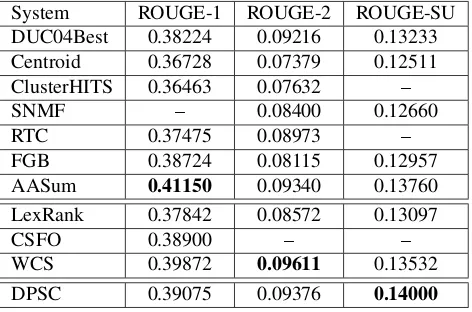
For our DPSC method, we adopt the following settings: (1) Density threshold is set 0.22 as it is empirically found as optimal in Section 4.2 in the DUC04 dataset. (2) Term weighting scheme is set Boolean. In our experiments, Boolean is found outperforming tf and tfisf in sentence representa-tion, this is because term repetition happens less frequently in short text units like sentences than that in documents. Experimental results of the MDS methods are presented in Table 1. Note the ROUGE values of some MDS methods are not reported in the literatures and marked with0−0 in Table 1.
According to Table 1, DPSC outperforms DUC04Best, which ignores the cross-sentence information to solve the diversity problem. DPSC
1http://duc.nist.gov/duc2004/tasks.html 2Options used: -a -c 95 -b 665 -m -n 4 -w 1.2 3http://tartarus.org/martin/PorterStemmer/
[image:4.612.314.550.90.246.2]4Interested readers can refer to details in the references.
Table 1: Experimental results of the MDS methods on DUC04.
System ROUGE-1 ROUGE-2 ROUGE-SU
DUC04Best 0.38224 0.09216 0.13233
Centroid 0.36728 0.07379 0.12511
ClusterHITS 0.36463 0.07632 –
SNMF – 0.08400 0.12660
RTC 0.37475 0.08973 –
FGB 0.38724 0.08115 0.12957
AASum 0.41150 0.09340 0.13760
LexRank 0.37842 0.08572 0.13097
CSFO 0.38900 – –
WCS 0.39872 0.09611 0.13532
DPSC 0.39075 0.09376 0.14000
outperforms most clustering-based methods except for AASum, which performs slightly better than DPSC on ROUGE-1. AASum is a very complex MDS method which fully exploits the advantages of clustering and the flexibility of matrix factorization. A weakness of the approach is that the number of archetypes must be predefined, and a post-processing module is required to reduce redundancy (Canhasi and Kononenko, 2013).
DPSCalso outperformsLexRankandCSFO, and yields close results compared withWCS. According to Table 1,DPSCperforms slightly worse thanWCS. The marginal performance gain ofWCScomes from the aggregation strategy, namely, multiple MDS systems are required. As a comparison, DPSC is a pure and simple MDS method, exhibiting much lower complexity.
DPSCmethod is also advantageous on usability, because it does not involve any external resources such as Wordnet and Wikipedia or very complex natural language processing algorithms such as sen-tence parsing. Moreover, DPSC is a very fast MDS method. Thus it can be easily reproduced and deployed in real environment.
4.2 Density Threshold
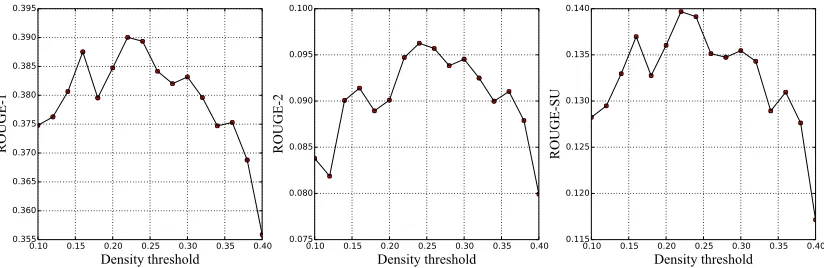
Following (Rodriguez and Laio, 2014), we design an experiment on DUC04 dataset to investigate how the density threshold influences quality of the sum-maries. We tune the density threshold by varying it from 0.10 to 0.40(see the X-axis in Figure 1).
0.10 0.15 0.20 0.25 0.30 0.35 0.40
Density threshold
0.355 0.360 0.365 0.370 0.375 0.380 0.385 0.390 0.395
ROUGE-1
0.10 0.15 0.20 0.25 0.30 0.35 0.40
Density threshold
0.075 0.080 0.085 0.090 0.095 0.100
ROUGE-2
0.10 0.15 0.20 0.25 0.30 0.35 0.40
Density threshold
0.115 0.120 0.125 0.130 0.135 0.140
[image:5.612.101.513.64.198.2]ROUGE-SU
Figure 1: ROUGE curves of DPSC method varying the density threshold.
when the density threshold is set around 0.22 while starts to drop significantly after 0.30. This indicates that 0.22 is a good setting for the density threshold on DUC04.
5 Conclusion and Future Work
In this paper we report the density peaks sentence clustering (DPSC) method for multi-document sum-marization. Different from the prior work which deals with representativeness and redundancy in-dependently, a unified sentence scoring model is designed in DPSC to combine the representative-ness score, the diversity score and the length s-core of each sentence. Experimental results on DUC04 dataset show that DPSC outperforms the DUC04 best method and the existing clustering-based methods. Meanwhile, it yields close results when compared with the state-of-the-art generic MDS methods. It is thus verified that density peaks clustering algorithm is able to handle MDS effectively.
However, this work is still preliminary. We will study semantic text similarity to improve the sentence similarity matrix. We will then apply the proposed method in query-based multi-document summarization.
Acknowledgement
This work is partially supported by Natural Science Foundation of China (61272233, 61373056, 61433018) and Shenzhen Peacock Scheme(183003656). We thank the reviewers for the insightful comments.
References
Xiaoyan Cai and Wenjie Li. 2013. Ranking through clustering: An integrated approach to multi-document
summarization. Audio, Speech, and Language
Processing, IEEE Transactions on, 21(7):1424–1433. Xiaoyan Cai, Wenjie Li, You Ouyang, and Hong
Yan. 2010. Simultaneous ranking and clustering of sentences: a reinforcement approach to
multi-document summarization. InProceedings of the 23rd
International Conference on Computational
Linguis-tics, pages 134–142. Association for Computational
Linguistics.
Ercan Canhasi and Igor Kononenko. 2013. Multi-document summarization via archetypal analysis of
the content-graph joint model. Knowledge and
Information Systems, pages 1–22.
Jaime Carbonell and Jade Goldstein. 1998. The use of mmr, diversity-based reranking for reordering
docu-ments and producing summaries. In Proceedings of
the 21st annual international ACM SIGIR conference on Research and development in information retrieval, pages 335–336. ACM.
John M Conroy, Judith D Schlesinger, Jade Goldstein, and Dianne P Oleary. 2004. Left-brain/right-brain
multi-document summarization. InProceedings of the
Document Understanding Conference (DUC 2004). G¨unes Erkan and Dragomir R Radev. 2004. Lexrank:
Graph-based lexical centrality as salience in text
summarization.J. Artif. Intell. Res.(JAIR), 22(1):457–
479.
Yihong Gong and Xin Liu. 2001. Generic text
summarization using relevance measure and latent
semantic analysis. InProceedings of the 24th annual
international ACM SIGIR conference on Research and development in information retrieval, pages 19–25. ACM.
based on non-negative matrix factorization. Informa-tion Processing & Management, 45(1):20–34.
Hui Lin and Jeff Bilmes. 2011. A class of
submodular functions for document summarization. In Proceedings of the 49th Annual Meeting of the Association for Computational Linguistics: Human Language Technologies-Volume 1, pages 510–520. Association for Computational Linguistics.
Chin-Yew Lin. 2004. Rouge: A package for automatic
evaluation of summaries. In Text Summarization
Branches Out: Proceedings of the ACL-04 Workshop, pages 74–81.
Dragomir R Radev, Hongyan Jing, Małgorzata Sty´s, and Daniel Tam. 2004. Centroid-based summarization
of multiple documents. Information Processing &
Management, 40(6):919–938.
Alex Rodriguez and Alessandro Laio. 2014. Clustering
by fast search and find of density peaks. Science,
344(6191):1492–1496.
Dou Shen, Jian-Tao Sun, Hua Li, Qiang Yang, and Zheng Chen. 2007. Document summarization using
conditional random fields. InIJCAI, volume 7, pages
2862–2867.
Chao Shen, Tao Li, and Chris HQ Ding. 2011. Integrat-ing clusterIntegrat-ing and multi-document summarization by bi-mixture probabilistic latent semantic analysis (plsa)
with sentence bases. InAAAI.
Xiaojun Wan and Jianwu Yang. 2008. Multi-document summarization using cluster-based link analysis. In
Proceedings of the 31st annual international ACM SIGIR conference on Research and development in information retrieval, pages 299–306. ACM.
Dingding Wang and Tao Li. 2012. Weighted consensus
multi-document summarization.Information
Process-ing & Management, 48(3):513–523.
Dingding Wang, Tao Li, Shenghuo Zhu, and Chris
Ding. 2008. Multi-document summarization
via sentence-level semantic analysis and symmetric
matrix factorization. InProceedings of the 31st annual
international ACM SIGIR conference on Research and development in information retrieval, pages 307–314. ACM.
Dingding Wang, Shenghuo Zhu, Tao Li, Yun Chi,
and Yihong Gong. 2011. Integrating document
clustering and multidocument summarization. ACM