Article
Development of a Modified Kinetic Method for
Modelling of Biogas Produced from Biomass
Bahman Najafi 1, Sina Faizollahzadeh Ardabili 2 and Shahaboddin Shamshirband 3,4*, Kwok-wing Chau5
1Biosystem Engineering Department, University of Mohaghegh Ardabili, Ardabil 5619911367, Iran;
2 Biosystem Engineering Department, University of Mohaghegh Ardabili, Ardabil 5619911367, Iran;
[email protected], [email protected]
3Department for Management of Science and Technology Development, Ton Duc Thang University, Ho Chi
Minh City, Viet Nam
4Faculty of Information Technology, Ton Duc Thang University, Ho Chi Minh City, Viet Nam
5 Department of Civil and Environmental Engineering, Hong Kong Polytechnic University, Hong Kong, People’s Republic of China
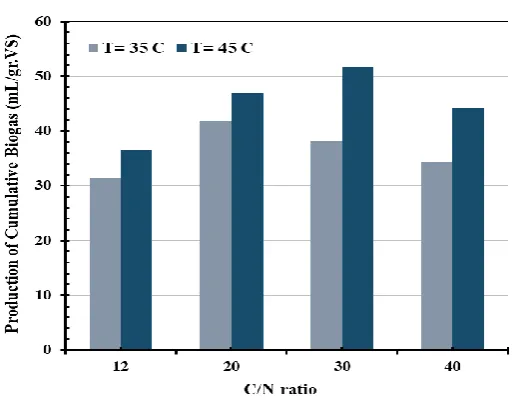
Abstract: The kinetics of biogas production from biomass depends on several factors such as: carbon to nitrogen ratio (C/N), reactor temperature (T), and retention time (RT). The purpose of this study was to obtain a new model for predicting biogas production. Spent Mushroom Compost (SMC) was used to produce biogas in a batch type reactor. The experiments were carried out with different C/N ratios (12.1, 20, 30 and 40) and in both mesophilic (35°C) and thermophilic (55°C) temperatures. The results showed that the Maximum biogas production at 35°C, C/N=20 was equal to 41.9 mL/gVS and 55°C, C/N=30 was equal to 51.6 mL/gVS. By using experimental data, a new kinetic model was proposed to predict biogas production. Comparing the values of the results indicate that the total values of RMSE for Logistics, Gampartz and new kinetic models was 0.1906, 0.1830 and 0.1617, respectively. Therefore, the process of anaerobic digestion of biomass can be assumed to be just a chemical reaction, and the new kinetic model is an appropriate alternative to microbial growth models.
Keywords: Biogas, Chemical kinetics, Anaerobic digestion, Modelling
Nomenclature
SMC Spent Mushroom Compost K(t) Reaction rate
WS Wheat straw a0, ..,a3 Kinetic model polynomial coefficients
TS Total Solids (%) Y=[B] Biogas cumulative production (mL/grVS)
VS Volatile organic material (%) A Maximum potential of biogas production (mL/grVS(
mTS Total weight of the solids (g) A*=[B]∞ Experimental maximum cumulative biogas production (mL/grVS(
m0 Initial weight of the biomass
(g) μm Maximum biogas production rate (mL/gVS.d) mash Weight of solid ash (g) λ Lag phase (days)
TKN Total kjeldahl nitrogen (%) e Euler's function equal to 2.7183
TOC Total organic carbon (%) t Time (day)
xA Target value r Correlation coefficient
xP Predicted value RMSE Root mean square error
1. Introduction
The energy crisis is a result of the deep dependence of societies on fossil fuels. On the one hand, the current trend will lead to the depletion of fossil fuels
,
On the other hand, generations will face a serious energy supply problem. Although the world benefits from rich oil and gas resources, it should not be forgotten that these resources, in addition to limited resources, are national assets and are bound to be preserved for next generations [1-3].In different countries of the world, to solve this serious crisis, various solutions have been proposed, one of the most efficient of which is the use of biogas technology. Biogas technology, in addition to solve many environmental problems as a clean energy source, will provide part of the energy needs. Despite the great potential of the use of this technology, its ease and its important side benefits, so far, this technology has been unfortunately overlooked.
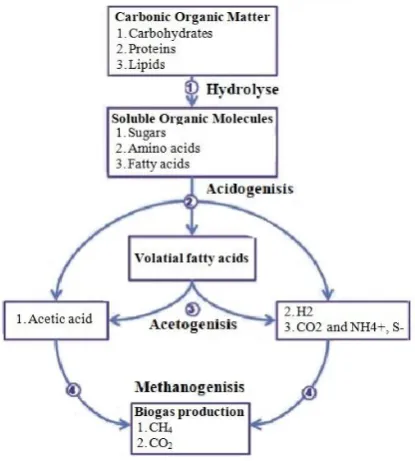
Biogas is obtained from the fermentation or anaerobic digestion of organic materials (such as agricultural waste, human waste, animal waste, urban wastewater and sewage sludge). Anaerobic digestion is a process that converts organic materials into carbon dioxide and methane in the absence of oxygen [4, 5]. This process occurs in four stages: 1) Hydrolysis, 2) Acidogenesis, 3) Acidogenesis, and 4) Methanogenesis. In the hydrolysis step, complex molecules such as fats, proteins, and carbohydrates are converted into simpler organic substances such as sugar, fatty acids with long hydrocarbon chain and amino acids. Then these substances convert to hydrogen, carbon dioxide, and volatile fatty acid at the acidogenesis. Fatty acids convert into hydrogen, carbon dioxide, and acetic acid again in the acidogenesis step. Finally, in the methanogenesis phase, by decomposition of hydrogen, carbon dioxide and acetic acid, methane is produced [6-10]. Figure 1 shows the phases of methane production during the anaerobic fermentation process [10].
Fig 1. Anaerobic Fermentation Process (methane production process)
The anaerobic fermentation is mostly done by mesophilic bacteria in the range of 30-35oC. The
environment of reactors and predict the potential of biogas production as a function of time. In these models, various parameters are involved, and the need for a large amount of input information is also too complicated. In this research, a novel kinetic model is proposed to predict biogas production over time using experimental data from a small scale laboratory.
2. Materials and Methods
2.1 Production and measurement of biogas
In this research, the main materials used were the spent mushroom compost (SMC) and wheat straw. The remaining mushroom compost was collected after leaving the mushroom cultivation halls. Then they were completely milled in a mixer and mixed with wheat straw. To measure the moisture content of the biomass of SMC, 100 g of it was placed in the oven at 24 °C for 24 hours and then weighed again after drying. The weight difference represents the initial moisture content of the biomass. Increasing or decreasing the moisture content of the fermentation tank has a significant effect on the production of biogas. To absorb organic materials by bacteria, it is necessary to be diluted in a solution. Increasing the concentration of the substances leads to increased adhesion and inhibits the growth of bacteria and reducing the concentration causes the solution to straighten.
In this study, dry solids content was considered to be 10%. By subtracting the amount of moisture from the total amount, the total amount of solids (TS) was calculated according to the APHA standard:
100
%
0
=
m
m
TS
TS (1)The percentage of volatile organic material (VS) was also determined by burning 10 grams of solids at a temperature of 550°C for 2 hours in an electric furnace, according to the APHA standard [14, 15]:
100
1
%
−
=
TS ashm
m
VS
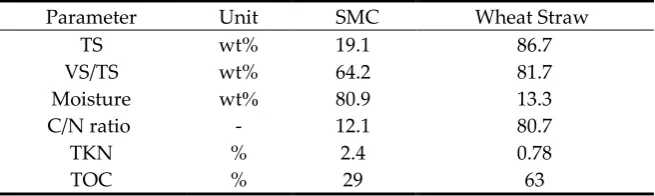
(2)The amount of nitrogen in the biomass was measured using the APHA standard by Kjeldahl and organic carbon content by chemical burning method. The results of the experiments are presented in Table 1:
Table 1.
Initial Characteristics of Spent Mushroom Compost and Wheat Straw
Wheat Straw SMC Unit Parameter 86.7 19.1 wt% TS 81.7 64.2 wt% VS/TS 13.3 80.9 wt% Moisture 80.7 12.1 - C/N ratio 0.78 2.4 % TKN 63 29 % TOC
Bath temperature control was measured and controlled by a digital thermostat with a precision of
±
0.1oC. Water displacement method was used to measure gas volume. In this method, the producedgas was guided to the equilibrium bottle through the interface tubes. As the pressure rises, the water moves upwards in the cylinder. The volume of displaced water is equivalent to the amount of gas produced [17]. Figure 2 shows the biogas production and measurement set. The percentage of methane was also measured by passing the produced biogas from the 0.5 M NaOH solution and absorbing CO2 and H2S by the solution and by water displacement with a precision of ±5mL [18]. To
maintain the pH of the environment, 10 gr of sodium bicarbonate solution was added to each container. During the experiment, pH was measured every day by sampling the solution into the reactors and, if necessary, sodium bicarbonate was added to maintain it in the range of 7 to 8.
Fig 2. The setup of production and measuring of biogas.
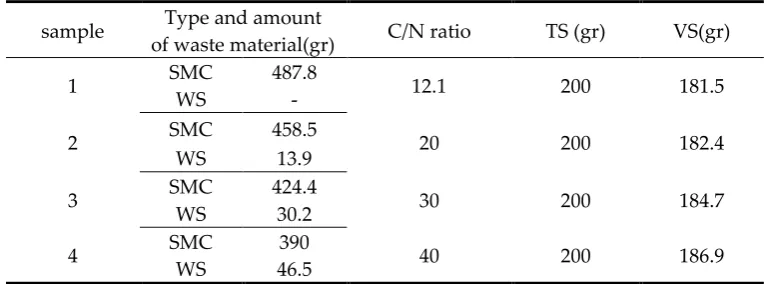
The TS, VS and C/N ratios for spent mushroom compost were 19.1, 64.2 and 12.1, and for wheat straw, 86.7, 81.7 and 126, respectively. The biomass content of bovine waste and wheat straw was 80.9 and 13.3, respectively. These materials were mixed according to table 2 to give 200 gr of total TS for each sample. In each sample, 2 liters of water were added to make the substrate concentration equal to 100 solids (TS=100 gr/L). The C/N ratio of the samples was 12.1, 20, 30 and 40 respectively; in this case, the substrate concentration in terms of volatile solids (VS) was 82.5, 82.9, 83.9 and 9/84 (gr/L). Reactors were loaded at two 35 and 55°C temperatures
.
Table 3 shows the experimental treatments.Table 2.
Loading in each reactor at two 35oC and 55oC temperatures
sample Type and amount
of waste material(gr) C/N ratio TS (gr) VS(gr)
1 SMC 487.8 12.1 200 181.5
WS -
2 SMC 458.5 20 200 182.4
WS 13.9
3 SMC 424.4 30 200 184.7
WS 30.2
4 SMC 390 40 200 186.9
WS 46.5
Table 3.
The treatments of experiment
Sample name R1 R2 R3 R4 R5 R6 R7 R8
Temperature (oC) 35 35 35 35 55 55 55 55
C/N ratio 12 20 30 40 12 20 30 40
To accelerate the digestion process, 10 g of bacteria-rich solution were added to each digestive
.
To prepare the enriched solution, 300 g of bovine stomach contents was mixed with 300 g of water and kept in oven for 5 days at 37°C for bacteria to replicate well. Data was taken at a specific time of every day for 21 days.2.2 Mathematical modeling
Anaerobic digestion is a biological process, but in this study, in order to simplify the model and to accurately predict the potential of biogas production over time, it is assumed that:
• A purely biochemical reaction occurs. In all tests, there are ideal conditions for bacterial activity. That is, the temperature (at the mesophilic or thermophilic temperature) is constant.
• The organic material in the digestion consists only of carbon, hydrogen and oxygen and is completely homogeneous.
• Reaction products only include methane gas and carbon dioxide, which are released daily from the reactor.
In this research, the production of methane and carbon dioxide gas from the biomass is based on the following equation [19].
2 4 2
(
)
(
)
(
)
4
2
2
4
4
2
4
4
a b c
b
c
a
b
c
a
b
c
C H O
+ − −
a
H O
→
− −
CH
+
− −
CO
(3)Where CaHbOcis the chemical formula of organic material, anda,band care fixed numbers. The initial conversion of organic material fermentation can be simplified in the following equation [20].
+
+
→
+
+
+
2 6 12 6 45 13
6
H
NO
H
O
H
C
H
O
NH
C
(4)According to Equation (4), the chemical formula of organic material is (
C
6H
12O
6) in which caseEquation (3) will be
:
4 2
6 12
6
H
O
3
CO
3
CH
C
+
(5)Kinetic studies the anaerobic digestion process is very useful for predicting the digestibility function and provides an understanding of the inhibitory mechanism of biological decomposition. Modified first-order kinetic models are simple and practical models that show the anaerobic digestion of organic material in real conditions. Therefore, in this research, a modified first-order model was used based on the availability of the substrate as a limiting factor [21, 22] . The variation in the concentration of each of the species involved in the reaction depends on the source of the production and is expressed as follows:
6 12 6
6 12 6
[
]
( ).[
]
d C H O
k t
C H O
dt
= −
(6)4
6 12 6
[
]
3 ( ).[
]
d CH
k t
C H O
dt
=
(7)2
6 12 6
[
]
3 ( ).[
]
d CO
k t
C H O
]
[
C
6H
12O
6 is the substrate volatile organic material content (gr/L).k t
( )
is the modified first order mode reaction rate that was assumed to be a function of t.Depending on the temperature, the reaction rate depends on the amount of carbon and nitrogen in the substrate. Digestive microorganisms need energy for their activity, which uses carbon as a source of energy. Also, they need nitrogen to growth and propagation conditions. In this study, these two parameters are expressed as C/N ratio.
By integrating the equation (6) in time:
6 12 6 6 12 6 0
0
[
] [
] . exp(
( ) )
t
C H O
=
C H O
−
k t dt
(9)That:
2 3
0 1 2 3
0
( )
( )
t
K t
=
k t dt
=
a
+
a t
+
a t
+
a t
(10)
By replacing Eq.9 and 10 in Eq.7, the changes in the concentration of produced methane gas are equal to:
4
6 12 6 0
[
]
3 ( ).[
] .exp(
( ))
d CH
k t
C H O
K t
dt
=
−
(11)By integrating Eq.11 in time:
4 6 12 6 0
[
CH
]
= −
3.[
C H O
] .exp(
−
K t
( ))
+
(12)Given the initial conditions (t=0 and
[
CH
4]
=0),
= +
3.[
C H O
6 12 6 0]
is obtained. As a result, changes in methane concentration will be as follows:(
)
4 6 12 6 0
[
CH
]
=
3.[
C H O
] . 1 exp(
−
−
K t
( ))
(13)Equation 13 can be generalized precisely to produce carbon dioxide
:
(
)
2 6 12 6 0
[
CO
]
=
3.[
C H O
] . 1 exp(
−
−
K t
( ))
(14)From Eq.12 and 13 it can be concluded that the changes in the concentration of biogas (total methane gas and carbon dioxide) are:
(
)
4 2 6 12 6 0
[ ] [
B
=
CH
] [
+
CO
]
=
2 3.[
C H O
] . 1 exp(
−
−
K t
( ))
(15)6 12 6 0
[ ]
B
=
2 3.[
C H O
]
(16)By inserting the Eq. 16 into 15 and rewriting it:
(
)
[ ]
B
=
[ ] . 1 exp(
B
−
−
K t
( ))
(17)It needs to be explained that
[
B
]
is the cumulative production of biogas at time t by mL/gVS.2.3 Kinetic Coefficient Calculation Method
For modeling, biogas production data from 8 reactors in 21 days was used. To reduce the error, the tests were performed in two replications. For modeling, the mean biogas production data was used to reduce the error of the measuring instrument with no significant effect on the results. By rewriting equation (17), the produced biogas changes (
[
B
]
) can be linked to time (t
) by the following equation:[ ]
( )
[ ]
[ ]
B
Ln
K t
B
B
=
−
(18)K(t) values were calculated by SPSS software using nonlinear regression modeling. It should be noted that the parameter K(t) depends on the temperature and the ratio of carbon and nitrogen in the substrate.
(
)
* 2 3
0 1 2 3
. 1 exp
(
)
Y
=
A
−
−
a
+
a t
+
a t
+
a t
(19)Where Y=[B] is the present model predicts the cumulative production of biogas at time t by mL/gVS and A*=[B]∞ is the experimental maximum cumulative production of biogas
at the last day.
2.4. Modeling of Microbial Growth
Experiment data of biogas production obtained from anaerobic digestion was used in microbial growth model fitting. The modified Logistic and Gompertz equations were used in order to prediction of trend of microbial growth in an anaerobic digester. Non-linear microbial growth models fitting was performed by using modified Gompertz and modified Logistic models as shown in Eq. (20) and Eq.(21), respectively[23, 24]. It was used to simulate cumulative biogas production.
modified Gompertz model:
1 exp
4
m(
) 2
A
Y
t
A
=
+
− +
modified Logistic model:
.
exp
exp
me
(
) 1
Y
A
t
A
=
−
− +
(21)Where Y is the cumulative production of biogas (mL/gVS) with respect to time t (days), Ais the maximum biogas potential (mL/gVS), μm is the maximum biogas production rate (mL/gVS/d), λ is
lag phase (days) and e is a Euler's function equal to 2.7183.
2.5. Evaluation of Kinetic and Logistic Models
The evaluation and comparing performance of kinetic and Logistic models were checked out using the comparing parameters such as correlation coefficient (r) and the root mean square error (RMSE) as follow.
1/ 2 2 1
2 1
(
)
1
n
A P i
n
Ai i
x
x
r
x
=
=
−
= −
(20)(
)
2 11
NA P
i
RMSE
x
x
N
==
−
(21)Where xA is the target value and xP is the predicted value. The root mean square error (RMSE) measures the difference between predicted and target values and Pearson correlation (r) measures the linear correlation between predicted and target values and shows the degree of linearity of predicted and target values [5].
3. Results
3.1 Effect of C/N ratio and temperature on biogas production
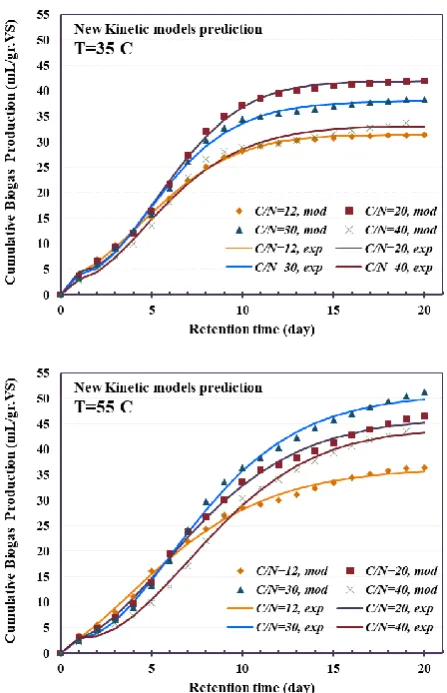
The results showed that the amount of produced biogas during the 21-day period was higher at 55°C than the temperature of 35°C (Figure 3). The average produced biogas in all 4 ratios of carbon to nitrogen (12, 20, 30 and 40) at 35oC equals 36.46 mL/gVS and at 55°C equals 45.02mL/gVS
.
TheFig 3. Effect of C/N ratio and temperature on biogas production
3.2 Daily production rate of biogas
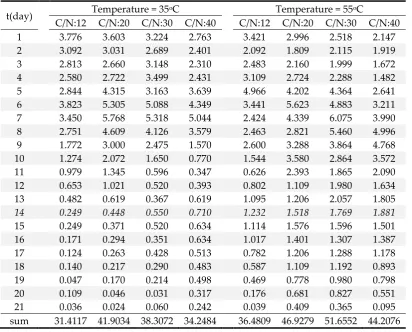
Table 4.
The daily production rate of biogas (mL/grVS)
t(day) C
o
Temperature = 35 Temperature = 55oC
C/N:12 C/N:20 C/N:30 C/N:40 C/N:12 C/N:20 C/N:30 C/N:40 1 3.776 3.603 3.224 2.763 3.421 2.996 2.518 2.147 2 3.092 3.031 2.689 2.401 2.092 1.809 2.115 1.919 3 2.813 2.660 3.148 2.310 2.483 2.160 1.999 1.672 4 2.580 2.722 3.499 2.431 3.109 2.724 2.288 1.482 5 2.844 4.315 3.163 3.639 4.966 4.202 4.364 2.641 6 3.823 5.305 5.088 4.349 3.441 5.623 4.883 3.211 7 3.450 5.768 5.318 5.044 2.424 4.339 6.075 3.990 8 2.751 4.609 4.126 3.579 2.463 2.821 5.460 4.996 9 1.772 3.000 2.475 1.570 2.600 3.288 3.864 4.768 10 1.274 2.072 1.650 0.770 1.544 3.580 2.864 3.572 11 0.979 1.345 0.596 0.347 0.626 2.393 1.865 2.090 12 0.653 1.021 0.520 0.393 0.802 1.109 1.980 1.634 13 0.482 0.619 0.367 0.619 1.095 1.206 2.057 1.805
14 0.249 0.448 0.550 0.710 1.232 1.518 1.769 1.881
15 0.249 0.371 0.520 0.634 1.114 1.576 1.596 1.501 16 0.171 0.294 0.351 0.634 1.017 1.401 1.307 1.387 17 0.124 0.263 0.428 0.513 0.782 1.206 1.288 1.178 18 0.140 0.217 0.290 0.483 0.587 1.109 1.192 0.893 19 0.047 0.170 0.214 0.498 0.469 0.778 0.980 0.798 20 0.109 0.046 0.031 0.317 0.176 0.681 0.827 0.551 21 0.036 0.024 0.060 0.242 0.039 0.409 0.365 0.095 sum 31.4117 41.9034 38.3072 34.2484 36.4809 46.9279 51.6552 44.2076
3.3 The results of Kinetic modeling
Table 5.
Estimation of parameter K(t) through regression model
Kinetic model polynomial coefficients
[ ]
B
(mL/grVS) 2R
a3
a2
a1
a0
0.991
-0.000246 0.022238
0.015395 0.106127
31.41166 R1
0.998
-0.000304 0.027773
-0.050866 0.135251
41.90344 R2
0.996
-0.001173 0.038560
-0.072428 0.143293
38.3072 R3
0.991
-0.001109 0.032066
-0.040189 0.099446
34.24844 R4
0.995
-0.000248 0.011398
0.057719 0.010294
36.48094 R5
0.997
-0.000340 0.015140
-0.001429 0.045814
46.9279 R6
0.997
-0.000441 0.018559
-0.030451 0.066653
51.6552 R7
0.975
0.000000 0.019000
-0.030000 0.067000
44.20761 R8
The kinetic models prediction of biogas production at 35 and 55°C temperatures is shown in Figure 4. As it is known, the production of biogas at mesophilic temperature (35oC) is better than
thermophilic temperature (55oC), which follows the kineticmodel well.
3.4. The results of microbial growth modeling
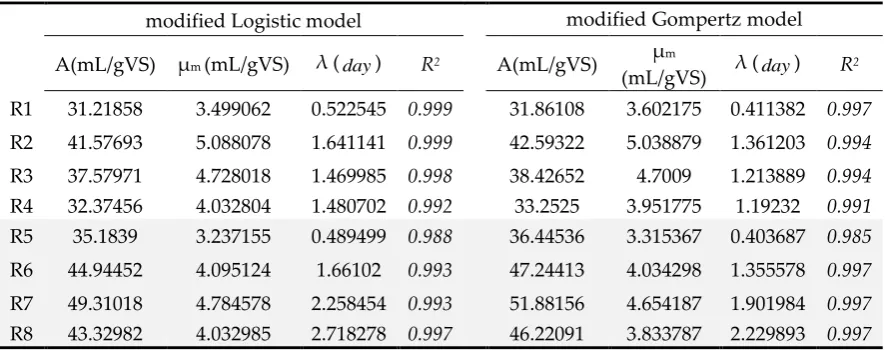
Table 6 shows the estimated parameters using software and determination coefficient of modified Gompertz and modified Logistic models. Where A is the cumulative production potential, μm is the maximum daily rate of biogas production and λ is the delay time.
Table 6.
Comparing of estimated parameters of biogas production
modified Gompertz model modified Logistic model
2 R λ (day)
μm
(mL/gVS) A(mL/gVS)
2 R λ (day)
μm (mL/gVS)
A(mL/gVS) 0.997 0.411382 3.602175 31.86108 0.999 0.522545 3.499062 31.21858 R1 0.994 1.361203 5.038879 42.59322 0.999 1.641141 5.088078 41.57693 R2 0.994 1.213889 4.7009 38.42652 0.998 1.469985 4.728018 37.57971 R3 0.991 1.19232 3.951775 33.2525 0.992 1.480702 4.032804 32.37456 R4 0.985 0.403687 3.315367 36.44536 0.988 0.489499 3.237155 35.1839 R5 0.997 1.355578 4.034298 47.24413 0.993 1.66102 4.095124 44.94452 R6 0.997 1.901984 4.654187 51.88156 0.993 2.258454 4.784578 49.31018 R7 0.997 2.229893 3.833787 46.22091 0.997 2.718278 4.032985 43.32982 R8
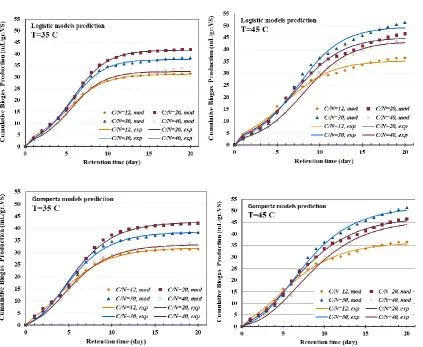
C o 55 and rediction of biogas production at 35 p
models Logistic and Gompertz models .
5 Fig.
3.5. The Comparision of Kinetic and Logistic models
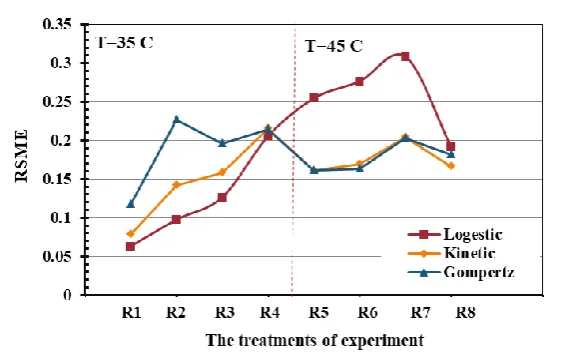
To verify the accuracy of the present study, simulations are conducted to each models and the results are compared with each other. Total results of kinetic, Logistic and Gompertz models are tabulated on Table 7. This results show r and RMSE values between output and target values of
various models.
Table 7.
The RSME and r of developed models.
Models R1 R2 R3 R4 R5 R6 R7 R8 Total
Kinetic RSME 0.0782 0.1413 0.1582 0.2150 0.1615 0.1695 0.2042 0.1658 0.1617
r 0.9955 0.9990 0.9980 0.9955 0.9975 0.9985 0.9985 0.9874
Logestic RSME 0.0633 0.0977 0.1267 0.2059 0.2547 0.2767 0.3083 0.1915 0.1906
r 0.9995 0.9995 0.9990 0.9960 0.9940 0.9965 0.9965 0.9985
Gompertz RSME 0.1174 0.2269 0.1964 0.2145 0.1611 0.1628 0.2033 0.1819 0.1830
r 0.9985 0.9970 0.9970 0.9955 0.9925 0.9985 0.9985 0.9985
the Logestic model. But at 55°C, the RSME value of the new model is equal to the Gompertz model and less than the Logestic model. Therefore, the new kinetic model has a good ability to predict cumulative biogas production. The new kinetic model at 35°C is better than the Gompertz model
and at 55°C better than both the Gompertz and Logestic models.
Fig. 6. Kineticmodels prediction of biogas production at 35and55oC
4. Conclusion
The aim of this study is to provide a new kinetic model to predict the production of biogas from biomass. Modeling was performed using biogas production data from SMC biomass [4, 5]. The new kinetic model, it was assumed that the reaction of anaerobic fermentation of biomass, is just a chemical reaction. It was assumed that the biomass includes carbon, hydrogen, and oxygen and fermentation products are methane and carbon dioxide. In previous studies, the coefficient of reaction was considered constant, but in the new kinetic model presented, it was assumed that the reaction coefficient is a polynomial function of time. The validation of the new model was done by comparing its results with the results of conventional microbial growth models such as Logistic and Gampartz.
The results showed that the anaerobic fermentation process of biomass could be assumed as a chemical process. The new kinetic model presented in this study showed that the chemical reaction
rate of organic material (biomass) and its chemical degradation depends on the reaction time and does not have a fixed value. By comparing the values of the results, it was found that the RSME of the new model is lower than the Gompertz model at mesophilic temperature (35oC) and is less
than the Logistic model at thermophilic temperature (55oC). The total values of RMSE for Logistics,
Reference:
1. Najafi, B., Experimental investigation of the effect of using biodiesel and biogas on dual fuel diesel
engine. 2011.
2. Vardin, F. H.; Najafi, B. J. R. E. F., Developing a novel downdraft fixed bed gasifier for hydrogen
production from sawdust to improve an SI engine exhaust emissions. 2018, 27, 88-96.
3. Akbarian, E.; Najafi, B.; Jafari, M.; Faizollahzadeh Ardabili, S.; Shamshirband, S.; Chau, K.-w. J. E. A. o.
C. F. M., Experimental and computational fluid dynamics-based numerical simulation of using natural gas in a dual-fueled diesel engine. 2018, 12, (1), 517-534.
4. Klass, D. L. J. E., Biomass for renewable energy and fuels. Encyclopedia of Energy. 2004, 1, 193-212. 5. Najafi, B.; Ardabili, S. F. J. R., Conservation; Recycling, Application of ANFIS, ANN, and logistic
methods in estimating biogas production from spent mushroom compost (SMC). 2018, 133, 169-178.
6. Salminen, E.; Rintala, J. J. B. t., Anaerobic digestion of organic solid poultry slaughterhouse waste–a review. 2002, 83, (1), 13-26.
7. Demirbas, M. F.; Balat, M. J. I. J. o. G. E., Progress and recent trends in biogas processing. 2009, 6, (2), 117-142.
8. Kao, C.-Y.; Chiu, S.-Y.; Huang, T.-T.; Dai, L.; Wang, G.-H.; Tseng, C.-P.; Chen, C.-H.; Lin, C.-S. J. B.; bioenergy, A mutant strain of microalga Chlorella sp. for the carbon dioxide capture from biogas. 2012,
36, 132-140.
9. Abatzoglou, N.; Boivin, S. J. B., Bioproducts; Biorefining, A review of biogas purification processes.
2009, 3, (1), 42-71.
10. Ramaraj, R.; Dussadee, N. J. I. J. o. S.; Field, G. E. S. I. R. E. A. i. t. A.; Technology, N. R., Biological purification processes for biogas using algae cultures: a review. 2015, 4, (1-1), 20-32.
11. De la Rubia, M.; Perez, M.; Romero, L.; Sales, D. J. C.; quarterly, b. e., Anaerobic mesophilic and thermophilic municipal sludge digestion. 2002, 16, (3), 119-124.
12. Fardad, K.; Najafi, B.; Ardabili, S. F.; Mosavi, A.; Shamshirband, S.; Rabczuk, T. J. C., Materials; Continua, Biodegradation of medicinal plants waste in an anaerobic digestion reactor for biogas
production. 2018, 55, (3), 318-392.
13. Mattocks, R.; Moser, M. In Fate of incoming solids to measure manure digester performance, Animal,
agricultural and food processing wastes. Proceedings of the Eighth International Symposium, Des Moines, Iowa, USA, 9-11 October, 2000, 2000; American Society of Agricultural Engineers: 2000; pp
187-193.
14. Manual, W. M. O. A. J. G. I. I., United States Environmental Protection Agency. 1988, 1-5.
15. Telliard, W. J. U. E. P. A. W., Method 1684: Total, fixed, and volatile solids in water, solids, and biosolids. 2001.
16. Krátký, L.; Jirout, T.; Nalezenec, J. J. A. P., Lab-scale technology for biogas production from
lignocellulose wastes. 2012, 52, (3).
17. VDI, V. D. I. J. V. D. I., editor. VDI Handbuch Energietechnik. Berlin: Beuth Verlag GmbH, 4630:
Fermentation of organic materials, characterisation of the substrate, sampling, collection of material data, fermentation tests. 2006, 44-59.
18. Ware, A.; Power, N. J. W. m., What is the effect of mandatory pasteurisation on the biogas transformation of solid slaughterhouse wastes? 2016, 48, 503-512.
20. Chang, F. H. In Energy and sustainability comparisons of anaerobic digestion and thermal technologies for processing animal waste, 2004 ASAE Annual Meeting, 2004; American Society of Agricultural and
Biological Engineers: 2004; p 1.
21. Rao, M.; Singh, S. J. B. T., Bioenergy conversion studies of organic fraction of MSW: kinetic studies and
gas yield–organic loading relationships for process optimisation. 2004, 95, (2), 173-185.
22. Sanchez, E.; Borja, R.; Lopez, M. J. B. t., Determination of the kinetic constants of anaerobic digestion of
sugar-mill-mud waste (SMMW). 1996, 56, (2-3), 245-249.
23. Zwietering, M.; Jongenburger, I.; Rombouts, F.; Van't Riet, K. J. A. E. M., Modeling of the bacterial growth curve. 1990, 56, (6), 1875-1881.