R. Dale et al. (Eds.): IJCNLP 2005, LNAI 3651, pp. 155–164, 2005. © Springer-Verlag Berlin Heidelberg 2005
in Korean Texts
Yong-Hun Lee, Mi-Young Kim, and Jong-Hyeok Lee
Div. of Electrical and Computer Engineering POSTECH and AITrc, San 31, Hyoja-dong, Nam-gu, Pohang, 790-784, R. of Korea
{yhlee95, colorful, jhlee}@postech.ac.kr
Abstract. We present a method of chunking in Korean texts using conditional random fields (CRFs), a recently introduced probabilistic model for labeling and segmenting sequence of data. In agglutinative languages such as Korean and Japanese, a rule-based chunking method is predominantly used for its sim-plicity and efficiency. A hybrid of a rule-based and machine learning method was also proposed to handle exceptional cases of the rules. In this paper, we present how CRFs can be applied to the task of chunking in Korean texts. Ex-periments using the STEP 2000 dataset show that the proposed method signifi-cantly improves the performance as well as outperforms previous systems.
1 Introduction
Text chunking is a process to identify non-recursive cores of various phrase types without conducting deep parsing of text [3]. Abney first proposed it as an intermedi-ate step toward full parsing [1]. Since Ramshaw and Marcus approached NP chunking using a machine learning method, many researchers have used various machine learn-ing techniques [2,4,5,6,10,11,13,14]. The chunklearn-ing task was extended to the CoNLL-2000 shared task with standard datasets and evaluation metrics, which is now a stan-dard evaluation task for text chunking [3].
Most previous works with relatively high performance in English used machine learning methods for chunking [4,13]. Machine learning methods are mainly divided into the generative approach and conditional approach. The generative approach relies on generative probabilistic models that assign a joint probability p(X,Y) of paired input sequence and label sequence, X and Y respectively. It provides straightforward understanding of underlying distribution. However, this approach is intractable in most domains without strong independence assumptions that each input element is independent from the other elements in input sequence, and is also difficult to use multiple interacting features and long-range dependencies between input elements. The conditional approach views the chunking task as a sequence of classification problems, and defines a conditional probability p(Y|X) over label sequence given input sequence. A number of conditional models recently have been developed for use. They showed better performance than generative models as they can handle many arbitrary and overlapping features of input sequence [12].
labeling and segmenting sequence of data [12], can be applied to the task of chunking in Korean texts. CRFs are undirected graphical models trained to maximize condi-tional probabilities of label sequence given input sequence. It takes advantage of gen-erative and conditional models. CRFs can include many correlated, overlapping fea-tures, and they are trained discriminatively like conditional model. Since CRFs have single exponential model for the conditional probability of entire label sequence given input sequence, they also guarantee to obtain globally optimal label sequence. CRFs successfully have been applied in many NLP problems such as part-of-speech tagging [12], text chunking [13,15] and table extraction from government reports [19].
The rest of this paper is organized as follows. Section 2 gives a simple introduction to CRFs. Section 3 explains how CRFs is applied to the task of chunking in Korean texts. Finally, we present experimental results and draw conclusions.
2 Conditional Random Fields
Conditional Random Fields (CRFs) are conditional probabilistic sequence models first introduced by Lefferty et al [12]. CRFs are undirected graphical models, which can be used to define the joint probability distribution over label sequence given the entire input sequence to be labeled, rather than being directed graphical models such as Maximum Entropy Markov Models (MEMMs) [11]. It relaxes the strong inde-pendence assumption of Hidden Markov Models (HMMs), as well as resolves the label bias problem exhibited by MEMMs and other non-generative directed graphical models such as discriminative Markov models [12].
2.1 Fundamentals of CRFs
CRFs may be viewed as an undirected graphical model globally conditioned on input sequence [14]. Let X=x1 x2 x3 …xn be an input sequence and Y=y1 y2 y3 …yn a label
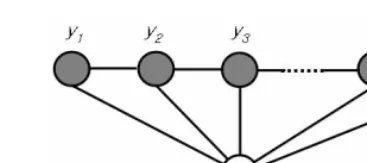
se-quence. In the chunking task, X is associated with a sequence of words and Y is asso-ciated with a sequence of chunk types. If we assume that the structure of a graph forms a simple first-order chain, as illustrated in Figure 1, CRFs define the condi-tional probability of a label sequence Y given an input sequence X by the Hammer-sley-Clifford theorem [16] as follows:
Fig. 1. Graphical structure of chain-structured CRFs
Equitation 1, the general form of a graph structure for modeling sequential data, can be expanded to Equation 2,
⎟
ters to be estimated from training data. The parameters λk and µk play similar roles to the transition and emission probabilities in HMMs [12]. Therefore, the most probable label sequence for input sequence X is Y* which maximizes a posterior probability.)
We can find Y* with dynamic programming using the Viterbi algorithm.
2.2 Parameter Estimation for CRFs
Assuming the training data {(X(n), Y(n))} are independently and identically distributed, the product of Equation 1 over all training sequences is a likelihood function of the parameter λ. Maximum likelihood training chooses parameter values such that the log-likelihood is maximized [10]. For CRFs, the log-likelihood L(λ) is given by
∑ ∑∑
It is not possible to analytically determine the parameter values that maximize the log-likelihood. Instead, maximum likelihood parameters must be identified using an iterative technique such as iterative scaling [12] or gradient-based methods [13,14].
We now describe how CRFs are applied to the task of chunking in Korean texts. Firstly, we explore characteristics and chunk types of Korean. Then we explain the features for the model of chunking in Korean texts using CRFs. The ultimate goal of a chunker is to output appropriate chunk tags of a sequence of words with part-of-speech tags.
3.1 Characteristics of Korean
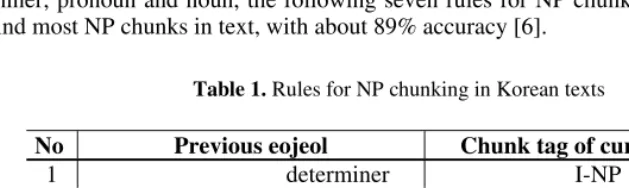
Korean is an agglutinative language, in which a word unit (called an eojeol) is a com-position of a content word and function word(s). Function words – postcom-positions and endings – give much information such as grammatical relation, case, tense, modal, etc. Well-developed function words in Korean help with chunking, especially NP and VP chunking. For example, when the part-of-speech of current word is one of deter-miner, pronoun and noun, the following seven rules for NP chunking in Table 1 can find most NP chunks in text, with about 89% accuracy [6].
Table 1. Rules for NP chunking in Korean texts
No Previous eojeol Chunk tag of current word
1 determiner I-NP
2 pronoun I-NP
3 noun I-NP
4 noun + possessive postposition I-NP 5 noun + relative postfix I-NP 6 adjective + relative ending I-NP
7 others B-NP
For this reason, boundaries of chunks are easily found in Korean, compared to other languages such as English or Chinese. This is why a rule-based chunking method is predominantly used. However, with sophisticated rules, the rule-based chunking method has limitations when handling exceptional cases. Park et al. pro-posed a hybrid of the rule-based and the machine learning method to resolve this problem [5,6]. Many recent machine learning techniques can capture hidden charac-teristics for classification. Despite its simplicity and efficiency, the rule-based method has recently been outdone by the machine learning method in various classification problems.
3.2 Chunk Types of Korean
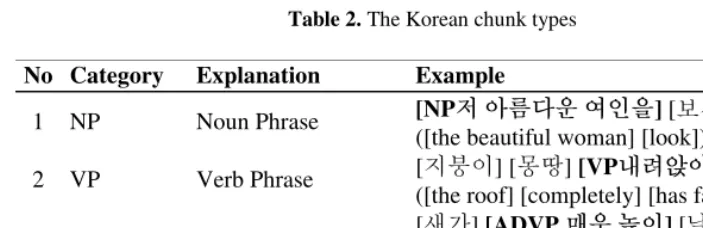
Korean, there are four basic phrases: noun phrase (NP), verb phrase (VP), adverb phrase (ADVP), and independent phrase (IP) [6]. As function words such as postposi-tion or ending are well-developed, the number of chunk types is small compared to other languages such as English or Chinese. Table 2 lists the Korean chunk types, a simple explanation and examples of each chunk type.
Table 2. The Korean chunk types
No Category Explanation Example
1 NP Noun Phrase [NP저아름다운여인을] [보세요]. ([the beautiful woman] [look])
2 VP Verb Phrase [지붕이] [몽땅] [VP내려앉아있다]. ([the roof] [completely] [has fallen in])
3 ADVP Adverb Phrase [새가] [ADVP 매우높이] [날고있다]. ([a bird] [very high] [is flying])
4 IP Independent Phrase [IP 와], [이거] [정말] [맛있다]. ([wow] [this] [very] [is delicious])
Like the CoNLL-2000 dataset, we use three types of chunk border tags, indicating whether a word is outside a chunk (O), starts a chunk (B), or continues a chunk (I). Each chunk type XP has two border tags: B-XP and I-XP. XP should be one of NP, VP, ADVP and IP. There exist nine chunk tags in Korean.
3.3 Feature Set of CRFs
One advantage of CRFs is that they can use many arbitrary, overlapping features. So we take advantage of all context information of a current word. We use words, part-of-speech tags of context and combinations of part-part-of-speech tags to determine the chunk tag of the current word,. The window size of context is 5; from left two words to right two words. Table 3 summarizes the feature set for chunking in Korean texts.
Table 3. Feature set for the chunking in Korean texts
Word POS tag Bi-gram of tags Tri-gram of tags wi-2= w
wi-1= w
wi= w
wi+1= w
wi+2= w
ti-2= t
ti-1= t
ti= t
ti+1= t
ti+2= t
ti-2= t’, ti-1= t
ti-1= t’, ti= t
ti= t’, ti+1= t
ti+1= t’,ti+2= t
ti-2= t”, ti-1= t’, ti= t
ti-1= t”, ti= t’, ti+1= t
ti= t”, ti+1= t’, ti+2= t
4 Experiments
Information Value
POS tags 52
Words 321,328 Sentences 12,092 Chunk tags 9
Chunks 112,658
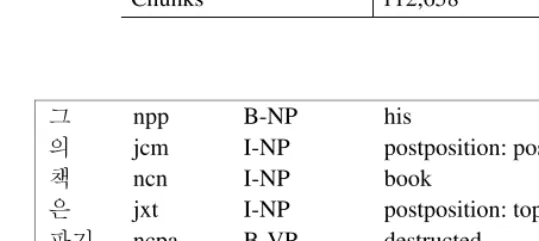
그 npp B-NP his
의 jcm I-NP postposition: possessive
책 ncn I-NP book
은 jxt I-NP postposition: topic
파기 ncpa B-VP destructed
되 xsv I-VP be
었 ep I-VP pre-final ending : past
다 ef I-VP ending : declarative . sf O
Fig. 2. An example of the STEP 2000 dataset
The STEP 2000 dataset consists of 12,092 sentences. We divide this corpus into training data and test data. Training data has 10,883 sentences and test data has 1,209 sentences, 90% and 10% respectively. Table 4 summarizes characteristics of the STEP 2000 dataset. Figure 2 shows an example sentence of the STEP 2000 data-set and its format is equal to that of CoNLL-2000 datadata-set. Each line is composed of a word, its part-of-speech (POS) tag and a chunk tag.
4.2 Evaluation Metric
The standard evaluation metrics for chunking performance are precision, recall and F-score (Fβ=1) [3]. F-score is used for comparisons with other reported results. Each
equation is defined as follows.
1
output
4.3 Experimental Results
Experiments were performed with C++ implementation of CRFs (FlexCRFs) on Linux with 2.4 GHz Pentium IV dual processors and 2.0Gbyte of main memory [18]. We use L-BFGS to train the parametersanduse aGaussian prior regularization in order to avoid overfitting [20].
Table 5. The performance of proposed method
Chunk tag Precision Recall F-score
NP 94.23 94.30 94.27 VP 96.71 96.28 96.49 ADVP 96.90 97.02 96.96 IP 99.53 99.07 99.30 All 95.42 95.31 95.36 Total number of CRF features is 83,264. As shown in Table 5, the performances of most chunk type are 96~100%, very high performance. However, the performance of NP chunk type is lowest, 94.27% because the border of NP chunk type is very am-biguous in case of consecutive nouns. Using more features such as previous chunk tag should be able to improve the performance of NP chunk type.
Table 6. The experimental results of various chunking methods2
HMMs DT MBL Rule SVMs Hybrid CRFs
Precision 73.75 92.29 91.41 91.28 93.63 94.47 95.42 Recall 76.06 90.45 91.43 92.47 91.48 93.96 95.31 F-score 74.89 91.36 91.38 91.87 92.54 94.21 95.36 Park et al. reported the performance of various chunking methods [6]. We add the experimental results of the chunking methods using HMMs-bigram and CRFs. In Table 6, F-score of chunking using CRFs in Korean texts is 97.19%, the highest
2
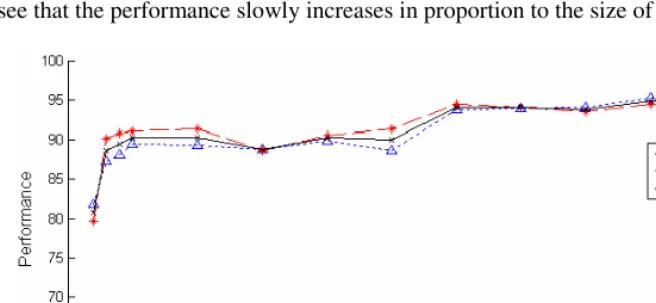
see that the performance slowly increases in proportion to the size of training data.
Fig. 3. The performance curve respect to the size of training data
In the experiment, we can see that CRFs can help improve the performance of chunking in Korean texts. CRFs have many promising properties except for the slow convergence speed compared to other models. In the next experiment, we have tried to analyze the importance of each feature and to make an additional experiment with various window sizes and any other useful features.
5 Conclusion
In this paper, we proposed a chunking method for Korean texts using CRFs. We ob-served that the proposed method outperforms other approaches. Experiments on the STEP 2000 dataset showed that the proposed method yields an F-score of 95.36%. This performance is 2.82% higher than that of SVMs and 1.15% higher than that of the hybrid method. CRFs use a number of correlated features and overcome the label bias problem. We obtained a very high performance using only small features. Thus, if we use more features such as semantic information or collocation, we can obtain a better performance.
Acknowledgements
This work was supported by the KOSEF through the Advanced Information Technol-ogy Research Center (AITrc) and by the BK21 Project.
References
1. S. Abney: Parsing by chunks. In R. Berwick, S. Abney, and C. Tenny, editors, Principle-based Parsing. Kluwer Academic Publishers (1991).
2. L. A. Ramashaw and M. P. Marcus: Text chunking using transformation-based learning. Proceedings of the Thired ACL Workshop on Very Large Corpora (1995).
3. E. F. Tjong Kim Sang and S. Buchholz: Introduction to the CoNLL-2000 shared task: Chunking. Proceedings of CoNLL-2000 (2000) 127-132.
4. T. Kudo and Y. Matsumoto: Chunking with support vector machines. Proceedings of NAACL2001, ACL (2001).
5. Park, S.-B. and Zhang, B.-T.: Combining a Rule-based Method and a k-NN for Chunking Korean Text. Proceedings of the 19th International Conference on Computer Processing of Oriental Languages (2001) 225-230.
6. Park, S.-B. and Zhang, B.-T.: Text Chunking by Combining Hand-Crafted Rules and Memory-Based Learning. Proceedings of the 41st Annual Meeting of the Association for Computational Linguistics (2003) 497-504.
7. H.-P. Shin: Maximally Efficient Syntactic Parsing with Minimal Resources. Proceedings of the Conference on Hangul and Korean Language Information Processing (1999) 242-244.
8. M.-Y. Kim, S.-J. Kang and J.-H. Lee: Dependency Parsing by Chunks. Proceedings of the 27th KISS Spring Conference (1999) 327-329.
9. J.-T. Yoon and K.-S. Choi: Study on KAIST Corpus, CS-TR-99-139, KAIST CS (1999). 10. A. L. Berger, S. A. Della Pietra and V. J. Della Pietra: A maximum entropy approach to
natural language processing. Computational Linguistics, 22(1) (1996) 39-71.
11. Andrew McCallum, D. Freitag and F. Pereira: Maximum entropy Markov models for in-formation extraction and segmentation. Proceedings of International Conference on Ma-chine Learning , Stanford, California (2000) 591-598.
12. John Lafferty, Andrew McCallum and Fernando Pereira: Conditional Random Fields: Probabilistic Models for Segmenting and Labeling Sequence Data. Proceedings of the 18th International Conference on Machine Learning (2001) 282-289.
13. Fei Sha and Fernando Pereira: Shallow Parsing with Conditional Random Fields. Proceed-ings of Human Language Technology-NAACL, Edmonton, Canada (2003).
14. Hanna Wallach: Efficient Training of Conditional Random Fields. Thesis. Master of Sci-ence School of Cognitive SciSci-ence, Division of Informatics. University of Edinburgh (2002).
15. Yongmei Tan, Tianshun Yao, Qing Chen and Jingbo Zhu: Applying Conditional Random Fields to Chinese Shallow Parsing. The 6th International Conference on Intelligent Text Processing and Computational Linguistics (CICLing-2005) . LNCS, Vol.3406, Springer, Mexico City, Mexico (2005) 167-176.