Human Age Estimation through Face
Recognition using Stacked Neural Network
based Deep Learning Approach
Khemchandra Patel1, Dr. Kamlesh Namdev2
M.Tech Scholar, Department of Computer Science and Engineering, SIRT-E, Bhopal, M.P, India 1
Professor, Department of Computer Science and Engineering, SIRT-E, Bhopal, M.P, India 2
ABSTRACT: Personal identity, facial expression, race, sex, age and posture are the most important human characteristics revealed by facial features. Among these, age has its own special characteristics. Age has always been an important attribute of identity. It also has been an important factor in social interaction. The facial wrinkles are the elements that facilitate the prediction of the user's age. The human face is the source of important and perceptible information. For age estimation from facial images there are many existing research work because there are many factors that causes obstacles in this field which causes difficulties to determine the age from facial features. So, there is need of more research work in this field.In this research work, an enhanced methodology for estimating age is described and simulated. Results are evaluated on the basis of MAE Analysis with varying age groups. Initially, the input image is preprocessed in which noise removal, image enhancement or grayscale conversion is done. Further from preprocessed image, significant features such as distances between different facial objects and edges in wrinkle areas are extracted. Then these extracted features are used to predict age using stacked deep autoencoders classifier. The simulation in performed on two datasets. One is newly created dataset of the surrounding having 100 images and the other is FGNET dataset. Results are compared with existing age estimation techniques and on the basis of performance evaluation this proposed work provided quiet significant and efficient facial age estimation.
KEYWORDS: Age Estimation Methods, Age Variation, Image Processing, Deep Learning, Autoencoder, Neural Network, Mean Absolute Error.
I.INTRODUCTION
Facial features like identity, gender, age, nose, eyes, wrinkles, etc. they need received plenty of attention in recent years, as facial image process techniques provide complete in varied fields. Age classification plays an important role in analysis supported image processing applications like human-computer interaction (HMI), second and 3D identity verification and virtual reality recognition [1]. Several different age estimation techniques are proposed which is specially focused on images of the faces and its features. Some of the them are such as: anthropometrical models, analysis of the variety and regression of aging. measuring finds the intensity of wrinkles in several age teams and different ways like age models to classify these features related with face image. This is focusing attention towards the this research work objectives.
After focusing these points it is concluded that age estimation from facial image requires two steps. The first step is intended towards the extraction of facial features related to determine the age of any human being. Second step is to recognize the similar patterns among these extracted features to identify the age group. The identification usually is intended to machine learning approach for classification as well as regression [3]. For age classification technique there is need of training dataset by which machine learning approach learns about the facial feature patterns for different age groups and further applies these learned patterns to determine the age. The main objective of this research work is to develop an algorithm that identifies the age of any human being from his/her facial features. Compared with other facial variations, aging effects has three unique characteristics [2]:
Each and every individual have different aging effect. Aging pattern also depends on gender i.e. male and female.
Aging also depends on the climatic condition in which a person lives. Aging also depends on the lifestyle of an individual.
So, there are many issues while categorizing age of an individual from their facial image because it depends on various factors such as gene, climate, lifestyle, gender, etc.The problem of age group classification from facial images is an actively growing area of research and has not been studied in depth yet. Age determination/classification is concerned with the training and test sets to generate a model that can classify the age of the facial images. The aim is to use an algorithm that determines a person’s age range based on features extracted from face images.
In research work aim to describe an age detection using facial images. This research work is intended towards the wrinkle region detection ad well as wrinkle feature extraction from facial image. Further classification techniques are also used. Age Group Classification algorithm is performed by using noise removal techniques and image enhancement techniques for efficiently extraction of features. The edge detection technique would be used in order to extract wrinkle features from locations around, forehead, eyes, cheeks and nose in facial image. After the extraction phase, deep learning approach is used as a classifier and trained with the extracted data. The trained classifiers are used as the decision-maker of the system i.e. age group estimation as well as age estimation.
The following objectives can be achieved in this research work:
1. Database preparation by using real time face images of different age group peoples in our surroundings.
2. This research work is intended towards the wrinkle region detection as well as wrinkle feature extraction from facial image.
3. Further classification techniques are also used to enhance performance parameters such as Mean Absolute Error (MAE) and Accuracy.
II.RELATED WORK
Average Error rate showing a value of 3.34% for MORPH dataset and 3.75% for FG-NET. Error rate is high in this research work
III.METHODOLOGY
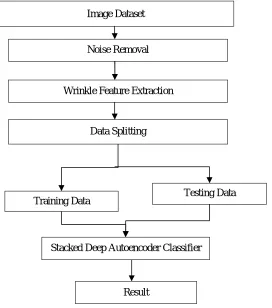
In this research work an approach is proposed for age estimation by facial images using biometric ratios and wrinkle analysis. Each age estimation system follows a general process as shown in figure 1.
Fig. 1: Proposed Age Estimation Process
In this research work an approach is proposed for age estimation by facial images using biometric ratios and wrinkle analysis. These features are used to classify an individual into different age groups. Wrinkle feature signifies age of a person. The wrinkle feature is calculated using forehead portion, between eyelashes, eye corner regions and upper portion of cheeks. For detection of wrinkles, the edges have to be calculated using canny edge detection in wrinkle regions. For classification process stacked autoencoder deep learning approach is used.
This research work shows a significant age estimation technique that uses five stages: Image capturing, pre-processing, feature extraction, classification, and age estimation as discussed below:
A. Image/Input Data Capturing
It includes fetching face from a database or can be captured in real time.
B. Preprocessing
It includes extracting the useful frame from the input if it is video frame. Detecting and cropping the face from the input image. Sometimes normalization of images is done before further processing, it can be contrast stretching, smoothening
Image Dataset
Noise Removal
Wrinkle Feature Extraction
Data Splitting
Training Data Testing Data
Stacked Deep Autoencoder Classifier
of image etc. The proposed algorithm includes steps i.e. image cropping, noise removal or de-blurring and grayscale conversion, which is shown in figure 2.
The rectangular face area is cropped from face image.
In this step the proposed algorithm uses Lucy-Richardson Algorithm is used for noise removal and de-blurring the blurred image.
Image is converted from RGB color scale to grayscale.
Fig.2: Pre-Processing Stage
C. Wrinkle Feature Extraction
Extracting the features which will be needed according to the approach used.
Extraction of global and local features is made from face images. The global features include various distance ratios of all crucial facial objects like left eyeball, right eyeball, nose, chin, lip, and forehead. The local feature that is mainly used here is wrinkle feature of some particular portions of the face like forehead region, eye corners regions, eyelids, mid of eyebrows. Using five distance values, six features namely feature 1 to feature 6 are calculated in the following way: Distance_1= Distance between right eyeball and left eyeball.
Distance_2= Distance between nosetip and right or left eyeball. Distance_3= Distance between mouth and right or left eyeball. Distance_4= Distance between chin and right or left eyeball. Distance_5= Distance between chin and forehead.
Feature1= (Distance_1)/( Distance_2) Feature2= (Distance_1)/( Distance_3) Feature3= (Distance_1)/( Distance_4) Feature4= (Distance_2)/( Diatance_3) Feature5= (Distance_2)/( Distance_4) Feature6= (Distance_4)/( Distance_5)
Wrinkle feature signifies age of a person. The wrinkle feature is calculated using forehead portion, between eyelashes, eye corner regions and upper portion of cheeks. For detection of wrinkles, the edges have to be calculated in wrinkle regions.In proposed work, edges are determined by using canny edge detection techniques. Using wrinkle features of face image, feature 7 is calculated as:
Input Image
Perform image enhancement
Select wrinkle regions as discussed below: A = (Forehead region, canny edge detection) B = Between eyelashes, canny edge detection) C = Before left eye, canny edge detection) D = Before right eye, canny edge detection) E = Left cheek, canny edge detection)
Image cropping
Image enhancement and noise removal
F = Right cheek, canny edge detection) Extract features using these wrinkle regions: Feature 1= sum(A,B,C,D,E,F)
Feature2= A/All pixels of region A; Feature3= B/All pixels of region B; Feature4= C/All pixels of region C; Feature5= D/All pixels of region D; Feature6= E/All pixels of region E; Feature7= F/All pixels of region F;
Feature8=(Feature2+Feature3+Feature4+Feature5+Feature6+Feature7)
D. Classification
It is generally done in two steps, coarse and fine. Classifiers are trained through training images by extracted features and the actual age of image. Deep Autoencoder classifier is used to classify based on all above features. Age groups are predicted by using trained classifiers. After estimation of age group classifiers are used to fine tune the estimation to age. In this research work, the age groups are divided into 12 groups whose description are discussed below:
if Original_age>=0 &&Original_age<=5 age_category= 1;
else if Original_age>=6 &&Original_age<=10 age_category= 2;
elseif Original_age>=11 &&Original_age<=15 age_category= 3;
elseif Original_age>=16 &&Original_age<=20 age_category= 4;
elseif Original_age>=21 &&Original_age<=25 age_category= 5;
elseif Original_age>=26 &&Original_age<=30 age_category= 6;
elseif Original_age>=31 &&Original_age<=35 age_category= 7;
elseif Original_age>=36 &&Original_age<=40 age_category= 8;
elseif Original_age>=41 &&Original_age<=45 age_category= 9;
elseif Original_age>=46 &&Original_age<=50 age_category= 10;
elseif Original_age>=51 &&Original_age<=55 age_category= 11;
elseif Original_age>=56 &&Original_age<=60 age_category= 12;
elseif Original_age>=61 &&Original_age<=65 age_category= 13;
else
age_category= 14; end if
Stacked Deep Autoencoder
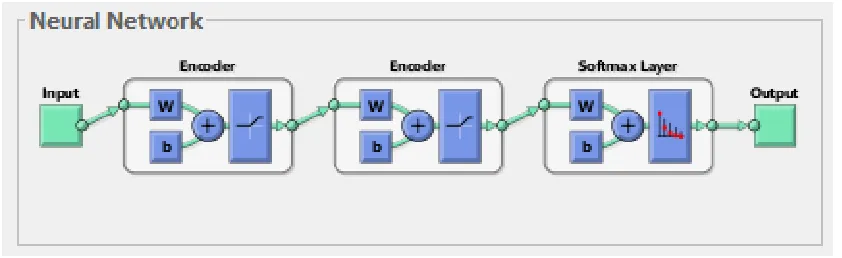
An autoencoder may be used for pre-training or for dimensionality reduction when the architecture takes the form of a bottleneck. For simplicity, consider an autoencoder with a hidden layer; autoencoder can then learn several levels of representations by stacking hidden layers. It is a features extraction algorithm; it helps to find a representation of data. The features generated by the autoencoders represent the data point better than the points themselves.
Figure 3: Stacked Deep Auto Encoder Architecture
The layer of deep autoencoder contains input layer, hidden layer and output layer. The input layer is for passing the input values
The value at hidden layer is calculated as:
= ∗ + (i)
Where, W= weight matrix
X= input data values coming from input layers B=Bias Matrix
And transfer function is calculated as :
( ) = 1
1 + (ii)
Where, e=error value
The stacked deep autoencoder neural network involves multiple layer of autoencoders neural network and the loss function that is to be minimized as :
= | −( ( … … … . ( ( ( )))))| (iii)
Where, W1, W2, ……Wl = weight function of all autoencoders = Decoding function of autoencoders
f(x) = function to calculate data values at each layer
Softmax classifier
A frequent use of the softmax function appears in the domain of machine learning, it associate with each output possibility a score, which is converted into probability with the softmax function. When a classification task has more than two classes, it is standard to use a softmax output layer. It is the latest layer and it offers a way to predict a discrete probability distribution over the classes.
Step 2: For each V do Step 3: Data classification
Step 4: Determine the age category
Step 5: Find Performance Parameters i.e. MAE end for
IV.RESULTANALYSIS
This section shows the experimental results. The dataset ie prepared using natural images. A new Face Database was created that has face from images of different age group faces. These faces are used to create training dataset in order to train the classifiers. For this research work facial dataset are used to group the database into different age groups. From facial dataset facial features as well as wrinkle features are exacted and used for further processing.
This section is also dedicated to evaluate the implemented method, and perform the various comparisons with other methods. The implementation method was based on the use of FG-NET dataset also. The evaluation of the performance of proposed methods is giving in the evaluation of features learning using supervised autoencoder using the FG-NET datasets also. The Face and Gesture Recognition Research Network (FG-NET) aging database contains on average 12 pictures of varying ages between 0 and 69, for each of its 82 subjects. Altogether there is a mixture of 1002 color and greyscale images, which were taken in totally uncontrolled environments.
Performance Parameter
To evaluate the performance of the proposed system, the following parameters are used, for example the mean absolute error. Mean Absolute Error (MAE) is a quantity used to measure how close predictions or forecasts are to final results. The average absolute error is given by:
MAE= 1/ ∑ | | (iv)
Where, N= Number of events
e= error value between actual and predicted outcomes.
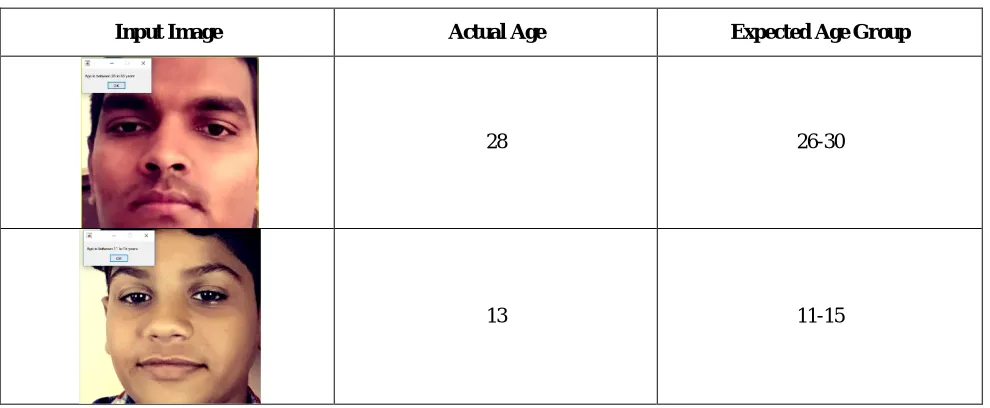
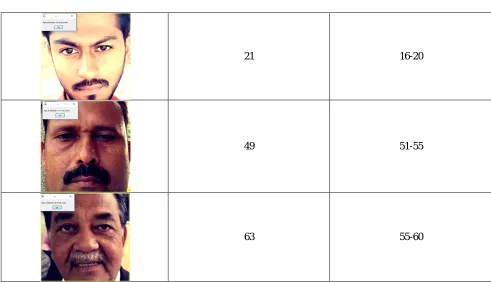
This section shows the experimental results. The dataset i.e. prepared using natural images. In order to evaluate the performance of proposed algorithm scheme total 8 features are extracted and the age groups are divided into 14 groups which is discussed in previous section. Following images shows the performance of the proposed work.
Table 1: Predicted Age from Facial Features
Input Image Actual Age Expected Age Group
28 26-30
21 16-20
49 51-55
63 55-60
Table II is used to analyze the performance of proposed algorithm. The result is analyzed by dividing the dataset into different age groups.
Table II: MAE Analysis on Own Dataset
Parameters Proposed Work Existing Work [1]
0-14 5.5000 2.88
16-30 1.6410 3.92
31-50 1.4167 4.16
50 Above 1.1200 4.69
Figure 5: MAE Analysis on Own Dataset
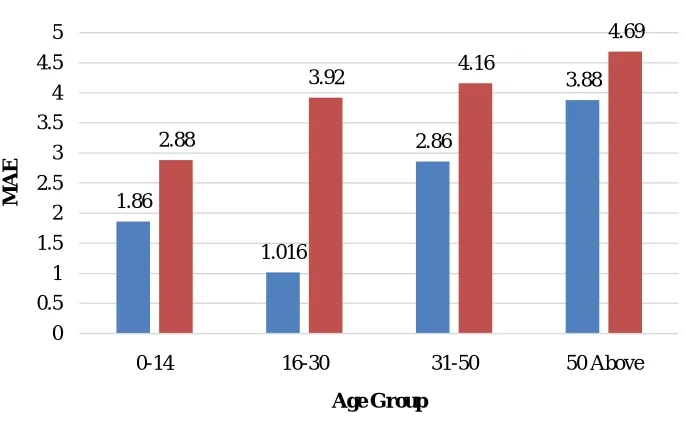
Table III is used to analyze the comparative performance of proposed algorithm with existing work [1]. In this comparison FGNET dataset is used and the result is analyzed by dividing the dataset into different age groups.
Table III: MAE Analysis on FGNET Dataset
Parameters Proposed Work Existing Work [1]
0-14 1.86 2.88
16-30 1.016 3.92
31-50 2.86 4.16
50 Above 3.88 4.69
The table illustrates the mean absolute analysis for different works. FGNET dataset is divided into two parts i.e. training and testing dataset. For this result analysis four different age groups are analyzed. Then these ratios are analyzed using different classifiers and it is noticed from result analysis of proposed algorithm is better to existing work in terms of MAE. Figure 6 illustrates the performance analysis with varying age groups on FGNET images.
5.5
1.641 1.4167
1.12 2.88
3.92 4.16
4.69
0 1 2 3 4 5 6
0-14 16-30 31-50 50 Above
M
A
E
Age Group
Figure 6: MAE Analysis on FGNET Dataset
V.CONCLUSION
Personal identity, facial expression, race, sex, age and posture are the most important human characteristics revealed by facial features. Among these, age has its own special characteristics. It also has been an important factor in social interaction. The facial wrinkles are the elements that facilitate the prediction of the user's age. The human face is the source of important and perceptible information.In this research work, an approach for age estimation is proposed using deepautoencoder which is build by stacking autoencoder based neural network and softmax classifier. The proposed algorithm is designed for estimation of age of different age groups. Images taken for experimental analysis are frontal view images with uniform light on each part of the face.The algorithm is performed in two stages. In first stage, pre-processing is done for noise removal and further image enhancement is performed. In second stage, post-pre-processing of the algorithm is done in which wrinkle features are extracted and classified into various age groups. Wrinkle features are extracted in order to extract high-level features and learn facial features. The proposed formulation aims to learn semi-supervised feature vectors that maximize the intra-class similarity. The experimental results showed better results with respect to MAE as compared to existing work.The images taken in this research work has human faces with hairless forehead. Taking this into account and adding some more facial features, accuracy of the age estimation can be enhanced.
REFERENCES
[1] Y. H. Kwon and N. Vitoria Lobo. “Age classification from facial images”, Computer Vision and Image Understanding Journal, vol. 74, issue. 1, 1999, pp. 1-21.
[2] W. B. Horng, C. P. Lee, C. W. Chen. “Classification of age groups based on facial features”, Journal of Science and Engineering, vol. 4, 2001, pp. 183–192.
[3] J. Hayashi, M. Yasumoto, H. Ito, Y. Niwa, and H. Koshimizu, “Age and Gender Estimation from Facial Image Processing”, Proceedings of the 41st SICE Annual Conference, Volume: 1, Aug. 2002, pp. 13 -18.
[4] Lanitis, “On the significance of different facial parts for automatic age estimation,” International Conference on Digital Signal Processing, Volume: 2, July 2002, pp. 1027 -1030.
[5] Chen, Yi-Wen, "Image-based age-group classification design using facial features." International Conference on System Science and Engineering, IEEE, 2010.
[6] Tonchev. K, "Human age-group classification of facial images with subspace projection and support vector machines" Intelligent Data Acquisition and Advanced Computing Systems (IDAACS), Vol. 1, IEEE, 2011.
1.86
1.016
2.86
3.88
2.88
3.92 4.16
4.69
0 0.5 1 1.5 2 2.5 3 3.5 4 4.5 5
0-14 16-30 31-50 50 Above
M
A
E
Age Group
[7] Khryashchev, Vladimir, “Age estimation from face images: challenging problem for audience measurement systems”, Conference of Open Innovations Association, IEEE, 2014.
[8] Li, Weixing, “Facial age classification based on weighted decision fusion”, Chinese Control Conference, IEEE, 2014.
[9] Guo, Guodong, “A probabilistic fusion approach to human age prediction”, Conference on Computer Vision and Pattern Recognition Workshops, IEEE, 2008.
[10] Günay, Asuman, and Vasif V. Nabiyev. “Automatic age classification with LBP”, International Symposium on Computer and Information Sciences, IEEE, 2008.
[11] Hajizadeh, Mohammad Ali, and Hossein Ebrahimnezhad, “Classification of Age Groups from Facial Image Using Histograms of Oriented Gradients”, Conference on Machine Vision and Image Processing, IEEE, 2011.
[12] Izadpanahi, Shima, and OnsenToygar, “Geometric feature based age classification using facial images”, Conference on Image Processing, IET, 2012.
[13] Luo, Ren C., Li Wen Chang, and Shih Che Chou, “Human age classification using appearance images for human-robot interaction”, Conference on Industrial Electronics Society, IECON, IEEE, 2013.
[14] Li, Weixin, Yunhong Wang, and Zhaoxiang Zhang, “A hierarchical framework for image-based human age estimation by weighted and OHRanked Sparse Representation-based classification”, International Conference on Biometrics (ICB), IEEE, 2012.
[15] Liu, Li, Jianming Liu, and Jun Cheng, “Age-group classification of facial images”, International Conference on Machine Learning and Applications, Vol. 1., IEEE, 2012.
[16] Ueki, Kazuya, TeruhideHayashida, and Tetsunori Kobayashi, “Subspace-based age-group classification using facial images under various lighting condition”, International Conference on Automatic Face and Gesture Recognition, IEEE, 2006.
[17] Sarita Jain, Dr. A.J. Patil, “Human Age Prediction from Facial Images”, International Journal of Innovative Research in Computer and Communication Engineering, Vol. 4, Issue 7, July 2016.
[18] Vikas, “Implementation Of Automatic Human Age Estimator”, International Journal Of Engineering Sciences & Research Technology, vol. 5, issue 1, 2016.
[19] Geng, Xin, Zhi-Hua Zhou, and Kate Smith-Miles. "Automatic age estimation based on facial aging patterns." Pattern Analysis and Machine Intelligence, IEEE Transactions, vol. 29, issue 12, 2007, pp. 2234-2240.
[20] Choi, Sung Eun, YounJoo Lee, Sung Joo Lee, Kang Ryoung Park, and Jaihie Kim, “Age estimation using a hierarchical classifier based on global and local facial features”, Pattern Recognition, IEEE, vol. 44, issue 6, 2011, pp. 1262-1281.
[21] Bekhouche, Salah Eddine, AbdelkrimOuafi, AbdelmalikTaleb-Ahmed, Abdenour Hadid, and AzeddineBenlamoudi, “Facial age estimation using BSIF and LBP”, arxiv preprint arXiv:1601.01876, 2016.
[22] Guo, Guodong, and Xiaolong Wang, “A study on human age estimation under facial expression changes”, In Computer Vision and Pattern Recognition, IEEE, 2012, pp. 2547-2553.
[23] Jana, Ranjan, Debaleena Datta, and RituparnaSaha, “Age Estimation from Face Image Using Wrinkle Features”, Procedia Computer Science Elsevier, vol. 46, 2015, pp. 1754-1761.
[24] Qawaqneh Z, Mallouh AA, Barkana BD, “Age and gender classiþcation from speech and face images by jointly fine-tuned deep neural networks”, Expert SystAppl 2017.