Compressive Sensing Based Detection Strategy
For Multiple Access Spatial Modulation
Channel
Pooja Chandankhede, Dr. Manish Sharma
ME Student, Dept. of E&TC, DYPCOE, Savitribai Phule Pune University, Akurdi, Pune, India Associate Professor, Dept. of E&TC, DYPCOE, Savitribai Phule Pune University, Akurdi, Pune, India
ABSTRACT: Wireless mobile communication has to deal with the problem of data traffic generated due to tremendous increase in wireless applications and the total energy consumption by them. The technology which deals with both these challenges is spatial modulation. Spatial modulation(SM) is a technology developed in multiple input multiple output(MIMO) by reducing its RF complexity. In conventional MIMO energy efficiency is incorporated by number of antennas at base station(BS), whereas SM switch on subset of antennas at BS instead of activating all the antennas simultaneously which reduces the complexity of cellular network. But it causes signal processing load which can be reduced by incorporating compressive sensing. A detector, based on the compressive sensing(CS) principles, for multiple-access spatial modulation channels with a large-scale antenna base station is proposed. Particularly, the use of a large number of antennas at the BSs and the structure and sparsity of the SM transmitted signals is exploited to improve the performance of conventional detection algorithms. Effectiveness of proposed strategy will be verified through simulation study on the basis of throughput, signal to noise ratio and bit error rate.
KEYWORDS: Spatial modulation, compressive sensing, multiple access channel. I. INTRODUCTION
Since the turn of the century, there has been a tremendous growth in the cellular market. Indeed, the penetration of mobile services exceeded that of the power grid. Mobile communication has to deal with the problem of data traffic. In order to address this challenge, radio frequencies are allocated to these networks, but that much spectrum is not available. Another challenge is to make the system more energy efficient. At moment there are about 1.5 million cellular radio base station(BS) deployed worldwide which consumes lot of energy. The total amount of energy consume by networks is above the prevalent or comparable to the entire air traffic[1]. Thus, it can be said that exponential growth of data rates in wireless communications has caused a significant increase in the total energy consumption required to establish the communication links[1],[2].
This effect is because of the novel transceiver structures consist of larger number of antennas, transmission power or complexity in their signal processing algorithms that has been designed to accommodate this growth. Because of this reason, the energy efficiency (EE) of the multi-user wireless transmission constitutes main areas of research interest at present[1-2]. MIMO and SM are the technologies which are developed with the intension of satisfying EE requirement. Massive MIMO technologies increase the EE by incorporating a large number of antennas at the BSs. However, this lead to an increase in number of radio frequency (RF) chains, which have a remarkable influence on the EE, thus it is severely affecting the large-scale benefits[3]. To reduce this impact, SM poses as a reduced RF-complexity scheme by using the transmit antenna indices as an additional source of information apart from the traditional Amplitude and Phase Modulation(APM).
amplitude-phase symbols[4]. This reduces the number of RF chains when compared to conventional MIMO systems but low complexity is achieved at the cost of decreasing the maximum achievable rates[4]-[6].
Low complexity results increase in signal processing load at base stations, which can be controlled through CS. Compressive sensing(CS) is an alternative to Shannon/Nyquist sampling for the getting sparse or compressible signals that can be well approximated by just K<<N elements from an N-dimensional basis. So, instead of taking periodic samples, CS measures inner products with M<N random vectors and then recovers the signal via a greedy algorithm[7]. In the family of MIMO techniques, the recently proposed spatial modulation [8] is capable of exploiting the indices of the transmit antennas as an additional dimension for transmitting infcccormation, which is different from the traditional Amplitude and Phase Modulation (APM). Altogether [3] SM is an attractive offer for wireless network’s area spectral efficiency and energy efficiency as like MIMO technologies. In [9], a low-complexity detector, called ordered nearest neighbour search (NNS) minimum mean square error (MMSE) detector, was proposed for the spatial modulation multiple-access channel with large number of receive antennas. Several low-complexity detectors that head towards the performance of the optimal maximum likelihood (ML) estimation have been proposed in [10]. For this context, the use of normalized CS detection technique as a low-complexity solution for space shift keying (SSK) and generalized space shift keying (GSSK) was introduced in [7]. Use of SM has been also extended to the multiple access channel(MAC) as an enhancement for achievable rates [11]. However, the signal processing load of ML detector makes it impractical in the MAC. For this purpose compressive sensing algorithm is used to reduce the signal processing load [12] and to reconstruct signal.
II. LITERATURESURVEY
In the family of MIMO techniques, the recently proposed spatial modulation [8] is capable of exploiting the indices of the transmit antennas as an additional dimension for transmitting information, which is different from the traditional Amplitude and Phase Modulation (APM). Altogether [3] SM is an attractive offer for wireless network’s area spectral efficiency and energy efficiency as like MIMO technologies. In [9], a low-complexity detector, called ordered nearest neighbour search (NNS) minimum mean square error (MMSE) detector, was proposed for the spatial modulation multiple-access channel with large number of receive antennas. Several low-complexity detectors that head towards the performance of the optimal maximum likelihood (ML) estimation have been proposed in [10]. For this context, the use of normalized CS detection technique as a low-complexity solution for space shift keying (SSK) and generalized space shift keying (GSSK) was introduced in [7]. Use of SM has been also extended to the multiple access channel(MAC) as an enhancement for achievable rates [11]. However, the signal processing load of ML detector makes it impractical in the MAC. For this purpose compressive sensing algorithm is used to reduce the signal processing load [12] and to reconstruct signal.
III.METHODOLOGY
Consider × element SM-MIMO system, which relies on transmit antenna and receive antenna, while communicating over flat fading channels. The conventional bit-to-symbol mapping rules of SM is shown in fig.1.
This mapping is divided into three steps which are as follows[5]
First, the information bit stream is divided into vectors containing = log ( . ) bits each.
Secondly, each vector is divided into two sub-vectors of log ( ) and log ( ) bits each. The bits in the first sub vector are used for activating a unique transmit antenna (TA) for transmission, while the bits in the second sub-vector are mapped to an APM symbol .
Finally, the transmitted symbol x is comprised of the APM symbol emitted from the activated TA n
The corresponding vector-based signal received at the SM-MIMO receiver is given by
= + (1)
where H is channel matrix, and w is Gaussian noise vector. In SM, each transmitter supports the same constellation symbol by activating a given number of antennas according to the input bit sequence [5],[8]. In this paper it is assumed that the users activate the same number of antennas, i.e. = × where, S is total number of antennas simultaneously active amongst the K mobile stations. The transmit signal of u-th SM transmitter can be expressed as
= [0 … . … . … .0] (2)
where ∈[1, ] is active antenna index and denotes n-th symbol of transmit constellation B. So, the number of transmit antenna combination is given by = 2 [5].
A. Direct application of CS algorithm for SM detection
The main issue with the conventional ZF and MMSE linear detectors when applied to SM is that the entire channel matrix H must be used for detection even though only S columns contribute for acquiring amplitude-phase signal information. This can be avoided by using the sparsity of SM signals for reducing the complexity of linear detectors. The signals carried by SM are defined as S-sparse because they only contain S<<M nonzero entries which is equal to the number of antennas simultaneously active S. Using this property, CS improves signal estimation from compressive measurements[13]. The Compressive Sampling Matching Pursuit (CoSaMP) is used for this purpose. CoSaMP in [12] is a low-complexity algorithm that follows an iterative reconstruction process for recovering both the active antenna indices and the amplitude-phase information of transmitted signals. Moreover, this algorithm provides optimal error guarantees for the detection of sparse signals, similarly to the more complex convex algorithms, a stable signal recovery is guaranteed under noisy conditions with a comparable number of receive antennas. Moreover, as the structure of the transmitted signals is not accounted for in the generic CS detection, the following section gives an approach to improve the detection performance [12].
B. Spatial modulation matching pursuit(SMMP)
Conventional CS greedy algorithm has no prior knowledge about the sparse signal rather than number of nonzero entries. When it is applied to multiple access channel scenario, it generates situation in which output of detector do not have any physical sense. For clip, assume that the detected signal could have more than one active antenna per user, which is not possible when SM modulation is used because only single active antenna is considered throughout. This unexpected operating condition is caused by the noise and inter-user interference effect that arises due to the multiple channels. To reduce this additional prior knowledge about the distribution of the non-zero entries in the transmitted signal is incorporated to enhance performance [13]. The algorithm for SMMP is as follows[13]
Input H, y, S, ,
1: Output: ≜ -Spare Approximation 2: ←0, ←0 {Initialization}
3: while halting criterion false do
4: ← − {Updateresidual}
5: ← + 1
6: ← {MFtoestimateactiveantennaindices}
{7-11: Detect indices with highest energy per user} 7: Ω ← ∅
8: for j= 1→ K do
9: ←{( −1). … … . ( −1)}
11: end for
{12-13: Detect remaining k-S highest energy indices} 12: (Ω)←0
13: Ω ←(arg max{| |} )∪ Ω
14: ← Ω ∪supp( ) {mergesupport}
15: | ← ʈ {leastsquareproblem}
16: | ←0
{17-22: Obtain next signal approximation} 17: ←0
18: for j= 1→ K do
19: ←{( −1). … … . ( −1)}
20: (arg max{| | } )← {| | }
21: end for 22: end while
The detection algorithm considered above is referred to spatial modulation matching pursuit (SMMP) which clearly indicates that it corresponds to a particularization to SM operation of the structured CoSaMP iteration developed in [12]. SMMP reduces the errors in identification of the active antennas by using the known distribution of the non-zero entries[13]. The algorithm in [13] starts by producing an estimate of the largest components of the transmitted signal for identifying active antennas. For this, the algorithm uses the residual signal r∈C × given by
r≜y−Hx = H(x−x ) + w (3)
where x ∈C × is the approximation of transmit signal at i-th iteration. The residual signal gather energy on the
components with largest error in estimated received signal y = Hx. The decision metric determines acceptable active antennas c∈C × which is obtained as the output of a matched filter and it is expressed as
c = H r (4)
Once this decision metric is determined, the active antenna estimation process forms a set Ω of decision variables
with|Ω| = k≥S. This algorithm[13] forces on selecting at least entries per user. After this the entries with highest
error energy in the current residual have been estimated, the set T is obtained a
s
≜ Ω ∪supp(x ) (5)
This set provides a final estimate of the plausible active antennas used for transmission by incorporating the ones considered in the previous iteration. Therefore the set T determines the columns of the matrix H used to solve the unconstrained least square (LS) problem given by
min
| ‖ | − ‖ → | =
ʈ
( + ) (6)
here b|T denotes the entries of ∈ × supported in T. At the end, sparse output of the algorithm x is obtained
after that algorithm reaches the maximum pre-defined number of iterations imax or in short halting criterion is satisfied. IV.SIMULATION RESULTS
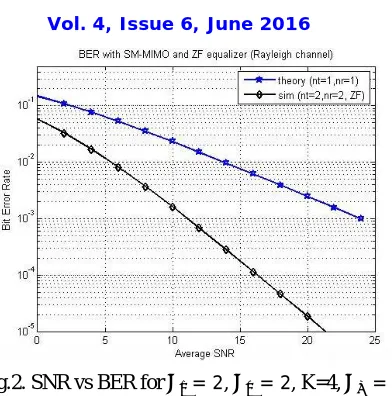
Fig.2. SNR vs BER for = 2, = 2, K=4, = 1
The use of SMMP also allows outshine conventional MIMO systems with a pair of RF chains for range of practical BERs. Moreover, it has been seen that the SMMP algorithm clearly improves the performance of other linear detectors also. Fig.3 shows SNR vs Spectral efficiency of proposed work by increasing number of active antennas. . This figure characterizes the spectral efficiency of spatial modulation matching pursuit algorithm by increasing the number of active antennas.
Fig. 3. SNR vs Spectral efficiency
The spectral efficiency increases as number of active antennas increases. The results of this figure show that SM systems with SMMP detection are capable of improving the performance of conventional MIMO systems employing the same number of RF chains. Spectral efficiency increases for more number of active antennas.
V. CONCLUSION
REFERENCES
[1] G. Li et al., “Energy-efficient wireless communications: Tutorial, survey, and open issues”, IEEE Wireless Commun., vol. 18, no. 6, pp. 28–35, Dec. 2011
[2] E. Bjornson, L. Sanguinetti, J. Hoydis and M. Debbah, “Optimal design of energy-efficient multi-user MIMO systems: Is massive MIMO the answer”, IEEE Trans. Wireless Commun., vol. 14, no. 6, pp. 3059–3075, 2015.
[3] M. Di Renzo, H. Haas, A. Ghrayeb, S. Sugiura and L. Hanzo, “Spatial modulation for generalized MIMO: Challenges, opportunities, and implementation”, Proc.in IEEE, vol. 102, no. 1, pp. 56–103, 2014.
[4] C. Masouros, M. Sellathurai and T. Ratnarajah, “Large-scale MIMO transmitters in fixed physical spaces: The effect of transmit correlation and mutual coupling”, IEEE Trans. Wireless Commun., vol. 61, no. 7, pp. 2794–2804, 2013.
[5] P. Yang, M. Di Renzo, Y. Xiao, S. Li, and L. Hanzo, “Design guidelines for spatial modulation,” IEEE Commun. Surveys Tuts., vol. 17, no. 1, pp. 6–26, 1st Quart. 2015.
[6] A. Younis, S. Sinanovic, M. Di Renzo, R. Mesleh and H. Haas, “Generalised sphere decoding for spatial modulation”, IEEE Trans. Commun., vol. 61, no. 7, pp. 2805–2815, 2013.
[7] R. G. Baraniuk, V. Cevher, M. F. Duarte, and C. Hegde, “Model based compressive sensing,” IEEE Trans. Inf. Theory, vol. 56, no. 4, pp. 1982–2001, 2010M.
[8] R. Y. Mesleh, H. Haas, S. Sinanovic, C. W. Ahn, and S. Yun, “Spatial modulation,” IEEE Trans. Veh. Technol., vol. 57, no. 4, pp. 2228–2241, Jul. 2008.
[9] J. Zheng, “Low-complexity detector for spatial modulation multiple access channels with a large number of receive antennas,” IEEE Commun. Lett., vol. 18, no. 11, pp. 2055–2058, 2014.
[10] M. Di Renzo and H. Haas, “Bit error probability of space-shift keying MIMO over multiple-access independent fading channels”, IEEE Trans. Veh. Technol., vol. 60, no. 8, pp. 3694–3711, 2011.
[11] L.-L. Yang, “Signal detection in antenna-hopping space-division multiple access systems with space-shift keying modulation”, IEEE Trans. SignalProcess., vol. 60, no. 1, pp. 351–366, 2012.
[12] D. Needell and J. A. Tropp, “CoSaMP: Iterative signal recovery from incomplete and inaccurate samples”, Appl. Comput. Harmonic Anal., vol. 26, no. 3, pp. 301–321, 2009.
[13] A. Garcia-Rodriguez and C. Masouros, “Low-Complexity Compressive Sensing Detection for Spatial Modulation in Large-Scale Multiple Access Channels”, IEEE trans. on Commu., vol. 60, pp. 2565-2579, 2015
BIOGRAPHY
![Fig. 1: SM bit-to-symbol mapping rule[5]](https://thumb-us.123doks.com/thumbv2/123dok_us/1442172.1176661/2.595.193.416.616.780/fig-sm-bit-to-symbol-mapping-rule.webp)