and Techniques: A Survey
Chaudhari Nivrutti Janardhan1, Gagan Sharma2, Rajesh Sharma3,
1,2,3
Department of Computer Science & Engineering,
RKDF University, Bhopal, India
Abstract: Face recognition techniques has evolved as importance and interest research area. Face recognition is a specific pattern recognition technique in digital im-age analysis with the pattern of localizing face region from background. Face recognition has many applica-tions in various fields such as intelligent human com-puter interfaces, video surveillance and so on. Several techniques have been proposed for face recognition with their advantage and limitations. This paper presents a survey of various modern face detection methods. Fi-nally, in this survey, a novel method and technique are envisioned to overcome the limitations of previous face recognition techniques.
Keywords: Face Recognition, Pattern Recognition, Eigenfaces, Biometric Identification.
1
Introduction
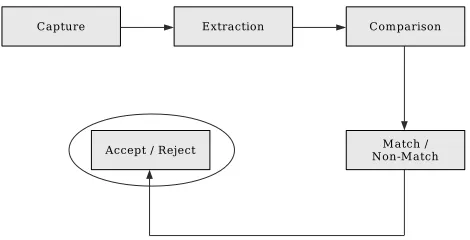
Face recognition [1] system is basically a computer ap-plication which is developed for identification and verifi-cation of a person from database of computerized video source. The faces identified with the help of face fea-tures in a face recognition system. Face recognition with machine learning methods becomes a new research are because there is a need to develop such system which should be user friendly as well as capable to secure our possession and also give privacy without compromising the identity. The general face recognition working pro-cess is presented in Figure 1.
In order to develop a system which is able to con-trol both the necessity face recognition play a great role, means it should establish system which is user friendly with providing great security. With the support of ma-chine learning technique faces are recognized where the image size is very low resolution or it is not able to iden-tify the person. There are several applications of face recognition system in various fields like in image pro-cessing and it also has application in the gaming. This technology also launched a game which uses face
recog-Figure 1: Face Recognition Working Steps
nition method to recognize that it is a human face or vampires. Many recent games are in market based on this method with affordable cost. Many other applica-tions of face recognition is creating mental notes with the help of smart phones and this facilitate in organizing face images as a reminder [2]. There are various applica-tion in distinguishing TV shows that recognize the TV shows we are watching. It also discover application in image search, solving sudoku puzzles, augmented real-ity, in security and also in protecting more about ourself in public [3][4].
Generally there are two types of features which are used in face recognition system.
• Global Feature: The global feature identifies the whole image. This feature is usually not identically robust as a alteration in the image component may create it to break down as it will misrepresent the resulting form.
• Local Feature:The local feature identifies a patch within the image. Multiple local signifier and de-scriptor are employed to manage a image and this is more effective as not everything of the signifier and descriptors require to coordinate for the corre-lation to successful making. This develops it more robust.
There are two main reasons for the interest of research in face recognition.
1. It provides best scope in the application design-ing of video surveillance and security. Many of the fields in facial expression change with time, poses may be different, partial front position and low-resolution, now it is also embedded into an appli-cation on low determination images which can be developed by the natural settings and configura-tion. Still, face recognition based on low resolution image is still an critical subject in the research area.
2. Face recognition is also applied for application to prevent fake identification cards, voter fraud and biometric usages also find application in phones.
2
Face Recognition Tasks
Usually it involves three major problems in automatic face recognition task. Three key task of face recognition are:
1. Face detection with the rough normalization on face image.
2. Feature extraction with normalization.
3. Identification or verification the face.
It Sometimes becomes challenging task to categorize each subtask. For example, many features are common in face detection and recognition. The facial and some common features are structures like nose, eyes, mouth and ex-traction of all features can be possible simultaneously [5]. Other difficulties in face recognition or detection are the different size of database, noise, background effect and distinct speed of the model [6].
The steps in face recognition are:
1. Firstly detect the face.
2. After feature extraction, it is required to save into a classification model.
Features for face recognition can be global or local and this feature type depends on the model. Mainly two statistics are considered in detection problem: true pos-itives (detection rate) and false pospos-itives (detections in non face regions). The true positive rate should be max-imum for an ideal system and false positive rates should be minimum. Face recognition play a major role and it is a day-to-day procedure for humans, in building a com-puter system, it has great demand and a large future scope [7]. Face recognition may encounter many heavy
challenges in terms of identical face expressions, factional occlusion, pose variations and even at low resolution, basically depend on environment condition and the bio-metric devices which is kept at a far distance. However low resolution face recognition has great research scope. Complexity increases when image size is small with low quality, which degrades the performance of face recogni-tion [8].
3
Literature Survey
In this paper we surveyed and analyzed adaptive modern face recognition techniques.
3.1
Geometrical Feature Matching
Geometrical features matching method is based on the set of geometrical features mathematical computation of the face image [9]. The face recognition is possible even at low resolution as 8×6 pixels when an individual fa-cial feature is hardly revealed in detail implies that the overall geometrical configuration of the facial features is sufficient for recognition. The overall shape configura-tion of the image can be identified by a vector posiconfigura-tion and size of the main facial features, such as nose, eyes and eyebrows, angle of jaw, mouth and face outline shape [10].
3.2
Support Vector Machine (SVM)
Many support vector machine (SVM) [11] based com-puter vision problem has been proposed. An SVM for face detection is required where the discrimination lies between two categories: face and non-face.
Support vector machine (SVM) is a learning tech-nique which can be applied for general purpose pattern recognition because it has high generalization perfor-mance without other knowledge [12][13]. Initially, given a set of points belonging to two classes, a support vec-tor machine (SVM) finds a hyper plane which divides the largest possible fraction of points at the same class on the same side, with increasing distance between class and its hyperplane. This hyperplane is known as Optimal Sep-arating Hyperplane (OSH) [14] which reduces the risk of misclassifying not only examples in the database of training set but also the unobserved example of the test set.
3.3
Hidden Markov Models (HMMs)
recogni-tion techniques. The stochastic modeling of non-starecogni-tionary vector time series based on hidden markov model (HMM) has been very successful for speech recognition applica-tions. Faces were intuitively divided into regions such as the eyes, nose, mouth, jaw etc., which can be associ-ated with the states of a hidden Markov model. Since HMMs need a one-dimensional observation sequence and images are two-dimensional, so the images should be con-verted into either 1D temporal sequences or 1D spatial sequences [16][17].
3.4
Appearance-Based Face Recognition
Appearance-based face recognitions are classical pattern matching techniques and it can be categorized into lin-ear analysis methods like Principal Component Anal-ysis (PCA) [18], Linear Discriminant AnalAnal-ysis (LDA) [19], Independent Component Analysis (ICA) and non-linear analysis methods, like Kernel Principal Compo-nent Analysis (KPCA). Traditional linear appearance-based methods are PCA, ICA and LDA, these methods have their own basis vector components of higher dimen-sional face image coordinates. With the help of these linear analysis techniques the face vectors are projected to the basis coordinates.
By projection of higher dimensional input image space into a lower dimensional space vector, the dimensions of the original input image space vectors can be minimized. The score of matching pattern lies between the test face image and training images which are estimated by com-puting the differences between their space vector projec-tions. There are more similarity between those two face images if the score is higher.
3.4.1 Principal Component Analysis
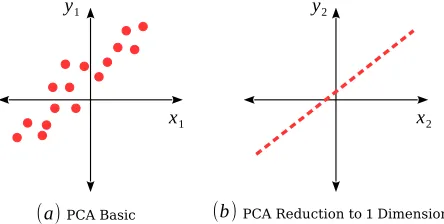
Principal component analysis (PCA) [20] is for comput-ing the vector spaces that generally describe their min-imized area of image space. This is basically eigenvec-tor and also called Karhunen-Love expansion [21], eigen-picture and principal component. The principle behind the principal component analysis is to compute the vec-tors that best describe the distribution of face images in the database of complete image space. This principle is represented by Figure 2.
Computation of PCA is usually accomplished by pro-jecting new image into the vector subspace (face space) paired by eigen faces and classifying the face by compar-ing its coordinate location in face space with the posi-tions of known individuals. The function of PCA is to compute a subspace where the deviation is maximized.
Figure 2: The Concept of PCA
3.4.2 Independent Component Analysis
For improving the performance of PCA, an additional discriminant analysis is needed because it extracts only the principal features which is not related to the adap-tive face recognition. So,independent component analy-sis (ICA) [22] describes more effective data representa-tion as compared to PCA as its target is to give an inde-pendent representation instead of non-correlated struc-ture and image decomposition. ICA is basically a gener-alization form of PCA [23].
3.4.3 Linear Discriminant Analysis
Linear discriminant analysis (LDA) is process applied in machine learning and pattern recognition for comput-ing a linear combination of features which classifies two or more classes of objects. Image similarities and pro-jections are related together, various image propro-jections place far away PCA is used, however, the projection of different class images are mixed together. LDA [19] is ca-pable to enhance the ratio of between-class distribution to its within-class distribution [24]. LDA is also known as Fisher Discriminant Analysis (FDA).
3.4.4 Non-Linear Analysis
3.5
Eigenfaces Method
Eigenfaces [26] was the name acknowledged to the set of eigenvectors as it is used in human face recognition. Eigenfaces method generally use dimensionality reduc-tion technique. The correlareduc-tion techniques are compu-tationally costly and the huge amount of storage space is needed, so dimensionality reduction technique such as eigenfaces is needed. In this method, the eigen vector as a reduced dimension is extracted from the higher di-mensional images vectors. In this method, the principal components are evaluated more easily [27].
LetTis a matrix of preprocessed training image sets, its each column of the image vector have one mean-subtracted image. A covariance vector is calculated as
S =T TT (1)
An eigenvector decomposition ofS is given by
Svi=T TTvi=λivi (2)
HoweverT TT is a huge vector, so the eigenvalue decom-position are taken of this equation:
TTT ui=λiui (3)
By multiplying with T on both sides of the equation it becomes:
T TTT ui=λiT ui (4)
It demonstrates that, ifuiis an eigenvector ofTTT, then
vi=T ui is an eigenvector of vectorS. If a training im-age set of 500 imim-ages of 100×100 pixels, then the vector
TTT is a 500×500 vector, those are manageable than the 10000×10000 covariance vector. The eigenfaces tech-nique has advantage over traditional techtech-niques, such as the processing speed and system efficiency. The system can represent several subjects points with a compara-tively small set of data of images because eigenface is primarily a dimension reduction technique. As an adap-tive face recognition method eigenface is invariant to the large reductions in image dimensions.
4
Problem Formulation
The pattern matching and face recognition techniques discussed in literature survey have some limitations. Sev-eral face recognition methods succeed and failed also at broadly various viewing points and illumination condi-tions. Generally one method which is extremely appro-priate for some type of images but cannot be applied under other circumstance.
In another point of view, the face recognition meth-ods required in adaptive and useful day-to-day recog-nition system which cannot be applied to one specific applicable recognition technique. It appears that vari-ous individual face recognition on different applications creates a problem due to this limitation. The overall limitations can be considered in different face recogni-tion techniques as image quality, image size, angles of face structure, processing speed and time complexity of the algorithms. These limitations can not be totally re-moved, but can be reduced.
5
Proposed Methodology
Among various face recognition methods, there are some basic, fundamental and efficient face recognition meth-ods which use similar concepts, basic dimensionality re-duction method and mathematical calculations. The analysis introduces that various conditions of face recog-nition methods can be effectively combined to enhance the identification performance that can be achieved with a given image gallery. The analysis shows that for the given images the combination of three face classifiers is superior to two classifiers. Further researches, however, have to investigate whether this is a general behavior, and how much influence the quality of the images and the choice of the face classifiers have.
However, among fundamental methods and algorithms, some methods have advantages over other methods for face recognition, and by applying the soft computing techniques the recognition rate can be effectively im-proved. So the best solution approach for biometric pat-tern matching algorithms and face recognition methods will be the hybrid method of best combinations of soft computing techniques. The combination of best features of different methods or hybrid methods will represent improved face recognition.
6
Conclusion and Future Work
can handle all face recognition factors, the hybrid ap-proach will be the improved method.
References
[1] A. J. O’Toole, X. An, J. Dunlop, V. Natu, and P. J. Phillips, “Comparing face recognition algorithms to hu-mans on challenging tasks,”ACM Trans. Appl. Percept., vol. 9, pp. 16:1–16:13, Oct. 2012.
[2] A. W. Senior and R. M. Bolle,Face Recognition and its
Application, pp. 83–97. Boston, MA: Springer US, 2002.
[3] T. Huang, Z. Xiong, and Z. Zhang, Face Recognition
Applications, pp. 617–638. London: Springer London,
2011.
[4] G.-M. Jeong, H.-S. Ahn, S.-I. Choi, N. Kwak, and C. Moon, “Pattern recognition using feature feedback: Application to face recognition,” International
Jour-nal of Control, Automation and Systems, vol. 8, no. 1,
pp. 141–148, 2010.
[5] D. Zhang, Y. Xu, and W. Zuo, Sparse
Representation-Based Classification for Biometric Recognition, pp. 61–
77. Singapore: Springer Singapore, 2016.
[6] A. Poursaberi, J. Vana, S. Mracek, R. Dvora, S. N. Yanushkevich, M. Drahansky, V. P. Shmerko, and M. L. Gavrilova, “Facial biometrics for situational awareness systems,”IET Biometrics, vol. 2, pp. 35–47, June 2013.
[7] A. Noore, “Highly robust biometric smart card design,”
IEEE Transactions on Consumer Electronics, vol. 46,
pp. 1059–1063, Nov 2000.
[8] R. Sanchez-Reillo, “Smart card information and opera-tions using biometrics,”IEEE Aerospace and Electronic
Systems Magazine, vol. 16, pp. 3–6, April 2001.
[9] R. Brunelli and T. Poggio, Face recognition through
geometrical features, pp. 792–800. Berlin, Heidelberg:
Springer Berlin Heidelberg, 1992.
[10] F. Xie, G. Xu, and E. Hundt, A Face Verification
Al-gorithm Integrating Geometrical and Template Features,
pp. 253–260. Berlin, Heidelberg: Springer Berlin Heidel-berg, 2001.
[11] Z. Yanhun and L. Chongqing, “Face recognition based on support vector machine and nearest neighbor classi-fier,” Journal of Systems Engineering and Electronics, vol. 14, pp. 73–76, Sept 2003.
[12] Z. Li and X. Tang, “Using support vector machines to enhance the performance of bayesian face recognition,”
IEEE Transactions on Information Forensics and Secu-rity, vol. 2, pp. 174–180, June 2007.
[13] J. Hu and L. You, Face Recognition Based on
Cross-Validation by Support Vector Machine, pp. 1011–1018.
Cham: Springer International Publishing, 2015.
[14] H. Lue, J. He, X. Hu, and J. Wang, “Asymmetrical sup-port vector machine based on moving optimal separating hyperplane,” in2006 6th World Congress on Intelligent
Control and Automation, vol. 1, pp. 2517–2520, 2006.
[15] A. V. Nefian and M. H. Hayes, “Hidden markov mod-els for face recognition,” inAcoustics, Speech and Signal Processing, 1998. Proceedings of the 1998 IEEE
Interna-tional Conference on, vol. 5, pp. 2721–2724 vol.5, May
1998.
[16] H.-S. Le and H. Li,Simple 1D Discrete Hidden Markov
Models for Face Recognition, pp. 41–49. Berlin,
Heidel-berg: Springer Berlin Heidelberg, 2003.
[17] A. V. Nefian and M. H. Hayes, “Face detection and recognition using hidden markov models,” in Proceed-ings 1998 International Conference on Image
Process-ing. ICIP98 (Cat. No.98CB36269), vol. 1, pp. 141–145
vol.1, Oct 1998.
[18] X. Xu, W. Liu, and S. Venkatesh, “An innovative face image enhancement based on principle component anal-ysis,” International Journal of Machine Learning and
Cybernetics, vol. 3, no. 4, pp. 259–267, 2012.
[19] A. Montanari, “Linear discriminant analysis and transvariation,”Journal of Classification, vol. 21, no. 1, pp. 71–88, 2004.
[20] C. Wen, T. Wang, and J. Hu, “Relative principle com-ponent and relative principle comcom-ponent analysis algo-rithm,” Journal of Electronics (China), vol. 24, no. 1, pp. 108–111, 2007.
[21] Y. Chien and K.-S. Fu, “On the generalized karhunen-loeve expansion (corresp.),” IEEE Transactions on
In-formation Theory, vol. 13, pp. 518–520, July 1967.
[22] T.-W. Lee,Independent Component Analysis, pp. 27–66. Boston, MA: Springer US, 1998.
[23] Y.-Z. Lu, “A novel face recognition algorithm for distin-guishing faces with various angles,”International
Jour-nal of Automation and Computing, vol. 5, no. 2, pp. 193–
197, 2008.
[24] G. Ragozini, “A computational geometry approach for linear and non linear discriminant analysis,”
Computa-tional Statistics, vol. 15, no. 1, pp. 115–125, 2000.
[25] B. Xu and P. Guo, “Kernel ica applied to feature extrac-tion for image annotaextrac-tion,” in 2010 10th International Conference on Intelligent Systems Design and
Applica-tions, pp. 889–893, Nov 2010.
[26] W. Yu, Z. Wang, and W. Chen, “Selecting discrimi-nant eigenfaces by using binary feature selection,”
Neu-ral Computing and Applications, vol. 19, no. 6, pp. 911–
918, 2010.
[27] H.-C. Kim, D. Kim, and S. Y. Bang, “Face recognition using the mixture-of-eigenfaces method,”Pattern