Social Anxiety Symptoms
Hosein Khedmatgozar1, Behrooz Birashk1, Hassan Ashayeri2, Aliasghar Asgharnejad Farid4
* Corresponding Author:
Hosein Khedmatgozar, PhD,
Department of psychiatry, Shahid mohammad Bagher Lavasani hospital, Tehran, Iran (Tel: +98 21 77311011 - +98 21 66551655
E-mail: [email protected]
Introduction: Although the effectiveness of paroxetine and Attention Modification
Program has been studied separately in treating social anxiety disorder, there has been no research comparing them according to the literature. The aim of this study
was to compare the effectiveness of paroxetine, Attention Modification Program
(AMP) and combination of both on improving the Social Anxiety Symptoms.
Methods: 33 patients meeting DSM-IV-TR criteria for social anxiety disorder were randomly assigned in 3 groups: 11 in paroxetine group, 11 in AMP group and 11 in combined group. Treatment intervention was done during 8 weeks period. Social Phobia Inventory (SPIN), Beck Depression Inventory (BDI-II) and Sheehan Disability Scale (SDS) were administered before and after treatment intervention. One-way Analysis of Covariance (ANCOVA) was used to determine
the differences and efficacy of treatment interventions between groups. Data
analysis was done by SPSS-16 software.
Results: 28 participants completed the treatment period. One-way ANCOVA
results showed statistically significant differences in post-treatment scores of
social phobia (p=0/007), depressive symptoms (p=0.007) and daily life functioning (p=0.011) between three groups. Bonferroni correction showed that combined
treatment is significantly more effective than AMP in reducing social phobia
symptoms (p=0.007), depressive symptoms (p=0.022) and enhancing daily life
functioning (0.019). Yet, there were no significant differences between Paroxetine
and combined treatment in all post-treatment scores (p=0.890, p=1.000, p=1.000 for social phobia, depressive symptoms and daily life functioning respectively).
Paroxetine showed more significant improvement of depressive symptoms
(p=0.016) and enhancing daily life functioning (p=0.045) than AMP. Also, there
were no significant differences between paroxetine and AMP in reducing social
anxiety symptoms.
Discussion: It seems that paroxetine has wider effect in reducing social anxiety symptoms, depressive symptoms and enhancing daily life functioning than
AMP and adding the AMP to paroxetine does not make significant changes than
medicating with paroxetine alone.
A B S T R A C T
Article info:
Received: 13 January 2012 First Revision: 31 January 2012 Accepted: 12 February 2012
Key Words:
Paroxetine,
Attention Modification
Program, Social Anxiety, Social phobia.
1. Tehran Psychiatric Institute, Tehran University of Medical Science, Tehran, Iran. 2. Department of Physiotherapy, Tehran University of Medical Science, Tehran, Iran.
Summer 2012, Volume 3, Number 4 Basic and Clinical
1. Introduction
ocial phobia or social anxiety disorder is
defined as the fear of social situations such
as criticism and being in touch with strang-ers and becoming embarrassed in social meetings or verbal presentation in front of
others. They may also experience specific fears when
they are doing certain activities such as writing,
speak-ing in front of others or unspecific fears in social situ -ations (McClure, 2009). Compared with matched unaf-fected controls, individuals with SAD report impaired social functioning, diminished social support, lower levels of educational attainment, poorer occupational function, and decreased rates of marriage (Comer & Olfson, 2010).
The National Comorbidity Survey Replication Study (NCS-R), which assessed over 9,000 non-institution-alized individuals throughout the United States, found
that 12.1% of people have social anxiety disorder at
some point during their lives. In this survey, social anxi-ety disorder was the fourth most common psychiatric disorder, with only major depressive disorder, alcohol
abuse, and specific phobia being more prevalent. More
conservative lifetime prevalence estimates suggest that
clinically significant social anxiety affects a compelling but more modest (4%) of the population (Turk et al.,
2008).
Existing literature supports the link between atten-tional bias towards negative emoatten-tional information and emotional disorders (Amir & Taylor, 2010). There is general support for the notion of attention bias in SAD. Individuals with SAD exhibit increased attention to potentially threatening social information. Findings on attentional bias support the assumption that the stimu-lus-driven attentional system is more affected by threat-related stimuli in anxious individuals than in non-anx-ious individuals (Craig et al., 2009).
The attention-based treatments aim to modify patho-logical cognitive operations characteristic of emotional dysregulation rather than targeting the content of those
cognitive processes that may be more specific to par -ticular psychological disorders. For example, whereas cognitive restructuring techniques typically target
disorder-specific cognitive misappraisals (e.g., fear of
bodily sensations in panic disorder; fear of negative
evaluation in SAD; inflated appraisals of responsibil -ity in obsessive–compulsive disorder), attention inter-ventions are intended to target basic underlying cogni-tive functions (e.g., attention control) hypothesized to
S
play a role in the persistence of psychopathology. Thus, attention-based interventions may more directly target fundamental psychopathological vulnerabilities, while the maladaptive cognitions and behaviors characteristic of emotional disorders may be viewed as more distal expressions of those basic vulnerabilities (Amir & Tay-lor, 2010). Therefore, emphasizing on unconscious as-pects of mental disorders in psychotherapy and research means that verbal intervention is not the only way of intervention and many other therapeutic methods such as exposure can impact unconscious information pro-cessing (David, Ellis & Lynn, 2010; Dobson, 2010).According to the Schematic Propositional Analogical Associative Representation Systems (SPAARS) model of emotion, the so called basic emotions have an innate prewired component and certain emotions may come to be elicited directly, without any apparent “on-line” interpretation or appraisal (Power & Dalgleish, 2008). Some types of information processing (including both perceptual and semantic processing), by their nature, cannot be made conscious because they are represent-ed in our memory in a format (e.g., non-verbal asso-ciations) that is not consciously accessible (Schacter &
Tulving, 1994). Few workers in the field have assimi -lated this line of cognitive unconscious research in psy-chotherapy.
Indirect evidence for the causal role of attentional bias to threat in SAD has been evaluated in the context of treatment outcome studies. That is, if attentional bias to threat is a necessary condition for SAD, amelioration of the disorder should be associated with a reduction of attentional bias to threat. Empirical investigations have generally supported this hypothesis in socially anxious individuals using both the emotional Stroop paradigm and the dot probe paradigm (Amir& Boymea, 2010).
Several randomized, controlled trials have established
the efficacy of both Selective Serotonin Reuptake Inhib -itors (SSRIs) and Serotonin-Norepinephrine Reuptake Inhibitors (SNRI) in the treatment of generalized social anxiety disorder. The fact that SSRIs and SNRIs share
similar pharmacological properties and safety profiles has supported their role as the first-line pharmacologi -cal agents. None of these medications has been
estab-lished as superior to another, in efficacy or acceptability.
But, paroxetine in its immediate-release and controlled-release forms is one of the SSRIs most studied in ran-domized, controlled trials for the treatment of social
anxiety disorder, and it was the first drug to receive US
pharmaco-Our knowledge and understanding of basic attentional processes in generating and regulating emotion and of how attentional deviation could cause emotional disor-der is developing. Also, in regard to a causal role of the attentional bias in emotional disorders (Amir & Bomy-ea, 2010), we face some questions: “could changes in attention be effective in reducing the symptoms of emo-tional disorders (especially in social anxiety disorder)?
Are there any differences between Attention Modifica -tion Program and paroxetine in treating social anxiety disorder?”
2. Methods
33 patients with social anxiety disorder referring to outpatient clinics in Tehran were recruited and random-ly assigned in 3 groups in a semi-experimental research design. Independent variable was a 3-typed treatment
intervention including Attention Modification Program,
pharmacotherapy (Treatment As Usual to stand as a control group) and a combination of both. Dependent variable was the possibility of some therapeutic chang-es in social anxiety disorder, deprchang-ession and daily life functioning.
Participants were diagnosed by psychiatrists, on the basis of Diagnostic and Statistical Manual of mental disorders (DSM-IV-TR) criteria (American Psychiatric Association, 2000), who then signed the consent sheet. All participants were informed that their information
will be kept confidential and will be used for the re -search purpose. Structured Clinical Interview for axis I Disorders (SCID-I, First et al., 1996) and axis II Dis-orders (SCID-II, First et al., 1997) was administered to
finalize the diagnosis. Participants with SAD who were
under psychotherapy and pharmacotherapy prior to this research, also participants with suicidal ideation, sub-stance abuse and other axis I and II disorders were all excluded from this study. Participants with SAD, who had 18 to 50 years of age and middle school or higher levels of education, were included in this study.
Participants were randomly assigned in 3 groups: 11 patients in paroxetine group, 11 patients in Attention
Modification Program group and 11 patients in com -bined group. 2 patients in the paroxetine group and 2 others in the combined group left the study because of
the drug side effects. 1 patient in the Attention Modifi -cation Program group also left the study. They received,
A software known as the Probe Detection Task had
been applied by McLeod (1986) for the first time for
detecting attentional biases. Amir and his colleagues
(2009) used modified version of this software for treat -ing some mental disorders especially social anxiety dis-order. A computer based program adopted from Amir and his colleagues’ work was written by a computer programmer (Saeed Khavandizadeh Aghdam) and the corresponding author of this article in Visual Basic lan-guage. This program has the possibility of presenting words and pictures. 14 socio-emotionally neutral words and 14 socially emotion evoking words were adopted from Ostvar (2006) and were used as stimulus in this program. Patients would be sitting in front of a 17 inch-es monitor at a 30 centimeter distance. All randomly paired words (emotional and neutral) were presented in a white Arial 12 font inside two rectangles on the center of monitor with a black background and 1.5 centime-ter space between two rectangles. Therefore, all emo-tional words were accompanied by neutral words. All randomly paired words were presented in 500 millisec-onds. A + sign were appeared in the center of the moni-tor about 1650 millisecond before presenting words to attract the patient’s attention. In 100 percent of trials a
● sign known as the probe sign was replaced with the
neutral word. The patient’s task was to press the corre-sponding arrow key on the keyboard immediately after observing the probe sign. In the total trials, 50 percent of emotional and neutral words were appeared on the right side and 50 percent on the left side. Thus, 196 trials were formed and by repeating the trials we had 392 tri-als for each session per week. To make the participants acquainted with the program, 10 trials were preplanned
for rehearsal at the beginning of the first session. Usual -ly, the therapeutic period of social anxiety disorder with paroxetine is 6-12 months, with the highest therapeutic effectiveness in 8-12 weeks (Blanco et al., 2009). Our total Paroxetine sample received the daily, oral dosage of 20 mg of the generic Paroxetine prescribed by psy-chiatrist. Participants in the combined group received
both paroxetine and Attention Modification Program as defined earlier. Treatment interventions in all 3 groups
were done during 8 weeks period in this study. The limi-tations of this study are the lack of placebo for the
Summer 2012, Volume 3, Number 4 Basic and Clinical
2.1. Measurement Tools
Structured Clinical Interview (SCID), Social Phobia Inventory (SPIN), Beck Depression Inventory (BDI-II) and Sheehan Disability Scale (SDS) were administered before and after intervention.
Structured Clinical Interview (SCID-I and II): In a study on 299 individuals, 18 to 65 years old who had been referred to inpatient or outpatient clinics in Teh-ran, psychometric properties of SCID were assessed. In this study the results of psychiatrist interviews and SCID were compared. The validity of SCIDS was high, measured by the diagnosis made by independent psy-chiatric interviews. On the other hand, the diagnostic agreements between test and retest SCID administration were fair to good for most diagnostic categories.
Over-all weighted κ was 0.52 for current diagnoses and 0.55 for lifetime diagnoses. Specificity values for most psy
-chiatric disorders were high (>0.85) (Sharifi, 2009). `
Social Phobia Inventory (SPIN): Connor and his col-leagues (2000) made this inventory for assessing social anxiety. SPIN consists of 17 items rated on a scale from 0 to 4 (not at all, a little bit, somewhat, very much and extremely). The full scale score thus ranges from 0 to 68. The result of Connor study indicates that SPIN ex-hibits acceptable psychometric properties. It demon-strates both good test-retest reliability (0.78-0.89) and
internal cohesion (α=0.94). The SPIN also shows a sub -stantial difference between people with social phobia and people without, when compared with a gold stan-dard clinical interview. In a study in Iran, Abdi (2007)
reported acceptable internal consistency (α=0.86) and
good test-retest reliability (0.83).
Beck Depression Inventory (BDI-II) is a 21 item self-reporting scale for assessing severity of depression. Each item has a score of 0 to 3 and 0 to 63 for the whole scale. Research studies focusing on the psychometric properties of the Beck Depression Inventory (BDI) with psychiatric and non-psychiatric samples were reviewed from 1961 to June, 1986. A meta-analysis of the BDI‘s
internal consistency estimates, yielded a mean coeffi -cient alpha of 0.86 for psychiatric patients and 0.81 for non-psychiatric subjects. The concurrent validities of the BDI, with respect to clinical ratings, and the Ham-ilton Psychiatric Rating Scale for Depression (HRSD) were also high. The mean correlations of the BDI sam-ples with clinical ratings and the HRSD were 0.72 and 0.73, respectively for psychiatric patients. With non-psychiatric subjects, the mean correlations of the BDI with clinical ratings and the HRSD were 0.60 and 0.74,
respectively. Recent evidence indicates that the BDI discriminates subtypes of depression and differentiates depression from anxiety (Beck et al., 1988). A study on 94 Iranian samples has reported good test-retest
reliabil-ity (0.94) and alpha coefficient (0.91) (Fata et al., 2005).
The Sheehan Disability Scale (SDS) is a self-re-porting visual analog scale and measures impairment in daily life functioning. The scale generates 3 scores in 3 items: a work disability score, a social life dis-ability score, a family life disdis-ability score and a total score. Scores for each item range from 0 to 10 on a Lik-ert scale. The 3 items can also be summed into a single dimensional measure of global functional impairment, ranging from 0 (unimpaired) to 30 (highly impaired).
Elevated score (≥5) on each item has been shown to be
related to high risk in psychiatric disorders. There are also evidences that show SDS is sensitive to therapeu-tic changes (Sheehan, 1983). In a study on 54 Spanish patients with social phobia (based on DSM-IV criteria) and 53 healthy individuals, convergent validity of SDS with Global Assessment of Functioning was 0.39. Inter-nal consistency for SDS subscale was 0.75 (Cronbach’s alpha) and test-retest reliability was 0.88 (Gonzalez et al., 2009).
3. Results
Analysis on demographic data and pre-treatment
scores statistically showed no significant difference be -tween the 3 groups. As the table 1 presents there were
statistically no significant differences between the 3
groups in sex (p>0.05), age (p>0.05), job (p>0.05) and educational level (p>0.05) of participants. Results of the Analysis of Variance (ANOVA) on pre-treatment scores of SPIN (p>0.05), BDI-II (p>0.05) and SDS (p>0.05)
presented in table 2 also showed no statistically signifi -cant difference between the 3 groups. One-way Analysis of Covariance (ANCOVA) on SPIN, BDI-II and SDS
post-treatment scores showed statistically significant
differences between the 3 groups. The results of AN-COVA have been shown in table 3. As table 3 shows, the effect of groups on SPIN (F=6.09, df=2, p=0.007), BDI-II (F=6.09, df=2, p=0.007) and SDS (F=5.44, df=2,
p=0.011) post-treatment is significant. Bonferroni cor -rection revealed that differences between the mean of social anxiety post-treatment scores in combined group
and the combined group, but there are significant differ -ences between paroxetine and AMP group on the mean of BDI (p=0.016) and SDS (p=0.045) scores. Also,
there were significant differences between combined
and AMP group on the mean of SDS, DBI-II (p=0.022) and SDS (p=0.019) post-treatment scores. The results
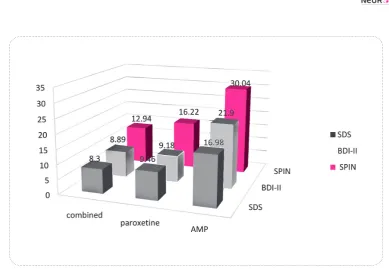
life functioning. Therefore, adding the AMP to
parox-etine does not make any significant changes compared
to medicating with paroxetine alone. These results and
modified means of SPIN, BDI-II and SDS post-treat -ment scores have been presented in Graph 1.
Variables
Groups χ 2
F sig
Paroxetine AMP Combined
Gender (%women) 44 30 33 χ 0.80
Age (years) 30.44(7.68) 25.20(4.44) 27.22(5.40) 0.185 0.18 Education 15.44(2.51) 14.40(2.33) 14.89(2.71) 0.000 0.67
Marital status(%married) 44 30 22 0.016 0.60
Job (%unemployed, %student) 33,11 50,20 33,22
χ 2=1.01
χ 2=3.07
0.21
Variables
Groups
F sig
Paroxetine AMP Combined
SPIN 36.67 (14.08) 35.70 (14.70) 30.89 (9.25) 0.42 0.66
BDI-II 22.56 (8.79) 22.70 (12.64) 24.56 (10.90) 0.94 0.91
SDS 17.56 (5.70) 18.20 (4.64) 19.47 (4.47) 0.83 0.83
Variables Sum of Square df SquareMean F Sig Partial eta Square
SPIN 830.26 2 415.13 6.09 0.007 0.34
BDI-II 305.91 2 152.96 6.09 0.007 0.34
SDS 122.51 2 61.26 5.44 0.011 0.31
Table 1. Demographic properties of participants in 3 groups: (proportions, ANOVA results, χ 2, F results, Standard Deviations and ρ values). SDs are in brackets
Table 2. Means, Standard Deviations and ANOVA results of pre-treatment scores of measures
Summer 2012, Volume 3, Number 4 Basic and Clinical
Graph 1. Modified means of SPIN, BDI-II and SDS post-treatment scores
Measure
Group Paroxetine vs. Combined
AMP vs. Combined
Paroxetine vs. Amp
SPIN 0.890 0.007 0.090
BDI-II 1.000 0.022 0.016
SDS 1.000 0.019 0.045
Table 4. P values of pair wise posthoc comparisons
4. Discussion
The results of this study showed that paroxetine and the combined treatment (paroxetine and AMP) are more effective than the AMP in reducing social anxiety symp-toms and enhancing the total daily life functioning. A Meta-analysis of a series of AMP effectiveness studies has revealed very diverse results. Treating psychologi-cal disorders by modifying attention bias is in its initial stages and results of effectiveness of this method are different in literature (Hakamata et al., 2010). Studies on the effectiveness of the paroxetine, however, have
always showed consistent positive findings (e.g. Stein
et al., 1996; Allgulander, 1999; Leibowitz et al., 2002).
Effectiveness of paroxetine in this study is consistent with other investigations on the effectiveness of
Selec-tive Serotonin Reuptake Inhibitors (SSRI) in reducing social anxiety symptoms (e.g. Gould et al., 1997; Stein et al., 1996; Leibowitz et al., 2002). Therefore, it was not out of expectation that paroxtine could be effective in this study too. However, the smaller effectiveness of AMP could be a matter of discussion in the present re-search. As mentioned above this method is in its initial stages and there are many variables that their impacts on modifying attention biases are not yet completely investigated. According to the attention bias theory, tar-geting mechanisms of attention control related to bias to threat could directly impact social anxiety symptoms in affected people. Based on this hypothesis, attention bias
modification training targets information processing
stimulus, number of stimulus, etc. These variables have to be investigated to determine their exact impacts on modifying the attention bias leading to therapeutic ef-fectiveness.
Reduction in depression scores in this study is con-sistent with other investigations that emphasize on re-lation between depression and social anxiety disorder. For example, in a study Moscovitch and his colleagues (2005) reported that paroxetine causes changes in social anxiety symptoms and accordingly changes in depres-sive symptoms. In another research, Dempsey (2009) found that paroxetine leads to reduction in social anxi-ety symptoms during time, along with reduction in pressive symptoms. In regard to less reduction in de-pressive symptoms of AMP group versus the two other groups, it seems that there would be direct correlation between changes in social anxiety symptoms and de-pressive symptoms. Therefore, less reduction in depres-sive symptoms is because of the fact that there is less reduction in social anxiety symptoms in AMP group than in two other groups. This result is consistent with Kocabasoglu and his colleagues (2003), who suggest-ed that there are correlations between improvement of anxiety and depressive symptoms. In addition, it seems that there are common factors between social anxiety and depression that paroxetine also targets; factors such as neurochemical links between depression and anxiety (Iny et al., 1994; Zaninelli, 1999), interpersonal sensi-tivity (Vidyanidhi et al., 2009) and dysfunctional atti-tudes (Reiter et al., 1991).
Consistent with other studies (e.g. McCafferty, 2000; Baldwin et al., 1999; Sheehan et al., 2003) this research showed that paroxetine leads to daily life functioning improvement in patients with social anxiety disorder. Sheehan and his colleagues (2000) suggest that pres-ence of mood and anxiety disorders strongly cause im-pairment in daily life functions. As a result, it is natural that daily life functioning improves in accordance with social anxiety symptoms reduction. Therefore, it seems that the smaller amount of functional improvement in AMP group versus two other groups could be the result of lesser improvement in social anxiety symptoms of this group.
In general, it seems that the limitation in sample size of
the present study on one hand, and the lack of identifica -tion of more detailed determinants of the possible
effec-social anxiety symptoms in comparison to the other two methods. Another reason for less effectiveness of AMP could be unfamiliarity of the participants with comput-er-based treatments. Patients are familiar with standard
treatments and it might have been difficult for them to
accept that computer could treat psychological disor-ders. It seems that paroxetine has wider effect in reduc-ing social anxiety symptoms, depressive symptoms and enhancing daily life functioning than AMP. Therefore, it seems that paroxetine could be a better choice for treat-ing social anxiety, depressive symptoms and enhanctreat-ing daily life functioning than AMP and more research need to be done to prove that AMP can replace it.
Acknowledgement
Thanks to Dr Shiva Dolatabadi of Allameh Tabatabai University for editing this article. Also, thanks to Dr Mohammadali Hemmati psychiatrist of Shahid Lava-sani hospital.
This study was supported by the grant of research cen-ter in Tehran University of Medical Science and the
Summer 2012, Volume 3, Number 4 Basic and Clinical
References
Abdi, R., Birashk, B., Alilu, M.M., Asgharnejhadfarid, A.A. (2007). Interpretation bias in social phobia disorder. Journal of Psychology (Tabriz University) 1(4), 143-159., Persian Allgulander, C. (1996). Paroxetine in social anxiety disorder: a
randomized placebo-controlled study. Acta Psychiatr Scand 100,193–198
American Psychiatric Association. (2000). Diagnostic and Sta-tistical Manual of Mental Disorders (fourth ed., text revised). Washington DC
Amir, N., & Taylor, C.T. (2010). Attention and Emotion Regula-tion in Kring, AM., Sloan, DM. (Ed): EmoRegula-tion RegulaRegula-tion and Psychopathology. New York-London: The Guilford Press Amir, N., Beard, C., Burns, M., BOmyea, J. (2009). Attention
Modification Program in Individuals with Generalized Anxi -ety Disorder. Journal of Abnormal Psychology 118 (1), 28-33 Amir, N., & Boymea, J.A. (2010). Cognitive Biases in Social
Anxiety Disorder in Hofmann G. Stefan (Ed): Social Anxiety. New York, Elsevier
Baldwin, D.S. (1999). Paroxetine for Social Anxiety Disorder: Review of Three Randomized, Double-Blind, Placebo- Con-trolled Studies. European Neuropsychopharmachology 9, P313
Beck, A. T., Steer, R. A., Garbin, M. G. (1988). psychometric properties of the Beck Depression Inventory: Twenty years of evaluation. Clinical Psychological Review, 77-100 Blanco, C., Schneier, R.F., Lopez, V.O., Liebowitz, M.R. (2009).
Pharmacotherapy for Social Anxiety Disorder in Stein, JD, Holander, E., Rothbaum O.B. (Ed) Textbook of Anxiety Dis-orders. USA. American Psychiatric Publishing
Comer, J., & Olfson, M. (2010). The Epidemiology of Anxiety Disorders in Simpson, B., Neria, Y., Fernandez, LR., Schneier, F. (Ed) Anxiety Disorders. New York, Cambridge University press
Connor, K.M., Davidson, J.R.T., Churchill, E., Sherwood, A., Foa, E., Weisler, R.H. (2000). Psychometric properties of So-cial Phobia Inventory: New self-rating scale. British Journal of Psychiatry 179, 379-386
Craig, J.K., & Chamberlain, R.S. (2009), The Neuropsychology of Anxiety Disorders in Stein, JD., Holander, E., Rothbaum, OB (Ed): Textbook of Anxiety Disorders, USA. American Psychiatric Publishing
David, D., Ellis, A., Dryden, w. (2010). Rational Emotive Ther-apy in Dobson, KS (Ed): Handbook of Cognitive Behavioral Therapies. New York-London: The Guilford Press
Dempsy, J.P., Randall, P.K., Thomas, S.E., Book S.W., Carrigan, M.H. (2009). Treatment of Social Anxiety with Paroxetine: Mediation of Changes in Anxiety and Depression Symp-toms. Comprehensive Psychiatry 50, 135-141
Dobson, K.S. (2010). Handbook of Cognitive Behavioral Thera-py. New York, London: The Guilford Press
Fata, L., Birashk, B., Atef-Vahid, M.K., Dabson, K.S. (2005). Meaning assignment structures, schema, emotional states and cognitive processing of emotional information: compar-ing two conceptual frameworks. Iranian J Psychiat Clin Psy-chol (Andisheh Va Raftar) 11(3): 312-26. Persian.
First, M.B., Gibbon, M., Spitze,r R.L., Williams, J.B.W, Ben-jamin, L. (1997). Structured Clinical Interview for DSM-IV Axis II Disorders (SCID-II). Washington, DC: American Psy-chiatric Association
First, M.B., Spitzer, R.L., Gibbon, M., Williams, J.B.W. (1996). Structured Clinical Interview for DSM-IV Axis I Disorders- Patient edition (SCID-I/P, Version 2.0). New York: New York Psychiatric Institute, Biometrics Research Department Gould, R.A., Buckminster, S., Pollack, M.H., et al. (1997).
Cog-nitive behavioral and pharmacological treatment for social phobia: a meta-analysis. Clin Psychol (New York) 4:291–306 Hakamata, Y., Lissek, S.L., Bar –Haim, Y., Britton, C.J., Fon,
A.N., Leibenluft, E., Ernst, M., Pine, S.D. (2010). Attention
Bias Modification Treatment: A Meta- Analysis Toward the
Establishment of Novel Treatment for Anxiety;.Biol Psy-chiatry 68, 982-990
Iny, L.J., Pecknold, J., Surangi-Cadotte, B.E., Berhier, B., Lorenz, N.P., et al. (1994). Studies of Neurochemical Link Between Depression, Anxiety and Stress from [3H] Imipramine and [3H] and Paroxetine Binding on Human Platelets. Biological Psychiatry 36, 281-291
Kocabasoglu, N., Corapcioglu, A., Yargic, I. (2003). The
Mul-ti-Central Clinical Study on the Efficacy of Paroxetine over
Anxiety Symptoms in Mixed Anxiety-Depression. European Neuropsychopharmachology 13, 213-214
Liebowitz, M.R., Stein, M.B., Tancer, M., et al. (2002). A
rand-omized, double-blind, fixed-dose comparison of paroxetine
and placebo in the treatment of generalized social anxiety disorder. J Clin Psychiatry 63, 66–74
Gonzalez, M.P., Bobes, J., García, M., Badía, X., Luque, A., Dal-Re, R. (1998). Assessing social phobia. The Spanish validation of the Sheehan Disability Scales European Neuropsychop-harmacology 8 P 259
Macleod, C., Mathews, A., Tata. (1986). Attentional Bias in Emotional Disorder. Journal of Abnormal Psychology 95(1) 15-20
Ostvar, S., Khayyer, M., Lotfian, M. (2006). Memory bias in ad -olescence with social anxiety disorder. Journal of Psychology 10, 349-364., Persian
March, J.S. (2010). Attention Bias Modification Training and the
New Interventions Research, Biological Psychiatry, 68, issue 11, 1, 978-979
Moscovitch, D.A., Hofman, G., Suvak, M.K., Albon, T.L. (2005). Mediation of Changes in Anxiety and Depression During Treatment of Social Phobia; Journal of consulting and clinical psychology 73, 945-952
Power, M., & Dalgleish, T. (2008). Cognition and Emotion: From Order to Disorder. Second Edition. New York: Psycho-logical Press
Reiter. S.R., Otto, M.W., Pollack, M.H., Rosenbaum, J.F. (1991). Major Depression in Panic Disorder Patients With Comorbid Social Phobia. Journal of Affective Disorder 22, 171-177 Schacter, D.L., & Tulving, E. (1994). Memory systems.
Cam-bridge, MA: MIT Press
Sharifi, V., Assadi, S.M., Mohammadi, M.R., Amini, H., Kavi -ani, H., Semn-ani, Y., et al. (2009). Translation of the Structured Clinical Interview for Diagnostic and Statistical Manual of Mental Disorders, Fourth Edition: psychometric properties. Comprehensive Psychiatry 50, 86–91
Sheehan, D., Christie, J., Dube, E. (2003). Paroxetine Improves the Functional Disability Associated with Mood and Anxiety Disorder; European Neuropsychopharmachology. 13, P375 Sheehan, D.V. (1983). The Anxiety Disease, New York, Scribner Stein, M.B., Chartier, M.J., Hazen, A.L., et al. (1996). Paroxet-ine in the treatment of generalized social phobia: open-label treatment and double-blind placebo-controlled discontinua-tion. J Clin Psychopharmacol 16, 218–222
Turk, C.L., Heimberg, R.G., Magee, L. (2008). Social Anxiety in Barlow, HD(Ed), Clinical handbook of Psychological Disor-ders, New York,Guilford Press
Vidyanidhi, K., & Sudhir, P.M. (2009). Interpersonal Sensitivity and Dysfunctional Cognition in Social Anxiety and Depres-sion. Asian Journal of Psychiatry, 2, 25-28