Available Online At www.ijpret.com
INTERNATIONAL JOURNAL OF PURE AND
APPLIED RESEARCH IN ENGINEERING AND
TECHNOLOGY
A PATH FOR HORIZING YOUR INNOVATIVE WORK
PERSONALIZED PRIVACY PRESERVING USING SENSITIVE ATTRIBUTE
GENERALIZATION
RAJESHWARI SURYAWANSHI, PROF. PARUL BHANARKAR, PROF. GIRISH AGARWAL
Rashtrasant Tukdoji Maharaj, Nagpur university, Abha Gaikwad Patil College of Engineering, Nagpur, India
Accepted Date:
27/02/2013
Publish Date:
01/04/2013
Keywords
Anonymous database,
Personalized Anonymity,
K-Anonymity,
Generalization,
SA-generalization
Corresponding Author Ms. Rajeshwari
Suryawanshi
Abstract
The most important principle of privacy is that individual has
the freedom to decide the/her privacy preferences, which
should be taken into account when data holder of privacy
preserving micro data released to the researcher. Whenever
an update is performed on anonymous database the database
should be anonymous after the update. The previous work on
updates to anonymous database used the concept of
k-anonymity. The paper proposes a model to perform updates
on personalized anonymous database by performing QI –
generalization and SA generalization. In this paper Different
modules are described performing the above described tasks.
The First Module i.e. the admin module output for Patient view
Available Online At www.ijpret.com
INTRODUCTION
Large amount of sensitive information about
citizens accumulated in the databases of
government agencies and private
organizations, such as Social Security
Administration, banks, and health care
providers, has been increasing steadily in the
past decades. While it has long been realized
that there is a need to protect the
information both in storage and transition, it
has recently become apparent that the
information needs to be properly guarded
from unauthorized disclosure during the
Process of testing newly developed
applications that employ the databases.
The objective of personalized privacy is to
guard the interests of peoples at the primary
place. An individual can specify the degree of
privacy protection for her/his sensitive values
but using the concept of personalized
anonymity. When a database needs to be
updated by inserting a tuple which contains
information about an individual, introduces
two problems concerning both the anonymity
and confidentiality of the data stored in the
database and the privacy of the individual
whose data is to be inserted. In general every
individual is concerned about its privacy and
also the organization to which the individual
belongs to. So, the technique of personalized
anonymity can be used to make the database
anonymous with minimum loss of
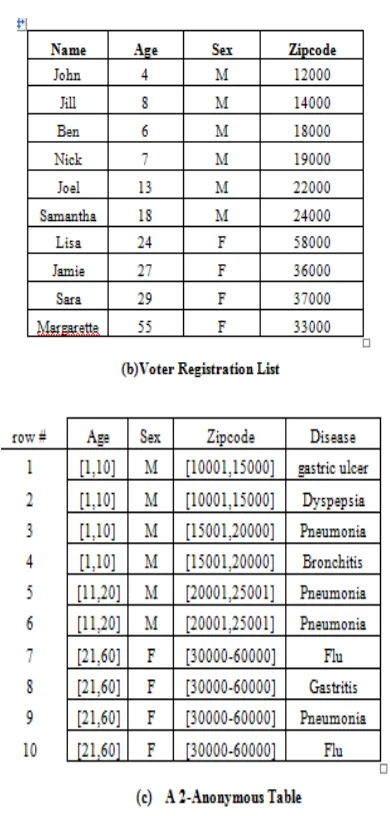
information. For example, assume that the
hospital publishes the table, which does not
explicitly indicate the names of patients.
However, if an adversary has access to the
voter registration list in table b, s/he can
easily discover the identities of all patients by
joining the two tables on {Age, Sex, Zipcode}.
These three attributes are, therefore, the
quasi-identifier (QI) attributes. The 2
anonymous tables for micro data are shown
in table c of Fig.1.
The paper proposes an update technique on
personalized anonymous database. The
Existing method supports on K-anonymization
that exerts the same amount of preservation
for all persons. Section 2 gives the detailed
literature survey. Section 3 explains the
problem that need to be considered. Section
4 gives the proposed work with the design
view of the system. The proposed system
inserts a tuple concerning information about
a person in personalized anonymous
database and checks whether the database
still satisfies personalized anonymity.
2. LITERATURE SURVEY
In the paper [1] author proposed a formal
Available Online At www.ijpret.com privacy de-identification. It prevents the
attack by suppressing and generalizing the
Quasi-identifier attributes which can combine
with public records and uniquely identify the
records. A microdata release provides
k-anonymity protection if the information for
each person contained in the release cannot
be distinguished from at least k-1 individuals
in microdata . This paper also verifies
re-identification attacks that can be realized on
releases that adhere to k-anonymity.
In the paper [2] author introduces a new
notion of privacy called as l-diversity. As
k-anonymity protects the microdata released
table against identity disclosure, it is
insufficient to provide attribute disclosure.
L-diversity requires that each equivalence class
of dataset should have at least l represented
values for sensitive attribute. Its limitation is
that it is possible for an adversary to gain
information about the sensitive attribute if
the attacker has knowledge about global
distribution of the attribute.
In the paper [3] author proposes novel
privacy called t-closeness and showed that
l-diversity has number of limitations as it is
difficult to achieve and insufficient to prevent
attribute disclosure. If the distance between
the distribution of a sensitive attribute in a
equivalence class and the distribution of the
attribute in the whole table is less than or
equal to threshold t then the equivalence
class is having t-closeness. These highly limit
the amount of individual specific knowledge
an attacker can learn.
In the paper [4] the author proposed
technique that performs the minimum
generalization for satisfying everybody’s
requirements, and thus, retains the largest
amount of information from the micro data. It
illustrates how the k-anonymity requirement
can be translated, through the concept of
quasi-identifiers, in terms of a property on
the released table. The authors illustrated
how k-anonymity can be enforced by using
generalization and suppression techniques.
They have introduced the concept of
generalized table, minimal generalization, and
minimal required suppression. I
n the paper [5] the author proposed
personalized anonymity concept which
specify degree of privacy for his/her sensitive
values. K-anonymity has several drawbacks
as discussed in the paper [5]. A k-anonymous
table may lose considerable information from
the microdata and may allow an adversary to
derive the sensitive information of an
individual with 100% confidence. This paper
also explains the algorithm for deriving
Available Online At www.ijpret.com
greedy framework and optimal
SA-generalization.
In the paper [6] the author suggested paper
deals with problems concerning privacy and
confidentiality such that updates can be
performed without revealing the contents of
tuples and DB to the user or data provider. It
exerts the same amount of preservation for
all persons, resulting in more information loss
in microdata release. The first protocol is
aimed at suppression-based anonymous
databases which allow the database owner to
anonym zed the tuple without gaining any
information about the individual specific data
and without sending new tuples owner newly
generated data. The second protocol is aimed
at generalization-based anonymous
databases, and it works mainly on a secure
set intersection protocol, to provide
privacy-preserving updates on a generalization-based
k-anonymous database.
In the paper [7] the author proposed the
techniques which address the problems of
efficiently and privately computing set
intersection database oriented operations. It
formalize the notion of minimal information
sharing across In these paper the author
proposed protocols for three operations
Intersection, Intersection size and Equijoin
and proved that these protocols disclose
minimal information apart from query results.
It then gives cost analysis for these protocols
and estimation of execution times of the
application examples. It has two limitations. It
do not address the problem of what the
parties might learn by combining the results
of multiple queries and how to find which
database contains which tables and what are
the attributes names.
In this paper [8] the two protocols are
proposed to perform private updates on
anonymous database. But these protocols
have limitations, of not supporting to
generalization-based updates, which is the
main strategy adopted for database
anonymity. Therefore, if the database is not
anonymous with respect to a tuple to be
inserted, the insertion cannot be performed.
One of the protocols proposed in the paper is
Available Online At www.ijpret.com
Figure 1: Microdata, external source, and
quasi-identifier generalization
3.PROBLEM STATEMENT
Consider the tables in Fig 1.The Microdata for
medical facility is given in Figure 1(a) and the
other database for voter registration list is
given in Fig 1(b). Assume that an adversary
attempts to infer the disease of Joel, knowing
his age 13, sex, and zip code 22000. From the
published table in Fig1(c), s/he knows that
Nick may correspond to tuple 5 or 6 (the QI
values of the other tuples do not cover those
of Nick). The diseases of both tuples are
pneumonia; hence, the adversary can declare
(with 100% confidence) that Joel must have
contracted pneumonia. Again it does not take
into account personal anonymity
requirements.
The Existing system [6] has K- anonymized
Database DB by generalizing and suppressing
the tuples before performing private updates.
In addition, k-anonymity fails to guarantee
safe publication, even in the scenario with no
personal preferences. Assume that the
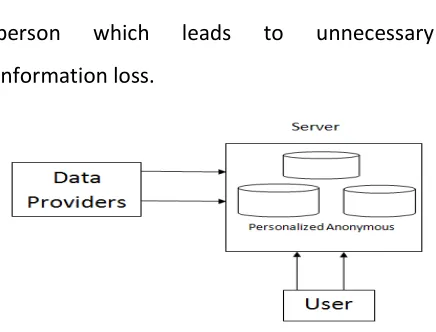
information related to a patient is stored in a
tuple t of Database and it is kept
confidentially at the server as shown in fig.2.
The insertion of information about new
patient in the anonymous database DB can be
performed if the updated database DB U t is
still anonymous. Since Database contains
privacy sensitive data, main concern is to
protect the identity of patient. So the
database is K-anonymized by performing
Generalization and suppression. While
inserting a tuple in anonymous database, the
main concern is to protect the identity of
patient. Therefore before inserting the tuple
it is anonymized and then it is inserted in
Anonymous database. But the existing
Available Online At www.ijpret.com
person which leads to unnecessary
information loss.
Figure 2. Anonymous Database
4. PROPOSED WORK
As k-anonymity has several drawbacks, the
concept of personalized anonymity is used.
The proposed system is a new generalization
framework based on the concept of
personalized anonymity, as k-anonymity has
several drawbacks. A simple taxonomy on
attribute Disease is accessible by the public It
organizes all diseases as leaves of a tree as
shown in Figure 3. An intermediate node
carries a name summarizing the diseases in its
sub tree. Individual may specify node as the
“guarding node” for his privacy, for sensitive
attribute value. An individual may specify
which implicit node of the taxonomy
underneath all the leave is used. The
empty-set preference implies that he is willing to
release his actual diagnosis result for e.g. flu
for Lisa in Figure 1; therefore it can be
published directly.
Figure 3: Taxonomy for Disease
Personalized privacy approach provides direct
protection against the association between
individuals and their sensitive values. This
Paper proposes private updates techniques
on a Database generalized using SA
generalization algorithm [2] based on
personalized anonymity concept that
preserves a large amount of information in
the microdata release without violating any
privacy constraint.
To achieve personalized anonymity
SA-generalization algorithm s used. It works in
two steps. In the first steps a generalization
function for every QI attribute is chosen and
the generalized value is obtained for all tuple
t Є T. The Generalized tuple are divided into
QI-Group. In the second step
SA-generalization uses a different function for
each group. This strategy achieves less
Information loss, by allowing each group to
decide the amount of necessary
generalization. SA-generalization results in
less precise values on sensitive attribute, it
Available Online At www.ijpret.com
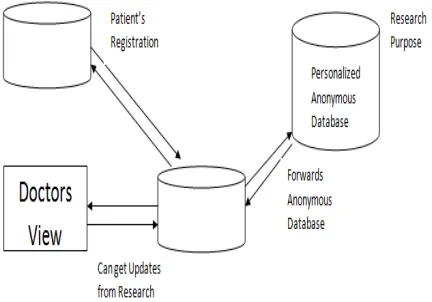
4.1 Design View of Proposed System
Figure 4 shows view of the proposed system
for medical database for a patient, where the
patient registers their details
Figure 4.Design View of Proposed System
initially. The doctor can update record of
patients and their treatments to the patient
database. Also the doctor can retrieve
information from other sources regarding the
illnesses and their treatments.
The Personalized anonymous database can
forward information to research center which
has permission access the information. The
research centre has its own access rights
which will restrict use of the data. They can
access only superficial data. They cannot
access the patient details or the particular
patient illness.
5. BASIC DEFINITIONS
The microdata which contains all information
about all the patients alongwith sensitive
information disease. Before forwarding these
data to the researcher,the data is made
anonymous by using personalized anonymity
to minimize the information loss. The Table
representing the dataset is indicated by T.The
publishable Table is given at T*.The sensitive
attribute value for a tuple is given by As. To
understand the concept of personalized
anonymity we should understand the
following terms:
Definition 1(As Subtree). For any node x in the
taxonomy of As, we represent its subtree as
SUBTR(x), which includes x itself, and the part
of the taxonomy under it.
Definition 2(Guarding Node) For a tuple t ϵ T,
its guarding nodet.GN is a node on the path
from the root to t.As in the taxonomy of As.
Definition 3 (Breach probability) For a tuple t
ϵ T,its breach probability Pbreach(t) equals
the probability that an adversary can infer
from T¤ that any of the associations {o, v1},
..., {o, vx} exists in T, where v1, ..., vx are the
leaf values in SUBTR(t.GN).
6. EXPERIMENTS
These section experimentally evaluates the
effectiveness of our technique using the
patients dataset The dataset contains 100
tuples each storing information of a patient
.The relation has 5 columns:Name,Age, Sex,
Available Online At www.ijpret.com the QI Attribute. Disease is the sensitive
attribute. The modules which implements the
concept of personalized anonymity is
described as follows.
Admin Module 1: These module is used to
insert new tuples into the dataset. There are
three different view in the first module Admin
view ,Doctor view and patient view. The
patient view as shown in fig 5 will give access
to only his/her tuple where he/she can select
whether they want privacy for their sensitive
information.
Personalized anonymity Modules 2:These
module perform personalized anonymity on
the dataset from module 1
Figure 5.Module 1 Patient View
It implements Greedy framework for
personalized anonymity. The greedy
framework performs QI generalization on the
dataset and then the SA generalization is
performed on a QI group.The SA
Generalization is carried out by checking the
breach probability of each tuple in QI group.If
the value for probability breach value is more
than the minimum considerable value then
the sensitive attribute value will be set to one
level up in taxonomy tree.
Results Module 3:It performs updates on
personalized anonymous database.The results
based on information loss of personalized
anonymity and information loss of
K-anonymity is compared.
7.CONCLUSION
generalization methods using k-anonymity
are inadequate because they cannot
guarantee privacy protection in all cases, and
often incur unnecessary information loss by
performing excessive generalization. So the
concept of Personalized Anonymity is
becoming more important .In this paper, we
work with the concept of personalized
anonymity, and updates will be performed on
these personally anonymized databases by
using Greedy Framework .The Admin Module
inserting new tuples consisting information
about patient is hown in paper. So whenever
a new tuple is inserted the individual will
decide the level of privacy from taxonomy
tree for sensitive attributes .Depending on
Available Online At www.ijpret.com will be inserted into table which results
mainly in less information loss.
REFERENCES
1. L. Sweeney, “k-Anonymity: A Model for
Protecting Privacy,” Int’l J. Uncertainty,
Fuzziness and Knowledge-Based Systems, vol.
10, no. 5, pp. 557-570, 2002.
2. A. Machanavajjhala, J. Gehrke, et al.,
ℓ-diversity: Privacy beyond k-anonymity, In
Proc. of ICDE, Apr.2006.B
3. N. Li, T. Li, and S. Venkatasubramanian,
t-Closeness: Privacy Beyond k-anonymity and
l-Diversity, In Proc. Of ICDE, 2007, pp. 106-115.
4. P. Samarati, “Protecting Respondent’s
Privacy in Mirodata Release, “IEEE Trans.
Knowledge and Data Eng., vol. 13,no.6,pp.
1010-1027, Nov./Dec. 2001. W. and
Marchionini, G. 1997.
5. Xiaokui Xiao, Yufei Tao “Personalized
Privacy Preservation”, SIGMOD 2006, June
27–29, 2006, Chicago, Illinois, USA. Copyright
2006 ACM 1595932569/ 06/0006
6. Alberto Trombetta ,Wei Jaing, Elisa Bertino
and Lorenzo Bossi, “Privacy Preserving
Updates to anonymous and Confidential
database” IEEE TRANSACTIONS ON
DEPENDABLE AND SECURE COMPUTING, VOL.
8, NO. 4, JULY/AUGUST 2011.
7. R. Agrawal, A. Evfimievski, and R. Srikant,
“Information Sharing across Private
Databases,” Proc. ACM SIGMOD Int’l Conf.
Management of Data, 2003.
8. A. Trombetta and E. Bertino, “Private
Updates to Anonymous Databases,” Proc. Int’l