L - 17
Life Science Botany
DIGITAL VISUAL BARK
AN IMAGE BASED TOOL FOR PLANT DIVERSITY RESEARCH,
DIVERSITY IN BARK SUPPORTS IN TREE IDENTIFICATION
RANJAN B. KALBANDE
Dept. of Botany, Shri Dr. R. G. Rathod Arts & Science College, Murtizapur, Dist Akola, M.S. India
ABSTRACT
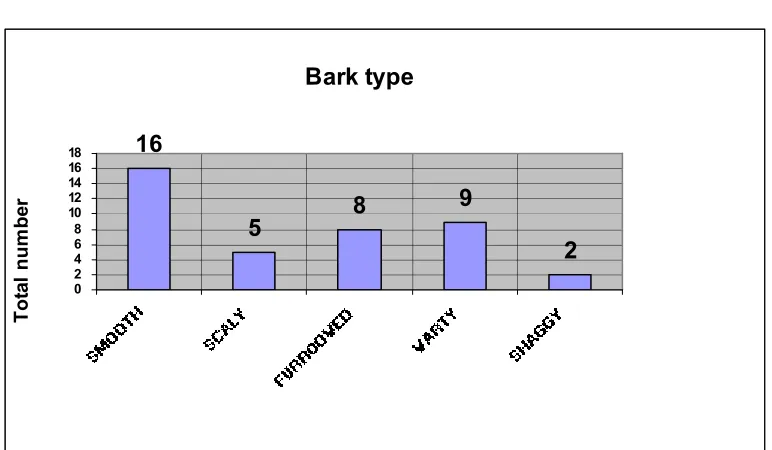
Tree bark is protective and valuable. Tree bark was source of organic matter. The tree bark was traditionally used for medicinal purposes. In this present study, bark morphology of 40 trees belonging to compartment number 1016 research plot was studied. The tree bark was broadly classified on the basis of morphological characters, colour and texture whether it was smooth, scaly, furrowed, warty or shaggy. It was concluded that the diverse natures of the barks of the forest trees support for identification of species. It was found that out of 40 bark samples 16 were smooth, 5 scaly, 8 furrowed, 9 warty and 2 Shaggy types. From this study it was evident that the diverse natures of the barks the forest trees pave way for identification of species. There is an enormous amount of research being conducted in the medical field to determine the benefits of bark. In the present study, researcher tudied bark features and to prepare Digital Bark Library. Bark diversity of some species supports in tree identification.
Key Words: Digital forestry, WWW, Digital visual bark, Database, Morphodiversity, Digital Bark Library
INTRODUCTION
Tree bark is protective and valuable. It was found that bark has its uses to human as well as to trees, was acting as the ‘skin’ of the tree. The bark was protecting cover of the tree, and for protection purpose form infections, fires etc. Tree bark was source of organic matter. The tree bark was traditionally used for medicinal purposes. The tree bark was broadly classified on the basis of morphological characters, colour and texture whether it was smooth, scaly, furrowed, warty or shaggy. In this present study, Bark morphology of 40 trees belonging to compartment number 1016 research plot was studied. It was evident that the diverse natures of the barks of the forest trees supports for identification of species. Tree bark is a source of organic matter for soil.
Review of Literature
L - 18
Life Science Botany
Lavras, Minas Gerais, Brazil, were described by selecting vegetative characteristics using CARip, a Microsoft Access database application specially developed for this study. Only one specimen per species was usually described. Thus, 2 observers described 567 herbarium species as a base to test methods of identification as part of a larger study. This work provided information on the distribution of 22 vegetative characters among 16 families having 10 or more species described. The study found marked differences, even discontinuities of distributions of characters between those families. Therefore it was possible to incorporate phylogenetic relationships into the identification process. Furthermore, very often the majority of identifications of some surveys must be based on sterile or vegetative material such as leaves, stems and bark and certain filed characters. Jingzhu et al., (2006) prepared a database framework of digital forestry towards sustainable forestry development in China. It was necessary to comply with the fundamental that sustainable forest management was the theoretical base to design the database framework of digital forestry. Digital forestry database of high efficiency and perfection could
L - 19
Life Science Botany
MATERIALS AND METHODS
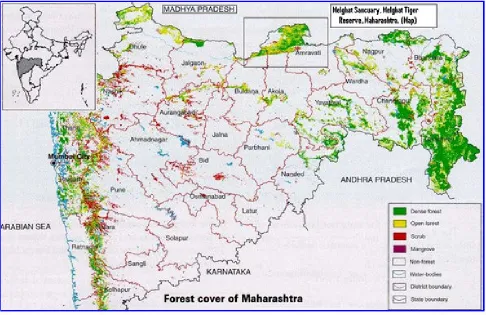
Figure 1.1
Position of Melghat Tiger Reserve, Maharashtra, India indicated by rectangle The study area (Fig. 1.1) compartment 1016,
research plot, Melghat Sanctuary, Melghat Tiger Reserve Maharashtra located under East Dhargad Circle and is situated in between Gullarghat village and the Narnala Fort. The bark specimens are collected by cutting asmall portion of the bark of the trees and tagged. External features like colour and texture of the bark was studied. On the basis of these characters the bark was classified in different types such as smooth, furrowed, scaly, warty and shaggy. The diverse nature of the bark was a supporting character for tree identification in morphodiversity studies. The information on medicinal use of the bark was collected from local tribal inhabitants.
Digital Bark Library
After collection of bark samples, the digital scanning of all specimens was done by using an HP digital scanner. After classification of the bark, the
data table was prepared in spreadsheet using MS-Excel software. The barks of the trees were well organized and labeled in presentation form. The Digital bark library was prepared with the help of Microsoft’s PowerPoint software and CDROM was developed. Now the bark specimens were available electronically in the form of Compact Disc which gave user friendly access. Photo images of bark specimens had taken by using camera and the images were processed using Photoshop version 7.0. All images were saved as JPEG files.
Forest Tree Bark Digital Bark Library
L - 20
Life Science Botany
features were studied and recorded. Collected samples were carried to work place and properly identified, labeled and classified on the basis of external features. The ‘Digital Bark Library’ was
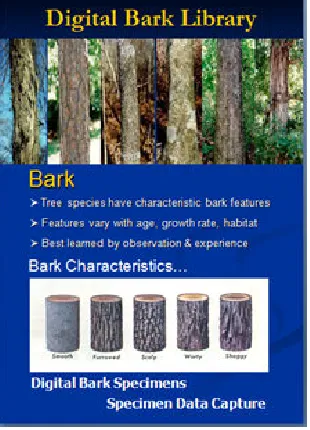
prepared. Scanned images of the barks were arranged properly with the help of computer software for further study. (Fig. 1.2 a.,b., c.)
Digital Bark Library
( A Computational work on diverse features of bark ) BARK FEATURES
(Tree identification on the basis of bark surface)
Figure. 1.2 a
Bark types: Smooth, Furrowed, Scaly, Warty, and Shaggy
16
5 8
9
2
0 2 4 6 8 10 12 14 16 18
Bark type
T
o
ta
l
n
u
m
b
e
r
L - 21
Life Science Botany
Figure. 1.2 c
Broadly classified on the basis of morphological characters
Figure. 1.2 d
L - 22
Life Science Botany
Bark morphology of 40 trees belonging to compartment number 1016 research plot was studied. The tree bark was broadly classified on the basis of morphological characters, colour and texture whether it was smooth, scaly, furrowed, warty or shaggy. (Fig. 1.2 c., d.) It was found that out of 40 bark samples 16 were smooth, 5 scaly, 8 furrowed, 9 warty and 2 Shaggy types. From this study it was evident that the diverse natures of the barks the forest trees pave way for identification of species.
Tree bark: An important source of the medicine Tree bark was an important ethnobotanical source of tribal life to control health related problems such as skin diseases, cuts, dysentery, digestion, acidity, body power, bone fracture and cough. The tree bark was traditionally used for medicinal purposes by the local residents and ethnobotanical knowledge was descended from older to younger generation. It was known that wild animals of the forest used to sallow tree bark. In the present study the ethnobotanical information was gathered by communicating the local resident of Gullarghat and Dharghad villages.
Tree bark is protective and valuable
It was found that bark has its uses to human as well as to trees. The bark served as protecting cover of a tree, without bark there would not be the survival of trees. Some tree bark found affected by beetles and used to cause damage to the external surface of the trunk. The bark was protecting as cover to the tree, and was acting as the ‘skin’ of the tree from infections, fires etc. During observations some tree barks found to bear thorns, gums and resins. It was told by the inhabitants that there were some tree barks storing water, during dry hot summer when food and water was not sufficient, many animals found to use tree bark as their requirement of food and water.
Tree bark was source of organic matter
In the present study it was noted that the tribal of Melghat villages often used the powder of the dried bark as the organic material by mixing it with the soil. The plants growing on such a soil showed improvement in the growth rate, flowering and fruiting. This indicated that bark powder was useful for nursery soils for rapid growth of plant
species. It was because of bark having many more chemical features, resulting positively on the tree growth. So, this nutritive quality of the bark was the notable feature that could be properly utilized in the nursery practices.
Digital Bark Library
The CD-ROM on digital bark contained bark characters such as smooth, scaly, shaggy, furrowed, and warty. The bark types were classified on the basis of their colors and textures. The features were varying in different species; the diverse nature of the bark was an additional feature for tree identification. This was acquired by observations & experience. This system provided slide show presentation on bark specimens in the MS-PowerPoint 2003 software. The real bark specimens were collected and provided material for Digital Bark Library along with their botanical name, family and external characters. The present study focused on exploring, linking and accessing the data in its desire form with simple and quick results.
DISCUSSION
L - 23
Life Science Botany
entitled “agroforestyBASE” containing information on various aspects of agroforestry. The software tuned on a HTTP server and served the request of client on any computer connected with internet and having a graphic web browser. There was provision to browse information through user-friendly interface. In view of Sambandan and Chowdhery (2004) herbarium database was a computational method, where the information about the herbarium specimens were digitized in such a way that it was easily accessible with the help of Internet and World wide Web (WWW) throughout the world. The modern databases included actual herbarium specimens as digital images with all accompanying information available on the herbarium sheet label.
Hargreaves (2006) Studied vegetative morphology for species identification of tropical trees. Tree specimens from the ESAL herbarium of the Universidade Federal de Lavras, Minas Gerais, Brazil, were described by vegetative characteristics using CARip, a Microsoft Access database application specially developed for this study. Thus, 2 observers described 567 herbarium species as a base to test methods of identification as part of a larger study. The work formed part of that study and provided information on the distribution of 22 vegetative characters among 16 families having 10 or more species described. Traditionally, the taxonomic information was found in print formats only, examples might be cited of monographs and floras. It was the contention of Shanmughavel (2007) that the massive development of biodiversity related information system over the WWW (World Wide Web) created much excitement in recent years. Taxonomist created the nomenclature and classification databases. Databases also contained all kinds of information about organisms, including their characteristics, economic importance, conservation and management. Newer digital formats developed by Cui (2008) opened up an opportunity for a wide range of innovative usages of taxonomic descriptions, including searching in more precise and flexible ways, integrating morphological, genomic, georeference, or other information,
automatically generating taxonomic keys, knowledge mining and visualizing taxonomic data. He reported his experience with the development of an automated semantic markup system named MARTT and discussed challenging issues involved. Here the candidate applied different database tools to describe biodiversity informatics of Melghat. So the attempt was made to develop the database on plant description. Trees of the compartment number 1016 were described by providing information on morphological characters of 40 species belonging to 34 genera and 24 families, with the help of MS-Access database software. These databases were convenient for accessing, transferring of data from wide distances by providing additional security. Database management system was an important tool for the processing of huge data. Forest databases might be of different types and the present researcher was able to develop database on various morphodiversity features of forest of compartment number 1016, research plot.
CONCLUSION
The distribution of the trees species and forest cover of compartment 1016 was not uniform all over. Vegetation of the forest area of the compartment adjacent to villages Gullarghat and Dharghad was found thin and sparcy. The vegetation site was consisting mostly of middle and small sized trees, due to the hot dry climatic conditions, except Tectona grandis L.f. Suppl. which exibited maximum girth (170 cm) and height (58 feet) among 456 numbers of trees scored. Digital bark library of the 40 trees species exhibited diverse surface patterns e.g. smooth, scaly, furrowed, warty and shaggy types, in addition spiny nature of Aegle marmelos (L.) Corr. and Ziziphus mauritiana Lamk. and papery bark of Boswellia serrata Roxb. ex. Coleb. helped in tree identification. It was further to conclude that bark could become one of the important taxonomic characters for plant description.
L - 24
Life Science Botany
REFERENCES
1. Baskauf SJ, Kirchoff BK. 2008. Digital Plants Images as Specimens: Towards Standards for Photographing Living Plants. Vulpia 7: pp.16-30.
2. Berendsohn WG. 2001. Biodiversity
Informatics. From
http://www.bgbm.org/bioDivInf/def-e.htm Proceedings of the second National Colloquium on Global change Research 1-8.
3. Blum SD. 2000. An overview of Biodiversity Informatics. From http://research.calacademy.org/research/inf ormatics/sblum/pub/biodivinformatics.htm l 1-14.
4. Brij B. 2008. Bioinformatics: Definition of this New Type of intelligent Technology. From http://www.brightthub.com /science/medical/articles/2282.aspx.
5. Cui H. 2008. Converting Taxonomic Descriptions to New Digital Formats. Biodiversity Informatics 5: 20-40.
6. Dhore MA, Joshi PA. 1988. Flora of Melghat Tiger Reserve. Directorate, Project Tiger Melghat, Paratwada – 444805, Maharashtra (India) 1-248.
7. Fasola TR, Egunyomi A. 2005. Nigerian Usage of Bark in Phytomedicine. From http://hdl.handle.net/10125/156.
Ethanobotany Research & Application 3: 073-077.
8. Hargreaves P. 2006. Vegetative Morphology for Species Identification of Tropical Trees: Family Distribution. Cerne, Lavras 12(1): 1-7.
9. Jingzhu Z, Yanchun W, Rencai D. 2006. A Database Framework of Digital Forestry towards Sustainable Forestry Development in China. Science in China E Technological Sciences 49: 19-26.
10. Musavi A, Mathur PK, Qureishi Q, Sawarkar VB. 2006. Mapping of Biotic Pressure and its Impact on Prey Densities in Melghat Tiger Reserve, Maharashtra. International Journal of Ecology and Environmental Sciences 32(4): 327-343. 11. Pant A. 2003. Ecological Analysis of the
Satpura Conservation Area Landscape through Stratified Field Sampling and Remotely Sensed Data. Map India Conference on Forestry & Biodiversity from http://GISdevelopement.net
12. Patel RI. 1968. Forest Flora of Melghat. International Book Distributors 1-380. 13. Shanmughavel P. 2007. An Overview on
Biodiversity Information in Databases.
From www.bioinformation.net
Bioinformation 1(9) 367-369.