PROBLEMS OF UNDERGRADUATE GIRL STUDENTS IN THE RURAL
AREAS OFHAMIRPUR DISTRICT OF HIMACHAL PRADESH
Anju Bala
Ph.D. Research Scholar, Department of Education, HPU, Shimla, India E-mail – [email protected]
1. INTRODUCTION:
Education of a boy is the education of one person, but education of a girl is the education of the entire family.
--- Jawahar Lal Nehru
It has been rightly said, “Where women are respected, there the goals delights, and where they are not, there all work and effort came to naught. There is no hope of rise for the family or country where they live in sadness.” Thus education has been perceived to be a significant instrument in improving the status of women and consequently there have been efforts to improving the access of girls and women education. In the modern world, the role and the responsibilities of the women go much beyond the household wives and bringing of the children. She is now adopting the method of sharing all the problems of life with men. She also participates in active political and social life. They must be provided with at least general education. It is through the education of women that we can expect better homes, greater production and happier family life. In the modern world, the role of women goes beyond the home and the bringing up of the children. She is now adopting a career of her own choice and sharing equally with man the responsibility for the development of society in all its aspects. Education is the life long process. The education cannot be treated as an end in itself. In the state of Himachal Pradesh the situation is somewhat better but the disparities are still there i.e. the male literacy rate is 86.05 percent and female literacy rate is 68.08 percent which need to be abridged if upliftment of the women is required. In the light of this the present study is undertaken to find out the problems of girls at the undergraduate college level in the Hamirpur District of Himachal Pradesh.
2. REVIEW OF THE RELATED LITERATURE:
Kumari (1989) investigated the “Causes of the lack of Girls Education with Special reference to Rohru Tehsil of Shimla District” and found that:
1. The majority of the parents of Rohru Tehsils are Hindu and they believe in Hindu traditions they do not attach much importance of the education of girls because the girls because the girls came to school on foot from distant areas.
2. All the parents wish their daughters to be taught by female teachers
3. Majority of parents are poor their income is low hence they are not in a position to sent their daughter away from home to pursue studies.
Abstract: Education is an unique feature of human society enables the human beings not only to distinguish between the civilized and uncivilized, but also help them to achieve what otherwise remains unachieved. Education is a tool that plays a vital role in improving the socio-economic condition of the nation. Since the Constitution was adopted in 1950, the main focus of educational programmes remained on elementary education. The constitutional commitment being free and compulsory education to all children up to the age fourteen, all efforts aimed at achieving the goal of universal elementary education. The Right to Education has also been enshrined as a fundamental right by the constitution of India. It states that “The state shall provide free and compulsory
education to all children of the age of six to fourteen years in such a manner as the State may, by law, determine.”
Himachal Pradesh has made a tremendous progress in the field of enrolment of students, reduction in the dropout rate, improvement in the literacy rate, reduction in the gap of gender literacy rate etc. It has been rightly said, “Where women are respected, there the goals delights, and where they are not, there all work and effort came to
naught. There is no hope of rise for the family or country where they live in sadness.” Thus education has been
perceived to be a significant instrument in improving the status of women and consequently there have been efforts to improving the access of girls and women education. The removal of women illiteracy will not help in universal enrolment and retention of children in the age group of 6-14, but also will help in the preservation of the talent of the women.
4. Girls find less time for studies at home because they have to help their mother in household works and agriculture work.
5. Most of the parents in villages are illiterate but they want to educate their daughters.
Thakur (1993) conducted a survey on “Problems of girls education at secondary level in Sunder Nagar tehsil of Mandi district” and found that:
1. Majority of parents are poor. They are not in a position to send their daughter away from home to pursue higher education or to go for professional training
2. No proper facilities in school like hostel facilities toilet, provisions, seating arrangements in the schools etc. 3. Girls find less time for study at home because of household work.
4. Most of the girls aspired to become teachers.
Bala (2006-07) conducted a study of the problems of girl’s students at senior secondary level in rural areas of Una District of H.P. and found that:
1. Majority of parents i.e. 86% are interested towards girls higher education
2. Problems of seating arrangement and the problems of toilet facilities in various schools are prevalent. 3. All the teachers are in the favour of co-education for girls.
4. All the parents are in the favour of girl’s employment.
Pandey (2007) conducted a study on the problems of girl’s education at high school stage in the rural areas in the rural areas of Shimla district of Himachal Pradesh and found that:
1. Provision of free books for all the girls students of the school. 2. Guidance and counseling services are not provided in the school
3. Majority of girls parents are illiterate and fathers of girl students have more qualification as compared to mothers.
3. NEED AND SIGNIFICANCE OF THE STUDY:
There is a great need to study the various problems occurring in the education of girls in rural area of District Hamirpur. Therefore, in the present study an attempt has been made to find out the problems of undergraduate girls students in the Hamirpur District of Himachal Pradesh as perceived by the students. The present study will be helpful to policy makers, bureaucrats, different women organization, administrator, research scholar, educators, politicians, statisticians because it give understanding about the problems faced by the girls students in the areas of education.
4. OBJECTIVES OF THE STUDY:
1. To study the familiar status of girl students in rural areas of Hamirpur district. 2. To study the girls attitude towards their education.
5. DELIMITATION OF THE STUDY:
The study was delimited to the undergraduate college of the Hamirpur district. Study was delimited to the students who are at undergraduate level.
6. METHODOLOGY:
Descriptive survey method of research was used to conduct the present study
7. SAMPLE:
In the present study 3 undergraduate colleges were selected randomly. Each college was selected by draw a lots. So 150 girl students were selected from three different colleges of district Hamirpur.
8. ANALYSIS OF DATA:
8.1 DISTANCE OF COLLEGE FROM RESIDENCE
The responses of girl students regarding the distance of the college from their residence were seeked. Their views are given in table 8.1.
TABLE 8.1
Distance of college from residence
Sr. No Distance Number Percentage
1. Less than 4 Km 44 29.33
4. 13 or more 31 20.67
Total 150 100.0
Table 8.1 depicts that 29.33 percent of the girls students come from the distance less than 4 Km and 26.67 percent of the girls students come to college from the distance in between 5-8 Km and 23.33 percent of girls students come to college from the distance between 9-12 Km and 20.67 percent of girls students go to college from the distance in between 13 Km or more from their residence.
It is concluded that majority of the girl students goes to college within 12 kilometer.
8.2 MEANS TO REACH THE COLLEGE
The responses of girl students regarding the means to reach college are given in table 8.2. Table 8.2
Mean to Reach the College
Sr.No. Mode of Conveyance Number Percentage
1. On foot 22 14.67
2. Cycle 3 2.0
3. Bus 119 79.33
4. Other means 6 4.0
Total 150 100.0
Table 8.2 shows that majority of girls students i.e. 79.33 percent go to college by bus.14.67 percent of girls students go to college on foot. 4 percent of girl students go to college by other means. 2 percent of the girl students go to the college by cycle.
It may be seen from above table that majority of the girls goes to college by bus.
8.3 DIFFICULTIES FACED IN REACHING THE COLLEGE
The responses of the girls students relating to difficulties faced in reaching the college are given in the table 8.3. Table 8.3
Difficulties Faced in Reaching the College
Sr. No. Difficulties Number Percentage
1. Irregular bus service 61 40.67
2. Teasing by boys 0 0.0
3. No difficulties 69 46.0
4. Other 20 13.33
Total 150 100.0
Table 8.3 shows that majority of the girls faces no difficulties in reaching the college. 40.67 percent of the girl’s students faced many problems in irregularity in bus service.13.33 percent of the girl students faces other type of difficulties.
It may be interpreted from above table that majority of the girls faced no difficulties in reaching the college.
8.4 RESPONSES REGARDING DIFFICULTIES FACED IN CO-EDUCATION
The percentage of the responses of girl students regarding difficulties faced in co-education is given in table 8.4 Table 8.4
Responses Regarding Difficulties Faced in Co-education
Sr. No. Statement Number Percentage
1. Seating problem 13 8.67
2. Teasing by boys 12 8.0
3. No feeling of independence 23 15.33
4. Other 102 68.0
Total 150 100.0
Table 8.4 shows that 15.33 percent of girls feel no independence in co-education. 8.67 percent of girl students face difficulties in seating problem. 8 percent of girls students faces difficulties due to teasing by boys.68 percent of girls students faces other difficulties while studying in co-education.
8.5 DIFFICULTIES IN PURSUING HIGHER EDUCATION
The percentage of the responses regarding difficulties in pursing higher education is given in table 8.5. Table 8.5
Difficulties in Receiving Higher Education
Sr. No. Statements Number Percentage
1. Accommodation Problem 18 12.0
2. Bad Financial Condition 80 53.33
3. Pressure of Early Marriage 9 6.0
4. Other 43 28.67
Total 150 100.0
This table 8.5 shows that 53.33 percent of girls students faces difficulties in receiving higher education due to bad financial condition.12.0 percent of girls students faces difficulties in receiving higher education due to accommodation problem. 6.0 percent of girl students faced difficulties in receiving due to pressure of early marriage. It may be inferred from above table 8.5 that majority of the girl students faced difficulties in receiving Higher Education due to bad financial conditions.
8.6 RESPONSES OF STUDENTS REGARDING PARENTS ATTITUDE TOWARDS THEIR HIGHER EDUCATION
Responses regarding parent’s attitude and difficulties faced in receiving higher education are given in table 8.6.
Table 8.6
Attitude towards their higher education
Sr.No. Statement Number Percentage
1. Parents want to give higher education to girls 138 92.0
2. Parents do not want to send them for higher education because of -
2a. Poor economic condition 8 5.33
2b. Conservative outlook 2 1.33
2c. Narrow vision for co-education 1 0.67
2d. Sense of insecurity 1 0.67
Total 150 100.0
Table 8.6 shows that 92.0 percent of the girls feels that their parents have positive attitude towards providing higher education to them.5.33 percent of the girls feels that their parents do not want to send them for higher education because of poor economic condition, conservative outlook, narrow vision for co-education and sense of insecurity. It may be inferred from above table that majority of the students parents want to give higher education to girls.
8.7 RESPONSES REGARDING PARENTS EXPECTATION FROM GIRLS
The responses of the girls students regarding the parents expectations from the girls education is given in the table 8.7.
Table 8.7
Responses Regarding Parents Expectation from Girls
Sr. No. Parents Expectation from Girls Number Percentage
1. To get 1st position in the class 87 59.0
2. To pass the examination 5 3.33
3. To play along with the study 41 27.33
4. To do house work 17 11.33
Total 150 100.0
Table 8.7 shows that 59.0 percent of the parents desire that their daughters should take 1st position in the class. 3.33 percent of the girls students responded that their parents send them to college just to pass the examination.27.33 percent of the parents wants that their daughters to play along with the studies and only 11.33 percent of the parents want that their daughters to do house work along with their study.
It may be seen from table 8.7 that majority of the girl students parents expected to get 1st position in the class.
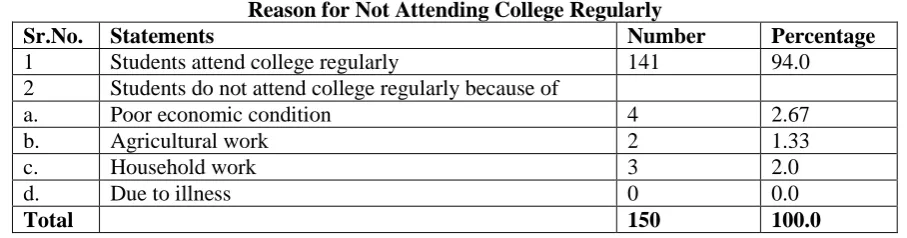
Table 8.8
Reason for Not Attending College Regularly
Sr.No. Statements Number Percentage
1 Students attend college regularly 141 94.0
2 Students do not attend college regularly because of
a. Poor economic condition 4 2.67
b. Agricultural work 2 1.33
c. Household work 3 2.0
d. Due to illness 0 0.0
Total 150 100.0
Table 8.8 depicts that majority of girls students attend college regularly i.e. 94.0 percent and 6.0 percent of the girls students do not attend college regularly because of poor economic condition, agricultural work, household work and due to illness.
It may be inferred from table that majority of the girl students attend college regularly.
8.9 RESPONSES REGARDING RIGHTS TO MALE AND FEMALE CHILDREN IN THE FAMILY Responses of girls regarding rights to male and female children at home are given in table 8.9.
Table 8.9
Responses Regarding Rights to Male and Female Children in the Family
Sr.No. Statement Number Percentage
1. Equal rights at home 145 96.67
2. No equal rights at home because of -
a. No equal distribution of work 5 3.33
b. No equal distribution of pocket money 0 0.0
c. No equal distribution of things at home 0 0.0
d. No equal distribution of time for studies 0 0.0
Total 150 100.0
Table 8.9 depicts that 96.67% of parents of girl students give equal rights to male and female children in the family. Whereas only 3.33% of parents do not give same rights to girls because of no equal distribution of work, pocket money, things at home and time for studies.
It may be inferred from above table that majority of the girl students had equal rights at home.
9. CONCLUSION:
It is concluded from the study that majority of the girl students goes to college within 12 Kilometer. Majority of the girls goes to college by bus. Majority of the girls faced no difficulties in reaching the college. Girl students faced no problem in co-education. The study also shows that majority of the girl students faced difficulties in receiving Higher Education due to bad financial conditions. Majority of the students parents want to give higher education to girls. Most of the girl student’s parents expected to get 1st position in the class. Most of the girl students enjoy equal rights at home.
REFERENCES:
1. Aggarwal, J.C., S.P. (2003), Modern Indian Education, Shipra Publication New Delhi.p 57
2. Aggarwal, J.C., Aggarwal S.P., Women Education in India, Concept Publishing Company, New Delhi-110059 3. Bala, Ranjan (2007), A study of the Problems of Girls students at Senior Secondary level in Rural areas of 4. Una District of H.P., M.Ed. Dissertation, H. P. University, Shimla.
5. Census of India 2001, Series-3 Himachal Pradesh Provisional Population, Total paper-3 of 2001. 6. Koul, Lokesh (1997), Methodology of Education Research, Vikas Publishing House, New Delhi.p 60 7. Kumari, Sarojini(1989), Causes of lack of girls education in Rohru Tehsils of Shimla District, M.Ed. 8. Disseration Department of Education, H.P. University, Shimla.
9. Pandey, Tara Datt, A study of the Problems of Girls education at high school stage in the rural areas Of Shimla district Of H.P. ,M.Ed. Dissertation, H. P. University, Shimla.
10. Sharma, R.N. (2003), Methodology of Educational Research, Surjeet Publication, Kamla Nagar, Delhi.p 87 11. Thakur(1993). Problems of girls education at secondary level in Sunder Nagar tehsil of Mandi district. M.Ed.
Dissertation, H. P. University, Shimla.