*Corresponding author:Sairabanu Daragad
Department of Human Development and Research Centre, Smt. VHD. Central Institute of Home Science (Autonomous), Seshadri ISSN: 0976-3031
Research Article
IMPACT OF AN EDUCATIONAL PROGRAM ON SELF ESTEEM
OF CHILDREN IN ORPHANAGES
Sairabanu Daragad and Roopa K. S
Department of Human Development and Research Centre, Smt. VHD. Central Institute of Home Science
(Autonomous), Seshadri Road, Bangalore 560 001, Karnataka, India
DOI: http://dx.doi.org/10.24327/ijrsr.2019.1007.3728
ARTICLE INFO ABSTRACT
Self-esteem is a basic human need it makes an essential contribution to the life process, is indispensable to normal and healthy self-development and adds a value for survival. Hence, the study aimed to know the impact of an educational program on self esteem among boys and girls residing in orphanages at Urban Bangalore district. Self structured questionnaire was developed and administered on a sample of 80 children which consisted of 40 boys and 40 girls, between the age group of 9-12 years. A module of the educational program was developed by the researcher and executed for the experimental group of respondents for a period of 3 months separately for boys and girls in the selected orphanages. The statistical analysis was carried out by applying percentage, standard deviation, mean, chi square and paired ‘t’ test. The findings revealed that, majority of boys and girls belonged to the age group of 12 years. In post-test the overall mean score percentage found to be higher as compared to pre-test mean score which is significant at 5% level. In all the dimensions of self esteem the 't' values found to be statistically significant(p<0.05) among boys and girls. During the post-test both boys and girls showed a higher score on the level of self esteem as compared to pre-test scores, the obtained chi-square value (87.55) found to be significant which showed the impact of an educational program on self esteem of children.
INTRODUCTION
Self-esteem is an evaluation of the self; it is an effective response to one’s self-description. The evaluation refers to a judgment of one’s worth and what is being judged is one’s perception of who one is or one’s self-concept. It is how one values them; it is also how people perceive their value to the world and how valuable they think they are to others. Self-esteem affects their trust in others, their relationships, and their work – nearly every part of their lives. Positive self-esteem gives them the strength and flexibility to take charge of their lives and grow from their mistakes without the fear of rejection.
Dimensions of Self esteem
Personal:It is anidentity, the concept one develops about themself that evolves over the course of their life. This may include aspects of their life that they have no control over, such as where they grew up or the color of their skin, as well as choices they make in life, how they spend their time and what they believe.
Social: It is the development of capacity of people to work continuously for their own and society’s welfare and the alteration of institutions so that human needs are met at all levels especially the lowest, through the process of improving the relationships between expression of needs and the means to attain them.
Emotional: One of the basic aims of education is to develop a sound and stable personality of an individual in order to enable him or her to live healthy social life. In this regard, emotional development plays vital role in the social life of a person. A person with emotional soundness proves to be useful and lead a happy and peaceful life as against a person who is emotionally disturbed.
Academic:Academic achievement represents performance
outcomes that indicate the extent to which a person has accomplished specific goals that were the focus of activities in instructional environments, specifically in school, college, and university. Academic achievement should be considered to be a multifaceted construct that comprises different domains of learning.
International Journal of
Recent Scientific
Research
International Journal of Recent Scientific Research
Vol. 10, Issue, 07(F), pp. 33700-33704, July, 2019
Copyright © Sairabanu Daragad and Roopa K. S, 2019, this is an open-access article distributed under the terms of the Creative Commons Attribution License, which permits unrestricted use, distribution and reproduction in any medium, provided the original work is properly cited.
DOI: 10.24327/IJRSR
CODEN: IJRSFP (USA)
Article History:
Received 13th April, 2019
Received in revised form 11th May, 2019
Accepted 8th June, 2019
Published online 28th July, 2019
Key Words:
Intellectual: It is relating to your ability to think and understand things, especially complicated ideas. It means involving a person's ability to think and to understand ideas and information.
Moral: Moral development is the process through which children develop proper attitudes and behaviors toward other people in society, based on social and cultural norms, rules and laws. It refers to the ways one distinguish right from wrong as one grow and mature.
The important factors of self esteem is sense of belonging and acceptance: This factor reflects how much one feels wanted and a part of the group and how much one likes and accepts themselves as they are. The more one feels accepted and acceptable, the more they are able to express themselves, act authentically and be fully present to others. Whereas in the factor sense of competence which relates to one’s self-efficacy or how “good at things” one thinks as they are. Our unconscious is getting continuous data related to our relative level of competence. If we interpret our experience as progress and/or success we become more confident and more inclined to take risks in the future. Self concept and self esteem is very much important during early years of life. As children start evaluating themself it is very much necessary to make them aware about positive and negative self esteem.
Children with high self-esteem are proud of themselves assume responsibility for their own actions. Healthy self- esteem is based on the ability to assess oneself accurately and still be accepting of who they are. This means being able to acknowledge one’s strengths and weaknesses and at the same time recognize that they are worthy and worthwhile. Individual self-esteem evolves throughout their lives as they develop an image of themselves through their experiences with different people and activities. Experiences during childhood play a particularly larger role in the shaping of self-esteem. Children residing in orphanages without parental assistance need proper guidance to face challenges in life and improve their self-esteem.
In the light of the above discussion an attempt was made to assess the level of self esteem of children and to develop a module of an intervention program to enhance their self esteem.
METHODOLOGY
Objectives
1. To study the self esteem of children living in orphanages with respect to six dimensions viz. personal, social, emotional, academic, intellectual and moral.
2. To study the level of self esteem of children and to develop a module of an intervention program to enhance their self esteem.
3. To study the impact of an educational program; a. On the overall mean score of children on self esteem. b. Among boys in the six dimensions of self esteem. c. Among girls in the six dimensions of self esteem. d. Overall mean score of children in the six dimensions of
self esteem.
Hypothesis
1. There is a significant difference in self esteem of children living in orphanages with respect to six dimensions viz. socialization personal, social, emotional, academic, intellectual and moral.
2. The developed module of intervention program will have a significant impact on the level of self esteem of children.
3. There exist an impact of an educational program; A. On the overall mean score of children on self
esteem.
B. Among boys in the six dimensions of self esteem. C. Among girls in the six dimensions of self esteem. D. Overall mean score of children in the six
dimensions of self esteem.
Selection of sample and sampling technique
Purposive random sampling technique was adopted. The sample were drawn from the two orphanages catering to boys and girls separately at Urban Bangalore District.
A total number of 80 children between the age group of 9-12 years of which 40 were boys and 40 were girls residing in orphanages were selected for the experimental group.
Tool
A questionnaire was developed by the investigator for the purpose to know the demographic details and to assess the self esteem with respect to six dimensions; personal, social, emotional, academic, intellectual and moral among children which consisted of 78 statements including positive and negative items with 5 point rating scale.
Procedure
Two orphanages catering to boys and girls separately at Urban Bangalore district was identified, the aim and purpose of the study was explained to the administrators. An official permission was obtained by the administrators of the orphanages to conduct the educational program relating to self esteem. The developed questionnaire was administered to the 80 experimental groups of respondents to study the level of self esteem among children (Pre-test). A module of educational program was developed by the researcher to enhance the self esteem of children.
Whether an educational program had any effect on the level of self esteem on the children was evaluated with a post-test. The same tool was administered to the children with an interval of one month. The dully filled questionnaire was collected and subjected to statistical analysis to study the impact of the program.
RESULTS AND DISCUSSION
The data was tabulated and statistically analyzed by applying percentage, Chi square, Mean, Standard Deviation and ‘Paired ‘t’ test.
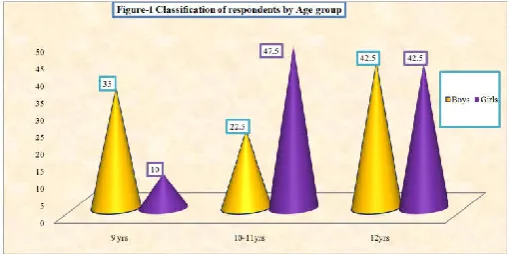
Figure-1 indicates the classification of respondents based on age group. Majority of boys (42.50%) were in the age group of 12 years, followed by 35.0 percent were between the age group of 9 years and 22.50 percent of them were from between the age group of 10-11 years.
A higher percentage of girls (47.50%) belonged to 10-11 years of age group whereas 42.50 percent of them were from 12 years of age group and only 10 percent of them were from 9 years of age group.
Table 1 shows level of self esteem among respondents.
Table 1 Classification of boys and girls with respect to the level of self esteem
Gender Self
esteem
Classification of Respondents χ 2
Value
Pre test Post test
N % N %
Boys (n=40)
Low 29 72.50 00 0.00
59.05*
Moderate 11 27.50 10 25.00
High 00 0.00 30 75.00
Girls (n=40)
Low 11 27.50 00 0.00
28.36*
Moderate 24 60.00 12 30.00
High 05 12.50 28 70.00
Combine d (n=80)
Low 40 50.00 00 0.00
87.55*
Moderate 35 43.80 22 27.50
High 05 6.20 58 72.50
* Significant at 5% level,
χ2 (0.05, 2df ) = 5.991
Table - 1 shows the distribution of respondents at different levels of self esteem based on scores. It was hypothesized that there will be an improvement in the level of self esteem of respondents after participating in an educational program.
In pre-test, majority of boys (72.50%) had low level of self esteem and 27.50 percent of them had moderate level. Whereas in post-test, majority of boys (75.00%) had high level of self esteem and 25.00 percent of them had moderate level. There is an association between different levels of self esteem among respondents and their performance during pre and post test. The
obtained chi-square value of 59.05 was found to be significant beyond 5 percent level.
Among girls, in pre-test a higher percentage of them (60.00%) had moderate level of self esteem, 12.5 percent were at high level and 27.50 percent of them had low level of self esteem. Whereas, during post-test, 70.00 percent of them had high level of self esteem and 30.00 percent of them had moderate level. The chi-square value found to 28.36 which is significant beyond 5 percent level.
Combined results showed that as compared to pre-test, after an educational program majority of respondents (72.50%) had high level of self esteem and 27.50 percent of them had moderate level. The chi-square value was significant for association between different levels of self esteem and the pre - post performance for both boys and girls. The obtained chi-square value is 87.55 which is significant beyond 5 percent level.
The chi-square value suggests significant association between different levels of self esteem and the pre-post test performance for both boys and girls by accepting the hypothesis. As compared to girls, more number of boys moved to the high level after the educational program. None of them is left at the low level of self esteem.
Table -2 shows the pre and post test scores of boys and girls on overall perception of self esteem. It was hypothesized that there exist an impact of an educational program on the mean score of respondents on self esteem.
Table 2 Pre and post-test over all mean scores of respondents on self esteem
N=80
Gender Sample (n) Aspects
Self esteem Scores Paired
‘t’ Test
Mean SD Mean (%) SD (%)
Boys 40
Pre test 137.43 35.3 44.00 11.3
17.81*
Post test 252.60 16.1 81.00 5.1
Enhancement 115.18 40.7 36.90 13.1
Girls 40
Pre test 179.50 51.4 57.50 16.5
13.33*
Post test 255.30 16.7 81.80 5.4
Enhancement 75.80 50.9 24.30 16.3
Combined 80
Pre test 158.46 48.9 50.80 15.7
12.10*
Post test 253.95 16.4 81.40 5.3
Enhancement 95.50 50.1 30.60 16.0
* Significant at 5% level, t (0.05, 39df ) = 1.96, Maximum Score =312
Table - 2 indicates the pre and post test scores of boys and girls on overall scores on self esteem. It was hypothesized that there will be an improvement in the overall perception of self esteem of the experimental group of respondents after exposing them to an educational program.
Above results shows that, among boys the mean score percentage was found to be higher in post-test (81.00%) as compared to pre-test mean score percentage (44.00). The mean value of enhancement was 36.90. The obtained ’t’ value was found to be significant beyond 5 percent level (t=17.81*, p<0.05).
The initial pre test score is higher for girls, but there is no difference in the post test score of girls and boys. Therefore, the enhancement in score is found to be more for boys as compared to girls. As indicated by the standard deviation of pre and post tests scores, individual differences in score has been reduced during post test.
Combined results showed the increase in mean score percentage in post-test to 81.40 as compared to pre-test mean score of 50.80. However, the gain is similar for both boys and girls as the raise is 30.60 and the ’t’ value found to be t=12.10* and is significant beyond 5 percent level. The results showed the impact of educational program on the overall mean score of self esteem of boys and girls accepting the hypothesis set for study.
The enhancement of scores on different dimensions of self esteem was also considered for study. The scores on different dimensions during pre and post test are given in table 3, 4 and 5.
Table 3 Dimension wise pre and post-test mean scores on self esteem among boys
N = 40
Dimensions
Respondents (%) Paired
‘t’ Test
Pre test Post test Enhancement
Mean SD Mean SD Mean SD
Personal 40.70 14.1 81.80 6.6 41.10 16.3 15.95*
Social 41.70 13.2 41.30 7.7 39.70 16.9 14.86*
Emotional 44.60 12.6 79.40 5.7 34.80 14.1 15.61*
Academic 43.80 13.9 83.80 6.1 40.00 15.0 16.87*
Intellectual 43.00 15.0 82.50 7.2 39.40 17.7 14.08*
Moral 49.70 11.7 78.10 4.8 28.40 13.0 13.82*
* Significant at 5% level, t (0.05,39df ) = 1.96
The result obtained for boys is shown in table 3 which indicates the impact of an educational program on different dimensions of self esteem among boys. In all the six dimensions of self esteem i.e., personal, social, emotional, academic, intellectual and moral, the mean score percentage increased in post-test after the intervention program. The 't' values in all the dimensions showed the statistically significant increase beyond 5 percent level (p<0.05) by accepting the hypothesis.
Table 4 Dimension wise pre and post-test mean score scores on self esteem among girls
N = 40
Dimensions
Respondents (%) Paired
‘t’ Test
Pre test Post test Enhancement
Mean SD Mean SD Mean SD
Personal 57.90 14.4 81.00 6.2 23.30 15.4 9.57*
Social 82.60 6.5 27.90 19.1 55.80 17.6 20.05*
Emotional 55.80 17.6 79.60 6.9 23.80 17.7 8.50*
Academic 58.50 19.9 82.70 7.0 24.20 18.8 8.14*
Intellectual 55.50 18.2 83.30 6.4 27.70 17.8 9.84*
Moral 61.60 14.4 82.60 5.7 21.00 15.2 8.74*
* Significant at 5% level, t (0.05,39df ) = 1.96
The above table 4 shows the impact of an educational program on different dimensions of self esteem for girls. In all the dimensions of self esteem as compared to the pre-test the mean score percentage was increased in post-test after an educational program. The 't' values in all the dimensions showed the statistically significant increase beyond 5 percent level (p<0.05).
The hypothesis formed that the educational program increases the scores on various dimensions of self esteem was accepted for both boys and girls. An increase in scores on all the dimensions assessed on self esteem was noticed due to the impact of an educational program on the experimental group of respondents.
Table 5 Dimension wise pre and post test overall mean scores on self esteem of respondents
N = 80
Dimensions
Respondents (%) Paired
‘t’ Test
Pre test Post test Enhancement
Mean SD Mean SD Mean SD
Personal 49.30 16.6 81.40 6.4 32.20 18.1 15.91*
Social 48.80 18.4 82.00 7.1 33.80 18.9 15.99*
Emotional 50.20 16.2 79.50 6.3 29.30 16.9 15.51*
Academic 51.10 18.7 83.20 6.5 32.10 18.7 15.35*
Intellectual 49.30 17.8 82.90 6.8 33.60 18.6 16.16*
Moral 55.70 14.5 80.40 5.7 24.70 14.7 15.03*
* Significant at 5% level, t (0.05,79df ) = 1.96
The improvement in the overall mean scores of self esteem can be seen from pre to post test scores on various dimensions of self esteem in Table - 5.
In the dimension of personal, the mean score has increased from 49.30 to 81.40 from pre to post test with an enhancement score of 32.20. The ‘t’ test value was 15.91 and significant beyond 5 percent level. The present study shows an agreement with the finding of the study conducted by Priyadarshini, H.A., (2004), children who were given opportunities to perform in front of their peers as well as other open audience, showed remarkable improvement in levels of self confidence, focus and motivation.
In the case of social dimension the score has increased from 48.80 to 82.0 from pre to post test. The enhancement was 33.80. The calculated ‘t’ ratio was found to be 15.99 and was significant beyond 5 percent level. In the emotional dimension, the score increased from 50.20 to 79.50 from pre to post test. The enhancement was 29.30. The ‘t’ value of 15.51 was found to be significant beyond 5 percent level. In the area of academic, the respondents mean score was found to be 83.20 during post test as compared to pre test score of 51.10. The enhancement was 32.10. The obtained ‘t’ value of 15.35 was found to be significant beyond 5 percent level. In the intellectual domain of self esteem, the score has increased from 49.30 to 82.90 from pre to post test. The enhancement was 33.60. The ‘t’ value was found to be 16.16 and was significant at 5 percent level. In case of moral dimension the respondents mean score was found to be 80.40 during post-test as compared to pre-test score of 55.70. The enhancement was 24.70. The obtained 't' value of 15.03 was found to be significant beyond 5 percent level.
The results revealed that there is an impact of educational program on respondents with significant improvement in the overall mean score self esteem with regard to all the dimensions. The initial individual differences in the scores have also been reduced during post test.
genuine and based on experience. When adults create opportunities for children to take risks and experience success, they are helping them develop a sense of self-worth. When children make mistakes, they need supportive adults who do not rescue them from the consequences but teach them to solve problems and express confidence that they will do better next time. Overall, children need to know that they are cared for and valued.
According Catherine, G., (2016), self esteem is a cornerstone of positive attitude towards living. It refers to an overall evaluation of one's worth or value as person. Children residing at orphanage have to fulfill many needs to lead a healthy life. The development of a strong sense of self-esteem during childhood is important if children are to withstand the stresses, social pressures, and temptations of deviance encountered at earlier ages of life. Findings revealed that, children residing in orphanage home had moderate and low level of self esteem during the pre test and during the post test they showed high level of self esteem. The statistically significant difference was noticed between the pre and post test on the level of self esteem of respondents.
CONCLUSION
The findings revealed that, during post-test the overall mean score percentage found to be higher as compared to pre-test mean score which showed the impact of an educational program. In all the dimensions of self esteem there is an enhancement in mean score of respondents after participating in the educational program. During the post-test both boys and girls showed a higher level of self esteem.
Research showed that teaching the life skills for the children at early stage of life helps in lessening the violent behavior; increased pro-social behavior and decreased negative, self-destructive behavior; increased the ability to plan ahead and choose effective solutions to problems and improved self-image, self-awareness, social and emotional adjustment. This program further helped to increase acquisition of knowledge; improved classroom behavior; gained in self control and handling of interpersonal problems and coping with anxiety; and improved constructive conflict resolution with peers, impulse control and popularity. Children started analyzing their personality traits, importance of body image, they focused on accepting the challenges of life.
References
1. Catherine, T. Golden., (2015). Effectiveness of self-esteem therapy on level of self-self-esteem among adolescent children residing at selected orphanage home. International Journal of Science and Research (IJSR) Vol.5 (9), pp: 1406-1408.
2. Harter S. The development of self-esteem. In Kernis, M.H. (Ed.). 2006. Self- esteem issues and answers: a sourcebook of current perspectives. New York: Psychology Press. 2006.
3. Markos, Abiso. Erango., Ayele, Taye. Goshu., (2015). Parents health and social life matter for self-esteem of child orphans. psychology and behavioral sciences. Vol. 4, No. 3, 2015, pp. 90-93.
4. Park, L. E., and Crocker, J., Lee, S. J., (2004). The pursuit of self-esteem: Implications for good and evil. In A. G. Miller (Ed.), The social psychology of good and evil, 271- 302. New York: Guilford Press.
5. Priyadarshini, A.H., (2007). Life skills building in orphan and vulnerable children, Nalanda Way Foundation. Published online (2007).
6. Siyad, B.R., Muneer, P., (2016). Comparison of self-esteem of orphans with parental care children. International Journal of Physiology, Nutrition and Physical Education 2016; 1(1): 108-110.
7. Tatyana,I., Shulga., Daria, D., Savchenko., and Filinkova, B. Evgeniya., (2016). Psychological characteristics of adolescents orphans with different experience of living in a family. International Journal of Environmental & Science Education, Vol. 11, No. 17, pp: 10493-10504.
8. Wanjiru, Margaret., and Gathogo, Julius., (2014). The impact of gender on orphans’ self-esteem and academic performance among secondary school students in Kirinyaga and Nyeri Counties of Kenya. International Research Journal of Arts and social Science Vol. 3(4) pp. 98-103.
Website
1. https://owlcation.com/social-sciences/Whats-the-difference-between-self-esteem-and-confidence. 2. https://www.verywell.com/what-is-self-esteem-2795868 3.
http://psychcentral.com/lib/how-to-raise-your-self-esteem/
4. http://www.macses.ucsf.edu/research/psychosocial/selfe steem.php
5. http://www.education.com/reference/article/influences-sibling-relationships/
How to cite this article:
Sairabanu Daragad and Roopa K. S.2019, Impact of an Educational Program on Self Esteem of Children In Orphanages. Int J Recent Sci Res. 10(07), pp.33700-33704. DOI: http://dx.doi.org/10.24327/ijrsr.2019.1007.3728